Market Overview
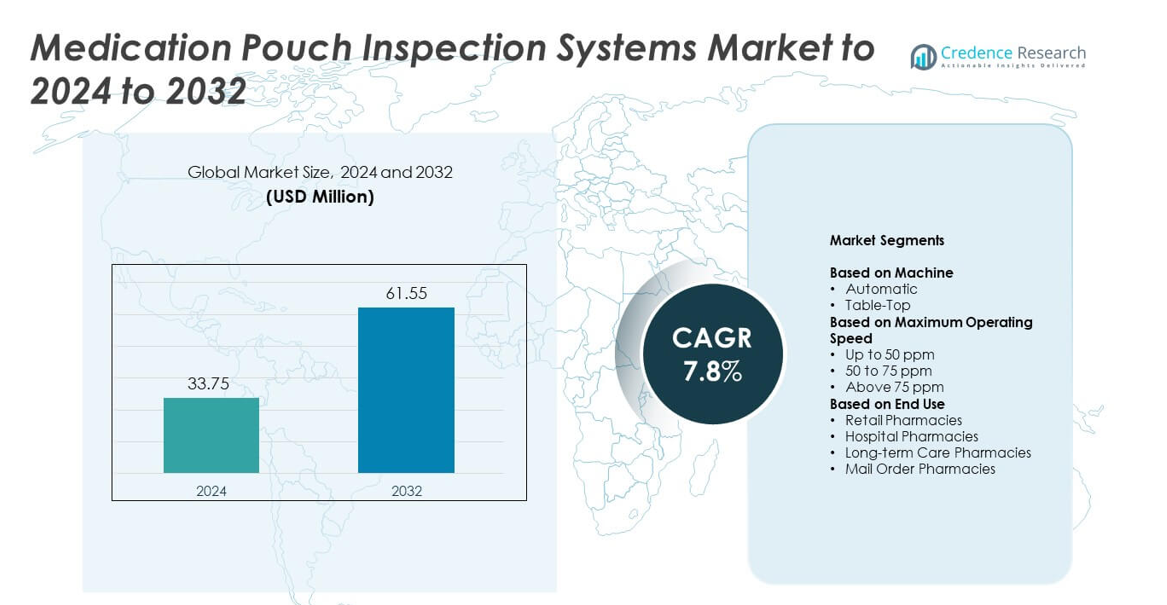
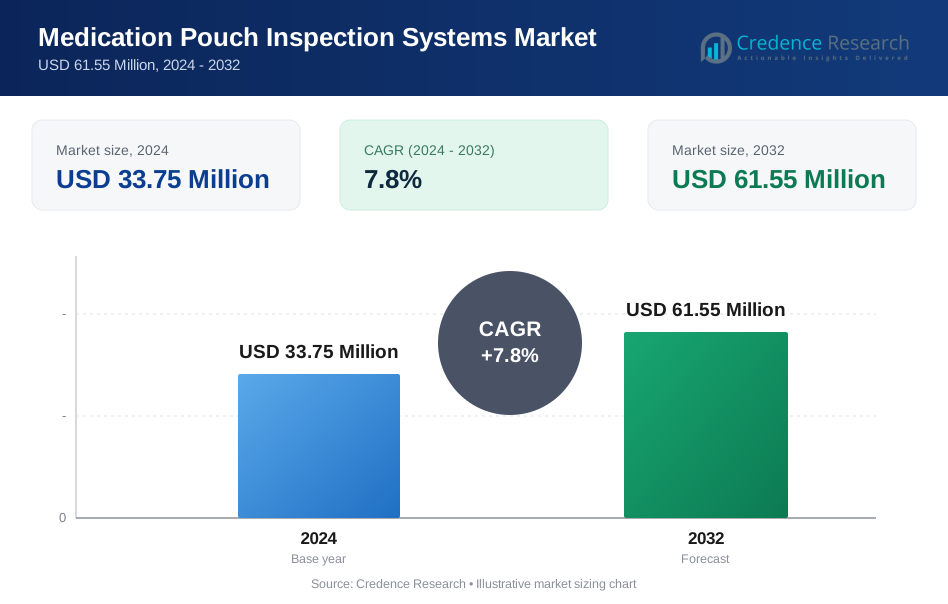
Medication Pouch Inspection Systems Market size was valued at USD 33.75 Million in 2024 and is anticipated to reach USD 61.55 Million by 2032, at a CAGR of 7.8% during the forecast period.
| REPORT ATTRIBUTE | DETAILS |
|---|---|
| Historical Period | 2020-2023 |
| Base Year | 2024 |
| Forecast Period | 2025-2032 |
| Medication Pouch Inspection Systems Market Size 2024 | USD 33.75 Million |
| Medication Pouch Inspection Systems Market, CAGR | 7.8% |
| Medication Pouch Inspection Systems Market Size 2032 | USD 61.55 Million |
4The Medication Pouch Inspection Systems Market is shaped by leading companies including Gerresheimer, JVM, Global Factories, ARxIUM, Jones Healthcare Group, PTI, Parata Systems, TCGRx, Nireco, and ZiuZ Holding. These players compete through high-speed inspection technology, AI-based accuracy improvements, and integration with automated dispensing systems. Product upgrades focus on reducing medication errors and supporting large-volume pharmacy operations. North America led the global market in 2024 with about 38% share, driven by strong automation adoption across retail chains, long-term care facilities, and centralized fill centers. Europe followed with nearly 29% share, supported by strict medication safety standards and expanding digital pharmacy infrastructure.
Market Insights
- The Medication Pouch Inspection Systems Market reached USD 33.75 Million in 2024 and is projected to hit USD 61.55 Million by 2032, growing at a CAGR of 7.8%.
- Market growth is driven by rising adoption of multi-dose pouch packaging, expanding pharmacy automation, and increasing focus on medication safety across long-term care and hospital pharmacies, where long-term care held about 41% share in 2024.
- AI-enabled inspection, high-speed verification units, and compact modular systems form key trends as pharmacies modernize workflows to handle higher prescription volumes with improved accuracy.
- The competitive landscape features strong innovation in high-speed and AI-powered systems, along with integration upgrades that support centralized fill operations and advanced dispensing environments.
- North America led the market with about 38% share in 2024, followed by Europe at nearly 29% and Asia Pacific at around 23%, driven by expanding automation and rising chronic disease-related prescription loads.
Market Segmentation Analysis:
By Machine
Automatic systems dominated the Medication Pouch Inspection Systems Market in 2024 with about 67% share. Automated units gained strong traction because pharmacies sought higher accuracy, faster output, and reduced manual checks. Large chains and hospital networks preferred these systems due to reliable error detection and seamless link with dispensing workflows. Table-top units grew at a steady pace as smaller pharmacies adopted compact systems for basic verification needs, but their market share remained lower because they offer limited throughput and fewer advanced inspection features.
- For instance, BD’s BD Rowa Vmax automated pharmacy robot has a documented stock input capacity of 150–200 packs per hour for rectangular packs, according to its official technical brochure.
By Maximum Operating Speed
The above 75 ppm category led the segment in 2024 with nearly 49% share. High-speed systems supported large-volume prescription handling and ensured faster verification for multi-dose pouch packaging. Pharmacies processing thousands of pouches per hour selected these models to reduce bottlenecks and improve medication safety. The 50 to 75 ppm range showed healthy growth among mid-sized pharmacies, while the up to 50 ppm category remained relevant for smaller facilities with lower daily pouch output and limited automation needs.
- Parata’s pouch inspection solution, the BD Parata InspectRx™2 Pouch Inspector, has a base transport speed of up to 5,000 pouches per hour. An optional add-on, the Collector unit, enables an upgrade to a high-speed capacity of 12,000 pouches per hour to accommodate increased production demand
By End Use
Long-term care pharmacies held the dominant position in 2024 with about 41% share. These facilities rely heavily on multi-dose pouch packaging to support adherence programs for chronic-care patients, driving significant demand for advanced inspection systems. Hospital pharmacies followed due to rising inpatient medication volumes and stricter quality compliance needs. Retail pharmacies and mail-order pharmacies also expanded adoption as they shifted toward automated medication management to enhance accuracy, cut dispensing errors, and streamline high-volume prescription fulfillment.
Key Growth Drivers
Rising Adoption of Multi-Dose Pouch Packaging
Demand increased as pharmacies used multi-dose pouches to improve patient adherence and reduce medication errors. Healthcare facilities relied on these formats for chronic disease management and long-term care settings, which pushed pharmacies to adopt faster and more accurate inspection systems. Growing prescription volumes and higher focus on safety standards supported wider installation of automated pouch verification units across retail, mail-order, and hospital pharmacies.
- For instance, TCGRx disclosed that it has installed over 700 automated pouch-packaging systems, and one ATP 2 deployment was described as handling about 260,000 medication doses per month into roughly 50,000 pouches, underlining real-world multi-dose pouch volumes.
Strict Medication Safety and Compliance Requirements
Regulatory focus on error reduction encouraged pharmacies to implement advanced inspection systems. Healthcare providers strengthened quality checks to meet safety guidelines for dispensing accuracy, especially in settings where multi-dose packaging is common. Automated inspection systems helped reduce human error and supported digital traceability, which made them essential for pharmacies aiming to meet rising compliance benchmarks and improve patient outcomes.
- For instance, a study on Swisslog’s PillPick unit-dose robot reported that the system packed 377 unit doses per hour and dispensed 537 unit doses per hour, demonstrating industrial-scale, controlled packaging and dispensing performance for safety-focused hospitals
Expansion of Large-Scale Pharmacy Automation
Major pharmacy chains and long-term care facilities expanded automation to handle high prescription loads. These organizations invested in high-speed inspection units to improve throughput and cut operational delays. Integration with automated dispensing machines improved workflow efficiency and reduced manual handling, encouraging broader adoption. Growth in centralized fill centers further boosted demand for high-capacity inspection solutions across regional pharmacy networks.
Key Trends & Opportunities
Growth of AI-Enabled Inspection Capabilities
AI-based systems gained momentum as pharmacies looked for greater accuracy in detecting packaging defects, missing pills, and labeling issues. Machine learning features improved real-time error identification and reduced false alarms. Vendors leveraged data analytics to enhance decision-making in pharmacy workflows, creating opportunities for more advanced, predictive inspection models. The shift toward intelligent automation supported wider use across large-volume dispensing settings.
- For instance, RxSafe’s RapidPakRx adherence strip packager uses an integrated machine-vision verification workflow and can fill a 30-day supply of multi-med pouches in under 10 minutes, according to RxSafe’s published FAQs and buyer guidance.
Rising Demand for High-Speed and Compact Systems
Pharmacies handling large prescription volumes sought faster inspection units to reduce bottlenecks in pouch verification. High-speed designs helped optimize daily operations in centralized fill models, while compact inspection systems opened growth avenues for smaller pharmacies with limited space. Manufacturers responded by offering modular systems that balanced accuracy, footprint efficiency, and scalability. This created strong opportunities in both urban and rural pharmacy environments.
- For instance, ScriptPro’s SP 200 robotic dispensing system, designed as a compact unit, is specified to fill, label, and deliver up to 150 prescriptions per hour and to hold 200 universal dispensing cells, combining high throughput with a relatively small footprint.
Increasing Adoption in Long-Term and Home-Care Settings
A rise in chronic diseases increased the need for consistent medication adherence support. Long-term care pharmacies expanded multi-dose pouch dispensing, opening opportunities for advanced inspection systems. Growth in home-care programs encouraged adoption of reliable pouch packaging to support elderly patients. Vendors benefited as more healthcare providers integrated automated inspection into broader medication management solutions.
Key Challenges
High Initial Investment and Integration Complexity
Many pharmacies faced financial barriers due to high upfront installation costs for advanced inspection systems. Integration with existing dispensing workflows, software platforms, and automation lines increased project complexity. Smaller pharmacies often delayed adoption due to limited budgets and concerns about operational disruption. These factors slowed penetration in cost-sensitive markets despite long-term efficiency benefits.
Limited Skilled Workforce for Automated Systems
Operating and maintaining advanced inspection units required trained staff, which many pharmacies lacked. Workforce gaps created challenges in achieving smooth system operation and handling technical issues. Training programs remained inconsistent, especially in small and mid-sized pharmacies. This reduced the pace of technology adoption and increased dependence on vendor support, slowing wider deployment across diverse pharmacy environments.
Regional Analysis
North America
North America held the largest share of the Medication Pouch Inspection Systems Market in 2024 with about 38%. Growth remained strong as retail chains, long-term care facilities, and centralized fill centers expanded automation to improve medication accuracy and reduce dispensing errors. Hospitals increased adoption to meet strict compliance standards and support rising inpatient prescription volumes. Strong presence of advanced automation vendors, along with rapid integration of AI-based verification systems, helped reinforce regional leadership. Mail-order pharmacies also invested heavily in high-speed inspection units to support large-scale prescription fulfillment.
Europe
Europe accounted for nearly 29% share in 2024, supported by strong use of automated pharmacy technologies across hospital and retail networks. Medication safety regulations and standardized dispensing practices drove higher installation of inspection systems. Long-term care organizations expanded multi-dose pouch adoption to support chronic patient needs, further boosting demand. Countries with advanced healthcare infrastructure invested in high-speed systems to improve accuracy and reduce operational workload. Growth also came from rising digitalization of pharmacy workflows and broader adoption of centralized dispensing models.
Asia Pacific
Asia Pacific held around 23% share in 2024 and recorded the fastest growth due to expanding pharmacy automation across China, Japan, South Korea, and Australia. Rapid rise in chronic disease cases increased reliance on multi-dose pouch packaging, especially in elderly-care settings. Large hospital networks modernized their dispensing systems to reduce manual handling and improve safety. Regional pharmacies adopted compact and mid-capacity inspection units to manage growing prescription volumes. Government support for digital healthcare transformation further strengthened adoption across emerging markets.
Latin America
Latin America captured roughly 6% share in 2024, driven by gradual adoption of automated dispensing technologies across urban hospital networks and select retail pharmacy chains. Countries such as Brazil and Mexico increased investment in medication safety tools to reduce prescription errors. Growth remained moderate due to budget constraints in smaller pharmacies, but centralized dispensing facilities expanded use of inspection systems to handle high drug volumes. Rising focus on digital health and modernization of pharmacy workflows continued to support market expansion.
Middle East and Africa
Middle East and Africa held about 4% share in 2024, supported by growing automation in hospital pharmacies across the Gulf region. Large healthcare facilities adopted high-accuracy inspection systems to strengthen quality assurance and reduce manual verification time. Adoption in Africa remained slower due to limited infrastructure, but private hospitals and specialty pharmacies showed rising interest in automated pouch packaging. Investment in digital health programs and modernization of pharmacy services helped drive gradual market penetration across both public and private sectors.
Market Segmentations:
By Machine
- Automatic
- Table-Top
By Maximum Operating Speed
- Up to 50 ppm
- 50 to 75 ppm
- Above 75 ppm
By End Use
- Retail Pharmacies
- Hospital Pharmacies
- Long-term Care Pharmacies
- Mail Order Pharmacies
By Geography
- North America
- U.S.
- Canada
- Mexico
- Europe
- Germany
- France
- U.K.
- Italy
- Spain
- Rest of Europe
- Asia Pacific
- China
- Japan
- India
- South Korea
- South-east Asia
- Rest of Asia Pacific
- Latin America
- Brazil
- Argentina
- Rest of Latin America
- Middle East & Africa
- GCC Countries
- South Africa
- Rest of the Middle East and Africa
Competitive Landscape
The Medication Pouch Inspection Systems Market features key players such as Gerresheimer, JVM, Global Factories, ARxIUM, Jones Healthcare Group, PTI, Parata Systems, TCGRx, Nireco, and ZiuZ Holding. The competitive landscape continued to advance through strong emphasis on automation, higher detection accuracy, and integration with large-scale dispensing workflows. Vendors focused on enhancing AI-driven inspection capabilities to reduce human error and streamline pouch verification. Product portfolios expanded through the launch of high-speed systems designed for centralized fill centers and long-term care pharmacies. Companies also invested in compact units to support smaller pharmacies seeking low-footprint automation. Strategic moves included software upgrades, workflow optimization tools, and improved connectivity with pharmacy management systems. Growing demand for scalable solutions encouraged manufacturers to offer modular platforms suitable for diverse prescription volumes and operational needs across global markets.
Key Player Analysis
- Gerresheimer
- JVM
- Global Factories
- ARxIUM
- Jones Healthcare Group
- PTI
- Parata Systems
- TCGRx
- Nireco
- ZiuZ Holding
Recent Developments
- In 2025, Parata Systems, a BD company, launched the enhanced InspectRx™2 Pouch Inspector.
- In 2024, Gerresheimer Successfully completed the acquisition of the Bormioli Pharma Group, a move expected to expand their product portfolio for high-value plastic solutions and glass manufacturing capabilities relevant to pharmaceutical packaging.
- In 2024, the Jones Healthcare Group launched a new line of smart adherence packages that utilizes technology to monitor medication usage and enhance patient engagement.
Report Coverage
The research report offers an in-depth analysis based on Machine, Maximum Operating Speed, End-Use and Geography. It details leading market players, providing an overview of their business, product offerings, investments, revenue streams, and key applications. Additionally, the report includes insights into the competitive environment, SWOT analysis, current market trends, as well as the primary drivers and constraints. Furthermore, it discusses various factors that have driven market expansion in recent years. The report also explores market dynamics, regulatory scenarios, and technological advancements that are shaping the industry. It assesses the impact of external factors and global economic changes on market growth. Lastly, it provides strategic recommendations for new entrants and established companies to navigate the complexities of the market.
Future Outlook
- The market will expand as pharmacies increase automation to manage rising prescription loads.
- AI-driven inspection features will improve accuracy and reduce false error alerts.
- High-speed systems will gain wider adoption in centralized fill and mail-order pharmacies.
- Compact and modular inspection units will grow in demand among small and mid-sized pharmacies.
- Long-term care facilities will continue driving strong usage due to chronic patient needs.
- Integration with advanced dispensing robots will streamline full pharmacy workflows.
- Cloud-based analytics will support better tracking of medication accuracy and system performance.
- Global vendors will invest in smarter software to optimize real-time decision-making.
- Adoption will increase in emerging regions as healthcare digitalization progresses.
- Focus on patient safety will continue to push pharmacies toward automated inspection technologies.
Request a Free Sample
Fill in your details and we'll send you a free sample report.
- Sample data tables & charts
- Research methodology
Market Dynamics
Rising Adoption of Multi-Dose Pouch Packaging
Pharmacies are increasingly using multi-dose pouch packaging to improve patient adherence and reduce medication errors, especially in chronic disease and long-term care settings. This trend drives demand for advanced inspection systems that can handle higher volumes and ensure accuracy.
Expansion of Pharmacy Automation
Large pharmacy chains, long-term care facilities, and centralized fill centers are investing in automation to manage growing prescription loads. Automated pouch inspection systems are essential for improving throughput, reducing manual checks, and integrating with dispensing workflows.
Strict Medication Safety and Compliance Requirements
Regulatory bodies are enforcing stricter standards for medication dispensing accuracy, pushing pharmacies to adopt automated inspection systems. These systems help reduce human error, support digital traceability, and ensure compliance with safety guidelines.
Growth of AI-Enabled Inspection Capabilities
AI-powered inspection systems are gaining traction for their ability to detect packaging defects, missing pills, and labeling issues with greater accuracy. Machine learning and data analytics enhance real-time error identification, supporting the modernization of pharmacy workflows.
Increasing Adoption in Long-Term and Home-Care Settings
The rise in chronic diseases and the expansion of home-care programs are driving the need for reliable medication pouch inspection. Long-term care and home-care providers are adopting advanced systems to support adherence and patient safety for elderly and chronic-care populations.
Need a Custom Version of This Report?
Tailor the scope, geography, or segments to your exact requirements.
- Custom geography or segment scope
- Direct access to our analyst team
Frequently Asked Questions
What is the current market size for Medication Pouch Inspection Systems Market, and what is its projected size in 2032?
At what Compound Annual Growth Rate is the Medication Pouch Inspection Systems Market projected to grow between 2025 and 2032?
Who are the major players in the global medication pouch inspection systems market?
What are the major market drivers of the medication pouch inspection systems industry?
What are the major market restraints of the medication pouch inspection systems industry?
What are the major market opportunities of the medication pouch inspection systems industry?
Who are the leading companies in the Medication Pouch Inspection Systems Market?
Table of Content
Chapter 1 Market Segmentation
- 1.1 Segmentation Framework
- 1.1.1 Product and Service Classification
- 1.1.2 Application and End-Use Classification
- 1.1.3 Technology and Solution Classification
- 1.1.4 Customer and Distribution Channel Classification
- 1.1.5 Geographic Segmentation
- 1.1.6 Market Segment Definitions and Boundaries
- 1.2 By End Use
- 1.2.1 Retail Pharmacies
- 1.2.2 Hospital Pharmacies
- 1.2.3 Long-term Care Pharmacies
- 1.2.4 Mail Order Pharmacies
- 1.3 By Machine
- 1.3.1 Automatic
- 1.3.2 Table-Top
- 1.4 By Maximum Operating Speed
- 1.4.1 Up to 50 ppm
- 1.4.2 50 to 75 ppm
- 1.4.3 Above 75 ppm
Chapter 2 Introduction
- 2.1 Report Objectives and Scope
- 2.2 Product Definition and Industry Terminology
- 2.3 Market Inclusions and Exclusions
- 2.4 Research Process
- 2.4.1 Primary Research and Expert Interviews
- 2.4.2 Secondary Research and Source Review
- 2.4.3 Top-Down and Bottom-Up Estimation
- 2.4.4 Data Triangulation and Verification
- 2.5 Market Size Measurement Basis
- 2.5.1 2024: USD 33.75 Million → 2032: USD 61.55 Million
- 2.6 Historical and Forecast Reference Periods
- 2.6.1 Base Year: 2024
- 2.6.2 Forecast Period: 2024-2032
- 2.7 Research Assumptions and Limitations
Chapter 3 Executive Summary
- 3.1 Market Snapshot and Key Findings
- 3.2 Base-Year Market Size, 2024
- 3.3 Forecast Market Size, 2032
- 3.4 Revenue and Volume Growth Outlook
- 3.5 Key Demand and Supply Indicators
- 3.6 Leading Market Segments
- 3.7 Fastest-Growing Market Opportunities
- 3.8 Regional Performance Highlights
- 3.9 Technology and Industry Transformation
- 3.10 Competitive Landscape Summary
- 3.11 Analyst View and Strategic Implications
Chapter 4 Global Medication Pouch Inspection Systems Market Trends and Developments
- 4.1 Historical Industry Development
- 4.2 Recent Market Trends and Developments
- 4.3 Demand and Customer Behavior Trends
- 4.4 Technology and Product Innovation
- 4.5 Artificial Intelligence, Automation and Digitalization
- 4.6 Local Manufacturing and Supply Chain Realignment
- 4.7 Industry Partnerships, Mergers and Acquisitions
- 4.8 Sustainability and Circular Economy Developments
- 4.9 Government and Private Sector Investment Trends
- 4.10 Emerging Business Models and Commercialization
- 4.11 Industry Developments and Announcements
Chapter 5 Global Medication Pouch Inspection Systems Market Production, Supply and Demand Analysis
- 5.1 Demand Trend and Consumption Analysis
- 5.2 Demand Forecast, 2024-2032
- 5.3 Production and Output Trend
- 5.4 Production and Output Forecast, 2024-2032
- 5.5 Installed Capacity and Capacity Utilization
- 5.6 Company-Wise Production Plants and Statistics
- 5.6.1 Installed Production Capacity
- 5.6.2 Actual Production
- 5.6.3 Planned Capacity and Expansion Targets
- 5.7 Supply Chain Structure and Procurement Trends
- 5.8 Supply-Demand Gap and Bottlenecks
- 5.9 Import Dependence and Sourcing Structure
- 5.10 Contract Manufacturing and Outsourcing
- 5.11 Regional Supply and Demand Concentration
Chapter 6 Global Medication Pouch Inspection Systems Market Pricing Analysis
- 6.1 Pricing Structure and Measurement
- 6.2 Historical Pricing Trends
- 6.3 Pricing Outlook, 2024-2032
- 6.4 Average Selling Price and Unit Economics
- 6.5 Pricing by Product and Market Segment
- 6.6 Geographic Pricing Differences
- 6.7 Key Input, Energy, Labor and Logistics Costs
- 6.8 Contract Pricing and Purchasing Models
- 6.9 Pricing Sensitivity and Competitive Positioning
- 6.10 Price, Margin and Profitability Implications
Chapter 7 Global Medication Pouch Inspection Systems Market Dynamics
- 7.1 Market Growth Drivers
- 7.1.1 Demand-Side Drivers
- 7.1.2 Technology and Innovation Drivers
- 7.1.3 Infrastructure and Investment Drivers
- 7.1.4 Regulatory and Policy Drivers
- 7.2 Market Restraints
- 7.2.1 Cost and Affordability Constraints
- 7.2.2 Technology and Adoption Barriers
- 7.2.3 Supply Chain and Operational Constraints
- 7.3 Market Challenges
- 7.3.1 Competitive Pressure and Margin Erosion
- 7.3.2 Skills, Infrastructure and Implementation Gaps
- 7.4 Emerging Market Opportunities
- 7.5 Market Dynamics Impact and Time-Horizon Assessment
Chapter 8 Global Medication Pouch Inspection Systems Value Chain Analysis
- 8.1 Industry Value Chain Overview
- 8.2 Upstream Suppliers and Critical Inputs
- 8.3 Technology and Component Providers
- 8.4 Manufacturing or Service Delivery
- 8.5 Distribution, Channel Partners and Integrators
- 8.6 Downstream Applications and End Users
- 8.7 Value Addition and Profit Pools
- 8.8 Vertical Integration and Outsourcing
- 8.9 Supplier Concentration and Risk
- 8.10 Supply Chain Localization and Resilience
Chapter 9 Global Medication Pouch Inspection Systems Market Regulations and Policies
- 9.1 Relevant Laws, Standards and Compliance Frameworks
- 9.2 Product, Service, Safety and Quality Requirements
- 9.3 Government Policies, Incentives and Subsidies
- 9.4 Imports, Exports and Trade Barriers
- 9.5 Public Procurement and Local Content Requirements
- 9.6 Environmental and Sustainability Compliance
- 9.7 Upcoming Policy Changes and Market Implications
Chapter 10 Global Medication Pouch Inspection Systems Market Hotspots and Opportunities
- 10.1 Market Opportunity Mapping and Growth Hotspots
- 10.2 High-Growth Applications and Customer Groups
- 10.3 Underserved Markets and White-Space Opportunities
- 10.4 Emerging Technology and Product Opportunities
- 10.5 New Capacity and Investment Hotspots
- 10.6 Market Entry and Expansion Opportunities
- 10.7 Distribution and Partnership Opportunities
- 10.8 Near-Term and Long-Term Commercial Potential
- 10.9 Opportunity Attractiveness and Execution Risks
Chapter 11 Global Medication Pouch Inspection Systems Market Outlook, 2024-2032
- 11.1 Market Size and Analysis
- 11.1.1 Revenue (Market Measurement: 2024: USD 33.75 Million → 2032: USD 61.55 Million)
- 11.1.2 Market Volume and Quantity Sold
- 11.1.3 Historical Market Size
- 11.1.4 Base-Year Market Size, 2024
- 11.2 Market Forecast, 2024-2032
- 11.2.1 Revenue Forecast to 2032
- 11.2.2 Volume Forecast to 2032
- 11.2.3 CAGR and Year-on-Year Growth
- 11.2.4 Incremental Revenue Opportunity
- 11.3 Forecast Assumptions and Scenario Analysis
- 11.3.1 Base-Case Forecast
- 11.3.2 Optimistic and Conservative Scenarios
- 11.3.3 Technology, Pricing and Policy Sensitivities
- 11.4 Market Attractiveness and Growth Outlook
Chapter 12 Global Medication Pouch Inspection Systems Market Segmentation and Outlook
- 12.1 Segmentation Summary and Market Shares, 2024
- 12.2 Largest and Fastest-Growing Segments
- 12.3 By End Use - Market Size and Forecast, 2024-2032
- 12.3.1 Segment Definition and Scope
- 12.3.2 Historical Market Size
- 12.3.3 Revenue Forecast, 2024-2032
- 12.3.4 Volume Forecast, 2024-2032
- 12.3.5 Base-Year Market Share, 2024
- 12.3.6 Segment CAGR and Growth Drivers
- 12.3.7 Subsegment Market Size and Forecast
- 12.3.7.1 Retail Pharmacies
- 12.3.7.2 Hospital Pharmacies
- 12.3.7.3 Long-term Care Pharmacies
- 12.3.7.4 Mail Order Pharmacies
- 12.3.8 Subsegment Pricing and Adoption Trends
- 12.3.9 Leading Suppliers and Competition
- 12.3.10 Regional Demand and Opportunities
- 12.4 By Machine - Market Size and Forecast, 2024-2032
- 12.4.1 Segment Definition and Scope
- 12.4.2 Historical Market Size
- 12.4.3 Revenue Forecast, 2024-2032
- 12.4.4 Volume Forecast, 2024-2032
- 12.4.5 Base-Year Market Share, 2024
- 12.4.6 Segment CAGR and Growth Drivers
- 12.4.7 Subsegment Market Size and Forecast
- 12.4.7.1 Automatic
- 12.4.7.2 Table-Top
- 12.4.8 Subsegment Pricing and Adoption Trends
- 12.4.9 Leading Suppliers and Competition
- 12.4.10 Regional Demand and Opportunities
- 12.5 By Maximum Operating Speed - Market Size and Forecast, 2024-2032
- 12.5.1 Segment Definition and Scope
- 12.5.2 Historical Market Size
- 12.5.3 Revenue Forecast, 2024-2032
- 12.5.4 Volume Forecast, 2024-2032
- 12.5.5 Base-Year Market Share, 2024
- 12.5.6 Segment CAGR and Growth Drivers
- 12.5.7 Subsegment Market Size and Forecast
- 12.5.7.1 Up to 50 ppm
- 12.5.7.2 50 to 75 ppm
- 12.5.7.3 Above 75 ppm
- 12.5.8 Subsegment Pricing and Adoption Trends
- 12.5.9 Leading Suppliers and Competition
- 12.5.10 Regional Demand and Opportunities
- 12.6 Segment Growth Comparison
- 12.7 Segment Attractiveness and Priority Matrix
Chapter 13 Global Medication Pouch Inspection Systems End-Use and Application Market Outlook
- 13.1 End-Use Industry and Customer Demand Structure
- 13.2 Leading Applications and Customer Groups
- 13.3 End-Use Market Size, Share and Forecast
- 13.4 Major End-Use Industry Deep Dives
- 13.4.1 Customer Requirements and Use Cases
- 13.4.2 Demand and Replacement Cycles
- 13.4.3 Technical and Regulatory Considerations
- 13.4.4 Purchasing and Procurement Models
- 13.4.5 Leading Vendors and Distribution Channels
- 13.4.6 Forecast and Commercial Opportunities
- 13.5 Emerging Applications and Cross-Segment Demand
- 13.6 End-Use Industry Investment Priorities
Chapter 14 Global Medication Pouch Inspection Systems Geographic Market Outlook, 2024-2032
- 14.1 Regional Market Size and Share, 2024
- 14.2 Regional Market Forecast, 2024-2032
- 14.3 Regional Pricing, Production and Demand Differences
- 14.4 North America
- 14.4.1 United States
- 14.4.2 Canada
- 14.4.3 Mexico
- 14.5 Europe
- 14.5.1 Germany
- 14.5.2 France
- 14.5.3 Italy
- 14.5.4 United Kingdom
- 14.5.5 Spain
- 14.5.6 Poland
- 14.5.7 Russia
- 14.5.8 Netherlands
- 14.5.9 Belgium
- 14.5.10 Sweden
- 14.5.11 Denmark
- 14.5.12 Norway
- 14.5.13 Rest of Europe
- 14.6 Asia Pacific
- 14.6.1 China
- 14.6.2 India
- 14.6.3 Japan
- 14.6.4 South Korea
- 14.6.5 Thailand
- 14.6.6 Indonesia
- 14.6.7 Vietnam
- 14.6.8 Malaysia
- 14.6.9 Australia
- 14.6.10 Rest of Asia Pacific
- 14.7 Latin America
- 14.7.1 Brazil
- 14.7.2 Argentina
- 14.7.3 Colombia
- 14.7.4 Chile
- 14.7.5 Rest of Latin America
- 14.8 Middle East
- 14.8.1 Saudi Arabia
- 14.8.2 United Arab Emirates
- 14.8.3 Turkey
- 14.8.4 Israel
- 14.8.5 Iran
- 14.8.6 Rest of the Middle East
- 14.9 Africa
- 14.9.1 South Africa
- 14.9.2 Egypt
- 14.9.3 Nigeria
- 14.9.4 Morocco
- 14.9.5 Rest of Africa
- 14.10 Regional Investment, Policy and Supply Chain Differences
- 14.11 Regional Competitive Landscape
- 14.12 Geographic Growth Hotspots
Chapter 15 Global Medication Pouch Inspection Systems Technology, Innovation and Sustainability Outlook
- 15.1 Technology Landscape and Maturity
- 15.2 Product, Process and Service Innovation
- 15.3 AI, Automation and Digital Tools in the Industry
- 15.4 Technology Adoption and Performance Benchmarking
- 15.5 Innovation Pipeline and R&D Investment
- 15.6 Patent and Intellectual Property Trends
- 15.7 Energy Efficiency and Resource Management
- 15.8 Sustainability, Recycling and Circularity
- 15.9 Technology Roadmap, 2024-2032
- 15.10 Risks of Obsolescence and Technology Substitution
Chapter 16 Global Medication Pouch Inspection Systems Market Key Strategic Imperatives
- 16.1 Growth and Market Entry Priorities
- 16.2 High-Return Products and Segments
- 16.3 Pricing, Profitability and Cost Optimization
- 16.4 Technology Investment and Product Differentiation
- 16.5 Supply Chain Localization and Resilience
- 16.6 Distribution and Customer Acquisition
- 16.7 Partnership, Acquisition and Capacity Strategy
- 16.8 Regional Expansion Priorities
- 16.9 Short-, Medium- and Long-Term Actions
Chapter 17 Competition Outlook
- 17.1 Industry Competition Characteristics
- 17.2 Market Structure and Concentration
- 17.3 Market Share and Competitive Positioning, 2024
- 17.4 Company-Wise Revenue and Product Benchmarking
- 17.5 Production and Service Capacity Benchmarking
- 17.6 Technology, Pricing and Differentiation
- 17.7 Regional Footprint and Distribution Strength
- 17.8 Mergers, Acquisitions and Strategic Alliances
- 17.9 New Entrants and Competitive Threats
- 17.10 Porter's Five Forces and Industry Attractiveness
- 17.11 Competitive Outlook, 2024-2032
Chapter 18 Company Profiles
- 18.1 Company Coverage and Selection Criteria
- 18.2 Gerresheimer
- 18.2.1 Business Description
- 18.2.2 Company Ownership and Geographic Presence
- 18.2.3 Product and Service Portfolio
- 18.2.4 Manufacturing and Operating Footprint
- 18.2.5 Production Capacity and Expansion Plans
- 18.2.6 Financial Performance and Investment
- 18.2.7 Market Share and Competitive Position
- 18.2.8 Technology and Innovation Capabilities
- 18.2.9 Strategic Alliances or Partnerships
- 18.2.10 Recent Developments
- 18.2.11 Growth Strategy and Outlook
- 18.3 JVM
- 18.4 Global Factories
- 18.5 ARxIUM
- 18.6 Jones Healthcare Group
- 18.7 PTI
- 18.8 Parata Systems
- 18.9 TCGRx
- 18.10 Nireco
- 18.11 ZiuZ Holding
- 18.12 Other Relevant Market Participants
Note: Every listed company is profiled on the structure shown under the first company. The company list is preliminary and may change based on research findings, market developments, data availability and client requirements.
Chapter 19 Disclaimer
- 19.1 Research and Forecast Disclaimer
- 19.2 Data Source and Estimation Limitations
Note: The depth of individual sections depends on data availability for this market. Volume, capacity, trade and other unit-based metrics are included where applicable.