
| REPORT ATTRIBUTE | DETAILS |
|---|---|
| Historical Period | 2020-2023 |
| Base Year | 2024 |
| Forecast Period | 2025-2032 |
| Mexico Data Center Containment Market Size 2024 | USD 76.92 million |
| Mexico Data Center Containment Market, CAGR | 9.06% |
| Mexico Data Center Containment Market Size 2032 | USD 153.96 million |
Market Overview
The Mexico Data Center Containment Market is projected to grow from USD 76.92 million in 2024 to an estimated USD 153.96 million by 2032, with a compound annual growth rate (CAGR) of 9.06% from 2025 to 2032. This growth is driven by the increasing demand for efficient data center operations and the need for cost-effective cooling solutions.
Market drivers include the rapid growth of data generation, the shift toward cloud computing, and the adoption of green building initiatives. Furthermore, technological advancements in containment systems, such as hot and cold aisle containment, are leading to better thermal management and reducing operational costs. The increasing focus on energy-efficient data centers and regulatory mandates around energy consumption are also boosting the demand for containment solutions. Trends such as the rise of edge computing and the expansion of hyperscale data centers are further accelerating market growth.
Geographically, Mexico is emerging as a significant player in the Latin American data center market due to its strategic location and growing demand for data center infrastructure. Key players in the Mexico Data Center Containment Market include Schneider Electric, Vertiv, Stulz, and Huawei, which are actively contributing to the market's growth through innovative containment solutions and partnerships with local data center operators. These companies are focusing on improving energy efficiency and scalability to meet the evolving needs of Mexico's growing digital economy.
Market Insights
- The Mexico Data Center Containment Market is projected to grow from USD 76.92 million in 2024 to USD 153.96 million by 2032, with a CAGR of 9.06% from 2025 to 2032.
- The Global Data Center Containment Market is projected to grow from USD 3,719.95 million in 2024 to USD 8,654.34 million by 2032, driven by a CAGR of 11.13% from 2025 to 2032.
- The need for cost-effective cooling solutions and energy-efficient data centers is driving the demand for advanced containment systems.
- The increasing shift toward cloud services, edge computing, and hyperscale data centers is fueling the growth of the market.
- Regulatory pressures and the adoption of green building initiatives are encouraging the adoption of energy-efficient containment solutions.
- High initial costs for implementing containment systems may limit adoption, particularly for smaller data center operators.
- Mexico City, Monterrey, Guadalajara, and Querétaro are key regions driving the market, with Mexico City accounting for the largest market share.
- Innovations in containment technologies, such as hot/cold aisle containment and in-row cooling systems, are improving data center efficiency and cooling performance.
Market Drivers
Regulatory Pressures and Sustainability Initiatives
Governments and regulatory bodies across the globe, including in Mexico, are placing greater emphasis on sustainability and reducing carbon footprints in industries such as data centers. Mexico’s commitment to reducing its greenhouse gas emissions and increasing the adoption of renewable energy sources has prompted businesses to seek more sustainable data center solutions. These regulatory pressures are driving the adoption of advanced containment solutions that not only improve energy efficiency but also help companies comply with environmental regulations. Data center operators in Mexico are focusing on implementing energy-efficient technologies, including containment systems, to meet local and international sustainability standards. For example, the demand for Green Building Certifications such as LEED (Leadership in Energy and Environmental Design) is growing, and companies are looking to gain these certifications to enhance their competitive positioning. Containment solutions are seen as essential for meeting these certifications, as they help in lowering energy consumption, improving air conditioning efficiency, and reducing the carbon footprint of data center operations.
Technological Advancements in Containment Solutions
Technological innovations in data center containment solutions are also driving the market’s growth in Mexico. As data centers evolve to accommodate increasingly complex IT infrastructures, the need for more effective and adaptable containment systems is growing. New containment solutions, such as modular and scalable containment systems, offer greater flexibility and ease of installation for data center operators. These systems can be customized to meet specific requirements, from improving airflow and reducing cooling load to supporting high-density racks. Additionally, the integration of artificial intelligence (AI) and machine learning (ML) in monitoring and managing data center operations is improving the performance of containment systems by predicting cooling requirements in real-time and optimizing airflow. These technological advancements are leading to more efficient data center operations, which ultimately help operators save costs and improve their competitive edge. In Mexico, this trend is particularly important as businesses are striving to balance performance, efficiency, and scalability in an increasingly competitive digital market. The evolution of containment solutions ensures that data centers remain adaptable and sustainable, meeting the needs of modern IT workloads while maintaining operational efficiency.
Growing Demand for Data Center Infrastructure and Digitalization
Mexico’s ongoing digital transformation has led to a surge in demand for advanced data center infrastructure. The rapid growth of sectors such as cloud computing, e-commerce, fintech, and telecommunications is driving the need for efficient and scalable facilities to manage vast data volumes. For instance, the expansion of hyperscale facilities in key locations like Querétaro reflects the increasing reliance on robust data centers to support complex workloads and ensure reliability. As businesses integrate technologies like artificial intelligence (AI), big data analytics, and the Internet of Things (IoT), data centers must evolve to meet these demands while addressing energy efficiency challenges. Government initiatives supporting digital economic growth further fuel the development of new facilities, emphasizing the importance of containment systems that optimize cooling and operational costs. This dynamic environment underscores Mexico’s position as a critical hub for digital infrastructure in Latin America.
Energy Efficiency and Cost Optimization
Energy efficiency remains a cornerstone of Mexico’s Data Center Containment Market as operators seek solutions to reduce operational costs and environmental impact. Data centers are known for their high energy consumption, particularly in cooling systems. For instance, containment technologies like hot aisle and cold aisle systems are being widely adopted to enhance airflow management and improve cooling efficiency. These innovations enable substantial energy savings while ensuring compliance with regulatory standards on energy use. The growing awareness of sustainability has further accelerated the adoption of energy-efficient solutions, aligning with global trends toward decarbonization. By implementing advanced containment systems, businesses can optimize their IT infrastructure performance while minimizing electricity expenses-a significant portion of operational costs. As Mexico continues to expand its data center footprint, these measures are crucial for meeting both economic and environmental goals in an increasingly competitive market.
Market Trends
Shift Toward Modular and Scalable Containment Solutions
Another key trend in the Mexico Data Center Containment Market is the shift toward modular and scalable containment solutions. Traditional containment systems often required large-scale, fixed installations, which could be challenging for data center operators who need flexible solutions that can evolve with the growing demands of their operations. Modular containment solutions allow data center operators to add or remove containment panels and structures as required, without the need for a complete overhaul of the system. This flexibility is particularly valuable in the fast-paced digital economy, where businesses are constantly scaling up their IT infrastructure to accommodate growing workloads. In Mexico, this trend is helping data center operators meet the increasing demand for computing power while minimizing the upfront capital investment required to expand or modify their facilities. Scalable containment systems are also crucial in meeting the needs of hyper-scale data centers, which require rapid expansion capabilities and the ability to support high-density computing environments. As Mexico’s digital landscape continues to evolve, modular containment solutions are expected to play an essential role in accommodating these changes by providing both efficiency and flexibility.
Focus on Sustainability and Green Data Centers
Sustainability is becoming a defining trend in the Mexico Data Center Containment Market. With growing awareness of the environmental impact of large-scale data centers, there is an increasing emphasis on creating energy-efficient and eco-friendly data centers in the region. Mexico has made substantial progress in adopting renewable energy sources, and data center operators are now aligning with these goals by investing in energy-efficient containment solutions. The integration of green technologies, such as free cooling systems and renewable energy-powered data centers, is on the rise in Mexico. Containment solutions are being optimized to ensure that cooling processes consume less energy, contributing to both cost savings and a reduction in the carbon footprint of data center operations. For example, the adoption of liquid cooling technologies, coupled with efficient containment systems, is gaining popularity in Mexico as a sustainable solution for high-density IT setups. Additionally, as part of Mexico’s broader commitment to achieving sustainability goals, data centers are increasingly pursuing green building certifications like LEED (Leadership in Energy and Environmental Design). These trends are driving the market toward more eco-conscious designs, ensuring that data centers not only meet the growing demand for computing power but also adhere to environmentally responsible practices.
Adoption of Hot Aisle and Cold Aisle Containment Systems
One of the key trends shaping the Mexico Data Center Containment Market is the growing adoption of hot aisle and cold aisle containment systems. These systems are specifically designed to enhance cooling efficiency by separating hot and cold airflows within data centers, thereby optimizing airflow management. In a country like Mexico, where energy costs are high and sustainability is increasingly prioritized, such solutions are becoming indispensable. For instance, modular containment systems introduced by prominent companies offer flexible configurations that cater to diverse data center layouts, making them a preferred choice for operators. By isolating hot and cold aisles, data centers can significantly reduce energy consumption, which not only lowers operational costs but also improves the overall performance of IT infrastructure. Additionally, these systems enable higher server density within limited spaces without compromising cooling efficiency. As Mexico's data center industry expands due to rising demand for cloud computing, e-commerce, and digital services, the adoption of these containment solutions is expected to grow further.
Integration of Artificial Intelligence and Machine Learning for Smart Containment
The integration of Artificial Intelligence (AI) and Machine Learning (ML) is revolutionizing containment management in Mexico's data centers. These technologies enable real-time optimization of cooling and airflow by analyzing operational data to predict temperature fluctuations and adjust cooling settings dynamically. For instance, advanced AI-driven solutions are being used to monitor energy consumption patterns and identify inefficiencies, allowing operators to take corrective actions proactively. This trend is driving the market toward smarter, adaptive containment systems that enhance energy efficiency while reducing cooling costs. Moreover, AI and ML facilitate data-driven decision-making in areas like capacity planning and maintenance, ensuring optimal performance of containment solutions at all times. As sectors such as fintech, e-commerce, and artificial intelligence demand high-performance computing capabilities, the need for intelligent containment systems is becoming increasingly critical. This shift toward automation not only improves reliability but also positions Mexico's data centers as leaders in sustainable and advanced infrastructure solutions.
Market Challenges
High Initial Capital Investment and Operational Costs
One of the primary challenges faced by the Mexico Data Center Containment Market is the high initial capital investment required to implement advanced containment systems. Data center operators in Mexico often face significant financial hurdles when upgrading or constructing facilities with state-of-the-art containment solutions, especially in an environment where infrastructure costs are rising due to the increasing demand for high-density IT setups. For instance, surveys from industry leaders highlight the need for substantial upfront investments in specialized equipment and skilled labor, which can be a barrier for smaller operators or those with limited budgets. Furthermore, the complexity of these systems demands skilled labor for installation and ongoing management, adding to the operational challenges and costs. This financial strain could slow the adoption of efficient containment systems in some parts of the market, limiting the potential for energy savings and optimal operational performance.
Limited Availability of Skilled Workforce
Another significant challenge in the Mexico Data Center Containment Market is the limited availability of skilled professionals with expertise in managing advanced containment solutions. As the demand for data centers grows and the complexity of operations increases, the need for trained personnel who can design, implement, and manage efficient containment systems is becoming critical. However, the supply of professionals with specialized knowledge in this area is currently insufficient in Mexico. Data center operators often face difficulties in recruiting and retaining skilled labor, which can hinder the proper implementation of containment solutions. This shortage of expertise not only delays project timelines but also increases the risk of operational inefficiencies, as improper installation or management of containment systems can negate the potential benefits of energy savings and cooling efficiency. The lack of an adequately trained workforce is thus a significant challenge that can undermine the effective adoption and implementation of data center containment technologies in Mexico.
Market Opportunities
Expansion of Cloud Computing and Digital Infrastructure
The growing adoption of cloud computing, digital transformation initiatives, and the increasing reliance on data-driven technologies in Mexico present significant opportunities for the Data Center Containment Market. As businesses across industries embrace digital solutions such as artificial intelligence (AI), big data, and the Internet of Things (IoT), the demand for efficient and scalable data centers continues to rise. Data centers are crucial to supporting the infrastructure required for these technologies, driving the need for containment solutions that optimize cooling, improve energy efficiency, and reduce operational costs. As Mexico becomes an increasingly important hub for digital services in Latin America, there is ample opportunity for containment system providers to cater to the needs of both new data centers and the modernization of existing facilities. This trend is particularly relevant as more organizations seek to scale their data center operations, thereby creating a significant market opportunity for advanced, cost-effective containment systems.
Sustainability and Green Building Certification Demand
The growing emphasis on sustainability and environmental responsibility in Mexico offers another significant opportunity for the Data Center Containment Market. With heightened awareness of the environmental impact of large-scale data operations, there is a strong market push for energy-efficient and eco-friendly data center solutions. Containment systems, which enhance cooling efficiency and reduce energy consumption, align perfectly with the increasing demand for green technologies and the pursuit of certifications like LEED (Leadership in Energy and Environmental Design). As Mexico aims to meet its sustainability goals and improve its environmental performance, data center operators are increasingly adopting containment solutions to comply with local and global sustainability standards. This presents a valuable opportunity for containment system providers to cater to the growing demand for energy-efficient, eco-conscious data center operations.
Market Segmentation Analysis
By Containment Type
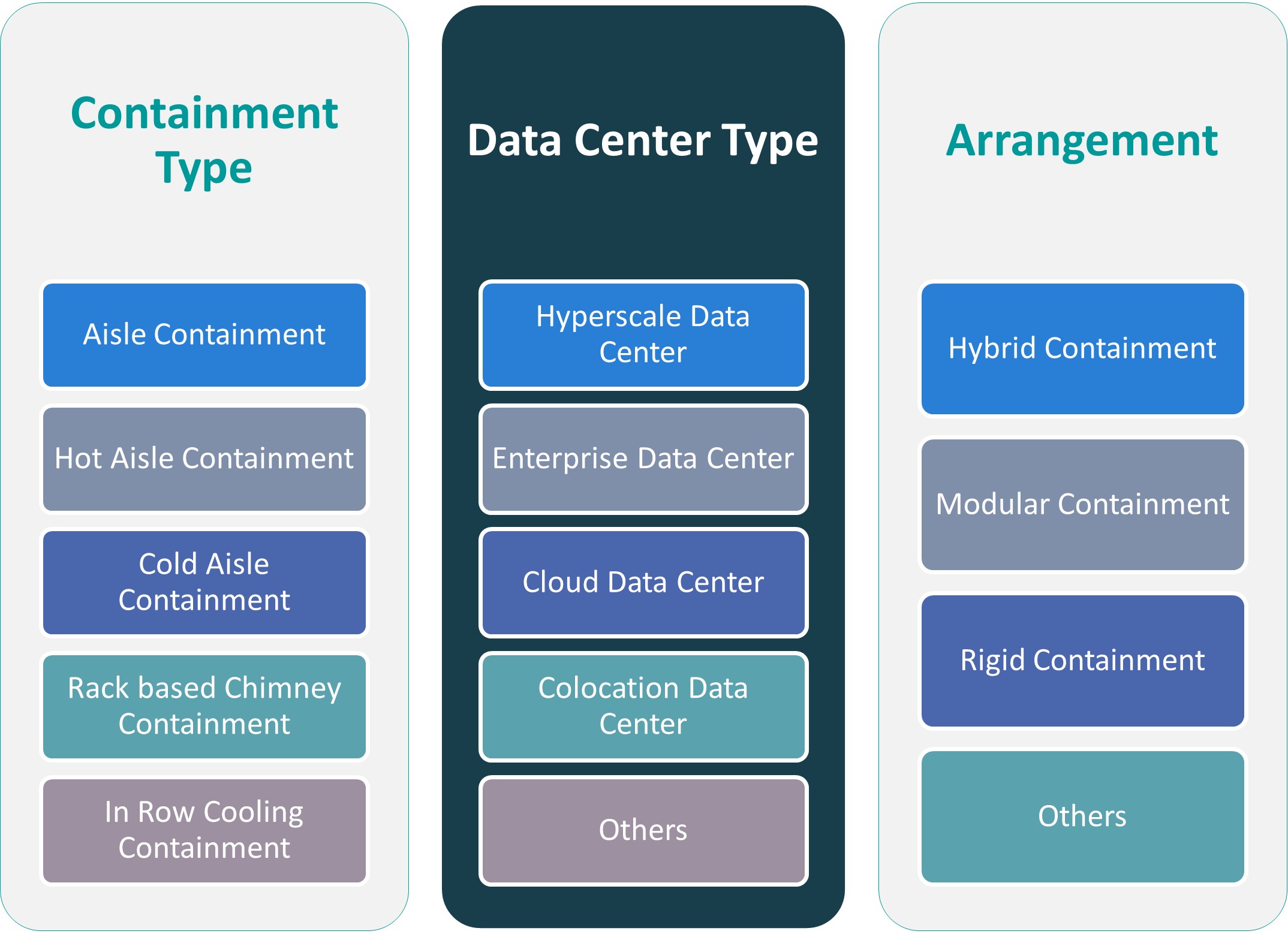
The Mexico Data Center Containment Market is segmented by containment type, which includes various solutions designed to optimize cooling efficiency and space utilization within data centers. The most common containment types include hot aisle containment, cold aisle containment, rack-based chimney containment, and in-row cooling containment. Hot aisle containment involves the enclosure of hot air aisles, directing the hot exhaust air away from sensitive IT equipment, thereby improving cooling efficiency. This containment type is particularly effective in high-density environments, where cooling needs are crucial. Cold aisle containment, on the other hand, isolates cold air into aisles, ensuring that the cold air directly reaches the servers and prevents hot air from circulating. This method is widely used in most data centers for its simplicity and effectiveness in managing airflow. Rack-based chimney containment is gaining popularity as it isolates the heat generated by individual server racks, ensuring that each rack's hot exhaust is directed to a specific location, improving cooling efficiency. Lastly, in-row cooling containment places cooling units within the server rows themselves, offering targeted cooling where it is needed most. This solution is ideal for environments where precision cooling is necessary, and it is becoming increasingly common in Mexico as data centers expand and require more effective ways to manage high-density IT loads. The adoption of these containment types is expected to grow as data center operators in Mexico look for ways to improve energy efficiency and optimize cooling performance.
By Data Center Type
The Mexico Data Center Containment Market is also segmented by data center type, which includes hyperscale data centers, enterprise data centers, cloud data centers, colocation data centers, and others. Hyperscale data centers, which are large facilities designed to scale efficiently, dominate the market due to the increasing demand for cloud services, big data, and AI technologies. These data centers require highly efficient containment solutions to manage their large-scale operations, making them a key driver of market growth in Mexico. Enterprise data centers, typically owned by large corporations for internal use, are also significant in the market. These data centers focus on ensuring high reliability and uptime while maintaining energy efficiency, creating a demand for advanced containment systems. Cloud data centers, which host data for various service providers, continue to expand rapidly in Mexico as the country increasingly adopts cloud-based services. As cloud infrastructure grows, so does the need for energy-efficient containment solutions to support high-density computing environments. Colocation data centers, where multiple customers share space in a single facility, are another growing segment. These data centers require containment systems that can manage diverse customer needs, ensuring that each tenant’s IT equipment is optimally cooled. As Mexico’s digital economy grows, the demand for data center containment solutions across these diverse data center types will continue to increase, with containment systems being crucial to maintaining energy efficiency and performance.
Segments
Based on Containment Type
- Aisle Containment
- Hot Aisle Containment
- Cold Aisle Containment
- Rack based Chimney Containment
- In Row Cooling Containment
Based on Data Center Type
- Hyperscale Data Center
- Enterprise Data Center
- Cloud Data Center
- Colocation Data Center
- Others
Based on Arrangement
- Hybrid Containment
- Modular Containment
- Rigid Containment
- Others
Based on Region
- Mexico City
- Monterrey
- Guadalajara
- Querétaro
Regional Analysis
Mexico City (40%)
Mexico City, as the capital and economic hub, holds the largest market share in the Mexico Data Center Containment Market, accounting for approximately 40% of the market share. The region's dominance is attributed to its role as the primary center for technology, telecommunications, and business services. With a growing number of enterprises and hyperscale data centers, Mexico City is experiencing significant demand for advanced containment solutions to enhance cooling efficiency and reduce operational costs. The ongoing digital transformation in industries like banking, telecommunications, and e-commerce is further contributing to the expansion of data centers in this region, driving the need for efficient containment technologies.
Monterrey (25%)
Monterrey, located in the northern part of Mexico, is another key region with a growing share in the data center market, accounting for roughly 25% of the total market share. As an industrial and commercial hub, Monterrey attracts significant investments in infrastructure, including data centers. The region’s proximity to the United States and its status as a center for manufacturing and business services have contributed to the increasing demand for data center containment systems. Monterrey’s growing adoption of cloud services, e-commerce platforms, and financial technologies has led to the need for advanced containment solutions to manage the high-density IT workloads effectively.
Key players
- Kio Networks
- Axtel
- Telmex
- Interconexion
- Grupo Kibernum
Competitive Analysis
The Mexico Data Center Containment Market is highly competitive, with key players such as Kio Networks, Axtel, Telmex, Interconexion, and Grupo Kibernum driving innovation and expanding their market presence. Kio Networks stands out as a significant player, providing a comprehensive portfolio of containment solutions tailored to meet the needs of high-performance data centers. Axtel and Telmex, both major telecommunications companies in Mexico, leverage their strong infrastructure and client base to offer advanced data center containment solutions, focusing on scalability and energy efficiency. Interconexion, a key player in data center operations, competes by offering specialized containment and cooling systems, addressing the demand for energy-efficient data centers. Grupo Kibernum brings its expertise in IT services to the market, focusing on delivering solutions that optimize operational performance. Each of these companies is positioning itself strategically through innovation, cost-effective solutions, and efficient service offerings to maintain a competitive edge in the growing market.
Recent Developments
- In November 2023, Huawei introduced two new additions to its Smart Modular Data Center and SmartLi uninterruptible power supply (UPS) series – FusionModule2000 6.0, a modular small/medium-sized data center solution, and UPS2000-H, a small-footprint power supply solution running on SmartLi Mini.
- In February 2025, Trane Technologies expanded its data center solutions to include liquid cooling thermal management systems, introducing the Trane 1MW Coolant Distribution Unit for high-performance workloads.
- In 2025, Honeywell launched a data center management suite to improve efficiency and sustainability by integrating operational and IT infrastructure data.
- In March 2025, Vertiv introduced new solutions to support dense AI and high-performance computing workloads, including consolidated infrastructure management software and prefabricated modular overhead infrastructure.
- In March 2025, Siemens announced a $285 million investment in U.S. manufacturing, including establishing new facilities in California and Texas. This investment aims to enhance manufacturing capabilities and advance AI technologies, supporting sectors such as commercial, industrial, construction, and AI data centers.
Market Concentration and Characteristics
The Mexico Data Center Containment Market exhibits a moderately concentrated structure, with a mix of established players and emerging companies actively competing for market share. Major players like Kio Networks, Axtel, Telmex, and Interconexion dominate the landscape by offering a wide range of containment solutions tailored to the needs of large-scale, high-performance data centers. These companies leverage their strong infrastructure, technological expertise, and strategic partnerships to maintain a competitive edge. However, the market also sees participation from smaller, specialized firms that focus on niche containment technologies, adding diversity to the competitive environment. The market is characterized by a growing demand for energy-efficient solutions, advanced cooling technologies, and modular containment systems, driven by the rapid expansion of data centers and the increasing need for sustainable operations. As the digital economy continues to grow, market competition is expected to intensify, with companies striving to innovate and offer cost-effective, scalable, and eco-friendly containment solutions.
Report Coverage
The research report offers an in-depth analysis based on Containment Type, Data Center Type, Arrangement and Region. It details leading market players, providing an overview of their business, product offerings, investments, revenue streams, and key applications. Additionally, the report includes insights into the competitive environment, SWOT analysis, current market trends, as well as the primary drivers and constraints. Furthermore, it discusses various factors that have driven market expansion in recent years. The report also explores market dynamics, regulatory scenarios, and technological advancements that are shaping the industry. It assesses the impact of external factors and global economic changes on market growth. Lastly, it provides strategic recommendations for new entrants and established companies to navigate the complexities of the market.
Future Outlook
- As energy consumption becomes a critical concern, data centers in Mexico will increasingly adopt advanced containment solutions to optimize cooling and reduce operational costs.
- The rapid expansion of cloud services will drive the need for more data centers, fostering greater demand for scalable containment solutions to support high-density IT operations.
- The rise of hyperscale data centers in Mexico will push for more efficient containment systems, focusing on maximizing space utilization and cooling performance.
- The use of AI and machine learning in data center operations will enable real-time monitoring and optimization of containment systems, improving cooling efficiency and reducing energy waste.
- With Mexico’s growing emphasis on sustainability, data center operators will adopt greener technologies, including energy-efficient containment solutions, to comply with environmental regulations.
- Continued innovation in containment technologies, such as liquid cooling and modular systems, will provide more efficient and flexible solutions to meet the needs of modern data centers.
- Modular containment solutions will become more popular due to their flexibility, scalability, and ease of installation, allowing data center operators to expand their infrastructure as needed.
- The growth of colocation data centers in Mexico will drive the need for customized containment solutions, ensuring that each customer’s equipment is efficiently cooled while optimizing energy consumption.
- As Mexico’s digital economy grows, secondary markets such as Monterrey and Querétaro will see increased data center development, further boosting demand for efficient containment technologies.
- The Mexico Data Center Containment Market will become more competitive as both established players and new entrants develop innovative, cost-effective containment solutions to capture market share in the expanding sector.

Request a Free Sample
Fill in your details and we'll send you a free sample report.
- Sample data tables & charts
- Research methodology
Market Dynamics
Regulatory Pressures and Sustainability Initiatives
Mexico's commitment to reducing greenhouse gas emissions and increasing renewable energy adoption is pushing data center operators to implement energy-efficient containment solutions that comply with environmental regulations and support green building certifications like LEED.
Technological Advancements in Containment Solutions
Innovations such as modular, scalable, and AI-integrated containment systems are enabling more efficient cooling, real-time airflow optimization, and adaptability to high-density IT environments, making advanced containment more attractive and effective for Mexican data centers.
Expansion of Cloud Computing and Digital Infrastructure
The rapid growth of cloud services, e-commerce, fintech, and digital transformation in Mexico is driving the need for new and upgraded data centers, which in turn increases demand for advanced containment systems to ensure efficient, scalable, and reliable operations.
Energy Efficiency and Cost Optimization
With high energy costs and a focus on operational savings, Mexican data centers are adopting hot/cold aisle and other containment technologies to optimize airflow, reduce cooling loads, and minimize electricity expenses, directly impacting profitability and sustainability.
Growth of Hyperscale and Colocation Data Centers
The rise of hyperscale and colocation facilities in key Mexican regions is fueling demand for sophisticated containment solutions that can support high-density workloads, flexible expansion, and diverse customer requirements, further accelerating market growth.
Need a Custom Version of This Report?
Tailor the scope, geography, or segments to your exact requirements.
- Custom geography or segment scope
- Direct access to our analyst team
Frequently Asked Questions
What is the market size of the Mexico Data Center Containment Market in 2023 and 2032?
What are the main drivers of the Mexico Data Center Containment Market?
How is the geographical distribution of the Mexico Data Center Containment Market evolving?
Who are the key players in the Mexico Data Center Containment Market?
Table of Content
Chapter 1 Market Segmentation
- 1.1 Segmentation Framework
- 1.1.1 Product and Service Classification
- 1.1.2 Application and End-Use Classification
- 1.1.3 Technology and Solution Classification
- 1.1.4 Customer and Distribution Channel Classification
- 1.1.5 Geographic Segmentation
- 1.1.6 Market Segment Definitions and Boundaries
- 1.2 By Arrangement
- 1.2.1 Hybrid Containment
- 1.2.2 Modular Containment
- 1.2.3 Rigid Containment
- 1.2.4 Others
- 1.3 By Containment Type
- 1.3.1 Hot Aisle Containment
- 1.3.2 Cold Aisle Containment
- 1.3.3 Rack-based Chimney Containment
- 1.3.4 In Row Cooling Containment
- 1.3.5 Aisle Containment
- 1.4 By Data Center Type
- 1.4.1 Hyperscale Data Center
- 1.4.2 Enterprise Data Center
- 1.4.3 Cloud Data Center
- 1.4.4 Colocation Data Center
- 1.4.5 Others
Chapter 2 Introduction
- 2.1 Report Objectives and Scope
- 2.2 Product Definition and Industry Terminology
- 2.3 Market Inclusions and Exclusions
- 2.4 Research Process
- 2.4.1 Primary Research and Expert Interviews
- 2.4.2 Secondary Research and Source Review
- 2.4.3 Top-Down and Bottom-Up Estimation
- 2.4.4 Data Triangulation and Verification
- 2.5 Market Size Measurement Basis
- 2.5.1 2024: USD 76.92 million → 2032: USD 153.96 million
- 2.6 Historical and Forecast Reference Periods
- 2.6.1 Base Year: 2024
- 2.6.2 Forecast Period: 2024-2032
- 2.7 Research Assumptions and Limitations
Chapter 3 Executive Summary
- 3.1 Market Snapshot and Key Findings
- 3.2 Base-Year Market Size, 2024
- 3.3 Forecast Market Size, 2032
- 3.4 Revenue and Volume Growth Outlook
- 3.5 Key Demand and Supply Indicators
- 3.6 Leading Market Segments
- 3.7 Fastest-Growing Market Opportunities
- 3.8 Regional Performance Highlights
- 3.9 Technology and Industry Transformation
- 3.10 Competitive Landscape Summary
- 3.11 Analyst View and Strategic Implications
Chapter 4 Mexico Data Center Containment Market Trends and Developments
- 4.1 Historical Industry Development
- 4.2 Recent Market Trends and Developments
- 4.3 Demand and Customer Behavior Trends
- 4.4 Technology and Product Innovation
- 4.5 Artificial Intelligence, Automation and Digitalization
- 4.6 Local Manufacturing and Supply Chain Realignment
- 4.7 Industry Partnerships, Mergers and Acquisitions
- 4.8 Sustainability and Circular Economy Developments
- 4.9 Government and Private Sector Investment Trends
- 4.10 Emerging Business Models and Commercialization
- 4.11 Industry Developments and Announcements
Chapter 5 Mexico Data Center Containment Market Production, Supply and Demand Analysis
- 5.1 Demand Trend and Consumption Analysis
- 5.2 Demand Forecast, 2024-2032
- 5.3 Production and Output Trend
- 5.4 Production and Output Forecast, 2024-2032
- 5.5 Installed Capacity and Capacity Utilization
- 5.6 Company-Wise Production Plants and Statistics
- 5.6.1 Installed Production Capacity
- 5.6.2 Actual Production
- 5.6.3 Planned Capacity and Expansion Targets
- 5.7 Supply Chain Structure and Procurement Trends
- 5.8 Supply-Demand Gap and Bottlenecks
- 5.9 Import Dependence and Sourcing Structure
- 5.10 Contract Manufacturing and Outsourcing
- 5.11 Regional Supply and Demand Concentration
Chapter 6 Mexico Data Center Containment Market Pricing Analysis
- 6.1 Pricing Structure and Measurement
- 6.2 Historical Pricing Trends
- 6.3 Pricing Outlook, 2024-2032
- 6.4 Average Selling Price and Unit Economics
- 6.5 Pricing by Product and Market Segment
- 6.6 Geographic Pricing Differences
- 6.7 Key Input, Energy, Labor and Logistics Costs
- 6.8 Contract Pricing and Purchasing Models
- 6.9 Pricing Sensitivity and Competitive Positioning
- 6.10 Price, Margin and Profitability Implications
Chapter 7 Mexico Data Center Containment Market Dynamics
- 7.1 Market Growth Drivers
- 7.1.1 Demand-Side Drivers
- 7.1.2 Technology and Innovation Drivers
- 7.1.3 Infrastructure and Investment Drivers
- 7.1.4 Regulatory and Policy Drivers
- 7.2 Market Restraints
- 7.2.1 Cost and Affordability Constraints
- 7.2.2 Technology and Adoption Barriers
- 7.2.3 Supply Chain and Operational Constraints
- 7.3 Market Challenges
- 7.3.1 Competitive Pressure and Margin Erosion
- 7.3.2 Skills, Infrastructure and Implementation Gaps
- 7.4 Emerging Market Opportunities
- 7.5 Market Dynamics Impact and Time-Horizon Assessment
Chapter 8 Mexico Data Center Containment Value Chain Analysis
- 8.1 Industry Value Chain Overview
- 8.2 Upstream Suppliers and Critical Inputs
- 8.3 Technology and Component Providers
- 8.4 Manufacturing or Service Delivery
- 8.5 Distribution, Channel Partners and Integrators
- 8.6 Downstream Applications and End Users
- 8.7 Value Addition and Profit Pools
- 8.8 Vertical Integration and Outsourcing
- 8.9 Supplier Concentration and Risk
- 8.10 Supply Chain Localization and Resilience
Chapter 9 Mexico Data Center Containment Market Regulations and Policies
- 9.1 Relevant Laws, Standards and Compliance Frameworks
- 9.2 Product, Service, Safety and Quality Requirements
- 9.3 Government Policies, Incentives and Subsidies
- 9.4 Imports, Exports and Trade Barriers
- 9.5 Public Procurement and Local Content Requirements
- 9.6 Environmental and Sustainability Compliance
- 9.7 Upcoming Policy Changes and Market Implications
Chapter 10 Mexico Data Center Containment Market Hotspots and Opportunities
- 10.1 Market Opportunity Mapping and Growth Hotspots
- 10.2 High-Growth Applications and Customer Groups
- 10.3 Underserved Markets and White-Space Opportunities
- 10.4 Emerging Technology and Product Opportunities
- 10.5 New Capacity and Investment Hotspots
- 10.6 Market Entry and Expansion Opportunities
- 10.7 Distribution and Partnership Opportunities
- 10.8 Near-Term and Long-Term Commercial Potential
- 10.9 Opportunity Attractiveness and Execution Risks
Chapter 11 Mexico Data Center Containment Market Outlook, 2024-2032
- 11.1 Market Size and Analysis
- 11.1.1 Revenue (Market Measurement: 2024: USD 76.92 million → 2032: USD 153.96 million)
- 11.1.2 Market Volume and Quantity Sold
- 11.1.3 Historical Market Size
- 11.1.4 Base-Year Market Size, 2024
- 11.2 Market Forecast, 2024-2032
- 11.2.1 Revenue Forecast to 2032
- 11.2.2 Volume Forecast to 2032
- 11.2.3 CAGR and Year-on-Year Growth
- 11.2.4 Incremental Revenue Opportunity
- 11.3 Forecast Assumptions and Scenario Analysis
- 11.3.1 Base-Case Forecast
- 11.3.2 Optimistic and Conservative Scenarios
- 11.3.3 Technology, Pricing and Policy Sensitivities
- 11.4 Market Attractiveness and Growth Outlook
Chapter 12 Mexico Data Center Containment Market Segmentation and Outlook
- 12.1 Segmentation Summary and Market Shares, 2024
- 12.2 Largest and Fastest-Growing Segments
- 12.3 By Arrangement - Market Size and Forecast, 2024-2032
- 12.3.1 Segment Definition and Scope
- 12.3.2 Historical Market Size
- 12.3.3 Revenue Forecast, 2024-2032
- 12.3.4 Volume Forecast, 2024-2032
- 12.3.5 Base-Year Market Share, 2024
- 12.3.6 Segment CAGR and Growth Drivers
- 12.3.7 Subsegment Market Size and Forecast
- 12.3.7.1 Hybrid Containment
- 12.3.7.2 Modular Containment
- 12.3.7.3 Rigid Containment
- 12.3.7.4 Others
- 12.3.8 Subsegment Pricing and Adoption Trends
- 12.3.9 Leading Suppliers and Competition
- 12.3.10 Regional Demand and Opportunities
- 12.4 By Containment Type - Market Size and Forecast, 2024-2032
- 12.4.1 Segment Definition and Scope
- 12.4.2 Historical Market Size
- 12.4.3 Revenue Forecast, 2024-2032
- 12.4.4 Volume Forecast, 2024-2032
- 12.4.5 Base-Year Market Share, 2024
- 12.4.6 Segment CAGR and Growth Drivers
- 12.4.7 Subsegment Market Size and Forecast
- 12.4.7.1 Hot Aisle Containment
- 12.4.7.2 Cold Aisle Containment
- 12.4.7.3 Rack-based Chimney Containment
- 12.4.7.4 In Row Cooling Containment
- 12.4.7.5 Aisle Containment
- 12.4.8 Subsegment Pricing and Adoption Trends
- 12.4.9 Leading Suppliers and Competition
- 12.4.10 Regional Demand and Opportunities
- 12.5 By Data Center Type - Market Size and Forecast, 2024-2032
- 12.5.1 Segment Definition and Scope
- 12.5.2 Historical Market Size
- 12.5.3 Revenue Forecast, 2024-2032
- 12.5.4 Volume Forecast, 2024-2032
- 12.5.5 Base-Year Market Share, 2024
- 12.5.6 Segment CAGR and Growth Drivers
- 12.5.7 Subsegment Market Size and Forecast
- 12.5.7.1 Hyperscale Data Center
- 12.5.7.2 Enterprise Data Center
- 12.5.7.3 Cloud Data Center
- 12.5.7.4 Colocation Data Center
- 12.5.7.5 Others
- 12.5.8 Subsegment Pricing and Adoption Trends
- 12.5.9 Leading Suppliers and Competition
- 12.5.10 Regional Demand and Opportunities
- 12.6 Segment Growth Comparison
- 12.7 Segment Attractiveness and Priority Matrix
Chapter 13 Mexico Data Center Containment Geographic Market Outlook, 2024-2032
- 13.1 Domestic Market Distribution and Demand Clusters
- 13.2 State- or Province-Wise Market Size and Forecast, 2024-2032
- 13.3 City and Metropolitan Market Outlook
- 13.4 Industrial, Manufacturing and Commercial Clusters
- 13.5 Geographic Concentration of Key End Users
- 13.6 Local Pricing and Purchasing Differences
- 13.7 Domestic Production Facilities and Capacity Map
- 13.8 Local Infrastructure and Project Pipeline
- 13.9 State-Level Policy and Incentive Differences
- 13.10 Subnational Investment Hotspots and Opportunities
- 13.11 Distribution and Logistics Networks
- 13.12 Domestic Competitive Footprint
Chapter 14 Mexico Data Center Containment Technology, Innovation and Sustainability Outlook
- 14.1 Technology Landscape and Maturity
- 14.2 Product, Process and Service Innovation
- 14.3 AI, Automation and Digital Tools in the Industry
- 14.4 Technology Adoption and Performance Benchmarking
- 14.5 Innovation Pipeline and R&D Investment
- 14.6 Patent and Intellectual Property Trends
- 14.7 Energy Efficiency and Resource Management
- 14.8 Sustainability, Recycling and Circularity
- 14.9 Technology Roadmap, 2024-2032
- 14.10 Risks of Obsolescence and Technology Substitution
Chapter 15 Mexico Data Center Containment Market Key Strategic Imperatives
- 15.1 Growth and Market Entry Priorities
- 15.2 High-Return Products and Segments
- 15.3 Pricing, Profitability and Cost Optimization
- 15.4 Technology Investment and Product Differentiation
- 15.5 Supply Chain Localization and Resilience
- 15.6 Distribution and Customer Acquisition
- 15.7 Partnership, Acquisition and Capacity Strategy
- 15.8 Regional Expansion Priorities
- 15.9 Short-, Medium- and Long-Term Actions
Chapter 16 Competition Outlook
- 16.1 Industry Competition Characteristics
- 16.2 Market Structure and Concentration
- 16.3 Market Share and Competitive Positioning, 2024
- 16.4 Company-Wise Revenue and Product Benchmarking
- 16.5 Production and Service Capacity Benchmarking
- 16.6 Technology, Pricing and Differentiation
- 16.7 Regional Footprint and Distribution Strength
- 16.8 Mergers, Acquisitions and Strategic Alliances
- 16.9 New Entrants and Competitive Threats
- 16.10 Porter's Five Forces and Industry Attractiveness
- 16.11 Competitive Outlook, 2024-2032
Chapter 17 Company Profiles
- 17.1 Company Coverage and Selection Criteria
- 17.2 Kio Networks
- 17.2.1 Business Description
- 17.2.2 Company Ownership and Geographic Presence
- 17.2.3 Product and Service Portfolio
- 17.2.4 Manufacturing and Operating Footprint
- 17.2.5 Production Capacity and Expansion Plans
- 17.2.6 Financial Performance and Investment
- 17.2.7 Market Share and Competitive Position
- 17.2.8 Technology and Innovation Capabilities
- 17.2.9 Strategic Alliances or Partnerships
- 17.2.10 Recent Developments
- 17.2.11 Growth Strategy and Outlook
- 17.3 Axtel
- 17.4 Telmex
- 17.5 Interconexion
- 17.6 Grupo Kibernum
- 17.7 Schneider Electric
- 17.8 Vertiv
- 17.9 Stulz
- 17.10 Huawei
- 17.11 Honeywell
- 17.12 Other Relevant Market Participants
Note: Every listed company is profiled on the structure shown under the first company. The company list is preliminary and may change based on research findings, market developments, data availability and client requirements.
Chapter 18 Disclaimer
- 18.1 Research and Forecast Disclaimer
- 18.2 Data Source and Estimation Limitations
Note: The depth of individual sections depends on data availability for this market. Volume, capacity, trade and other unit-based metrics are included where applicable.

