
Market Overview:
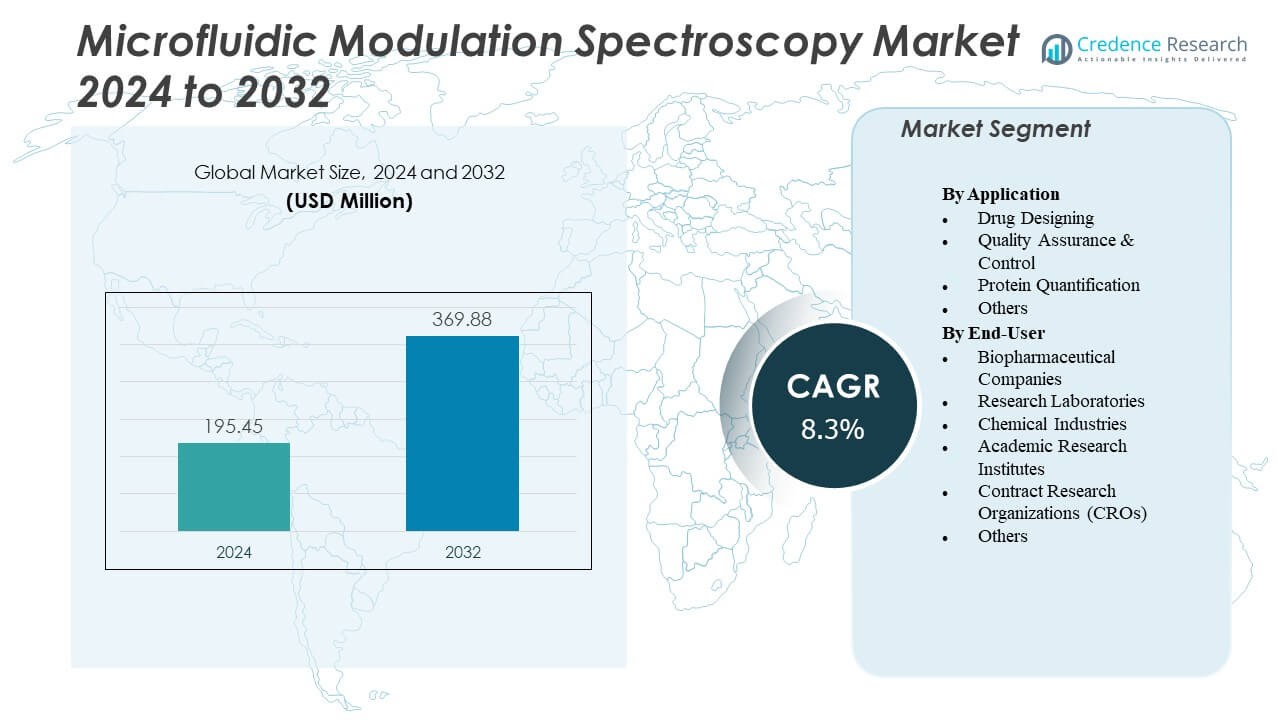
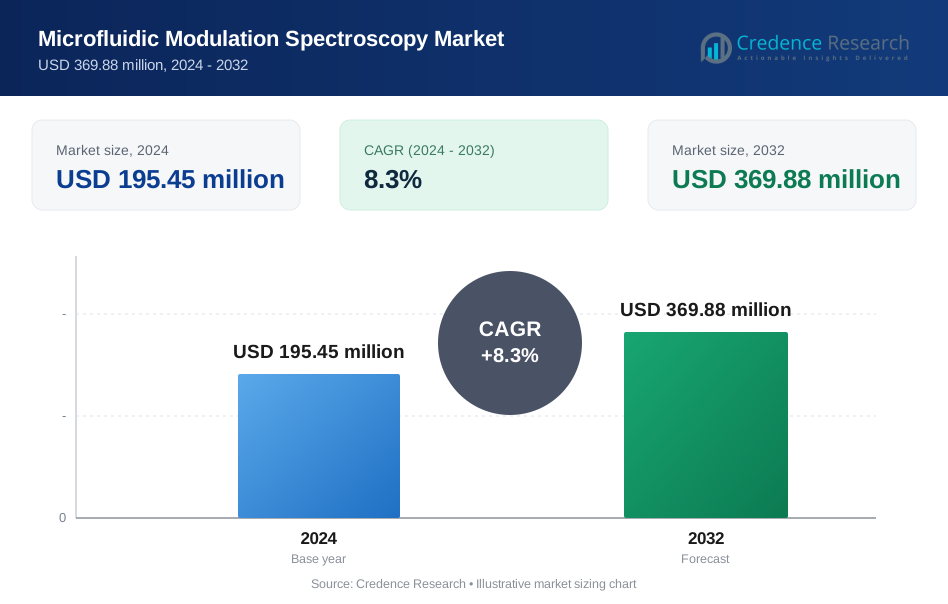
The Microfluidic Modulation Spectroscopy Market is projected to grow from USD 195.45 million in 2024 to an estimated USD 369.88 million by 2032, with a compound annual growth rate (CAGR) of 8.3% from 2024 to 2032.
| REPORT ATTRIBUTE | DETAILS |
|---|---|
| Historical Period | 2020-2023 |
| Base Year | 2024 |
| Forecast Period | 2025-2032 |
| Microfluidic Modulation Spectroscopy Market Size 2024 | USD 195.45 Million |
| Microfluidic Modulation Spectroscopy Market, CAGR | 8.3% |
| Microfluidic Modulation Spectroscopy Market Size 2032 | USD 369.88 Million |
Market drivers for microfluidic modulation spectroscopy are rooted in the technology’s importance for biopharmaceutical research, precision drug development, and advanced protein analysis. Biopharmaceutical companies increasingly demand high-sensitivity platforms for rapid molecular characterization, supporting faster and more reliable drug discovery processes. Regulatory standards mandate detailed quality control, while increased R&D spending and the integration of artificial intelligence and automation encourage widespread platform adoption in laboratories. Scientists and manufacturers value this technology for its ability to deliver both accuracy and efficiency in demanding analytical workflows.
Geographically, North America stands out as the clear leader in the Microfluidic Modulation Spectroscopy Market, supported by robust investment in research infrastructure and early adoption of analytical innovations. Europe maintains significant strength, especially in countries like Germany, France, and the UK, fueled by biopharma production and strong regulatory frameworks. Asia Pacific is an emerging market, with expanding demand in China, India, and Japan driven by healthcare system modernization, new research funding, and a rising need for advanced diagnostics pointing to high-growth potential across the region
Market Insights:
- The Microfluidic Modulation Spectroscopy Market was valued at USD 195.45 million in 2024 and is projected to reach USD 369.88 million by 2032 with an 8.3% CAGR.
- Adoption is being accelerated by strong demand in drug designing, where precision protein analysis and rapid biomolecular characterization are essential.
- Market growth is fueled by regulatory pressure for quality control, rising R&D investment, and the push for automated, high-throughput workflows.
- Equipment cost and technical complexity remain key restraints for smaller labs and slow adoption in less-developed segments.
- North America leads, accounting for about 40% of the Microfluidic Modulation Spectroscopy Market, owing to a high concentration of research facilities and early technology adoption.
- Europe remains a core region, benefiting from robust biopharma infrastructure and regulatory support, with Germany, France, and the UK as key markets.
- Asia Pacific is rapidly emerging, driven by investment in healthcare, research infrastructure, and advancing pharmaceutical industries in China, India, and Japan.
Market Drivers
Surging Demand for High-Precision Analytical Tools in Drug Development and Biologics Research
Biopharmaceutical and research organizations prioritize adopting analytical techniques that deliver high-resolution molecular characterization, making the Microfluidic Modulation Spectroscopy Market essential for modern laboratories. Its core value lies in advancing drug discovery and formulation optimization while offering rapid, reproducible results with minimal sample volumes. Companies commit escalating investments in drug development, fueling strong demand for advanced microfluidic platforms integrating spectroscopy. Regulatory standards enforce the adoption of superior technology for quality and safety in biologics, propelling usage in preclinical and clinical workflows. The market sustains momentum as more researchers integrate real-time monitoring and data-driven decision-making. High-throughput screening processes benefit from efficient, cost-effective solutions. Regulatory trends encourage laboratories to upgrade their analytical toolkits. This convergence of regulatory guidance and market innovation positions the segment for ongoing expansion.
Technology Innovation and Integration with Automation, Artificial Intelligence, and Data Analytics Platforms
The Microfluidic Modulation Spectroscopy Market experiences robust growth due to continued product innovation and technology integration. Manufacturers integrate artificial intelligence and machine learning to enhance data interpretation accuracy and streamline experimental workflows. Advancements in automation support higher sample throughput and limit operator dependency, optimizing process efficiency. The market benefits from platforms now compatible with complex computational modeling, delivering precise molecular stability and binding kinetics insights. AI accelerates product development cycles, while predictive analytics support proactive quality assurance. Such digital transformation and smart automation create significant value for both research and commercial laboratories. Laboratories prioritize adaptable hardware that supports seamless data integration. Efficiency-driven upgrades substantiate the shift toward interconnected, intelligent analytical ecosystems.
- For instance, RedShift BioAnalytics again unveiled its Aurora TX in May 2024, supporting biomolecule concentrations from 0.1 mg/mL to >200 mg/mL, offering walk-away automation and thermal-ramping capabilities for high-resolution structural stability analysis.
Expanding Biopharmaceutical Pipelines and Widespread Adoption in Personalized Medicine and Continuous Manufacturing
The Microfluidic Modulation Spectroscopy Market draws momentum from the expansion of biologics development, personalized therapies, and continuous production systems. It addresses the escalating complexity of protein therapeutics and the shift to individualized medicine. Players optimize R&D workflows to streamline timelines and enhance compliance with evolving assays. Laboratories require scalable, real-time, non-destructive molecular analysis suitable for early and late-stage drug development. The market’s leading end-user segment, biopharmaceutical firms, emphasizes precise measurement technologies that ensure formulation stability and accelerated release cycles. Automated, high-throughput measurement solutions facilitate cost control and regulatory compliance. Companies value continuous laboratory innovation to address patient-specific therapies. Market relevance intensifies as healthcare trends focus on tailored therapeutic outcomes.
Supportive Regulatory Environment and Global Investment in Research Infrastructure and Advanced Instrumentation
The Microfluidic Modulation Spectroscopy Market’s growth is catalyzed by stable regulatory frameworks and global investment in research capacity. Policymakers and funding agencies recognize the segment’s role in supporting robust public health and life science innovation. Significant allocations for laboratory upgrades and analytical instrumentation drive adoption. Regulatory authorities recommend advanced analytical techniques for biologics safety, reproducibility, and batch release, motivating laboratories to implement microfluidic spectroscopy. Emerging markets accelerate investment in health infrastructure and workforce development, which in turn expands addressable demand. Progressive regulations synchronize with market advancements, fostering a climate conducive to ongoing innovation. Laboratories around the world leverage government support to deploy new technologies, raising standards across geographies.
- For instance, Fluidic Sciences Ltd. relaunched its Fluidity One-M instrument in May 2024, leveraging microfluidic diffusional sizing (MDS) technology acquired from a predecessor; the company noted the instrument already served “30 to 40 international customers” prior to relaunch, indicating investment in advanced instrumentation and infrastructure.
Market Trends
Integration of Artificial Intelligence and Machine Learning into Analytical Workflows for Advanced Molecular Characterization
Artificial intelligence transforms the Microfluidic Modulation Spectroscopy Market through real-time analytics and automated data interpretation. Organizations increasingly deploy AI-driven platforms to detect molecular trends and ensure the highest quality of analytical outcomes. Machine learning algorithms facilitate predictive analytics, helping laboratories anticipate process deviations. Companies develop self-learning systems that adapt to changing workflows, fostering continuous efficiency enhancements. These features create agile business environments well-suited for complex molecular investigations. The synergy between AI and microfluidic platforms sharpens laboratory decision-making. AI-powered platforms also enable deeper customization of assays. Processes transition toward fully digital, transparent, and interconnected laboratory ecosystems.
- For instance, Illumina, Inc. in its January 2025 collaboration with NVIDIA Corporation announced combining Illumina’s sequencing and informatics tools with NVIDIA’s accelerated AI platforms to support multiomic data interpretation and accelerate drug-discovery workflows.
Widespread Commercialization of Next-Generation Platforms with Enhanced Sample Throughput and Reduced Volume Requirements
Cutting-edge microfluidic modulation spectroscopy systems feature improved sample processing and innovative low-volume workflow capabilities. New instrumentation designs support ultra-high-throughput screening with fewer resources. Labs respond to this by prioritizing platforms that conserve reagents and accelerate analytical timelines. Compact, modular device architecture becomes common. Vendors highlight ease of integration with existing laboratory automation frameworks. Commercial availability of advanced modular solutions shapes purchasing decisions. Microfluidic devices supporting streamlined measurement in diverse settings expand market accessibility. Labs value flexible, compact products that lower operational expenses.
- For instance, RedShift BioAnalytics, Inc. launched its “Aurora” MMS platform in July 2023 with a 50 µL sample volume requirement (a ten-fold decrease compared to its first-generation platform) and capable of measuring across a concentration range from 100 µg/mL to >100 mg/mL, achieving 20× faster throughput and 30× greater sensitivity versus CD/FTIR methods.
Expansion into Emerging and High-Growth Sectors, Including Food Safety, Environmental Monitoring, and Material Science Applications
Demand for microfluidic modulation spectroscopy platforms extends beyond healthcare and biopharma to include food safety, environmental analysis, and industrial applications. Manufacturers design systems for diverse testing environments with strict accuracy standards. Popularity grows among firms pursuing non-destructive protein analysis for quality assurance. Environmental labs seek sensitive detection for trace analytes and contaminants. Material science teams leverage microfluidic platforms for rapid polymer and nanomaterial characterization. These cross-industry applications supplement core revenue streams and enhance market resilience. Growth outside traditional healthcare boosts innovation in peripheral features. The market diversifies through strategic product positioning in adjacent fields.
Increasing Importance of Ecosystem Partnerships, Strategic Collaborations, and Academic-Industry Alliances in Accelerating Product Innovation
The Microfluidic Modulation Spectroscopy Market witnesses a surge in strategic partnerships and joint technology development. Industry players form alliances to accelerate innovation and increase competitive differentiation. Academic institutions and corporate partners collaborate to push technology boundaries. Co-development initiatives shorten commercialization timelines for novel platforms. Shared research infrastructure opens new avenues for prototype testing and validation. The emphasis on knowledge exchange strengthens best practices and catalyzes disruptive breakthroughs. Academic alliances propel rapid prototyping and validation efforts. Partnerships also increase access to new funding sources and broader technology adoption networks.
Market Challenges Analysis
Barriers Related to Equipment Cost, User Awareness, and Technical Complexity of Microfluidic Modulation Spectroscopy Implementation
The Microfluidic Modulation Spectroscopy Market encounters several adoption challenges, especially among smaller laboratories and resource-constrained research centers. Equipment costs can be significant, creating high barriers for entry in price-sensitive segments. Technical complexity in operating and maintaining advanced spectroscopic systems may deter organizations lacking specialized expertise. Limited awareness of microfluidic modulation spectroscopy’s advantages over conventional methods inhibits expansion in certain markets. Training requirements and system calibration introduce operational overhead. Distribution networks in less-developed regions remain in early stages, reducing device accessibility. Vendors must address perceptions of risk and steep learning curves. The market will further benefit from targeted educational campaigns. Resolving these obstacles is essential to reach broader customer bases.
Existing Regulatory, Supply Chain, and Market Penetration Hurdles Impacting Long-Term Growth Potential Across Segments
The Microfluidic Modulation Spectroscopy Market must contend with compliance demands that add layers of procedural requirements for laboratories. Navigating country-specific regulatory landscapes can slow down device approval and delay market entry. The supply chain’s complexity occasionally introduces risk of disruption, especially for precision components. Entry barriers in emerging economies include limited infrastructure and technical workforce availability. The presence of established conventional spectroscopy methods creates inertia that must be overcome for wider technology uptake. Relatively low market penetration in developing sectors implies slow user conversion. Market players must offer compelling value propositions and robust after-sale support. Successful navigation of regulatory and supply obstacles will ensure broader adoption and sustainable growth.
Market Opportunities
Expansion into Untapped Regional Markets and Growth of New Application Segments Such as Food, Pharma, and Environmental Testing
Significant opportunities exist for the Microfluidic Modulation Spectroscopy Market to penetrate untapped regional markets and address new segments. Growth initiatives targeting Asia-Pacific, Latin America, and the Middle East are predicted to drive future expansion. Governments in emerging economies invest heavily in healthcare infrastructure, catalyzing broader demand for advanced instrumentation. The market can extend into food safety labs and environmental quality control, where sensitive molecular analysis is increasingly valued. Vendors who adapt products for robust, field-based testing applications stand to gain market share. Integrators who provide specialized training and technology transfer solutions will improve local adoption rates.
Acceleration of Technology Integration with Complementary Platforms and Increasing Adoption Through Strategic Partnerships and Cross-Industry Alliances
The Microfluidic Modulation Spectroscopy Market is primed to benefit from integration with complementary analytical platforms, including mass spectrometry and high-throughput screening devices. Technology interoperability creates new value propositions for drug discovery, biotechnology, and diagnostics companies. Strategic partnerships between platform developers, academic institutions, and industrial labs will unlock innovation and accelerate product cycles. The trend toward open research environments enables faster validation and customization of spectroscopy solutions. Cross-industry alliances offer access to expanded funding, distribution, and collaborative networks. These alliances also stimulate disruptive market transitions and create groundwork for long-termrm growth
Market Segmentation Analysis:
By Application
The Microfluidic Modulation Spectroscopy Market is segmented by both application and end-user domains, illustrating its versatile utility across life sciences and biopharmaceutical sectors. On the application side, drug designing holds the largest market share, fueled by the need for precise biomolecular analysis and the rapid development of biologics. Quality assurance and control is another prominent segment, as companies increasingly use this technology to validate batch consistency and meet strict regulatory standards. Protein quantification remains critical for both research and industry, enabling accurate measurement in clinical and diagnostic workflows. The "Others" segment covering environmental monitoring and food safety further extends adoption, underscoring the market's adaptability beyond mainstream healthcare and pharmaceuticals.
- For instance, RedShiftBio’s microfluidic modulation spectroscopy (MMS) system has been demonstrated to measure protein secondary structure at concentrations ranging from 0.1 mg/mL to 200 mg/mL, with 20 times greater sensitivity compared to FTIR, achieving repeatability above 99% for area of overlap in protein structure analysis-a key parameter in drug design and characterization workflows.
By End-User
From an end-user perspective, biopharmaceutical companies lead the market, leveraging microfluidic modulation spectroscopy to streamline R&D, optimize bioprocessing, and maintain robust quality controls. Research laboratories and academic institutes play a vital role in innovation and early adoption, using these tools for advanced research and protein characterization. Chemical industries and contract research organizations (CROs) also contribute to steady market expansion, particularly as demand grows for precise analytical instrumentation in diverse testing environments. While biopharma remains dominant, the technology’s versatility continues to attract new users from multiple scientific domains, reinforcing the Microfluidic Modulation Spectroscopy Market’s relevance across a range of analytical applications.
- For example, microfluidics-enabled high-throughput protein functional analysis, such as SPARKfold, now allows for the measurement of 1,104 protein unfolding rate constants in less than two days, demonstrating the scalability and cross-domain applicability of the technology.
Segmentation:
By Application
- Drug Designing
- Quality Assurance & Control
- Protein Quantification
- Others
By End-User
- Biopharmaceutical Companies
- Research Laboratories
- Chemical Industries
- Academic Research Institutes
- Contract Research Organizations (CROs)
- Others
By Region
- North America
- U.S.
- Canada
- Mexico
- Europe
- Germany
- France
- U.K.
- Italy
- Spain
- Rest of Europe
- Asia Pacific
- China
- Japan
- India
- South Korea
- South-east Asia
- Rest of Asia Pacific
- Latin America
- Brazil
- Argentina
- Rest of Latin America
- Middle East & Africa
- GCC Countries
- South Africa
- Rest of the Middle East and Africa
Regional Analysis:
North America leads the Microfluidic Modulation Spectroscopy Market, accounting for nearly 40% of the global market share. This region’s strong dominance stems from a robust healthcare infrastructure and a high concentration of top-tier research laboratories and biopharmaceutical enterprises utilizing advanced spectroscopic tools for drug discovery and diagnostic innovation. Ongoing demand for rapid, reproducible measurements and stringent regulatory standards further support widespread adoption across the United States and Canada. North America’s prominence is also sustained by continual technological advancements and substantial investments in analytical instrumentation, making it a focal region for manufacturers and developers.
Europe follows as the second-largest region, holding approximately 30% market share in the Microfluidic Modulation Spectroscopy Market. Pharmaceutical research and quality assurance remain critical drivers, supported by a consistent push toward regulatory compliance and innovation in biotechnology and chemical industries. Key markets such as Germany, France, and the United Kingdom are instrumental, with Germany maintaining a leadership position through its commitment to life science R&D and high-value biomanufacturing. The European region’s sector growth is further propelled by increasing collaborations between academia, industry, and regulatory bodies, broadening the scope for advanced microfluidic spectroscopy solutions in research and clinical practice.
Asia Pacific has emerged as a rapidly expanding market, capturing around 15% of global share in the Microfluidic Modulation Spectroscopy Market. China, India, and Japan drive momentum through rising investments in pharmaceutical, biotechnology, and healthcare infrastructure. Asia Pacific’s market ascent is shaped by growing demand for advanced diagnostic technologies and spectroscopic solutions in therapeutic development and protein characterization. Health system modernization, expanding research activities, and government initiatives in several countries are catalyzing adoption. While the region currently trails North America and Europe in absolute market share, its CAGR outpaces mature markets, indicating high-growth potential and mounting influence in global industry dynamics.
Key Player Analysis:
- RedShift BioAnalytics, Inc.
- Lumedica Inc.
- Spectradyne LLC
- Insplorion AB
- Fluidion SAS
- Biolin Scientific AB
- uFluidix
- Bio-Rad Laboratories
- Illumina
- PerkinElmer, Inc.
- Emulate
- Unchained Labs (Dolomite Microfluidics)
- Sphere Fluidics
- Standard BioTools
- Micronit
Competitive Analysis:
The Microfluidic Modulation Spectroscopy Market is characterized by a moderately consolidated competitive landscape, anchored by a mix of specialized innovators and global analytical technology firms. Leading players include RedShift BioAnalytics, Inc., Lumedica Inc., Spectradyne LLC, Insplorion AB, Fluidion SAS, and Biolin Scientific AB. RedShift BioAnalytics has asserted a prominent position with frequent instrument launches and global distribution partnerships, underlining its technological leadership. Firms differentiate through major investments in R&D, ongoing product innovation, collaboration with research institutions, and targeted mergers or partnerships designed to expand regional reach and address new applications. The sector rewards those who leverage advanced microfluidic capabilities, integrate with high-throughput workflows, and demonstrate reliability in pharmaceutical, life science, and diagnostic settings. The Microfluidic Modulation Spectroscopy Market exhibits regional variations in market concentration, but it remains dynamic and growth-oriented as new entrants pursue opportunities and established leaders drive transformative advancements.
Recent Developments:
- In May 2024, RedShift BioAnalytics unveiled Aurora TX at The Protein & Antibody Engineering Summit (PEGS) in Boston. This advanced instrument deploys their proprietary MMS technology and introduces thermal ramping for high-resolution temperature-based structural studies of proteins and RNA.
Report Coverage:
The research report offers an in-depth analysis based on application and end-user. It details leading market players, providing an overview of their business, product offerings, investments, revenue streams, and key applications. Additionally, the report includes insights into the competitive environment, SWOT analysis, current market trends, as well as the primary drivers and constraints. Furthermore, it discusses various factors that have driven market expansion in recent years. The report also explores market dynamics, regulatory scenarios, and technological advancements that are shaping the industry. It assesses the impact of external factors and global economic changes on market growth. Lastly, it provides strategic recommendations for new entrants and established companies to navigate the complexities of the market.
Future Outlook:
- Researchers will drive wider adoption of microfluidic modulation spectroscopy by prioritizing high-resolution and real-time molecular analysis tools for precision medicine.
- Biopharmaceutical companies are expected to expand use of the technology to accelerate protein characterization and streamline biologics development, optimizing research and production timelines.
- Integration with automated, high-throughput laboratory workflows is likely to proliferate, supporting scalable applications from drug discovery to quality control.
- Collaborations between market leaders and research institutions will stimulate innovation, broaden applications, and sharpen competitive differentiation.
- Asia Pacific will see rapid market growth attributed to healthcare infrastructure investment and rising adoption in pharmaceutical research and diagnostics.
- Artificial intelligence and advanced data analytics will enhance the value of microfluidic platforms, enabling predictive quality assessment and workflow efficiency.
- Market participants will focus on user-friendly system designs and cost reduction, making advanced spectroscopy solutions more accessible across labs of varying sizes.
- Diversification into untapped application segments such as food safety, environmental testing, and industrial analysis is set to unlock new revenue streams.
- Regulatory trends will further fuel demand, elevating the role of advanced spectroscopy in ensuring product safety and compliance in global life sciences markets.
- Ongoing product development and strong R&D investments will continue transforming the competitive landscape, ensuring sustained momentum for the Microfluidic Modulation Spectroscopy Market.
Request a Free Sample
Fill in your details and we'll send you a free sample report.
- Sample data tables & charts
- Research methodology
Need a Custom Version of This Report?
Tailor the scope, geography, or segments to your exact requirements.
- Custom geography or segment scope
- Direct access to our analyst team
Frequently Asked Questions
What is the current market size for Microfluidic Modulation Spectroscopy Market, and what is its projected size in 2032?
At What Compound Annual Growth Rate is the Microfluidic Modulation Spectroscopy Market projected to grow between 2024 and 2032?
Which Microfluidic Modulation Spectroscopy Market segment held the largest share in 2024?
What are the primary factors fueling the growth of the Microfluidic Modulation Spectroscopy Market?
Who are the leading companies in the Microfluidic Modulation Spectroscopy Market?
Which region commanded the largest share of the Microfluidic Modulation Spectroscopy Market in 2024?
Table of Content
Chapter 1. Report Introduction
- 1.1 Report Description & Purpose
- 1.1.1 Report Title & Market Definition
- 1.1.2 Unique Selling Propositions (USP) & Key Differentiators
- 1.1.3 Value Proposition for Stakeholders
- 1.2 Research Objectives
- 1.2.1 Market Sizing Objectives (Volume & Revenue) (Volume Where Applicable)
- 1.2.2 Segmentation Objectives
- 1.2.3 Competitive Intelligence Objectives
- 1.2.4 Forecast & Scenario Objectives
- 1.3 Report Scope
- 1.3.1 Microfluidic Modulation Spectroscopy Scope – Segments & Subsegments Covered
- 1.3.2 Geographic Scope – Regions & Countries Covered
- 1.3.3 Historical Period, Base Year & Forecast Period (2024; forecast to 2032)
- 1.3.4 Inclusions & Exclusions
- 1.4 Industry Classification & Applicable Codes
- 1.5 Currency, Measurement Units & Valuation Basis
- 1.6 Target Stakeholders
- 1.7 Limitations & Assumptions
Chapter 2. Executive Summary
- 2.1 Global Microfluidic Modulation Spectroscopy Market Snapshot
- 2.1.1 Market Size – Historical (2024) & Forecast (2024-2032) (2024: USD 195.45 million → 2032: USD 369.88 million)
- 2.1.2 Volume & Revenue – Global Totals (Volume Where Applicable)
- 2.1.3 Key Market Highlights – Top Five Facts
- 2.2 Microfluidic Modulation Spectroscopy Market Segmentation Snapshot
- 2.2.1 Market Split by Region – 2024 vs. 2032
- 2.3 Competitive Snapshot
- 2.3.1 Top 10 Players by Revenue Share – 2024
- 2.3.2 Top 10 Players by Volume Share – 2024 (Volume Where Applicable)
- 2.3.3 Recent Strategic Developments (18-Month Summary)
- 2.4 Key Investment Highlights & Strategic Conclusions
Chapter 3. Microfluidic Modulation Spectroscopy Market Dynamics & Industry Analysis
- 3.1 Market Overview & Context
- 3.1.1 Microfluidic Modulation Spectroscopy Market Position in the Broader Industry Value Chain
- 3.1.2 Demand Structure & Purchasing Dynamics
- 3.1.3 Market Maturity & Development Stage by Region
- 3.2 Microfluidic Modulation Spectroscopy Market Drivers
- 3.3 Microfluidic Modulation Spectroscopy Market Restraints & Challenges
- 3.4 Microfluidic Modulation Spectroscopy Market Opportunities
- 3.5 Porter's Five Forces Analysis
- 3.5.1 Threat of New Entrants
- 3.5.2 Bargaining Power of Suppliers
- 3.5.3 Bargaining Power of Buyers
- 3.5.4 Threat of Substitutes
- 3.5.5 Competitive Rivalry – Intensity Assessment
- 3.6 Microfluidic Modulation Spectroscopy Value Chain Analysis
- 3.6.1 Upstream – Key Inputs, Resources & Suppliers
- 3.6.1.1 Key Input/Resource 1
- 3.6.1.2 Key Input/Resource 2
- 3.6.1.3 Key Input/Resource 3
- 3.6.2 Midstream – Core Operations & Value Creation
- 3.6.2.1 Operating Model & Process Overview
- 3.6.2.2 Key Operating Locations & Capabilities by Company
- 3.6.3 Downstream – Market Channels & End Users
- 3.6.3.1 Direct Sales & Customer Engagement Channels
- 3.6.3.2 Indirect Sales, Intermediaries & Partner Channels
- 3.6.4 Value Chain Profitability Analysis
- 3.6.1 Upstream – Key Inputs, Resources & Suppliers
- 3.7 PESTEL Analysis
- 3.7.1 Political Factors
- 3.7.2 Economic Factors
- 3.7.3 Social Factors
- 3.7.4 Technological Factors
- 3.7.5 Environmental Factors
- 3.7.6 Legal Factors
- 3.8 Microfluidic Modulation Spectroscopy Supply Chain Analysis
- 3.8.1 Critical Input & Resource Availability Risk Assessment
- 3.8.2 Supplier & Operational Concentration Risk (Geographic Exposure)
- 3.8.3 Supply & Service Disruption Impact Analysis
- 3.9 Regulatory & Policy Landscape
Note: The regulatory and policy landscape section covers regulations based on their applicability to the market, Microfluidic Modulation Spectroscopy category, geography, and scope of the study. Only regulatory frameworks with a material impact on operations, compliance, trade, sustainability, or market access are analyzed in detail.
Chapter 4. Key Investment Pockets & Opportunity Analysis
- 4.1 Microfluidic Modulation Spectroscopy Market Attractiveness Analysis
- 4.1.1 By Region – Investment Attractiveness Matrix (Market Size × CAGR)
- 4.2 Absolute Revenue Growth Opportunity
- 4.2.1 By Region – Absolute Revenue Growth Through 2032
- 4.3 Incremental Demand Opportunity
- 4.3.1 By Region – Incremental Demand Through 2032
- 4.3.2 Segment – Incremental Demand
- 4.4 Emerging Submarket Opportunity Deep Dive (Subject to Applicability)
- 4.5 Priority Market Opportunity Scorecards
- 4.5.1 United States
- 4.5.2 Europe
- 4.5.3 Asia
- 4.5.4 Middle East & Africa
Note: Priority market opportunity scorecards reflect the geographic scope and strategic relevance of the study. Listed markets are indicative and may be adapted to the industry.
Chapter 5. Microfluidic Modulation Spectroscopy Cross-Border Trade & Market Access Analysis
- 5.1 International Trade & Cross-Border Activity Overview
- 5.1.1 Global Export Value by Country (2024)
- 5.1.2 Global Export Volume by Country (2024) (Volume Where Applicable)
- 5.1.3 Global Import Value by Country (2024)
- 5.1.4 Global Import Volume by Country (2024) (Volume Where Applicable)
- 5.1.5 Net Trade Balance by Country (2024)
- 5.2 Export Analysis – Segment
- 5.2.1 Category 1 (Applicable Classification Code)
- 5.2.2 Category 2 (Applicable Classification Code)
- 5.2.3 Category 3 (Applicable Classification Code)
- 5.2.4 Category 4 (Applicable Classification Code)
- 5.2.5 Category 5 (Applicable Classification Code)
- 5.3 Import Analysis – Segment
- 5.3.1 Category 1 (Applicable Classification Code)
- 5.3.2 Category 2 (Applicable Classification Code)
- 5.3.3 Category 3 (Applicable Classification Code)
- 5.3.4 Category 4 (Applicable Classification Code)
- 5.3.5 Category 5 (Applicable Classification Code)
- 5.4 Cross-Border Pricing & Transaction Benchmarks
- 5.4.1 Export Pricing – Segment & Country
- 5.4.2 Import Pricing – Segment & Source Country
- 5.4.3 Price Trends (2024)
- 5.5 Key Cross-Border Trade & Delivery Routes
- 5.5.1 Cross-Border Trade/Delivery Route 1
- 5.5.2 Cross-Border Trade/Delivery Route 2
- 5.5.3 Cross-Border Trade/Delivery Route 3
- 5.5.4 Cross-Border Trade/Delivery Route 4
- 5.5.5 Cross-Border Trade/Delivery Route 5
- 5.6 Trade Policy & Market Access Impact Assessment
- 5.6.1 Tariff & Non-Tariff Barriers
- 5.6.2 Regional Trade & Economic Integration Frameworks
- 5.6.3 Bilateral & Multilateral Trade Agreements
- 5.6.4 Cross-Border Operating, Licensing & Localization Requirements
Note: This chapter applies where cross-border trade or delivery is relevant to Microfluidic Modulation Spectroscopy. Goods, services, and digital offerings are assessed using applicable classifications and transaction measures. Import-export volumes, trade balances, and route analyses are included only where meaningful to the market.
Chapter 6. Competitive Landscape & Company Benchmarking
- 6.1 Microfluidic Modulation Spectroscopy Market Concentration & Structure
- 6.1.1 Herfindahl-Hirschman Index (HHI) – vs. 2024
- 6.1.2 Leading, Mid-Sized & Emerging Player Structure
- 6.1.3 Global, Regional & Local Player Dynamics
- 6.2 Microfluidic Modulation Spectroscopy Market Share Analysis – 2024
- 6.2.1 Global Revenue Share by Company
- 6.2.2 Global Volume Share by Company (Volume Where Applicable)
- 6.2.3 Regional Revenue Share
- 6.2.4 Market Share Evolution ( vs. 2024)
- 6.2.5 Company Market Share by Key Segment
- 6.2.6 Company Market Share by Customer Group
- 6.3 Operating Scale, Capacity & Infrastructure Analysis
- 6.3.1 Global Operating Scale & Supply Capacity
- 6.3.2 Resource Utilization & Operating Efficiency
- 6.3.3 Output, Service Delivery & Activity Metrics
- 6.3.4 Operating Footprint & Infrastructure Map
- 6.3.5 Planned Operational & Capacity Expansion
- 6.4 Microfluidic Modulation Spectroscopy Competitive Benchmarking Matrix
- 6.4.1 Revenue, Growth, Profitability & Operating Metric Comparison
- 6.4.2 Channel Revenue Mix
- 6.4.3 Geographic Revenue Exposure
- 6.4.4 R&D Intensity
- 6.4.5 Sustainability Maturity
- 6.5 Strategic Developments in Microfluidic Modulation Spectroscopy (Last 24 Months)
- 6.5.1 Mergers, Acquisitions & Divestments
- 6.5.2 New Products, Services & Solutions in Microfluidic Modulation Spectroscopy
- 6.5.3 Operational & Infrastructure Expansions
- 6.5.4 Strategic Alliances, Joint Ventures & Partnerships
- 6.5.5 Distribution Expansion & Market Entry
- 6.5.6 Sustainability & ESG Initiatives
- 6.6 Competitive Strategy Mapping
- 6.6.1 Leader, Challenger, Follower & Niche Classification
- 6.6.2 Pricing Strategy Comparison
- 6.6.3 Channel Strategy Matrix
Note: Strategic developments are included based on their materiality and the availability of reliable information.
Chapter 7. Global Microfluidic Modulation Spectroscopy Market – By Sales & Delivery Channel
- 7.1 Segment Overview
- 7.1.1 Volume & Revenue Split by Channel (2024 & 2032) (Volume Where Applicable)
- 7.1.2 Channel Mix Evolution (2024-2032)
Chapter 8. Regional Market Analysis – Global Overview
- 8.1 Global Regional Overview
- 8.1.1 Regional Volume Share (Volume Where Applicable)
- 8.1.2 Regional Revenue Share
- 8.1.3 Regional Volume by Region (Volume Where Applicable)
- 8.1.4 Regional Revenue by Region
- 8.1.5 Regional Forecast Through 2032
- 8.2 Cross-Regional Segment Analysis
- 8.2.1 By Sales & Delivery Channel
- 8.2.2 By Competitive Positioning & Price Tier
Chapter 9. North America Microfluidic Modulation Spectroscopy Market
- 9.1 United States
- 9.2 Canada
- 9.3 Mexico
Chapter 10. Europe Microfluidic Modulation Spectroscopy Market
- 10.1 Germany
- 10.2 France
- 10.3 Italy
- 10.4 United Kingdom
- 10.5 Spain
- 10.6 Poland
- 10.7 Russia
- 10.8 Netherlands
- 10.9 Belgium
- 10.10 Sweden
- 10.11 Denmark
- 10.12 Norway
- 10.13 Rest of Europe
Chapter 11. Asia Pacific Microfluidic Modulation Spectroscopy Market
- 11.1 China
- 11.2 India
- 11.3 Japan
- 11.4 South Korea
- 11.5 Thailand
- 11.6 Indonesia
- 11.7 Vietnam
- 11.8 Malaysia
- 11.9 Australia
- 11.10 Rest of Asia Pacific
Chapter 12. Latin America Microfluidic Modulation Spectroscopy Market
- 12.1 Brazil
- 12.2 Argentina
- 12.3 Colombia
- 12.4 Chile
- 12.5 Rest of Latin America
Chapter 13. Middle East Microfluidic Modulation Spectroscopy Market
- 13.1 Saudi Arabia
- 13.2 United Arab Emirates
- 13.3 Turkey
- 13.4 Israel
- 13.5 Iran
- 13.6 Rest of the Middle East
Chapter 14. Africa Microfluidic Modulation Spectroscopy Market
- 14.1 South Africa
- 14.2 Egypt
- 14.3 Nigeria
- 14.4 Morocco
- 14.5 Rest of Africa
Chapter 15. Microfluidic Modulation Spectroscopy Company Profiles
- 15.1 [Company 01]
- 15.1.1 Company Overview
- 15.1.2 Key Management Personnel
- 15.1.3 Products & Services Portfolio
- 15.1.4 Financial Performance
- 15.1.5 Key Market Focus & Geographic Presence
- 15.1.6 Recent Developments & Strategic Initiatives
Note: The company profile list is preliminary and may change based on research findings, market developments, data availability, and client requirements.
Chapter 16. Appendices
- Appendix A – List of Abbreviations & Acronyms
- Appendix B – Industry Classification Code Reference – Full Series
- Appendix C – Supply, Output & Operating Capacity Data Tables
- Appendix D – End-Use & Demand Base Tables
- Appendix E – Demand, Adoption & Usage Assumptions
- Appendix F – Pricing & Revenue Metric Reference Tables
- Appendix G – Company Operations & Infrastructure Database
- Appendix H – Cross-Border Trade & Activity Data Tables (Where Applicable)
- Appendix I – Regulatory Summary Tables
- Appendix J – Primary Research Participant List (Anonymized)
- Appendix K – Primary Research Questionnaire Framework
- Appendix L – Data Sources & Bibliography
- Appendix M – Market Size Divergence & Source Comparison
Chapter 17. Research Methodology
- 17.1 Research Framework & Philosophy
- 17.2 Secondary Research – Sources, Hierarchy & Data Extraction
- 17.3 Data Modeling – Bottom-Up & Top-Down Market Sizing
- 17.4 Primary Research – Stakeholder Framework, LOI & Sample Sizes
- 17.5 Forecast Methodology – Regression, Scenario & Sensitivity Analysis
- 17.6 Quality Control – Four-Layer Validation Framework
- 17.7 Limitations & Standard Assumptions
- 17.8 Disclaimer
