| REPORT ATTRIBUTE | DETAILS |
|---|---|
| Historical Period | 2020-2023 |
| Base Year | 2024 |
| Forecast Period | 2025-2032 |
| Middle East Off the Road Tire market Size 2023 | USD 378.36 million |
| Middle East Off the Road Tire market, CAGR | 1.98% |
| Middle East Off the Road Tire market Size 2032 | USD 452.53 million |
Market Overview:
Middle East Off the Road Tire market size was valued at USD 378.36 million in 2023 and is anticipated to reach USD 452.53 million by 2032, at a CAGR of 1.98% during the forecast period (2023-2032).
Several factors are propelling the demand for OTR tires in the Middle East. A significant driver is the surge in construction and mining activities, particularly in countries like Saudi Arabia and the UAE, where large-scale infrastructure projects necessitate heavy machinery equipped with durable OTR tires. Additionally, the region's harsh climatic conditions, characterized by high temperatures and rugged terrains, require specialized tires capable of withstanding such environments. This has led to an increased demand for tires that offer enhanced durability and performance under extreme conditions. Furthermore, the growing adoption of advanced technologies in tire manufacturing, such as smart sensors and eco-friendly materials, is contributing to market expansion by providing more efficient and sustainable solutions.
Geographically, the Middle East's OTR tire market exhibits varied dynamics. The Gulf Cooperation Council (GCC) countries, including Saudi Arabia, the UAE, and Qatar, are at the forefront of this growth due to their substantial investments in infrastructure and mining sectors. For instance, the UAE is witnessing rapid urbanization and a burgeoning tourism sector, leading to increased demand for construction equipment and, consequently, OTR tires. In contrast, countries like Turkey and Iran are also contributing to market growth, albeit at a more moderate pace, influenced by their unique industrial activities and economic conditions. Overall, the regional market is poised for continued expansion, driven by both governmental initiatives and private sector investments in industrial and infrastructure development.
Market Insights:
- The Middle East Off the Road (OTR) tire market was valued at USD 378.36 million in 2023 and is expected to reach USD 452.53 million by 2032, growing at a CAGR of 1.98% during the forecast period.
- The Global OTR tire market was valued at USD 18,234 million in 2023 and is expected to grow to USD 27,097.46 million by 2032, at a CAGR of 4.5%.
- The surge in large-scale construction and mining activities in Saudi Arabia and the UAE is driving the demand for durable OTR tires required by heavy machinery.
- The region's harsh climatic conditions, characterized by high temperatures and rugged terrains, are increasing the demand for specialized OTR tires that offer enhanced durability and performance.
- Technological advancements in tire design, including the adoption of smart sensors and eco-friendly materials, are fueling market expansion by providing more efficient and sustainable solutions.
- GCC countries such as Saudi Arabia, the UAE, and Qatar are leading the market due to significant investments in infrastructure and mining sectors, with urbanization and tourism boosting tire demand in the UAE.
- Agricultural mechanization in the Middle East is contributing to the growing demand for OTR tires, as countries modernize farming practices with machinery that requires durable and high-performance tires.
- The ongoing focus on infrastructure development, mining sector growth, and technological innovation ensures continued market expansion, despite challenges like high initial costs and supply chain vulnerabilities.
Report scope
This report segments the Middle East Off the Road Tire market as follow: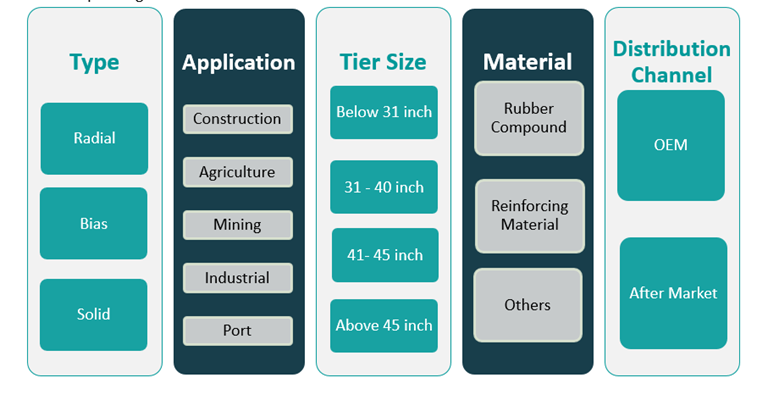
Market Drivers:
Growth in Infrastructure Development
One of the key drivers of the Middle East Off-the-Road (OTR) tire market is the significant growth in infrastructure development. The region is witnessing an accelerated pace of urbanization, particularly in countries like Saudi Arabia, the UAE, and Qatar. These nations are investing heavily in large-scale construction projects, such as roads, bridges, and high-rise buildings. For instance, in 2024, the Abu Dhabi Executive Council approved 144 projects with a budget of USD 17.97 billion, focusing on housing, education, tourism, and natural resources, with USD 16 billion specifically allocated to housing and public facilities across the emirate. The construction industry’s reliance on heavy machinery such as bulldozers, excavators, and loaders creates a growing demand for OTR tires that can withstand the tough conditions of construction sites. As these projects progress, the need for durable tires that ensure high performance and safety across various terrains becomes paramount. The continuous expansion of infrastructure will remain a key factor driving the market's growth in the coming years.
Mining Sector Expansion
The mining sector in the Middle East is another crucial driver of the OTR tire market. The region is rich in natural resources such as oil, gas, minerals, and metals, and several countries have been focusing on diversifying their economies by expanding mining operations. Saudi Arabia, for example, has been making significant investments in its mining industry as part of the Vision 2030 initiative, which aims to reduce dependence on oil revenues. The increase in mining activities, including both surface and underground mining, requires specialized OTR tires that are designed to handle rough and rocky terrains while supporting heavy mining equipment. As the mining industry continues to grow, the demand for OTR tires designed for durability and performance in extreme conditions will rise in tandem.
Agricultural Mechanization
The shift towards agricultural mechanization is a pivotal driver for the OTR tire market in the Middle East. Many countries in the region are modernizing their agricultural practices by adopting advanced machinery like tractors, harvesters, and plows, which require high-quality tires capable of functioning in diverse field conditions. As the region focuses on improving food security and agricultural productivity, the mechanization of farming processes is becoming increasingly important. The demand for specialized OTR tires that can withstand the challenges of agricultural environments, such as uneven terrain and extreme weather conditions, is expected to grow. This transition towards more efficient agricultural practices is propelling the market for OTR tires across the region.
Technological Advancements in Tire Design
Technological innovations in tire design and manufacturing processes are playing a significant role in driving the OTR tire market in the Middle East. Manufacturers are continuously improving tire materials and designs to enhance their performance, durability, and sustainability. The development of tires with better fuel efficiency, increased longevity, and improved resistance to wear and tear is helping meet the region’s demand for more cost-effective and high-performing solutions. Additionally, the introduction of eco-friendly tires made from sustainable materials is gaining traction, as the Middle East increasingly focuses on environmental sustainability. These innovations in tire technology provide end-users with more efficient options, thereby increasing the overall adoption of OTR tires in various sectors like construction, mining, and agriculture.
Market Trends:
Advancements in Tire Technology
The Middle East Off-the-Road (OTR) tire market is witnessing significant technological advancements aimed at enhancing performance and durability. Manufacturers are increasingly integrating smart technologies into tire designs, such as embedded sensors that monitor tire pressure, temperature, and tread wear in real-time. These innovations enable predictive maintenance, reducing downtime and improving safety for heavy machinery used in construction and mining sectors. For instance, in November 2025, Galileo Wheel LTD introduced its SkidCup airless tires specifically designed for skid steers and loaders. These innovative tires eliminate puncture risks, enhance traction and stability, and reduce maintenance costs, thereby improving efficiency for construction and landscaping applications. Additionally, the development of heat-resistant and puncture-proof materials is addressing the challenges posed by the region's harsh climatic conditions, thereby extending tire lifespan and performance under extreme temperatures and rugged terrains.
Shift Towards Radial Tires
There is a noticeable shift in preference from bias tires to radial tires within the Middle East OTR tire market. Radial tires are gaining popularity due to their superior durability, better fuel efficiency, and enhanced load-carrying capacity. For example, the Saudi Arabia OTR Tire Market reports that the radial tire type holds a higher market share, as these tires offer enhanced performance and durability, making them the preferred choice in mining, construction, and agriculture applications. This transition is particularly evident in sectors such as mining and construction, where heavy-duty equipment demands high-performance tires. The adoption of radial tires is also driven by their ability to withstand the abrasive and challenging environments typical of the Middle East, offering a more cost-effective solution in the long term despite their higher initial investment.
Emphasis on Sustainability
Sustainability is becoming a central focus in the Middle East OTR tire market. Manufacturers are increasingly adopting eco-friendly practices, including the use of sustainable materials in tire production and the promotion of tire retreading to extend product life cycles. These initiatives are in response to growing environmental concerns and regulatory pressures aimed at reducing carbon footprints. The emphasis on sustainability is also influencing consumer preferences, with a rising demand for products that align with environmental stewardship, prompting companies to innovate and offer more sustainable tire solutions.
Growth of E-Commerce Platforms
The expansion of e-commerce platforms is reshaping the distribution channels in the Middle East OTR tire market. Consumers and businesses are increasingly turning to online platforms for purchasing tires, attracted by the convenience, competitive pricing, and broader selection available. This trend is prompting traditional tire retailers and manufacturers to enhance their online presence and digital marketing strategies to cater to the evolving consumer behavior. The growth of e-commerce is not only facilitating easier access to OTR tires but also fostering a more competitive market environment, driving companies to improve service offerings and customer engagement.
Market Challenges Analysis:
High Initial Costs
One of the primary challenges in the Middle East Off-the-Road (OTR) tire market is the high initial cost associated with high-performance OTR tires. For instance, manufacturers like Galileo Wheel LTD have introduced advanced products such as the SkidCup airless tires, which, while offering benefits like puncture elimination and reduced maintenance, require a significant upfront investment due to their innovative design and materials. While these tires offer superior durability, safety, and efficiency, their upfront cost can be a significant barrier for many businesses, particularly small and medium-sized enterprises (SMEs) operating in construction, mining, and agriculture. The price of high-quality tires can be prohibitive, leading some companies to opt for cheaper alternatives that may not perform as well or last as long. This cost sensitivity can slow market growth, particularly in price-sensitive sectors.
Availability of Suitable Infrastructure
Despite substantial investments in infrastructure development in the region, there are still challenges related to the availability and maintenance of suitable infrastructure for OTR tire usage. Many regions, particularly remote mining areas and rural agricultural zones, face issues with poor road conditions and inadequate tire service networks. These factors can cause increased tire wear and frequent maintenance needs, reducing the operational efficiency of vehicles and machinery. Inadequate infrastructure hinders the performance and lifespan of OTR tires, which can result in higher operational costs for businesses in the long term.
Limited Recycling and Disposal Systems
The Middle East faces limitations in its tire recycling and disposal systems, creating environmental concerns and regulatory challenges. As the demand for OTR tires grows, the disposal of used tires becomes increasingly problematic. With insufficient recycling facilities in many parts of the region, the accumulation of worn-out tires can lead to environmental pollution and increased waste management costs. Moreover, governments are beginning to impose stricter environmental regulations, which may increase compliance costs for manufacturers and end-users, further restricting market growth.
Supply Chain Vulnerabilities
The Middle East OTR tire market is also facing challenges related to supply chain vulnerabilities. Disruptions in the global supply chain, including delays in the delivery of raw materials, shipping constraints, and geopolitical tensions, can impact the availability of tires and tire components. These factors can lead to price fluctuations, delays in tire availability, and reduced inventory levels, which can negatively affect businesses reliant on timely and consistent tire supplies for their operations.
Market Opportunities:
The Middle East Off-the-Road (OTR) tire market presents substantial growth opportunities driven by the region's ongoing infrastructure development. As countries like Saudi Arabia and the UAE continue to invest heavily in large-scale construction and urbanization projects, there is an increasing demand for durable and high-performance OTR tires to support heavy machinery. Additionally, with the Middle East's strategic focus on diversifying economies away from oil and gas, sectors such as mining, agriculture, and tourism are becoming key growth areas. The expansion of these industries offers a significant opportunity for tire manufacturers to introduce advanced tire solutions designed to meet the unique needs of harsh environments and heavy-duty equipment. Companies that innovate in tire durability and performance, catering to these growing sectors, can capitalize on this upward trend.
Furthermore, the growing emphasis on sustainability in the Middle East presents a promising opportunity for eco-friendly OTR tires. Governments in the region are increasingly prioritizing environmental sustainability, offering incentives for the use of greener technologies and materials. Tire manufacturers that invest in sustainable practices, such as using recyclable materials and producing energy-efficient products, are likely to see higher demand for their offerings. This aligns with the rising consumer preference for environmentally friendly products, providing a competitive advantage for companies that embrace these trends. As the region moves toward more sustainable practices, there is a clear opportunity for tire manufacturers to expand their market share by aligning with the broader goals of environmental responsibility.
Market Segmentation Analysis:
The Middle East Off-the-Road (OTR) tire market is segmented into various categories, each contributing uniquely to its growth.
By type, the market is primarily divided into radial, bias, and solid tires. Radial tires dominate due to their superior durability, fuel efficiency, and load-bearing capacity, particularly in the construction and mining sectors. Bias tires remain popular for their lower initial cost but offer less durability compared to radial tires. Solid tires are gaining traction in applications where tire puncture resistance is critical, such as in port operations.
By application, the market is driven by sectors such as construction, agriculture, mining, industrial, and port operations. The construction industry is the largest consumer of OTR tires, driven by heavy machinery usage in infrastructure projects. The agricultural sector is growing with mechanization, increasing the demand for specialized tires for farm machinery. Mining activities, particularly in countries like Saudi Arabia, are pushing the demand for durable tires suited for harsh terrains. The industrial and port sectors also contribute significantly, requiring tires capable of supporting heavy-duty equipment.
By tire size, the market is segmented into below 31 inches, 31-40 inches, 41-45 inches, and above 45 inches. The 31-40-inch category is the largest due to its widespread use in heavy construction and mining machinery.
By material segment includes rubber compounds, reinforcing materials, and others, with rubber compounds being the dominant component for its elasticity and durability.
By distribution channels into OEM and after-market segments, with OEM sales leading in terms of volume, as new machinery often requires original tires.
Segmentation:
By Type Segment
- Radial
- Bias
- Solid
By Application Segment
- Construction
- Agriculture
- Mining
- Industrial
- Port
By Tire Size Segment
- Below 31 inch
- 31 - 40 inch
- 41 - 45 inch
- Above 45 inch
By Material Segment
- Rubber Compound
- Reinforcing Material
- Others
By Distribution Channel Segment
- OEM
- After Market
Regional Analysis:
The Middle East Off-the-Road (OTR) tire market exhibits varied dynamics across its key regions, with growth largely driven by infrastructure development, mining activities, and agriculture. The regional market is dominated by the Gulf Cooperation Council (GCC) countries, which include Saudi Arabia, the UAE, Qatar, Oman, Kuwait, and Bahrain. These countries collectively account for a significant share of the market due to their rapid urbanization, large-scale construction projects, and mining sector expansion. As of the latest reports, the GCC countries hold approximately 60-65% of the market share, with Saudi Arabia and the UAE being the largest contributors.
Gulf Cooperation Council (GCC)
The GCC region continues to lead the Middle East OTR tire market, driven by significant infrastructure projects such as the development of new cities, highways, and bridges. Saudi Arabia’s Vision 2030 and the UAE’s efforts to diversify its economy are fostering massive investments in the construction and mining sectors. In addition, the UAE’s growing port operations and logistics industry are creating a steady demand for OTR tires. The GCC region’s market is expected to grow at a CAGR of approximately 5.5% during the forecast period, maintaining its dominance in the market due to its substantial investments in infrastructure and industrial development.
Rest of the Middle East
In addition to the GCC, the broader Middle East region, which includes countries like Iraq, Iran, Turkey, and Egypt, is showing growing demand for OTR tires. Although these regions currently represent a smaller portion of the overall market, they are experiencing steady growth, particularly in the mining and agricultural sectors. These countries are focusing on infrastructure development and increasing agricultural mechanization, which is boosting the demand for OTR tires. The rest of the Middle East holds about 35-40% of the market share, and this segment is expected to grow at a slightly higher rate of approximately 6% annually.
North Africa
Although technically outside the traditional Middle East, North African countries such as Algeria, Tunisia, and Morocco are contributing to the regional demand for OTR tires. The mining sector in these countries, particularly in phosphate and mineral extraction, is driving the demand for robust OTR tires. The North African market represents a smaller portion of the regional market share but is anticipated to grow steadily as mining and infrastructure projects gain momentum.
Key Player Analysis:
- Bridgestone
- Michelin
- Goodyear
- Yokohama Tire
- China National Tire & Rubber
- MRF
- Continental AG
- Belshina
- Cheng-Shin Rubber
- Eurotire
Competitive Analysis:
The Middle East Off-the-Road (OTR) tire market is highly competitive, with key players focusing on product innovation, technological advancements, and expanding their regional presence. Major global tire manufacturers such as Michelin, Bridgestone, Goodyear, and Continental dominate the market, leveraging their extensive distribution networks and strong brand recognition. These companies are continually investing in research and development to improve tire durability, fuel efficiency, and environmental sustainability, which are critical factors for customers in industries like construction, mining, and agriculture. In addition to global players, regional manufacturers are gaining ground by offering competitive pricing and products tailored to the specific needs of the Middle Eastern market. Companies like Al Dobowi Group and Gulf OTR are capitalizing on their local expertise to better serve the demand for durable tires suited to the harsh climate and rough terrains of the region. The market’s competitive landscape is expected to remain dynamic, with new entrants focusing on cost-effective and specialized tire solutions.
Recent Developments:
- In November 2024, Saudi Arabia’s Black Arrow Tire Co. entered into a significant partnership with Thailand’s Golden Star Rubber to establish the Middle East's largest tire manufacturing facility in Yanbu. This collaboration involves an investment of USD 470 million and aims to produce 6 million tires annually, including off-the-road (OTR) tires for trucks and buses, marking a major step in expanding local production capacity and meeting the region’s growing demand for OTR tires.
- In October 2023, Goodyear launched its second-generation KMAX S EXTREME GEN2 on-road long-haul tires, developed to meet the requirements of hot-climate countries in the Middle East and Africa. This product launch supports fleet customers in achieving better cost efficiency and tire performance under extreme temperature conditions, reflecting the company’s focus on innovation for regional challenges.
- On February 3, 2025, Goodyear completed the sale of its off-the-road (OTR) tire business to Yokohama Rubber for $905 million. This divestiture is part of Goodyear’s strategy to streamline its portfolio and focus on core products and services. The OTR business covered tires for mining, construction, quarry, and industrial markets, and its sale marks a significant shift in Goodyear’s global strategy.
Market Concentration & Characteristics:
The Middle East Off-the-Road (OTR) tire market is moderately concentrated, with a few major international players dominating the landscape. Global tire manufacturers, including Michelin, Bridgestone, Goodyear, and Continental, hold significant market shares due to their established reputation, advanced technology, and extensive distribution networks. However, local players like Al Dobowi Group and Gulf OTR are carving out a niche by offering region-specific solutions tailored to the demanding conditions of the Middle East. The market is characterized by intense competition in terms of product innovation, particularly regarding tire durability, performance, and cost-efficiency. Companies are increasingly focusing on sustainability, incorporating eco-friendly materials and manufacturing processes to meet regulatory requirements and customer demand. The market is also influenced by large infrastructure projects, mining expansion, and agricultural mechanization, which contribute to a steady demand for specialized OTR tire solutions.
Report Coverage:
The research report offers an in-depth analysis based on Type, Application, Tire Size, Material and Distribution Channel It details leading market players, providing an overview of their business, product offerings, investments, revenue streams, and key applications. Additionally, the report includes insights into the competitive environment, SWOT analysis, current market trends, as well as the primary drivers and constraints. Furthermore, it discusses various factors that have driven market expansion in recent years. The report also explores market dynamics, regulatory scenarios, and technological advancements that are shaping the industry. It assesses the impact of external factors and global economic changes on market growth. Lastly, it provides strategic recommendations for new entrants and established companies to navigate the complexities of the market.
Future Outlook:
- The Middle East OTR tire market is expected to grow at a steady CAGR, driven by increasing infrastructure development across the region.
- The rise in mining activities, particularly in Saudi Arabia and the UAE, will continue to fuel demand for heavy-duty tires.
- Technological advancements in tire durability, fuel efficiency, and performance will remain a key market trend.
- The shift towards radial tires over bias tires will gain momentum due to better longevity and load-bearing capacity.
- The agricultural sector’s mechanization will significantly contribute to the demand for specialized OTR tires.
- The introduction of eco-friendly OTR tires will become more prevalent, driven by regulatory pressures and sustainability trends.
- E-commerce platforms will expand, offering greater accessibility and competitive pricing for OTR tires.
- Increased investments in port infrastructure will boost demand for solid tires due to their puncture-resistant properties.
- Manufacturers will focus on enhancing tire life cycles through retreading services and improved recycling solutions.
- GCC countries will remain the dominant market players, with growing contributions from emerging markets in North Africa.

Request a Free Sample
Fill in your details and we'll send you a free sample report.
- Sample data tables & charts
- Research methodology
Market Dynamics
Growth in Infrastructure Development
Massive investments in infrastructure projects across the Middle East, especially in Saudi Arabia, the UAE, and Qatar, are driving demand for OTR tires as heavy machinery is required for construction of roads, bridges, and urban developments.
Mining Sector Expansion
The region's focus on diversifying economies and increasing mining activities, particularly in Saudi Arabia under Vision 2030, is boosting the need for durable OTR tires capable of withstanding harsh, rocky terrains and supporting heavy mining equipment.
Agricultural Mechanization
Modernization of agriculture through increased use of tractors, harvesters, and other machinery is fueling demand for specialized OTR tires that can perform reliably in challenging field conditions and extreme climates.
Technological Advancements in Tire Design
Innovations such as smart sensors, eco-friendly materials, and improved tire structures are enhancing durability, efficiency, and sustainability, making OTR tires more attractive for end-users in construction, mining, and agriculture.
Emphasis on Sustainability and Local Production
Rising environmental regulations and consumer preference for sustainable products, along with investments in local tire manufacturing facilities, are encouraging the adoption of eco-friendly OTR tires and reducing reliance on imports.
Need a Custom Version of This Report?
Tailor the scope, geography, or segments to your exact requirements.
- Custom geography or segment scope
- Direct access to our analyst team
Frequently Asked Questions
What is the current size of the Middle East Off the Road Tire market?
What factors are driving the growth of the Middle East Off the Road Tire market?
What are some challenges faced by the Middle East Off the Road Tire market?
Who are the major players in the Middle East Off the Road Tire market?
Table of Content
Chapter 1 Market Segmentation
- 1.1 Segmentation Framework
- 1.1.1 Product and Service Classification
- 1.1.2 Application and End-Use Classification
- 1.1.3 Technology and Solution Classification
- 1.1.4 Customer and Distribution Channel Classification
- 1.1.5 Geographic Segmentation
- 1.1.6 Market Segment Definitions and Boundaries
- 1.2 By Type
- 1.2.1 Radial
- 1.2.2 Bias
- 1.2.3 Solid
- 1.3 By Tire Size
- 1.3.1 Below 31 inch
- 1.3.2 31 - 40 inch
- 1.3.3 41 - 45 inch
- 1.3.4 Above 45 inch
- 1.4 By Application
- 1.4.1 Construction
- 1.4.2 Agriculture
- 1.4.3 Mining
- 1.4.4 Industrial
- 1.4.5 Port
Chapter 2 Introduction
- 2.1 Report Objectives and Scope
- 2.2 Product Definition and Industry Terminology
- 2.3 Market Inclusions and Exclusions
- 2.4 Research Process
- 2.4.1 Primary Research and Expert Interviews
- 2.4.2 Secondary Research and Source Review
- 2.4.3 Top-Down and Bottom-Up Estimation
- 2.4.4 Data Triangulation and Verification
- 2.5 Market Size Measurement Basis
- 2.5.1 2023: USD 378.36 million → 2032: USD 452.53 million
- 2.6 Historical and Forecast Reference Periods
- 2.6.1 Base Year: 2023
- 2.6.2 Forecast Period: 2023-2032
- 2.7 Research Assumptions and Limitations
Chapter 3 Executive Summary
- 3.1 Market Snapshot and Key Findings
- 3.2 Base-Year Market Size, 2023
- 3.3 Forecast Market Size, 2032
- 3.4 Revenue and Volume Growth Outlook
- 3.5 Key Demand and Supply Indicators
- 3.6 Leading Market Segments
- 3.7 Fastest-Growing Market Opportunities
- 3.8 Regional Performance Highlights
- 3.9 Technology and Industry Transformation
- 3.10 Competitive Landscape Summary
- 3.11 Analyst View and Strategic Implications
Chapter 4 Middle East Off-the-Road Tire Market Trends and Developments
- 4.1 Historical Industry Development
- 4.2 Recent Market Trends and Developments
- 4.3 Demand and Customer Behavior Trends
- 4.4 Technology and Product Innovation
- 4.5 Artificial Intelligence, Automation and Digitalization
- 4.6 Local Manufacturing and Supply Chain Realignment
- 4.7 Industry Partnerships, Mergers and Acquisitions
- 4.8 Sustainability and Circular Economy Developments
- 4.9 Government and Private Sector Investment Trends
- 4.10 Emerging Business Models and Commercialization
- 4.11 Industry Developments and Announcements
Chapter 5 Middle East Off-the-Road Tire Market Production, Supply and Demand Analysis
- 5.1 Demand Trend and Consumption Analysis
- 5.2 Demand Forecast, 2023-2032
- 5.3 Production and Output Trend
- 5.4 Production and Output Forecast, 2023-2032
- 5.5 Installed Capacity and Capacity Utilization
- 5.6 Company-Wise Production Plants and Statistics
- 5.6.1 Installed Production Capacity
- 5.6.2 Actual Production
- 5.6.3 Planned Capacity and Expansion Targets
- 5.7 Supply Chain Structure and Procurement Trends
- 5.8 Supply-Demand Gap and Bottlenecks
- 5.9 Import Dependence and Sourcing Structure
- 5.10 Contract Manufacturing and Outsourcing
- 5.11 Regional Supply and Demand Concentration
Chapter 6 Middle East Off-the-Road Tire Market Pricing Analysis
- 6.1 Pricing Structure and Measurement
- 6.2 Historical Pricing Trends
- 6.3 Pricing Outlook, 2023-2032
- 6.4 Average Selling Price and Unit Economics
- 6.5 Pricing by Product and Market Segment
- 6.6 Geographic Pricing Differences
- 6.7 Key Input, Energy, Labor and Logistics Costs
- 6.8 Contract Pricing and Purchasing Models
- 6.9 Pricing Sensitivity and Competitive Positioning
- 6.10 Price, Margin and Profitability Implications
Chapter 7 Middle East Off-the-Road Tire Market Dynamics
- 7.1 Market Growth Drivers
- 7.1.1 Demand-Side Drivers
- 7.1.2 Technology and Innovation Drivers
- 7.1.3 Infrastructure and Investment Drivers
- 7.1.4 Regulatory and Policy Drivers
- 7.2 Market Restraints
- 7.2.1 Cost and Affordability Constraints
- 7.2.2 Technology and Adoption Barriers
- 7.2.3 Supply Chain and Operational Constraints
- 7.3 Market Challenges
- 7.3.1 Competitive Pressure and Margin Erosion
- 7.3.2 Skills, Infrastructure and Implementation Gaps
- 7.4 Emerging Market Opportunities
- 7.5 Market Dynamics Impact and Time-Horizon Assessment
Chapter 8 Middle East Off-the-Road Tire Value Chain Analysis
- 8.1 Industry Value Chain Overview
- 8.2 Upstream Suppliers and Critical Inputs
- 8.3 Technology and Component Providers
- 8.4 Manufacturing or Service Delivery
- 8.5 Distribution, Channel Partners and Integrators
- 8.6 Downstream Applications and End Users
- 8.7 Value Addition and Profit Pools
- 8.8 Vertical Integration and Outsourcing
- 8.9 Supplier Concentration and Risk
- 8.10 Supply Chain Localization and Resilience
Chapter 9 Middle East Off-the-Road Tire Market Regulations and Policies
- 9.1 Relevant Laws, Standards and Compliance Frameworks
- 9.2 Product, Service, Safety and Quality Requirements
- 9.3 Government Policies, Incentives and Subsidies
- 9.4 Imports, Exports and Trade Barriers
- 9.5 Public Procurement and Local Content Requirements
- 9.6 Environmental and Sustainability Compliance
- 9.7 Upcoming Policy Changes and Market Implications
Chapter 10 Middle East Off-the-Road Tire Market Hotspots and Opportunities
- 10.1 Market Opportunity Mapping and Growth Hotspots
- 10.2 High-Growth Applications and Customer Groups
- 10.3 Underserved Markets and White-Space Opportunities
- 10.4 Emerging Technology and Product Opportunities
- 10.5 New Capacity and Investment Hotspots
- 10.6 Market Entry and Expansion Opportunities
- 10.7 Distribution and Partnership Opportunities
- 10.8 Near-Term and Long-Term Commercial Potential
- 10.9 Opportunity Attractiveness and Execution Risks
Chapter 11 Middle East Off-the-Road Tire Market Outlook, 2023-2032
- 11.1 Market Size and Analysis
- 11.1.1 Revenue (Market Measurement: 2023: USD 378.36 million → 2032: USD 452.53 million)
- 11.1.2 Market Volume and Quantity Sold
- 11.1.3 Historical Market Size
- 11.1.4 Base-Year Market Size, 2023
- 11.2 Market Forecast, 2023-2032
- 11.2.1 Revenue Forecast to 2032
- 11.2.2 Volume Forecast to 2032
- 11.2.3 CAGR and Year-on-Year Growth
- 11.2.4 Incremental Revenue Opportunity
- 11.3 Forecast Assumptions and Scenario Analysis
- 11.3.1 Base-Case Forecast
- 11.3.2 Optimistic and Conservative Scenarios
- 11.3.3 Technology, Pricing and Policy Sensitivities
- 11.4 Market Attractiveness and Growth Outlook
Chapter 12 Middle East Off-the-Road Tire Market Segmentation and Outlook
- 12.1 Segmentation Summary and Market Shares, 2023
- 12.2 Largest and Fastest-Growing Segments
- 12.3 By Type - Market Size and Forecast, 2023-2032
- 12.3.1 Segment Definition and Scope
- 12.3.2 Historical Market Size
- 12.3.3 Revenue Forecast, 2023-2032
- 12.3.4 Volume Forecast, 2023-2032
- 12.3.5 Base-Year Market Share, 2023
- 12.3.6 Segment CAGR and Growth Drivers
- 12.3.7 Subsegment Market Size and Forecast
- 12.3.7.1 Radial
- 12.3.7.2 Bias
- 12.3.7.3 Solid
- 12.3.8 Subsegment Pricing and Adoption Trends
- 12.3.9 Leading Suppliers and Competition
- 12.3.10 Regional Demand and Opportunities
- 12.4 By Tire Size - Market Size and Forecast, 2023-2032
- 12.4.1 Segment Definition and Scope
- 12.4.2 Historical Market Size
- 12.4.3 Revenue Forecast, 2023-2032
- 12.4.4 Volume Forecast, 2023-2032
- 12.4.5 Base-Year Market Share, 2023
- 12.4.6 Segment CAGR and Growth Drivers
- 12.4.7 Subsegment Market Size and Forecast
- 12.4.7.1 Below 31 inch
- 12.4.7.2 31 - 40 inch
- 12.4.7.3 41 - 45 inch
- 12.4.7.4 Above 45 inch
- 12.4.8 Subsegment Pricing and Adoption Trends
- 12.4.9 Leading Suppliers and Competition
- 12.4.10 Regional Demand and Opportunities
- 12.5 By Application - Market Size and Forecast, 2023-2032
- 12.5.1 Segment Definition and Scope
- 12.5.2 Historical Market Size
- 12.5.3 Revenue Forecast, 2023-2032
- 12.5.4 Volume Forecast, 2023-2032
- 12.5.5 Base-Year Market Share, 2023
- 12.5.6 Segment CAGR and Growth Drivers
- 12.5.7 Subsegment Market Size and Forecast
- 12.5.7.1 Construction
- 12.5.7.2 Agriculture
- 12.5.7.3 Mining
- 12.5.7.4 Industrial
- 12.5.7.5 Port
- 12.5.8 Subsegment Pricing and Adoption Trends
- 12.5.9 Leading Suppliers and Competition
- 12.5.10 Regional Demand and Opportunities
- 12.6 Segment Growth Comparison
- 12.7 Segment Attractiveness and Priority Matrix
Chapter 13 Middle East Off-the-Road Tire End-Use and Application Market Outlook
- 13.1 End-Use Industry and Customer Demand Structure
- 13.2 Leading Applications and Customer Groups
- 13.3 End-Use Market Size, Share and Forecast
- 13.4 Major End-Use Industry Deep Dives
- 13.4.1 Customer Requirements and Use Cases
- 13.4.2 Demand and Replacement Cycles
- 13.4.3 Technical and Regulatory Considerations
- 13.4.4 Purchasing and Procurement Models
- 13.4.5 Leading Vendors and Distribution Channels
- 13.4.6 Forecast and Commercial Opportunities
- 13.5 Emerging Applications and Cross-Segment Demand
- 13.6 End-Use Industry Investment Priorities
Chapter 14 Middle East Off-the-Road Tire Geographic Market Outlook, 2023-2032
- 14.1 Regional Market Size and Country-Level Shares, 2023
- 14.2 Country Market Size Comparison, 2023
- 14.3 Country Market Forecasts, 2023-2032
- 14.4 Subregional Industrial and Demand Clusters
- 14.5 Intra-Regional Pricing and Cost Differences
- 14.6 Cross-Border Trade and Supply Networks
- 14.7 Regional Supply and Demand Balances
- 14.8 Country Opportunity Comparison and Prioritization
Note: Every listed country is covered on the structure shown under the first country.
Chapter 15 Middle East Off-the-Road Tire Technology, Innovation and Sustainability Outlook
- 15.1 Technology Landscape and Maturity
- 15.2 Product, Process and Service Innovation
- 15.3 AI, Automation and Digital Tools in the Industry
- 15.4 Technology Adoption and Performance Benchmarking
- 15.5 Innovation Pipeline and R&D Investment
- 15.6 Patent and Intellectual Property Trends
- 15.7 Energy Efficiency and Resource Management
- 15.8 Sustainability, Recycling and Circularity
- 15.9 Technology Roadmap, 2023-2032
- 15.10 Risks of Obsolescence and Technology Substitution
Chapter 16 Middle East Off-the-Road Tire Market Key Strategic Imperatives
- 16.1 Growth and Market Entry Priorities
- 16.2 High-Return Products and Segments
- 16.3 Pricing, Profitability and Cost Optimization
- 16.4 Technology Investment and Product Differentiation
- 16.5 Supply Chain Localization and Resilience
- 16.6 Distribution and Customer Acquisition
- 16.7 Partnership, Acquisition and Capacity Strategy
- 16.8 Regional Expansion Priorities
- 16.9 Short-, Medium- and Long-Term Actions
Chapter 17 Competition Outlook
- 17.1 Industry Competition Characteristics
- 17.2 Market Structure and Concentration
- 17.3 Market Share and Competitive Positioning, 2023
- 17.4 Company-Wise Revenue and Product Benchmarking
- 17.5 Production and Service Capacity Benchmarking
- 17.6 Technology, Pricing and Differentiation
- 17.7 Regional Footprint and Distribution Strength
- 17.8 Mergers, Acquisitions and Strategic Alliances
- 17.9 New Entrants and Competitive Threats
- 17.10 Porter's Five Forces and Industry Attractiveness
- 17.11 Competitive Outlook, 2023-2032
Chapter 18 Company Profiles
- 18.1 Company Coverage and Selection Criteria
- 18.2 Bridgestone
- 18.2.1 Business Description
- 18.2.2 Company Ownership and Geographic Presence
- 18.2.3 Product and Service Portfolio
- 18.2.4 Manufacturing and Operating Footprint
- 18.2.5 Production Capacity and Expansion Plans
- 18.2.6 Financial Performance and Investment
- 18.2.7 Market Share and Competitive Position
- 18.2.8 Technology and Innovation Capabilities
- 18.2.9 Strategic Alliances or Partnerships
- 18.2.10 Recent Developments
- 18.2.11 Growth Strategy and Outlook
- 18.3 Michelin
- 18.4 Goodyear
- 18.5 Yokohama Tire
- 18.6 China National Tire & Rubber
- 18.7 MRF
- 18.8 Continental AG
- 18.9 Belshina
- 18.10 Cheng-Shin Rubber
- 18.11 Eurotire
- 18.12 Other Relevant Market Participants
Note: Every listed company is profiled on the structure shown under the first company. The company list is preliminary and may change based on research findings, market developments, data availability and client requirements.
Chapter 19 Disclaimer
- 19.1 Research and Forecast Disclaimer
- 19.2 Data Source and Estimation Limitations
Note: The depth of individual sections depends on data availability for this market. Volume, capacity, trade and other unit-based metrics are included where applicable.