| REPORT ATTRIBUTE | DETAILS |
|---|---|
| Historical Period | 2019-2022 |
| Base Year | 2023 |
| Forecast Period | 2024-2032 |
| Multi-Head Filling Machines Market Size 2024 | USD 4025 Million |
| Multi-Head Filling Machines Market, CAGR | 6% |
| Multi-Head Filling Machines Market Size 2032 | USD 6415.23 Million |
Market Overview:
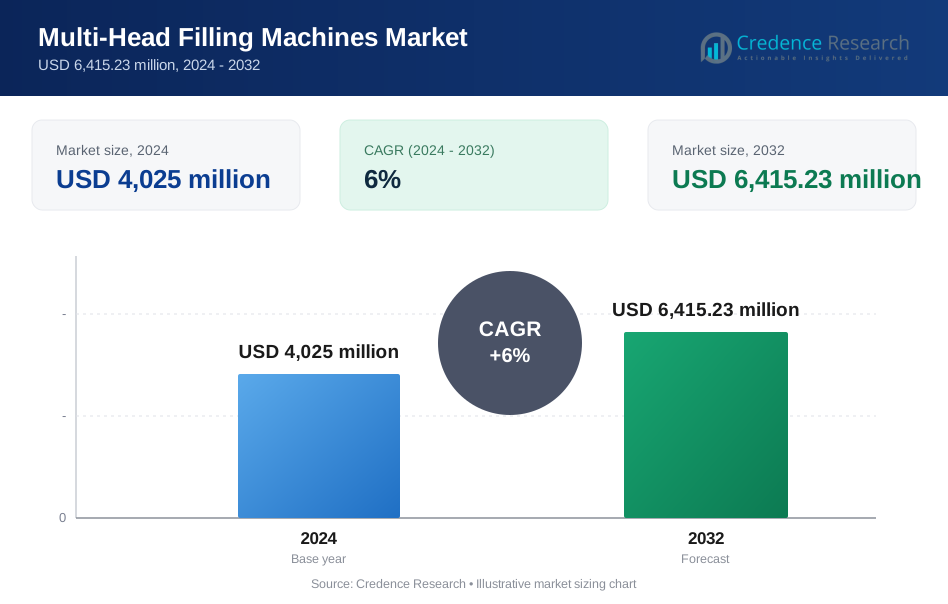
The Multi-Head Filling Machines Market is projected to grow from USD 4025 million in 2024 to an estimated USD 6415.23 million by 2032, with a compound annual growth rate (CAGR) of 6% from 2024 to 2032.
The growth of the multi-head filling machines market is fueled by several key drivers. The increasing demand for efficient packaging solutions, driven by the expansion of the food and beverage and pharmaceutical sectors, is a primary growth catalyst. The rising need for enhanced production speeds and reduced operational costs is pushing manufacturers to invest in advanced filling technologies. Additionally, the growing emphasis on product consistency and hygiene, especially in regulated industries like pharmaceuticals and food, has led to greater adoption of automated multi-head filling machines. Technological advancements, such as the integration of IoT and AI for predictive maintenance and real-time monitoring, are further propelling market growth by ensuring operational efficiency and minimizing downtime.
Regionally, North America dominates the market, accounting for the largest share, driven by high levels of automation in the manufacturing sector and strong demand from the food and pharmaceutical industries. Europe follows closely, supported by stringent regulations on packaging and labeling, which encourage the adoption of advanced filling technologies. The Asia-Pacific region is the fastest-growing market, fueled by rapid industrialization, the expansion of the food and beverage sector, and rising demand for cost-effective packaging solutions in countries like China and India. Emerging markets in Latin America and the Middle East & Africa are also witnessing steady growth, attributed to improving manufacturing infrastructure and increasing investments in automation.
Market Insights:
- The market is projected to grow from USD 4,025 million in 2024 to USD 6,415.23 million by 2032, registering a CAGR of 6%, driven by increased automation in packaging.
- Growth in the food and beverage sector, driven by consumer demand for high-quality packaged goods, is a key factor propelling market expansion.
- IoT and AI integration in filling machines enhances operational efficiency, predictive maintenance, and real-time monitoring, reducing downtime and operational costs.
- North America dominates the market, accounting for the largest share due to automation advancements and strong demand from the food and pharmaceutical sectors.
- Asia-Pacific is the fastest-growing region, fueled by rapid industrialization, rising demand for cost-effective solutions, and expansion in countries like China and India.
- Stringent regulations in pharmaceuticals and food industries drive the adoption of advanced filling technologies for compliance with hygiene and safety standards.
- Emerging markets in Latin America and the Middle East & Africa show steady growth, supported by improving infrastructure and rising investments in automation.
Market Drivers:
Increasing Demand for Automation in Manufacturing
The rising adoption of automation in manufacturing processes is a primary driver of the multi-head filling machines market. Industries such as food and beverage, pharmaceuticals, and cosmetics are increasingly integrating automated filling machines to enhance efficiency, precision, and productivity. Automation reduces human intervention, minimizing errors and ensuring consistency in production, which is critical for maintaining product quality and adhering to regulatory standards. For instance, Tetra Pak's A3/Speed filling machine can fill up to 12,000 packages per hour, significantly enhancing production efficiency. Additionally, automated filling machines offer flexibility in handling various product types, including liquids, semi-liquids, and granules, making them indispensable in modern manufacturing facilities.
Growth of the Food and Beverage Industry
The expansion of the food and beverage industry is significantly fueling the demand for multi-head filling machines. As consumers demand higher-quality and hygienically packaged products, manufacturers are turning to advanced filling technologies to meet these expectations. Multi-head filling machines enable faster and more accurate packaging, addressing the need for mass production while ensuring product safety and consistency. For example, Krones' Contiform Bloc system integrates blow molding, filling, and capping processes, achieving an output of up to 81,000 bottles per hour. The growth of ready-to-eat meals, beverages, and packaged foods has further intensified the need for efficient and versatile filling solutions, driving market growth.
Advancements in Filling Technologies
Technological advancements in multi-head filling machines are playing a pivotal role in market growth. Innovations such as IoT-enabled devices, AI-powered predictive maintenance, and real-time monitoring systems have enhanced the operational efficiency and reliability of these machines. For instance, Bosch Packaging Technology's ALF 5000 filling and closing machine features IoT connectivity, enabling real-time monitoring and predictive maintenance, which reduces downtime. These advancements allow manufacturers to optimize production processes, reduce downtime, and lower operational costs. Furthermore, the development of energy-efficient and eco-friendly filling machines aligns with global sustainability goals, making them a preferred choice among environmentally conscious manufacturers.
Stringent Regulatory Requirements in Key Industries
Stringent regulations regarding product packaging and labeling in industries such as pharmaceuticals and food have driven the adoption of multi-head filling machines. These machines ensure compliance with hygiene and safety standards by minimizing contamination risks and maintaining product integrity during the filling process. For example, the Romaco Macofar LF 200 liquid filling machine complies with stringent pharmaceutical regulations, ensuring precise filling and capping of sterile products. The ability of these machines to meet precise filling requirements, even for highly sensitive products, has positioned them as critical components in regulated industries. As regulatory frameworks become increasingly stringent, manufacturers are investing in advanced filling technologies to ensure compliance and maintain a competitive edge.
Market Trends:
Integration of Smart Technologies
The integration of smart technologies such as IoT and AI is revolutionizing the multi-head filling machines market. Manufacturers are increasingly adopting IoT-enabled systems that allow real-time monitoring of machine performance, enabling predictive maintenance and minimizing downtime. AI-powered solutions are also enhancing the precision and adaptability of filling processes, particularly in handling complex product formulations. For instance, PDM Makina has introduced IoT-enabled filling machines that facilitate real-time monitoring and predictive maintenance, achieving reduction in downtime. These technologies provide actionable insights, optimize production efficiency, and reduce operational costs. The rising demand for smart factories and Industry 4.0 solutions is further driving the adoption of technologically advanced filling machines, making them a cornerstone of modern manufacturing processes.
Customization and Flexibility in Filling Solutions
The market is witnessing a growing trend toward customization and flexibility in multi-head filling machines. Industries require machines that can handle diverse product types, packaging formats, and production volumes. In response, manufacturers are offering modular designs and multi-functional capabilities that cater to specific industry needs. For instance, Filsilpek Group offers customizable bottle filling systems with modular designs that enable quick changeovers between various container shapes and sizes. Customizable features, such as programmable filling heads and adjustable speed settings, are becoming standard, allowing companies to adapt quickly to changing consumer demands and market conditions.
Sustainability and Eco-Friendly Packaging
Sustainability has emerged as a key trend shaping the multi-head filling machines market. With increasing environmental concerns and stricter regulations, manufacturers are focusing on developing energy-efficient machines that support eco-friendly packaging materials. The adoption of lightweight and biodegradable packaging has created demand for filling machines that can handle these materials without compromising efficiency. For instance, PDM Makina's filling machines incorporate energy-efficient motors and optimized heating systems, cutting energy consumption. Additionally, advancements in energy-efficient motors and components are reducing the carbon footprint of these machines, aligning with global sustainability initiatives. This trend is particularly strong in regions like Europe, where environmental regulations are stringent and consumer awareness is high.
Growing Demand in Emerging Markets
Emerging markets such as Asia-Pacific and Latin America are witnessing a surge in demand for multi-head filling machines, driven by rapid industrialization and the expansion of the food and beverage and pharmaceutical sectors. In countries like India, China, and Brazil, the rising disposable income and changing consumer lifestyles are boosting the demand for packaged goods, thereby increasing the need for efficient filling solutions. For instance, GEA Group is addressing the rising demand for efficient filling solutions in emerging markets like India and Brazil by providing cost-effective multi-head filling machines tailored for local industries. Governments in these regions are also encouraging the adoption of advanced manufacturing technologies through initiatives aimed at industrial growth. The availability of cost-effective machines tailored for these markets is further accelerating their adoption, making emerging economies key growth drivers for the industry.
Market Challenges Analysis:
High Initial Investment Costs
One of the primary restraints in the multi-head filling machines market is the significant upfront investment required for advanced machinery. High-performance filling machines equipped with IoT and AI capabilities often come with substantial costs, including installation, customization, and training expenses. This creates a barrier for small and medium-sized enterprises (SMEs), which may struggle to allocate the necessary resources for adopting these technologies. The cost factor also extends to regular maintenance and upgrades, further limiting the adoption of these machines in cost-sensitive markets.
Complexity in Operation and Maintenance
The increasing sophistication of multi-head filling machines, while enhancing efficiency, introduces challenges related to operation and maintenance. These machines often require skilled personnel to manage programming, troubleshooting, and maintenance tasks. A shortage of trained professionals, particularly in emerging markets, can hinder the optimal utilization of these advanced systems. Additionally, operational complexity may lead to higher downtime and inefficiencies, impacting overall productivity for manufacturers unfamiliar with these technologies.
Stringent Regulatory Compliance
Compliance with stringent regulations in industries such as food, pharmaceuticals, and chemicals poses challenges for manufacturers of multi-head filling machines. These industries demand equipment that meets rigorous standards for hygiene, precision, and safety. Ensuring that machines comply with various regional and international regulations can lead to increased costs for research, testing, and certification. For manufacturers, navigating this regulatory landscape requires significant investment in resources and expertise, creating a challenge for smaller players.
Limited Adoption in Emerging Markets
While emerging markets present growth opportunities, adoption is limited due to factors such as lack of awareness, insufficient infrastructure, and constrained budgets. Many manufacturers in these regions continue to rely on traditional filling methods, perceiving advanced machines as unnecessary or unattainable. Educating stakeholders about the long-term benefits of multi-head filling machines, including improved efficiency and reduced waste, is crucial to overcoming this challenge and expanding market penetration.
Market Opportunities:
The multi-head filling machines market presents significant growth opportunities, driven by the increasing demand for automation and efficiency in manufacturing processes across various industries. The food and beverage sector, in particular, offers vast potential as manufacturers seek advanced solutions to meet the rising demand for packaged products. Multi-head filling machines, known for their precision and speed, enable companies to achieve higher production volumes while maintaining product consistency and quality. Additionally, the pharmaceutical industry’s growing need for accurate and hygienic packaging of sensitive products, such as liquid medications and powders, underscores the importance of these machines. Advancements in technology, including IoT integration and AI-powered predictive maintenance, further enhance the capabilities of these machines, positioning them as essential tools for modern manufacturing.
Emerging markets in Asia-Pacific, Latin America, and the Middle East & Africa also present untapped opportunities for market growth. Rapid industrialization, coupled with increasing investments in automation, is driving demand for efficient filling solutions in these regions. The expansion of manufacturing hubs in countries like China, India, and Brazil is creating a favorable environment for adopting multi-head filling machines. Moreover, the growing emphasis on sustainability and eco-friendly packaging is encouraging manufacturers to develop energy-efficient machines that align with global environmental standards. By addressing the unique needs of these markets and offering cost-effective, customizable solutions, manufacturers can unlock substantial growth potential and expand their global footprint in the multi-head filling machines market.
Market Segmentation Analysis:
The multi-head filling machines market is segmented based on product type, filler type, automation type, packaging capacity, end-use industry, and region, each addressing specific industry needs.
By Product Type, the market encompasses liquid, paste, powder, and granular filling machines. Liquid filling machines dominate due to their widespread application in the food & beverage and pharmaceutical sectors, while paste and powder filling machines cater to cosmetics, personal care, and industrial requirements.
By Filler Type, the segmentation includes vacuum fillers, piston fillers, spray fillers, and others. Piston fillers are widely used due to their versatility and precision in handling both liquid and semi-liquid substances, making them suitable for diverse industries.
By Automation Type, the market is categorized into automatic and semi-automatic machines. Automatic machines hold a larger market share, driven by their high efficiency and suitability for large-scale production, while semi-automatic machines are preferred by small and medium enterprises for their cost-effectiveness.
By Packaging Capacity, the segmentation covers machines designed for below 10 ml, above 10 ml up to 20 ml, and above 20 ml. The flexibility in capacity ensures their adoption across industries with varying product packaging needs.
By End Use, the market serves food & beverages, cosmetics & personal care, pharmaceuticals, chemicals & lubricants, and others. The food & beverage industry leads, driven by the rising demand for packaged goods and beverages.
Segmentation:
By Product Type:
- Liquid Filling Machine
- Paste Filling Machine
- Powder Filling Machine
- Granular Filling Machine
By Filler Type:
- Vacuum Fillers
- Piston Fillers
- Spray Fillers
- Others
By Automation Type:
- Automatic
- Semi-automatic
By Packaging capacity
- Below 10 ml
- Above 10 ml up to 20 ml
- Above 20 ml
By End Use:
- Food & Beverages
- Cosmetics & Personal Care
- Pharmaceuticals
- Chemical & Lubricants
- Others (Manufacturing, Industrial packaging, etc.)
By Region:
- North America
- U.S.
- Canada
- Mexico
- Europe
- UK
- France
- Germany
- Italy
- Spain
- Russia
- Belgium
- Netherlands
- Austria
- Sweden
- Poland
- Denmark
- Switzerland
- Rest of Europe
- Asia Pacific
- China
- Japan
- South Korea
- India
- Australia
- Thailand
- Indonesia
- Vietnam
- Malaysia
- Philippines
- Taiwan
- Rest of Asia Pacific
- Latin America
- Brazil
- Argentina
- Peru
- Chile
- Colombia
- Rest of Latin America
- Middle East
- UAE
- KSA
- Israel
- Turkey
- Iran
- Rest of Middle East
- Africa
- Egypt
- Nigeria
- Algeria
- Morocco
- Rest of Africa
Regional Analysis:
The multi-head filling machines market exhibits varied growth dynamics across different regions, driven by industry-specific demands and advancements in manufacturing technologies. North America and Europe dominate the market, while Asia-Pacific emerges as the fastest-growing region, showcasing robust potential for future expansion.
North America holds the largest share of the global market, accounting for approximately 35% of the total revenue in 2024. The region’s strong foothold in industries such as food and beverage, pharmaceuticals, and chemicals drives the demand for multi-head filling machines. High levels of automation, coupled with stringent regulatory requirements for packaging and labeling, encourage manufacturers to adopt advanced filling solutions. The United States, in particular, leads the regional market due to its well-established manufacturing sector and focus on technological innovation.
Europe follows closely, with a market share of approximately 28%. The region’s growth is propelled by strict regulations on packaging safety and sustainability, especially in the food and pharmaceutical sectors. Countries such as Germany, France, and Italy lead the market in Europe, supported by their advanced industrial infrastructure and increasing adoption of energy-efficient technologies. The push for eco-friendly packaging materials and machines also aligns with Europe’s stringent environmental regulations, further bolstering market growth.
The Asia-Pacific region is the fastest-growing market, projected to account for nearly 25% of the global revenue by 2032. Rapid industrialization, coupled with the expansion of the food and beverage and pharmaceutical sectors in countries like China, India, and Japan, drives this growth. The rising middle-class population and increasing consumer demand for packaged goods fuel the adoption of multi-head filling machines. Government initiatives promoting automation and manufacturing excellence, such as “Make in India” and “Made in China 2025,” further enhance regional opportunities.
Latin America and the Middle East & Africa collectively contribute approximately 12% of the market. These regions are witnessing steady growth, supported by improving industrial infrastructure and rising investments in automation. Brazil, South Africa, and the UAE are key contributors, driven by the growing demand for efficient filling solutions in the food and beverage and chemical industries.
Key Player Analysis:
- P. Pack Solutions
- Accutek Packaging Equipment Companies, Inc.
- All-Fill International Ltd.
- Bosch Packaging Technology
- Carbonation Techniques
- Coesia S.p.A.
- Filtec Automation Ltd.
- Fuji Machinery Co., Ltd.
- GEA Group AG
- Hassia-Redatron GmbH
- Inline Filling Systems Inc.
- Krones AG
- Mentpack Frankfurt
- PER-FIL Industries
- Ronchi Mario S.p.A.
- Serac Group
- Smurfit Kappa Group Plc.
- Tenco srl
- Tetra Pak International S.A.
- TGP Packaging Private Limited
Competitive Analysis:
The multi-head filling machines market is characterized by intense competition, with several global and regional players striving to enhance their market positions. Key companies, such as Bosch Packaging Technology, Tetra Pak International S.A., Krones AG, and Serac Group, dominate the market by offering a wide range of technologically advanced and customizable filling solutions. These companies leverage innovations such as IoT integration, AI-driven predictive maintenance, and energy-efficient designs to address evolving customer demands. For instance, Krones' Dynafill system combines filling and capping in a single unit, achieving speeds of up to 80,000 containers per hour. Regional players and emerging manufacturers are also gaining traction by providing cost-effective solutions tailored to specific industries, particularly in growing markets like Asia-Pacific and Latin America. Strategic initiatives, including mergers, acquisitions, and collaborations, are common among leading firms to expand their portfolios and market presence. Furthermore, a strong focus on sustainability and eco-friendly packaging aligns with global environmental goals, helping companies differentiate themselves in this competitive landscape.
Recent Developments:
- In Oct 2024, Coesia acquired AMC, LLC, strengthening its packaging technology portfolio.
- On November 13, 2024, Filtec successfully implemented automation technology at its distribution center, significantly boosting operational efficiency.
- During PACK EXPO International 2024, held in Chicago from October 31 to November 1, Accutek showcased its latest advancements, including multi-stroke filling machines designed to enhance precision.
Market Concentration & Characteristics:
The multi-head filling machines market is moderately fragmented, with a mix of global leaders and regional players contributing to its growth. Established companies such as Bosch Packaging Technology, Tetra Pak International S.A., and Krones AG hold significant market shares, leveraging their advanced technologies, extensive distribution networks, and brand recognition to maintain a competitive edge. These players focus on continuous innovation, offering customizable and energy-efficient solutions to meet diverse industry requirements. Regional manufacturers are steadily gaining market presence, particularly in emerging economies like Asia-Pacific and Latin America, by providing cost-effective solutions tailored to local demands. The market is characterized by rapid technological advancements, including IoT-enabled devices and AI-powered systems, driving operational efficiency and predictive maintenance capabilities. Additionally, the growing emphasis on sustainability and compliance with stringent regulatory standards has further shaped market dynamics, encouraging manufacturers to adopt eco-friendly and energy-efficient technologies.
Report Coverage:
The research report offers an in-depth analysis based on By Product Type, By Filler Type, By Automation Type, By Packaging capacity and By End Use. It details leading market players, providing an overview of their business, product offerings, investments, revenue streams, and key applications. Additionally, the report includes insights into the competitive environment, SWOT analysis, current market trends, as well as the primary drivers and constraints. Furthermore, it discusses various factors that have driven market expansion in recent years. The report also explores market dynamics, regulatory scenarios, and technological advancements that are shaping the industry. It assesses the impact of external factors and global economic changes on market growth. Lastly, it provides strategic recommendations for new entrants and established companies to navigate the complexities of the market.
Future Outlook:
- The market is expected to grow significantly, driven by increasing automation across manufacturing industries.
- Integration of IoT and AI technologies will enhance operational efficiency and predictive maintenance capabilities.
- Rising demand for packaged food and beverages will create substantial opportunities in the sector.
- Expansion of pharmaceutical production will boost the adoption of precise and hygienic filling machines.
- The Asia-Pacific region will emerge as the fastest-growing market, fueled by industrialization and automation initiatives.
- Sustainability trends will drive the development of energy-efficient and eco-friendly filling machines.
- Customization and modular designs will gain prominence to meet diverse industry-specific requirements.
- Small and medium enterprises in emerging markets will increasingly adopt cost-effective filling solutions.
- Regulatory frameworks will shape innovations, ensuring compliance with safety and quality standards.
- Collaborations and mergers among key players will strengthen technological capabilities and global market presence.
Request a Free Sample
Fill in your details and we'll send you a free sample report.
- Sample data tables & charts
- Research methodology
Market Dynamics
Rising Automation in Manufacturing
Manufacturers in food, beverage, and pharmaceutical sectors are increasingly adopting automated multi-head filling machines to boost production efficiency, reduce labor costs, and ensure consistent product quality, driving market growth.
Expansion of Food & Beverage Industry
The surge in demand for packaged and ready-to-eat foods is pushing producers to invest in high-speed, precise filling solutions, making multi-head filling machines essential for meeting large-scale production needs.
Technological Advancements (IoT & AI Integration)
The integration of IoT and AI enables predictive maintenance, real-time monitoring, and operational optimization, reducing downtime and operational costs, which encourages wider adoption of advanced filling machines.
Stringent Hygiene and Regulatory Standards
Strict regulations in the food and pharmaceutical industries require precise, contamination-free filling processes, leading companies to invest in advanced multi-head filling machines that ensure compliance and product safety.
Growth in Emerging Markets
Rapid industrialization and rising investments in automation in Asia-Pacific, Latin America, and the Middle East & Africa are creating new opportunities for multi-head filling machine adoption, especially as local manufacturers modernize their operations.
Need a Custom Version of This Report?
Tailor the scope, geography, or segments to your exact requirements.
- Custom geography or segment scope
- Direct access to our analyst team
Frequently Asked Questions
What is the projected growth of the multi-head filling machines market?
What are the key drivers of market growth?
Which region holds the largest market share?
What challenges does the market face?
Table of Content
Chapter 1 Market Segmentation
- 1.1 Segmentation Framework
- 1.1.1 Product and Service Classification
- 1.1.2 Application and End-Use Classification
- 1.1.3 Technology and Solution Classification
- 1.1.4 Customer and Distribution Channel Classification
- 1.1.5 Geographic Segmentation
- 1.1.6 Market Segment Definitions and Boundaries
- 1.2 By End Use
- 1.2.1 Food & Beverages
- 1.2.2 Pharmaceuticals
- 1.2.3 Cosmetics & Personal Care
- 1.2.4 Chemical & Lubricants
- 1.2.5 Others
- 1.3 By Filler Type
- 1.3.1 Vacuum Fillers
- 1.3.2 Piston Fillers
- 1.3.3 Spray Fillers
- 1.3.4 Others
- 1.4 By Product Type
- 1.4.1 Liquid Filling Machine
- 1.4.2 Paste Filling Machine
- 1.4.3 Powder Filling Machine
- 1.4.4 Granular Filling Machine
- 1.5 By Automation Type
- 1.5.1 Automatic
- 1.5.2 Semi-automatic
Chapter 2 Introduction
- 2.1 Report Objectives and Scope
- 2.2 Product Definition and Industry Terminology
- 2.3 Market Inclusions and Exclusions
- 2.4 Research Process
- 2.4.1 Primary Research and Expert Interviews
- 2.4.2 Secondary Research and Source Review
- 2.4.3 Top-Down and Bottom-Up Estimation
- 2.4.4 Data Triangulation and Verification
- 2.5 Market Size Measurement Basis
- 2.5.1 2024: USD 4,025 million → 2032: USD 6,415.23 million
- 2.6 Historical and Forecast Reference Periods
- 2.6.1 Base Year: 2024
- 2.6.2 Forecast Period: 2024-2032
- 2.7 Research Assumptions and Limitations
Chapter 3 Executive Summary
- 3.1 Market Snapshot and Key Findings
- 3.2 Base-Year Market Size, 2024
- 3.3 Forecast Market Size, 2032
- 3.4 Revenue and Volume Growth Outlook
- 3.5 Key Demand and Supply Indicators
- 3.6 Leading Market Segments
- 3.7 Fastest-Growing Market Opportunities
- 3.8 Regional Performance Highlights
- 3.9 Technology and Industry Transformation
- 3.10 Competitive Landscape Summary
- 3.11 Analyst View and Strategic Implications
Chapter 4 Global Multi-Head Filling Machines Market Trends and Developments
- 4.1 Historical Industry Development
- 4.2 Recent Market Trends and Developments
- 4.3 Demand and Customer Behavior Trends
- 4.4 Technology and Product Innovation
- 4.5 Artificial Intelligence, Automation and Digitalization
- 4.6 Local Manufacturing and Supply Chain Realignment
- 4.7 Industry Partnerships, Mergers and Acquisitions
- 4.8 Sustainability and Circular Economy Developments
- 4.9 Government and Private Sector Investment Trends
- 4.10 Emerging Business Models and Commercialization
- 4.11 Industry Developments and Announcements
Chapter 5 Global Multi-Head Filling Machines Market Production, Supply and Demand Analysis
- 5.1 Demand Trend and Consumption Analysis
- 5.2 Demand Forecast, 2024-2032
- 5.3 Production and Output Trend
- 5.4 Production and Output Forecast, 2024-2032
- 5.5 Installed Capacity and Capacity Utilization
- 5.6 Company-Wise Production Plants and Statistics
- 5.6.1 Installed Production Capacity
- 5.6.2 Actual Production
- 5.6.3 Planned Capacity and Expansion Targets
- 5.7 Supply Chain Structure and Procurement Trends
- 5.8 Supply-Demand Gap and Bottlenecks
- 5.9 Import Dependence and Sourcing Structure
- 5.10 Contract Manufacturing and Outsourcing
- 5.11 Regional Supply and Demand Concentration
Chapter 6 Global Multi-Head Filling Machines Market Pricing Analysis
- 6.1 Pricing Structure and Measurement
- 6.2 Historical Pricing Trends
- 6.3 Pricing Outlook, 2024-2032
- 6.4 Average Selling Price and Unit Economics
- 6.5 Pricing by Product and Market Segment
- 6.6 Geographic Pricing Differences
- 6.7 Key Input, Energy, Labor and Logistics Costs
- 6.8 Contract Pricing and Purchasing Models
- 6.9 Pricing Sensitivity and Competitive Positioning
- 6.10 Price, Margin and Profitability Implications
Chapter 7 Global Multi-Head Filling Machines Market Dynamics
- 7.1 Market Growth Drivers
- 7.1.1 Demand-Side Drivers
- 7.1.2 Technology and Innovation Drivers
- 7.1.3 Infrastructure and Investment Drivers
- 7.1.4 Regulatory and Policy Drivers
- 7.2 Market Restraints
- 7.2.1 Cost and Affordability Constraints
- 7.2.2 Technology and Adoption Barriers
- 7.2.3 Supply Chain and Operational Constraints
- 7.3 Market Challenges
- 7.3.1 Competitive Pressure and Margin Erosion
- 7.3.2 Skills, Infrastructure and Implementation Gaps
- 7.4 Emerging Market Opportunities
- 7.5 Market Dynamics Impact and Time-Horizon Assessment
Chapter 8 Global Multi-Head Filling Machines Value Chain Analysis
- 8.1 Industry Value Chain Overview
- 8.2 Upstream Suppliers and Critical Inputs
- 8.3 Technology and Component Providers
- 8.4 Manufacturing or Service Delivery
- 8.5 Distribution, Channel Partners and Integrators
- 8.6 Downstream Applications and End Users
- 8.7 Value Addition and Profit Pools
- 8.8 Vertical Integration and Outsourcing
- 8.9 Supplier Concentration and Risk
- 8.10 Supply Chain Localization and Resilience
Chapter 9 Global Multi-Head Filling Machines Market Regulations and Policies
- 9.1 Relevant Laws, Standards and Compliance Frameworks
- 9.2 Product, Service, Safety and Quality Requirements
- 9.3 Government Policies, Incentives and Subsidies
- 9.4 Imports, Exports and Trade Barriers
- 9.5 Public Procurement and Local Content Requirements
- 9.6 Environmental and Sustainability Compliance
- 9.7 Upcoming Policy Changes and Market Implications
Chapter 10 Global Multi-Head Filling Machines Market Hotspots and Opportunities
- 10.1 Market Opportunity Mapping and Growth Hotspots
- 10.2 High-Growth Applications and Customer Groups
- 10.3 Underserved Markets and White-Space Opportunities
- 10.4 Emerging Technology and Product Opportunities
- 10.5 New Capacity and Investment Hotspots
- 10.6 Market Entry and Expansion Opportunities
- 10.7 Distribution and Partnership Opportunities
- 10.8 Near-Term and Long-Term Commercial Potential
- 10.9 Opportunity Attractiveness and Execution Risks
Chapter 11 Global Multi-Head Filling Machines Market Outlook, 2024-2032
- 11.1 Market Size and Analysis
- 11.1.1 Revenue (Market Measurement: 2024: USD 4,025 million → 2032: USD 6,415.23 million)
- 11.1.2 Market Volume and Quantity Sold
- 11.1.3 Historical Market Size
- 11.1.4 Base-Year Market Size, 2024
- 11.2 Market Forecast, 2024-2032
- 11.2.1 Revenue Forecast to 2032
- 11.2.2 Volume Forecast to 2032
- 11.2.3 CAGR and Year-on-Year Growth
- 11.2.4 Incremental Revenue Opportunity
- 11.3 Forecast Assumptions and Scenario Analysis
- 11.3.1 Base-Case Forecast
- 11.3.2 Optimistic and Conservative Scenarios
- 11.3.3 Technology, Pricing and Policy Sensitivities
- 11.4 Market Attractiveness and Growth Outlook
Chapter 12 Global Multi-Head Filling Machines Market Segmentation and Outlook
- 12.1 Segmentation Summary and Market Shares, 2024
- 12.2 Largest and Fastest-Growing Segments
- 12.3 By End Use - Market Size and Forecast, 2024-2032
- 12.3.1 Segment Definition and Scope
- 12.3.2 Historical Market Size
- 12.3.3 Revenue Forecast, 2024-2032
- 12.3.4 Volume Forecast, 2024-2032
- 12.3.5 Base-Year Market Share, 2024
- 12.3.6 Segment CAGR and Growth Drivers
- 12.3.7 Subsegment Market Size and Forecast
- 12.3.7.1 Food & Beverages
- 12.3.7.2 Pharmaceuticals
- 12.3.7.3 Cosmetics & Personal Care
- 12.3.7.4 Chemical & Lubricants
- 12.3.7.5 Others
- 12.3.8 Subsegment Pricing and Adoption Trends
- 12.3.9 Leading Suppliers and Competition
- 12.3.10 Regional Demand and Opportunities
- 12.4 By Filler Type - Market Size and Forecast, 2024-2032
- 12.4.1 Segment Definition and Scope
- 12.4.2 Historical Market Size
- 12.4.3 Revenue Forecast, 2024-2032
- 12.4.4 Volume Forecast, 2024-2032
- 12.4.5 Base-Year Market Share, 2024
- 12.4.6 Segment CAGR and Growth Drivers
- 12.4.7 Subsegment Market Size and Forecast
- 12.4.7.1 Vacuum Fillers
- 12.4.7.2 Piston Fillers
- 12.4.7.3 Spray Fillers
- 12.4.7.4 Others
- 12.4.8 Subsegment Pricing and Adoption Trends
- 12.4.9 Leading Suppliers and Competition
- 12.4.10 Regional Demand and Opportunities
- 12.5 By Product Type - Market Size and Forecast, 2024-2032
- 12.5.1 Segment Definition and Scope
- 12.5.2 Historical Market Size
- 12.5.3 Revenue Forecast, 2024-2032
- 12.5.4 Volume Forecast, 2024-2032
- 12.5.5 Base-Year Market Share, 2024
- 12.5.6 Segment CAGR and Growth Drivers
- 12.5.7 Subsegment Market Size and Forecast
- 12.5.7.1 Liquid Filling Machine
- 12.5.7.2 Paste Filling Machine
- 12.5.7.3 Powder Filling Machine
- 12.5.7.4 Granular Filling Machine
- 12.5.8 Subsegment Pricing and Adoption Trends
- 12.5.9 Leading Suppliers and Competition
- 12.5.10 Regional Demand and Opportunities
- 12.6 By Automation Type - Market Size and Forecast, 2024-2032
- 12.6.1 Segment Definition and Scope
- 12.6.2 Historical Market Size
- 12.6.3 Revenue Forecast, 2024-2032
- 12.6.4 Volume Forecast, 2024-2032
- 12.6.5 Base-Year Market Share, 2024
- 12.6.6 Segment CAGR and Growth Drivers
- 12.6.7 Subsegment Market Size and Forecast
- 12.6.7.1 Automatic
- 12.6.7.2 Semi-automatic
- 12.6.8 Subsegment Pricing and Adoption Trends
- 12.6.9 Leading Suppliers and Competition
- 12.6.10 Regional Demand and Opportunities
- 12.7 Segment Growth Comparison
- 12.8 Segment Attractiveness and Priority Matrix
Chapter 13 Global Multi-Head Filling Machines End-Use and Application Market Outlook
- 13.1 End-Use Industry and Customer Demand Structure
- 13.2 Leading Applications and Customer Groups
- 13.3 End-Use Market Size, Share and Forecast
- 13.4 Major End-Use Industry Deep Dives
- 13.4.1 Customer Requirements and Use Cases
- 13.4.2 Demand and Replacement Cycles
- 13.4.3 Technical and Regulatory Considerations
- 13.4.4 Purchasing and Procurement Models
- 13.4.5 Leading Vendors and Distribution Channels
- 13.4.6 Forecast and Commercial Opportunities
- 13.5 Emerging Applications and Cross-Segment Demand
- 13.6 End-Use Industry Investment Priorities
Chapter 14 Global Multi-Head Filling Machines Geographic Market Outlook, 2024-2032
- 14.1 Regional Market Size and Share, 2024
- 14.2 Regional Market Forecast, 2024-2032
- 14.3 Regional Pricing, Production and Demand Differences
- 14.4 North America
- 14.4.1 United States
- 14.4.2 Canada
- 14.4.3 Mexico
- 14.5 Europe
- 14.5.1 Germany
- 14.5.2 France
- 14.5.3 Italy
- 14.5.4 United Kingdom
- 14.5.5 Spain
- 14.5.6 Poland
- 14.5.7 Russia
- 14.5.8 Netherlands
- 14.5.9 Belgium
- 14.5.10 Sweden
- 14.5.11 Denmark
- 14.5.12 Norway
- 14.5.13 Rest of Europe
- 14.6 Asia Pacific
- 14.6.1 China
- 14.6.2 India
- 14.6.3 Japan
- 14.6.4 South Korea
- 14.6.5 Thailand
- 14.6.6 Indonesia
- 14.6.7 Vietnam
- 14.6.8 Malaysia
- 14.6.9 Australia
- 14.6.10 Rest of Asia Pacific
- 14.7 Latin America
- 14.7.1 Brazil
- 14.7.2 Argentina
- 14.7.3 Colombia
- 14.7.4 Chile
- 14.7.5 Rest of Latin America
- 14.8 Middle East
- 14.8.1 Saudi Arabia
- 14.8.2 United Arab Emirates
- 14.8.3 Turkey
- 14.8.4 Israel
- 14.8.5 Iran
- 14.8.6 Rest of the Middle East
- 14.9 Africa
- 14.9.1 South Africa
- 14.9.2 Egypt
- 14.9.3 Nigeria
- 14.9.4 Morocco
- 14.9.5 Rest of Africa
- 14.10 Regional Investment, Policy and Supply Chain Differences
- 14.11 Regional Competitive Landscape
- 14.12 Geographic Growth Hotspots
Chapter 15 Global Multi-Head Filling Machines Technology, Innovation and Sustainability Outlook
- 15.1 Technology Landscape and Maturity
- 15.2 Product, Process and Service Innovation
- 15.3 AI, Automation and Digital Tools in the Industry
- 15.4 Technology Adoption and Performance Benchmarking
- 15.5 Innovation Pipeline and R&D Investment
- 15.6 Patent and Intellectual Property Trends
- 15.7 Energy Efficiency and Resource Management
- 15.8 Sustainability, Recycling and Circularity
- 15.9 Technology Roadmap, 2024-2032
- 15.10 Risks of Obsolescence and Technology Substitution
Chapter 16 Global Multi-Head Filling Machines Market Key Strategic Imperatives
- 16.1 Growth and Market Entry Priorities
- 16.2 High-Return Products and Segments
- 16.3 Pricing, Profitability and Cost Optimization
- 16.4 Technology Investment and Product Differentiation
- 16.5 Supply Chain Localization and Resilience
- 16.6 Distribution and Customer Acquisition
- 16.7 Partnership, Acquisition and Capacity Strategy
- 16.8 Regional Expansion Priorities
- 16.9 Short-, Medium- and Long-Term Actions
Chapter 17 Competition Outlook
- 17.1 Industry Competition Characteristics
- 17.2 Market Structure and Concentration
- 17.3 Market Share and Competitive Positioning, 2024
- 17.4 Company-Wise Revenue and Product Benchmarking
- 17.5 Production and Service Capacity Benchmarking
- 17.6 Technology, Pricing and Differentiation
- 17.7 Regional Footprint and Distribution Strength
- 17.8 Mergers, Acquisitions and Strategic Alliances
- 17.9 New Entrants and Competitive Threats
- 17.10 Porter's Five Forces and Industry Attractiveness
- 17.11 Competitive Outlook, 2024-2032
Chapter 18 Company Profiles
- 18.1 Company Coverage and Selection Criteria
- 18.2 Bosch Packaging Technology
- 18.2.1 Business Description
- 18.2.2 Company Ownership and Geographic Presence
- 18.2.3 Product and Service Portfolio
- 18.2.4 Manufacturing and Operating Footprint
- 18.2.5 Production Capacity and Expansion Plans
- 18.2.6 Financial Performance and Investment
- 18.2.7 Market Share and Competitive Position
- 18.2.8 Technology and Innovation Capabilities
- 18.2.9 Strategic Alliances or Partnerships
- 18.2.10 Recent Developments
- 18.2.11 Growth Strategy and Outlook
- 18.3 Tetra Pak International S.A.
- 18.4 Krones AG
- 18.5 Serac Group
- 18.6 Accutek Packaging Equipment Companies, Inc.
- 18.7 Coesia S.p.A.
- 18.8 GEA Group AG
- 18.9 All-Fill International Ltd.
- 18.10 Fuji Machinery Co., Ltd.
- 18.11 Inline Filling Systems Inc.
- 18.12 Other Relevant Market Participants
Note: Every listed company is profiled on the structure shown under the first company. The company list is preliminary and may change based on research findings, market developments, data availability and client requirements.
Chapter 19 Disclaimer
- 19.1 Research and Forecast Disclaimer
- 19.2 Data Source and Estimation Limitations
Note: The depth of individual sections depends on data availability for this market. Volume, capacity, trade and other unit-based metrics are included where applicable.