Market Overview
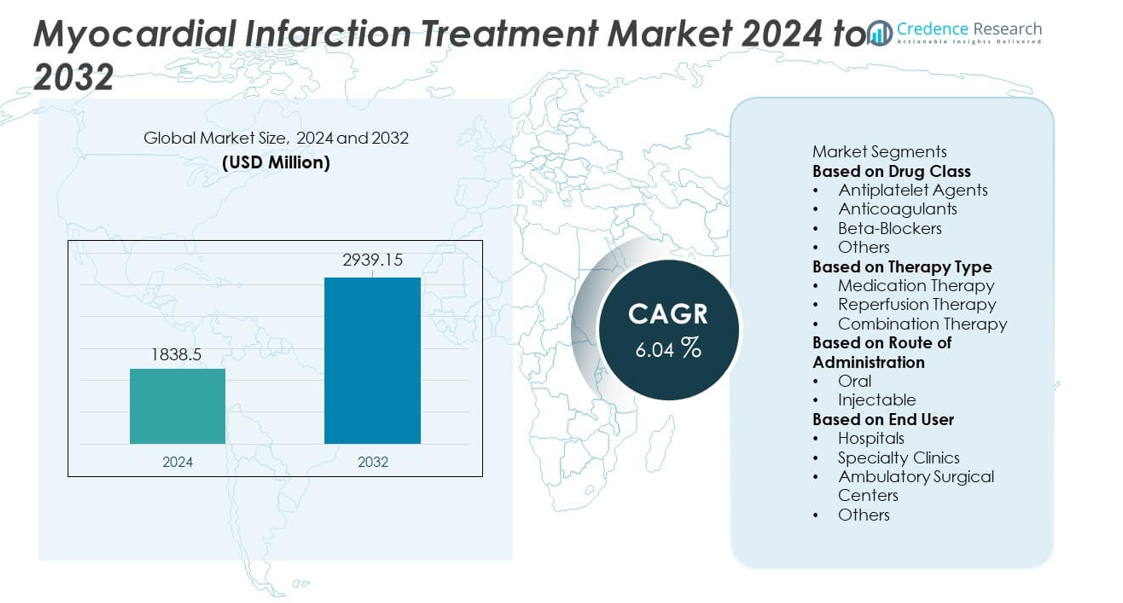
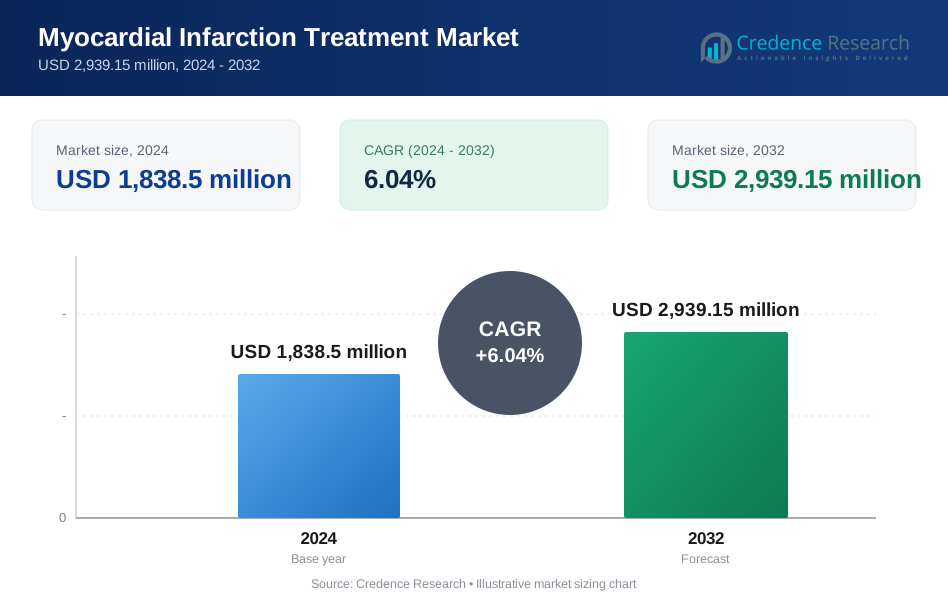
The Myocardial Infarction Treatment market was valued at USD 1,838.5 million in 2024 and is projected to reach USD 2,939.15 million by 2032, expanding at a CAGR of 6.04% during the forecast period.
| REPORT ATTRIBUTE | DETAILS |
|---|---|
| Historical Period | 2020-2023 |
| Base Year | 2024 |
| Forecast Period | 2025-2032 |
| Myocardial Infarction Treatment Market Size 2024 | USD 1,838.5 million |
| Myocardial Infarction Treatment Market, CAGR | 6.04% |
| Myocardial Infarction Treatment Market Size 2032 | USD 2,939.15 million |
The top players in the Myocardial Infarction Treatment market include AstraZeneca, Novartis AG, Bayer AG, Bristol-Myers Squibb, Johnson & Johnson, Pfizer Inc., Amgen Inc., Eli Lilly and Company, Sanofi, and Merck & Co., Inc. These companies strengthen their presence through advanced antiplatelets, anticoagulants, statins, and innovative combination therapies supported by strong clinical research and global distribution networks. North America leads the market with a 38% share, driven by high cardiovascular disease prevalence and well-established cardiac care infrastructure. Europe follows with a 29% share, supported by strong preventive care programs, while Asia Pacific holds a 24% share fueled by rising cardiac risk factors and expanding access to advanced MI treatments.
Market Insights
- The Myocardial Infarction Treatment market reached USD 1,838.5 million in 2024 and is projected to reach USD 2,939.15 million by 2032, growing at a CAGR of 6.04% during the forecast period.
- Market growth is driven by rising cardiovascular disease incidence, improved access to emergency care, and increased adoption of evidence-based therapies, with antiplatelet agents leading the drug class segment at a 38% share.
- Key trends include growing use of personalized treatment plans, increased adoption of digital health tools for remote cardiac monitoring, and continued development of safer, more effective antiplatelet and anticoagulant drugs.
- Competitive intensity rises as major pharmaceutical companies invest in R&D pipelines, pursue regulatory approvals for advanced formulations, and expand preventive cardiology portfolios to strengthen global positioning.
- North America leads with a 38% share, followed by Europe at 29% and Asia Pacific at 24%, supported by improving cardiac care infrastructure, rising patient awareness, and growing demand for long-term MI management therapies.
Market Segmentation Analysis:
By Drug Class
Antiplatelet agents dominate the drug class segment with a 38% market share, driven by their central role in preventing further clot formation and reducing the risk of recurrent myocardial infarction. These drugs remain the first-line choice due to proven clinical efficacy, strong guideline recommendations, and widespread use in both acute and long-term management. Anticoagulants also contribute significantly, especially during early intervention phases, while beta-blockers support long-term cardiac recovery. Rising cardiovascular disease prevalence, increasing emergency admissions, and expanding adoption of evidence-based treatment protocols continue to reinforce the dominance of antiplatelet therapies.
- For instance, AstraZeneca reported clinical data from the ONSET/OFFSET study showing ticagrelor (180 mg loading dose) achieving a rapid onset of antiplatelet effect, with 41% inhibition of platelet aggregation (IPA) at 30 minutes, which supports faster stabilization during acute myocardial infarction compared to clopidogrel.
By Therapy Type
Medication therapy leads the therapy type segment with a 52% market share, supported by its essential role in stabilizing patients, managing symptoms, and preventing complications before and after hospital intervention. Medications such as antiplatelets, beta-blockers, and statins form the backbone of myocardial infarction management and are prescribed in nearly all cases. Reperfusion therapy, including thrombolysis and angioplasty support, accounts for additional demand but depends on facility availability and patient eligibility. Combination therapy gains traction in advanced cases requiring integrated approaches. Increased clinical adoption of guideline-based medical management drives the leadership of medication therapy.
- For instance, Forest Laboratories (and later AbbVie, following an acquisition) reported strong clinical adoption of its beta-blocker formulation Bystolic following results from a pivotal clinical trial program involving over 2,000 patients, showing effective blood pressure and heart rate control.
By Route of Administration
Oral administration dominates the segment with a 59% market share, driven by the long-term use of maintenance medications such as statins, ACE inhibitors, antiplatelets, and beta-blockers. Oral formulations support better patient compliance, cost effectiveness, and ease of chronic disease management following acute myocardial infarction. Injectable treatments hold a smaller share but remain critical during emergency care and early intervention stages, particularly for anticoagulants and thrombolytic agents. The strong global burden of cardiovascular disease and the need for lifelong therapy reinforce the continued dominance of oral administration in the market.
Key Growth Drivers
Rising Global Burden of Cardiovascular Diseases
The growing incidence of cardiovascular diseases remains a major driver of the myocardial infarction treatment market. Sedentary lifestyles, rising obesity rates, hypertension, and diabetes contribute significantly to increased cardiac events worldwide. Healthcare systems are witnessing higher emergency admissions, creating a strong need for efficient acute and post-acute care therapies. Advancements in diagnostic accuracy and greater awareness of early symptoms improve treatment initiation rates. Governments and health organizations continue to emphasize preventive cardiology, increasing the demand for long-term therapeutic management and accelerating market growth across both developed and emerging regions.
- For instance, Medtronic expanded its global cardiac care footprint by deploying its Reveal LINQ cardiac monitor to support early detection of cardiac arrhythmias, such as atrial fibrillation (AF), in patients with symptoms like unexplained fainting or stroke.
Advancements in Drug Therapies and Treatment Protocols
Continuous improvements in drug formulations and evidence-based treatment guidelines strengthen the adoption of modern myocardial infarction therapies. Newer antiplatelet agents, safer anticoagulants, and more effective beta-blockers enhance patient outcomes and reduce adverse events. Clinical research supports optimized combination therapies that deliver improved results during both acute intervention and secondary prevention. Hospitals and clinics increasingly adopt standardized MI treatment pathways, ensuring consistent and high-quality care. Growing investments in cardiovascular R&D and the introduction of novel therapeutics fuel greater market penetration and long-term adoption of advanced treatment options.
- For instance, Bayer strengthened its anticoagulant portfolio by completing the pivotal ATLAS ACS 2-TIMI 51 clinical study of over 15,500 patients, which demonstrated a significant reduction in cardiovascular death, myocardial infarction (MI), or stroke when low-dose rivaroxaban was used in combination therapy.
Expansion of Healthcare Infrastructure and Access to Emergency Care
Improved availability of cardiac care units, better-equipped hospitals, and the rise of specialized cardiology centers support faster and more effective MI treatment. Expanding emergency medical services and quicker response systems increase survival rates, driving demand for reperfusion therapies and life-saving drugs. Developing regions are investing heavily in healthcare modernization, making advanced cardiac treatments more accessible. Government-led health insurance programs further improve affordability for patients. The broader availability of skilled cardiologists and advanced interventional technologies continues to reinforce demand for comprehensive MI treatment solutions.
Key Trends & Opportunities
Growing Adoption of Personalized and Evidence-Based Treatment Approaches
Healthcare providers increasingly adopt personalized treatment plans tailored to patient-specific risk profiles, genetic markers, and comorbidities. Precision dosing of antiplatelets, beta-blockers, and anticoagulants enhances safety and reduces complications. Hospitals are integrating predictive analytics, AI-based diagnostic tools, and biomarker-driven decision-making to improve outcomes. The expansion of clinical data and real-world evidence supports better treatment optimization. This trend opens strong opportunities for pharmaceutical companies developing targeted therapies and advanced monitoring solutions for post-MI management.
- For instance, Roche advanced biomarker-guided treatment by introducing highly sensitive troponin T tests that allow for more rapid and accurate diagnosis of acute MI, with clinical studies involving thousands of patients worldwide.
Increasing Role of Digital Health and Remote Cardiac Monitoring
Digital health technologies create new opportunities in MI management by enabling continuous monitoring, timely intervention, and better adherence to medication. Wearable cardiac devices, remote ECG systems, and telemedicine platforms help clinicians track patient health after discharge, reducing the risk of recurrent events. Mobile health apps improve compliance with therapy and lifestyle changes. Hospitals increasingly adopt digital tools to support early diagnosis and faster triage. Growing acceptance of tele-cardiology strengthens the market for integrated digital and pharmaceutical care solutions.
- For instance, Apple expanded its cardiac monitoring ecosystem by enabling the ECG app on Apple Watch Series 4 and later models, which has been clinically validated as highly accurate for detecting signs of atrial fibrillation (AFib) in classifiable recordings, thus improving early arrhythmia detection.
Key Challenges
High Treatment Costs and Limited Access in Low-Income Regions
Despite advancements in MI therapies, high medication and hospitalization costs limit access in developing regions. Reperfusion procedures, branded antiplatelet drugs, and advanced diagnostics remain unaffordable for many patients. Unequal healthcare infrastructure and limited insurance coverage widen the treatment gap. This challenge restricts adoption of guideline-based therapies and delays critical intervention, affecting clinical outcomes. Pharmaceutical companies face obstacles in expanding penetration in cost-sensitive markets where affordability remains a primary concern.
Side Effects, Safety Concerns, and Treatment Compliance Issues
Many MI medications, including anticoagulants and antiplatelets, carry risks of bleeding and other adverse effects, requiring careful monitoring. Patient non-adherence to long-term therapy reduces treatment effectiveness and increases the likelihood of recurrent events. Complex medication regimens and lifestyle requirements further contribute to compliance challenges. Managing drug interactions in patients with multiple comorbidities remains difficult. These clinical and behavioral challenges make it harder for providers to maintain consistent therapeutic outcomes, affecting long-term market growth.
Regional Analysis
North America
North America holds a 38% market share, driven by a high prevalence of cardiovascular diseases, strong adoption of advanced treatment protocols, and widespread access to emergency care facilities. The United States leads regional demand due to well-established cardiac care centers, strong healthcare spending, and rapid adoption of evidence-based therapies. Favorable reimbursement policies and strong availability of skilled cardiologists further support treatment expansion. High awareness of early MI symptoms and increased use of preventive medications sustain long-term therapy demand. Continuous technological advancements and broad access to diagnostic tools reinforce North America’s dominant position in the market.
Europe
Europe accounts for a 29% market share, supported by strong healthcare infrastructure, national cardiac care programs, and rising emphasis on early diagnosis and preventive cardiology. Countries such as Germany, the United Kingdom, Italy, and France drive demand through well-developed emergency response systems and high utilization of standardized MI treatment pathways. The region benefits from growing adoption of statins, antiplatelet agents, and advanced reperfusion therapies. Aging populations and increasing lifestyle-related risk factors further accelerate market growth. Continuous investments in cardiac research and improved access to specialist care strengthen Europe’s position in the global market.
Asia Pacific
Asia Pacific holds a 24% market share, driven by rising incidence of cardiovascular diseases, rapid urbanization, and expanding access to hospital-based cardiac care. China, India, Japan, and South Korea represent major demand hubs due to large patient pools and increasing adoption of guideline-based treatments. Governments across the region invest heavily in healthcare modernization and public awareness campaigns related to heart diseases. Growing availability of emergency services and rising use of oral and injectable MI medications support market expansion. Asia Pacific remains the fastest-growing region due to improving healthcare access and increasing burden of cardiac risk factors.
Latin America
Latin America holds a 6% market share, driven by increasing awareness of cardiovascular diseases and expanding access to cardiac treatment services across Brazil, Mexico, Argentina, and Chile. Growth is supported by rising adoption of antiplatelet and anticoagulant therapies, though disparities in healthcare quality limit uniform access. Urban centers experience strong demand due to improved hospital infrastructure and expanding private healthcare networks. Public health initiatives focused on reducing hypertension and obesity also support early diagnosis and long-term therapy use. Despite economic fluctuations, the region shows steady growth driven by an increasing cardiac patient population.
Middle East & Africa
The Middle East & Africa region holds a 3% market share, influenced by rising cardiac risk factors, including diabetes, hypertension, and smoking. Countries such as Saudi Arabia, the UAE, and South Africa lead adoption due to expanding hospital infrastructure and greater availability of cardiology specialists. Investments in emergency medical services and improved diagnosis capabilities support early MI management. However, limited access to advanced therapies and affordability challenges constrain broader adoption. Growing government focus on healthcare modernization and preventive programs is expected to strengthen long-term demand for myocardial infarction treatment across the region.
Market Segmentations:
By Drug Class
- Antiplatelet Agents
- Anticoagulants
- Beta-Blockers
- Others
By Therapy Type
- Medication Therapy
- Reperfusion Therapy
- Combination Therapy
By Route of Administration
- Oral
- Injectable
By End User
- Hospitals
- Specialty Clinics
- Ambulatory Surgical Centers
- Others
By Geography
- North America
- U.S.
- Canada
- Mexico
- Europe
- Germany
- France
- U.K.
- Italy
- Spain
- Rest of Europe
- Asia Pacific
- China
- Japan
- India
- South Korea
- South-east Asia
- Rest of Asia Pacific
- Latin America
- Brazil
- Argentina
- Rest of Latin America
- Middle East & Africa
- GCC Countries
- South Africa
- Rest of the Middle East and Africa
Competitive Landscape
The competitive landscape includes major players such as AstraZeneca, Novartis AG, Bayer AG, Bristol-Myers Squibb, Johnson & Johnson, Pfizer Inc., Amgen Inc., Eli Lilly and Company, Sanofi, and Merck & Co., Inc. These companies strengthen their presence through extensive cardiovascular drug portfolios, strong distribution networks, and continuous investment in R&D for next-generation antiplatelets, anticoagulants, statins, and biologics. Many players focus on developing safer and more effective therapies with improved dosing profiles to reduce adverse events and enhance long-term patient outcomes. Strategic partnerships with research institutes, expansion into emerging markets, and regulatory approvals for advanced formulations support market growth. Companies also invest in real-world evidence studies and personalized medicine approaches to differentiate their products. With rising cardiovascular disease prevalence and growing demand for evidence-based therapies, leading players continue to compete on innovation, clinical trial success, and global market reach.
Key Player Analysis
- AstraZeneca
- Novartis AG
- Bayer AG
- Bristol-Myers Squibb
- Johnson & Johnson (Janssen Pharmaceuticals)
- Pfizer Inc.
- Amgen Inc.
- Eli Lilly and Company
- Sanofi
- Merck & Co., Inc.
Recent Developments
- In November 2025, Bristol‑Myers Squibb and Johnson & Johnson halted a late-stage trial of their experimental anticoagulant Milvexian in patients after acute coronary syndrome - including MI - because the drug was unlikely to meet its main efficacy goal (despite no new safety concerns).
- In August 2025, Merck & Co., Inc. presented new real-world and trial data at the European Society of Cardiology Congress 2025 (ESC 2025) on atherosclerotic cardiovascular disease, including myocardial infarction outcomes and lipid-lowering therapy use trends in large patient cohorts.
- In March 2025, Eli Lilly and Company reported that its experimental drug lepodisiran cut levels of lipoprotein(a) - a known risk factor for heart attack - by 94% in a Phase-2 trial compared with placebo
Report Coverage
The research report offers an in-depth analysis based on Drug Class, Therapy Type, Route of Administration, End User and Geography. It details leading market players, providing an overview of their business, product offerings, investments, revenue streams, and key applications. Additionally, the report includes insights into the competitive environment, SWOT analysis, current market trends, as well as the primary drivers and constraints. Furthermore, it discusses various factors that have driven market expansion in recent years. The report also explores market dynamics, regulatory scenarios, and technological advancements that are shaping the industry. It assesses the impact of external factors and global economic changes on market growth. Lastly, it provides strategic recommendations for new entrants and established companies to navigate the complexities of the market.
Future Outlook
- Demand for myocardial infarction treatments will rise as cardiovascular cases continue increasing worldwide.
- Advancements in antiplatelet and anticoagulant therapies will improve long-term patient outcomes.
- Personalized treatment approaches will gain traction through genetic profiling and risk-based therapy selection.
- Digital cardiac monitoring and telemedicine will strengthen post-MI care and reduce readmission rates.
- Reperfusion therapies will expand with better access to advanced cardiac centers in developing regions.
- Pharmaceutical companies will invest more in safer drugs with fewer bleeding risks.
- Combination therapy adoption will grow as clinical guidelines favor integrated treatment strategies.
- Emerging markets will experience faster growth due to improving healthcare infrastructure and growing awareness.
- AI-driven diagnostic tools will enhance early MI detection and quicker treatment decisions.
- Preventive cardiology programs will strengthen demand for long-term maintenance therapies across global markets.
Request a Free Sample
Fill in your details and we'll send you a free sample report.
- Sample data tables & charts
- Research methodology
Market Dynamics
Rising Global Burden of Cardiovascular Diseases
Increasing prevalence of risk factors such as obesity, hypertension, diabetes, and sedentary lifestyles is leading to more cases of myocardial infarction worldwide, driving demand for both acute and long-term treatment solutions.
Advancements in Drug Therapies and Treatment Protocols
Continuous innovation in antiplatelet agents, anticoagulants, and beta-blockers, along with updated clinical guidelines, is improving patient outcomes and expanding the adoption of evidence-based therapies for myocardial infarction.
Expansion of Healthcare Infrastructure and Emergency Care Access
Investment in cardiac care units, emergency medical services, and specialized cardiology centers - especially in developing regions - is enabling faster intervention and broader access to advanced MI treatments.
Growing Adoption of Personalized and Evidence-Based Treatment Approaches
Healthcare providers are increasingly using genetic profiling, biomarker-driven decision-making, and precision dosing to tailor therapies, which enhances safety, efficacy, and long-term patient adherence.
Increasing Role of Digital Health and Remote Cardiac Monitoring
The integration of wearable cardiac devices, telemedicine, and remote monitoring platforms is improving post-MI care, supporting early intervention, and reducing hospital readmissions, thereby fueling market growth.
Need a Custom Version of This Report?
Tailor the scope, geography, or segments to your exact requirements.
- Custom geography or segment scope
- Direct access to our analyst team
Frequently Asked Questions
What is the current market size for the Myocardial Infarction Treatment market, and what is its projected size in 2032?
At what Compound Annual Growth Rate is the Myocardial Infarction Treatment market projected to grow between 2025 and 2032?
Who are the major players in the global Myocardial Infarction Treatment Market?
What are the major market drivers of the Myocardial Infarction Treatment industry?
What are the major market restraints of the Myocardial Infarction Treatment industry?
What are the major market opportunities of the Myocardial Infarction Treatment industry?
Who are the leading companies in the Myocardial Infarction Treatment market?
Table of Content
Chapter 1 Market Segmentation
- 1.1 Segmentation Framework
- 1.1.1 Product and Service Classification
- 1.1.2 Application and End-Use Classification
- 1.1.3 Technology and Solution Classification
- 1.1.4 Customer and Distribution Channel Classification
- 1.1.5 Geographic Segmentation
- 1.1.6 Market Segment Definitions and Boundaries
- 1.2 By End User
- 1.2.1 Hospitals
- 1.2.2 Specialty Clinics
- 1.2.3 Ambulatory Surgical Centers
- 1.2.4 Others
- 1.3 By Drug Class
- 1.3.1 Antiplatelet Agents
- 1.3.2 Anticoagulants
- 1.3.3 Beta-Blockers
- 1.3.4 Others
- 1.4 By Therapy Type
- 1.4.1 Medication Therapy
- 1.4.2 Reperfusion Therapy
- 1.4.3 Combination Therapy
- 1.5 By Route of Administration
- 1.5.1 Oral
- 1.5.2 Injectable
Chapter 2 Introduction
- 2.1 Report Objectives and Scope
- 2.2 Product Definition and Industry Terminology
- 2.3 Market Inclusions and Exclusions
- 2.4 Research Process
- 2.4.1 Primary Research and Expert Interviews
- 2.4.2 Secondary Research and Source Review
- 2.4.3 Top-Down and Bottom-Up Estimation
- 2.4.4 Data Triangulation and Verification
- 2.5 Market Size Measurement Basis
- 2.5.1 2024: USD 1,838.5 million → 2032: USD 2,939.15 million
- 2.6 Historical and Forecast Reference Periods
- 2.6.1 Base Year: 2024
- 2.6.2 Forecast Period: 2024-2032
- 2.7 Research Assumptions and Limitations
Chapter 3 Executive Summary
- 3.1 Market Snapshot and Key Findings
- 3.2 Base-Year Market Size, 2024
- 3.3 Forecast Market Size, 2032
- 3.4 Revenue and Volume Growth Outlook
- 3.5 Key Demand and Supply Indicators
- 3.6 Leading Market Segments
- 3.7 Fastest-Growing Market Opportunities
- 3.8 Regional Performance Highlights
- 3.9 Technology and Industry Transformation
- 3.10 Competitive Landscape Summary
- 3.11 Analyst View and Strategic Implications
Chapter 4 Global Myocardial Infarction Treatment Market Trends and Developments
- 4.1 Historical Industry Development
- 4.2 Recent Market Trends and Developments
- 4.3 Demand and Customer Behavior Trends
- 4.4 Technology and Product Innovation
- 4.5 Artificial Intelligence, Automation and Digitalization
- 4.6 Local Manufacturing and Supply Chain Realignment
- 4.7 Industry Partnerships, Mergers and Acquisitions
- 4.8 Sustainability and Circular Economy Developments
- 4.9 Government and Private Sector Investment Trends
- 4.10 Emerging Business Models and Commercialization
- 4.11 Industry Developments and Announcements
Chapter 5 Global Myocardial Infarction Treatment Market Production, Supply and Demand Analysis
- 5.1 Demand Trend and Consumption Analysis
- 5.2 Demand Forecast, 2024-2032
- 5.3 Production and Output Trend
- 5.4 Production and Output Forecast, 2024-2032
- 5.5 Installed Capacity and Capacity Utilization
- 5.6 Company-Wise Production Plants and Statistics
- 5.6.1 Installed Production Capacity
- 5.6.2 Actual Production
- 5.6.3 Planned Capacity and Expansion Targets
- 5.7 Supply Chain Structure and Procurement Trends
- 5.8 Supply-Demand Gap and Bottlenecks
- 5.9 Import Dependence and Sourcing Structure
- 5.10 Contract Manufacturing and Outsourcing
- 5.11 Regional Supply and Demand Concentration
Chapter 6 Global Myocardial Infarction Treatment Market Pricing Analysis
- 6.1 Pricing Structure and Measurement
- 6.2 Historical Pricing Trends
- 6.3 Pricing Outlook, 2024-2032
- 6.4 Average Selling Price and Unit Economics
- 6.5 Pricing by Product and Market Segment
- 6.6 Geographic Pricing Differences
- 6.7 Key Input, Energy, Labor and Logistics Costs
- 6.8 Contract Pricing and Purchasing Models
- 6.9 Pricing Sensitivity and Competitive Positioning
- 6.10 Price, Margin and Profitability Implications
Chapter 7 Global Myocardial Infarction Treatment Market Dynamics
- 7.1 Market Growth Drivers
- 7.1.1 Demand-Side Drivers
- 7.1.2 Technology and Innovation Drivers
- 7.1.3 Infrastructure and Investment Drivers
- 7.1.4 Regulatory and Policy Drivers
- 7.2 Market Restraints
- 7.2.1 Cost and Affordability Constraints
- 7.2.2 Technology and Adoption Barriers
- 7.2.3 Supply Chain and Operational Constraints
- 7.3 Market Challenges
- 7.3.1 Competitive Pressure and Margin Erosion
- 7.3.2 Skills, Infrastructure and Implementation Gaps
- 7.4 Emerging Market Opportunities
- 7.5 Market Dynamics Impact and Time-Horizon Assessment
Chapter 8 Global Myocardial Infarction Treatment Value Chain Analysis
- 8.1 Industry Value Chain Overview
- 8.2 Upstream Suppliers and Critical Inputs
- 8.3 Technology and Component Providers
- 8.4 Manufacturing or Service Delivery
- 8.5 Distribution, Channel Partners and Integrators
- 8.6 Downstream Applications and End Users
- 8.7 Value Addition and Profit Pools
- 8.8 Vertical Integration and Outsourcing
- 8.9 Supplier Concentration and Risk
- 8.10 Supply Chain Localization and Resilience
Chapter 9 Global Myocardial Infarction Treatment Market Regulations and Policies
- 9.1 Relevant Laws, Standards and Compliance Frameworks
- 9.2 Product, Service, Safety and Quality Requirements
- 9.3 Government Policies, Incentives and Subsidies
- 9.4 Imports, Exports and Trade Barriers
- 9.5 Public Procurement and Local Content Requirements
- 9.6 Environmental and Sustainability Compliance
- 9.7 Upcoming Policy Changes and Market Implications
Chapter 10 Global Myocardial Infarction Treatment Market Hotspots and Opportunities
- 10.1 Market Opportunity Mapping and Growth Hotspots
- 10.2 High-Growth Applications and Customer Groups
- 10.3 Underserved Markets and White-Space Opportunities
- 10.4 Emerging Technology and Product Opportunities
- 10.5 New Capacity and Investment Hotspots
- 10.6 Market Entry and Expansion Opportunities
- 10.7 Distribution and Partnership Opportunities
- 10.8 Near-Term and Long-Term Commercial Potential
- 10.9 Opportunity Attractiveness and Execution Risks
Chapter 11 Global Myocardial Infarction Treatment Market Outlook, 2024-2032
- 11.1 Market Size and Analysis
- 11.1.1 Revenue (Market Measurement: 2024: USD 1,838.5 million → 2032: USD 2,939.15 million)
- 11.1.2 Market Volume and Quantity Sold
- 11.1.3 Historical Market Size
- 11.1.4 Base-Year Market Size, 2024
- 11.2 Market Forecast, 2024-2032
- 11.2.1 Revenue Forecast to 2032
- 11.2.2 Volume Forecast to 2032
- 11.2.3 CAGR and Year-on-Year Growth
- 11.2.4 Incremental Revenue Opportunity
- 11.3 Forecast Assumptions and Scenario Analysis
- 11.3.1 Base-Case Forecast
- 11.3.2 Optimistic and Conservative Scenarios
- 11.3.3 Technology, Pricing and Policy Sensitivities
- 11.4 Market Attractiveness and Growth Outlook
Chapter 12 Global Myocardial Infarction Treatment Market Segmentation and Outlook
- 12.1 Segmentation Summary and Market Shares, 2024
- 12.2 Largest and Fastest-Growing Segments
- 12.3 By End User - Market Size and Forecast, 2024-2032
- 12.3.1 Segment Definition and Scope
- 12.3.2 Historical Market Size
- 12.3.3 Revenue Forecast, 2024-2032
- 12.3.4 Volume Forecast, 2024-2032
- 12.3.5 Base-Year Market Share, 2024
- 12.3.6 Segment CAGR and Growth Drivers
- 12.3.7 Subsegment Market Size and Forecast
- 12.3.7.1 Hospitals
- 12.3.7.2 Specialty Clinics
- 12.3.7.3 Ambulatory Surgical Centers
- 12.3.7.4 Others
- 12.3.8 Subsegment Pricing and Adoption Trends
- 12.3.9 Leading Suppliers and Competition
- 12.3.10 Regional Demand and Opportunities
- 12.4 By Drug Class - Market Size and Forecast, 2024-2032
- 12.4.1 Segment Definition and Scope
- 12.4.2 Historical Market Size
- 12.4.3 Revenue Forecast, 2024-2032
- 12.4.4 Volume Forecast, 2024-2032
- 12.4.5 Base-Year Market Share, 2024
- 12.4.6 Segment CAGR and Growth Drivers
- 12.4.7 Subsegment Market Size and Forecast
- 12.4.7.1 Antiplatelet Agents
- 12.4.7.2 Anticoagulants
- 12.4.7.3 Beta-Blockers
- 12.4.7.4 Others
- 12.4.8 Subsegment Pricing and Adoption Trends
- 12.4.9 Leading Suppliers and Competition
- 12.4.10 Regional Demand and Opportunities
- 12.5 By Therapy Type - Market Size and Forecast, 2024-2032
- 12.5.1 Segment Definition and Scope
- 12.5.2 Historical Market Size
- 12.5.3 Revenue Forecast, 2024-2032
- 12.5.4 Volume Forecast, 2024-2032
- 12.5.5 Base-Year Market Share, 2024
- 12.5.6 Segment CAGR and Growth Drivers
- 12.5.7 Subsegment Market Size and Forecast
- 12.5.7.1 Medication Therapy
- 12.5.7.2 Reperfusion Therapy
- 12.5.7.3 Combination Therapy
- 12.5.8 Subsegment Pricing and Adoption Trends
- 12.5.9 Leading Suppliers and Competition
- 12.5.10 Regional Demand and Opportunities
- 12.6 By Route of Administration - Market Size and Forecast, 2024-2032
- 12.6.1 Segment Definition and Scope
- 12.6.2 Historical Market Size
- 12.6.3 Revenue Forecast, 2024-2032
- 12.6.4 Volume Forecast, 2024-2032
- 12.6.5 Base-Year Market Share, 2024
- 12.6.6 Segment CAGR and Growth Drivers
- 12.6.7 Subsegment Market Size and Forecast
- 12.6.7.1 Oral
- 12.6.7.2 Injectable
- 12.6.8 Subsegment Pricing and Adoption Trends
- 12.6.9 Leading Suppliers and Competition
- 12.6.10 Regional Demand and Opportunities
- 12.7 Segment Growth Comparison
- 12.8 Segment Attractiveness and Priority Matrix
Chapter 13 Global Myocardial Infarction Treatment End-Use and Application Market Outlook
- 13.1 End-Use Industry and Customer Demand Structure
- 13.2 Leading Applications and Customer Groups
- 13.3 End-Use Market Size, Share and Forecast
- 13.4 Major End-Use Industry Deep Dives
- 13.4.1 Customer Requirements and Use Cases
- 13.4.2 Demand and Replacement Cycles
- 13.4.3 Technical and Regulatory Considerations
- 13.4.4 Purchasing and Procurement Models
- 13.4.5 Leading Vendors and Distribution Channels
- 13.4.6 Forecast and Commercial Opportunities
- 13.5 Emerging Applications and Cross-Segment Demand
- 13.6 End-Use Industry Investment Priorities
Chapter 14 Global Myocardial Infarction Treatment Geographic Market Outlook, 2024-2032
- 14.1 Regional Market Size and Share, 2024
- 14.2 Regional Market Forecast, 2024-2032
- 14.3 Regional Pricing, Production and Demand Differences
- 14.4 North America
- 14.4.1 United States
- 14.4.2 Canada
- 14.4.3 Mexico
- 14.5 Europe
- 14.5.1 Germany
- 14.5.2 France
- 14.5.3 Italy
- 14.5.4 United Kingdom
- 14.5.5 Spain
- 14.5.6 Poland
- 14.5.7 Russia
- 14.5.8 Netherlands
- 14.5.9 Belgium
- 14.5.10 Sweden
- 14.5.11 Denmark
- 14.5.12 Norway
- 14.5.13 Rest of Europe
- 14.6 Asia Pacific
- 14.6.1 China
- 14.6.2 India
- 14.6.3 Japan
- 14.6.4 South Korea
- 14.6.5 Thailand
- 14.6.6 Indonesia
- 14.6.7 Vietnam
- 14.6.8 Malaysia
- 14.6.9 Australia
- 14.6.10 Rest of Asia Pacific
- 14.7 Latin America
- 14.7.1 Brazil
- 14.7.2 Argentina
- 14.7.3 Colombia
- 14.7.4 Chile
- 14.7.5 Rest of Latin America
- 14.8 Middle East
- 14.8.1 Saudi Arabia
- 14.8.2 United Arab Emirates
- 14.8.3 Turkey
- 14.8.4 Israel
- 14.8.5 Iran
- 14.8.6 Rest of the Middle East
- 14.9 Africa
- 14.9.1 South Africa
- 14.9.2 Egypt
- 14.9.3 Nigeria
- 14.9.4 Morocco
- 14.9.5 Rest of Africa
- 14.10 Regional Investment, Policy and Supply Chain Differences
- 14.11 Regional Competitive Landscape
- 14.12 Geographic Growth Hotspots
Chapter 15 Global Myocardial Infarction Treatment Technology, Innovation and Sustainability Outlook
- 15.1 Technology Landscape and Maturity
- 15.2 Product, Process and Service Innovation
- 15.3 AI, Automation and Digital Tools in the Industry
- 15.4 Technology Adoption and Performance Benchmarking
- 15.5 Innovation Pipeline and R&D Investment
- 15.6 Patent and Intellectual Property Trends
- 15.7 Energy Efficiency and Resource Management
- 15.8 Sustainability, Recycling and Circularity
- 15.9 Technology Roadmap, 2024-2032
- 15.10 Risks of Obsolescence and Technology Substitution
Chapter 16 Global Myocardial Infarction Treatment Market Key Strategic Imperatives
- 16.1 Growth and Market Entry Priorities
- 16.2 High-Return Products and Segments
- 16.3 Pricing, Profitability and Cost Optimization
- 16.4 Technology Investment and Product Differentiation
- 16.5 Supply Chain Localization and Resilience
- 16.6 Distribution and Customer Acquisition
- 16.7 Partnership, Acquisition and Capacity Strategy
- 16.8 Regional Expansion Priorities
- 16.9 Short-, Medium- and Long-Term Actions
Chapter 17 Competition Outlook
- 17.1 Industry Competition Characteristics
- 17.2 Market Structure and Concentration
- 17.3 Market Share and Competitive Positioning, 2024
- 17.4 Company-Wise Revenue and Product Benchmarking
- 17.5 Production and Service Capacity Benchmarking
- 17.6 Technology, Pricing and Differentiation
- 17.7 Regional Footprint and Distribution Strength
- 17.8 Mergers, Acquisitions and Strategic Alliances
- 17.9 New Entrants and Competitive Threats
- 17.10 Porter's Five Forces and Industry Attractiveness
- 17.11 Competitive Outlook, 2024-2032
Chapter 18 Company Profiles
- 18.1 Company Coverage and Selection Criteria
- 18.2 AstraZeneca
- 18.2.1 Business Description
- 18.2.2 Company Ownership and Geographic Presence
- 18.2.3 Product and Service Portfolio
- 18.2.4 Manufacturing and Operating Footprint
- 18.2.5 Production Capacity and Expansion Plans
- 18.2.6 Financial Performance and Investment
- 18.2.7 Market Share and Competitive Position
- 18.2.8 Technology and Innovation Capabilities
- 18.2.9 Strategic Alliances or Partnerships
- 18.2.10 Recent Developments
- 18.2.11 Growth Strategy and Outlook
- 18.3 Novartis AG
- 18.4 Bayer AG
- 18.5 Bristol-Myers Squibb
- 18.6 Johnson & Johnson
- 18.7 Pfizer Inc.
- 18.8 Amgen Inc.
- 18.9 Eli Lilly and Company
- 18.10 Sanofi
- 18.11 Merck & Co., Inc.
- 18.12 Other Relevant Market Participants
Note: Every listed company is profiled on the structure shown under the first company. The company list is preliminary and may change based on research findings, market developments, data availability and client requirements.
Chapter 19 Disclaimer
- 19.1 Research and Forecast Disclaimer
- 19.2 Data Source and Estimation Limitations
Note: The depth of individual sections depends on data availability for this market. Volume, capacity, trade and other unit-based metrics are included where applicable.