
Market Overview
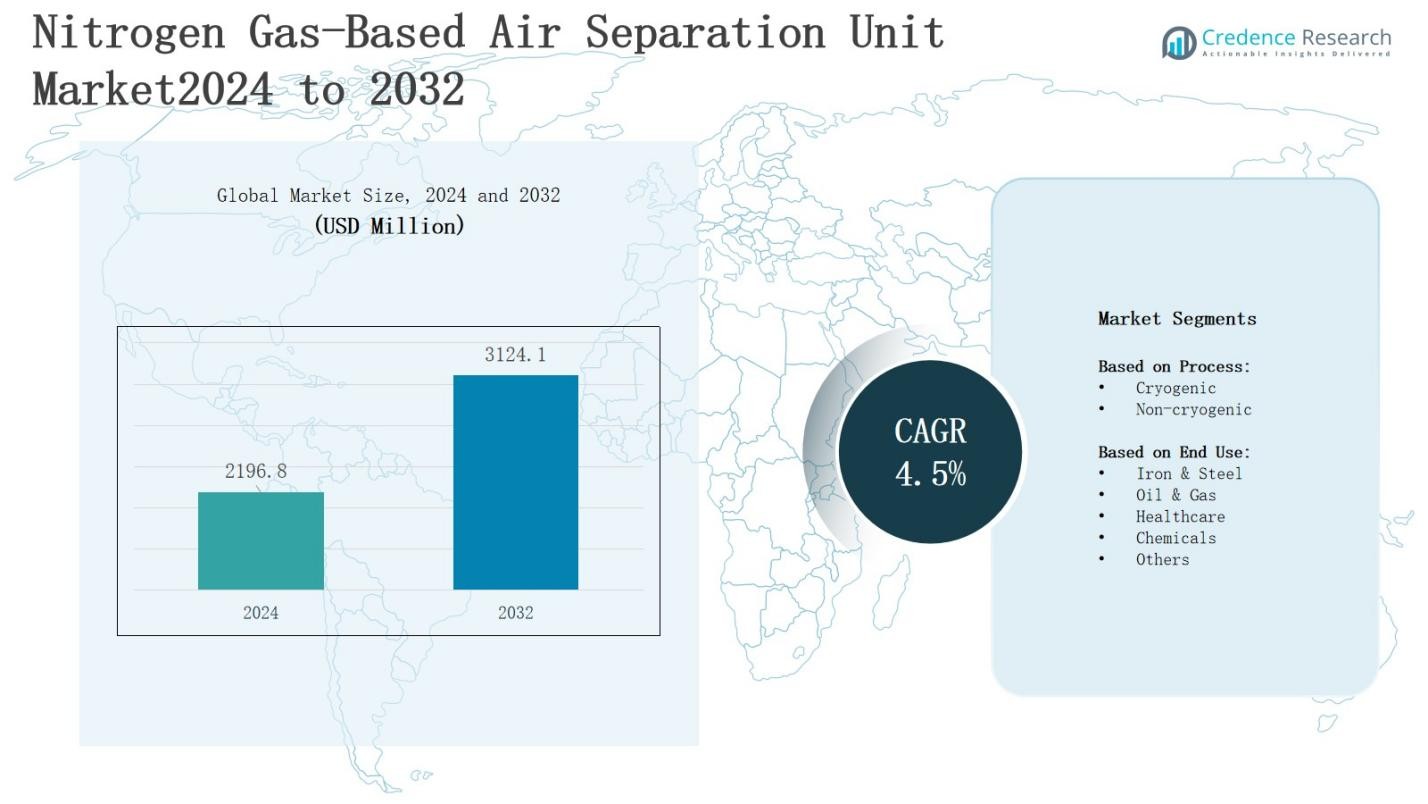
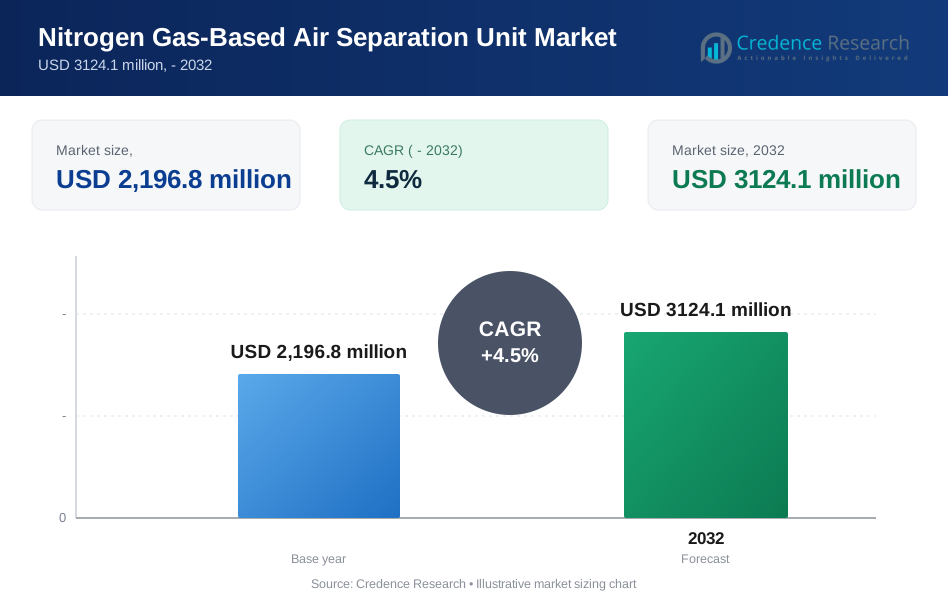
The Nitrogen Gas-Based Air Separation Unit Market is projected to grow from USD 2196.8 million in 2024 to USD 3124.1 million by 2032, registering a CAGR of 4.5% during the forecast period.
| REPORT ATTRIBUTE | DETAILS |
|---|---|
| Historical Period | 2020-2024 |
| Base Year | 2024 |
| Forecast Period | 2025-2032 |
| Nitrogen Gas-Based Air Separation Unit Market Size 2024 | USD 2196.8 Million |
| Nitrogen Gas-Based Air Separation Unit Market, CAGR | 4.5% |
| Nitrogen Gas-Based Air Separation Unit Market Size 2032 | USD 3124.1 Million |
The nitrogen gas-based air separation unit market is driven by rising industrial demand across sectors such as chemicals, food and beverages, healthcare, and electronics, where nitrogen is essential for inserting, packaging, and preservation processes. Increasing adoption in oil and gas for enhanced safety and operational efficiency further strengthens market expansion. Trends highlight a shift toward energy-efficient and modular units, supported by technological advancements in cryogenic and non-cryogenic processes. Growing environmental concerns are encouraging the use of sustainable separation technologies, while emerging economies are witnessing rising investments in industrial infrastructure, creating new opportunities for manufacturers to expand their presence.
The nitrogen gas based air separation unit market shows diverse geographical dynamics across key regions. Asia-Pacific leads with strong demand from steel, chemicals, and electronics, while North America and Europe follow, driven by advanced infrastructure, oil and gas, and healthcare. Latin America benefits from rising energy and chemical industries, and the Middle East & Africa see growth through oil and gas activities and industrial diversification. Key players include Air Liquide, Linde plc, Air Products and Chemicals, Messer, AIR WATER, CRYOTEC, Enerflex, EuroChem, KaiFeng Air Separation Group, Praxair Technology, and Ranch Cryogenics.
Market Insights
- The nitrogen gas-based air separation unit market will grow from USD 2196.8 million in 2024 to USD 3124.1 million by 2032, at a CAGR of 4.5% during the forecast period.
- Cryogenic process dominates with 65% share in 2024, driven by large-scale, high-purity nitrogen demand from steel, chemicals, and oil and gas, while non-cryogenic units hold 35% share, favored for cost-efficient operations.
- By end use, iron and steel leads with over 30% share, followed by oil and gas at 25%, chemicals at 20%, healthcare at 15%, and other industries including food and electronics with 10%.
- Asia-Pacific holds the largest share at 33%, North America follows with 28%, Europe stands at 24%, while Latin America and Middle East & Africa capture 8% and 7% respectively.
- Key players include Air Liquide, Linde plc, Air Products and Chemicals, Messer, AIR WATER, CRYOTEC, Enerflex, EuroChem, KaiFeng Air Separation Group, Praxair Technology, and Ranch Cryogenics.
Market Drivers
Rising Demand from Industrial Applications
The nitrogen gas based air separation unit market is witnessing strong growth due to rising demand across industries such as chemicals, pharmaceuticals, and electronics. Nitrogen is critical for maintaining inert atmospheres, preventing oxidation, and ensuring product stability. It is also widely applied in petrochemical processes and refining operations. The food and beverage industry uses nitrogen for packaging and preservation. Expanding applications across these sectors continue to drive the steady requirement for advanced air separation technologies.
- For instance, BASF employs nitrogen blanketing in chemical reactors to minimize explosion risks and ensure safe handling of flammable compounds.
Growth in Oil and Gas Sector
The nitrogen gas based air separation unit market benefits from growing applications in the oil and gas sector. Nitrogen is vital for pipeline purging, enhanced oil recovery, and fire suppression systems. It improves safety and operational efficiency in high-risk environments. Energy companies are investing in reliable air separation units to meet large-scale demand for nitrogen. Rising global exploration and production activities create consistent opportunities, strengthening the role of these units in energy infrastructure.
- For instance, ExxonMobil employs cryogenic air separation units to supply high-purity nitrogen for enhanced oil recovery processes in its Permian Basin fields.
Advancements in Air Separation Technologies
The nitrogen gas based air separation unit market is influenced by continuous innovation in cryogenic and non-cryogenic technologies. Companies are focusing on improving energy efficiency and lowering operational costs. Developments in pressure swing adsorption (PSA) and membrane technologies enhance flexibility for small and medium-scale industries. It enables end users to choose cost-effective and application-specific solutions. Technological upgrades also support sustainability goals, reducing environmental impact while meeting industrial-grade nitrogen demand across multiple end-use sectors.
Infrastructure Expansion in Emerging Economies
The nitrogen gas based air separation unit market is expanding rapidly in emerging economies due to rising industrial infrastructure. Growing manufacturing hubs in Asia-Pacific, Latin America, and the Middle East demand reliable nitrogen supply for diverse applications. Government initiatives to promote industrial growth fuel investments in production facilities. It encourages global manufacturers to establish regional supply networks. Increasing foreign direct investments and robust economic growth further support the adoption of advanced air separation units.
Market Trends
Shift Toward Energy-Efficient Systems
The nitrogen gas based air separation unit market is witnessing a strong trend toward energy-efficient systems. Rising energy costs and environmental concerns are driving industries to adopt units that minimize power consumption. Manufacturers are integrating advanced compressors, heat exchangers, and smart monitoring solutions to optimize performance. It helps reduce operational costs while meeting sustainability goals. Companies are also focusing on systems with lower carbon footprints, aligning with global initiatives promoting cleaner industrial processes.
- For instance, Air Liquide has deployed its proprietary Cryocap™ technology in ASU facilities, capturing CO₂ from oxygen and nitrogen production while lowering overall carbon emissions.
Adoption of Modular and On-Site Units
The nitrogen gas based air separation unit market is moving toward modular and on-site production systems. Industries with variable nitrogen demand prefer compact units that provide flexibility and cost savings. On-site generation reduces reliance on bulk nitrogen supply, enhancing operational efficiency. It ensures uninterrupted availability for critical applications such as healthcare, electronics, and food processing. Modular units are gaining traction in emerging regions where space constraints and scalability requirements remain significant concerns.
- For instance, Linde's SPECTRA modular ASUs are designed specifically for high-purity nitrogen needs in the electronics industry, offering capacities from 7,000 to 70,000 Nm³/h and providing low operating costs with rapid deployment.
Integration of Advanced Separation Technologies
The nitrogen gas based air separation unit market is advancing through greater integration of innovative technologies such as pressure swing adsorption, membrane-based separation, and cryogenic systems. These technologies offer varying purity levels and capacity to suit diverse industrial needs. It allows companies to select solutions tailored to their operations. Hybrid systems that combine multiple technologies are gaining popularity for their reliability and efficiency. This trend reflects a broader shift toward precision-engineered nitrogen solutions across industries.
Expansion Across Emerging Markets
The nitrogen gas based air separation unit market is experiencing robust expansion across emerging economies. Rapid industrialization in Asia-Pacific, Latin America, and the Middle East fuels significant investments in manufacturing and energy infrastructure. Rising demand for industrial gases is encouraging global players to establish localized production facilities. It supports cost-effective supply chains and reduces dependency on imports. With governments promoting industrial growth, these regions are expected to remain crucial growth centers for nitrogen production technologies.
Market Challenges Analysis
High Operational and Capital Costs
The nitrogen gas based air separation unit market faces challenges due to high initial investments and operating expenses. Cryogenic systems, which dominate large-scale production, require substantial infrastructure, energy input, and maintenance. Small and medium-scale enterprises often struggle to justify such expenditures, limiting adoption in cost-sensitive industries. It creates barriers for new entrants and restricts wider penetration in emerging regions. Volatility in energy prices further intensifies cost concerns, making operational sustainability a pressing issue for manufacturers and end users.
Complexity in Technological Integration and Supply Chains
The nitrogen gas based air separation unit market also encounters challenges from complex technological requirements and supply chain limitations. Integration of advanced systems like PSA, membrane, or hybrid technologies requires skilled expertise and precise calibration. It creates dependence on specialized service providers, raising operational risks in regions with limited technical support. Supply chain disruptions, particularly in critical components such as compressors and membranes, can delay installations. These factors slow adoption rates and hinder market scalability in global industrial sectors.
Market Opportunities
Rising Demand from Healthcare and Electronics Industries
The nitrogen gas based air separation unit market offers strong opportunities from the growing healthcare and electronics sectors. Nitrogen plays a vital role in medical applications such as cryopreservation, sterilization, and pharmaceutical manufacturing. Expanding hospital infrastructure and rising demand for high-purity gases create favorable conditions. The electronics industry also requires nitrogen for semiconductor production, circuit board manufacturing, and cleanroom operations. It supports continuous investment in advanced separation units capable of delivering reliable and high-purity nitrogen supplies for these critical industries.
Expansion in Emerging Economies and Green Technologies
The nitrogen gas based air separation unit market is positioned to benefit from rapid industrialization across Asia-Pacific, Latin America, and the Middle East. Rising manufacturing activity and infrastructure development fuel consistent demand for nitrogen. Global players are expanding their footprints by establishing regional production facilities and partnerships. It also benefits from a growing focus on environmentally friendly technologies, where energy-efficient and low-emission air separation systems align with sustainability goals. These factors create profitable growth opportunities for market participants.
Market Segmentation Analysis:
By Process
The cryogenic segment dominates the nitrogen gas based air separation unit market with around 65% share in 2024. It is favored for high-purity and large-scale nitrogen production, supporting industries such as steel, chemicals, and oil and gas. Its efficiency and reliability make it the preferred choice for bulk requirements. The non-cryogenic segment, with about 35% share, is gaining traction due to lower costs, modular design, and suitability for small to medium-scale operations.
- For instance, Parker Hannifin provides non-cryogenic membrane nitrogen generators used in small-scale applications like food packaging, where on-site generation reduces dependence on bulk deliveries.
By End Use
The iron and steel segment leads the nitrogen gas based air separation unit market with over 30% share, driven by nitrogen’s role in reducing oxidation and improving process stability. The oil and gas sector accounts for nearly 25%, using nitrogen in pipeline purging, safety systems, and enhanced oil recovery. Healthcare holds about 15%, supported by demand for medical-grade nitrogen. The chemicals sector contributes 20%, while other industries, including food and electronics, hold the remaining 10%.
- For example, ExxonMobil applies high-purity nitrogen to safely displace flammable gases during refinery maintenance shutdowns.
Segments:
Based on Process:
- Cryogenic
- Non-cryogenic
Based on End Use:
- Iron & Steel
- Oil & Gas
- Healthcare
- Chemicals
- Others
Based on the Geography:
- North America
- U.S.
- Canada
- Mexico
- Europe
- Germany
- France
- U.K.
- Italy
- Spain
- Rest of Europe
- Asia Pacific
- China
- Japan
- India
- South Korea
- South-east Asia
- Rest of Asia Pacific
- Latin America
- Brazil
- Argentina
- Rest of Latin America
- Middle East & Africa
- GCC Countries
- South Africa
- Rest of the Middle East and Africa
Regional Analysis
North America
North America holds 28% share of the nitrogen gas based air separation unit market in 2024. Strong demand from industries such as oil and gas, chemicals, and healthcare drives market growth. The region benefits from advanced manufacturing infrastructure and established technology providers. It continues to witness significant investments in energy and healthcare facilities requiring high-purity nitrogen. Rising focus on energy efficiency and sustainability supports adoption of advanced systems. Government initiatives to modernize industrial plants further strengthen demand for air separation units.
Europe
Europe accounts for 24% share of the nitrogen gas based air separation unit market in 2024. Strong steel and chemical industries across Germany, France, and the United Kingdom drive the need for nitrogen supply. The region benefits from stringent environmental standards, pushing companies to adopt energy-efficient and cleaner technologies. It also supports innovation in cryogenic systems due to strong R&D initiatives. Healthcare infrastructure in Europe creates additional demand for medical-grade nitrogen. Industrial modernization across Eastern Europe presents further opportunities.
Asia-Pacific
Asia-Pacific leads with 33% share of the nitrogen gas based air separation unit market in 2024. Rapid industrialization in China, India, Japan, and South Korea fuels strong demand. Large-scale steel production, expanding chemical industries, and growing electronics manufacturing boost adoption. It benefits from significant infrastructure investments and supportive government initiatives for industrial development. Healthcare advancements also increase the requirement for high-purity nitrogen. Rising adoption of modular and cost-effective systems strengthens the market’s growth across the region.
Latin America
Latin America captures 8% share of the nitrogen gas based air separation unit market in 2024. Growth is supported by the oil and gas sector in Brazil, Mexico, and Argentina. Expanding chemical industries and healthcare facilities further enhance demand. It faces challenges from infrastructure limitations, yet rising industrialization encourages adoption of efficient air separation units. Local and international players are investing in modular systems to meet regional needs. Government efforts to strengthen energy and manufacturing create favorable conditions.
Middle East & Africa
The Middle East & Africa holds 7% share of the nitrogen gas based air separation unit market in 2024. Strong oil and gas activities in GCC countries drive consistent demand for nitrogen-based applications. Industrial diversification efforts also create opportunities in chemicals and healthcare. It benefits from large-scale infrastructure investments across the region. International manufacturers are focusing on regional partnerships to strengthen presence. Rising energy and industrial requirements continue to push adoption of advanced air separation technologies.
Key Player Analysis
- Messer
- EuroChem
- Enerflex
- Ranch Cryogenics
- Linde plc
- AIR WATER
- Air Products and Chemicals
- Praxair Technology
- CRYOTEC
- KaiFeng Air Separation Group
- Air Liquide
Competitive Analysis
The nitrogen gas based air separation unit market is highly competitive with strong participation from global and regional players focusing on technological advancements, capacity expansions, and strategic partnerships. It is characterized by a mix of established multinational corporations and specialized manufacturers catering to diverse industrial needs. Leading companies such as Air Liquide, Linde plc, Air Products and Chemicals, Messer, and AIR WATER emphasize innovation in cryogenic and non-cryogenic technologies to deliver energy-efficient and reliable systems. Firms like CRYOTEC, Ranch Cryogenics, Enerflex, and KaiFeng Air Separation Group strengthen their market positions through modular solutions and regional expansions, targeting small and medium-scale industries. EuroChem and Praxair Technology contribute by integrating advanced systems into chemical and industrial applications, ensuring broader adoption. It demonstrates a competitive landscape where continuous investments in research, sustainability, and localized service support define differentiation strategies, while players seek long-term contracts with oil and gas, healthcare, and chemical industries to secure growth and reinforce market dominance.
Recent Developments
- In June 2025, SOL India inaugurated a new Air Separation Unit (ASU) in Ranipet, Tamil Nadu, enhancing its production capacity of nitrogen, oxygen, and argon to strengthen its position in central-southern India.
- In June 2024, Air Liquide announced a major USD 850 million investment to develop a new nitrogen air separation unit in Texas, USA, aimed at meeting the growing industrial gas demands across energy, manufacturing, and healthcare sectors.
- In May 2025, BCCK secured a contract to deliver a 45 MMSCFD nitrogen rejection unit to the Permian Basin, expected to be operational by early 2027, supporting gas processing amid high‑nitrogen reserves.
Report Coverage
The research report offers an in-depth analysis based on Process, End-Use and Geography. It details leading market players, providing an overview of their business, product offerings, investments, revenue streams, and key applications. Additionally, the report includes insights into the competitive environment, SWOT analysis, current market trends, as well as the primary drivers and constraints. Furthermore, it discusses various factors that have driven market expansion in recent years. The report also explores market dynamics, regulatory scenarios, and technological advancements that are shaping the industry. It assesses the impact of external factors and global economic changes on market growth. Lastly, it provides strategic recommendations for new entrants and established companies to navigate the complexities of the market.
Future Outlook
- Demand will grow from industries seeking high-purity nitrogen for manufacturing and processing needs.
- Cryogenic systems will continue dominating due to large-scale efficiency and reliable nitrogen output.
- Non-cryogenic units will expand among small enterprises needing flexible, cost-effective nitrogen generation solutions.
- Steel and chemical industries will remain primary consumers, ensuring stable long-term nitrogen supply requirements.
- Oil and gas operations will drive demand for nitrogen in pipeline purging and safety applications.
- Healthcare sector will boost adoption of medical-grade nitrogen for pharmaceutical production and cryopreservation processes.
- Environmental regulations will accelerate adoption of energy-efficient and low-emission nitrogen generation technologies.
- Asia-Pacific will maintain leadership, driven by rapid industrialization and strong manufacturing sector growth.
- Global players will expand through partnerships and regional facilities to strengthen supply chain efficiency.
- Modular and hybrid technologies will gain traction, meeting diverse purity needs across multiple industries.
Request a Free Sample
Fill in your details and we'll send you a free sample report.
- Sample data tables & charts
- Research methodology
Need a Custom Version of This Report?
Tailor the scope, geography, or segments to your exact requirements.
- Custom geography or segment scope
- Direct access to our analyst team
Frequently Asked Questions
What is the current market size for nitrogen gas based air separation unit market, and what is its projected size in 2032?
At what Compound Annual Growth Rate is the nitrogen gas based air separation unit market projected to grow between 2025 and 2032?
Which nitrogen gas based air separation unit market segment held the largest share in 2024?
What are the primary factors fueling the growth of the nitrogen gas based air separation unit market?
Who are the leading companies in the nitrogen gas based air separation unit market?
Which region commanded the largest share of the nitrogen gas based air separation unit market in 2024?
Table of Content
Chapter 1. Report Introduction
- 1.1 Report Description & Purpose
- 1.1.1 Report Title & Market Definition
- 1.1.2 Unique Selling Propositions (USP) & Key Differentiators
- 1.1.3 Value Proposition for Stakeholders
- 1.2 Research Objectives
- 1.2.1 Market Sizing Objectives (Volume & Revenue)
- 1.2.2 Segmentation Objectives
- 1.2.3 Competitive Intelligence Objectives
- 1.2.4 Forecast & Scenario Objectives
- 1.3 Report Scope
- 1.3.1 Nitrogen Gas-Based Air Separation Unit Scope – Types & Subtypes Covered
- 1.3.2 Geographic Scope – Regions & Countries Covered
- 1.3.3 Historical Period, Base Year & Forecast Period (the historical period; forecast to 2032)
- 1.3.4 Inclusions & Exclusions
- 1.4 HS Code & Classification Framework
- 1.5 Currency, Units & Pricing Basis
- 1.6 Target Stakeholders
- 1.7 Limitations & Assumptions
Chapter 2. Executive Summary
- 2.1 Global Nitrogen Gas-Based Air Separation Unit Market Snapshot
- 2.1.1 Market Size – Historical (the historical period) & Forecast (2032) (base year: USD 2,196.8 million → 2032: USD 3124.1 million)
- 2.1.2 Volume & Revenue – Global Totals
- 2.1.3 Key Market Highlights – Top Five Facts
- 2.2 Nitrogen Gas-Based Air Separation Unit Market Segmentation Snapshot
- 2.2.1 Market Split by Region – vs. 2032
- 2.3 Competitive Snapshot
- 2.3.1 Top 10 Players by Revenue Share –
- 2.3.2 Top 10 Players by Volume Share –
- 2.3.3 Recent Strategic Developments (18-Month Summary)
- 2.4 Key Investment Highlights & Strategic Conclusions
Chapter 3. Nitrogen Gas-Based Air Separation Unit Market Dynamics & Industry Analysis
- 3.1 Market Overview & Context
- 3.1.1 Nitrogen Gas-Based Air Separation Unit Market Position in the Broader Automotive Value Chain
- 3.1.2 OEM vs. Replacement Market Dynamics
- 3.1.3 Market Maturity & Development Stage by Region
- 3.2 Nitrogen Gas-Based Air Separation Unit Market Drivers
- 3.3 Nitrogen Gas-Based Air Separation Unit Market Restraints & Challenges
- 3.4 Nitrogen Gas-Based Air Separation Unit Market Opportunities
- 3.5 Porter's Five Forces Analysis
- 3.5.1 Threat of New Entrants
- 3.5.2 Bargaining Power of Suppliers
- 3.5.3 Bargaining Power of Buyers
- 3.5.4 Threat of Substitutes
- 3.5.5 Competitive Rivalry – Intensity Assessment
- 3.6 Nitrogen Gas-Based Air Separation Unit Value Chain Analysis
- 3.6.1 Upstream – Raw Material/Input Suppliers
- 3.6.1.1 Raw Material/Input 1
- 3.6.1.2 Raw Material/Input 2
- 3.6.1.3 Raw Material/Input 3
- 3.6.2 Midstream – Production/Manufacturing/Service Delivery
- 3.6.2.1 Production/Process Overview
- 3.6.2.2 Key Facility Locations & Capacity by Manufacturer
- 3.6.3 Downstream – Distribution & End Consumer
- 3.6.3.1 Primary Channel – B2B/OEM
- 3.6.3.2 Secondary Channels – Dealer, Retail, Online, Direct
- 3.6.4 Value Chain Profitability Analysis
- 3.6.1 Upstream – Raw Material/Input Suppliers
- 3.7 PESTEL Analysis
- 3.7.1 Political Factors
- 3.7.2 Economic Factors
- 3.7.3 Social Factors
- 3.7.4 Technological Factors
- 3.7.5 Environmental Factors
- 3.7.6 Legal Factors
- 3.8 Nitrogen Gas-Based Air Separation Unit Supply Chain Analysis
- 3.8.1 Raw Material/Input Supply Risk Assessment
- 3.8.2 Manufacturing Concentration Risk (Geographic Exposure)
- 3.8.3 Trade Disruption Impact Analysis
- 3.9 Regulatory & Policy Landscape
Note: The regulatory and policy landscape section covers regulations based on their applicability to the market, Nitrogen Gas-Based Air Separation Unit category, geography, and scope of the study. Only regulatory frameworks with a material impact on operations, compliance, trade, sustainability, or market access are analyzed in detail.
Chapter 4. Key Investment Pockets & Opportunity Analysis
- 4.1 Nitrogen Gas-Based Air Separation Unit Market Attractiveness Analysis
- 4.1.1 By Region – Investment Attractiveness Matrix (Volume × CAGR)
- 4.2 Absolute Revenue Growth Opportunity
- 4.2.1 By Region – Absolute USD Growth Through 2032
- 4.3 Incremental Volume Opportunity
- 4.3.1 By Region – Incremental Volume Through 2032
- 4.3.2 Segment – Incremental Volume
- 4.4 Emerging Submarket Opportunity Deep Dive (Subject to Applicability)
- 4.5 Emerging Market Opportunity Scorecards
- 4.5.1 United States
- 4.5.2 Europe
- 4.5.3 Asia
- 4.5.4 Middle East & Africa
Note: Emerging Market Opportunity Scorecards will be included based on relevance and strategic importance. Regions listed are indicative and may vary depending on data availability and market dynamics.
Chapter 5. Nitrogen Gas-Based Air Separation Unit Import-Export Analysis & Trade Flows
- 5.1 Global Trade Overview
- 5.1.1 Global Export Value by Country (the historical period)
- 5.1.2 Global Export Volume by Country (the historical period)
- 5.1.3 Global Import Value by Country (the historical period)
- 5.1.4 Global Import Volume by Country (the historical period)
- 5.1.5 Net Trade Balance by Country (the historical period)
- 5.2 Export Analysis – Segment
- 5.2.1 Type 1 (HS Code)
- 5.2.2 Type 2 (HS Code)
- 5.2.3 Type 3 (HS Code)
- 5.2.4 Type 4 (HS Code)
- 5.2.5 Type 5 (HS Code)
- 5.3 Import Analysis – Segment
- 5.3.1 Type 1 (HS Code)
- 5.3.2 Type 2 (HS Code)
- 5.3.3 Type 3 (HS Code)
- 5.3.4 Type 4 (HS Code)
- 5.3.5 Type 5 (HS Code)
- 5.4 Average Unit Trade Prices
- 5.4.1 Average Export Price – Segment & Country
- 5.4.2 Average Import Price – Segment & Source Country
- 5.4.3 Price Trends (the historical period)
- 5.5 Key Trade Route Analysis
- 5.5.1 Trade Route 1
- 5.5.2 Trade Route 2
- 5.5.3 Trade Route 3
- 5.5.4 Trade Route 4
- 5.5.5 Trade Route 5
- 5.6 Trade Policy Impact Assessment
- 5.6.1 US Anti-Dumping & Section 301 Tariffs
- 5.6.2 EU Customs Union Impact
- 5.6.3 Major Free Trade Agreements
- 5.6.4 USMCA Rules of Origin
Note: Trade policy analysis will be included only where relevant to the Nitrogen Gas-Based Air Separation Unit market.
Chapter 6. Competitive Landscape & Company Benchmarking
- 6.1 Nitrogen Gas-Based Air Separation Unit Market Concentration & Structure
- 6.1.1 Herfindahl-Hirschman Index (HHI) – vs.
- 6.1.2 Tier 1, Tier 2 & Tier 3 Market Structure
- 6.1.3 Global, Regional & Local Player Dynamics
- 6.2 Nitrogen Gas-Based Air Separation Unit Market Share Analysis –
- 6.2.1 Global Revenue Share by Company
- 6.2.2 Global Volume Share by Company
- 6.2.3 Regional Revenue Share
- 6.2.4 Market Share Evolution ( vs. )
- 6.2.5 OEM Segment Share by Company
- 6.2.6 Replacement Segment Share by Company
- 6.3 Production/Delivery Capacity & Facility Analysis
- 6.3.1 Global Installed Capacity
- 6.3.2 Capacity Utilization Rates
- 6.3.3 Production/Output Volume
- 6.3.4 Facility Locations & Capacity Map
- 6.3.5 Planned Capacity Additions
- 6.4 Nitrogen Gas-Based Air Separation Unit Competitive Benchmarking Matrix
- 6.4.1 Revenue, Volume, CAGR & Profitability Comparison
- 6.4.2 Channel Revenue Mix
- 6.4.3 Geographic Revenue Exposure
- 6.4.4 R&D Intensity
- 6.4.5 Sustainability Maturity
- 6.5 Strategic Developments in Nitrogen Gas-Based Air Separation Unit (Last 24 Months)
- 6.5.1 Mergers, Acquisitions & Divestments
- 6.5.2 New Nitrogen Gas-Based Air Separation Unit Launches
- 6.5.3 Facility Expansions
- 6.5.4 Strategic Alliances, Joint Ventures & Partnerships
- 6.5.5 Distribution Expansion & Market Entry
- 6.5.6 Sustainability & ESG Initiatives
- 6.6 Competitive Strategy Mapping
- 6.6.1 Leader, Challenger, Follower & Niche Classification
- 6.6.2 Pricing Strategy Comparison
- 6.6.3 Channel Strategy Matrix
Note: Strategic developments are included based on their materiality and the availability of reliable information.
Chapter 7. Global Nitrogen Gas-Based Air Separation Unit Market – By Distribution Channel
- 7.1 Segment Overview
- 7.1.1 Volume & Revenue Split by Channel ( & 2032)
- 7.1.2 Channel Mix Evolution (2032)
Chapter 8. Regional Market Analysis – Global Overview
- 8.1 Global Regional Overview
- 8.1.1 Regional Volume Share
- 8.1.2 Regional Revenue Share
- 8.1.3 Regional Volume by Region
- 8.1.4 Regional Revenue by Region
- 8.1.5 Regional Forecast Through 2032
- 8.2 Cross-Regional Segment Analysis
- 8.2.1 By Distribution Channel
- 8.2.2 By Brand/Price Tier
Chapter 9. North America Nitrogen Gas-Based Air Separation Unit Market
- 9.1 United States
- 9.2 Canada
- 9.3 Mexico
Chapter 10. Europe Nitrogen Gas-Based Air Separation Unit Market
- 10.1 Germany
- 10.2 France
- 10.3 Italy
- 10.4 United Kingdom
- 10.5 Spain
- 10.6 Poland
- 10.7 Russia
- 10.8 Netherlands
- 10.9 Belgium
- 10.10 Sweden
- 10.11 Denmark
- 10.12 Norway
- 10.13 Rest of Europe
Chapter 11. Asia Pacific Nitrogen Gas-Based Air Separation Unit Market
- 11.1 China
- 11.2 India
- 11.3 Japan
- 11.4 South Korea
- 11.5 Thailand
- 11.6 Indonesia
- 11.7 Vietnam
- 11.8 Malaysia
- 11.9 Australia
- 11.10 Rest of Asia Pacific
Chapter 12. Latin America Nitrogen Gas-Based Air Separation Unit Market
- 12.1 Brazil
- 12.2 Argentina
- 12.3 Colombia
- 12.4 Chile
- 12.5 Rest of Latin America
Chapter 13. Middle East Nitrogen Gas-Based Air Separation Unit Market
- 13.1 Saudi Arabia
- 13.2 United Arab Emirates
- 13.3 Turkey
- 13.4 Israel
- 13.5 Iran
- 13.6 Rest of the Middle East
Chapter 14. Africa Nitrogen Gas-Based Air Separation Unit Market
- 14.1 South Africa
- 14.2 Egypt
- 14.3 Nigeria
- 14.4 Morocco
- 14.5 Rest of Africa
Chapter 15. Nitrogen Gas-Based Air Separation Unit Company Profiles
- 15.1 [Company 01]
- 15.1.1 Company Overview
- 15.1.2 Key Management Personnel
- 15.1.3 Products & Services Portfolio
- 15.1.4 Financial Performance
- 15.1.5 Key Market Focus & Geographic Presence
- 15.1.6 Recent Developments & Strategic Initiatives
Note: The company profile list is preliminary and may change based on research findings, market developments, data availability, and client requirements.
Chapter 16. Appendices
- Appendix A – List of Abbreviations & Acronyms
- Appendix B – Industry Classification Code Reference – Full Series
- Appendix C – Production & Capacity Data Tables
- Appendix D – End-Use & Demand Base Tables
- Appendix E – Consumption & Replacement Rate Assumptions
- Appendix F – ASP Reference Tables
- Appendix G – Manufacturing & Facility Database
- Appendix H – Import-Export Data Tables
- Appendix I – Regulatory Summary Tables
- Appendix J – Primary Research Participant List (Anonymized)
- Appendix K – Primary Research Questionnaire Framework
- Appendix L – Data Sources & Bibliography
- Appendix M – Market Size Divergence & Source Comparison
Chapter 17. Research Methodology
- 17.1 Research Framework & Philosophy
- 17.2 Secondary Research – Sources, Hierarchy & Data Extraction
- 17.3 Data Modeling – Bottom-Up & Top-Down Market Sizing
- 17.4 Primary Research – Stakeholder Framework, LOI & Sample Sizes
- 17.5 Forecast Methodology – Regression, Scenario & Sensitivity Analysis
- 17.6 Quality Control – Four-Layer Validation Framework
- 17.7 Limitations & Standard Assumptions
- 17.8 Disclaimer
