
| REPORT ATTRIBUTE | DETAILS |
|---|---|
| Historical Period | 2019-2022 |
| Base Year | 2023 |
| Forecast Period | 2024-2032 |
| North America Data Centre Construction Market Size 2023 | USD 79,352.02 million |
| North America Data Centre Construction Market, CAGR | 7.09% |
| North America Data Centre Construction MarketSize 2032 | USD 143,419.70 million |
Market Overview
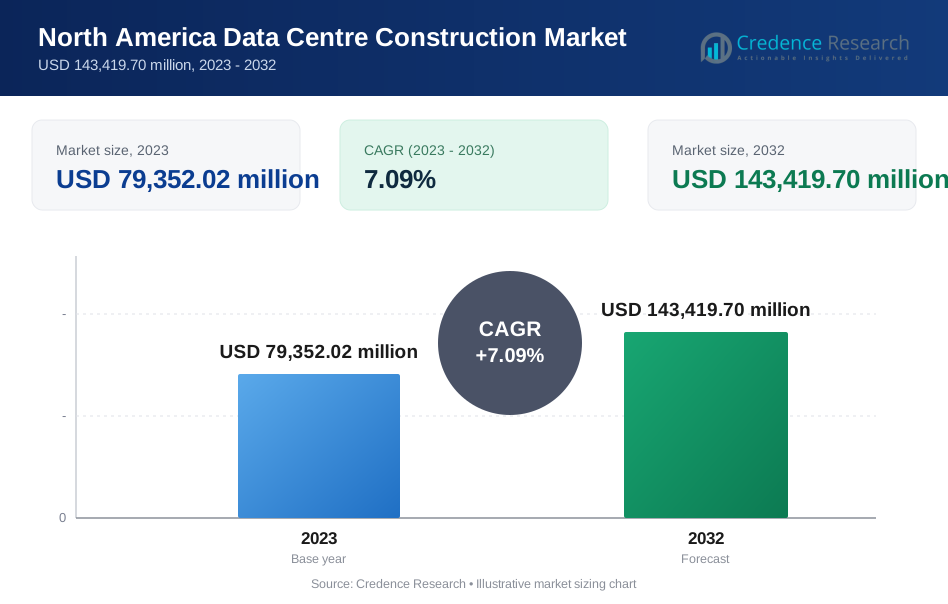
The North America Data Centre Construction Market is expected to grow from USD 79,352.02 million in 2023 to USD 143,419.70 million by 2032, reflecting a compound annual growth rate (CAGR) of 7.09%.
The North America Data Centre Construction Market is driven by the increasing demand for cloud services, big data analytics, and the growing adoption of AI and IoT technologies. As businesses continue to migrate to cloud-based solutions, the need for advanced data centres that offer high capacity and reliability is rising. Additionally, the surge in e-commerce and digital banking is further fueling demand for robust data storage and processing infrastructure. Trends such as the focus on energy efficiency, sustainability, and the integration of renewable energy sources into data centre operations are shaping the market's evolution.
The North America Data Centre Construction Market is predominantly led by the United States, which holds the largest market share due to its advanced technological infrastructure, significant investments in data centers, and the presence of major tech companies. Canada also plays a crucial role, driven by its growing demand for data storage and favorable government policies that encourage data center development. Key players in the market include AECOM, Turner Construction Co., DPR Construction, Jacobs Solutions Inc., and Skanska USA, all of which are recognized for their expertise in constructing state-of-the-art data centers to meet the region's increasing digital needs.
Market Drivers
Increased Demand for Cloud Computing
The North America Data Centre Construction Market is significantly driven by the rising demand for cloud computing. Cloud computing provides businesses with enhanced efficiency, scalability, and cost-effectiveness, making it an attractive solution for companies looking to optimize their operations. The need for robust data storage solutions is growing as businesses and individuals generate vast amounts of data daily. For instance, Google plans to invest $400 million to expand its data center operations in Nevada, boosting the state’s tech industry and economic growth. Cloud computing enables the storage, processing, and management of this data efficiently, supporting business continuity and digital transformation initiatives. As more organizations adopt cloud-based solutions, the demand for advanced data centres that can offer high capacity, security, and reliability continues to grow.
Advancements in Technology
Technological advancements, particularly in artificial intelligence (AI), machine learning (ML), and the Internet of Things (IoT), are key drivers of the North America Data Centre Construction Market. AI and ML technologies require powerful data centres capable of processing and analyzing large datasets to deliver insights and drive innovation. For instance, the synergy between IoT devices, infrastructure, and AI technologies is expected to deepen in 2024, furthering the progression of the artificial or augmented intelligence of things (AIoT). Similarly, the proliferation of IoT devices generates massive amounts of data that need to be stored and processed efficiently. Data centres provide the essential infrastructure to support these technologies, enabling businesses to harness the power of data for decision-making, automation, and enhancing customer experiences.
Digital Transformation
The ongoing digital transformation across various industries is another critical driver of the North America Data Centre Construction Market. Industries such as finance, healthcare, and manufacturing are increasingly adopting digital technologies, which drive the need for reliable and scalable data centres. The rise of remote work and e-commerce has also significantly increased demand for data centres, as businesses require robust infrastructure to support online services and ensure seamless operations. The shift towards digital platforms necessitates data centres that can handle increased traffic, provide high availability, and ensure data security.
Government Initiatives
Government initiatives and support play a crucial role in driving the growth of the data centre construction market in North America. Governments are investing heavily in infrastructure development, including data centres, to support economic growth and technological advancements. These investments create a conducive environment for the establishment and expansion of data centres. Moreover, the increasing focus on cybersecurity by governments is leading to higher demand for secure data centres that can protect sensitive information and comply with regulatory standards. This supportive regulatory environment and government incentives attract significant investments in the data centre sector, further boosting market growth.
Market Trends
Edge Computing and Sustainability
Edge computing is emerging as a critical trend in the North America Data Centre Construction Market, driven by the need to reduce latency and improve application performance. By placing data centres closer to the data source, edge computing ensures that data processing occurs nearer to end-users, thereby reducing the time taken for data to travel across the network. This approach is crucial for applications that require real-time processing, such as autonomous vehicles, smart cities, and industrial IoT. For instance, edge computing has been increasingly applied to support the 17 Sustainable Development Goals (SDGs), which address global challenges, including poverty, inequality, and climate change. The proliferation of edge data centres supports the growing demand for localized data processing, enhancing the user experience by providing faster and more reliable services. In parallel, there is an increasing focus on sustainability and energy efficiency within the data centre industry. As concerns about environmental impact grow, data centre operators are adopting green initiatives to minimize their carbon footprint. This includes the use of renewable energy sources, such as solar and wind power, to fuel data centre operations, as well as implementing energy-efficient cooling systems to reduce power consumption. These sustainable practices not only help in reducing operational costs but also align with corporate social responsibility goals, making data centres more attractive to environmentally-conscious customers. The integration of sustainability and energy efficiency into data centre design is becoming a standard practice, reflecting the industry's commitment to supporting a greener future while meeting the demands of a digital economy.
Hyperscale and Modular Data Centers
The North America Data Centre Construction Market is witnessing a significant trend towards the development of hyperscale and modular data centres. Hyperscale data centres, predominantly built by major technology companies such as Amazon, Google, and Microsoft, are becoming increasingly dominant due to their ability to support vast amounts of data and computing power. These tech giants are making large-scale investments to expand their data centre footprints, aiming to meet the growing demand for cloud services and big data analytics. The scalability and efficiency of hyperscale data centres make them ideal for handling the increasing volume of digital transactions and data storage needs. Alongside this, modular data centres are gaining traction due to their rapid deployment capabilities. Unlike traditional data centres that require extensive construction time, modular data centres can be assembled quickly, offering faster time-to-market for businesses. Their scalable nature allows companies to adjust capacity based on demand, making them a flexible solution for various industries. This adaptability is particularly beneficial in a dynamic market environment where business needs can change rapidly, ensuring that data centre infrastructure can keep pace with evolving requirements.
Market Challenges Analysis
Competitive Landscape and Regulatory Challenges
The competitive landscape of the North America Data Centre Construction Market is marked by the risk of overbuilding and intense competition. Rapid expansion of data centres in some regions has led to concerns about overbuilding, where the supply of data centre space exceeds demand. For instance, a recent industry survey found that many data center operators are concerned about potential oversupply in certain metro areas. This can result in excess capacity, lower occupancy rates, and downward pressure on pricing. Data centre operators must carefully assess market demand and manage their expansion plans to avoid oversupply and maintain profitability. Increased competition in the market also puts pressure on pricing and profit margins, as operators vie for clients and strive to offer competitive rates. Navigating the complex regulatory environment is another significant challenge for data centre developers. The process of obtaining necessary permits and approvals can be time-consuming and costly, with developers required to comply with various building codes, environmental regulations, and tax incentives. Policy uncertainty, including changes in government regulations, can create additional risks for investors, impacting their decision-making and long-term planning.
Talent Shortages and Economic Pressures
The North America Data Centre Construction Market faces a shortage of skilled workers, which poses a challenge to the industry's growth and efficiency. Finding and retaining professionals with expertise in data centre design, construction, and operations can be difficult, especially in technology hubs where competition for talent is high. The demand for skilled workers outpaces supply, leading to increased labor costs and potentially slowing down project timelines. Addressing this talent gap requires investment in training and development programs to build a capable workforce that can meet the industry's needs. Economic pressures, such as currency fluctuations and broader economic instability, also impact the market. These pressures can affect the cost of construction materials and equipment, making financial planning more complex for data centre developers. Political instability and security concerns can further create risks for data centre operations, requiring operators to implement robust security measures to protect their facilities and ensure business continuity. Balancing these challenges is crucial for sustaining the growth and competitiveness of the North America Data Centre Construction Market.
Market Segmentation Analysis:
By Type:
The North America Data Centre Construction Market is segmented by type into Tier 1, Tier 2, Tier 3, and Tier 4 facilities. Tier 1 and Tier 2 data centres offer basic infrastructure with limited redundancy, making them suitable for non-critical applications and smaller businesses. However, there is a growing demand for Tier 3 and Tier 4 data centres, which provide higher levels of redundancy, reliability, and security. These advanced facilities are designed to ensure continuous operation, even during maintenance or unexpected outages, making them ideal for mission-critical applications. Sectors such as finance, healthcare, and IT, which require robust data handling and 24/7 availability, are driving the demand for Tier 3 and Tier 4 data centres. As businesses increasingly prioritize data security and uptime, the market is shifting towards these higher-tier facilities to meet stringent industry standards and ensure business continuity.
By Infrastructure:
The North America Data Centre Construction Market is also segmented based on infrastructure, including IT infrastructure, power distribution and cooling (PD & Cooling) infrastructure, and miscellaneous infrastructure. IT infrastructure is a critical component, comprising networking equipment, servers, and storage solutions, which are essential for managing data and ensuring high-speed connectivity. The growing need for data storage and processing is driving investments in advanced IT infrastructure to support cloud services, big data, and artificial intelligence applications. PD & Cooling infrastructure is vital for maintaining optimal operating conditions, as data centres require efficient power distribution systems and advanced cooling solutions to prevent overheating and downtime. Effective cooling and reliable power supply are crucial for the stability and efficiency of data centre operations. Miscellaneous infrastructure includes additional elements such as security systems, fire suppression, and monitoring equipment, which are essential for ensuring the safety and reliability of data centres. This comprehensive approach to infrastructure development supports the growing demand for secure, efficient, and scalable data centre solutions in North America.
Segments:
Based on Type:
- Tier 1
- Tier 2
- Tier 3
- Tier 4
Based on Infrastructure:
- IT Infrastructure
- Networking Equipment
- Server
- Storage
- PD & Cooling Infrastructure
- Power Distribution
- Cooling
- Miscellaneous Infrastructure
Based on Vertical:
- IT & Telecom
- BFSI
- Government & Defense
- Healthcare
- Energy
- Others
Based on the Geography:
- US.
- Canada
- Mexico
Regional Analysis
U.S.
The United States dominates the North American data centre construction market with an overwhelming 85% market share. As a global technology leader, the U.S. continues to drive innovation and growth in the data centre industry. Key regions such as Northern Virginia, Silicon Valley, and Dallas-Fort Worth have emerged as major data centre hubs, attracting significant investments from both domestic and international players. The U.S. market is characterized by a diverse range of facilities, from hyperscale data centres supporting cloud giants to edge computing facilities catering to low-latency applications. The rapid adoption of AI, IoT, and 5G technologies is fueling demand for more sophisticated and energy-efficient data centre designs. U.S. data centre operators are at the forefront of implementing advanced cooling solutions, renewable energy integration, and modular construction techniques to optimize performance and sustainability. The market's growth is further bolstered by favorable tax incentives in key states, robust connectivity infrastructure, and a strong ecosystem of technology vendors and skilled professionals.
Canada
Canada holds a 10% market share in the North American data centre construction market, with its importance steadily growing. Major urban centers such as Toronto, Montreal, and Vancouver are emerging as significant data centre markets, attracting investments from both local and international operators. Canada's appeal lies in its stable political environment, abundant renewable energy sources, and cooler climate, which naturally aids in reducing cooling costs for data centres. The country's strict data sovereignty laws have also driven demand for in-country data storage solutions, particularly from government agencies and financial institutions. Canadian data centre operators are increasingly focusing on sustainability, with many facilities powered by hydroelectric and other renewable energy sources. The market is seeing a trend towards larger, more efficient facilities, with a growing emphasis on edge computing to support Canada's vast geography.
Key Player Analysis
- AECOM
- Whiting-Turner Contracting Company
- Turner Construction Co.
- Jacobs Solutions Inc.
- DPR Construction
- Skanska USA
- Balfour Beatty US
- Hensel Phelps
- McCarthy Building Companies Inc.
- Gilbane Building Company
- Brasfield & Gorrie LLC
Competitive Analysis
The North America Data Centre Construction Market is highly competitive, with leading players like AECOM, Turner Construction Co., DPR Construction, Jacobs Solutions Inc., and Skanska USA dominating the landscape. These companies leverage their extensive experience, advanced technological capabilities, and comprehensive service offerings to maintain their market positions. They provide end-to-end solutions, from design and planning to construction and integration of advanced IT and cooling systems, ensuring the efficient operation of data centers. Their competitive edge lies in their ability to deliver scalable, energy-efficient, and secure facilities that cater to the needs of various industries, including finance, healthcare, and cloud services. By focusing on innovation, sustainability, and compliance with regional regulations, these key players continue to attract significant projects and investments. Their strong presence across North America and ability to adapt to evolving market demands ensure they remain at the forefront of the data center construction industry.
Recent Developments
- In January 2024, Turner Construction was selected to build a hyperscale data center campus for Meta in Jeffersonville, Indiana. The project represents an investment of more than $800 million.
- In January 2024, Whiting-Turner was selected by Google to build a $600 million data center in Wasco County, Oregon.
- In May 2024, Skanska signed a contract to build a data center in Georgia, USA, worth $90 million. The project includes the construction of a 22,700 square-meter data center, associated site work, and underground utilities.
- In April 2024, Gilbane successfully completed the construction of the University of Virginia’s cutting-edge School of Data Science building.
- In October 2023, Meta resumed construction of its data centers in Temple, Texas, and Kuna, Idaho, with new AI design. Hensel Phelps is involved in the Kuna Data Center project.
Market Concentration & Characteristics
The North America Data Centre Construction Market exhibits a high level of market concentration, with a few dominant players such as AECOM, Turner Construction Co., and DPR Construction leading the industry. These companies hold significant market shares due to their established reputations, extensive experience, and ability to deliver comprehensive, high-quality data centre solutions. The market is characterized by a strong demand for Tier III and Tier IV facilities, driven by the need for high reliability, security, and uptime to support mission-critical applications. These advanced facilities are preferred by industries such as finance, healthcare, and technology, which require robust data handling capabilities. Additionally, the market is shaped by an increasing focus on sustainability and energy efficiency, with operators adopting green technologies and renewable energy sources to reduce environmental impact and operational costs. The combination of technological innovation, strategic location, and a focus on high-tier infrastructure continues to shape the competitive dynamics of the North America data centre construction market.
Report Coverage
The research report offers an in-depth analysis based on Type, Infrastructure, Vertical and Geography. It details leading market players, providing an overview of their business, product offerings, investments, revenue streams, and key applications. Additionally, the report includes insights into the competitive environment, SWOT analysis, current market trends, as well as the primary drivers and constraints. Furthermore, it discusses various factors that have driven market expansion in recent years. The report also explores market dynamics, regulatory scenarios, and technological advancements that are shaping the industry. It assesses the impact of external factors and global economic changes on market growth. Lastly, it provides strategic recommendations for new entrants and established companies to navigate the complexities of the market.
Future Outlook
- The demand for data centers in North America will continue to grow, driven by the increasing adoption of cloud computing and digital transformation.
- Investment in Tier III and Tier IV data centers will rise to meet the need for high reliability and security in data storage and processing.
- The expansion of edge computing will drive the development of smaller data centers closer to end-users to reduce latency and improve service delivery.
- Sustainability will become a key focus, with data center operators integrating renewable energy sources and energy-efficient technologies.
- The regulatory environment will evolve, with governments offering incentives to attract data center investments while ensuring compliance with data privacy and cybersecurity standards.
- Hyperscale data centers will proliferate, built by major technology companies to support large-scale cloud services and big data analytics.
- The rise of AI, ML, and IoT will further increase the demand for advanced data center infrastructure capable of handling massive data volumes.
- Regional diversification will continue, with data center development expanding into new areas to meet growing demand and optimize costs.
- The competitive landscape will intensify, with both established players and new entrants vying for market share in key regions.
- The need for a skilled workforce will lead to increased investment in training and development programs to support the growing data center industry.
Request a Free Sample
Fill in your details and we'll send you a free sample report.
- Sample data tables & charts
- Research methodology
Need a Custom Version of This Report?
Tailor the scope, geography, or segments to your exact requirements.
- Custom geography or segment scope
- Direct access to our analyst team
Frequently Asked Questions
What is the current size of the North America Data Centre Construction Market?
What factors are driving the growth of the North America Data Centre Construction Market?
What are the key segments within the North America Data Centre Construction Market?
Who are the major players in the North America Data Centre Construction Market?
Table of Content
Chapter 1. Report Introduction
- 1.1 Report Description & Purpose
- 1.1.1 Report Title & Market Definition
- 1.1.2 Unique Selling Propositions (USP) & Key Differentiators
- 1.1.3 Value Proposition for Stakeholders
- 1.2 Research Objectives
- 1.2.1 Market Sizing Objectives (Volume & Revenue)
- 1.2.2 Segmentation Objectives
- 1.2.3 Competitive Intelligence Objectives
- 1.2.4 Forecast & Scenario Objectives
- 1.3 Report Scope
- 1.3.1 North America Data Centre Construction Scope – Types & Subtypes Covered
- 1.3.2 Geographic Scope – Regions & Countries Covered
- 1.3.3 Historical Period, Base Year & Forecast Period (2023; forecast to 2032)
- 1.3.4 Inclusions & Exclusions
- 1.4 HS Code & Classification Framework
- 1.5 Currency, Units & Pricing Basis
- 1.6 Target Stakeholders
- 1.7 Limitations & Assumptions
Chapter 2. Executive Summary
- 2.1 Global North America Data Centre Construction Market Snapshot
- 2.1.1 Market Size – Historical (2023) & Forecast (2023-2032) (2023: USD 79,352.02 million → 2032: USD 143,419.70 million)
- 2.1.2 Volume & Revenue – Global Totals
- 2.1.3 Key Market Highlights – Top Five Facts
- 2.2 North America Data Centre Construction Market Segmentation Snapshot
- 2.2.1 Market Split by Region – 2023 vs. 2032
- 2.3 Competitive Snapshot
- 2.3.1 Top 10 Players by Revenue Share – 2023
- 2.3.2 Top 10 Players by Volume Share – 2023
- 2.3.3 Recent Strategic Developments (18-Month Summary)
- 2.4 Key Investment Highlights & Strategic Conclusions
Chapter 3. North America Data Centre Construction Market Dynamics & Industry Analysis
- 3.1 Market Overview & Context
- 3.1.1 North America Data Centre Construction Market Position in the Broader Automotive Value Chain
- 3.1.2 OEM vs. Replacement Market Dynamics
- 3.1.3 Market Maturity & Development Stage by Region
- 3.2 North America Data Centre Construction Market Drivers
- 3.3 North America Data Centre Construction Market Restraints & Challenges
- 3.4 North America Data Centre Construction Market Opportunities
- 3.5 Porter's Five Forces Analysis
- 3.5.1 Threat of New Entrants
- 3.5.2 Bargaining Power of Suppliers
- 3.5.3 Bargaining Power of Buyers
- 3.5.4 Threat of Substitutes
- 3.5.5 Competitive Rivalry – Intensity Assessment
- 3.6 North America Data Centre Construction Value Chain Analysis
- 3.6.1 Upstream – Raw Material/Input Suppliers
- 3.6.1.1 Raw Material/Input 1
- 3.6.1.2 Raw Material/Input 2
- 3.6.1.3 Raw Material/Input 3
- 3.6.2 Midstream – Production/Manufacturing/Service Delivery
- 3.6.2.1 Production/Process Overview
- 3.6.2.2 Key Facility Locations & Capacity by Manufacturer
- 3.6.3 Downstream – Distribution & End Consumer
- 3.6.3.1 Primary Channel – B2B/OEM
- 3.6.3.2 Secondary Channels – Dealer, Retail, Online, Direct
- 3.6.4 Value Chain Profitability Analysis
- 3.6.1 Upstream – Raw Material/Input Suppliers
- 3.7 PESTEL Analysis
- 3.7.1 Political Factors
- 3.7.2 Economic Factors
- 3.7.3 Social Factors
- 3.7.4 Technological Factors
- 3.7.5 Environmental Factors
- 3.7.6 Legal Factors
- 3.8 North America Data Centre Construction Supply Chain Analysis
- 3.8.1 Raw Material/Input Supply Risk Assessment
- 3.8.2 Manufacturing Concentration Risk (Geographic Exposure)
- 3.8.3 Trade Disruption Impact Analysis
- 3.9 Regulatory & Policy Landscape
Note: The regulatory and policy landscape section covers regulations based on their applicability to the market, North America Data Centre Construction category, geography, and scope of the study. Only regulatory frameworks with a material impact on operations, compliance, trade, sustainability, or market access are analyzed in detail.
Chapter 4. Key Investment Pockets & Opportunity Analysis
- 4.1 North America Data Centre Construction Market Attractiveness Analysis
- 4.1.1 By Region – Investment Attractiveness Matrix (Volume × CAGR)
- 4.2 Absolute Revenue Growth Opportunity
- 4.2.1 By Region – Absolute USD Growth Through 2032
- 4.3 Incremental Volume Opportunity
- 4.3.1 By Region – Incremental Volume Through 2032
- 4.3.2 Segment – Incremental Volume
- 4.4 Emerging Submarket Opportunity Deep Dive (Subject to Applicability)
- 4.5 Emerging Market Opportunity Scorecards
- 4.5.1 United States
- 4.5.2 Europe
- 4.5.3 Asia
- 4.5.4 Middle East & Africa
Note: Emerging Market Opportunity Scorecards will be included based on relevance and strategic importance. Regions listed are indicative and may vary depending on data availability and market dynamics.
Chapter 5. North America Data Centre Construction Import-Export Analysis & Trade Flows
- 5.1 Global Trade Overview
- 5.1.1 Global Export Value by Country (2023)
- 5.1.2 Global Export Volume by Country (2023)
- 5.1.3 Global Import Value by Country (2023)
- 5.1.4 Global Import Volume by Country (2023)
- 5.1.5 Net Trade Balance by Country (2023)
- 5.2 Export Analysis – Segment
- 5.2.1 Type 1 (HS Code)
- 5.2.2 Type 2 (HS Code)
- 5.2.3 Type 3 (HS Code)
- 5.2.4 Type 4 (HS Code)
- 5.2.5 Type 5 (HS Code)
- 5.3 Import Analysis – Segment
- 5.3.1 Type 1 (HS Code)
- 5.3.2 Type 2 (HS Code)
- 5.3.3 Type 3 (HS Code)
- 5.3.4 Type 4 (HS Code)
- 5.3.5 Type 5 (HS Code)
- 5.4 Average Unit Trade Prices
- 5.4.1 Average Export Price – Segment & Country
- 5.4.2 Average Import Price – Segment & Source Country
- 5.4.3 Price Trends (2023)
- 5.5 Key Trade Route Analysis
- 5.5.1 Trade Route 1
- 5.5.2 Trade Route 2
- 5.5.3 Trade Route 3
- 5.5.4 Trade Route 4
- 5.5.5 Trade Route 5
- 5.6 Trade Policy Impact Assessment
- 5.6.1 US Anti-Dumping & Section 301 Tariffs
- 5.6.2 EU Customs Union Impact
- 5.6.3 Major Free Trade Agreements
- 5.6.4 USMCA Rules of Origin
Note: Trade policy analysis will be included only where relevant to the North America Data Centre Construction market.
Chapter 6. Competitive Landscape & Company Benchmarking
- 6.1 North America Data Centre Construction Market Concentration & Structure
- 6.1.1 Herfindahl-Hirschman Index (HHI) – vs. 2023
- 6.1.2 Tier 1, Tier 2 & Tier 3 Market Structure
- 6.1.3 Global, Regional & Local Player Dynamics
- 6.2 North America Data Centre Construction Market Share Analysis – 2023
- 6.2.1 Global Revenue Share by Company
- 6.2.2 Global Volume Share by Company
- 6.2.3 Regional Revenue Share
- 6.2.4 Market Share Evolution ( vs. 2023)
- 6.2.5 OEM Segment Share by Company
- 6.2.6 Replacement Segment Share by Company
- 6.3 Production/Delivery Capacity & Facility Analysis
- 6.3.1 Global Installed Capacity
- 6.3.2 Capacity Utilization Rates
- 6.3.3 Production/Output Volume
- 6.3.4 Facility Locations & Capacity Map
- 6.3.5 Planned Capacity Additions
- 6.4 North America Data Centre Construction Competitive Benchmarking Matrix
- 6.4.1 Revenue, Volume, CAGR & Profitability Comparison
- 6.4.2 Channel Revenue Mix
- 6.4.3 Geographic Revenue Exposure
- 6.4.4 R&D Intensity
- 6.4.5 Sustainability Maturity
- 6.5 Strategic Developments in North America Data Centre Construction (Last 24 Months)
- 6.5.1 Mergers, Acquisitions & Divestments
- 6.5.2 New North America Data Centre Construction Launches
- 6.5.3 Facility Expansions
- 6.5.4 Strategic Alliances, Joint Ventures & Partnerships
- 6.5.5 Distribution Expansion & Market Entry
- 6.5.6 Sustainability & ESG Initiatives
- 6.6 Competitive Strategy Mapping
- 6.6.1 Leader, Challenger, Follower & Niche Classification
- 6.6.2 Pricing Strategy Comparison
- 6.6.3 Channel Strategy Matrix
Note: Strategic developments are included based on their materiality and the availability of reliable information.
Chapter 7. Global North America Data Centre Construction Market – By Distribution Channel
- 7.1 Segment Overview
- 7.1.1 Volume & Revenue Split by Channel (2023 & 2032)
- 7.1.2 Channel Mix Evolution (2023-2032)
Chapter 8. Regional Market Analysis – Global Overview
- 8.1 Global Regional Overview
- 8.1.1 Regional Volume Share
- 8.1.2 Regional Revenue Share
- 8.1.3 Regional Volume by Region
- 8.1.4 Regional Revenue by Region
- 8.1.5 Regional Forecast Through 2032
- 8.2 Cross-Regional Segment Analysis
- 8.2.1 By Distribution Channel
- 8.2.2 By Brand/Price Tier
Chapter 9. North America North America Data Centre Construction Market
- 9.1 United States
- 9.2 Canada
- 9.3 Mexico
Chapter 10. Europe North America Data Centre Construction Market
- 10.1 Germany
- 10.2 France
- 10.3 Italy
- 10.4 United Kingdom
- 10.5 Spain
- 10.6 Poland
- 10.7 Russia
- 10.8 Netherlands
- 10.9 Belgium
- 10.10 Sweden
- 10.11 Denmark
- 10.12 Norway
- 10.13 Rest of Europe
Chapter 11. Asia Pacific North America Data Centre Construction Market
- 11.1 China
- 11.2 India
- 11.3 Japan
- 11.4 South Korea
- 11.5 Thailand
- 11.6 Indonesia
- 11.7 Vietnam
- 11.8 Malaysia
- 11.9 Australia
- 11.10 Rest of Asia Pacific
Chapter 12. Latin America North America Data Centre Construction Market
- 12.1 Brazil
- 12.2 Argentina
- 12.3 Colombia
- 12.4 Chile
- 12.5 Rest of Latin America
Chapter 13. Middle East North America Data Centre Construction Market
- 13.1 Saudi Arabia
- 13.2 United Arab Emirates
- 13.3 Turkey
- 13.4 Israel
- 13.5 Iran
- 13.6 Rest of the Middle East
Chapter 14. Africa North America Data Centre Construction Market
- 14.1 South Africa
- 14.2 Egypt
- 14.3 Nigeria
- 14.4 Morocco
- 14.5 Rest of Africa
Chapter 15. North America Data Centre Construction Company Profiles
- 15.1 [Company 01]
- 15.1.1 Company Overview
- 15.1.2 Key Management Personnel
- 15.1.3 Products & Services Portfolio
- 15.1.4 Financial Performance
- 15.1.5 Key Market Focus & Geographic Presence
- 15.1.6 Recent Developments & Strategic Initiatives
Note: The company profile list is preliminary and may change based on research findings, market developments, data availability, and client requirements.
Chapter 16. Appendices
- Appendix A – List of Abbreviations & Acronyms
- Appendix B – Industry Classification Code Reference – Full Series
- Appendix C – Production & Capacity Data Tables
- Appendix D – End-Use & Demand Base Tables
- Appendix E – Consumption & Replacement Rate Assumptions
- Appendix F – ASP Reference Tables
- Appendix G – Manufacturing & Facility Database
- Appendix H – Import-Export Data Tables
- Appendix I – Regulatory Summary Tables
- Appendix J – Primary Research Participant List (Anonymized)
- Appendix K – Primary Research Questionnaire Framework
- Appendix L – Data Sources & Bibliography
- Appendix M – Market Size Divergence & Source Comparison
Chapter 17. Research Methodology
- 17.1 Research Framework & Philosophy
- 17.2 Secondary Research – Sources, Hierarchy & Data Extraction
- 17.3 Data Modeling – Bottom-Up & Top-Down Market Sizing
- 17.4 Primary Research – Stakeholder Framework, LOI & Sample Sizes
- 17.5 Forecast Methodology – Regression, Scenario & Sensitivity Analysis
- 17.6 Quality Control – Four-Layer Validation Framework
- 17.7 Limitations & Standard Assumptions
- 17.8 Disclaimer
