| REPORT ATTRIBUTE | DETAILS |
|---|---|
| Historical Period | 2020-2023 |
| Base Year | 2024 |
| Forecast Period | 2025-2032 |
| North America Off the Road Tire Market Size 2023 | USD 6,400.13 Million |
| North America Off the Road Tire Market, CAGR | 4.43% |
| North America Off the Road Tire Market Size 2032 | USD 9,450.24 Million |
Market Overview:
North America Off the Road Tire Market size was valued at USD 6,400.13 million in 2023 and is anticipated to reach USD 9,450.24 million by 2032, at a CAGR of 4.43% during the forecast period (2023-2032).
Several factors are propelling the growth of the OTR tire market in North America. A primary driver is the surge in infrastructure development and construction activities, which necessitate the use of heavy machinery equipped with durable OTR tires. This increase in infrastructure projects is closely tied to urbanization and public works initiatives that drive the need for specialized equipment. Additionally, the expansion of mining operations across the region increases the demand for tires capable of withstanding harsh and challenging terrains. As mineral extraction activities intensify, OTR tires are required for the safe and efficient operation of mining equipment in demanding environments. The agricultural sector's increasing mechanization further contributes to the market's growth, as modern farming equipment relies on high-performance tires for efficiency and productivity. With a push toward automation and high-yield farming, durable and reliable tires are essential.
The United States dominates the North American OTR tire market, accounting for a significant share due to substantial investments in infrastructure and mining projects. The demand for heavy-duty tires is propelled by major construction projects in both public and private sectors, including roadways, bridges, and residential developments. Canada's market is also expanding, driven by similar factors, including government support for infrastructure development and a growing focus on sustainable construction practices. The Canadian government’s commitment to large-scale infrastructure projects, such as highways and urban development, ensures the continuous demand for specialized OTR tires. Mexico, while smaller in comparison, is witnessing growth in its OTR tire market, supported by increasing industrial activities and infrastructure projects. This includes expanding agricultural and mining industries that require reliable tires for heavy equipment. Collectively, these countries contribute to the robust growth of the North American OTR tire market.
Market Insights:
- The North American Off-the-Road (OTR) tire market was valued at USD 6,400.13 million in 2023 and is expected to grow to USD 9,450.24 million by 2032, with a CAGR of 4.43% during the forecast period.
- The Global OTR tire market was valued at USD 18,234 million in 2023 and is expected to grow to USD 27,097.46 million by 2032, at a CAGR of 4.5%.
- Infrastructure development, particularly in construction projects such as highways and residential buildings, drives demand for durable OTR tires for heavy-duty machinery.
- The mining sector's expansion in the U.S. and Canada increases the need for OTR tires that can withstand harsh, rugged terrains and extreme environmental conditions.
- Agricultural mechanization is another major growth factor, as modern farming equipment, including tractors and harvesters, requires high-performance OTR tires for efficiency in diverse field conditions.
- Technological advancements in tire design, including the use of eco-friendly materials and improved tread patterns, contribute to better tire performance and durability, attracting industries like construction, mining, and agriculture.
- High costs associated with OTR tires remain a key challenge, limiting accessibility for smaller businesses or those with tighter budgets, despite the long-term benefits of performance and durability.
- Environmental concerns and regulatory compliance regarding tire disposal and recycling are increasing operational costs, as businesses must adhere to stricter sustainability standards.
Market Drivers:
Infrastructure Development and Construction Activities
A primary driver of the North American Off-the-Road (OTR) tire market is the substantial increase in infrastructure development across the region. As governments invest heavily in construction projects, such as highways, bridges, and residential complexes, the demand for heavy-duty machinery rises. For instance, the U.S. Infrastructure Investment and Jobs Act (IIJA) allocates $550 billion for physical infrastructure upgrades, while the Bipartisan Infrastructure Law (BIL) provides $1.2 trillion for transportation, energy, and climate infrastructure projects. These machines require specialized OTR tires capable of withstanding the rigorous conditions of construction sites. The growth in urbanization and public works projects further fuels the demand for OTR tires as these developments require large-scale machinery for earthmoving, excavating, and lifting. The ongoing investments in infrastructure, especially in the United States and Canada, ensure a steady demand for tires that can perform under extreme working conditions, solidifying OTR tire growth.
Expansion of the Mining Sector
Another significant factor driving the North American OTR tire market is the continued expansion of the mining sector. For instance, in 2023, U.S. mineral production contributed over $105 billion to the economy, with mining operations demanding tires capable of handling extreme loads and abrasive conditions. North America boasts substantial mineral resources, and mining activities, particularly in Canada and the United States, are ramping up to meet the increasing global demand for materials. Specialized mining equipment, such as haul trucks and excavators, require durable OTR tires that can operate in harsh and challenging terrains, including extreme temperatures and rough surfaces. As mining operations continue to grow and expand, the demand for tires designed to handle these difficult environments remains high. This growth in mining activity is a key factor behind the rising market demand for OTR tires in the region.
Agricultural Mechanization
The growing mechanization of agriculture is also playing a pivotal role in driving the North American OTR tire market. As the agricultural industry modernizes, more advanced machinery, such as tractors, harvesters, and loaders, are being adopted for high-efficiency farming. This shift towards automation and increased use of heavy-duty farming equipment demands specialized OTR tires to ensure efficient operations. The need for tires that can perform well in diverse field conditions-such as wet or uneven terrain-fuels the demand for high-performance OTR tires. This trend is particularly strong in the United States, where large-scale farming operations require robust and reliable tires to enhance productivity and maintain equipment longevity.
Technological Advancements in Tire Design
Technological advancements in OTR tire design and manufacturing are another key driver of market growth in North America. Tire manufacturers are continuously innovating to improve tire performance, durability, and fuel efficiency. Modern OTR tires are equipped with advanced materials and technologies that make them more resilient to wear and tear, thereby extending their lifespan and reducing the total cost of ownership for end-users. These innovations include the use of eco-friendly materials, improved tread patterns for better traction, and enhanced structural designs that enable tires to handle higher loads and more challenging operating conditions. As these innovations continue to evolve, OTR tires become increasingly attractive to businesses in the construction, mining, and agricultural sectors, contributing to the overall growth of the market.
Market Trends:
Shift Toward Sustainable and Eco-friendly Tires
One of the most prominent trends in the North American OTR tire market is the increasing demand for sustainable and eco-friendly tire solutions. As environmental concerns grow, there is a heightened focus on developing tires that minimize the environmental impact throughout their lifecycle. Manufacturers are incorporating more sustainable materials, such as bio-based rubbers and recycled materials, to produce OTR tires with a reduced carbon footprint. For instance, Bridgestone is investing in sustainable innovation by developing natural rubber from guayule, a desert shrub native to the Southwestern U.S., at its Biorubber Process Research Center in Arizona, aiming to diversify natural rubber sources and reduce environmental impact. Additionally, the shift toward renewable energy sources and eco-conscious business practices in the construction, mining, and agricultural sectors is further driving the demand for tires that align with sustainability goals. This trend is not only shaping the product development landscape but also influencing regulatory frameworks that promote greener industrial practices.
Technological Integration in Tire Manufacturing
Advancements in tire manufacturing technologies are transforming the North American OTR tire market. The integration of cutting-edge technologies, such as smart tire sensors and artificial intelligence, is enabling manufacturers to create more efficient and performance-oriented products. For instance, Goodyear introduced its SightLine technology, which integrates sensors directly into tires to monitor road conditions and tire performance, supporting autonomous vehicle operations by delivering critical data for operational safety and efficiency. Smart tires equipped with sensors are becoming increasingly popular as they provide real-time data on tire pressure, temperature, and wear patterns. This technology helps businesses optimize tire performance, reduce operational downtime, and extend tire lifespan. The growing use of digital tools in tire monitoring and management is a significant trend that enhances the overall value proposition of OTR tires for end-users across different industries, especially in the mining and construction sectors.
Growth of the Retread Tire Market
The retread tire market is witnessing considerable growth as businesses seek cost-effective alternatives to purchasing new OTR tires. Retreading involves renewing used tires, which can significantly reduce costs for industries that rely heavily on tires, such as construction and mining. This trend is particularly pronounced in North America, where cost-conscious businesses are increasingly opting for retreaded tires as they offer a more affordable yet reliable option without compromising on performance. Retreaded tires, especially for off-road applications, also help reduce waste, aligning with the broader push for sustainability. As a result, the retread tire market continues to gain traction alongside the growth of the OTR tire market.
Increased Focus on Tire Efficiency and Performance
The demand for tires with enhanced efficiency and performance capabilities is growing, particularly within the North American OTR tire market. As industries like construction and mining face increasing pressure to improve productivity and reduce operational costs, there is a rising demand for tires that offer better fuel efficiency, longer lifespan, and superior durability under heavy loads. Manufacturers are investing in innovative tire designs that deliver superior performance in extreme conditions, such as rough terrains, high temperatures, and heavy-duty applications. The focus on maximizing tire efficiency, through the development of advanced tread patterns and improved rubber compounds, is a key trend driving the OTR tire market forward. This trend aligns with the broader industry objective of achieving more sustainable and cost-effective operations.
Market Challenges Analysis:
High Cost of OTR Tires
One of the key restraints in the North American OTR tire market is the high cost associated with purchasing and maintaining specialized tires. OTR tires, designed to withstand extreme conditions in industries like construction, mining, and agriculture, are typically more expensive than standard tires. The advanced materials, technology, and durability required for these tires drive up their production cost, making them less accessible to smaller businesses or operations with limited budgets. For instance, the average cost of a large OTR tire can exceed $1,500, and in the case of mining haul trucks, new OTR tires can cost between $38,000 and $50,000 each, with haul trucks typically requiring six tires per vehicle. While the high initial investment may be justified by performance and longevity, the upfront cost can still act as a significant barrier for businesses, especially those with tight margins.
Limited Availability of Skilled Labor
Another challenge facing the North American OTR tire market is the shortage of skilled labor capable of properly maintaining and servicing these specialized tires. OTR tires require regular maintenance and specialized knowledge to ensure their optimal performance, particularly for businesses operating heavy machinery. As the demand for skilled tire technicians and mechanics outpaces supply, companies may face increased labor costs and difficulties in keeping their equipment running efficiently. This shortage of skilled labor can lead to longer downtimes, increased operational costs, and a greater reliance on external service providers.
Environmental Concerns and Regulatory Compliance
As environmental regulations tighten, the North American OTR tire market faces growing pressure to comply with sustainability standards. The disposal of worn-out OTR tires presents an environmental challenge due to the large volume of tires used across industries. Proper recycling and disposal are costly and increasingly regulated by both local and federal authorities. Businesses must invest in tire recycling initiatives and adhere to stricter regulations to minimize environmental impact, which can add to operational costs. Moreover, evolving environmental policies could affect production processes and further increase compliance costs for manufacturers.
Market Saturation
The North American OTR tire market is also facing saturation in certain segments, especially in mature industries like construction. As the market reaches maturity, growth becomes harder to sustain, and manufacturers must innovate or diversify their product offerings to maintain competitiveness. This saturation can result in price pressure and reduced profit margins, presenting a challenge for companies seeking to maintain market share in a highly competitive landscape.
Market Opportunities:
A significant opportunity in the North American OTR tire market lies in the continued expansion of infrastructure and construction projects across the region. Governments in the United States, Canada, and Mexico are investing heavily in public works, including road construction, bridges, and urban development. This ongoing focus on large-scale infrastructure projects provides a sustained demand for heavy machinery, which, in turn, drives the need for specialized OTR tires capable of handling extreme working conditions. As cities grow and aging infrastructure is upgraded, OTR tire manufacturers have a significant opportunity to meet the increasing demand for high-performance, durable tires designed for construction and excavation equipment. This expanding infrastructure investment is expected to be a primary driver of market growth in the coming years.
Another major opportunity for growth in the North American OTR tire market stems from emerging technological advancements and the growing emphasis on sustainability. As industries become more focused on reducing their environmental footprint, there is an increasing demand for eco-friendly OTR tire solutions. Tire manufacturers are innovating with sustainable materials, such as bio-based rubbers and recycling processes, to reduce the environmental impact of tire production and disposal. Additionally, the integration of smart tire technologies, such as sensors that monitor tire performance in real time, offers manufacturers the chance to meet the needs of industries looking for cost-effective solutions that enhance productivity and reduce operational downtime. By aligning product development with these trends, companies can tap into new market segments that prioritize both innovation and sustainability.
Market Segmentation Analysis:
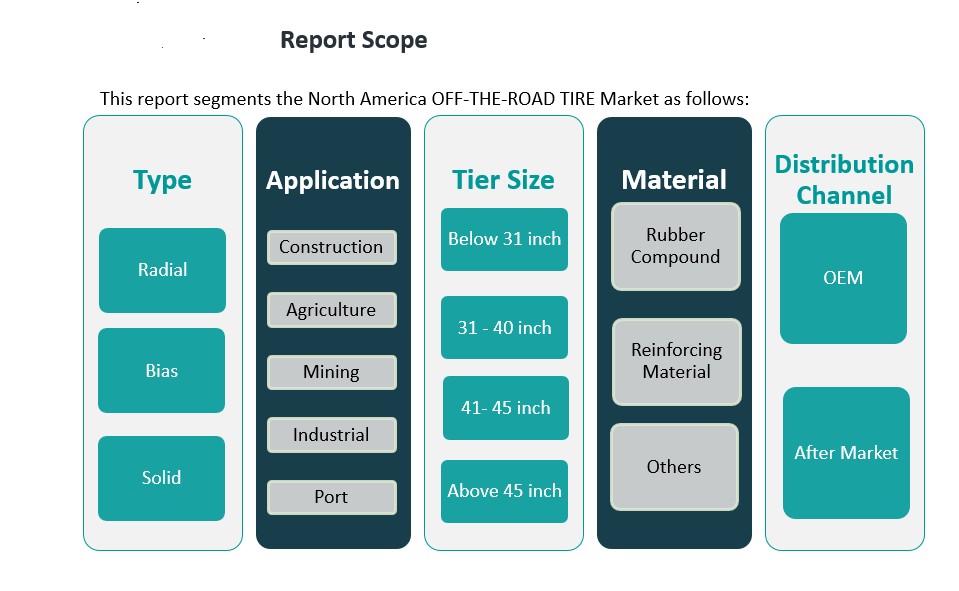
The North American Off-the-Road (OTR) tire market is segmented into several categories, each playing a crucial role in shaping the market dynamics.
By Type segment, radial tires dominate due to their superior durability and performance in heavy-duty applications, followed by bias tires, which are typically used in applications requiring more load-bearing capacity. Solid tires are gaining popularity in industries such as ports and waste management due to their ability to withstand severe wear and punctures.
By Application segment, the construction industry is the largest contributor, driven by extensive infrastructure projects and urbanization. The agriculture sector also holds significant demand for OTR tires, as mechanization continues to increase. The mining sector remains a vital application, requiring durable tires for harsh terrain, while the industrial and port sectors rely on specialized tires for material handling and operational efficiency.
By Tire Size segment reflects varied demand across industries, with 31-40 inch and 41-45 inch tires being the most popular in construction and mining applications. Larger tires, such as those above 45 inches, are preferred for heavy-duty mining and port operations.
By Material segment, rubber compounds dominate as they provide the necessary strength and flexibility for heavy-duty operations. The reinforcing materials category, which includes steel belts and fabric, plays a crucial role in enhancing the structural integrity of tires.
By Distribution Channel segment shows a strong presence of OEMs in supplying original equipment to industries, while the aftermarket segment caters to replacement tire demand, driven by long-term usage and maintenance needs.
Segmentation:
By Type Segment
- Radial
- Bias
- Solid
By Application Segment
- Construction
- Agriculture
- Mining
- Industrial
- Port
By Tire Size Segment
- Below 31 inch
- 31 - 40 inch
- 41 - 45 inch
- Above 45 inch
By Material Segment
- Rubber Compound
- Reinforcing Material
- Others
By Distribution Channel Segment
- OEM
- After Market
Regional Analysis:
The North American Off-the-Road (OTR) tire market is influenced by the varying demand across different regions within the continent. The key regions driving growth in this market include the United States, Canada, and Mexico, each contributing uniquely to the overall market landscape.
United States
The United States holds the largest market share in the North American OTR tire market, accounting for approximately 70% of the total market value. The nation's extensive infrastructure development, mining operations, and agricultural mechanization are the primary drivers behind this dominance. Large-scale construction and public works projects, particularly in urban and suburban areas, continue to push the demand for heavy-duty machinery, which in turn boosts the need for durable OTR tires. Moreover, the robust mining industry, especially in states like Nevada and Arizona, contributes significantly to the demand for tires designed for harsh, rugged terrains. The U.S. also sees growing adoption of advanced tire technologies, including smart tire sensors and sustainable tire solutions, further expanding the market.
Canada
Canada, holding approximately 20% of the North American OTR tire market share, is also witnessing significant growth, driven by similar factors as the United States. The country’s mining sector, particularly in regions like Ontario and Quebec, remains a key contributor to the demand for OTR tires. Canada’s focus on sustainable infrastructure development and government investment in renewable energy projects is pushing the need for eco-friendly tires. Additionally, the agricultural sector's increasing mechanization ensures a steady requirement for specialized OTR tires capable of handling diverse field conditions. As Canada continues its efforts to modernize its infrastructure, the demand for OTR tires is expected to grow steadily.
Mexico
Mexico represents around 10% of the North American OTR tire market and is witnessing increasing demand, particularly in the construction and mining sectors. The country’s strong focus on infrastructure development, including the construction of highways, bridges, and industrial zones, is a key factor driving the OTR tire market. Mexico’s mining industry, with operations in states such as Zacatecas and Sonora, also creates significant demand for specialized tires that can perform under harsh conditions. Furthermore, Mexico’s growing agricultural mechanization, supported by government policies aimed at improving productivity, also contributes to the overall demand for OTR tires. The country’s expanding manufacturing base is set to further boost the demand for high-performance tires.
Key Player Analysis:
- Bridgestone
- Michelin
- Goodyear
- Yokohama Tire
- China National Tire & Rubber
- MRF
- Continental AG
- Belshina
- Cheng-Shin Rubber
- Eurotire
Competitive Analysis:
The North American Off-the-Road (OTR) tire market is highly competitive, with several prominent players dominating the landscape. Major global tire manufacturers such as Michelin, Bridgestone, Goodyear, Continental, and Yokohama lead the market, offering a wide range of tires designed for various heavy-duty applications. These companies maintain a strong market presence through extensive distribution networks, robust research and development capabilities, and a focus on innovation, including the development of eco-friendly and smart tire technologies. In addition to these global giants, regional players also contribute to the competition, with specialized offerings catering to specific industry needs, such as mining or agriculture. The market is witnessing increasing consolidation, with manufacturers expanding their portfolios through strategic acquisitions and partnerships. As the demand for durable, high-performance tires grows, companies are increasingly focusing on product differentiation, technological advancements, and sustainability to maintain competitive advantage.
Recent Developments:
- In March 2024, Goodyear, a leading U.S.-based tire manufacturer, launched the RL-5K OTR tire designed specifically for heavy-duty loaders and wheel dozers in North America. This new product features a three-star load capacity rating, enhancing its durability and performance for demanding operations. The RL-5K OTR tire represents a significant advancement in OTR tire technology, focusing on efficiency, durability, and operational performance for the construction and mining industries.
- In February 2025, Yokohama Rubber completed the acquisition of Goodyear’s OTR tire business, including assets in North America. This acquisition is a central part of Yokohama’s medium-term growth strategy, aiming to expand its off-highway tire product offerings and strengthen its position in the mining and construction sectors.
Market Concentration & Characteristics:
The North American Off-the-Road (OTR) tire market is moderately concentrated, with a few large multinational players dominating the market share, including Michelin, Bridgestone, Goodyear, and Continental. These companies have a significant presence due to their advanced manufacturing capabilities, extensive product portfolios, and established brand recognition. They leverage economies of scale, robust distribution networks, and continuous innovation to maintain a competitive edge. However, the market also includes regional and specialized players that focus on specific applications, such as mining or agriculture, offering tailored solutions for niche markets. The market's characteristics are driven by high capital investment requirements, long product life cycles, and a focus on product performance and durability. With increasing demand for eco-friendly and technologically advanced tire solutions, there is a noticeable trend toward innovation and sustainability within the market, contributing to a dynamic competitive environment.
Report Coverage:
The research report offers an in-depth analysis based on Type, Application, Tire Size, Material and Distribution Channel It details leading market players, providing an overview of their business, product offerings, investments, revenue streams, and key applications. Additionally, the report includes insights into the competitive environment, SWOT analysis, current market trends, as well as the primary drivers and constraints. Furthermore, it discusses various factors that have driven market expansion in recent years. The report also explores market dynamics, regulatory scenarios, and technological advancements that are shaping the industry. It assesses the impact of external factors and global economic changes on market growth. Lastly, it provides strategic recommendations for new entrants and established companies to navigate the complexities of the market.
Future Outlook:
- The North American OTR tire market will continue to grow due to the rising demand from construction, mining, and agricultural sectors.
- Infrastructure development projects, particularly in urbanization and public works, will drive sustained tire demand.
- Technological advancements in tire performance, including smart sensors and eco-friendly solutions, will shape the market's evolution.
- Increasing focus on sustainability will push manufacturers toward developing tires made from recycled materials and renewable resources.
- Growth in the mining industry, especially in the U.S. and Canada, will maintain high demand for durable OTR tires for harsh environments.
- Mechanization in agriculture will create further demand for specialized tires, particularly in large-scale farming operations.
- The market will see expansion in retreaded tires as cost-effective and sustainable alternatives to new tires.
- OEM and aftermarket segments will grow as industries invest in both new tire installations and replacements.
- Market competition will intensify, with global and regional players focusing on product differentiation and technological innovation.
- The regional OTR tire market will witness increased consolidation, with strategic mergers and acquisitions enhancing competitive dynamics.

Request a Free Sample
Fill in your details and we'll send you a free sample report.
- Sample data tables & charts
- Research methodology
Market Dynamics
Infrastructure Development and Construction Activities
Large-scale investments in infrastructure, such as highways, bridges, and urban development across North America, are driving demand for heavy-duty machinery and, consequently, durable OTR tires capable of withstanding rigorous construction site conditions.
Expansion of the Mining Sector
The growth of mining operations in the U.S. and Canada, fueled by rising mineral production and global material demand, is increasing the need for OTR tires that can handle extreme loads, abrasive surfaces, and harsh environments.
Agricultural Mechanization
Modernization and automation in agriculture, particularly in the U.S. and Canada, are boosting the adoption of advanced farming equipment that requires high-performance OTR tires for efficient operation in diverse and challenging field conditions.
Technological Advancements in Tire Design
Innovations such as smart tire sensors, eco-friendly materials, and improved tread patterns are enhancing tire durability, performance, and sustainability, making OTR tires more attractive to construction, mining, and agricultural sectors.
Growth of Retread Tire Market
Cost-conscious industries are increasingly adopting retreaded OTR tires as a sustainable and economical alternative to new tires, supporting market growth while aligning with environmental and waste reduction goals.
Need a Custom Version of This Report?
Tailor the scope, geography, or segments to your exact requirements.
- Custom geography or segment scope
- Direct access to our analyst team
Frequently Asked Questions
What is the current size of the North America Off the Road Tire market?
What factors are driving the growth of the North America Off the Road Tire market?
What are the key segments within the North America Off the Road Tire market?
What are some challenges faced by the North America Off the Road Tire market?
Who are the major players in the North America Off the Road Tire market?
Table of Content
Chapter 1 Market Segmentation
- 1.1 Segmentation Framework
- 1.1.1 Product and Service Classification
- 1.1.2 Application and End-Use Classification
- 1.1.3 Technology and Solution Classification
- 1.1.4 Customer and Distribution Channel Classification
- 1.1.5 Geographic Segmentation
- 1.1.6 Market Segment Definitions and Boundaries
- 1.2 By Type
- 1.2.1 Radial
- 1.2.2 Bias
- 1.2.3 Solid
- 1.3 By Tire Size
- 1.3.1 Below 31 inch
- 1.3.2 31 - 40 inch
- 1.3.3 41 - 45 inch
- 1.3.4 Above 45 inch
- 1.4 By Application
- 1.4.1 Construction
- 1.4.2 Agriculture
- 1.4.3 Mining
- 1.4.4 Industrial
- 1.4.5 Port
Chapter 2 Introduction
- 2.1 Report Objectives and Scope
- 2.2 Product Definition and Industry Terminology
- 2.3 Market Inclusions and Exclusions
- 2.4 Research Process
- 2.4.1 Primary Research and Expert Interviews
- 2.4.2 Secondary Research and Source Review
- 2.4.3 Top-Down and Bottom-Up Estimation
- 2.4.4 Data Triangulation and Verification
- 2.5 Market Size Measurement Basis
- 2.5.1 2023: USD 6,400.13 million → 2032: USD 9,450.24 million
- 2.6 Historical and Forecast Reference Periods
- 2.6.1 Base Year: 2023
- 2.6.2 Forecast Period: 2023-2032
- 2.7 Research Assumptions and Limitations
Chapter 3 Executive Summary
- 3.1 Market Snapshot and Key Findings
- 3.2 Base-Year Market Size, 2023
- 3.3 Forecast Market Size, 2032
- 3.4 Revenue and Volume Growth Outlook
- 3.5 Key Demand and Supply Indicators
- 3.6 Leading Market Segments
- 3.7 Fastest-Growing Market Opportunities
- 3.8 Regional Performance Highlights
- 3.9 Technology and Industry Transformation
- 3.10 Competitive Landscape Summary
- 3.11 Analyst View and Strategic Implications
Chapter 4 North America Off-the-Road Tire Market Trends and Developments
- 4.1 Historical Industry Development
- 4.2 Recent Market Trends and Developments
- 4.3 Demand and Customer Behavior Trends
- 4.4 Technology and Product Innovation
- 4.5 Artificial Intelligence, Automation and Digitalization
- 4.6 Local Manufacturing and Supply Chain Realignment
- 4.7 Industry Partnerships, Mergers and Acquisitions
- 4.8 Sustainability and Circular Economy Developments
- 4.9 Government and Private Sector Investment Trends
- 4.10 Emerging Business Models and Commercialization
- 4.11 Industry Developments and Announcements
Chapter 5 North America Off-the-Road Tire Market Production, Supply and Demand Analysis
- 5.1 Demand Trend and Consumption Analysis
- 5.2 Demand Forecast, 2023-2032
- 5.3 Production and Output Trend
- 5.4 Production and Output Forecast, 2023-2032
- 5.5 Installed Capacity and Capacity Utilization
- 5.6 Company-Wise Production Plants and Statistics
- 5.6.1 Installed Production Capacity
- 5.6.2 Actual Production
- 5.6.3 Planned Capacity and Expansion Targets
- 5.7 Supply Chain Structure and Procurement Trends
- 5.8 Supply-Demand Gap and Bottlenecks
- 5.9 Import Dependence and Sourcing Structure
- 5.10 Contract Manufacturing and Outsourcing
- 5.11 Regional Supply and Demand Concentration
Chapter 6 North America Off-the-Road Tire Market Pricing Analysis
- 6.1 Pricing Structure and Measurement
- 6.2 Historical Pricing Trends
- 6.3 Pricing Outlook, 2023-2032
- 6.4 Average Selling Price and Unit Economics
- 6.5 Pricing by Product and Market Segment
- 6.6 Geographic Pricing Differences
- 6.7 Key Input, Energy, Labor and Logistics Costs
- 6.8 Contract Pricing and Purchasing Models
- 6.9 Pricing Sensitivity and Competitive Positioning
- 6.10 Price, Margin and Profitability Implications
Chapter 7 North America Off-the-Road Tire Market Dynamics
- 7.1 Market Growth Drivers
- 7.1.1 Demand-Side Drivers
- 7.1.2 Technology and Innovation Drivers
- 7.1.3 Infrastructure and Investment Drivers
- 7.1.4 Regulatory and Policy Drivers
- 7.2 Market Restraints
- 7.2.1 Cost and Affordability Constraints
- 7.2.2 Technology and Adoption Barriers
- 7.2.3 Supply Chain and Operational Constraints
- 7.3 Market Challenges
- 7.3.1 Competitive Pressure and Margin Erosion
- 7.3.2 Skills, Infrastructure and Implementation Gaps
- 7.4 Emerging Market Opportunities
- 7.5 Market Dynamics Impact and Time-Horizon Assessment
Chapter 8 North America Off-the-Road Tire Value Chain Analysis
- 8.1 Industry Value Chain Overview
- 8.2 Upstream Suppliers and Critical Inputs
- 8.3 Technology and Component Providers
- 8.4 Manufacturing or Service Delivery
- 8.5 Distribution, Channel Partners and Integrators
- 8.6 Downstream Applications and End Users
- 8.7 Value Addition and Profit Pools
- 8.8 Vertical Integration and Outsourcing
- 8.9 Supplier Concentration and Risk
- 8.10 Supply Chain Localization and Resilience
Chapter 9 North America Off-the-Road Tire Market Regulations and Policies
- 9.1 Relevant Laws, Standards and Compliance Frameworks
- 9.2 Product, Service, Safety and Quality Requirements
- 9.3 Government Policies, Incentives and Subsidies
- 9.4 Imports, Exports and Trade Barriers
- 9.5 Public Procurement and Local Content Requirements
- 9.6 Environmental and Sustainability Compliance
- 9.7 Upcoming Policy Changes and Market Implications
Chapter 10 North America Off-the-Road Tire Market Hotspots and Opportunities
- 10.1 Market Opportunity Mapping and Growth Hotspots
- 10.2 High-Growth Applications and Customer Groups
- 10.3 Underserved Markets and White-Space Opportunities
- 10.4 Emerging Technology and Product Opportunities
- 10.5 New Capacity and Investment Hotspots
- 10.6 Market Entry and Expansion Opportunities
- 10.7 Distribution and Partnership Opportunities
- 10.8 Near-Term and Long-Term Commercial Potential
- 10.9 Opportunity Attractiveness and Execution Risks
Chapter 11 North America Off-the-Road Tire Market Outlook, 2023-2032
- 11.1 Market Size and Analysis
- 11.1.1 Revenue (Market Measurement: 2023: USD 6,400.13 million → 2032: USD 9,450.24 million)
- 11.1.2 Market Volume and Quantity Sold
- 11.1.3 Historical Market Size
- 11.1.4 Base-Year Market Size, 2023
- 11.2 Market Forecast, 2023-2032
- 11.2.1 Revenue Forecast to 2032
- 11.2.2 Volume Forecast to 2032
- 11.2.3 CAGR and Year-on-Year Growth
- 11.2.4 Incremental Revenue Opportunity
- 11.3 Forecast Assumptions and Scenario Analysis
- 11.3.1 Base-Case Forecast
- 11.3.2 Optimistic and Conservative Scenarios
- 11.3.3 Technology, Pricing and Policy Sensitivities
- 11.4 Market Attractiveness and Growth Outlook
Chapter 12 North America Off-the-Road Tire Market Segmentation and Outlook
- 12.1 Segmentation Summary and Market Shares, 2023
- 12.2 Largest and Fastest-Growing Segments
- 12.3 By Type - Market Size and Forecast, 2023-2032
- 12.3.1 Segment Definition and Scope
- 12.3.2 Historical Market Size
- 12.3.3 Revenue Forecast, 2023-2032
- 12.3.4 Volume Forecast, 2023-2032
- 12.3.5 Base-Year Market Share, 2023
- 12.3.6 Segment CAGR and Growth Drivers
- 12.3.7 Subsegment Market Size and Forecast
- 12.3.7.1 Radial
- 12.3.7.2 Bias
- 12.3.7.3 Solid
- 12.3.8 Subsegment Pricing and Adoption Trends
- 12.3.9 Leading Suppliers and Competition
- 12.3.10 Regional Demand and Opportunities
- 12.4 By Tire Size - Market Size and Forecast, 2023-2032
- 12.4.1 Segment Definition and Scope
- 12.4.2 Historical Market Size
- 12.4.3 Revenue Forecast, 2023-2032
- 12.4.4 Volume Forecast, 2023-2032
- 12.4.5 Base-Year Market Share, 2023
- 12.4.6 Segment CAGR and Growth Drivers
- 12.4.7 Subsegment Market Size and Forecast
- 12.4.7.1 Below 31 inch
- 12.4.7.2 31 - 40 inch
- 12.4.7.3 41 - 45 inch
- 12.4.7.4 Above 45 inch
- 12.4.8 Subsegment Pricing and Adoption Trends
- 12.4.9 Leading Suppliers and Competition
- 12.4.10 Regional Demand and Opportunities
- 12.5 By Application - Market Size and Forecast, 2023-2032
- 12.5.1 Segment Definition and Scope
- 12.5.2 Historical Market Size
- 12.5.3 Revenue Forecast, 2023-2032
- 12.5.4 Volume Forecast, 2023-2032
- 12.5.5 Base-Year Market Share, 2023
- 12.5.6 Segment CAGR and Growth Drivers
- 12.5.7 Subsegment Market Size and Forecast
- 12.5.7.1 Construction
- 12.5.7.2 Agriculture
- 12.5.7.3 Mining
- 12.5.7.4 Industrial
- 12.5.7.5 Port
- 12.5.8 Subsegment Pricing and Adoption Trends
- 12.5.9 Leading Suppliers and Competition
- 12.5.10 Regional Demand and Opportunities
- 12.6 Segment Growth Comparison
- 12.7 Segment Attractiveness and Priority Matrix
Chapter 13 North America Off-the-Road Tire End-Use and Application Market Outlook
- 13.1 End-Use Industry and Customer Demand Structure
- 13.2 Leading Applications and Customer Groups
- 13.3 End-Use Market Size, Share and Forecast
- 13.4 Major End-Use Industry Deep Dives
- 13.4.1 Customer Requirements and Use Cases
- 13.4.2 Demand and Replacement Cycles
- 13.4.3 Technical and Regulatory Considerations
- 13.4.4 Purchasing and Procurement Models
- 13.4.5 Leading Vendors and Distribution Channels
- 13.4.6 Forecast and Commercial Opportunities
- 13.5 Emerging Applications and Cross-Segment Demand
- 13.6 End-Use Industry Investment Priorities
Chapter 14 North America Off-the-Road Tire Geographic Market Outlook, 2023-2032
- 14.1 Regional Market Size and Country-Level Shares, 2023
- 14.2 Country Market Size Comparison, 2023
- 14.3 Country Market Forecasts, 2023-2032
- 14.4 Subregional Industrial and Demand Clusters
- 14.5 Intra-Regional Pricing and Cost Differences
- 14.6 Cross-Border Trade and Supply Networks
- 14.7 Regional Supply and Demand Balances
- 14.8 Country Opportunity Comparison and Prioritization
Note: Every listed country is covered on the structure shown under the first country.
Chapter 15 North America Off-the-Road Tire Technology, Innovation and Sustainability Outlook
- 15.1 Technology Landscape and Maturity
- 15.2 Product, Process and Service Innovation
- 15.3 AI, Automation and Digital Tools in the Industry
- 15.4 Technology Adoption and Performance Benchmarking
- 15.5 Innovation Pipeline and R&D Investment
- 15.6 Patent and Intellectual Property Trends
- 15.7 Energy Efficiency and Resource Management
- 15.8 Sustainability, Recycling and Circularity
- 15.9 Technology Roadmap, 2023-2032
- 15.10 Risks of Obsolescence and Technology Substitution
Chapter 16 North America Off-the-Road Tire Market Key Strategic Imperatives
- 16.1 Growth and Market Entry Priorities
- 16.2 High-Return Products and Segments
- 16.3 Pricing, Profitability and Cost Optimization
- 16.4 Technology Investment and Product Differentiation
- 16.5 Supply Chain Localization and Resilience
- 16.6 Distribution and Customer Acquisition
- 16.7 Partnership, Acquisition and Capacity Strategy
- 16.8 Regional Expansion Priorities
- 16.9 Short-, Medium- and Long-Term Actions
Chapter 17 Competition Outlook
- 17.1 Industry Competition Characteristics
- 17.2 Market Structure and Concentration
- 17.3 Market Share and Competitive Positioning, 2023
- 17.4 Company-Wise Revenue and Product Benchmarking
- 17.5 Production and Service Capacity Benchmarking
- 17.6 Technology, Pricing and Differentiation
- 17.7 Regional Footprint and Distribution Strength
- 17.8 Mergers, Acquisitions and Strategic Alliances
- 17.9 New Entrants and Competitive Threats
- 17.10 Porter's Five Forces and Industry Attractiveness
- 17.11 Competitive Outlook, 2023-2032
Chapter 18 Company Profiles
- 18.1 Company Coverage and Selection Criteria
- 18.2 Bridgestone
- 18.2.1 Business Description
- 18.2.2 Company Ownership and Geographic Presence
- 18.2.3 Product and Service Portfolio
- 18.2.4 Manufacturing and Operating Footprint
- 18.2.5 Production Capacity and Expansion Plans
- 18.2.6 Financial Performance and Investment
- 18.2.7 Market Share and Competitive Position
- 18.2.8 Technology and Innovation Capabilities
- 18.2.9 Strategic Alliances or Partnerships
- 18.2.10 Recent Developments
- 18.2.11 Growth Strategy and Outlook
- 18.3 Michelin
- 18.4 Goodyear
- 18.5 Yokohama Tire
- 18.6 Continental AG
- 18.7 China National Tire & Rubber
- 18.8 MRF
- 18.9 Belshina
- 18.10 Cheng-Shin Rubber
- 18.11 Eurotire
- 18.12 Other Relevant Market Participants
Note: Every listed company is profiled on the structure shown under the first company. The company list is preliminary and may change based on research findings, market developments, data availability and client requirements.
Chapter 19 Disclaimer
- 19.1 Research and Forecast Disclaimer
- 19.2 Data Source and Estimation Limitations
Note: The depth of individual sections depends on data availability for this market. Volume, capacity, trade and other unit-based metrics are included where applicable.