
Employers buy clinics to hold down medical claims
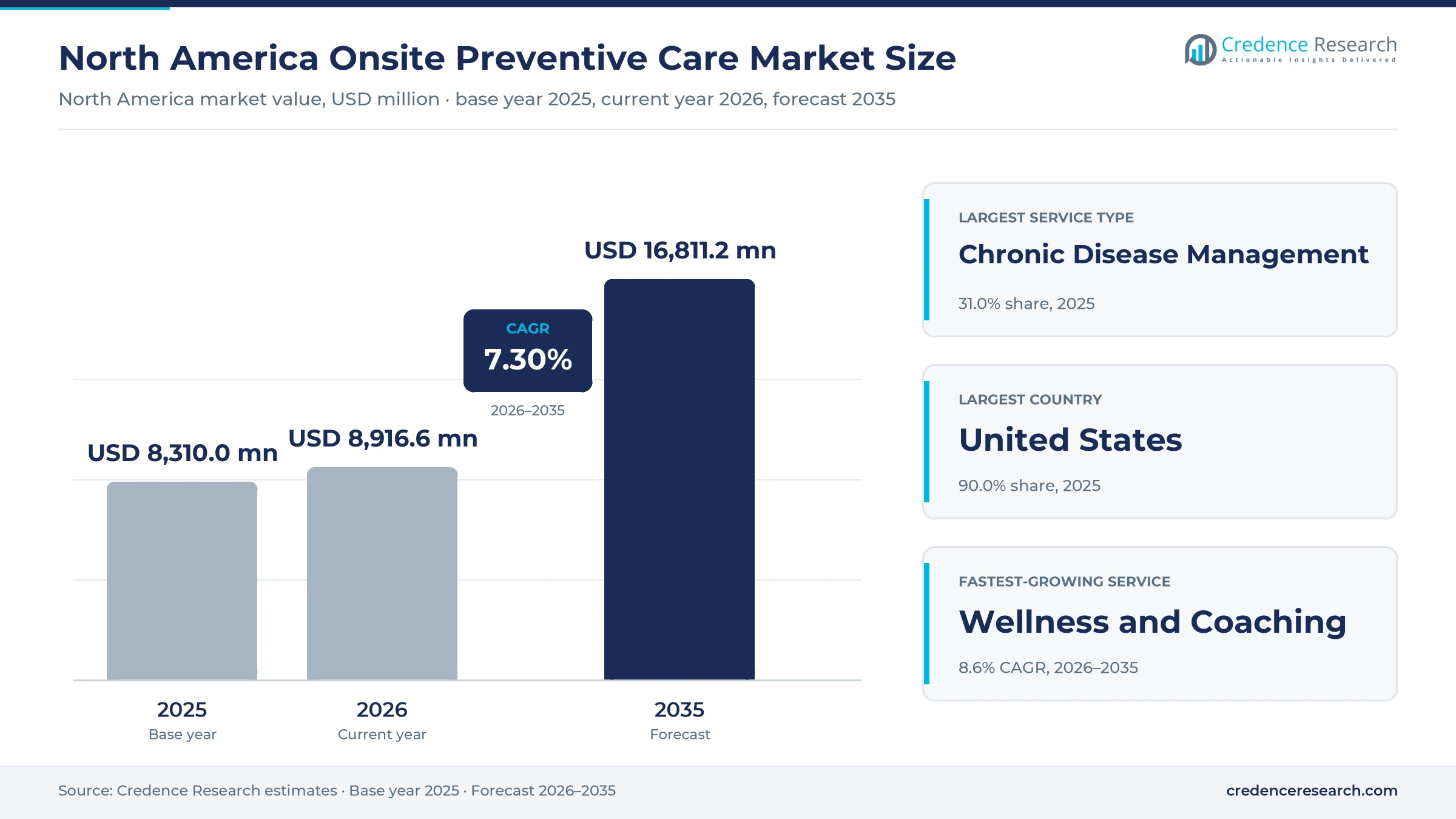
The North America onsite preventive care market was valued at USD 8.31 billion in 2025 and is projected to increase from USD 8.92 billion in 2026 to USD 16.81 billion by 2035, registering a CAGR of 7.30% during 2026–2035. Demand comes from self-insured employers, school districts, counties and union plans that place clinicians at or near worksites to hold down claims for primary care, chronic conditions and injuries. The United States held the largest share, 90.0% in 2025, because employers there carry medical claims directly, while Mexico is the fastest-growing country at 8.7% a year as social security workplace programs reach more firms. Consolidation is reshaping supply, with the largest vendors combining into networks of several hundred centers each. Benefit cost increases push buyers to ask for measurable returns, although standardized outcome metrics remain scarce and many contracts still pay vendors on a cost-plus basis.
Clinics, screenings and coaching delivered where employees work
The estimate covers preventive and primary health services that employers buy for staff at the worksite or at shared near-site centers in the United States, Canada and Mexico. It counts acute visits, chronic disease management, biometric and laboratory screening, vaccinations, health coaching and nutrition programs, whether the employer runs the clinic itself or pays a vendor to staff it.
The estimate excludes insurance premiums, retail clinic visits that employees pay for themselves, standalone wellness software and workers’ compensation claims. Value is measured as employer spending on clinicians, supplies, management fees and screening events, so a clinic billed on a cost-plus contract counts at its full operating cost.
North America Onsite Preventive Care Market Insights
- The North America onsite preventive care market was valued at USD 8.31 billion in 2025 and is projected to reach USD 16.81 billion by 2035, registering a CAGR of 7.30% during 2026–2035.
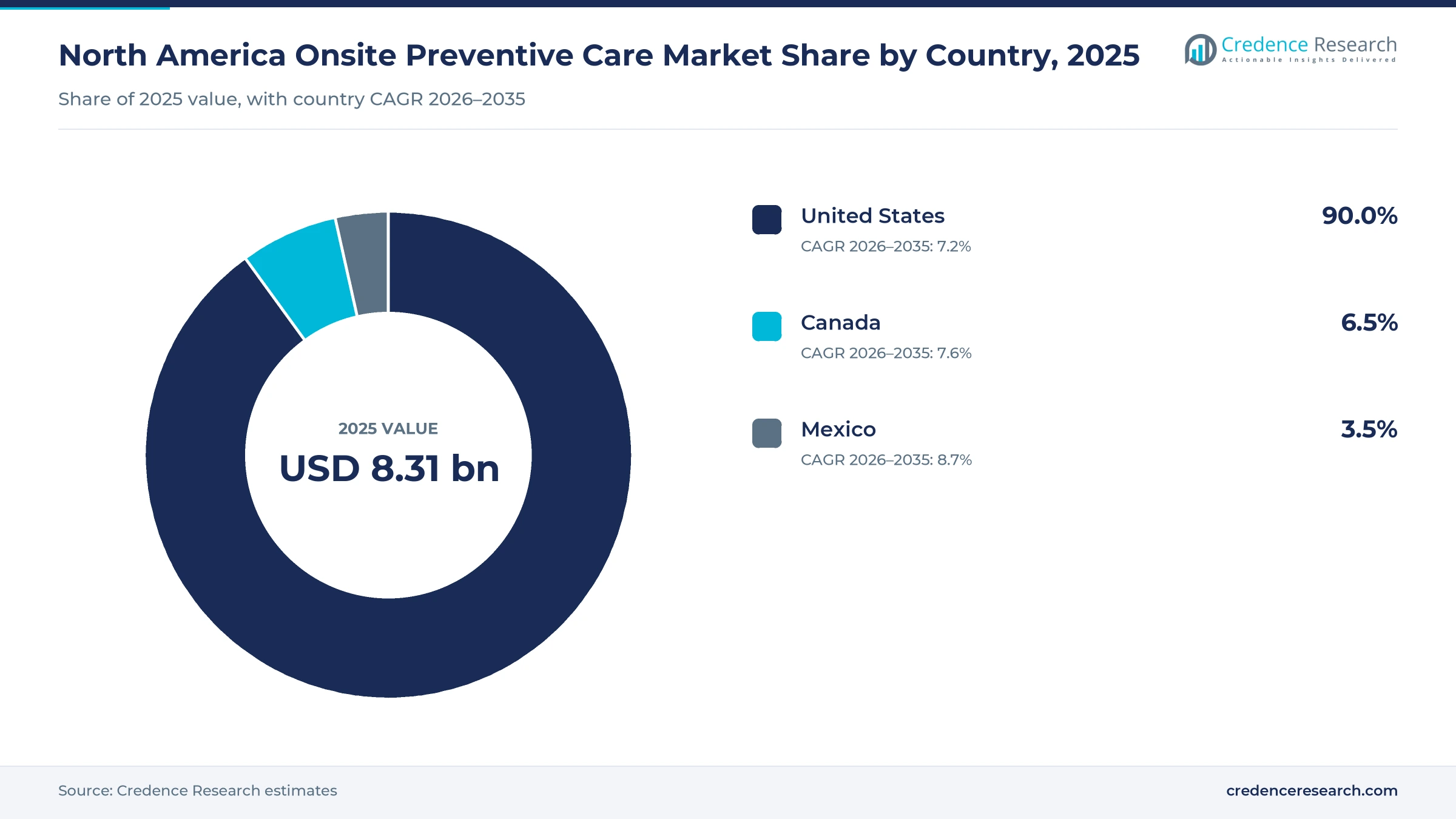
- The United States held a 90.0% share of 2025 value, because self-insured employers there pay claims directly and fund most worksite clinics.
- Chronic disease management led service types with a 31.0% share in 2025, as chronic and mental health conditions absorb 90% of U.S. health spending.
- Premise Health and Crossover Health agreed to merge in January 2026, combining nearly 900 onsite, near-site and virtual centers.
- Wellness and coaching grows fastest at 8.6% a year during 2026–2035, as employers that run worksite centers plan to add services and staff.
Chronic care leads as wellness coaching grows fastest
Chronic disease management leads while coaching grows fastest
Based on service type, the market is categorized into acute care, chronic disease management, wellness and coaching, nutrition management and diagnostic and screening. Chronic Disease Management led with 31.0% of 2025 value, because people with chronic and mental health conditions account for 90% of the USD 5.3 trillion in annual U.S. health spending, according to the CDC, so employers aim clinic hours at diabetes, hypertension and weight. Wellness and Coaching grows fastest at 8.6% a year, because 54% of employers running worksite centers plan to add clinic services or staff within two years, according to a 2025 Alliant Insurance Services and NAWHC survey, and coaching needs fewer licensed clinicians than full primary care.
Outsourced clinics lead while hybrid models grow fastest
Based on management model, the market is categorized into in-house management, hybrid management model and outsourced management model. The Outsourced Management Model led with 54.0% of 2025 value, because few employers want to employ clinicians directly, and cost-plus contracts, under which a vendor staffs the clinic and passes its costs through, were the most common arrangement at 44% in the same Alliant survey. The Hybrid Management Model grows fastest at 8.8% a year, as vendors open shared centers for several employers, such as the four-center Detroit network that Marathon Health announced in June 2026.
Private employers lead while public buyers grow fastest
Based on employer type, the market is categorized into private employers, public sector employers and unions and multiemployer plans. Private Employers led with 72.0% of 2025 value, because large self-insured firms bear claims directly, and Concentra alone operated 411 onsite clinics at employer worksites in 44 states at the end of 2025, its annual report shows. Public Sector Employers grow fastest at 8.4% a year, as school districts and counties tender clinic contracts, and the Round Rock school board in Texas approved a four-year worksite clinic contract with Marathon Health in August 2025.
| Segment Group | Leading Sub-segment | Share, 2025 | Fastest-growing Sub-segment | CAGR, 2026–2035 |
|---|---|---|---|---|
| By Service Type | Chronic Disease Management | 31.0% | Wellness and Coaching | 8.6% |
| By Management Model | Outsourced Management Model | 54.0% | Hybrid Management Model | 8.8% |
| By Employer Type | Private Employers | 72.0% | Public Sector Employers | 8.4% |
Per-shot and per-screen fees set entry prices
Employer prices follow two distinct models across clinic and screening services in the region. Event services such as flu shots and screenings are sold per participant with minimum volumes, and Walmart lists a 25-vaccine minimum plus a USD 125-per-hour clinic operations fee in the Kaiser Permanente notice. Full clinics are priced on cost-plus terms, under which the employer pays clinician wages, supplies and a management fee, or on per-member monthly fees. Clinician wages are the largest cost, so vendors with shared near-site centers can quote lower per-member prices than single-site clinics. Employers comparing bids should weigh these fees against expected visit volume.
| Service | Typical price or fee | Basis |
|---|---|---|
| Worksite flu shot, standard dose, under 65 | USD 35.50 per shot | Albertsons and Safeway list in Kaiser Permanente broker notice, 2025 |
| Worksite flu shot, high dose, 65 and older | USD 64 per shot | Albertsons and Safeway list in Kaiser Permanente broker notice, 2025 |
| Biometric screening, fingerstick panel | USD 40 to 45 per participant | Montage Health price list, November 2026 |
| Preventive health assessment, Canada | CAD 499 to CAD 4,995 per person | TELUS Health Care Centres, November 2026 |
Request a Free Sample
Fill in your details and we'll send you a free sample report.
- Sample data tables & charts
- Research methodology
Benefit costs, chronic disease and access gaps lift use
Benefit cost growth pushes employers toward direct care
Employer health costs keep climbing faster than budgets, so self-insured firms look for services that reduce claims rather than shift costs to workers. The average family premium reached USD 26,993 in 2025, up 6% in a year, according to the KFF Employer Health Benefits Survey. Mercer projected in November 2025 that total benefit cost per employee would pass USD 18,500 in 2026, a 6.7% increase after a 6% rise in 2025, based on responses from 2,010 employers. Onsite clinics answer this pressure by steering employees away from emergency and specialist visits toward salaried clinicians. Vendors with claims-level reporting gain the most, because finance teams now ask for evidence of savings before they renew a clinic contract.
Chronic disease burden makes worksite screening a cost lever
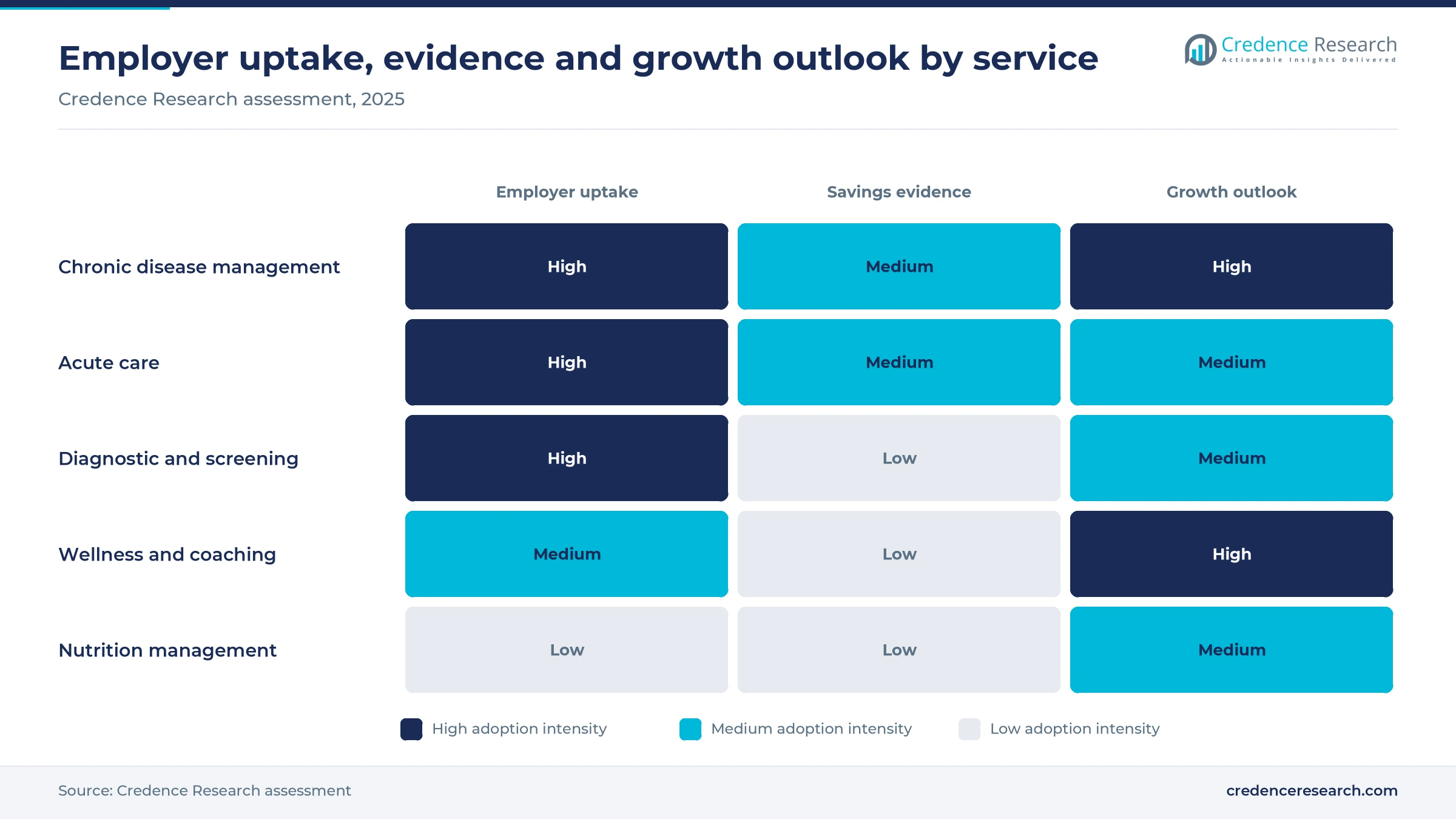
Chronic conditions drive most employer claims, which makes early detection at the worksite one of the few levers employers control directly. Obesity affects 40% of U.S. adults and costs the health system nearly USD 173 billion a year, the CDC estimates. Diagnosed diabetes cost USD 640 billion in medical costs and lost productivity in 2022, the agency adds. KFF found that 83% of firms with 200 or more workers offered at least one wellness program in 2025, such as help to stop smoking or lose weight. Among large firms with a biometric screening program, 62% used incentives or penalties to encourage participation. Screening finds the patients that clinics then manage over years, which is why chronic disease management holds a 31.0% share in the Credence Research estimate.
Physician shortages raise the value of guaranteed access
Primary care access is tightening, so employers that guarantee same-day appointments offer staff a service the open market struggles to provide. The Association of American Medical Colleges projected in March 2024 that the United States could face a shortage of up to 86,000 physicians by 2036. In Canada, 83.4% of adults reported access to a primary health care provider in 2025, according to Statistics Canada data published by CIHI, which leaves about one adult in six without one. Walmart closed all 51 of its health centers in five states in April 2024, citing reimbursement and operating costs, which removed one retail alternative. Employer-paid clinics avoid fee-for-service reimbursement, which helps explain why they keep expanding while retail clinics retreat.
HSA reform widens the route to clinic enrollment
Tax rules shape how clinics are offered to workers in high-deductible plans, and 2025 legislation loosened them. The budget law passed on July 4, 2025, lets employees with health savings accounts join direct primary care arrangements costing up to USD 150 a month for an individual or USD 300 for a family, law firm Groom Law Group noted. IRS Notice 2026-05, issued Dec. 9, 2025, explained how the new rules apply. Groom added that an employer may be able to structure part of an onsite clinic as such an arrangement if the clinic bills separately for other services. Clearer rules lower the compliance cost of offering clinics to HSA enrollees, which favors vendors that already price primary care as a monthly membership.
Vendor mergers and virtual add-ons reshape the offer
Vendors are consolidating into national clinic networks
Clinic vendors are shifting toward scale through mergers to address employer demand for national coverage and common reporting, creating openings for networks that serve employers with dispersed sites. Premise Health and Crossover Health agreed to merge in January 2026 and completed the deal in March 2026, combining nearly 900 onsite, near-site and virtual centers that serve more than 400 employers and unions, HIT Consultant reported. Everside Health and Marathon Health merged in 2024 to form a network of more than 680 centers in 41 states, Fierce Healthcare reported. Concentra, the third national operator, pairs its employer-site clinics with a stand-alone occupational network, which gives it entry to industrial employers. Larger networks gain bargaining power and shared data platforms, while mid-size vendors compete on local service and on price.
Clinics are adding virtual musculoskeletal and mental health care
Clinic operators are shifting toward hybrid programs that pair in-person visits with digital therapy to address musculoskeletal pain and mental health, two of the largest claim categories. Marathon Health and Medbridge began a limited release of a virtual musculoskeletal program at select Marathon centers in September 2025, with expansion across the network planned for 2026. Their release cited a Business Group on Health survey in which 71% of employers ranked musculoskeletal issues among their top three cost drivers. Telehealth was offered by 75% of employers in the Alliant survey. Integrated telehealth lets a small clinic team cover more sites, which favors vendors with digital platforms over clinic-only operators.
Smaller employers form an underserved buyer group
Small and mid-size employers are the clearest gap, because few can fund a dedicated clinic but most face the same claims pressure as large firms. KFF found that only 22% of firms with 10 to 199 workers offered biometric screening in 2025, against 43% of larger firms, and 35% offered health risk assessments, against 53%. Shared near-site centers spread fixed staffing costs across several employers, and the Detroit network noted above follows this model. Among employers already running centers, 28% plan to add locations within two years, according to the Alliant and NAWHC survey. Vendors that price per member rather than per clinic can reach thousands of employers that cannot fill a full-time clinic schedule.
Mexico’s workplace health program opens a new buyer base
Mexico offers a growth opening, because federal rules and programs already push employers to organize preventive services at the workplace. Federal standard NOM-030-STPS-2009 requires every workplace to appoint internal or external preventive safety and health services, so most large employers already buy some occupational support. The voluntary ELSSA healthy workplace program had 18,000 participating companies covering 5.1 million workers, according to an IMSS bulletin from October 2026. Diagnosed diabetes affects 10.9% of Mexican adults and diagnosed hypertension 15.9%, according to ENSANUT 2022. Vendors that bundle chronic disease screening with occupational compliance gain an entry point with large employers.
Weak metrics, tax rules and vendor churn restrain buyers
Savings are hard to prove without common metrics
Employers lack standard ways to measure clinic returns, which slows renewals and new contracts. The Alliant survey found that 94% of employers reported positive returns, but it covered only 108 employers, and results rest on each vendor’s own methodology. The USD 5 million to USD 7 million in claims savings projected for the Round Rock clinic depends on good utilization, local reporting noted in August 2025. Finance teams that cannot compare vendors on common measures favor shorter contracts, which raises sales costs for smaller vendors.
Vendor transitions disrupt patient relationships
Consolidation can break the clinician relationships on which clinic savings depend. Monroe County, Indiana, switched its employee clinic from Everside Health to Proactive MD in June 2024 despite employee pushback, Indiana Public Media reported, a few months after Everside agreed to merge with Marathon Health. Each switch forces employees to change clinicians and rebuild records, which can lower use in the first months. Employers with small sites are most exposed, because a vendor exit can leave them without a nearby provider.
HSA rules still restrict free clinic visits
Tax rules still constrain clinics for employees in high-deductible plans, because free care before the deductible can disqualify HSA contributions. Groom Law Group noted that other onsite clinic exceptions under earlier IRS notices still require a factual analysis, even after the December 2025 guidance. As a result, 69% of employers with HSA-eligible plans in the Alliant survey charge a single flat fee to meet fair market value rules. Employees with HSAs therefore face a charge at the clinic door, which lowers use among workers that employers most want to reach.
Canada’s public insurance narrows the private clinic scope
In Canada, the Canada Health Act requires provincial plans to cover medically necessary physician services and bars extra-billing and user charges for them, the Library of Parliament explains. Employer clinics therefore sell mainly uninsured services, and TELUS Health lists preventive health assessments from CAD 499 to CAD 4,995 per person, prices suited to executive programs. That limits the reach of each contract, so U.S.-style primary care clinics are rare. Vendors that depend on primary care volume are most exposed, while assessment and wellbeing providers face fewer limits.
U.S. employers dominate while Mexico grows fastest
The North America onsite preventive care market is split into the United States, Canada and Mexico. Country shares and growth rates are Credence Research estimates based on vendor clinic counts, World Bank health spending per person and labor force data.
| Country | Value, 2025 (USD billion) | Share, 2025 | CAGR, 2026–2035 |
|---|---|---|---|
| United States | 7.48 | 90.0% | 7.2% |
| Canada | 0.54 | 6.5% | 7.6% |
| Mexico | 0.29 | 3.5% | 8.7% |
Self-insured employers keep the United States in front
The United States held 90.0% of 2025 value and grows at 7.2% a year. Self-insured employers carry claims directly, and the benefit cost projections noted above keep clinics on renewal agendas. The three largest vendors, Premise Health, Marathon Health and Concentra, together operated close to 2,000 onsite and near-site centers by 2026, based on company disclosures. Concentra also ran 628 stand-alone centers in 41 states at the end of 2025, which links clinic contracts to the occupational health services that employers already buy.
Canada favors assessments and wellbeing services
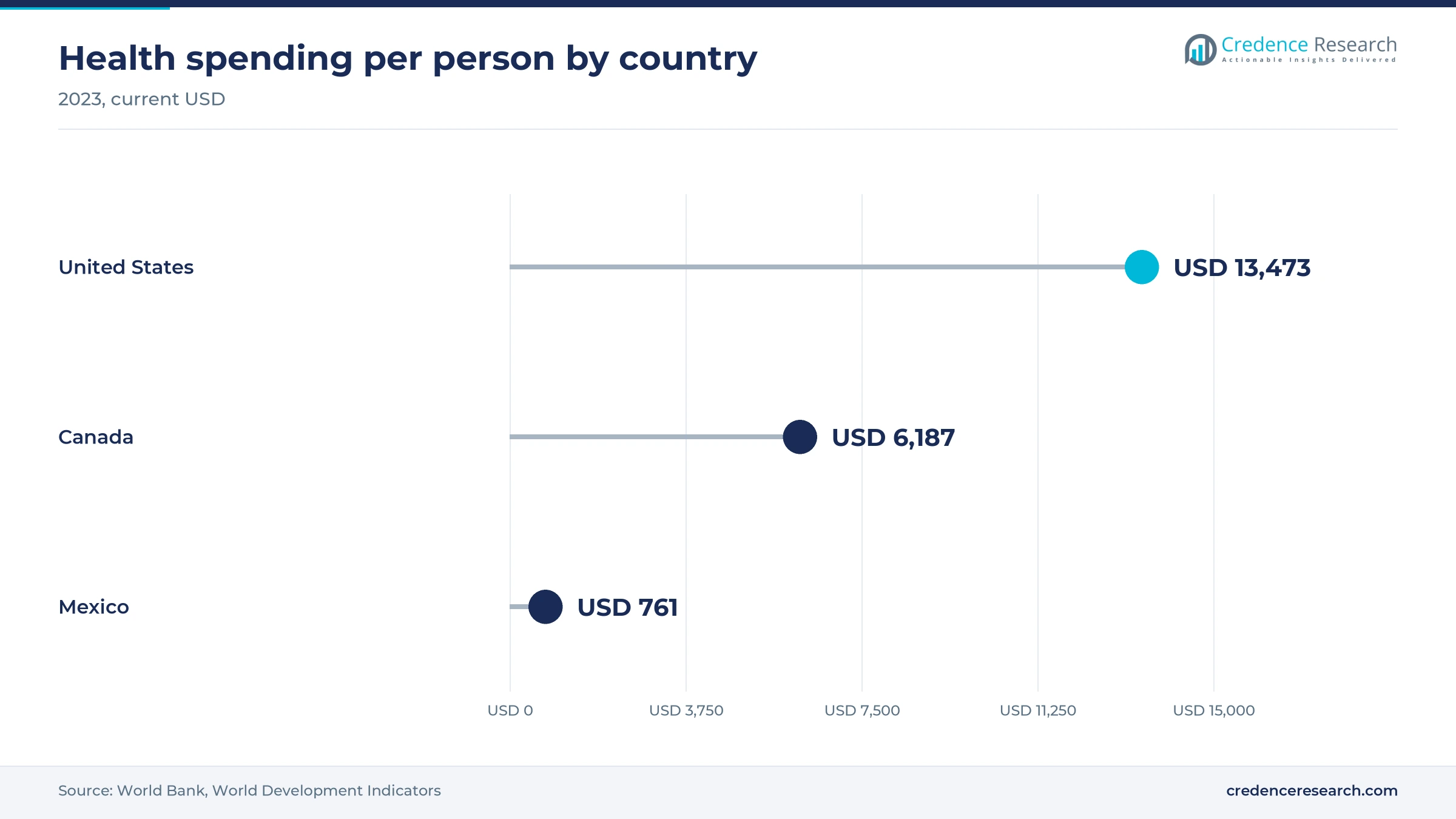
Canada held 6.5% of 2025 value and grows at 7.6% a year. Its labor force reached 22.7 million people in 2024, World Bank data show, and health spending averaged about USD 6,187 per person in 2023. TELUS Health acquired Workplace Options in May 2025, adding employee assistance and wellbeing services across 200 countries and territories. Employers buy these services alongside workplace health and safety programs, because public plans cover most physician visits.
Mexico grows fastest from a low-cost base
Mexico held 3.5% of 2025 value and grows fastest at 8.7% a year. Health spending averaged about USD 761 per person in 2023, against USD 13,473 in the United States, World Bank data show, so service prices sit far lower. Its labor force of 60.9 million in 2024 is the second largest in the region, and the ELSSA program noted above gives large employers a framework for workplace health. Public data on private onsite clinic contracts in Mexico are scarce, so its share is the most assumption-heavy estimate in this report.
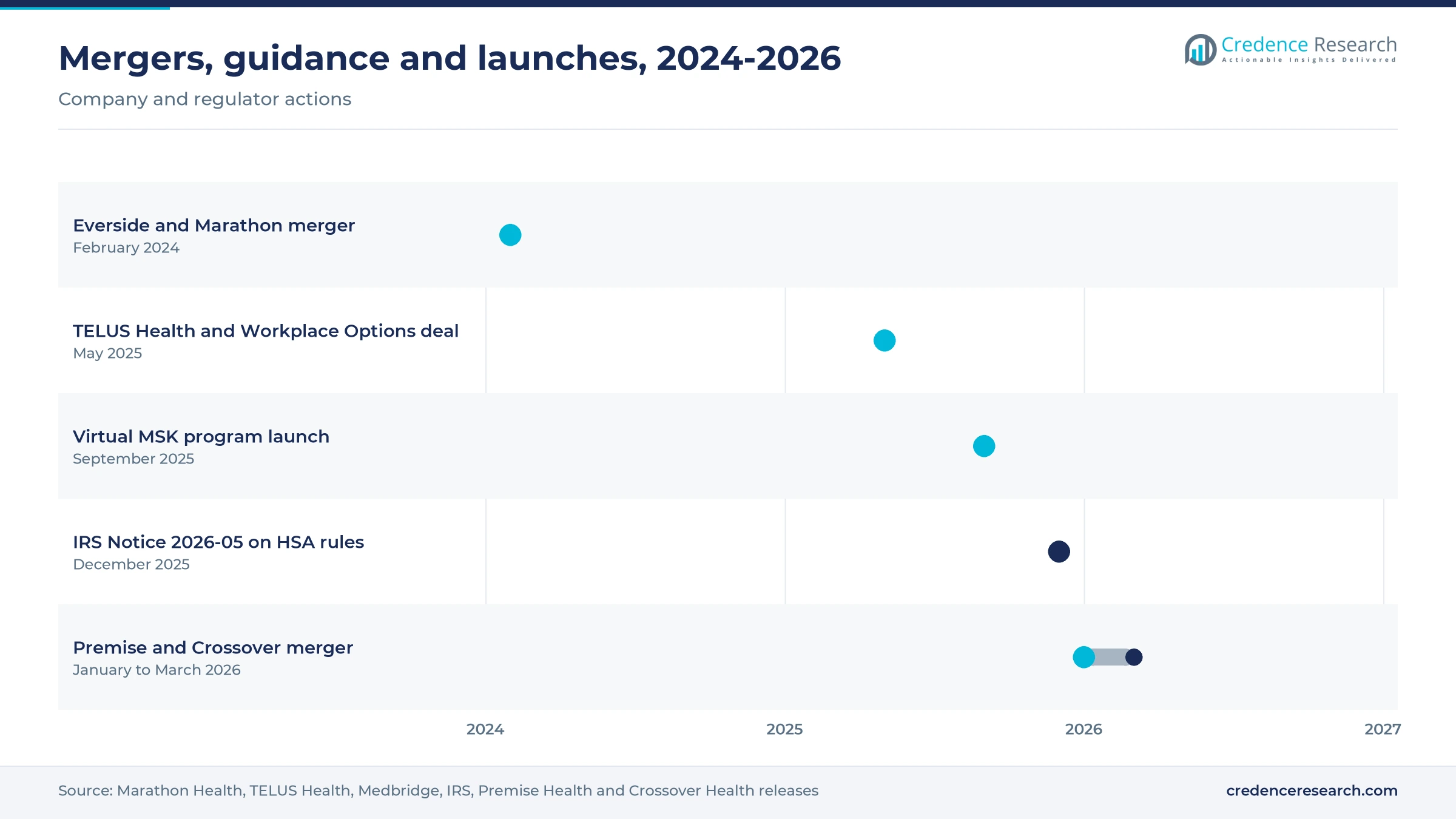
Mergers, tax guidance and new centers mark 2024 to 2026
| Development | Status and market relevance |
|---|---|
| In February 2024, Everside Health and Marathon Health announced a merger to form a network of more than 680 health centers in 41 states. | Merger completed, operating as Marathon Health |
| In May 2025, TELUS Health completed the acquisition of Workplace Options, a provider of employee assistance and wellbeing services. | Acquisition completed, adds employee assistance and wellbeing services for employers |
| In September 2025, Marathon Health and Medbridge launched a virtual musculoskeletal program integrated into advanced primary care. | Limited launch at select centers, network expansion planned for 2026 |
| In December 2025, the IRS issued Notice 2026-05 on the new HSA rules for direct primary care and telehealth. | Guidance issued, applies to employer clinic design |
| In January 2026, Premise Health and Crossover Health signed an agreement to combine into one advanced primary care company. | Merger completed, March 2026 |
Records, rapid tests and virtual visits extend clinics
- Electronic health records linked to claims let vendors show employers which visits replaced emergency or specialist care, the evidence that finance teams now request at each contract renewal.
- Point-of-care fingerstick tests return cholesterol, glucose and blood pressure results during a single screening visit, so clinicians can enroll high-risk employees in chronic disease programs the same day.
- Virtual visits extend clinic hours to remote sites and night shifts without adding staff on location, which lets one clinical team cover several smaller worksites.
- Digital musculoskeletal therapy uses motion capture and guided exercise to treat back and joint pain between visits, reducing referrals to outside specialists and imaging centers.
Need a Custom Version of This Report?
Tailor the scope, geography, or segments to your exact requirements.
- Custom geography or segment scope
- Direct access to our analyst team
Three national operators lead outsourced clinic supply
Competition in the North America onsite preventive care market is decided by clinic network size, claims reporting and the ability to recruit clinicians, rather than by price alone. Premise Health, enlarged by its Crossover Health merger, and Marathon Health, enlarged by Everside, compete for national employers that want one vendor across many sites. Concentra competes from its base in occupational health, serving employers through onsite and stand-alone centers. Proactive MD wins mid-size and public contracts, including county clinics that switch vendors. Screening specialists such as Quest Diagnostics, Wellness Corporate Solutions and Total Wellness Health compete on event logistics and price per participant, often supporting corporate wellness programs. In Canada, TELUS Health leads in assessments and employee assistance. No private clinic vendor of national scale could be verified in Mexico.
How concentrated is the vendor base?
Supply is concentrated among a few national operators at the top and fragmented below them. Three national operators, Premise Health after its Crossover merger, Marathon Health and Concentra, run most outsourced full-service clinics, while Proactive MD and regional health systems compete for mid-size and public contracts. A second tier of screening specialists, including Quest Diagnostics, Wellness Corporate Solutions and Total Wellness Health, sells biometric events and laboratory testing. Entry barriers are clinician recruitment, multistate licensing and claims reporting. Margins sit in management fees and per-member contracts, while screening events compete on price per participant.
Companies profiled and their roles in this market
| Company | Type | Role in the market |
|---|---|---|
| Premise Health | National clinic operator | Runs onsite, near-site and virtual primary care centers for employers and unions |
| Marathon Health | National clinic operator | Runs employer and shared near-site health centers with primary and preventive care |
| Concentra | Occupational and onsite care provider | Operates onsite clinics at employer worksites and stand-alone occupational centers |
| Proactive MD | Clinic operator | Runs employer health centers for mid-size firms and public employers |
| Quest Diagnostics | Screening and laboratory provider | Sells onsite and remote biometric screening and lab testing to employers |
| Wellness Corporate Solutions | Screening specialist | Provides biometric screenings, health coaching and employee testing for employers |
| Total Wellness Health | Screening specialist | Provides onsite flu shot clinics and biometric screening events for employers |
| TELUS Health | Health services and wellbeing provider | Sells preventive health assessments and employee wellbeing services in Canada |
Why proof of savings will decide clinic growth
Credence Research’s view is that growth in the North America onsite preventive care market will depend less on new employer interest than on proof of savings. Benefit costs give finance teams a strong reason to buy, but contracts renew only when vendors show which claims a clinic replaced. Consolidation helps large employers with national footprints, while smaller firms will reach the market mainly through shared near-site centers. Mexico grows fastest from a small base, and evidence on private clinic contracts there is thin. Public buyers that tender multi-year contracts, such as the Round Rock school district, offer vendors the most predictable new volume.
Clinic counts, prices and surveys anchor the estimate
The report uses 2025 as the base year and forecasts to 2035. The 2025 value is the Credence Research model value, built from vendor clinic counts in company disclosures, list prices for screenings and vaccinations, employer surveys and World Bank health spending and labor force data. Country, service type, management model and employer type splits are Credence Research estimates, and the outsourced management model share of 54.0% in 2025 rests on vendor clinic counts. The analysis does not rely on interviews or surveys conducted for this report.
Shared centers and public buyers widen use to 2035
The North America onsite preventive care market is expected to grow from USD 8.92 billion in 2026 to USD 16.81 billion by 2035, a CAGR of 7.30%. Chronic disease management will keep the largest share, while wellness coaching and shared near-site centers grow fastest. National operators will extend their networks after the 2024 and 2026 mergers, and public employers will tender more contracts. Mexico should grow fastest from a 2025 share of only 3.5%, although outcome data that convince finance teams will decide how quickly smaller employers adopt clinics across the region.
What decides the range of outcomes to 2035?
The base case assumes steady clinic additions by large employers, gradual uptake of shared centers by smaller firms and slow growth in Mexico. The downside case follows a slowdown in hiring and tighter benefit budgets, which would lead employers to cut screening events and delay new clinics. The upside case needs common outcome metrics that let finance teams verify savings, together with wider public sector tendering. The downside case lowers the annual CAGR by 1.5 points and the upside case raises it by 1.3 points, against the base forecast for 2026 to 2035.
| Scenario | CAGR, 2026–2035 | Value, 2035 | What has to hold |
|---|---|---|---|
| Downside | 5.8% | USD 14.81 billion | Benefit budgets tighten and employers cut screening events and new clinics |
| Base | 7.30% | USD 16.81 billion | Large employers keep adding services and shared centers spread gradually |
| Upside | 8.6% | USD 18.74 billion | Common savings metrics emerge and public employers tender clinics widely |
Frequently Asked Questions
How big is the North America onsite preventive care market?
Which country leads the market?
Which country grows fastest?
Which service type holds the largest share?
How much does a worksite flu shot or screening cost?
Who are the largest clinic vendors?
How do new HSA rules affect employer clinics?
What restrains growth in the market?
Table of Content
Chapter 1 Market Segmentation
- 1.1 Segmentation Framework
- 1.1.1 Product and Service Classification
- 1.1.2 Application and End-Use Classification
- 1.1.3 Technology and Solution Classification
- 1.1.4 Customer and Distribution Channel Classification
- 1.1.5 Geographic Segmentation
- 1.1.6 Market Segment Definitions and Boundaries
- 1.2 By Service Type
- 1.2.1 Chronic Disease Management
- 1.2.2 Acute Care
- 1.2.3 Diagnostic and Screening
- 1.2.4 Wellness and Coaching
- 1.2.5 Nutrition Management
- 1.3 By Management Model
- 1.3.1 Outsourced Management Model
- 1.3.2 In-House Management
- 1.3.3 Hybrid Management Model
- 1.4 By Employer Type
- 1.4.1 Private Employers
- 1.4.2 Public Sector Employers
- 1.4.3 Unions and Multiemployer Plans
- 1.5 By Country
- 1.5.1 United States
- 1.5.2 Canada
- 1.5.3 Mexico
Chapter 2 Introduction
- 2.1 Report Objectives and Scope
- 2.2 Product Definition and Industry Terminology
- 2.3 Market Inclusions and Exclusions
- 2.4 Research Process
- 2.4.1 Primary Research and Expert Interviews
- 2.4.2 Secondary Research and Source Review
- 2.4.3 Top-Down and Bottom-Up Estimation
- 2.4.4 Data Triangulation and Verification
- 2.5 Market Size Measurement Basis
- 2.5.1 2025: USD 8.31 billion → 2035: USD 16.81 billion
- 2.6 Historical and Forecast Reference Periods
- 2.6.1 Historical Period: 2018-2025
- 2.6.2 Base Year: 2025
- 2.6.3 Forecast Period: 2025-2035
- 2.7 Research Assumptions and Limitations
Chapter 3 Executive Summary
- 3.1 Market Snapshot and Key Findings
- 3.2 Base-Year Market Size, 2025
- 3.3 Forecast Market Size, 2035
- 3.4 Revenue and Volume Growth Outlook
- 3.5 Key Demand and Supply Indicators
- 3.6 Leading Market Segments
- 3.7 Fastest-Growing Market Opportunities
- 3.8 Regional Performance Highlights
- 3.9 Technology and Industry Transformation
- 3.10 Competitive Landscape Summary
- 3.11 Analyst View and Strategic Implications
Chapter 4 North America Onsite Preventive Care Market Trends and Developments
- 4.1 Historical Industry Development, 2018-2025
- 4.2 Recent Market Trends and Developments
- 4.3 Demand and Customer Behavior Trends
- 4.4 Technology and Product Innovation
- 4.5 Artificial Intelligence, Automation and Digitalization
- 4.6 Local Manufacturing and Supply Chain Realignment
- 4.7 Industry Partnerships, Mergers and Acquisitions
- 4.8 Sustainability and Circular Economy Developments
- 4.9 Government and Private Sector Investment Trends
- 4.10 Emerging Business Models and Commercialization
- 4.11 Industry Developments and Announcements
Chapter 5 North America Onsite Preventive Care Market Production, Supply and Demand Analysis
- 5.1 Demand Trend and Consumption Analysis, 2018-2025
- 5.2 Demand Forecast, 2025-2035
- 5.3 Production and Output Trend, 2018-2025
- 5.4 Production and Output Forecast, 2025-2035
- 5.5 Installed Capacity and Capacity Utilization
- 5.6 Company-Wise Production Plants and Statistics
- 5.6.1 Installed Production Capacity
- 5.6.2 Actual Production
- 5.6.3 Planned Capacity and Expansion Targets
- 5.7 Supply Chain Structure and Procurement Trends
- 5.8 Supply-Demand Gap and Bottlenecks
- 5.9 Import Dependence and Sourcing Structure
- 5.10 Contract Manufacturing and Outsourcing
- 5.11 Regional Supply and Demand Concentration
Chapter 6 North America Onsite Preventive Care Market Pricing Analysis
- 6.1 Pricing Structure and Measurement
- 6.2 Historical Pricing Trends, 2018-2025
- 6.3 Pricing Outlook, 2025-2035
- 6.4 Average Selling Price and Unit Economics
- 6.5 Pricing by Product and Market Segment
- 6.6 Geographic Pricing Differences
- 6.7 Key Input, Energy, Labor and Logistics Costs
- 6.8 Contract Pricing and Purchasing Models
- 6.9 Pricing Sensitivity and Competitive Positioning
- 6.10 Price, Margin and Profitability Implications
Chapter 7 North America Onsite Preventive Care Market Dynamics
- 7.1 Market Growth Drivers
- 7.1.1 Demand-Side Drivers
- 7.1.2 Technology and Innovation Drivers
- 7.1.3 Infrastructure and Investment Drivers
- 7.1.4 Regulatory and Policy Drivers
- 7.2 Market Restraints
- 7.2.1 Cost and Affordability Constraints
- 7.2.2 Technology and Adoption Barriers
- 7.2.3 Supply Chain and Operational Constraints
- 7.3 Market Challenges
- 7.3.1 Competitive Pressure and Margin Erosion
- 7.3.2 Skills, Infrastructure and Implementation Gaps
- 7.4 Emerging Market Opportunities
- 7.5 Market Dynamics Impact and Time-Horizon Assessment
Chapter 8 North America Onsite Preventive Care Value Chain Analysis
- 8.1 Industry Value Chain Overview
- 8.2 Upstream Suppliers and Critical Inputs
- 8.3 Technology and Component Providers
- 8.4 Manufacturing or Service Delivery
- 8.5 Distribution, Channel Partners and Integrators
- 8.6 Downstream Applications and End Users
- 8.7 Value Addition and Profit Pools
- 8.8 Vertical Integration and Outsourcing
- 8.9 Supplier Concentration and Risk
- 8.10 Supply Chain Localization and Resilience
Chapter 9 North America Onsite Preventive Care Market Regulations and Policies
- 9.1 Relevant Laws, Standards and Compliance Frameworks
- 9.2 Product, Service, Safety and Quality Requirements
- 9.3 Government Policies, Incentives and Subsidies
- 9.4 Imports, Exports and Trade Barriers
- 9.5 Public Procurement and Local Content Requirements
- 9.6 Environmental and Sustainability Compliance
- 9.7 Upcoming Policy Changes and Market Implications
Chapter 10 North America Onsite Preventive Care Market Hotspots and Opportunities
- 10.1 Market Opportunity Mapping and Growth Hotspots
- 10.2 High-Growth Applications and Customer Groups
- 10.3 Underserved Markets and White-Space Opportunities
- 10.4 Emerging Technology and Product Opportunities
- 10.5 New Capacity and Investment Hotspots
- 10.6 Market Entry and Expansion Opportunities
- 10.7 Distribution and Partnership Opportunities
- 10.8 Near-Term and Long-Term Commercial Potential
- 10.9 Opportunity Attractiveness and Execution Risks
Chapter 11 North America Onsite Preventive Care Market Outlook, 2025-2035
- 11.1 Market Size and Analysis
- 11.1.1 Revenue (Market Measurement: 2025: USD 8.31 billion → 2035: USD 16.81 billion)
- 11.1.2 Market Volume and Quantity Sold
- 11.1.3 Historical Market Size, 2018-2025
- 11.1.4 Base-Year Market Size, 2025
- 11.2 Market Forecast, 2025-2035
- 11.2.1 Revenue Forecast to 2035
- 11.2.2 Volume Forecast to 2035
- 11.2.3 CAGR and Year-on-Year Growth
- 11.2.4 Incremental Revenue Opportunity
- 11.3 Forecast Assumptions and Scenario Analysis
- 11.3.1 Base-Case Forecast
- 11.3.2 Optimistic and Conservative Scenarios
- 11.3.3 Technology, Pricing and Policy Sensitivities
- 11.4 Market Attractiveness and Growth Outlook
Chapter 12 North America Onsite Preventive Care Market Segmentation and Outlook
- 12.1 Segmentation Summary and Market Shares, 2025
- 12.2 Largest and Fastest-Growing Segments
- 12.3 By Service Type - Market Size and Forecast, 2025-2035
- 12.3.1 Segment Definition and Scope
- 12.3.2 Historical Market Size, 2018-2025
- 12.3.3 Revenue Forecast, 2025-2035
- 12.3.4 Volume Forecast, 2025-2035
- 12.3.5 Base-Year Market Share, 2025
- 12.3.6 Segment CAGR and Growth Drivers
- 12.3.7 Subsegment Market Size and Forecast
- 12.3.7.1 Chronic Disease Management
- 12.3.7.2 Acute Care
- 12.3.7.3 Diagnostic and Screening
- 12.3.7.4 Wellness and Coaching
- 12.3.7.5 Nutrition Management
- 12.3.8 Subsegment Pricing and Adoption Trends
- 12.3.9 Leading Suppliers and Competition
- 12.3.10 Regional Demand and Opportunities
- 12.4 By Management Model - Market Size and Forecast, 2025-2035
- 12.4.1 Segment Definition and Scope
- 12.4.2 Historical Market Size, 2018-2025
- 12.4.3 Revenue Forecast, 2025-2035
- 12.4.4 Volume Forecast, 2025-2035
- 12.4.5 Base-Year Market Share, 2025
- 12.4.6 Segment CAGR and Growth Drivers
- 12.4.7 Subsegment Market Size and Forecast
- 12.4.7.1 Outsourced Management Model
- 12.4.7.2 In-House Management
- 12.4.7.3 Hybrid Management Model
- 12.4.8 Subsegment Pricing and Adoption Trends
- 12.4.9 Leading Suppliers and Competition
- 12.4.10 Regional Demand and Opportunities
- 12.5 By Employer Type - Market Size and Forecast, 2025-2035
- 12.5.1 Segment Definition and Scope
- 12.5.2 Historical Market Size, 2018-2025
- 12.5.3 Revenue Forecast, 2025-2035
- 12.5.4 Volume Forecast, 2025-2035
- 12.5.5 Base-Year Market Share, 2025
- 12.5.6 Segment CAGR and Growth Drivers
- 12.5.7 Subsegment Market Size and Forecast
- 12.5.7.1 Private Employers
- 12.5.7.2 Public Sector Employers
- 12.5.7.3 Unions and Multiemployer Plans
- 12.5.8 Subsegment Pricing and Adoption Trends
- 12.5.9 Leading Suppliers and Competition
- 12.5.10 Regional Demand and Opportunities
- 12.6 By Country - Market Size and Forecast, 2025-2035
- 12.6.1 Segment Definition and Scope
- 12.6.2 Historical Market Size, 2018-2025
- 12.6.3 Revenue Forecast, 2025-2035
- 12.6.4 Volume Forecast, 2025-2035
- 12.6.5 Base-Year Market Share, 2025
- 12.6.6 Segment CAGR and Growth Drivers
- 12.6.7 Subsegment Market Size and Forecast
- 12.6.7.1 United States
- 12.6.7.2 Canada
- 12.6.7.3 Mexico
- 12.6.8 Subsegment Pricing and Adoption Trends
- 12.6.9 Leading Suppliers and Competition
- 12.6.10 Regional Demand and Opportunities
- 12.7 Segment Growth Comparison
- 12.8 Segment Attractiveness and Priority Matrix
Chapter 13 North America Onsite Preventive Care Geographic Market Outlook, 2025-2035
- 13.1 Regional Market Size and Country-Level Shares, 2025
- 13.2 Country Market Size Comparison, 2025
- 13.3 Country Market Forecasts, 2025-2035
- 13.4 Subregional Industrial and Demand Clusters
- 13.5 Intra-Regional Pricing and Cost Differences
- 13.6 Cross-Border Trade and Supply Networks
- 13.7 Regional Supply and Demand Balances
- 13.8 Country Opportunity Comparison and Prioritization
Note: Every listed country is covered on the structure shown under the first country.
Chapter 14 North America Onsite Preventive Care Technology, Innovation and Sustainability Outlook
- 14.1 Technology Landscape and Maturity
- 14.2 Product, Process and Service Innovation
- 14.3 AI, Automation and Digital Tools in the Industry
- 14.4 Technology Adoption and Performance Benchmarking
- 14.5 Innovation Pipeline and R&D Investment
- 14.6 Patent and Intellectual Property Trends
- 14.7 Energy Efficiency and Resource Management
- 14.8 Sustainability, Recycling and Circularity
- 14.9 Technology Roadmap, 2025-2035
- 14.10 Risks of Obsolescence and Technology Substitution
Chapter 15 North America Onsite Preventive Care Market Key Strategic Imperatives
- 15.1 Growth and Market Entry Priorities
- 15.2 High-Return Products and Segments
- 15.3 Pricing, Profitability and Cost Optimization
- 15.4 Technology Investment and Product Differentiation
- 15.5 Supply Chain Localization and Resilience
- 15.6 Distribution and Customer Acquisition
- 15.7 Partnership, Acquisition and Capacity Strategy
- 15.8 Regional Expansion Priorities
- 15.9 Short-, Medium- and Long-Term Actions
Chapter 16 Competition Outlook
- 16.1 Industry Competition Characteristics
- 16.2 Market Structure and Concentration
- 16.3 Market Share and Competitive Positioning, 2025
- 16.4 Company-Wise Revenue and Product Benchmarking
- 16.5 Production and Service Capacity Benchmarking
- 16.6 Technology, Pricing and Differentiation
- 16.7 Regional Footprint and Distribution Strength
- 16.8 Mergers, Acquisitions and Strategic Alliances
- 16.9 New Entrants and Competitive Threats
- 16.10 Porter's Five Forces and Industry Attractiveness
- 16.11 Competitive Outlook, 2025-2035
Chapter 17 Company Profiles
- 17.1 Company Coverage and Selection Criteria
- 17.2 Premise Health
- 17.2.1 Business Description
- 17.2.2 Company Ownership and Geographic Presence
- 17.2.3 Product and Service Portfolio
- 17.2.4 Manufacturing and Operating Footprint
- 17.2.5 Production Capacity and Expansion Plans
- 17.2.6 Financial Performance and Investment
- 17.2.7 Market Share and Competitive Position
- 17.2.8 Technology and Innovation Capabilities
- 17.2.9 Strategic Alliances or Partnerships
- 17.2.10 Recent Developments
- 17.2.11 Growth Strategy and Outlook
- 17.3 Marathon Health
- 17.4 Concentra
- 17.5 Proactive MD
- 17.6 Quest Diagnostics
- 17.7 Wellness Corporate Solutions
- 17.8 Total Wellness Health
- 17.9 TELUS Health
- 17.10 Other Relevant Market Participants
Note: Every listed company is profiled on the structure shown under the first company. The company list is preliminary and may change based on research findings, market developments, data availability and client requirements.
Chapter 18 Disclaimer
- 18.1 Research and Forecast Disclaimer
- 18.2 Data Source and Estimation Limitations
Note: The depth of individual sections depends on data availability for this market. Volume, capacity, trade and other unit-based metrics are included where applicable.

