
Market Overview:
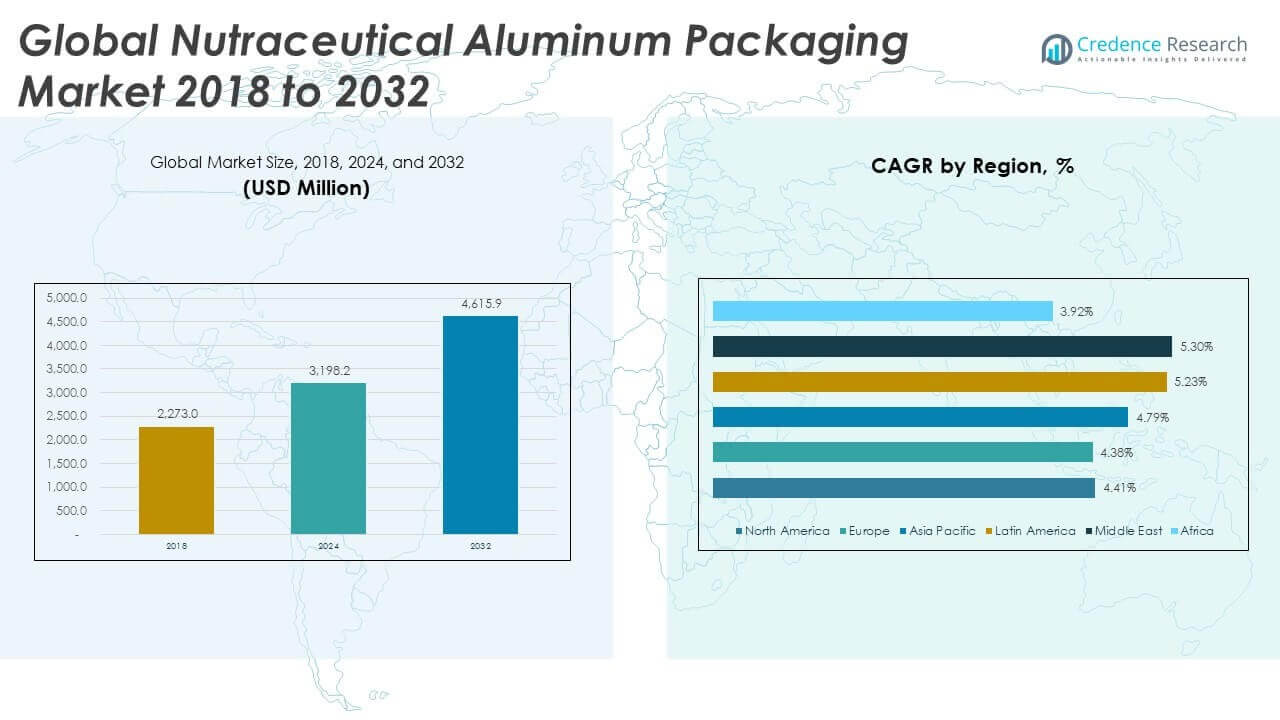
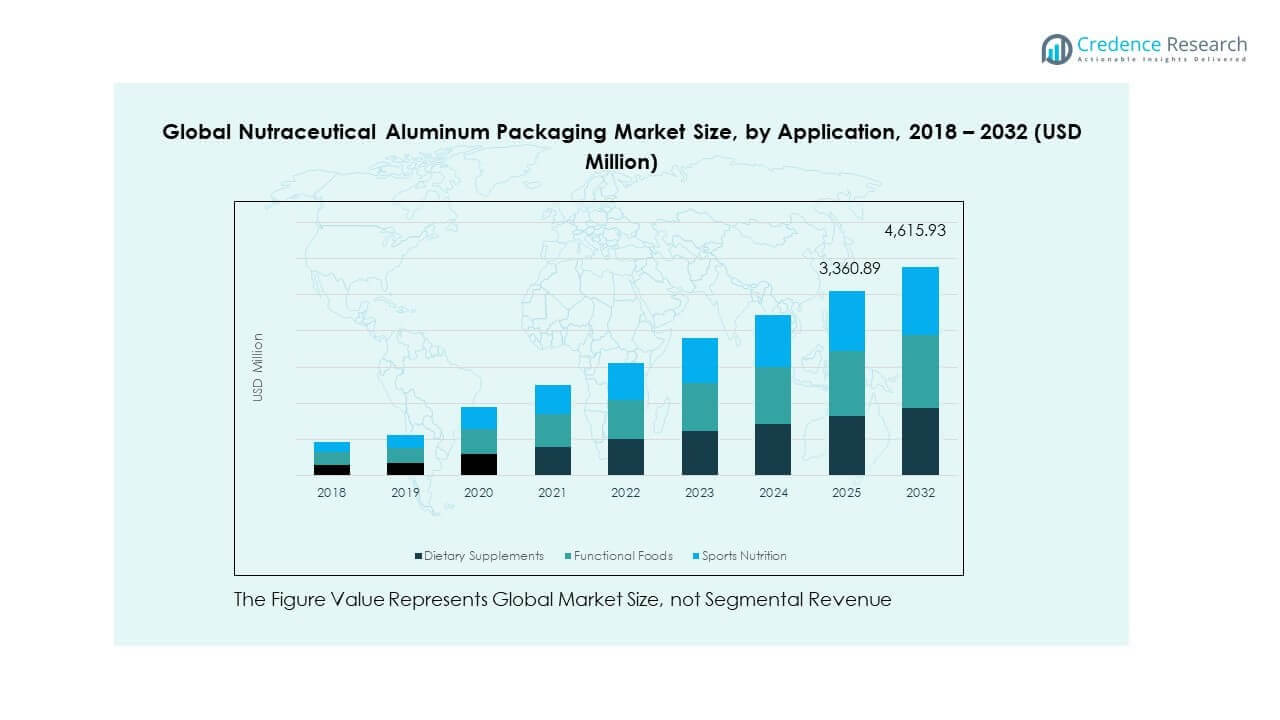
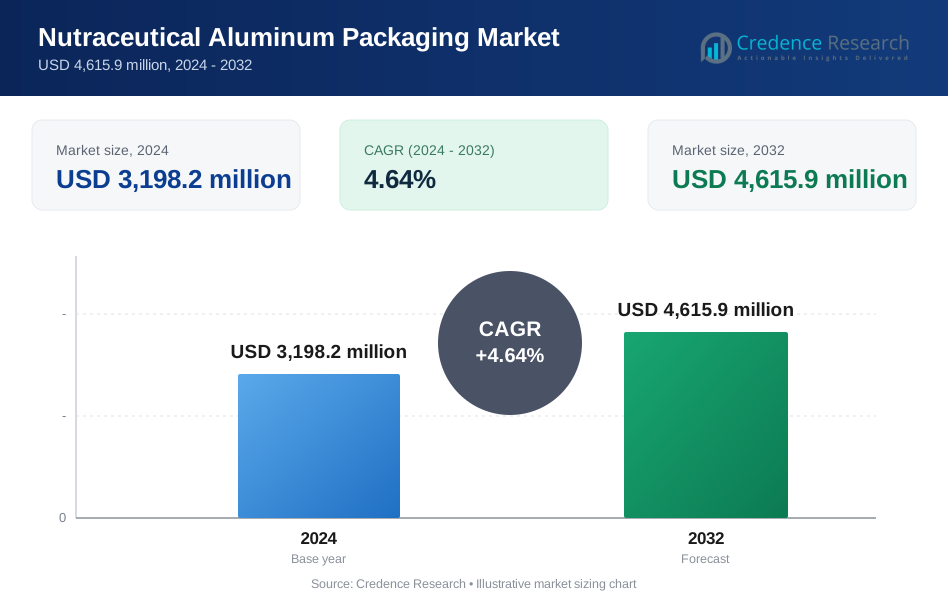
The Global Nutraceutical Aluminum Packaging Market size was valued at USD 2,273.0 million in 2018 to USD 3,198.2 million in 2024 and is anticipated to reach USD 4,615.9 million by 2032, at a CAGR of 4.64% during the forecast period.
| REPORT ATTRIBUTE | DETAILS |
|---|---|
| Historical Period | 2020-2023 |
| Base Year | 2024 |
| Forecast Period | 2025-2032 |
| Nutraceutical Aluminum Packaging Market Size 2024 | USD 3,198.2 million |
| Nutraceutical Aluminum Packaging Market, CAGR | 4.64% |
| Nutraceutical Aluminum Packaging Market Size 2032 | USD 4,615.9 million |
The market is witnessing strong momentum due to rising health awareness, growing supplement consumption, and increased preference for recyclable, tamper-proof packaging. Aluminum offers enhanced barrier protection, longer shelf life, and a premium look, making it ideal for tablets, capsules, powders, and liquids. Regulatory pressure against plastic and consumer demand for sustainable solutions are shifting brand strategies toward metal-based formats. Innovations in design, smart labeling, and single-dose convenience continue to drive adoption across global nutraceutical players.
Regionally, Asia Pacific leads the market, driven by expanding middle-class populations and rising demand for functional health products. North America and Europe follow with mature consumer bases and advanced recycling infrastructure. Latin America and the Middle East show growing interest, supported by wellness trends and improving retail access. Africa remains in the early stages, with potential tied to health initiatives and packaging modernization.
Market Insights:
- The Global Nutraceutical Aluminum Packaging Market was valued at USD 2,273.0 million in 2018, reached USD 3,198.2 million in 2024, and is projected to attain USD 4,615.9 million by 2032, expanding at a CAGR of 4.64% over the forecast period.
- Asia Pacific leads with about 32.96% share, followed by Europe at 26.61% and North America at 23.80%, driven by high nutraceutical consumption, strong manufacturing bases, sustainability policies, and advanced retail and e‑commerce penetration.
- The Middle East is the fastest-growing region, holding roughly 4.97% share, supported by rising wellness spending, premium supplement adoption, and preference for durable, heat-resistant aluminum packaging.
- By application, dietary supplements account for the largest share at around 45%, reflecting high demand for blister packs and bottles for daily vitamins and capsules.
- Functional foods contribute nearly 35% share, while sports nutrition holds close to 20%, supported by growing use of aluminum pouches, cans, and sachets for powders and ready-to-drink formats.
Market Drivers
Rising Health-Conscious Consumer Base Driving Demand for Safer and Sustainable Packaging Formats
A growing number of health-conscious consumers actively seek clean-label supplements and vitamins. These buyers prefer safe and eco-friendly packaging, fueling demand for aluminum formats. The Global Nutraceutical Aluminum Packaging Market benefits from this shift as users reject plastic-based solutions. Consumers associate aluminum with purity, protection, and quality. Shelf-stable packaging also supports longer product life without preservatives. Nutraceutical firms leverage this trend to position products as premium and safe. Clear labeling and recyclable design support sustainability messaging. Companies use aluminum containers to enhance product appeal and reduce contamination risks.
- For instance, McKessonlaunched an aluminum packaging line for its Foster & Thrive brand in July 2025, which reduced plastic use by 70% per bottle compared to traditional resin-based OTC containers.
Brand Differentiation Through Premium Aesthetic Appeal and Surface Customization Capabilities
Aluminum packaging supports embossed, printed, or anodized surfaces that help brands stand out. Marketers use customized designs to position products as luxury or clinical-grade. The Global Nutraceutical Aluminum Packaging Market grows as aluminum allows precise labeling and high-end finishes. Companies compete for shelf visibility using unique formats. Packaging becomes a tool for brand storytelling and consumer engagement. It also improves product traceability, meeting regulatory needs. Transparent labeling on aluminum drives trust in ingredient safety. Brand owners rely on design innovation to create distinct market positioning.
- For instance, Mondi Group strengthened its packaging portfolio and production capabilities in Western Europe through the completion of its acquisition of Schumacher Packaging in April 2025, expanding access to advanced rigid packaging formats, digital printing technologies, and sustainable high‑performance solutions applicable to health and nutraceutical packaging.
Government Regulations and Bans on Single-Use Plastics Accelerating the Shift Toward Recyclable Options
Governments across key regions continue to impose restrictions on plastic waste and non-recyclable materials. The Global Nutraceutical Aluminum Packaging Market gains momentum as aluminum meets circular economy targets. Producers adopt aluminum to meet extended producer responsibility policies. Regulatory pressure forces nutraceutical brands to shift toward recyclable and sustainable packaging. Compliance with packaging recovery frameworks strengthens aluminum adoption. Policy-driven market transformation encourages innovation in aluminum closure and sealing systems. Industry players benefit from reduced regulatory risk by switching to recyclable formats. National recycling schemes further improve collection and reuse systems.
E-Commerce Expansion Creating New Use Cases for Lightweight and Tamper-Proof Aluminum Packs
E-commerce growth across health and wellness categories increases demand for protective packaging. The Global Nutraceutical Aluminum Packaging Market supports this trend with lightweight and tamper-evident designs. Online retailers require durable packaging to protect products during transport. Aluminum tubes, blister packs, and tins maintain product integrity under varying conditions. Tamper-proof features reduce returns and enhance consumer trust. Brands use compact aluminum formats for direct-to-consumer delivery channels. High-performance packaging ensures regulatory compliance during long-distance shipping. E-commerce platforms favor aluminum for its balance of weight, strength, and recyclability.
Market Trends
Integration of QR Codes and Smart Labels Enhancing Traceability and Consumer Transparency
Manufacturers are adopting digital labeling features such as QR codes and NFC tags. These technologies improve batch traceability and ingredient verification. The Global Nutraceutical Aluminum Packaging Market sees rising adoption of smart labels for consumer education. Shoppers scan codes to access dosage information, certifications, and sourcing details. Digital features increase confidence in product authenticity. Brands leverage packaging as a bridge between physical products and digital platforms. Smart packaging also helps brands meet regulatory transparency requirements. Interactive elements improve user experience and brand loyalty.
Adoption of Lightweight Foil-Based Aluminum Solutions in Unit Dose and Sample Packaging Formats
Unit dose packaging is gaining popularity across OTC and supplement categories. The Global Nutraceutical Aluminum Packaging Market responds with foil sachets, strips, and single-use blister packs. Lightweight formats reduce shipping costs and improve user convenience. Brands launch trial packs and travel kits using aluminum foil systems. Foil-based packs offer excellent barrier protection and flexibility. They also suit regulated pharmaceuticals and wellness applications. Product freshness and hygiene improve with single-use dispensing formats. Growing sampling activity among nutraceutical firms fuels demand for such packs.
- For instance, Ball Corporation has implemented gauge reduction programs that have reduced aluminum can weight by over 38% since the 1970s, and its Alumi-Tek® bottles are used for single-use wellness shots, offering tamper-evident, premium rigid packaging suitable for functional supplements and nutraceutical beverage.
Growth of Vegan, Herbal, and Organic Nutraceuticals Driving Packaging Innovation for Niche Audiences
The surge in plant-based and organic supplement products is shaping packaging demand. The Global Nutraceutical Aluminum Packaging Market caters to these trends with minimalistic, recyclable designs. Aluminum formats resonate with clean-label values of these products. Herbal brands favor plastic-free, biodegradable, or low-carbon options. Packaging aesthetics mirror the natural positioning of product content. Companies use metallic finishes and neutral palettes to target eco-aware consumers. Regulatory-compliant labeling supports niche marketing strategies. Packaging acts as a visual cue for authenticity and environmental alignment.
Emergence of Customizable Packs for Subscription-Based Nutraceutical Business Models
Subscription services offering monthly vitamin packs require scalable, protective packaging. The Global Nutraceutical Aluminum Packaging Market aligns with this shift through compact and easy-to-store containers. Customization supports personalized dosages and consumer-specific combinations. Brands use modular aluminum systems for easy refill and delivery cycles. Rigid aluminum cases enhance brand recall in recurring shipments. Sustainable packaging improves brand reputation among subscription users. Packs are designed to fit mail slots and reduce transit damage. These trends increase demand for user-friendly, protective formats.
- For instance, Aptar Pharma offers a broad range of customizable dispensing solutions, including metered pumps and child-resistant closures, designed to improve dosing accuracy and support direct-to-consumer health and wellness packaging formats.
Market Challenges Analysis
Fluctuating Raw Material Prices and Supply Chain Pressures Hindering Cost-Effective Scalability for Manufacturers
Aluminum price volatility impacts margins for nutraceutical packaging producers. The Global Nutraceutical Aluminum Packaging Market faces cost fluctuations tied to energy prices and raw material availability. Producers struggle to maintain profitability under unstable commodity pricing. Long-term contracts sometimes shield manufacturers, but spot pricing adds pressure. Global supply chain disruptions further increase lead times and logistics expenses. Smaller nutraceutical brands face higher entry barriers due to capital requirements. Pricing constraints affect R&D investment in new formats. Cost optimization remains a key challenge for mass adoption.
Limited Recycling Infrastructure and Collection Inefficiencies in Developing Markets Slowing Circular Economy Goals
Many developing countries lack strong aluminum recycling infrastructure. The Global Nutraceutical Aluminum Packaging Market faces limitations where recovery systems are fragmented. Packaging ends up in mixed waste streams, reducing reuse rates. Informal recycling networks fail to meet food-grade quality standards. Collection inefficiencies result in underutilized secondary material. These regions also lack awareness and incentives for recycling participation. Multinational brands must invest in education and local partnerships. Building reverse logistics and take-back programs adds to operational complexity.
Market Opportunities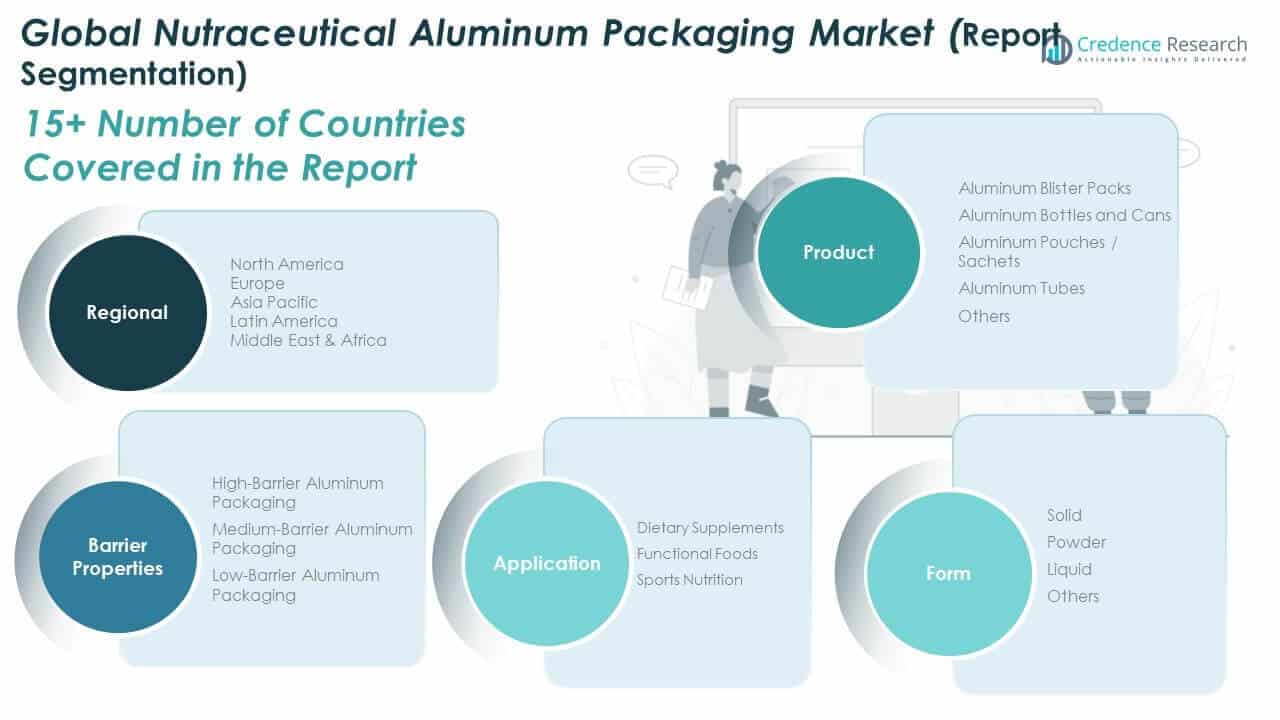
Rising Nutraceutical Consumption Across Emerging Asia-Pacific and Latin America Expanding Demand for Aluminum Packs
Growing awareness of preventive health in developing nations supports packaging growth. The Global Nutraceutical Aluminum Packaging Market gains traction in urban Asia-Pacific and Latin America. Expanding retail distribution and digital access boost supplement consumption. Aluminum packaging meets rising expectations for hygiene and portability. International players target these regions through local product launches. Market entry creates demand for scalable and compliant packaging systems. Governments promote wellness programs, further increasing product reach.
Innovation in Barrier Coatings and Bio-Coated Aluminum Foils Creating New Differentiation Levers
R&D investments target coatings that extend shelf life and enhance recyclability. The Global Nutraceutical Aluminum Packaging Market benefits from bio-based lacquers and heat-seal layers. These solutions replace plastic laminates and reduce contamination. Innovation creates new value propositions for eco-conscious brands. High-barrier foils improve performance in humid or high-temperature climates. Custom coatings help meet evolving food safety and sustainability standards.
Market Segmentation Analysis:
By Product Segment
Among product types, aluminum blister packs dominate due to their lightweight, tamper-evident features and compatibility with tablets and capsules. Aluminum bottles and cans are widely used for liquid nutraceuticals, offering durability and a premium look. Aluminum pouches and sachets serve growing demand for trial packs and on-the-go supplements. Aluminum tubes address needs in gel and cream-based formulations. The others category includes hybrid packs and custom closures adopted in niche applications. Product diversification supports usage across dietary, functional, and therapeutic wellness offerings.
- For instance, Gerresheimer supplies child-resistant closures, moisture-protective systems, and pharmaceutical-grade packaging components for solid and liquid formulations, supporting regulated use in healthcare and wellness applications.
By Barrier Properties
High-barrier aluminum packaging leads the segment by offering maximum protection against oxygen, moisture, and UV rays, crucial for sensitive products. Medium-barrier packaging supports less sensitive formulations with moderate cost efficiency. Low-barrier packaging finds utility in applications where shelf life is shorter or cost is a primary concern. Companies choose barrier types based on formulation sensitivity, market channel, and geographic humidity conditions. Barrier property selection directly impacts shelf stability and brand compliance.
By Application
Dietary supplements hold the largest share, driven by daily-use vitamins and minerals packaged in aluminum blister strips and bottles. Functional foods use aluminum primarily for improved food safety, preservation, and premium positioning. Sports nutrition embraces aluminum cans, pouches, and bottles for powdered and ready-to-drink products that demand durability and consumer convenience. Application-specific packaging innovation enables brands to match consumer usage habits, shelf-life needs, and retail format requirements.
By Form
Solid nutraceuticals represent the largest segment, with products like capsules, tablets, and chewables favoring blister and bottle formats. Powder-based supplements utilize pouches, sachets, and tins for flexibility in serving sizes and portability. Liquid formulations rely on aluminum vials and bottles for spill-proof, contamination-resistant storage. The others segment includes gels and emulsions, commonly packaged in aluminum tubes. Packaging by form enables compatibility with dispensing requirements, safety standards, and consumer convenience across usage settings.
- For instance, Amcor’s high‑barrier aluminum foil and film solutions provide strong protection against moisture and oxygen, supporting extended shelf life and product integrity in moisture‑sensitive packaging formats such as blister lidding for tablet and powder applications.
Segmentation:
By Product Segment
- Aluminum Blister Packs
- Aluminum Bottles and Cans
- Aluminum Pouches / Sachets
- Aluminum Tubes
- Others
By Barrier Properties
- High-Barrier Aluminum Packaging
- Medium-Barrier Aluminum Packaging
- Low-Barrier Aluminum Packaging
By Application
- Dietary Supplements
- Functional Foods
- Sports Nutrition
By Form
- Solid
- Powder
- Liquid
- Others
By Region
- North America
- U.S.
- Canada
- Mexico
- Europe
- Germany
- France
- U.K.
- Italy
- Spain
- Rest of Europe
- Asia Pacific
- China
- Japan
- India
- South Korea
- South-east Asia
- Rest of Asia Pacific
- Latin America
- Brazil
- Argentina
- Rest of Latin America
- Middle East & Africa
- GCC Countries
- South Africa
- Rest of the Middle East and Africa
Regional Analysis:
North America
The North America Global Nutraceutical Aluminum Packaging Market size was valued at USD 548.01 million in 2018 to USD 761.21 million in 2024 and is anticipated to reach USD 1,079.67 million by 2032, at a CAGR of 4.41% during the forecast period. North America accounts for approximately 23.80% of the global market in 2024. The region leads due to strong consumer awareness, high nutraceutical intake, and preference for sustainable packaging. Aluminum packaging formats support regulatory compliance and premium positioning across vitamins, supplements, and wellness beverages. U.S.-based brands emphasize tamper-proof formats and shelf appeal. Rising e-commerce sales support demand for lightweight and protective solutions. Manufacturers benefit from advanced recycling infrastructure and favorable policy frameworks. Brand competition drives continuous investment in design customization and traceability. The region also witnesses strategic partnerships among nutraceutical producers and packaging converters.
Europe
The Europe Global Nutraceutical Aluminum Packaging Market size was valued at USD 613.70 million in 2018 to USD 851.17 million in 2024 and is anticipated to reach USD 1,204.76 million by 2032, at a CAGR of 4.38% during the forecast period. Europe represents 26.61% of the global market share in 2024. Strong sustainability regulations and bans on single-use plastics drive rapid adoption of aluminum formats. Consumers in Germany, France, and the UK prefer recyclable, BPA-free packaging across supplements and fortified food products. Nutraceutical companies in Europe are early adopters of bio-coated and smart-labeled aluminum containers. Brands align packaging with clean-label and eco-conscious marketing. Regulatory frameworks like Extended Producer Responsibility (EPR) and packaging tax incentives support growth. Pharmaceutical-grade packaging is gaining popularity for high-potency wellness solutions. European firms integrate circularity into product lifecycle strategies. Local production capacities and cross-border supply chains improve responsiveness.
Asia Pacific
The Asia Pacific Global Nutraceutical Aluminum Packaging Market size was valued at USD 742.58 million in 2018 to USD 1,054.03 million in 2024 and is anticipated to reach USD 1,538.95 million by 2032, at a CAGR of 4.79% during the forecast period. Asia Pacific contributes 32.96% of the global market in 2024, making it the largest regional segment. China, Japan, India, and South Korea lead demand with rising middle-class consumption and strong health awareness. Nutraceutical sales rise due to urban lifestyles, e-pharmacy expansion, and retail modernization. Local brands use aluminum to signal hygiene and shelf-stability. Global firms increase regional packaging operations to meet domestic demand. Lightweight sachets, tubes, and cans suit small-dose, high-frequency consumption. Demand for personalized wellness drives innovation in pack sizing and design. Investments in localized production and logistics reduce delivery time and cost.
Latin America
The Latin America Global Nutraceutical Aluminum Packaging Market size was valued at USD 199.11 million in 2018 to USD 290.30 million in 2024 and is anticipated to reach USD 438.51 million by 2032, at a CAGR of 5.23% during the forecast period. Latin America holds 9.08% of the global market in 2024. Brazil and Mexico drive demand, supported by expanding health supplement markets and growing wellness culture. Aluminum’s recyclability and protective benefits meet rising regulatory and consumer expectations. Import-reliant nutraceutical brands choose aluminum for transit durability and longer shelf life. Health-focused retailers offer private-label products in premium metallic finishes. Limited local recycling infrastructure presents challenges, but collection rates are improving. E-commerce platforms adopt small-dose, portable formats for single-use items. Growth in sports nutrition and herbal supplements supports packaging diversification. National policies on waste management create tailwinds for recyclable materials.
Middle East
The Middle East Global Nutraceutical Aluminum Packaging Market size was valued at USD 108.65 million in 2018 to USD 159.04 million in 2024 and is anticipated to reach USD 241.41 million by 2032, at a CAGR of 5.30% during the forecast period. The region represents 4.97% of the global market in 2024. UAE and Saudi Arabia lead adoption due to rising disposable incomes and wellness-focused spending. Nutraceutical packaging evolves alongside modern retail and pharmacy formats. Aluminum formats align with heat-resistance, tamper protection, and long storage needs in arid climates. High-end consumers seek imported wellness products with premium, branded packaging. The halal nutraceutical segment also favors aluminum for hygiene and regulatory alignment. Regional producers scale up operations to reduce import dependency. Health ministries emphasize packaging safety in public guidelines. Packaging converters explore strategic alliances for local production.
Africa
The Africa Global Nutraceutical Aluminum Packaging Market size was valued at USD 60.92 million in 2018 to USD 82.42 million in 2024 and is anticipated to reach USD 112.63 million by 2032, at a CAGR of 3.92% during the forecast period. Africa contributes 2.58% to the global market in 2024. Growth remains moderate due to limited purchasing power and packaging infrastructure. South Africa leads regional consumption, followed by Egypt and Nigeria. International brands dominate distribution of premium packaged supplements. Aluminum packs support storage stability in regions with poor cold-chain access. Informal retail channels challenge product authentication and traceability. Government health programs increasingly promote fortified supplements. Educational campaigns raise awareness of proper storage and usage. Local capacity building in aluminum recycling can strengthen long-term adoption.
Key Player Analysis:
- Mondi Group
- NuEra Nutraceuticals Inc
- Sona Extrusion Pvt. Ltd
- Encaplast
- Flexifoil Packaging Private Limited
- Momar Industries
- Condensa
- SupremeX
- Ezhou Xinji Pharmaceutical Packaging Co., Ltd
- Other Key Players
Competitive Analysis:
The Global Nutraceutical Aluminum Packaging Market features a moderately fragmented landscape with both global converters and regional packaging specialists. It is shaped by innovation in barrier coatings, sustainability strategies, and customized formats tailored for wellness brands. Leading players include Mondi Group, NuEra Nutraceuticals Inc., Encaplast, and Sona Extrusion Pvt. Ltd., which focus on high-barrier, recyclable aluminum solutions. Companies compete through product differentiation, regional expansion, and contract manufacturing for major nutraceutical firms. Market leaders invest in design capabilities, smart labeling, and lightweight formats to meet evolving consumer preferences. Partnerships with health supplement brands and entry into direct-to-consumer packaging channels enhance competitiveness. Smaller firms gain market share through agility, localized production, and cost-effective supply chains. Strategic mergers and acquisitions strengthen product portfolios and geographic footprint. The market continues to attract investment due to rising demand for traceable, tamper-proof, and eco-conscious packaging aligned with global nutraceutical growth.
Recent Developments:
- In April 2025, Mondi Group recently completed the acquisition of Schumacher Packaging’s Western Europe operations, enhancing its sustainable packaging portfolio and capacity for high-performance solutions relevant to nutraceutical needs like barrier protection.
- In January 2025, TricorBraun acquired Veritiv Containers to expand its primary packaging offerings, including those relevant to nutraceuticals, enhancing North American distribution with added warehouses and supply chain capabilities for aluminum and other materials.
Report Coverage:
The research report offers an in-depth analysis based on product, barrier properties, application, and form. It details leading market players, providing an overview of their business, product offerings, investments, revenue streams, and key applications. Additionally, the report includes insights into the competitive environment, SWOT analysis, current market trends, as well as the primary drivers and constraints. Furthermore, it discusses various factors that have driven market expansion in recent years. The report also explores market dynamics, regulatory scenarios, and technological advancements that are shaping the industry. It assesses the impact of external factors and global economic changes on market growth. Lastly, it provides strategic recommendations for new entrants and established companies to navigate the complexities of the market.
Future Outlook:
- Rising health awareness and supplement consumption will strengthen demand for safe and functional packaging.
- Brands will increase use of high-barrier aluminum formats to extend product shelf life and ensure stability.
- Regulatory bans on plastics and sustainability mandates will accelerate aluminum packaging adoption.
- Smart labeling and QR-code integration will drive consumer engagement and product traceability.
- Lightweight and tamper-evident formats will gain traction across e-commerce and subscription channels.
- Customized blister packs and aluminum bottles will support growth in functional food and liquid supplements.
- Manufacturers will expand production capacity in Asia Pacific and Latin America to meet regional demand.
- Strategic partnerships between packaging firms and nutraceutical brands will enhance product-market alignment.
- Technology upgrades in barrier coatings and recyclable laminates will offer new product differentiation.
- Market players will focus on premium aesthetics and branding features to attract health-conscious consumers.
Request a Free Sample
Fill in your details and we'll send you a free sample report.
- Sample data tables & charts
- Research methodology
Need a Custom Version of This Report?
Tailor the scope, geography, or segments to your exact requirements.
- Custom geography or segment scope
- Direct access to our analyst team
Frequently Asked Questions
What is the current market size for Global Nutraceutical Aluminum Packaging Market, and what is its projected size in 2032?
At what Compound Annual Growth Rate is the Global Nutraceutical Aluminum Packaging Market projected to grow between 2024 and 2032?
Which Global Nutraceutical Aluminum Packaging Market segment held the largest share in 2024?
What are the primary factors fueling the growth of the Global Nutraceutical Aluminum Packaging Market?
Who are the leading companies in the Global Nutraceutical Aluminum Packaging Market?
Which region commanded the largest share of the Global Nutraceutical Aluminum Packaging Market in 2024?
Table of Content
Chapter 1. Report Introduction
- 1.1 Report Description & Purpose
- 1.1.1 Report Title & Market Definition
- 1.1.2 Unique Selling Propositions (USP) & Key Differentiators
- 1.1.3 Value Proposition for Stakeholders
- 1.2 Research Objectives
- 1.2.1 Market Sizing Objectives (Volume & Revenue)
- 1.2.2 Segmentation Objectives
- 1.2.3 Competitive Intelligence Objectives
- 1.2.4 Forecast & Scenario Objectives
- 1.3 Report Scope
- 1.3.1 Nutraceutical Aluminum Packaging Scope – Types & Subtypes Covered
- 1.3.2 Geographic Scope – Regions & Countries Covered
- 1.3.3 Historical Period, Base Year & Forecast Period (2024; forecast to 2032)
- 1.3.4 Inclusions & Exclusions
- 1.4 HS Code & Classification Framework
- 1.5 Currency, Units & Pricing Basis
- 1.6 Target Stakeholders
- 1.7 Limitations & Assumptions
Chapter 2. Executive Summary
- 2.1 Global Nutraceutical Aluminum Packaging Market Snapshot
- 2.1.1 Market Size – Historical (2024) & Forecast (2024-2032) (2024: USD 3,198.2 million → 2032: USD 4,615.9 million)
- 2.1.2 Volume & Revenue – Global Totals
- 2.1.3 Key Market Highlights – Top Five Facts
- 2.2 Nutraceutical Aluminum Packaging Market Segmentation Snapshot
- 2.2.1 Market Split by Region – 2024 vs. 2032
- 2.3 Competitive Snapshot
- 2.3.1 Top 10 Players by Revenue Share – 2024
- 2.3.2 Top 10 Players by Volume Share – 2024
- 2.3.3 Recent Strategic Developments (18-Month Summary)
- 2.4 Key Investment Highlights & Strategic Conclusions
Chapter 3. Nutraceutical Aluminum Packaging Market Dynamics & Industry Analysis
- 3.1 Market Overview & Context
- 3.1.1 Nutraceutical Aluminum Packaging Market Position in the Broader Automotive Value Chain
- 3.1.2 OEM vs. Replacement Market Dynamics
- 3.1.3 Market Maturity & Development Stage by Region
- 3.2 Nutraceutical Aluminum Packaging Market Drivers
- 3.3 Nutraceutical Aluminum Packaging Market Restraints & Challenges
- 3.4 Nutraceutical Aluminum Packaging Market Opportunities
- 3.5 Porter's Five Forces Analysis
- 3.5.1 Threat of New Entrants
- 3.5.2 Bargaining Power of Suppliers
- 3.5.3 Bargaining Power of Buyers
- 3.5.4 Threat of Substitutes
- 3.5.5 Competitive Rivalry – Intensity Assessment
- 3.6 Nutraceutical Aluminum Packaging Value Chain Analysis
- 3.6.1 Upstream – Raw Material/Input Suppliers
- 3.6.1.1 Raw Material/Input 1
- 3.6.1.2 Raw Material/Input 2
- 3.6.1.3 Raw Material/Input 3
- 3.6.2 Midstream – Production/Manufacturing/Service Delivery
- 3.6.2.1 Production/Process Overview
- 3.6.2.2 Key Facility Locations & Capacity by Manufacturer
- 3.6.3 Downstream – Distribution & End Consumer
- 3.6.3.1 Primary Channel – B2B/OEM
- 3.6.3.2 Secondary Channels – Dealer, Retail, Online, Direct
- 3.6.4 Value Chain Profitability Analysis
- 3.6.1 Upstream – Raw Material/Input Suppliers
- 3.7 PESTEL Analysis
- 3.7.1 Political Factors
- 3.7.2 Economic Factors
- 3.7.3 Social Factors
- 3.7.4 Technological Factors
- 3.7.5 Environmental Factors
- 3.7.6 Legal Factors
- 3.8 Nutraceutical Aluminum Packaging Supply Chain Analysis
- 3.8.1 Raw Material/Input Supply Risk Assessment
- 3.8.2 Manufacturing Concentration Risk (Geographic Exposure)
- 3.8.3 Trade Disruption Impact Analysis
- 3.9 Regulatory & Policy Landscape
Note: The regulatory and policy landscape section covers regulations based on their applicability to the market, Nutraceutical Aluminum Packaging category, geography, and scope of the study. Only regulatory frameworks with a material impact on operations, compliance, trade, sustainability, or market access are analyzed in detail.
Chapter 4. Key Investment Pockets & Opportunity Analysis
- 4.1 Nutraceutical Aluminum Packaging Market Attractiveness Analysis
- 4.1.1 By Region – Investment Attractiveness Matrix (Volume × CAGR)
- 4.2 Absolute Revenue Growth Opportunity
- 4.2.1 By Region – Absolute USD Growth Through 2032
- 4.3 Incremental Volume Opportunity
- 4.3.1 By Region – Incremental Volume Through 2032
- 4.3.2 Segment – Incremental Volume
- 4.4 Emerging Submarket Opportunity Deep Dive (Subject to Applicability)
- 4.5 Emerging Market Opportunity Scorecards
- 4.5.1 United States
- 4.5.2 Europe
- 4.5.3 Asia
- 4.5.4 Middle East & Africa
Note: Emerging Market Opportunity Scorecards will be included based on relevance and strategic importance. Regions listed are indicative and may vary depending on data availability and market dynamics.
Chapter 5. Nutraceutical Aluminum Packaging Import-Export Analysis & Trade Flows
- 5.1 Global Trade Overview
- 5.1.1 Global Export Value by Country (2024)
- 5.1.2 Global Export Volume by Country (2024)
- 5.1.3 Global Import Value by Country (2024)
- 5.1.4 Global Import Volume by Country (2024)
- 5.1.5 Net Trade Balance by Country (2024)
- 5.2 Export Analysis – Segment
- 5.2.1 Type 1 (HS Code)
- 5.2.2 Type 2 (HS Code)
- 5.2.3 Type 3 (HS Code)
- 5.2.4 Type 4 (HS Code)
- 5.2.5 Type 5 (HS Code)
- 5.3 Import Analysis – Segment
- 5.3.1 Type 1 (HS Code)
- 5.3.2 Type 2 (HS Code)
- 5.3.3 Type 3 (HS Code)
- 5.3.4 Type 4 (HS Code)
- 5.3.5 Type 5 (HS Code)
- 5.4 Average Unit Trade Prices
- 5.4.1 Average Export Price – Segment & Country
- 5.4.2 Average Import Price – Segment & Source Country
- 5.4.3 Price Trends (2024)
- 5.5 Key Trade Route Analysis
- 5.5.1 Trade Route 1
- 5.5.2 Trade Route 2
- 5.5.3 Trade Route 3
- 5.5.4 Trade Route 4
- 5.5.5 Trade Route 5
- 5.6 Trade Policy Impact Assessment
- 5.6.1 US Anti-Dumping & Section 301 Tariffs
- 5.6.2 EU Customs Union Impact
- 5.6.3 Major Free Trade Agreements
- 5.6.4 USMCA Rules of Origin
Note: Trade policy analysis will be included only where relevant to the Nutraceutical Aluminum Packaging market.
Chapter 6. Competitive Landscape & Company Benchmarking
- 6.1 Nutraceutical Aluminum Packaging Market Concentration & Structure
- 6.1.1 Herfindahl-Hirschman Index (HHI) – vs. 2024
- 6.1.2 Tier 1, Tier 2 & Tier 3 Market Structure
- 6.1.3 Global, Regional & Local Player Dynamics
- 6.2 Nutraceutical Aluminum Packaging Market Share Analysis – 2024
- 6.2.1 Global Revenue Share by Company
- 6.2.2 Global Volume Share by Company
- 6.2.3 Regional Revenue Share
- 6.2.4 Market Share Evolution ( vs. 2024)
- 6.2.5 OEM Segment Share by Company
- 6.2.6 Replacement Segment Share by Company
- 6.3 Production/Delivery Capacity & Facility Analysis
- 6.3.1 Global Installed Capacity
- 6.3.2 Capacity Utilization Rates
- 6.3.3 Production/Output Volume
- 6.3.4 Facility Locations & Capacity Map
- 6.3.5 Planned Capacity Additions
- 6.4 Nutraceutical Aluminum Packaging Competitive Benchmarking Matrix
- 6.4.1 Revenue, Volume, CAGR & Profitability Comparison
- 6.4.2 Channel Revenue Mix
- 6.4.3 Geographic Revenue Exposure
- 6.4.4 R&D Intensity
- 6.4.5 Sustainability Maturity
- 6.5 Strategic Developments in Nutraceutical Aluminum Packaging (Last 24 Months)
- 6.5.1 Mergers, Acquisitions & Divestments
- 6.5.2 New Nutraceutical Aluminum Packaging Launches
- 6.5.3 Facility Expansions
- 6.5.4 Strategic Alliances, Joint Ventures & Partnerships
- 6.5.5 Distribution Expansion & Market Entry
- 6.5.6 Sustainability & ESG Initiatives
- 6.6 Competitive Strategy Mapping
- 6.6.1 Leader, Challenger, Follower & Niche Classification
- 6.6.2 Pricing Strategy Comparison
- 6.6.3 Channel Strategy Matrix
Note: Strategic developments are included based on their materiality and the availability of reliable information.
Chapter 7. Global Nutraceutical Aluminum Packaging Market – By Distribution Channel
- 7.1 Segment Overview
- 7.1.1 Volume & Revenue Split by Channel (2024 & 2032)
- 7.1.2 Channel Mix Evolution (2024-2032)
Chapter 8. Regional Market Analysis – Global Overview
- 8.1 Global Regional Overview
- 8.1.1 Regional Volume Share
- 8.1.2 Regional Revenue Share
- 8.1.3 Regional Volume by Region
- 8.1.4 Regional Revenue by Region
- 8.1.5 Regional Forecast Through 2032
- 8.2 Cross-Regional Segment Analysis
- 8.2.1 By Distribution Channel
- 8.2.2 By Brand/Price Tier
Chapter 9. North America Nutraceutical Aluminum Packaging Market
- 9.1 United States
- 9.2 Canada
- 9.3 Mexico
Chapter 10. Europe Nutraceutical Aluminum Packaging Market
- 10.1 Germany
- 10.2 France
- 10.3 Italy
- 10.4 United Kingdom
- 10.5 Spain
- 10.6 Poland
- 10.7 Russia
- 10.8 Netherlands
- 10.9 Belgium
- 10.10 Sweden
- 10.11 Denmark
- 10.12 Norway
- 10.13 Rest of Europe
Chapter 11. Asia Pacific Nutraceutical Aluminum Packaging Market
- 11.1 China
- 11.2 India
- 11.3 Japan
- 11.4 South Korea
- 11.5 Thailand
- 11.6 Indonesia
- 11.7 Vietnam
- 11.8 Malaysia
- 11.9 Australia
- 11.10 Rest of Asia Pacific
Chapter 12. Latin America Nutraceutical Aluminum Packaging Market
- 12.1 Brazil
- 12.2 Argentina
- 12.3 Colombia
- 12.4 Chile
- 12.5 Rest of Latin America
Chapter 13. Middle East Nutraceutical Aluminum Packaging Market
- 13.1 Saudi Arabia
- 13.2 United Arab Emirates
- 13.3 Turkey
- 13.4 Israel
- 13.5 Iran
- 13.6 Rest of the Middle East
Chapter 14. Africa Nutraceutical Aluminum Packaging Market
- 14.1 South Africa
- 14.2 Egypt
- 14.3 Nigeria
- 14.4 Morocco
- 14.5 Rest of Africa
Chapter 15. Nutraceutical Aluminum Packaging Company Profiles
- 15.1 [Company 01]
- 15.1.1 Company Overview
- 15.1.2 Key Management Personnel
- 15.1.3 Products & Services Portfolio
- 15.1.4 Financial Performance
- 15.1.5 Key Market Focus & Geographic Presence
- 15.1.6 Recent Developments & Strategic Initiatives
Note: The company profile list is preliminary and may change based on research findings, market developments, data availability, and client requirements.
Chapter 16. Appendices
- Appendix A – List of Abbreviations & Acronyms
- Appendix B – Industry Classification Code Reference – Full Series
- Appendix C – Production & Capacity Data Tables
- Appendix D – End-Use & Demand Base Tables
- Appendix E – Consumption & Replacement Rate Assumptions
- Appendix F – ASP Reference Tables
- Appendix G – Manufacturing & Facility Database
- Appendix H – Import-Export Data Tables
- Appendix I – Regulatory Summary Tables
- Appendix J – Primary Research Participant List (Anonymized)
- Appendix K – Primary Research Questionnaire Framework
- Appendix L – Data Sources & Bibliography
- Appendix M – Market Size Divergence & Source Comparison
Chapter 17. Research Methodology
- 17.1 Research Framework & Philosophy
- 17.2 Secondary Research – Sources, Hierarchy & Data Extraction
- 17.3 Data Modeling – Bottom-Up & Top-Down Market Sizing
- 17.4 Primary Research – Stakeholder Framework, LOI & Sample Sizes
- 17.5 Forecast Methodology – Regression, Scenario & Sensitivity Analysis
- 17.6 Quality Control – Four-Layer Validation Framework
- 17.7 Limitations & Standard Assumptions
- 17.8 Disclaimer
