Market Overviews
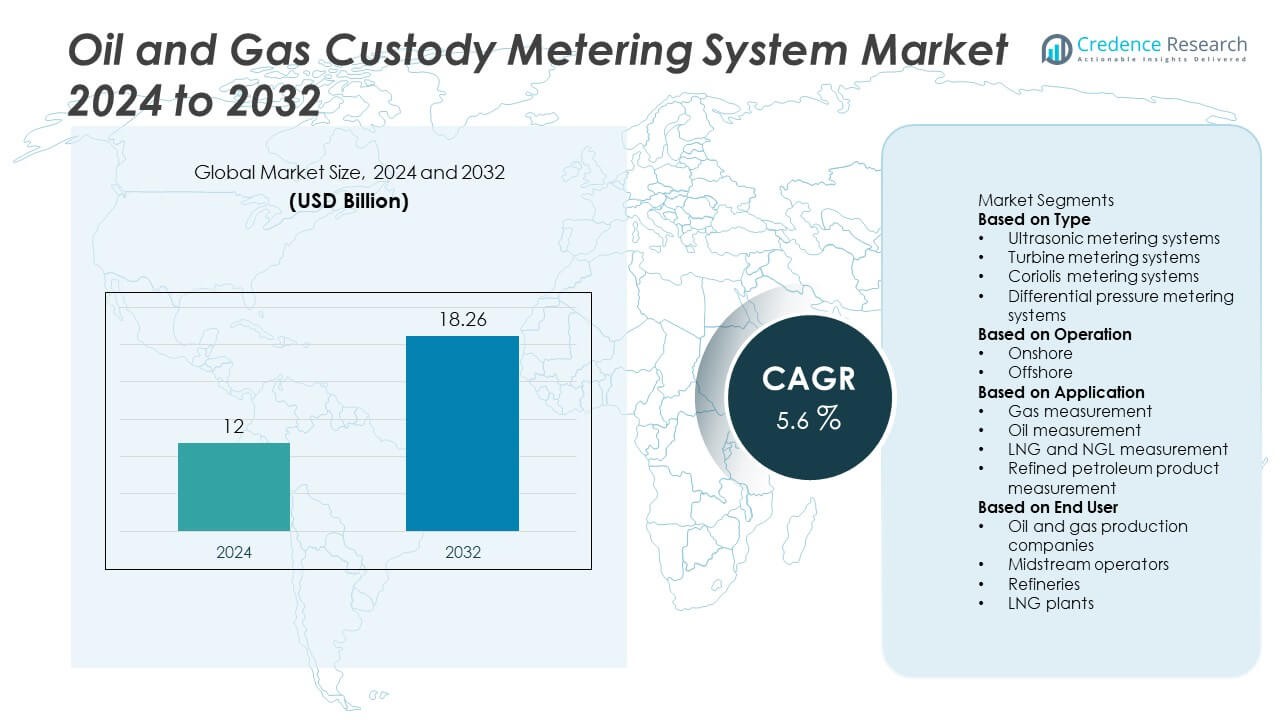
Oil and Gas Custody Metering System market size reached USD 12 billion in 2024 and is expected to reach USD 18.26 billion by 2032, registering a 5.6% CAGR during the forecast period.
| REPORT ATTRIBUTE | DETAILS |
|---|---|
| Historical Period | 2020-2023 |
| Base Year | 2024 |
| Forecast Period | 2025-2032 |
| Oil and Gas Custody Metering System Market Size 2024 | USD 12 Billion |
| Oil and Gas Custody Metering System Market, CAGR | 5.6% |
| Oil and Gas Custody Metering System Market Size 2032 | USD 18.26 Billion |
Top players in the Oil and Gas Custody Metering System market include Emerson Electric, Honeywell International, ABB, Schneider Electric, Yokogawa Electric, Endress+Hauser, KROHNE, TechnipFMC, Cameron, and Thermo Fisher Scientific. These companies strengthen their positions by offering high-accuracy ultrasonic, Coriolis, and turbine metering technologies designed for reliable custody transfer across pipelines, refineries, and export terminals. Their focus on digital diagnostics, remote monitoring, and automated proving enhances operational efficiency for major operators. North America leads the market with a 34% share, supported by strong midstream infrastructure, advanced regulatory standards, and rapid adoption of next-generation metering systems across large oil and gas networks.
Market Insights
- Oil and Gas Custody Metering System market reached USD 12 billion in 2024 and will grow at a 5.6% CAGR through the forecast period.
- Strong growth comes from rising demand for accurate flow measurement, driven by stricter regulatory audits and the need for transparent hydrocarbon trade across pipelines, terminals, and refining networks.
- Key trends include fast adoption of digital metering, automated proving, and smart diagnostics, while ultrasonic systems lead the type segment with a 38% share due to high accuracy and low maintenance.
- Competitive activity remains strong as top players expand portfolios with advanced ultrasonic and Coriolis technologies; however, high installation costs and complex calibration rules continue to restrain adoption.
- North America dominates regional demand with a 34% market share, followed by Europe at 27% and Asia Pacific at 23%, supported by expanding midstream infrastructure and growing LNG and refined product measurement needs.
Market Segmentation Analysis:
By Type
Ultrasonic metering systems hold the leading share of the type segment, registering a market share of 38% due to strong accuracy and low maintenance needs. These systems support high-flow conditions and manage varying pressures without mechanical wear. Turbine meters remain relevant in legacy facilities, while Coriolis units gain traction for density-based measurement demands. Differential pressure systems stay common in mature plants that favor established calibration practices. The rising shift toward digital flow diagnostics and real-time monitoring continues to push operators toward ultrasonic platforms, strengthening their dominance across new midstream and downstream installations.
- For instance, Honeywell’s ultrasonic flow meters are increasingly adopted in the midstream oil and gas sector for real-time digital flow diagnostics, reflecting the market's shift toward advanced technologies that minimize operational costs and downtime.
By Operation
Onshore facilities account for the dominant portion of the operation segment with a market share of 62%, driven by widespread pipeline networks, storage hubs, refineries, and metering skid installations. Onshore operators invest in system upgrades to meet stricter custody transfer accuracy rules and enhance loss-control performance. Offshore units show steady growth as deepwater projects adopt robust metering technologies that withstand harsh conditions. The increasing deployment of automated flow verification, leak detection tools, and digital calibration functions helps onshore systems maintain strong adoption across both established and expanding production regions.
- For instance, TechnipFMC provides measurement technologies and complete skid systems for both onshore and offshore applications, with over 80 years of experience in custody transfer solutions, to enhance accuracy and operational efficiency.
By Application
Oil measurement leads the application segment with a market share of 41%, supported by high transfer volumes across upstream, midstream, and refining infrastructure. Accurate oil custody metering reduces reconciliation errors and improves revenue assurance for operators. Gas measurement follows as natural gas trading expands, and LNG and NGL measurement gains importance as liquefaction plants scale export activities. Refined product measurement remains essential for distribution terminals. Rising demand for precise mass-flow tracking, better viscosity compensation, and digital meter diagnostics drives oil measurement’s strong position in custody transfer operations.
Key Growth Drivers
Rising Need for Accurate Flow Measurement
Growing demand for precise flow tracking strengthens the adoption of high-accuracy custody metering systems. Operators aim to reduce measurement errors, prevent revenue leakage, and meet strict inspection standards. Real-time diagnostics help limit manual intervention and improve reconciliation across producing, transporting, and refining stages. This driver gains momentum as companies prioritize transparent hydrocarbon trade and seek reliable validation of transfer quantities across complex supply networks.
- For instance, Emerson's Daniel™ 3808 and 3810 mass flow computers offer advanced real-time diagnostics that provide accurate measurement and validation of hydrocarbon flow in critical pipeline operations, minimizing manual intervention.
Expansion of Midstream Infrastructure Networks
New pipelines, storage facilities, and export terminals continue to expand global midstream capacity, driving strong demand for custody metering upgrades. Operators invest in advanced systems that maintain stable accuracy under changing operating conditions. These systems support continuous monitoring and automated proving across large transport corridors. Rising crude and gas movement across regional trade routes further encourages modernization of older metering assets, reinforcing this driver’s impact on long-term market growth.
- For instance, KROHNE's OPTIMASS 7400 Coriolis flow meters are designed for demanding process and custody transfer (CT) applications (fiscal metering), providing highly accurate measurement of gases and liquids, including crude, even under variable operating conditions.
Shift Toward Digital and Automated Metering
Digital tools reshape metering operations as companies integrate smart sensors, remote dashboards, and predictive analytics. Automated calibration reduces human error and improves operational consistency. Cloud-enabled platforms allow teams to access flow data instantly, supporting faster decision-making and reducing downtime. This shift enhances transparency across custody transactions and helps firms maintain strong measurement integrity across onshore and offshore networks.
Key Trends & Opportunities
Adoption of Multiphase and High-Performance Metering
A major trend involves increasing preference for multiphase meters that measure oil, gas, and water without separation. These systems cut operational costs and minimize footprint requirements in offshore and remote facilities. High-performance ultrasonic and Coriolis meters also gain traction due to their strong accuracy and minimal maintenance. The opportunity grows as operators look for compact, efficient technologies suited for dynamic flow environments.
- For instance, Schlumberger's Raptor multiphase flow meters are used in offshore operations to reduce operational costs and space requirements while maintaining high measurement accuracy under challenging conditions.
Integration of Advanced Data and Cloud Platforms
Integration of digital data layers creates new opportunities for enhanced monitoring, compliance, and reporting. Cloud-based platforms centralize flow records, diagnostics, and historical logs, improving transparency during audit processes. Remote access tools help detect irregularities quickly and support preventive maintenance. Growing interest in automated alerts and secure data chains increases adoption of software-driven custody metering solutions.
- For instance, Endress+Hauser's Netilion platform provides secure, cloud-based access to flow measurement data, enabling operators to monitor equipment performance remotely and detect irregularities quickly.
Upgrades Aligned with ESG and Emission Reduction Goals
Companies now replace older metering assets to reduce leaks, improve efficiency, and support environmental commitments. Modern systems offer better precision with lower energy use, helping operators limit unaccounted hydrocarbons. Digital upgrades also support leak-detection workflows and optimize flow conditions. This trend encourages investment in compact, low-emission metering solutions that align with sustainability strategies across global oil and gas operations.
Key Challenges
Complex Calibration and Compliance Requirements
Custody metering systems must meet strict calibration and verification rules, creating operational complexity. Operators perform regular proving and maintain detailed documentation to stay compliant. Variations across international and regional standards add further challenges. Insufficient calibration accuracy may cause disputes, penalties, or shutdowns. Smaller firms often face high costs and limited expertise to manage these compliance-heavy workflows.
High Installation and Modernization Costs
Advanced custody metering systems require significant investment in precision equipment, digital proving platforms, and integration engineering. Retrofitting legacy facilities increases design and installation complexity. Offshore sites demand rugged and highly specialized systems, raising project costs further. These financial barriers slow adoption in emerging regions and delay modernization cycles for operators with restricted capital budgets.
Regional Analysis
North America
North America leads the market with a market share of 34%, supported by strong pipeline networks, advanced midstream infrastructure, and strict regulatory frameworks that emphasize accurate custody transfer. Operators invest in high-performance ultrasonic and Coriolis meters to improve flow verification and limit losses across large transport corridors. Growth in shale production and expansion of export terminals sustain steady demand for advanced metering skids. The region also benefits from rapid adoption of digital diagnostics and automated proving systems, reinforcing its leadership in high-accuracy measurement technology across upstream, midstream, and refining operations.
Europe
Europe holds a market share of 27%, driven by strict compliance standards, strong technological adoption, and mature oil and gas transport networks. The region’s operators prioritize system upgrades to meet stringent measurement accuracy rules and enhance audit transparency. Expansion of cross-border gas trade and LNG import facilities drives further investment in premium metering systems. European firms also deploy digital monitoring tools to strengthen flow assurance and improve operational integrity. Transition toward low-carbon operations encourages modernization of older metering units, supporting continued demand across pipeline grids, terminals, and refined product distribution networks.
Asia Pacific
Asia Pacific accounts for a market share of 23%, fueled by growing energy consumption, rapid infrastructure development, and increasing investment in LNG terminals and cross-country pipeline projects. National oil companies and private operators deploy advanced custody metering systems to support expanding crude imports and refined product movement. Rising adoption of digital measurement platforms and smart sensors enhances flow management across large and diverse networks. Emerging demand for metering upgrades in offshore fields also contributes to steady growth. The region’s expanding refining capacity further strengthens the need for accurate, high-reliability measurement technologies.
Latin America
Latin America captures a market share of 9%, supported by expanding upstream activity, new pipeline developments, and rising export volumes in key producing countries. Operators focus on improving measurement accuracy to reduce losses and strengthen trade transparency. Investments in modern ultrasonic and Coriolis meters grow as firms replace older mechanical units. National reforms in energy markets and rising offshore developments drive additional demand for reliable custody transfer solutions. Growing interest in digital monitoring and automated calibration tools helps improve operational efficiency across midstream and refining networks in emerging markets.
Middle East & Africa
The Middle East & Africa region holds a market share of 7%, driven by strong crude production volumes and expanding export infrastructure. National oil companies adopt advanced custody metering systems to support large pipeline networks, storage hubs, and export terminals. Investments focus on enhancing accuracy and reducing unaccounted losses in high-capacity flow environments. Offshore expansion and new gas monetization projects increase demand for durable, high-performance meters. The region also sees rising interest in digital diagnostics and remote monitoring to improve efficiency and meet international trade standards across complex production zones.
Market Segmentations:
By Type
- Ultrasonic metering systems
- Turbine metering systems
- Coriolis metering systems
- Differential pressure metering systems
By Operation
- Onshore
- Offshore
By Application
- Gas measurement
- Oil measurement
- LNG and NGL measurement
- Refined petroleum product measurement
By End User
- Oil and gas production companies
- Midstream operators
- Refineries
- LNG plants
By Geography
- North America
- U.S.
- Canada
- Mexico
- Europe
- Germany
- France
- U.K.
- Italy
- Spain
- Rest of Europe
- Asia Pacific
- China
- Japan
- India
- South Korea
- South-east Asia
- Rest of Asia Pacific
- Latin America
- Brazil
- Argentina
- Rest of Latin America
- Middle East & Africa
- GCC Countries
- South Africa
- Rest of the Middle East and Africa
Competitive Landscape
The competitive landscape features leading companies such as Emerson Electric, Honeywell International, ABB, Schneider Electric, Yokogawa Electric, Endress+Hauser, KROHNE, Thermo Fisher Scientific, TechnipFMC, and Cameron. These firms compete by offering advanced custody metering solutions that enhance accuracy, reduce operational losses, and support digital integration across pipeline networks and terminal operations. Most companies focus on expanding product portfolios with high-performance ultrasonic, Coriolis, and turbine meters designed for demanding flow conditions. Strategic moves include partnerships with midstream operators, investments in automated proving systems, and upgrades in smart diagnostics. Players also emphasize remote monitoring capabilities, cybersecurity features, and data-driven measurement platforms to strengthen operational reliability. Continuous innovation in metering skids, sensor technologies, and cloud-enabled data systems helps these companies maintain strong market positions.
Key Player Analysis
- Emerson Electric Co.
- Honeywell International Inc.
- ABB Ltd.
- Schneider Electric
- Yokogawa Electric Corporation
- Endress+Hauser Group
- Thermo Fisher Scientific
- KROHNE Group
- TechnipFMC
- Cameron (a Schlumberger Company)
Recent Developments
- In August 2024, Honeywell International Inc. announced its Emissions Management Suite became Hazardous‑Location (HazLoc) and marine certified, enabling deployment in offshore oil & gas custody transfer and monitoring applications.
- In November 2023, Emerson published guidance emphasising periodic calibration of marine custody‑transfer systems using radar technology to maintain measurement accuracy.
- In October 2023, ABB announced a partnership with ODS Metering Systems to integrate ABB’s Flow‑X computers into custody‑transfer measurement systems and enhance digitalisation in oil & gas metering.
Report Coverage
The research report offers an in-depth analysis based on Type, Operation, Application, End User and Geography. It details leading market players, providing an overview of their business, product offerings, investments, revenue streams, and key applications. Additionally, the report includes insights into the competitive environment, SWOT analysis, current market trends, as well as the primary drivers and constraints. Furthermore, it discusses various factors that have driven market expansion in recent years. The report also explores market dynamics, regulatory scenarios, and technological advancements that are shaping the industry. It assesses the impact of external factors and global economic changes on market growth. Lastly, it provides strategic recommendations for new entrants and established companies to navigate the complexities of the market.
Future Outlook
- Demand for high-accuracy ultrasonic and Coriolis meters will rise as operators target stronger flow reliability.
- Digital diagnostics and predictive maintenance will become central to reducing downtime and improving asset performance.
- Automated proving systems will gain wider adoption to streamline calibration and support regulatory compliance.
- Cloud-based monitoring platforms will expand as companies centralize custody data across large pipeline networks.
- Integration of advanced sensors will improve real-time detection of flow irregularities and operational losses.
- High-capacity metering skids will see increased use in growing LNG and refined product export terminals.
- Remote monitoring will transform measurement workflows in offshore developments and isolated production sites.
- Replacement of aging mechanical meters will accelerate as operators shift toward maintenance-free technologies.
- Cybersecure metering systems will gain importance as digital data flows increase across the supply chain.
- ESG commitments will drive adoption of low-leakage, energy-efficient metering designs in global operations.

Request a Free Sample
Fill in your details and we'll send you a free sample report.
- Sample data tables & charts
- Research methodology
Market Dynamics
Rising Need for Accurate Flow Measurement
Stricter regulatory audits and the necessity for transparent hydrocarbon trade are driving demand for high-accuracy custody metering systems. Operators seek to minimize measurement errors and revenue leakage, making advanced metering technologies essential for compliance and operational integrity.
Expansion of Midstream Infrastructure Networks
The ongoing development of pipelines, storage facilities, and export terminals globally is increasing the need for custody metering upgrades. Modern systems are required to maintain accuracy under variable conditions and support continuous monitoring across expanding transport corridors.
Shift Toward Digital and Automated Metering
Operators are rapidly adopting digital diagnostics, automated calibration, and cloud-based platforms to enhance measurement transparency and reduce manual intervention. These technologies improve operational efficiency and support real-time decision-making across complex oil and gas networks.
Adoption of Multiphase and High-Performance Metering
There is a growing preference for multiphase and high-accuracy meters, such as ultrasonic and Coriolis systems, which can handle dynamic flow environments and reduce operational costs. This trend is particularly strong in offshore and remote facilities where space and maintenance access are limited.
Upgrades Aligned with ESG and Emission Reduction Goals
Companies are replacing older metering assets with modern, energy-efficient systems to reduce leaks, improve measurement precision, and support environmental commitments. This aligns with broader industry moves toward sustainability and regulatory compliance.
Need a Custom Version of This Report?
Tailor the scope, geography, or segments to your exact requirements.
- Custom geography or segment scope
- Direct access to our analyst team
Frequently Asked Questions
What is the current market size for the Oil and Gas Custody Metering System market, and what is its projected size in 2032?
At what Compound Annual Growth Rate is the Oil and Gas Custody Metering System market projected to grow between 2025 and 2032?
Which Oil and Gas Custody Metering System market segment held the largest share in 2024?
What are the primary factors fueling the growth of the Oil and Gas Custody Metering System market?
Who are the leading companies in the Oil and Gas Custody Metering System market?
Which region commanded the largest share of the Oil and Gas Custody Metering System market in 2024?
Table of Content
Chapter 1 Market Segmentation
- 1.1 Segmentation Framework
- 1.1.1 Product and Service Classification
- 1.1.2 Application and End-Use Classification
- 1.1.3 Technology and Solution Classification
- 1.1.4 Customer and Distribution Channel Classification
- 1.1.5 Geographic Segmentation
- 1.1.6 Market Segment Definitions and Boundaries
- 1.2 By Type
- 1.2.1 Ultrasonic metering systems
- 1.2.2 Turbine metering systems
- 1.2.3 Coriolis metering systems
- 1.2.4 Differential pressure metering systems
- 1.3 By End User
- 1.3.1 Oil and gas production companies
- 1.3.2 Midstream operators
- 1.3.3 Refineries
- 1.3.4 LNG plants
- 1.4 By Operation
- 1.4.1 Onshore
- 1.4.2 Offshore
- 1.5 By Application
- 1.5.1 Gas measurement
- 1.5.2 Oil measurement
- 1.5.3 LNG and NGL measurement
- 1.5.4 Refined petroleum product measurement
Chapter 2 Introduction
- 2.1 Report Objectives and Scope
- 2.2 Product Definition and Industry Terminology
- 2.3 Market Inclusions and Exclusions
- 2.4 Research Process
- 2.4.1 Primary Research and Expert Interviews
- 2.4.2 Secondary Research and Source Review
- 2.4.3 Top-Down and Bottom-Up Estimation
- 2.4.4 Data Triangulation and Verification
- 2.5 Market Size Measurement Basis
- 2.5.1 2024: USD 12 billion → 2032: USD 18.26 billion
- 2.6 Historical and Forecast Reference Periods
- 2.6.1 Base Year: 2024
- 2.6.2 Forecast Period: 2024-2032
- 2.7 Research Assumptions and Limitations
Chapter 3 Executive Summary
- 3.1 Market Snapshot and Key Findings
- 3.2 Base-Year Market Size, 2024
- 3.3 Forecast Market Size, 2032
- 3.4 Revenue and Volume Growth Outlook
- 3.5 Key Demand and Supply Indicators
- 3.6 Leading Market Segments
- 3.7 Fastest-Growing Market Opportunities
- 3.8 Regional Performance Highlights
- 3.9 Technology and Industry Transformation
- 3.10 Competitive Landscape Summary
- 3.11 Analyst View and Strategic Implications
Chapter 4 Global Oil and Gas Custody Metering System Market Trends and Developments
- 4.1 Historical Industry Development
- 4.2 Recent Market Trends and Developments
- 4.3 Demand and Customer Behavior Trends
- 4.4 Technology and Product Innovation
- 4.5 Artificial Intelligence, Automation and Digitalization
- 4.6 Local Manufacturing and Supply Chain Realignment
- 4.7 Industry Partnerships, Mergers and Acquisitions
- 4.8 Sustainability and Circular Economy Developments
- 4.9 Government and Private Sector Investment Trends
- 4.10 Emerging Business Models and Commercialization
- 4.11 Industry Developments and Announcements
Chapter 5 Global Oil and Gas Custody Metering System Market Production, Supply and Demand Analysis
- 5.1 Demand Trend and Consumption Analysis
- 5.2 Demand Forecast, 2024-2032
- 5.3 Production and Output Trend
- 5.4 Production and Output Forecast, 2024-2032
- 5.5 Installed Capacity and Capacity Utilization
- 5.6 Company-Wise Production Plants and Statistics
- 5.6.1 Installed Production Capacity
- 5.6.2 Actual Production
- 5.6.3 Planned Capacity and Expansion Targets
- 5.7 Supply Chain Structure and Procurement Trends
- 5.8 Supply-Demand Gap and Bottlenecks
- 5.9 Import Dependence and Sourcing Structure
- 5.10 Contract Manufacturing and Outsourcing
- 5.11 Regional Supply and Demand Concentration
Chapter 6 Global Oil and Gas Custody Metering System Market Pricing Analysis
- 6.1 Pricing Structure and Measurement
- 6.2 Historical Pricing Trends
- 6.3 Pricing Outlook, 2024-2032
- 6.4 Average Selling Price and Unit Economics
- 6.5 Pricing by Product and Market Segment
- 6.6 Geographic Pricing Differences
- 6.7 Key Input, Energy, Labor and Logistics Costs
- 6.8 Contract Pricing and Purchasing Models
- 6.9 Pricing Sensitivity and Competitive Positioning
- 6.10 Price, Margin and Profitability Implications
Chapter 7 Global Oil and Gas Custody Metering System Market Dynamics
- 7.1 Market Growth Drivers
- 7.1.1 Demand-Side Drivers
- 7.1.2 Technology and Innovation Drivers
- 7.1.3 Infrastructure and Investment Drivers
- 7.1.4 Regulatory and Policy Drivers
- 7.2 Market Restraints
- 7.2.1 Cost and Affordability Constraints
- 7.2.2 Technology and Adoption Barriers
- 7.2.3 Supply Chain and Operational Constraints
- 7.3 Market Challenges
- 7.3.1 Competitive Pressure and Margin Erosion
- 7.3.2 Skills, Infrastructure and Implementation Gaps
- 7.4 Emerging Market Opportunities
- 7.5 Market Dynamics Impact and Time-Horizon Assessment
Chapter 8 Global Oil and Gas Custody Metering System Value Chain Analysis
- 8.1 Industry Value Chain Overview
- 8.2 Upstream Suppliers and Critical Inputs
- 8.3 Technology and Component Providers
- 8.4 Manufacturing or Service Delivery
- 8.5 Distribution, Channel Partners and Integrators
- 8.6 Downstream Applications and End Users
- 8.7 Value Addition and Profit Pools
- 8.8 Vertical Integration and Outsourcing
- 8.9 Supplier Concentration and Risk
- 8.10 Supply Chain Localization and Resilience
Chapter 9 Global Oil and Gas Custody Metering System Market Regulations and Policies
- 9.1 Relevant Laws, Standards and Compliance Frameworks
- 9.2 Product, Service, Safety and Quality Requirements
- 9.3 Government Policies, Incentives and Subsidies
- 9.4 Imports, Exports and Trade Barriers
- 9.5 Public Procurement and Local Content Requirements
- 9.6 Environmental and Sustainability Compliance
- 9.7 Upcoming Policy Changes and Market Implications
Chapter 10 Global Oil and Gas Custody Metering System Market Hotspots and Opportunities
- 10.1 Market Opportunity Mapping and Growth Hotspots
- 10.2 High-Growth Applications and Customer Groups
- 10.3 Underserved Markets and White-Space Opportunities
- 10.4 Emerging Technology and Product Opportunities
- 10.5 New Capacity and Investment Hotspots
- 10.6 Market Entry and Expansion Opportunities
- 10.7 Distribution and Partnership Opportunities
- 10.8 Near-Term and Long-Term Commercial Potential
- 10.9 Opportunity Attractiveness and Execution Risks
Chapter 11 Global Oil and Gas Custody Metering System Market Outlook, 2024-2032
- 11.1 Market Size and Analysis
- 11.1.1 Revenue (Market Measurement: 2024: USD 12 billion → 2032: USD 18.26 billion)
- 11.1.2 Market Volume and Quantity Sold
- 11.1.3 Historical Market Size
- 11.1.4 Base-Year Market Size, 2024
- 11.2 Market Forecast, 2024-2032
- 11.2.1 Revenue Forecast to 2032
- 11.2.2 Volume Forecast to 2032
- 11.2.3 CAGR and Year-on-Year Growth
- 11.2.4 Incremental Revenue Opportunity
- 11.3 Forecast Assumptions and Scenario Analysis
- 11.3.1 Base-Case Forecast
- 11.3.2 Optimistic and Conservative Scenarios
- 11.3.3 Technology, Pricing and Policy Sensitivities
- 11.4 Market Attractiveness and Growth Outlook
Chapter 12 Global Oil and Gas Custody Metering System Market Segmentation and Outlook
- 12.1 Segmentation Summary and Market Shares, 2024
- 12.2 Largest and Fastest-Growing Segments
- 12.3 By Type - Market Size and Forecast, 2024-2032
- 12.3.1 Segment Definition and Scope
- 12.3.2 Historical Market Size
- 12.3.3 Revenue Forecast, 2024-2032
- 12.3.4 Volume Forecast, 2024-2032
- 12.3.5 Base-Year Market Share, 2024
- 12.3.6 Segment CAGR and Growth Drivers
- 12.3.7 Subsegment Market Size and Forecast
- 12.3.7.1 Ultrasonic metering systems
- 12.3.7.2 Turbine metering systems
- 12.3.7.3 Coriolis metering systems
- 12.3.7.4 Differential pressure metering systems
- 12.3.8 Subsegment Pricing and Adoption Trends
- 12.3.9 Leading Suppliers and Competition
- 12.3.10 Regional Demand and Opportunities
- 12.4 By End User - Market Size and Forecast, 2024-2032
- 12.4.1 Segment Definition and Scope
- 12.4.2 Historical Market Size
- 12.4.3 Revenue Forecast, 2024-2032
- 12.4.4 Volume Forecast, 2024-2032
- 12.4.5 Base-Year Market Share, 2024
- 12.4.6 Segment CAGR and Growth Drivers
- 12.4.7 Subsegment Market Size and Forecast
- 12.4.7.1 Oil and gas production companies
- 12.4.7.2 Midstream operators
- 12.4.7.3 Refineries
- 12.4.7.4 LNG plants
- 12.4.8 Subsegment Pricing and Adoption Trends
- 12.4.9 Leading Suppliers and Competition
- 12.4.10 Regional Demand and Opportunities
- 12.5 By Operation - Market Size and Forecast, 2024-2032
- 12.5.1 Segment Definition and Scope
- 12.5.2 Historical Market Size
- 12.5.3 Revenue Forecast, 2024-2032
- 12.5.4 Volume Forecast, 2024-2032
- 12.5.5 Base-Year Market Share, 2024
- 12.5.6 Segment CAGR and Growth Drivers
- 12.5.7 Subsegment Market Size and Forecast
- 12.5.7.1 Onshore
- 12.5.7.2 Offshore
- 12.5.8 Subsegment Pricing and Adoption Trends
- 12.5.9 Leading Suppliers and Competition
- 12.5.10 Regional Demand and Opportunities
- 12.6 By Application - Market Size and Forecast, 2024-2032
- 12.6.1 Segment Definition and Scope
- 12.6.2 Historical Market Size
- 12.6.3 Revenue Forecast, 2024-2032
- 12.6.4 Volume Forecast, 2024-2032
- 12.6.5 Base-Year Market Share, 2024
- 12.6.6 Segment CAGR and Growth Drivers
- 12.6.7 Subsegment Market Size and Forecast
- 12.6.7.1 Gas measurement
- 12.6.7.2 Oil measurement
- 12.6.7.3 LNG and NGL measurement
- 12.6.7.4 Refined petroleum product measurement
- 12.6.8 Subsegment Pricing and Adoption Trends
- 12.6.9 Leading Suppliers and Competition
- 12.6.10 Regional Demand and Opportunities
- 12.7 Segment Growth Comparison
- 12.8 Segment Attractiveness and Priority Matrix
Chapter 13 Global Oil and Gas Custody Metering System End-Use and Application Market Outlook
- 13.1 End-Use Industry and Customer Demand Structure
- 13.2 Leading Applications and Customer Groups
- 13.3 End-Use Market Size, Share and Forecast
- 13.4 Major End-Use Industry Deep Dives
- 13.4.1 Customer Requirements and Use Cases
- 13.4.2 Demand and Replacement Cycles
- 13.4.3 Technical and Regulatory Considerations
- 13.4.4 Purchasing and Procurement Models
- 13.4.5 Leading Vendors and Distribution Channels
- 13.4.6 Forecast and Commercial Opportunities
- 13.5 Emerging Applications and Cross-Segment Demand
- 13.6 End-Use Industry Investment Priorities
Chapter 14 Global Oil and Gas Custody Metering System Geographic Market Outlook, 2024-2032
- 14.1 Regional Market Size and Share, 2024
- 14.2 Regional Market Forecast, 2024-2032
- 14.3 Regional Pricing, Production and Demand Differences
- 14.4 North America
- 14.4.1 United States
- 14.4.2 Canada
- 14.4.3 Mexico
- 14.5 Europe
- 14.5.1 Germany
- 14.5.2 France
- 14.5.3 Italy
- 14.5.4 United Kingdom
- 14.5.5 Spain
- 14.5.6 Poland
- 14.5.7 Russia
- 14.5.8 Netherlands
- 14.5.9 Belgium
- 14.5.10 Sweden
- 14.5.11 Denmark
- 14.5.12 Norway
- 14.5.13 Rest of Europe
- 14.6 Asia Pacific
- 14.6.1 China
- 14.6.2 India
- 14.6.3 Japan
- 14.6.4 South Korea
- 14.6.5 Thailand
- 14.6.6 Indonesia
- 14.6.7 Vietnam
- 14.6.8 Malaysia
- 14.6.9 Australia
- 14.6.10 Rest of Asia Pacific
- 14.7 Latin America
- 14.7.1 Brazil
- 14.7.2 Argentina
- 14.7.3 Colombia
- 14.7.4 Chile
- 14.7.5 Rest of Latin America
- 14.8 Middle East
- 14.8.1 Saudi Arabia
- 14.8.2 United Arab Emirates
- 14.8.3 Turkey
- 14.8.4 Israel
- 14.8.5 Iran
- 14.8.6 Rest of the Middle East
- 14.9 Africa
- 14.9.1 South Africa
- 14.9.2 Egypt
- 14.9.3 Nigeria
- 14.9.4 Morocco
- 14.9.5 Rest of Africa
- 14.10 Regional Investment, Policy and Supply Chain Differences
- 14.11 Regional Competitive Landscape
- 14.12 Geographic Growth Hotspots
Chapter 15 Global Oil and Gas Custody Metering System Technology, Innovation and Sustainability Outlook
- 15.1 Technology Landscape and Maturity
- 15.2 Product, Process and Service Innovation
- 15.3 AI, Automation and Digital Tools in the Industry
- 15.4 Technology Adoption and Performance Benchmarking
- 15.5 Innovation Pipeline and R&D Investment
- 15.6 Patent and Intellectual Property Trends
- 15.7 Energy Efficiency and Resource Management
- 15.8 Sustainability, Recycling and Circularity
- 15.9 Technology Roadmap, 2024-2032
- 15.10 Risks of Obsolescence and Technology Substitution
Chapter 16 Global Oil and Gas Custody Metering System Market Key Strategic Imperatives
- 16.1 Growth and Market Entry Priorities
- 16.2 High-Return Products and Segments
- 16.3 Pricing, Profitability and Cost Optimization
- 16.4 Technology Investment and Product Differentiation
- 16.5 Supply Chain Localization and Resilience
- 16.6 Distribution and Customer Acquisition
- 16.7 Partnership, Acquisition and Capacity Strategy
- 16.8 Regional Expansion Priorities
- 16.9 Short-, Medium- and Long-Term Actions
Chapter 17 Competition Outlook
- 17.1 Industry Competition Characteristics
- 17.2 Market Structure and Concentration
- 17.3 Market Share and Competitive Positioning, 2024
- 17.4 Company-Wise Revenue and Product Benchmarking
- 17.5 Production and Service Capacity Benchmarking
- 17.6 Technology, Pricing and Differentiation
- 17.7 Regional Footprint and Distribution Strength
- 17.8 Mergers, Acquisitions and Strategic Alliances
- 17.9 New Entrants and Competitive Threats
- 17.10 Porter's Five Forces and Industry Attractiveness
- 17.11 Competitive Outlook, 2024-2032
Chapter 18 Company Profiles
- 18.1 Company Coverage and Selection Criteria
- 18.2 Emerson Electric Co.
- 18.2.1 Business Description
- 18.2.2 Company Ownership and Geographic Presence
- 18.2.3 Product and Service Portfolio
- 18.2.4 Manufacturing and Operating Footprint
- 18.2.5 Production Capacity and Expansion Plans
- 18.2.6 Financial Performance and Investment
- 18.2.7 Market Share and Competitive Position
- 18.2.8 Technology and Innovation Capabilities
- 18.2.9 Strategic Alliances or Partnerships
- 18.2.10 Recent Developments
- 18.2.11 Growth Strategy and Outlook
- 18.3 Honeywell International Inc.
- 18.4 ABB Ltd.
- 18.5 Schneider Electric
- 18.6 Yokogawa Electric Corporation
- 18.7 Endress+Hauser Group
- 18.8 Thermo Fisher Scientific
- 18.9 KROHNE Group
- 18.10 TechnipFMC
- 18.11 Cameron (a Schlumberger Company)
- 18.12 Other Relevant Market Participants
Note: Every listed company is profiled on the structure shown under the first company. The company list is preliminary and may change based on research findings, market developments, data availability and client requirements.
Chapter 19 Disclaimer
- 19.1 Research and Forecast Disclaimer
- 19.2 Data Source and Estimation Limitations
Note: The depth of individual sections depends on data availability for this market. Volume, capacity, trade and other unit-based metrics are included where applicable.