Market Overview:
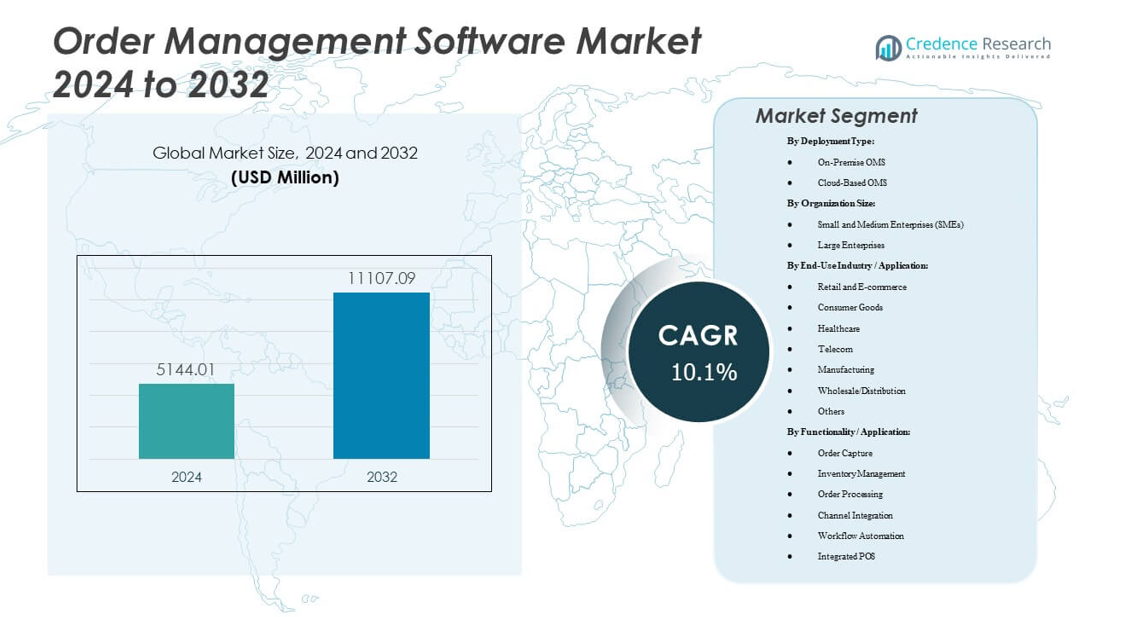
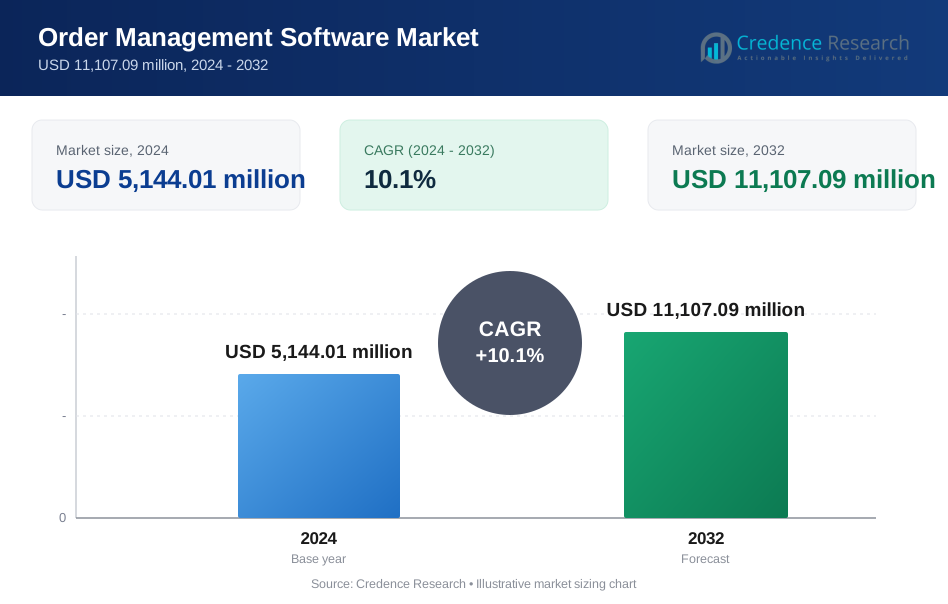
The Order Management Software Market is projected to grow from USD 5,144.01 million in 2024 to an estimated USD 11,107.09 million by 2032, with a compound annual growth rate (CAGR) of 10.1% from 2024 to 2032.
| REPORT ATTRIBUTE | DETAILS |
|---|---|
| Historical Period | 2020-2023 |
| Base Year | 2024 |
| Forecast Period | 2025-2032 |
| Order Management Software Market Size 2024 | USD 5,144.01 million |
| Order Management Software Market, CAGR | 10.1% |
| Order Management Software Market Size 2032 | USD 11,107.09 million |
The market growth is fueled by strong adoption of cloud-based solutions, automation, and AI-enabled order orchestration. Retailers and manufacturers rely on real-time analytics to manage inventory and fulfillment across multiple sales channels. Integration with ERP, CRM, and warehouse systems supports efficient data flow and transparency in global operations. It helps enterprises reduce delays, improve service accuracy, and manage complex logistics networks efficiently. Increasing preference for subscription-based SaaS models further boosts market scalability.
North America leads due to early technology adoption, robust retail ecosystems, and advanced e-commerce infrastructure. Europe follows with strong demand for omnichannel retail and compliance-focused solutions. Asia-Pacific emerges as the fastest-growing region due to expanding online retail, SME digitalisation, and rapid logistics infrastructure growth in countries like China, India, and Indonesia. Latin America and the Middle East & Africa show steady potential, driven by rising digital payment systems and increasing retail modernization efforts across urban centers.
Market Insights:
- The Order Management Software Market is projected to grow from USD 5,144.01 million in 2024 to USD 11,107.09 million by 2032, registering a CAGR of 10.1% during the forecast period.
- Rising adoption of cloud-based solutions and SaaS models drives efficiency and scalability across enterprises of all sizes.
- Integration of AI and automation enhances order accuracy, streamlines fulfillment, and reduces operational costs.
- High initial implementation costs and integration complexity with legacy systems limit adoption in smaller firms.
- North America leads with about 43% market share due to mature retail systems and strong digital infrastructure.
- Europe holds nearly 28% share, supported by omnichannel retail and regulatory compliance focus.
- Asia-Pacific emerges as the fastest-growing region with around 22% share, driven by expanding e-commerce and SME digitalization.
Market Drivers
Rising Demand for Real-Time Order Visibility and Customer Experience Enhancement
Businesses prioritise real-time visibility to meet rising customer expectations. Advanced analytics and automation enable faster order fulfilment. Retailers integrate data-driven platforms to improve operational control. Visibility across channels supports accuracy in inventory and delivery. Cloud-based models enhance scalability for peak seasons. It improves customer satisfaction by reducing errors and delays. The Order Management Software Market grows as enterprises adopt unified dashboards. End-to-end visibility strengthens responsiveness and boosts overall service efficiency.
Increasing Shift Toward Cloud-Based and SaaS Deployment Models
Organisations adopt cloud OMS for flexibility and lower maintenance needs. Scalable infrastructure supports global operations efficiently. Cloud tools reduce dependency on in-house IT resources. Firms gain faster access to system updates and security patches. Subscription models help manage operational budgets effectively. It allows seamless integration with third-party logistics and payment systems. Remote accessibility enables 24/7 monitoring across global supply networks. The rising transition to SaaS models drives long-term adoption.
Expansion of E-Commerce and Omnichannel Retail Operations
The e-commerce boom drives greater OMS adoption across industries. Unified platforms connect web, mobile, and in-store sales channels. Integration ensures accurate fulfilment and inventory balancing. Brands achieve consistency across multiple digital platforms. It helps retailers handle rising order volumes with reduced manual work. Automated routing reduces bottlenecks during promotional campaigns. Global marketplaces rely on OMS for multi-location operations. The Order Management Software Market benefits from robust omnichannel expansion.
- For instance, Shopify reported that its merchants generated USD 11.5 billion in global sales during the Black Friday–Cyber Monday 2024 weekend, with performance data directly published on Shopify’s official dashboard and confirmed through its annual BFCM report.
Automation and AI Integration Transforming Supply Chain Efficiency
AI-driven OMS enhances decision-making and operational precision. Predictive analytics anticipate order surges and optimise workflows. Automation minimises human errors in processing and delivery. Smart algorithms recommend faster fulfilment routes. It accelerates demand forecasting accuracy for retailers. Machine learning tools strengthen inventory planning capabilities. Businesses use automation to maintain real-time operational control. AI integration continues to drive market innovation and performance.
- For instance, Unilever’s Mannheim, Germany facility implemented layer-picking automation technology to boost warehouse efficiency, increasing picking capacity by around 50% and generating annual savings exceeding €1 million, as confirmed through Unilever’s official supply chain publications and operational reports.
Market Trends
Emergence of Headless Commerce and API-Driven Integrations
Headless architecture supports custom front-end experiences. API-driven integration enables faster adaptation to new channels. Modular systems offer brands flexibility in workflow configuration. Businesses upgrade OMS to support scalable commerce operations. It simplifies third-party connectivity and reduces downtime. Open APIs enhance collaboration with logistics partners. Retailers benefit from reduced deployment time for new features. The Order Management Software Market grows through demand for composable solutions.
- From a case study published by Coca‑Cola Hellenic Bottling Company (Coca-Cola HBC) and SAP Commerce Cloud, the company now supports 160,000 business customers and processes over 130,000 orders monthly using its cloud commerce platform.
Adoption of Mobile and Remote OMS Solutions for On-the-Go Management
usinesses adopt mobile-enabled OMS for field-based control. Managers track fulfilment operations remotely via secure platforms. It ensures continuous visibility during business travel or off-site work. Real-time notifications support faster response to disruptions. SMEs benefit from mobile tools offering instant analytics. Teams coordinate tasks more efficiently across dispersed networks. The mobility trend enhances agility in global operations. Growing mobile adoption reinforces OMS scalability and adoption.
- For instance, Rossum’s order management platform enables automated order capture across email, EDI, web portals, and mobile apps, helping users save up to 95% of time per document and achieve 71% straight-through processing, as confirmed in Rossum’s officially published impact reports and customer case studies.
Integration of OMS With Advanced Warehouse and ERP Systems
Integrated systems enable end-to-end control across supply chains. Synchronised data ensures real-time visibility in inventory levels. Automated stock updates prevent double-booking issues. OMS-ERP integration supports unified customer management. It drives efficiency by aligning finance, logistics, and sales functions. Warehouse connectivity enables faster picking and shipping. Enterprises achieve higher process consistency and traceability. The Order Management Software Market gains value through cross-platform integration.
Focus on Sustainability and Green Fulfilment Initiatives
Enterprises adopt OMS to support sustainable delivery networks. Route optimisation reduces fuel consumption in logistics. OMS-driven insights promote energy-efficient inventory management. Brands track carbon emissions during distribution cycles. It aligns business operations with environmental standards. Paperless invoicing and digital documentation gain traction. Supply chains benefit from lower waste levels. Sustainability-focused practices enhance brand credibility and customer loyalty.
Market Challenges Analysis
Integration Complexity Across Multi-Platform Environments
Enterprises struggle to integrate OMS with legacy and external systems. Disconnected data sources lead to fulfilment inconsistencies. Complex environments delay implementation timelines. It increases the cost of custom integration services. Managing multiple vendors raises technical challenges. Data migration requires skilled IT resources for accuracy. Limited interoperability restricts system performance across regions. The Order Management Software Market faces friction from integration difficulties.
High Cost of Deployment and Data Security Risks
Implementation costs deter smaller firms from early adoption. Custom configuration adds to development expenses. Security risks increase with cloud-based connectivity. It pushes companies to invest in encryption and compliance tools. Breaches threaten financial and customer data integrity. Regulatory complexities vary across regions, creating confusion. Continuous monitoring demands higher operational budgets. These factors limit large-scale adoption across price-sensitive industries.
Market Opportunities
Expansion Across Emerging Digital Economies
Emerging markets show strong demand for digital retail systems. SMEs adopt OMS to manage rising online sales volumes. Cloud availability lowers barriers to software adoption. It enables businesses to participate in global e-commerce networks. Local logistics partners benefit from OMS integration. Government-led digitalisation initiatives further boost adoption. Rising mobile commerce accelerates transformation in retail operations. The Order Management Software Market gains traction through emerging economies’ digital progress.
Growth Potential Through AI, Analytics, and Robotic Integration
Advanced AI tools reshape fulfilment and forecasting capabilities. Robotics improve picking accuracy in warehouses. It enhances speed and reduces manual workload. Predictive analytics identify performance inefficiencies early. Integration with IoT sensors supports real-time shipment visibility. Companies use AI to personalise customer experiences. Smart data-driven decisions improve profit margins. Innovation in automation creates new growth opportunities globally.
Market Segmentation Analysis:
By Deployment Type
The Order Management Software Market by deployment type divides into on-premise and cloud-based systems. On-premise OMS solutions remain preferred by large enterprises requiring tighter control and data security. These deployments cater to firms with established IT infrastructure. Cloud-based OMS dominates growth due to its flexibility, scalability, and low maintenance needs. It allows remote access and real-time updates across locations. SMEs increasingly select cloud platforms for quick implementation and affordability. Enterprises value cloud models for API connectivity with logistics and ERP systems. The shift toward SaaS-based architecture continues to strengthen this segment’s expansion.
- For instance, IBM Sterling Order Management was deployed by Lowe’s across its more than 1,700 US stores to centralise the fulfilment process and secure order-data management. This on-premise implementation supports the retailer’s in-store and online operations with single-system inventory visibility and fulfilment orchestration.
By Organization Size
SMEs adopt OMS to manage growing digital sales and reduce manual processing errors. Cloud-based platforms help small firms scale operations without major capital investment. These systems streamline multi-channel order management for retail and service providers. Large enterprises focus on automation and integration across global supply chains. It supports end-to-end visibility and compliance with corporate data policies. Larger organisations invest heavily in advanced analytics to optimise fulfilment accuracy. Both segments show rising preference for unified dashboards. Demand from mid-tier enterprises supports balanced market growth.
By End-Use Industry / Application
Retail and e-commerce lead adoption due to the surge in online shopping. Consumer goods brands rely on OMS for improved demand forecasting. Healthcare institutions use it to manage supply delivery and patient orders efficiently. Telecom providers streamline customer provisioning through automated order routing. Manufacturing and distribution players focus on inventory accuracy and faster turnaround. It enhances product tracking and resource planning. Other sectors, including food, automotive, and BFSI, leverage OMS for compliance and multi-channel integration. Strong cross-industry adoption underpins market resilience.
By Functionality / Application
Order capture systems ensure precise entry and validation of sales data. Inventory management modules track stock levels and prevent shortages. Order processing functions cover payment handling, shipping, invoicing, and returns. Channel integration tools synchronise multiple sales platforms under one system. Workflow automation improves fulfilment speed and operational efficiency. Integrated POS bridges in-store and online orders for unified visibility. It allows enterprises to create a seamless purchasing journey for customers. These combined functionalities define the technological depth of the market.
- For instance, TOMS (Tejas Order Management System) offers real-time inventory updates across all channels and integrates with shipping carriers, ERP systems, and label printing tools.
Segmentation:
By Deployment Type:
- On-Premise OMS
- Cloud-Based OMS
By Organization Size:
- Small and Medium Enterprises (SMEs)
- Large Enterprises
By End-Use Industry / Application:
- Retail and E-commerce
- Consumer Goods
- Healthcare
- Telecom
- Manufacturing
- Wholesale/Distribution
- Others (including Food & Beverage, Automotive, Electronics, BFSI, IT, Energy Utilities)
By Functionality / Application:
- Order Capture
- Inventory Management
- Order Processing (Payment Processing, Shipping, Invoicing, Returns Management)
- Channel Integration
- Workflow Automation
- Integrated POS
By Region:
- North America
- U.S.
- Canada
- Mexico
- Europe
- Germany
- France
- U.K.
- Italy
- Spain
- Rest of Europe
- Asia Pacific
- China
- Japan
- India
- South Korea
- South-east Asia
- Rest of Asia Pacific
- Latin America
- Brazil
- Argentina
- Rest of Latin America
- Middle East & Africa
- GCC Countries
- South Africa
- Rest of the Middle East and Africa
Regional Analysis:
North America Leading With High Market Share
North America commands roughly 43 % of the global Order Management Software Market share due to advanced e-commerce infrastructure and mature retail ecosystems. The U.S. and Canada host strong supplier networks and early cloud adoption, driving demand for scalable fulfilment solutions. Enterprises in this region prioritise order accuracy, fast delivery and multi-channel integration. It supports large-scale roll-outs and cross-border operations. Technology investment remains high, allowing deeper system penetration. The region’s regulatory clarity and developed logistics infrastructure further encourage OMS deployment.
Europe Holding Significant Share While Transitioning
Europe holds around 28 % of the market share and benefits from well-developed retail chains, cross-border trade and strong IT services. Several nations focus on GDPR-compliant order-management solutions and cross-EU fulfilment models. It faces moderate growth due to saturated markets, but firms continue upgrading legacy systems. It supports cloud-based OMS roll-outs linked to warehouse automation and omni-channel retail expansion. Firms in the region emphasise sustainability, compliance and fulfilment transparency. These factors sustain steady adoption growth.
Asia-Pacific Emerging Rapidly With Strong Growth Potential
The Asia-Pacific region holds about 22 % of the market share and leads in growth momentum due to digital commerce expansion in China, India and Southeast Asia. Rapid infrastructure build-out, growing middle-class consumption and mobile commerce drive elevated OMS adoption. SMEs in this region embrace cloud-based models to scale quickly with limited budgets. It supports cross-border fulfilment for international brands. Investment in logistics and last-mile networks advances system uptake. Regulatory reforms and increasing internet penetration accelerate market expansion.
Key Player Analysis:
- Oracle Corporation
- IBM Corporation
- SAP SE
- Salesforce, Inc.
- Microsoft Corporation
- HCL Technologies
- NetSuite (Oracle)
- Adobe Inc. (Magento Commerce)
- Zoho Corporation
- com
- Unicommerce eSolutions
- Brightpearl
- Blue Yonder (formerly JDA Software)
- Manhattan Associates
- Vinculum Solutions
Competitive Analysis:
The Order Management Software Market features a competitive landscape with global leaders such as Oracle Corporation, SAP SE, IBM Corporation, and Salesforce, Inc. These firms offer broad enterprise platforms with extensive integration capabilities and strong brand recognition. Mid-tier and niche players like Zoho Corporation Pvt. Ltd., Vinculum Solutions Pvt. Limited, and Manhattan Associates attract SMEs and regional clients with flexible cloud models. It expects M&A activity, partnerships, and platform enhancements to define upcoming competitive moves. Providers invest in analytics, automation, and specialised fulfilment tools to differentiate. Strong customer service, global reach, and continuous innovation determine leadership positions in this market.
Recent Developments:
- In November 2025, Microsoft Corporation made headlines with the launch of 80 new offers in its cloud solutions marketplace, prominently featuring updates to order management tools focused on integration and AI-driven optimization for business processes.
- In November 2025, Zoho Corporation announced a major update to its Zoho One business OS fusing advanced AI features and a redesigned interface to further optimize order and inventory workflows for SMEs globally.
- In October 2025, Vinculum launched an enhanced version of its modular order management system, offering real-time order processing and flexible integration capabilities tailored for evolving business needs. This update enables businesses to adapt quickly to changing market demands and streamline their omnichannel operations more efficiently.
- In October 2025, NetSuite (Oracle) expanded its SuiteCloud Developer partner program at SuiteWorld emphasizing AI-driven innovation for its cloud ERP and order management offerings, enabling faster deployment and improved customization for partners and customers.
- In September 2025, Microsoft Dynamics 365 introduced new features within its Intelligent Order Management component, focusing on advanced order orchestration, fulfillment, and lifecycle management.
- In May 2025, QuickOrders released a new version of its order management platform, emphasizing real-time inventory synchronization, intelligent order routing, and robust automation tools. This update is designed to help businesses scale their operations and provide a more seamless customer experience across various sales channels.
Report Coverage:
The research report offers an in-depth analysis based on Deployment Type, Organization Size, End-Use Industry / Application and Functionality / Application. It details leading market players, providing an overview of their business, product offerings, investments, revenue streams, and key applications. Additionally, the report includes insights into the competitive environment, SWOT analysis, current market trends, as well as the primary drivers and constraints. Furthermore, it discusses various factors that have driven market expansion in recent years. The report also explores market dynamics, regulatory scenarios, and technological advancements that are shaping the industry. It assesses the impact of external factors and global economic changes on market growth. Lastly, it provides strategic recommendations for new entrants and established companies to navigate the complexities of the market.
Future Outlook:
- Cloud-based deployment will dominate as enterprises prioritise flexibility, scalability, and reduced infrastructure costs.
- SMEs will increasingly adopt subscription-based OMS to enhance multi-channel visibility and reduce operational delays.
- Integration with AI and predictive analytics will transform decision-making, driving smarter fulfilment operations.
- Omnichannel retail growth will strengthen demand for systems that unify online and offline order workflows.
- Automation of inventory management and workflow orchestration will boost productivity and accuracy in fulfilment.
- API-driven and headless OMS architecture will gain traction, allowing rapid adaptation to new sales platforms.
- Data security and compliance solutions will become a key differentiator among leading OMS vendors.
- Strategic partnerships between OMS providers and logistics firms will redefine real-time order tracking standards.
- Regional growth will accelerate in Asia-Pacific, supported by expanding e-commerce and SME digitalisation.
- Continuous product innovation and M&A activities will intensify competition across global OMS suppliers.
Request a Free Sample
Fill in your details and we'll send you a free sample report.
- Sample data tables & charts
- Research methodology
Market Dynamics
Adoption of Cloud-Based and SaaS Deployment Models
Organizations are increasingly shifting to cloud-based and SaaS order management solutions for greater flexibility, scalability, and lower maintenance costs. This enables faster implementation, remote access, and seamless integration with third-party logistics and payment systems, driving widespread adoption across both SMEs and large enterprises.
Expansion of E-Commerce and Omnichannel Retail
The rapid growth of e-commerce and the need for unified management of online, mobile, and in-store sales channels are fueling demand for advanced order management software. Retailers and brands rely on OMS to handle rising order volumes, ensure inventory accuracy, and deliver consistent customer experiences across all platforms.
Integration of AI and Automation
AI-driven analytics and automation are transforming order management by improving order accuracy, streamlining fulfillment, and reducing operational costs. Predictive analytics, smart routing, and workflow automation enable businesses to anticipate demand surges, optimize inventory, and accelerate delivery times.
Demand for Real-Time Order Visibility and Customer Experience Enhancement
Businesses are prioritizing real-time visibility into orders and inventory to meet rising customer expectations for fast, accurate fulfillment. Unified dashboards and advanced analytics support operational control, reduce errors, and improve responsiveness, directly enhancing customer satisfaction.
Growth in Emerging Digital Economies
Emerging markets, particularly in Asia-Pacific, are experiencing rapid digitalization and e-commerce expansion. SMEs in these regions are adopting OMS solutions to manage increasing online sales, supported by government digital initiatives and improved logistics infrastructure, further accelerating market growth.
Need a Custom Version of This Report?
Tailor the scope, geography, or segments to your exact requirements.
- Custom geography or segment scope
- Direct access to our analyst team
Frequently Asked Questions
What is the current market size for Order Management Software Market, and what is its projected size in 2032?
At what Compound Annual Growth Rate is the Order Management Software Market projected to grow between 2024 and 2032?
Which is the leading region of the market for order management software?
What are the key drivers for the growth of the order management software market?
Which is the major segment in the order management software market by application?
Who are the leading companies in the Order Management Software Market?
Table of Content
Chapter 1 Market Segmentation
- 1.1 Segmentation Framework
- 1.1.1 Product and Service Classification
- 1.1.2 Application and End-Use Classification
- 1.1.3 Technology and Solution Classification
- 1.1.4 Customer and Distribution Channel Classification
- 1.1.5 Geographic Segmentation
- 1.1.6 Market Segment Definitions and Boundaries
- 1.2 By Deployment Type
- 1.2.1 On-Premise OMS
- 1.2.2 Cloud-Based OMS
- 1.3 By Organization Size
- 1.3.1 Small and Medium Enterprises (SMEs)
- 1.3.2 Large Enterprises
- 1.4 By Functionality / Application
- 1.4.1 Order Capture
- 1.4.2 Inventory Management
- 1.4.3 Order Processing (Payment Processing, Shipping, Invoicing, Returns Management)
- 1.4.4 Channel Integration
- 1.4.5 Workflow Automation
- 1.4.6 Integrated POS
- 1.5 By End-Use Industry / Application
- 1.5.1 Retail and E-commerce
- 1.5.2 Consumer Goods
- 1.5.3 Healthcare
- 1.5.4 Telecom
- 1.5.5 Manufacturing
- 1.5.6 Wholesale/Distribution
- 1.5.7 Others (Food & Beverage, Automotive, Electronics, BFSI, IT, Energy Utilities)
Chapter 2 Introduction
- 2.1 Report Objectives and Scope
- 2.2 Product Definition and Industry Terminology
- 2.3 Market Inclusions and Exclusions
- 2.4 Research Process
- 2.4.1 Primary Research and Expert Interviews
- 2.4.2 Secondary Research and Source Review
- 2.4.3 Top-Down and Bottom-Up Estimation
- 2.4.4 Data Triangulation and Verification
- 2.5 Market Size Measurement Basis
- 2.5.1 2024: USD 5,144.01 million → 2032: USD 11,107.09 million
- 2.6 Historical and Forecast Reference Periods
- 2.6.1 Base Year: 2024
- 2.6.2 Forecast Period: 2024-2032
- 2.7 Research Assumptions and Limitations
Chapter 3 Executive Summary
- 3.1 Market Snapshot and Key Findings
- 3.2 Base-Year Market Size, 2024
- 3.3 Forecast Market Size, 2032
- 3.4 Revenue and Volume Growth Outlook
- 3.5 Key Demand and Supply Indicators
- 3.6 Leading Market Segments
- 3.7 Fastest-Growing Market Opportunities
- 3.8 Regional Performance Highlights
- 3.9 Technology and Industry Transformation
- 3.10 Competitive Landscape Summary
- 3.11 Analyst View and Strategic Implications
Chapter 4 Global Order Management Software Market Trends and Developments
- 4.1 Historical Industry Development
- 4.2 Recent Market Trends and Developments
- 4.3 Demand and Customer Behavior Trends
- 4.4 Technology and Product Innovation
- 4.5 Artificial Intelligence, Automation and Digitalization
- 4.6 Local Manufacturing and Supply Chain Realignment
- 4.7 Industry Partnerships, Mergers and Acquisitions
- 4.8 Sustainability and Circular Economy Developments
- 4.9 Government and Private Sector Investment Trends
- 4.10 Emerging Business Models and Commercialization
- 4.11 Industry Developments and Announcements
Chapter 5 Global Order Management Software Market Supply and Demand Analysis
- 5.1 Demand Trend and Consumption Analysis
- 5.2 Demand Forecast, 2024-2032
- 5.3 Supply Chain Structure and Procurement Trends
- 5.4 Supply-Demand Gap and Bottlenecks
- 5.5 Import Dependence and Sourcing Structure
- 5.6 Regional Supply and Demand Concentration
Chapter 6 Global Order Management Software Market Pricing Analysis
- 6.1 Pricing Structure and Measurement
- 6.2 Historical Pricing Trends
- 6.3 Pricing Outlook, 2024-2032
- 6.4 Pricing by Product and Market Segment
- 6.5 Geographic Pricing Differences
- 6.6 Key Input, Energy, Labor and Logistics Costs
- 6.7 Contract Pricing and Purchasing Models
- 6.8 Pricing Sensitivity and Competitive Positioning
- 6.9 Price, Margin and Profitability Implications
Chapter 7 Global Order Management Software Market Dynamics
- 7.1 Market Growth Drivers
- 7.1.1 Demand-Side Drivers
- 7.1.2 Technology and Innovation Drivers
- 7.1.3 Infrastructure and Investment Drivers
- 7.1.4 Regulatory and Policy Drivers
- 7.2 Market Restraints
- 7.2.1 Cost and Affordability Constraints
- 7.2.2 Technology and Adoption Barriers
- 7.2.3 Supply Chain and Operational Constraints
- 7.3 Market Challenges
- 7.3.1 Competitive Pressure and Margin Erosion
- 7.3.2 Skills, Infrastructure and Implementation Gaps
- 7.4 Emerging Market Opportunities
- 7.5 Market Dynamics Impact and Time-Horizon Assessment
Chapter 8 Global Order Management Software Value Chain Analysis
- 8.1 Industry Value Chain Overview
- 8.2 Upstream Suppliers and Critical Inputs
- 8.3 Technology and Component Providers
- 8.4 Manufacturing or Service Delivery
- 8.5 Distribution, Channel Partners and Integrators
- 8.6 Downstream Applications and End Users
- 8.7 Value Addition and Profit Pools
- 8.8 Vertical Integration and Outsourcing
- 8.9 Supplier Concentration and Risk
- 8.10 Supply Chain Localization and Resilience
Chapter 9 Global Order Management Software Market Regulations and Policies
- 9.1 Relevant Laws, Standards and Compliance Frameworks
- 9.2 Product, Service, Safety and Quality Requirements
- 9.3 Government Policies, Incentives and Subsidies
- 9.4 Imports, Exports and Trade Barriers
- 9.5 Public Procurement and Local Content Requirements
- 9.6 Data Protection, AI and Cybersecurity Compliance
- 9.7 Upcoming Policy Changes and Market Implications
Chapter 10 Global Order Management Software Market Hotspots and Opportunities
- 10.1 Market Opportunity Mapping and Growth Hotspots
- 10.2 High-Growth Applications and Customer Groups
- 10.3 Underserved Markets and White-Space Opportunities
- 10.4 Emerging Technology and Product Opportunities
- 10.5 New Capacity and Investment Hotspots
- 10.6 Market Entry and Expansion Opportunities
- 10.7 Distribution and Partnership Opportunities
- 10.8 Near-Term and Long-Term Commercial Potential
- 10.9 Opportunity Attractiveness and Execution Risks
Chapter 11 Global Order Management Software Market Outlook, 2024-2032
- 11.1 Market Size and Analysis
- 11.1.1 Revenue (Market Measurement: 2024: USD 5,144.01 million → 2032: USD 11,107.09 million)
- 11.1.2 Historical Market Size
- 11.1.3 Base-Year Market Size, 2024
- 11.2 Market Forecast, 2024-2032
- 11.2.1 Revenue Forecast to 2032
- 11.2.2 CAGR and Year-on-Year Growth
- 11.2.3 Incremental Revenue Opportunity
- 11.3 Forecast Assumptions and Scenario Analysis
- 11.3.1 Base-Case Forecast
- 11.3.2 Optimistic and Conservative Scenarios
- 11.3.3 Technology, Pricing and Policy Sensitivities
- 11.4 Market Attractiveness and Growth Outlook
Chapter 12 Global Order Management Software Market Segmentation and Outlook
- 12.1 Segmentation Summary and Market Shares, 2024
- 12.2 Largest and Fastest-Growing Segments
- 12.3 By Deployment Type - Market Size and Forecast, 2024-2032
- 12.3.1 Segment Definition and Scope
- 12.3.2 Historical Market Size
- 12.3.3 Revenue Forecast, 2024-2032
- 12.3.4 Base-Year Market Share, 2024
- 12.3.5 Segment CAGR and Growth Drivers
- 12.3.6 Subsegment Market Size and Forecast
- 12.3.6.1 On-Premise OMS
- 12.3.6.2 Cloud-Based OMS
- 12.3.7 Subsegment Pricing and Adoption Trends
- 12.3.8 Leading Suppliers and Competition
- 12.3.9 Regional Demand and Opportunities
- 12.4 By Organization Size - Market Size and Forecast, 2024-2032
- 12.4.1 Segment Definition and Scope
- 12.4.2 Historical Market Size
- 12.4.3 Revenue Forecast, 2024-2032
- 12.4.4 Base-Year Market Share, 2024
- 12.4.5 Segment CAGR and Growth Drivers
- 12.4.6 Subsegment Market Size and Forecast
- 12.4.6.1 Small and Medium Enterprises (SMEs)
- 12.4.6.2 Large Enterprises
- 12.4.7 Subsegment Pricing and Adoption Trends
- 12.4.8 Leading Suppliers and Competition
- 12.4.9 Regional Demand and Opportunities
- 12.5 By Functionality / Application - Market Size and Forecast, 2024-2032
- 12.5.1 Segment Definition and Scope
- 12.5.2 Historical Market Size
- 12.5.3 Revenue Forecast, 2024-2032
- 12.5.4 Base-Year Market Share, 2024
- 12.5.5 Segment CAGR and Growth Drivers
- 12.5.6 Subsegment Market Size and Forecast
- 12.5.6.1 Order Capture
- 12.5.6.2 Inventory Management
- 12.5.6.3 Order Processing (Payment Processing, Shipping, Invoicing, Returns Management)
- 12.5.6.4 Channel Integration
- 12.5.6.5 Workflow Automation
- 12.5.6.6 Integrated POS
- 12.5.7 Subsegment Pricing and Adoption Trends
- 12.5.8 Leading Suppliers and Competition
- 12.5.9 Regional Demand and Opportunities
- 12.6 By End-Use Industry / Application - Market Size and Forecast, 2024-2032
- 12.6.1 Segment Definition and Scope
- 12.6.2 Historical Market Size
- 12.6.3 Revenue Forecast, 2024-2032
- 12.6.4 Base-Year Market Share, 2024
- 12.6.5 Segment CAGR and Growth Drivers
- 12.6.6 Subsegment Market Size and Forecast
- 12.6.6.1 Retail and E-commerce
- 12.6.6.2 Consumer Goods
- 12.6.6.3 Healthcare
- 12.6.6.4 Telecom
- 12.6.6.5 Manufacturing
- 12.6.6.6 Wholesale/Distribution
- 12.6.6.7 Others (Food & Beverage, Automotive, Electronics, BFSI, IT, Energy Utilities)
- 12.6.7 Subsegment Pricing and Adoption Trends
- 12.6.8 Leading Suppliers and Competition
- 12.6.9 Regional Demand and Opportunities
- 12.7 Segment Growth Comparison
- 12.8 Segment Attractiveness and Priority Matrix
Chapter 13 Global Order Management Software End-Use and Application Market Outlook
- 13.1 End-Use Industry and Customer Demand Structure
- 13.2 Leading Applications and Customer Groups
- 13.3 End-Use Market Size, Share and Forecast
- 13.4 Major End-Use Industry Deep Dives
- 13.4.1 Customer Requirements and Use Cases
- 13.4.2 Demand and Replacement Cycles
- 13.4.3 Technical and Regulatory Considerations
- 13.4.4 Purchasing and Procurement Models
- 13.4.5 Leading Vendors and Distribution Channels
- 13.4.6 Forecast and Commercial Opportunities
- 13.5 Emerging Applications and Cross-Segment Demand
- 13.6 End-Use Industry Investment Priorities
Chapter 14 Global Order Management Software Geographic Market Outlook, 2024-2032
- 14.1 Regional Market Size and Share, 2024
- 14.2 Regional Market Forecast, 2024-2032
- 14.3 Regional Pricing, Production and Demand Differences
- 14.4 North America
- 14.4.1 United States
- 14.4.2 Canada
- 14.4.3 Mexico
- 14.5 Europe
- 14.5.1 Germany
- 14.5.2 France
- 14.5.3 Italy
- 14.5.4 United Kingdom
- 14.5.5 Spain
- 14.5.6 Poland
- 14.5.7 Russia
- 14.5.8 Netherlands
- 14.5.9 Belgium
- 14.5.10 Sweden
- 14.5.11 Denmark
- 14.5.12 Norway
- 14.5.13 Rest of Europe
- 14.6 Asia Pacific
- 14.6.1 China
- 14.6.2 India
- 14.6.3 Japan
- 14.6.4 South Korea
- 14.6.5 Thailand
- 14.6.6 Indonesia
- 14.6.7 Vietnam
- 14.6.8 Malaysia
- 14.6.9 Australia
- 14.6.10 Rest of Asia Pacific
- 14.7 Latin America
- 14.7.1 Brazil
- 14.7.2 Argentina
- 14.7.3 Colombia
- 14.7.4 Chile
- 14.7.5 Rest of Latin America
- 14.8 Middle East
- 14.8.1 Saudi Arabia
- 14.8.2 United Arab Emirates
- 14.8.3 Turkey
- 14.8.4 Israel
- 14.8.5 Iran
- 14.8.6 Rest of the Middle East
- 14.9 Africa
- 14.9.1 South Africa
- 14.9.2 Egypt
- 14.9.3 Nigeria
- 14.9.4 Morocco
- 14.9.5 Rest of Africa
- 14.10 Regional Investment, Policy and Supply Chain Differences
- 14.11 Regional Competitive Landscape
- 14.12 Geographic Growth Hotspots
Chapter 15 Global Order Management Software Technology, Innovation and Sustainability Outlook
- 15.1 Technology Landscape and Maturity
- 15.2 Product, Process and Service Innovation
- 15.3 AI, Automation and Digital Tools in the Industry
- 15.4 Technology Adoption and Performance Benchmarking
- 15.5 Innovation Pipeline and R&D Investment
- 15.6 Patent and Intellectual Property Trends
- 15.7 Energy Efficiency and Resource Management
- 15.8 Sustainability, Recycling and Circularity
- 15.9 Technology Roadmap, 2024-2032
- 15.10 Risks of Obsolescence and Technology Substitution
Chapter 16 Global Order Management Software Market Key Strategic Imperatives
- 16.1 Growth and Market Entry Priorities
- 16.2 High-Return Products and Segments
- 16.3 Pricing, Profitability and Cost Optimization
- 16.4 Technology Investment and Product Differentiation
- 16.5 Supply Chain Localization and Resilience
- 16.6 Distribution and Customer Acquisition
- 16.7 Partnership, Acquisition and Capacity Strategy
- 16.8 Regional Expansion Priorities
- 16.9 Short-, Medium- and Long-Term Actions
Chapter 17 Competition Outlook
- 17.1 Industry Competition Characteristics
- 17.2 Market Structure and Concentration
- 17.3 Market Share and Competitive Positioning, 2024
- 17.4 Company-Wise Revenue and Product Benchmarking
- 17.5 Production and Service Capacity Benchmarking
- 17.6 Technology, Pricing and Differentiation
- 17.7 Regional Footprint and Distribution Strength
- 17.8 Mergers, Acquisitions and Strategic Alliances
- 17.9 New Entrants and Competitive Threats
- 17.10 Porter's Five Forces and Industry Attractiveness
- 17.11 Competitive Outlook, 2024-2032
Chapter 18 Company Profiles
- 18.1 Company Coverage and Selection Criteria
- 18.2 Oracle Corporation
- 18.2.1 Business Description
- 18.2.2 Company Ownership and Geographic Presence
- 18.2.3 Product and Service Portfolio
- 18.2.4 Manufacturing and Operating Footprint
- 18.2.5 Financial Performance and Investment
- 18.2.6 Market Share and Competitive Position
- 18.2.7 Technology and Innovation Capabilities
- 18.2.8 Strategic Alliances or Partnerships
- 18.2.9 Recent Developments
- 18.2.10 Growth Strategy and Outlook
- 18.3 IBM Corporation
- 18.4 SAP SE
- 18.5 Salesforce, Inc.
- 18.6 Microsoft Corporation
- 18.7 HCL Technologies
- 18.8 NetSuite (Oracle)
- 18.9 Adobe Inc. (Magento Commerce)
- 18.10 Zoho Corporation
- 18.11 Manhattan Associates
- 18.12 Other Relevant Market Participants
Note: Every listed company is profiled on the structure shown under the first company. The company list is preliminary and may change based on research findings, market developments, data availability and client requirements.
Chapter 19 Disclaimer
- 19.1 Research and Forecast Disclaimer
- 19.2 Data Source and Estimation Limitations
Note: The depth of individual sections depends on data availability for this market. Volume, capacity, trade and other unit-based metrics are included where applicable.