
| REPORT ATTRIBUTE | DETAILS |
|---|---|
| Historical Period | 2019-2022 |
| Base Year | 2023 |
| Forecast Period | 2024-2032 |
| Outdoor Thermometer Market Size 2024 | USD 41.992 million |
| Outdoor Thermometer Market, CAGR | 4.68% |
| Outdoor Thermometer Market Size 2032 | USD 60.54 million |
Market Overview:
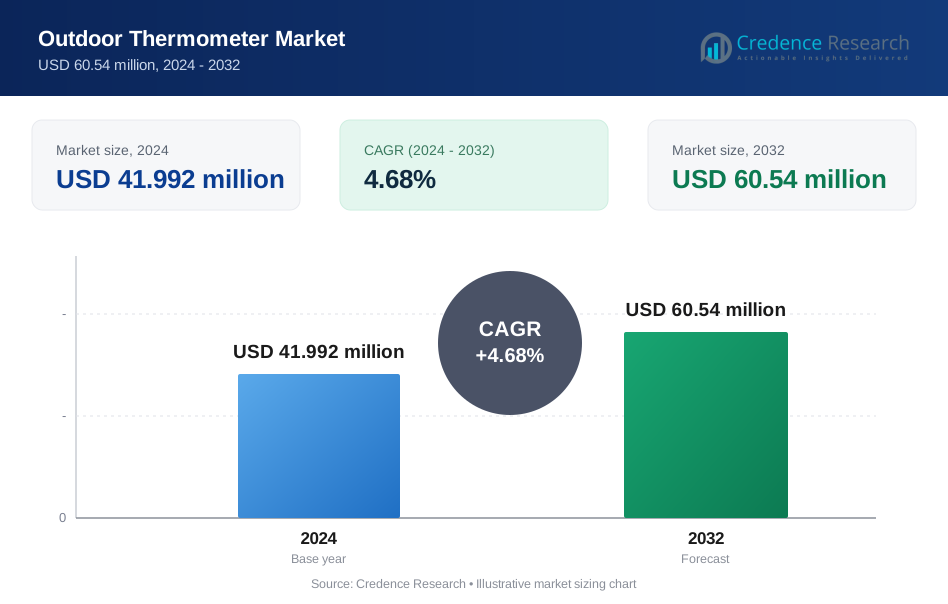
The Outdoor Thermometer Market is projected to grow from a market size of USD 41.992 million in 2024 to approximately USD 60.54 million by 2032, reflecting a compound annual growth rate (CAGR) of 4.68%. Outdoor thermometers are widely used for measuring ambient temperatures in outdoor environments, serving applications ranging from residential use and gardening to industrial and meteorological applications. Their utility in monitoring weather conditions, supporting agricultural productivity, and providing accurate temperature readings for safety and comfort purposes drives their adoption. The market's steady growth is attributed to technological advancements, expanding product varieties, and increased consumer interest in weather-related data.
The primary drivers of the Outdoor Thermometer Market include rising awareness and interest in weather monitoring and climate change impacts, driving demand for accurate and durable outdoor thermometers. The growing popularity of smart and connected outdoor thermometers, which allow users to monitor temperatures remotely using mobile devices, is also boosting market growth. Furthermore, increasing demand for outdoor temperature measurement in agriculture, gardening, construction, and recreational sectors supports steady adoption. Manufacturers are increasingly focusing on offering robust, easy-to-use, and environmentally resistant thermometers to meet diverse consumer needs.
Regionally, North America holds a substantial share of the Outdoor Thermometer Market, driven by a high interest in weather monitoring, outdoor activities, and technological advancements in smart thermometers. Europe follows closely, supported by a strong gardening culture, climate-focused initiatives, and demand for accurate outdoor temperature readings. The Asia-Pacific region is expected to experience significant growth due to rising agricultural activities, rapid urbanization, and increasing consumer awareness about weather monitoring and outdoor conditions. Latin America, the Middle East, and Africa are also experiencing gradual growth, driven by growing consumer demand and infrastructure development, which supports the adoption of outdoor temperature monitoring solutions.
Market Drivers:
Rising Interest in Weather Monitoring and Climate Awareness:
The growing interest in weather monitoring and heightened awareness about climate change are key drivers in the Outdoor Thermometer Market. According to the World Meteorological Organization (WMO), climate-related natural disasters increased by 45% over the past two decades, prompting greater public and governmental focus on accurate temperature monitoring. Consumers and businesses alike are investing in outdoor thermometers to track changing weather patterns. Companies such as La Crosse Technology are capitalizing on this trend by offering a range of high-precision outdoor thermometers tailored to user needs.
Technological Advancements and Smart Thermometer Adoption:
Technological innovations, particularly in smart thermometers, are transforming the market. Smart outdoor thermometers enable users to monitor temperatures remotely via mobile devices, enhancing convenience and utility. According to the number of smart home devices globally is expected to reach 1.4 billion units by 2025, reflecting rising adoption rates. Major players, including AcuRite and Ambient Weather, offer connected outdoor thermometers that integrate seamlessly with home automation systems, aligning with growing consumer demand for smart and interconnected solutions.
Increased Demand in Agriculture and Gardening:
The demand for outdoor thermometers in the agriculture and gardening sectors is on the rise. Farmers and gardeners rely on accurate temperature measurements to optimize crop growth and protect plants from adverse weather conditions. For instance, according to the Food and Agriculture Organization (FAO), global agricultural output must increase by 60% by 2050 to meet rising demand, emphasizing the need for precise weather monitoring tools. Outdoor thermometers designed for harsh environmental conditions help users track temperature changes critical to successful crop and garden management.
Expansion of Outdoor Recreational Activities:
The popularity of outdoor recreational activities, including hiking, camping, and sports, is fueling demand for outdoor thermometers. Accurate temperature readings enhance user safety and experience during outdoor activities. For instance, the Outdoor Industry Association reports that 50% of Americans participate in outdoor recreation annually, creating a significant market for temperature monitoring solutions. Leading manufacturers have responded by developing rugged and portable outdoor thermometers suitable for outdoor enthusiasts.
Market Trends:
Growing Adoption of Wireless and Digital Thermometers:
A significant trend in the Outdoor Thermometer Market is the increasing adoption of wireless and digital thermometers. Wireless technologies offer enhanced convenience, allowing users to remotely monitor outdoor temperatures through mobile devices and integrated home systems. According to a 2023 report, approximately 40% of U.S. households utilize smart home devices, reflecting the growing preference for wireless and digital solutions. Companies such as ThermoPro are leading this shift, offering wireless outdoor thermometers with extended range capabilities and user-friendly interfaces, catering to tech-savvy consumers.
Focus on Sustainability and Eco-Friendly Designs:
The market is seeing a rising emphasis on sustainability, with manufacturers developing eco-friendly outdoor thermometers made from recyclable materials and incorporating energy-saving features such as solar-powered displays. The European Union’s Green Deal, which aims to make Europe climate-neutral by 2050, has encouraged businesses to adopt environmentally conscious practices. For instance, several manufacturers have launched solar-powered thermometers that minimize environmental impact and offer reliable performance in outdoor settings.
Customization and Advanced Data Analytics:
Customization and the integration of advanced data analytics in outdoor thermometers are gaining traction. Consumers increasingly demand tailored solutions that provide not only temperature readings but also comprehensive weather data, including humidity, wind speed, and UV index. Advanced models offer predictive analytics and historical trend tracking, enhancing user engagement. Companies like Ambient Weather have developed multi-sensor outdoor thermometers that deliver a holistic view of weather conditions, appealing to data-driven users and hobbyists.
Rising Interest in Aesthetic and Decorative Thermometers:
Aesthetic and decorative outdoor thermometers are becoming popular, driven by demand for products that seamlessly integrate into outdoor decor. Many consumers prefer stylish designs that serve both functional and decorative purposes. For instance, according to a survey by the National Association of Home Builders, 30% of homeowners prioritize outdoor living enhancements, creating opportunities for decorative thermometers. Manufacturers have responded by offering a range of attractive, durable designs that complement outdoor spaces while delivering accurate temperature measurements.
Market Challenges Analysis:
Regulatory Compliance and Standards:
The Outdoor Thermometer Market faces challenges due to stringent regulatory compliance requirements and industry standards imposed by government authorities such as the U.S. Consumer Product Safety Commission (CPSC) and the European Committee for Standardization (CEN). These regulations often dictate product safety, material use, and accuracy levels, which can lead to increased production costs for manufacturers. Compliance with these regulatory frameworks across different regions is resource-intensive and may slow the introduction of new products, particularly for smaller market players.
Impact of Weather Variability and Environmental Factors:
Outdoor thermometers must withstand diverse environmental conditions, such as extreme heat, cold, humidity, and precipitation. Ensuring durability and consistent performance under varying weather conditions presents a technical challenge for manufacturers. Products that fail to perform reliably in harsh environments risk damaging brand reputation and customer trust. Designing robust, long-lasting outdoor thermometers requires continuous research and innovation, increasing development costs.
Competition from Low-Cost Alternatives:
The market faces competition from low-cost alternatives and counterfeit products that often do not meet the required quality and safety standards. These alternatives, typically imported from markets with fewer regulatory constraints, can undermine the market share of established players. Consumers may opt for these cheaper solutions, despite potential reliability or accuracy concerns, due to cost considerations.
Technological Complexity and Consumer Adaptation:
While smart and connected outdoor thermometers are growing in popularity, their technological complexity can pose challenges for certain consumer segments. Not all users are familiar with the use of connected devices, apps, or advanced features, potentially limiting adoption rates among older populations or less tech-savvy users. Manufacturers must balance the integration of advanced features with user-friendly interfaces to ensure broad market appeal and reduce barriers to adoption. This need for technological adaptation adds complexity to product development.
Market Segmentation Analysis:
By Type
The Outdoor Thermometer Market is segmented by type into analog and digital thermometers. Analog thermometers, commonly known as dial or mercury-based thermometers, remain popular due to their simplicity, cost-effectiveness, and reliability in basic outdoor temperature measurement applications. On the other hand, digital thermometers, which provide more precise readings, are gaining traction due to their ease of use and the availability of additional features such as humidity sensors and digital displays. Digital models are increasingly preferred for their convenience and accuracy, especially in applications that require real-time data.
By Technology
In terms of technology, the market is segmented into traditional and smart thermometers. Traditional outdoor thermometers operate using mechanical or digital sensors to provide temperature readings, often without advanced connectivity features. However, the rise of smart outdoor thermometers, equipped with wireless technology, allows users to track and monitor temperature remotely through mobile devices or integrated smart home systems. Smart thermometers also often include weather tracking features, such as humidity levels, UV index, and wind speed, contributing to the growing demand for connected, data-driven solutions in consumer and professional applications.
By End User
The market is also segmented by end user, including residential, commercial, and industrial sectors. In the residential segment, outdoor thermometers are primarily used for personal use, gardening, and recreational activities. The commercial segment includes applications in hospitality, outdoor events, and retail, where accurate weather data is essential for operational efficiency. In the industrial segment, outdoor thermometers are used in sectors such as agriculture, construction, and transportation, where environmental conditions play a critical role in safety, productivity, and decision-making processes. Each end user group drives specific demand patterns for outdoor thermometer features and capabilities.
Segmentations:
By Channel
- Retail chains
- Online
By Type
- Digital
- Analog
By Geographical
- North America
- U.S.
- Canada
- Mexico
- Europe
- Germany
- France
- U.K.
- Italy
- Spain
- Rest of Europe
- Asia Pacific
- China
- Japan
- India
- South Korea
- South-east Asia
- Rest of Asia Pacific
- Latin America
- Brazil
- Argentina
- Rest of Latin America
- Middle East & Africa
- GCC Countries
- South Africa
- Rest of the Middle East and Africa
Regional Analysis:
North America
North America holds a significant share of the Outdoor Thermometer Market, accounting for approximately 35% of the global market. This dominance is driven by the high demand for weather monitoring products in both residential and commercial applications, including smart home devices and outdoor recreational activities. The United States and Canada are key markets, where the growing interest in outdoor living, gardening, and smart home technology boosts the adoption of digital and connected thermometers. Moreover, government policies promoting environmental awareness and climate change adaptation have led to an increased emphasis on accurate weather data, further propelling the market. The presence of leading manufacturers and strong retail distribution networks in the region ensures continued market growth.
Europe
Europe represents around 30% of the market share, supported by a combination of cultural factors, government initiatives, and technological advancements. European countries, particularly Germany, France, and the UK, are major consumers of outdoor thermometers due to a strong gardening culture, interest in weather-related data, and environmental awareness. The demand for smart thermometers is increasing, driven by the region’s emphasis on digital transformation and sustainability. Regulations promoting eco-friendly products and energy-efficient solutions also support market growth. As outdoor recreational activities and home gardening continue to thrive, Europe’s share of the market is expected to remain robust.
Asia-Pacific
The Asia-Pacific region is projected to experience the fastest growth, capturing approximately 25% of the global market share. This growth is fueled by rapid urbanization, an increasing middle-class population, and rising awareness about climate change and outdoor temperature monitoring. Countries such as China, India, and Japan are leading the way, with expanding gardening markets and outdoor activity participation. The increasing adoption of smart home systems and connected devices also contributes to the rising demand for digital outdoor thermometers in this region. Government initiatives aimed at improving environmental monitoring and data collection are also accelerating market expansion.
Latin America, Middle East, and Africa
Latin America, the Middle East, and Africa together account for around 10% of the global market. While these regions face slower growth compared to North America and Europe, demand is steadily rising, driven by urbanization, agriculture, and outdoor activities. In Latin America, countries like Brazil and Mexico are seeing growth in the adoption of outdoor thermometers, particularly in gardening and agricultural applications. In the Middle East and Africa, improving infrastructure and climate monitoring practices contribute to increased market potential, though challenges such as economic instability and infrastructure gaps can slow widespread adoption. However, ongoing development projects and rising awareness of weather-related issues are expected to support steady market expansion in these regions.
Key Player Analysis:
- AcuRite
- Taylor Precision Products
- La Crosse Technology
- Ambient Weather
- REOTEMP
- ThermoPro
- WIKA
- BALDR Electronic
- Davis Instruments Corporation
- Govee
Competitive Analysis:
The Outdoor Thermometer Market is characterized by moderate to high competition, with leading players such as AcuRite, La Crosse Technology, and Ambient Weather dominating the market. These companies leverage technological advancements, particularly in the smart thermometer segment, to meet the growing demand for connected, data-driven solutions. By integrating wireless technology and mobile applications, they offer users the convenience of remotely monitoring outdoor temperatures and additional weather parameters. Smaller regional players also compete by providing cost-effective, customizable products tailored to specific consumer needs, such as those for gardening or outdoor recreational activities. Additionally, manufacturers focus on product innovation, durability, and ease of use to differentiate themselves in the market. Companies also prioritize meeting sustainability and environmental standards, as eco-friendly products gain traction. Strategic collaborations, partnerships, and a broadening product portfolio are key strategies for maintaining a competitive edge in this dynamic market.
Recent Developments:
- In January 2024 AcuRite introduced a new line of smart outdoor thermometers featuring advanced connectivity options, allowing users to monitor temperature data remotely via a dedicated mobile application. This innovation caters to the growing demand for integrated smart home solutions.
- In March 2023 La Crosse Technology expanded its distribution network to include key international markets, aiming to meet the increasing global demand for reliable outdoor weather monitoring solutions. This strategic move enhances the company's global presence.
- In June 2022 Ambient Weather launched a new series of solar-powered outdoor thermometers, emphasizing sustainability and energy efficiency. These devices offer users an eco-friendly option without compromising on performance.
- In September 2022 REOTEMP introduced a line of industrial-grade outdoor thermometers designed for harsh environments, catering to sectors such as agriculture and construction. These robust devices ensure accurate temperature readings under challenging conditions.
Market Concentration & Characteristics:
The Outdoor Thermometer Market exhibits moderate to high concentration, with key players such as AcuRite, La Crosse Technology, and Ambient Weather dominating the market. These companies maintain a competitive advantage through product innovation, strong brand presence, and extensive distribution networks. Market characteristics include a growing demand for smart and connected outdoor thermometers, as consumers increasingly seek convenience and real-time weather data through mobile apps. Additionally, there is rising interest in eco-friendly and sustainable products, prompting manufacturers to offer solar-powered and energy-efficient solutions. Smaller players also contribute to market competition by focusing on niche segments such as garden thermometers or decorative models. The market is highly driven by consumer preferences for ease of use, reliability, and durability, with a strong focus on product differentiation. Companies are investing in research and development to enhance thermometer functionality and meet the evolving needs of residential, commercial, and industrial users.
Report Coverage:
The research report offers an in-depth analysis based on Channel, Type, and Geographical. It details leading market players, providing an overview of their business, product offerings, investments, revenue streams, and key applications. Additionally, the report includes insights into the competitive environment, SWOT analysis, current market trends, as well as the primary drivers and constraints. Furthermore, it discusses various factors that have driven market expansion in recent years. The report also explores market dynamics, regulatory scenarios, and technological advancements that are shaping the industry. It assesses the impact of external factors and global economic changes on market growth. Lastly, it provides strategic recommendations for new entrants and established companies to navigate the complexities of the market.
Future Outlook:
- The demand for smart outdoor thermometers will continue to rise, driven by the growing popularity of smart home integration and connected devices.
- Consumers will increasingly seek outdoor thermometers with multi-functional capabilities, such as humidity monitoring, UV index, and wind speed tracking.
- The market will see continued innovation in solar-powered and energy-efficient outdoor thermometers, in response to increasing environmental awareness.
- Outdoor thermometers will be designed with enhanced durability to withstand extreme weather conditions, catering to both residential and industrial applications.
- The growing interest in gardening and outdoor recreational activities will increase the need for reliable, easy-to-use temperature monitoring devices.
- Manufacturers will focus on improving user-friendly interfaces, making outdoor thermometers more accessible for both tech-savvy and non-tech-savvy users.
- Rising awareness of climate change and weather-related impacts will spur demand for outdoor thermometers in agricultural and environmental monitoring applications.
- The popularity of DIY home improvement and gardening projects will lead to an uptick in the residential market for outdoor temperature monitoring.
- Regional markets, particularly in emerging economies, will expand as infrastructure improvements and consumer awareness about outdoor weather monitoring grow.
- Advancements in wireless technology will enable more seamless integration of outdoor thermometers with mobile devices, providing real-time, remote monitoring capabilities.
Request a Free Sample
Fill in your details and we'll send you a free sample report.
- Sample data tables & charts
- Research methodology
Need a Custom Version of This Report?
Tailor the scope, geography, or segments to your exact requirements.
- Custom geography or segment scope
- Direct access to our analyst team
Frequently Asked Questions
What is the current size of the Outdoor Thermometer Market?
What factors are driving the growth of the Outdoor Thermometer Market?
What are some challenges faced by the Outdoor Thermometer Market?
Who are the major players in the Outdoor Thermometer Market?
Which segment is leading the market share?
Table of Content
Chapter 1. Report Introduction
- 1.1 Report Description & Purpose
- 1.1.1 Report Title & Market Definition
- 1.1.2 Unique Selling Propositions (USP) & Key Differentiators
- 1.1.3 Value Proposition for Stakeholders
- 1.2 Research Objectives
- 1.2.1 Market Sizing Objectives (Volume & Revenue) (Volume Where Applicable)
- 1.2.2 Segmentation Objectives
- 1.2.3 Competitive Intelligence Objectives
- 1.2.4 Forecast & Scenario Objectives
- 1.3 Report Scope
- 1.3.1 Outdoor Thermometer Scope – Segments & Subsegments Covered
- 1.3.2 Geographic Scope – Regions & Countries Covered
- 1.3.3 Historical Period, Base Year & Forecast Period (2024; forecast to 2032)
- 1.3.4 Inclusions & Exclusions
- 1.4 Industry Classification & Applicable Codes
- 1.5 Currency, Measurement Units & Valuation Basis
- 1.6 Target Stakeholders
- 1.7 Limitations & Assumptions
Chapter 2. Executive Summary
- 2.1 Global Outdoor Thermometer Market Snapshot
- 2.1.1 Market Size – Historical (2024) & Forecast (2024-2032) (2024: USD 41.992 million → 2032: USD 60.54 million)
- 2.1.2 Volume & Revenue – Global Totals (Volume Where Applicable)
- 2.1.3 Key Market Highlights – Top Five Facts
- 2.2 Outdoor Thermometer Market Segmentation Snapshot
- 2.2.1 Market Split by Region – 2024 vs. 2032
- 2.3 Competitive Snapshot
- 2.3.1 Top 10 Players by Revenue Share – 2024
- 2.3.2 Top 10 Players by Volume Share – 2024 (Volume Where Applicable)
- 2.3.3 Recent Strategic Developments (18-Month Summary)
- 2.4 Key Investment Highlights & Strategic Conclusions
Chapter 3. Outdoor Thermometer Market Dynamics & Industry Analysis
- 3.1 Market Overview & Context
- 3.1.1 Outdoor Thermometer Market Position in the Broader Industry Value Chain
- 3.1.2 Demand Structure & Purchasing Dynamics
- 3.1.3 Market Maturity & Development Stage by Region
- 3.2 Outdoor Thermometer Market Drivers
- 3.3 Outdoor Thermometer Market Restraints & Challenges
- 3.4 Outdoor Thermometer Market Opportunities
- 3.5 Porter's Five Forces Analysis
- 3.5.1 Threat of New Entrants
- 3.5.2 Bargaining Power of Suppliers
- 3.5.3 Bargaining Power of Buyers
- 3.5.4 Threat of Substitutes
- 3.5.5 Competitive Rivalry – Intensity Assessment
- 3.6 Outdoor Thermometer Value Chain Analysis
- 3.6.1 Upstream – Key Inputs, Resources & Suppliers
- 3.6.1.1 Key Input/Resource 1
- 3.6.1.2 Key Input/Resource 2
- 3.6.1.3 Key Input/Resource 3
- 3.6.2 Midstream – Core Operations & Value Creation
- 3.6.2.1 Operating Model & Process Overview
- 3.6.2.2 Key Operating Locations & Capabilities by Company
- 3.6.3 Downstream – Market Channels & End Users
- 3.6.3.1 Direct Sales & Customer Engagement Channels
- 3.6.3.2 Indirect Sales, Intermediaries & Partner Channels
- 3.6.4 Value Chain Profitability Analysis
- 3.6.1 Upstream – Key Inputs, Resources & Suppliers
- 3.7 PESTEL Analysis
- 3.7.1 Political Factors
- 3.7.2 Economic Factors
- 3.7.3 Social Factors
- 3.7.4 Technological Factors
- 3.7.5 Environmental Factors
- 3.7.6 Legal Factors
- 3.8 Outdoor Thermometer Supply Chain Analysis
- 3.8.1 Critical Input & Resource Availability Risk Assessment
- 3.8.2 Supplier & Operational Concentration Risk (Geographic Exposure)
- 3.8.3 Supply & Service Disruption Impact Analysis
- 3.9 Regulatory & Policy Landscape
Note: The regulatory and policy landscape section covers regulations based on their applicability to the market, Outdoor Thermometer category, geography, and scope of the study. Only regulatory frameworks with a material impact on operations, compliance, trade, sustainability, or market access are analyzed in detail.
Chapter 4. Key Investment Pockets & Opportunity Analysis
- 4.1 Outdoor Thermometer Market Attractiveness Analysis
- 4.1.1 By Region – Investment Attractiveness Matrix (Market Size × CAGR)
- 4.2 Absolute Revenue Growth Opportunity
- 4.2.1 By Region – Absolute Revenue Growth Through 2032
- 4.3 Incremental Demand Opportunity
- 4.3.1 By Region – Incremental Demand Through 2032
- 4.3.2 Segment – Incremental Demand
- 4.4 Emerging Submarket Opportunity Deep Dive (Subject to Applicability)
- 4.5 Priority Market Opportunity Scorecards
- 4.5.1 United States
- 4.5.2 Europe
- 4.5.3 Asia
- 4.5.4 Middle East & Africa
Note: Priority market opportunity scorecards reflect the geographic scope and strategic relevance of the study. Listed markets are indicative and may be adapted to the industry.
Chapter 5. Outdoor Thermometer Cross-Border Trade & Market Access Analysis
- 5.1 International Trade & Cross-Border Activity Overview
- 5.1.1 Global Export Value by Country (2024)
- 5.1.2 Global Export Volume by Country (2024) (Volume Where Applicable)
- 5.1.3 Global Import Value by Country (2024)
- 5.1.4 Global Import Volume by Country (2024) (Volume Where Applicable)
- 5.1.5 Net Trade Balance by Country (2024)
- 5.2 Export Analysis – Segment
- 5.2.1 Category 1 (Applicable Classification Code)
- 5.2.2 Category 2 (Applicable Classification Code)
- 5.2.3 Category 3 (Applicable Classification Code)
- 5.2.4 Category 4 (Applicable Classification Code)
- 5.2.5 Category 5 (Applicable Classification Code)
- 5.3 Import Analysis – Segment
- 5.3.1 Category 1 (Applicable Classification Code)
- 5.3.2 Category 2 (Applicable Classification Code)
- 5.3.3 Category 3 (Applicable Classification Code)
- 5.3.4 Category 4 (Applicable Classification Code)
- 5.3.5 Category 5 (Applicable Classification Code)
- 5.4 Cross-Border Pricing & Transaction Benchmarks
- 5.4.1 Export Pricing – Segment & Country
- 5.4.2 Import Pricing – Segment & Source Country
- 5.4.3 Price Trends (2024)
- 5.5 Key Cross-Border Trade & Delivery Routes
- 5.5.1 Cross-Border Trade/Delivery Route 1
- 5.5.2 Cross-Border Trade/Delivery Route 2
- 5.5.3 Cross-Border Trade/Delivery Route 3
- 5.5.4 Cross-Border Trade/Delivery Route 4
- 5.5.5 Cross-Border Trade/Delivery Route 5
- 5.6 Trade Policy & Market Access Impact Assessment
- 5.6.1 Tariff & Non-Tariff Barriers
- 5.6.2 Regional Trade & Economic Integration Frameworks
- 5.6.3 Bilateral & Multilateral Trade Agreements
- 5.6.4 Cross-Border Operating, Licensing & Localization Requirements
Note: This chapter applies where cross-border trade or delivery is relevant to Outdoor Thermometer. Goods, services, and digital offerings are assessed using applicable classifications and transaction measures. Import-export volumes, trade balances, and route analyses are included only where meaningful to the market.
Chapter 6. Competitive Landscape & Company Benchmarking
- 6.1 Outdoor Thermometer Market Concentration & Structure
- 6.1.1 Herfindahl-Hirschman Index (HHI) – vs. 2024
- 6.1.2 Leading, Mid-Sized & Emerging Player Structure
- 6.1.3 Global, Regional & Local Player Dynamics
- 6.2 Outdoor Thermometer Market Share Analysis – 2024
- 6.2.1 Global Revenue Share by Company
- 6.2.2 Global Volume Share by Company (Volume Where Applicable)
- 6.2.3 Regional Revenue Share
- 6.2.4 Market Share Evolution ( vs. 2024)
- 6.2.5 Company Market Share by Key Segment
- 6.2.6 Company Market Share by Customer Group
- 6.3 Operating Scale, Capacity & Infrastructure Analysis
- 6.3.1 Global Operating Scale & Supply Capacity
- 6.3.2 Resource Utilization & Operating Efficiency
- 6.3.3 Output, Service Delivery & Activity Metrics
- 6.3.4 Operating Footprint & Infrastructure Map
- 6.3.5 Planned Operational & Capacity Expansion
- 6.4 Outdoor Thermometer Competitive Benchmarking Matrix
- 6.4.1 Revenue, Growth, Profitability & Operating Metric Comparison
- 6.4.2 Channel Revenue Mix
- 6.4.3 Geographic Revenue Exposure
- 6.4.4 R&D Intensity
- 6.4.5 Sustainability Maturity
- 6.5 Strategic Developments in Outdoor Thermometer (Last 24 Months)
- 6.5.1 Mergers, Acquisitions & Divestments
- 6.5.2 New Products, Services & Solutions in Outdoor Thermometer
- 6.5.3 Operational & Infrastructure Expansions
- 6.5.4 Strategic Alliances, Joint Ventures & Partnerships
- 6.5.5 Distribution Expansion & Market Entry
- 6.5.6 Sustainability & ESG Initiatives
- 6.6 Competitive Strategy Mapping
- 6.6.1 Leader, Challenger, Follower & Niche Classification
- 6.6.2 Pricing Strategy Comparison
- 6.6.3 Channel Strategy Matrix
Note: Strategic developments are included based on their materiality and the availability of reliable information.
Chapter 7. Global Outdoor Thermometer Market – By Sales & Delivery Channel
- 7.1 Segment Overview
- 7.1.1 Volume & Revenue Split by Channel (2024 & 2032) (Volume Where Applicable)
- 7.1.2 Channel Mix Evolution (2024-2032)
Chapter 8. Regional Market Analysis – Global Overview
- 8.1 Global Regional Overview
- 8.1.1 Regional Volume Share (Volume Where Applicable)
- 8.1.2 Regional Revenue Share
- 8.1.3 Regional Volume by Region (Volume Where Applicable)
- 8.1.4 Regional Revenue by Region
- 8.1.5 Regional Forecast Through 2032
- 8.2 Cross-Regional Segment Analysis
- 8.2.1 By Sales & Delivery Channel
- 8.2.2 By Competitive Positioning & Price Tier
Chapter 9. North America Outdoor Thermometer Market
- 9.1 United States
- 9.2 Canada
- 9.3 Mexico
Chapter 10. Europe Outdoor Thermometer Market
- 10.1 Germany
- 10.2 France
- 10.3 Italy
- 10.4 United Kingdom
- 10.5 Spain
- 10.6 Poland
- 10.7 Russia
- 10.8 Netherlands
- 10.9 Belgium
- 10.10 Sweden
- 10.11 Denmark
- 10.12 Norway
- 10.13 Rest of Europe
Chapter 11. Asia Pacific Outdoor Thermometer Market
- 11.1 China
- 11.2 India
- 11.3 Japan
- 11.4 South Korea
- 11.5 Thailand
- 11.6 Indonesia
- 11.7 Vietnam
- 11.8 Malaysia
- 11.9 Australia
- 11.10 Rest of Asia Pacific
Chapter 12. Latin America Outdoor Thermometer Market
- 12.1 Brazil
- 12.2 Argentina
- 12.3 Colombia
- 12.4 Chile
- 12.5 Rest of Latin America
Chapter 13. Middle East Outdoor Thermometer Market
- 13.1 Saudi Arabia
- 13.2 United Arab Emirates
- 13.3 Turkey
- 13.4 Israel
- 13.5 Iran
- 13.6 Rest of the Middle East
Chapter 14. Africa Outdoor Thermometer Market
- 14.1 South Africa
- 14.2 Egypt
- 14.3 Nigeria
- 14.4 Morocco
- 14.5 Rest of Africa
Chapter 15. Outdoor Thermometer Company Profiles
- 15.1 [Company 01]
- 15.1.1 Company Overview
- 15.1.2 Key Management Personnel
- 15.1.3 Products & Services Portfolio
- 15.1.4 Financial Performance
- 15.1.5 Key Market Focus & Geographic Presence
- 15.1.6 Recent Developments & Strategic Initiatives
Note: The company profile list is preliminary and may change based on research findings, market developments, data availability, and client requirements.
Chapter 16. Appendices
- Appendix A – List of Abbreviations & Acronyms
- Appendix B – Industry Classification Code Reference – Full Series
- Appendix C – Supply, Output & Operating Capacity Data Tables
- Appendix D – End-Use & Demand Base Tables
- Appendix E – Demand, Adoption & Usage Assumptions
- Appendix F – Pricing & Revenue Metric Reference Tables
- Appendix G – Company Operations & Infrastructure Database
- Appendix H – Cross-Border Trade & Activity Data Tables (Where Applicable)
- Appendix I – Regulatory Summary Tables
- Appendix J – Primary Research Participant List (Anonymized)
- Appendix K – Primary Research Questionnaire Framework
- Appendix L – Data Sources & Bibliography
- Appendix M – Market Size Divergence & Source Comparison
Chapter 17. Research Methodology
- 17.1 Research Framework & Philosophy
- 17.2 Secondary Research – Sources, Hierarchy & Data Extraction
- 17.3 Data Modeling – Bottom-Up & Top-Down Market Sizing
- 17.4 Primary Research – Stakeholder Framework, LOI & Sample Sizes
- 17.5 Forecast Methodology – Regression, Scenario & Sensitivity Analysis
- 17.6 Quality Control – Four-Layer Validation Framework
- 17.7 Limitations & Standard Assumptions
- 17.8 Disclaimer
