
| REPORT ATTRIBUTE | DETAILS |
|---|---|
| Historical Period | 2020-2023 |
| Base Year | 2024 |
| Forecast Period | 2025-2032 |
| Patient Handling Equipment Market Size 2024 | USD 19,178.30 million |
| Patient Handling Equipment Market, CAGR | 6.11% |
| Patient Handling Equipment Market Size 2032 | USD 30,755.37 million |
Market Overview
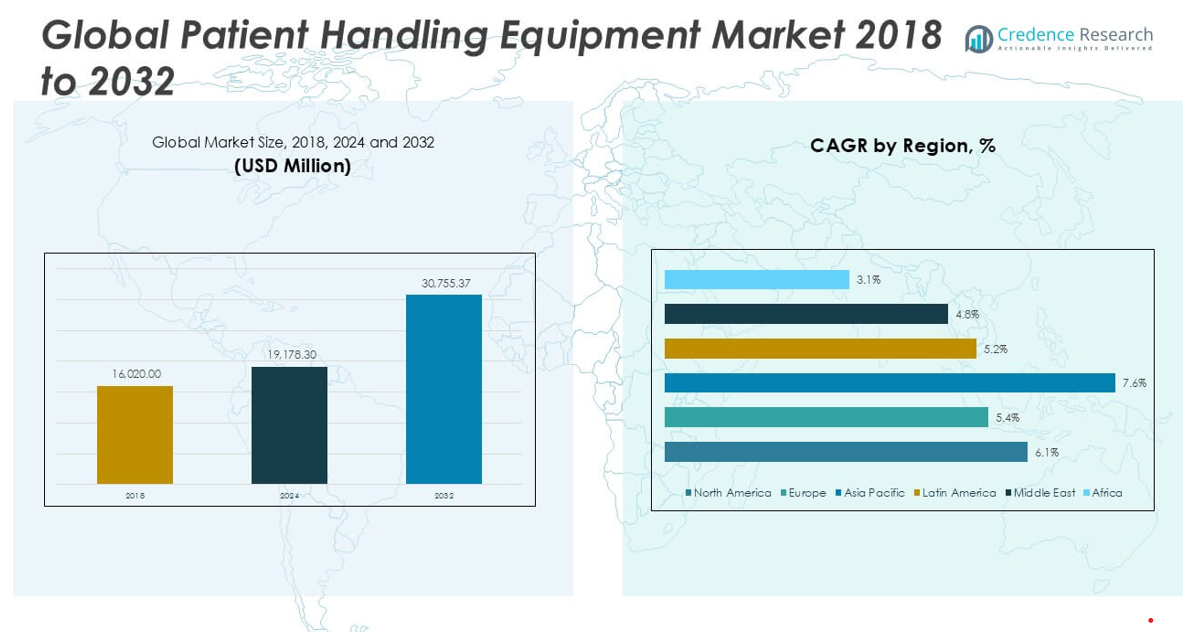
The Patient Handling Equipment Market size was valued at USD 16,020.00 million in 2018 and USD 19,178.30 million in 2024. It is anticipated to reach USD 30,755.37 million by 2032, growing at a CAGR of 6.11% during the forecast period.
The Patient Handling Equipment market is led by prominent players such as Stryker Corporation, Hill-Rom Holdings, Inc., Invacare Corporation, Getinge Group, and ArjoHuntleigh, Inc. These companies maintain strong market positions through continuous innovation, extensive product portfolios, and global distribution networks. Stryker and Hill-Rom are particularly recognized for their advanced medical beds and patient lifts, while Invacare and Getinge focus on mobility aids and transfer solutions. North America dominates the market, holding approximately 36.5% of the global market share in 2024, driven by well-established healthcare infrastructure, a growing elderly population, and stringent patient safety regulations. Europe follows with a 28.5% market share, supported by rising healthcare investments and increasing demand for homecare solutions. Asia Pacific is rapidly emerging, fueled by expanding healthcare facilities and a growing focus on patient safety, positioning it as a key growth region for major market players.
Market Insights
- The Patient Handling Equipment market was valued at USD 19,178.30 million in 2024 and is expected to reach USD 30,755.37 million by 2032, growing at a CAGR of 6.11% during the forecast period.
- The market is driven by the rising geriatric population, increasing chronic disease cases, and the growing need for patient safety and caregiver injury prevention across healthcare facilities.
- The market is witnessing trends such as technological advancements in smart beds and patient lifts, increasing demand for home healthcare equipment, and a growing focus on bariatric care solutions.
- North America holds the largest regional share at 36.5%, followed by Europe with 28.5% and Asia Pacific with 22.4%, while the medical beds segment leads in product share due to high demand for advanced safety features.
- High equipment costs, limited skilled workforce, and complex regulatory requirements are key restraints that may hinder market expansion, especially in developing regions.
Market Segmentation Analysis:
By Product Type:
The medical beds segment dominates the Patient Handling Equipment market, accounting for the largest market share in 2024. The rising demand for advanced hospital beds with enhanced safety features and adjustable positions drives this segment's growth. Increasing hospital admissions, the aging population, and the need for pressure ulcer prevention further support the demand. Additionally, the growing prevalence of chronic diseases and the need for patient comfort in both acute and long-term care settings significantly contribute to the expansion of the medical beds segment across various healthcare facilities.
- For instance, Stryker’s ProCuity® smart bed series has been widely adopted, with the company reporting the shipment of over 30,000 ProCuity beds globally since its launch, supporting hospitals in reducing patient falls and enhancing workflow efficiency.
By Application
Acute care is the leading application segment in the Patient Handling Equipment market, capturing the highest market share. The dominance of this segment is driven by the rising number of surgical procedures, emergency cases, and short-term treatments requiring efficient patient mobility and transfer solutions. The need for quick and safe patient handling in critical care units and operating rooms boosts the demand for specialized equipment. Furthermore, increasing investments in hospital infrastructure and the emphasis on improving patient outcomes are accelerating the adoption of patient handling equipment in acute care settings.
- For instance, Hillrom’s Centrella® Smart+ Bed, with more than 100,000 units installed globally, is specifically designed for acute care environments, providing advanced patient monitoring and mobility assistance to reduce adverse events.
By End Use
Hospitals hold the largest market share in the Patient Handling Equipment market, primarily due to high patient inflow and the availability of advanced medical infrastructure. The growing need to ensure patient safety, reduce caregiver injuries, and comply with strict regulatory guidelines fuels equipment demand in hospitals. Additionally, the increasing focus on hospital-acquired injury prevention and the integration of advanced handling systems to enhance operational efficiency further strengthen the segment’s growth. Rising healthcare expenditure and continuous technological advancements support the sustained dominance of hospitals as the key end user in this market.
Market Overview
Increasing Geriatric Population
The rising global geriatric population significantly drives the demand for patient handling equipment. Older adults are more susceptible to chronic illnesses, mobility limitations, and hospital admissions, creating a sustained need for efficient handling solutions. This demographic shift puts pressure on healthcare systems to adopt advanced equipment that ensures safe patient mobility, minimizes caregiver injuries, and enhances care quality. As the elderly population continues to grow, healthcare providers increasingly invest in patient handling technologies to improve patient outcomes and meet regulatory safety standards.
- For instance, Invacare has delivered over 250,000 electric wheelchairs worldwide, many tailored specifically for elderly users, enhancing independent mobility and reducing the burden on caregivers in both institutional and home settings.
Growing Incidence of Chronic Diseases
The increasing prevalence of chronic diseases such as cardiovascular conditions, diabetes, and musculoskeletal disorders has escalated hospital admissions and long-term care needs, fueling the demand for patient handling equipment. Patients with limited mobility require frequent repositioning, safe transfers, and specialized support systems to prevent complications like pressure ulcers. This growing disease burden compels hospitals, rehabilitation centers, and home care providers to invest in advanced handling devices that facilitate patient movement while ensuring caregiver safety and reducing physical strain.
- For instance, Getinge’s Total Assist patient transfer solutions are used in more than 4,500 hospitals worldwide to support the safe handling of patients with limited mobility, significantly reducing the risk of caregiver-related musculoskeletal injuries.
Rising Focus on Reducing Caregiver Injuries
The need to reduce caregiver injuries, particularly musculoskeletal disorders resulting from manual patient handling, is a major growth driver for the market. Healthcare facilities are increasingly adopting mechanical and automated handling equipment to comply with occupational safety guidelines and reduce compensation costs associated with workplace injuries. The integration of patient lifts, transfer aids, and ergonomic solutions not only enhances patient safety but also improves caregiver well-being, operational efficiency, and staff retention, encouraging widespread adoption of patient handling equipment globally.
Key Trends & Opportunities
Technological Advancements in Handling Equipment
The patient handling equipment market is witnessing rapid technological advancements, including the development of smart beds, motorized wheelchairs, and automated patient lifts with integrated sensors. These innovations offer enhanced safety, ease of use, and real-time patient monitoring, driving their adoption across hospitals and long-term care facilities. Advanced equipment helps prevent patient falls, pressure ulcers, and accidental injuries, positioning technology-driven solutions as a key opportunity for market players aiming to differentiate their offerings and gain a competitive edge.
- For instance, Arjo’s MaxiMove® lift system has been deployed in over 10,000 facilities globally, providing powered positioning and integrated weighing functions that enable safer, more precise patient transfers.
Expansion of Home Healthcare Services
The increasing preference for home healthcare services, driven by the rising costs of hospital stays and patient comfort considerations, presents significant growth opportunities for the patient handling equipment market. Portable, user-friendly handling devices such as foldable lifts, wheelchairs, and compact transfer aids are in high demand for home settings. This trend supports the shift toward decentralized care models and encourages manufacturers to design affordable, space-efficient equipment tailored for home use, unlocking new revenue streams beyond traditional healthcare facilities.
- For instance, Etac’s Molift Smart 150 portable lift system, weighing only 24 kg, has become a preferred choice for home healthcare, with the company reporting sales in over 70 countries to meet increasing global demand for home-based patient handling solutions.
Growing Demand for Bariatric Care Solutions
The global rise in obesity rates has created a growing demand for bariatric patient handling equipment capable of accommodating higher weight capacities. Bariatric beds, wheelchairs, and lifting slings are essential in providing safe and comfortable care for overweight patients, reducing the risk of injury for both patients and caregivers. Healthcare providers are increasingly investing in specialized bariatric equipment to meet patient needs and comply with safety regulations, offering manufacturers an opportunity to expand their product portfolios and target this growing segment.
Key Challenges
High Cost of Advanced Handling Equipment
The high initial cost of technologically advanced patient handling equipment poses a significant challenge, especially for small healthcare facilities and homecare providers with limited budgets. Smart beds, motorized lifts, and integrated patient monitoring systems often involve substantial capital investments, which can limit widespread adoption. Price sensitivity in emerging markets further restricts market penetration, compelling manufacturers to balance technological innovation with cost-effectiveness to remain competitive and accessible across various healthcare settings.
Limited Skilled Workforce for Equipment Operation
Effective use of patient handling equipment requires trained healthcare professionals to ensure safety and operational efficiency. However, many healthcare settings, especially in developing countries, face a shortage of adequately trained staff proficient in operating specialized equipment. Improper handling can lead to patient discomfort or injury and reduce equipment lifespan. This challenge underscores the need for comprehensive training programs and intuitive, user-friendly equipment designs to support broader adoption and minimize misuse in fast-paced care environments.
Regulatory Compliance and Safety Standards
Patient handling equipment must comply with stringent safety and quality regulations imposed by health authorities worldwide. Ensuring regulatory approvals, adhering to evolving safety standards, and meeting local certification requirements can be time-consuming and costly for manufacturers. Non-compliance risks product recalls, legal challenges, and reputational damage. Navigating these complex regulatory landscapes presents an ongoing challenge for companies seeking to introduce innovative equipment while maintaining global market presence and operational efficiency.
Regional Analysis
North America
North America holds the largest share of the Patient Handling Equipment market, accounting for approximately 36.5% of the global market in 2024, with a market size of USD 6,950.10 million, up from USD 5,876.14 million in 2018. The market is projected to reach USD 11,130.42 million by 2032, growing at a CAGR of 6.1% during the forecast period. The region’s growth is primarily driven by advanced healthcare infrastructure, increasing elderly population, and stringent patient safety regulations. Strong investments in innovative handling solutions and the high adoption of technologically advanced equipment further support North America's market dominance.
Europe
Europe holds a significant share in the Patient Handling Equipment market, capturing approximately 28.5% of the global market in 2024. The regional market grew from USD 4,725.90 million in 2018 to USD 5,461.46 million in 2024, and it is projected to reach USD 8,327.10 million by 2032, expanding at a CAGR of 5.4%. The region benefits from a rising geriatric population, growing focus on occupational safety for caregivers, and supportive government policies. Increasing investments in hospital infrastructure and the growing demand for home healthcare solutions are expected to sustain market growth across Europe over the forecast period.
Asia Pacific
Asia Pacific is the fastest-growing region in the Patient Handling Equipment market, representing approximately 22.4% of the global share in 2024. The market increased from USD 3,412.26 million in 2018 to USD 4,292.98 million in 2024, and it is anticipated to reach USD 7,698.09 million by 2032, growing at an impressive CAGR of 7.6%. Rapidly aging populations in countries like Japan and China, coupled with increasing healthcare investments and rising awareness about patient and caregiver safety, are driving regional growth. Expanding hospital networks and growing demand for affordable handling equipment in emerging economies further fuel the market's expansion.
Latin America
Latin America holds a moderate position in the global Patient Handling Equipment market, contributing approximately 7.0% of the global market share in 2024. The market rose from USD 1,137.42 million in 2018 to USD 1,349.96 million in 2024, and it is projected to reach USD 2,025.86 million by 2032, at a CAGR of 5.2%. The region's growth is driven by improving healthcare infrastructure, increasing focus on patient safety, and rising government healthcare expenditure. The growing adoption of patient handling solutions in public hospitals and the gradual rise in home healthcare services are key factors supporting market growth in Latin America.
Middle East
The Middle East accounts for approximately 3.6% of the global Patient Handling Equipment market in 2024. The market expanded from USD 608.76 million in 2018 to USD 682.62 million in 2024, and it is expected to reach USD 987.42 million by 2032, registering a CAGR of 4.8%. The region is witnessing gradual improvements in healthcare facilities and increasing demand for modern handling equipment, particularly in the Gulf countries. Government-led healthcare reforms and investments in hospital infrastructure are supporting market growth, although the market remains in its developing phase compared to North America and Europe.
Africa
Africa represents the smallest share in the Patient Handling Equipment market, accounting for approximately 2.3% of the global market in 2024. The market grew from USD 259.52 million in 2018 to USD 441.18 million in 2024, and it is projected to reach USD 586.48 million by 2032, growing at a CAGR of 3.1%. The African market’s growth is primarily driven by increasing government focus on improving basic healthcare services, rising awareness of patient safety, and gradual improvements in medical infrastructure. However, high equipment costs and limited healthcare funding in several countries continue to restrict faster market penetration in the region.
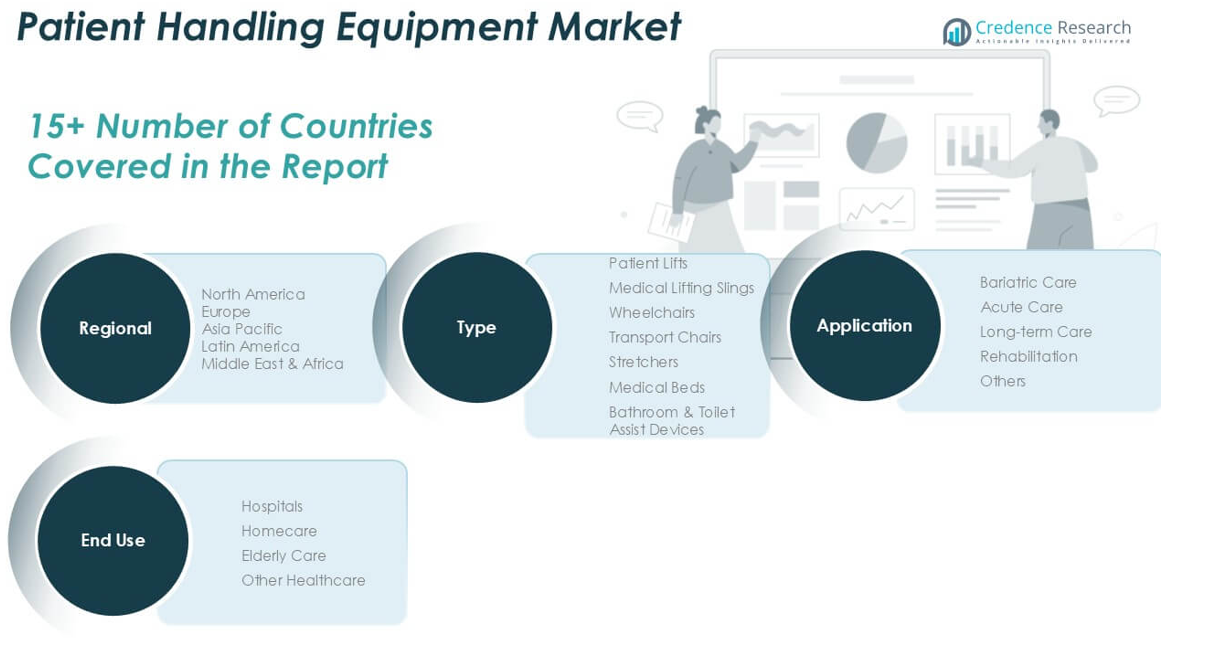
Market Segmentations:
By Product Type
- Patient Lifts
- Medical Lifting Slings
- Wheelchairs
- Transport Chairs
- Stretchers
- Medical Beds
- Bathroom & Toilet Assist Devices
By Application
- Bariatric Care
- Acute Care
- Long-term Care
- Rehabilitation
- Others
By End Use
- Hospitals
- Homecare
- Elderly Care
- Others
By Geography
- North America
- U.S.
- Canada
- Mexico
- Europe
- Germany
- France
- U.K.
- Italy
- Spain
- Rest of Europe
- Asia Pacific
- China
- Japan
- India
- South Korea
- South-east Asia
- Rest of Asia Pacific
- Latin America
- Brazil
- Argentina
- Rest of Latin America
- Middle East & Africa
- GCC Countries
- South Africa
- Rest of the Middle East and Africa
Competitive Landscape
The Patient Handling Equipment market is highly competitive, with key players focusing on product innovation, strategic partnerships, and geographical expansion to strengthen their market position. Major companies such as Stryker Corporation, Hill-Rom Holdings, Inc., Invacare Corporation, Getinge Group, and ArjoHuntleigh, Inc. dominate the market by offering a broad portfolio of advanced patient handling solutions. These organizations invest significantly in research and development to introduce technologically advanced equipment that enhances patient safety and operational efficiency. Additionally, companies like Joerns Healthcare, Stiegelmeyer, and Linet Americas are expanding their reach through acquisitions and collaborations, particularly in emerging markets. Smaller players such as Benmor Medical, Prism Medical, Etac Ltd., and Mangar International Ltd. focus on niche segments and customized solutions to gain a competitive edge. The market is also witnessing increased competition from regional manufacturers offering cost-effective alternatives. Continuous innovation, competitive pricing, and regulatory compliance remain critical factors shaping the competitive dynamics of the patient handling equipment industry.
Key Player Analysis
- Stryker Corporation
- Hill-Rom Holdings, Inc.
- Invacare Corporation
- Getinge Group
- ArjoHuntleigh, Inc.
- Joerns Healthcare, Inc.
- Stiegelmeyer, Inc.
- Benmor Medical Ltd.
- Prism Medical Ltd.
- Etac Ltd.
- Mangar International Ltd.
- Linet Americas, Inc.
Recent Developments
- In June 2025 Stryker Corporation launched the AXS Lift Intracranial Base Catheter, aimed at simplifying neurovascular access and enhancing therapy delivery (while not a traditional patient handling device, it reflects Stryker's ongoing innovation in medical equipment,
- In April 2025, Hill-Rom Holdings, Inc. (now part of Baxter International) continues to be a prominent provider of advanced patient handling solutions. They offer a range of products, including hospital beds, patient lifts, and transfer systems, all designed to enhance patient safety and improve the efficiency of caregiving. These solutions are part of Hillrom's broader portfolio, which also includes smart device connectivityand care communications
- In April 2025, Invacare Corporation remains focused on manufacturing durable and reliable patient handling equipment, particularly for home and long-term care settings. Their product line includes lifts, slings, and mobility aids, with an emphasis on affordability and user-friendly design.
- In April 2025: ArjoHuntleigh, Inc. (Arjo) Provides a comprehensive range of patient handling and mobility equipment, such as ceiling lifts, bathing systems, and ergonomic slings, all engineered to enhance safety and reduce physical strain for caregivers and patient.
- In March 2024, Stryker Corporation expanded its R&D facility in India to focus on patient handling technologies, aiming to accelerate innovation and support global product development. The expanded facility includes advanced infrastructure, enhanced microbiology capabilities, and a dedicated team to drive innovation and ensure product quality.
Market Concentration & Characteristics
The Patient Handling Equipment Market demonstrates a moderately consolidated structure, with a few key players holding significant market shares. Companies such as Stryker Corporation, Hill-Rom Holdings, Invacare Corporation, and Getinge Group lead through diverse product portfolios and strong global distribution networks. It shows high entry barriers due to stringent regulatory requirements, advanced technology demands, and substantial capital investments. The market favors manufacturers with the capability to offer ergonomic designs, safety-focused solutions, and reliable after-sales services. Pricing pressure remains notable, particularly in cost-sensitive regions, driving demand for competitively priced yet high-quality equipment. The market shows a steady shift toward home healthcare and outpatient care, creating opportunities for portable and user-friendly handling devices. It remains strongly influenced by technological advancements and healthcare reforms across developed and developing economies. Demand consistently increases due to the rising elderly population, chronic disease prevalence, and growing awareness of caregiver safety. Continuous product innovation and strategic partnerships characterize competition in this space.
Report Coverage
The research report offers an in-depth analysis based on Product Type, Application, End Use and Geography. It details leading market players, providing an overview of their business, product offerings, investments, revenue streams, and key applications. Additionally, the report includes insights into the competitive environment, SWOT analysis, current market trends, as well as the primary drivers and constraints. Furthermore, it discusses various factors that have driven market expansion in recent years. The report also explores market dynamics, regulatory scenarios, and technological advancements that are shaping the industry. It assesses the impact of external factors and global economic changes on market growth. Lastly, it provides strategic recommendations for new entrants and established companies to navigate the complexities of the market.
Future Outlook
- The Patient Handling Equipment market is expected to experience steady growth driven by increasing global healthcare demand.
- The rising geriatric population will continue to boost the need for advanced patient mobility and transfer solutions.
- Growing prevalence of chronic diseases will sustain high demand for safe and efficient patient handling equipment.
- Technological advancements in smart beds, motorized lifts, and mobility aids will significantly shape the market’s evolution.
- The shift toward home healthcare services will drive the demand for portable and user-friendly handling devices.
- Manufacturers will focus on developing cost-effective solutions to cater to price-sensitive markets, especially in Asia Pacific and Africa.
- Increasing focus on caregiver safety will accelerate the adoption of ergonomic and automated handling equipment.
- Expansion in emerging markets will offer key growth opportunities due to improving healthcare infrastructure.
- Stringent safety and regulatory standards will influence product development and market entry strategies.
- Strategic collaborations, mergers, and acquisitions will remain essential for companies to strengthen their market presence.

Request a Free Sample
Fill in your details and we'll send you a free sample report.
- Sample data tables & charts
- Research methodology
Market Dynamics
Increasing Geriatric Population
The growing elderly population worldwide is driving demand for patient handling equipment, as older adults are more prone to mobility limitations, chronic illnesses, and hospital admissions, necessitating advanced solutions for safe patient movement and caregiver injury prevention.
Rising Incidence of Chronic Diseases
The prevalence of chronic diseases such as cardiovascular disorders, diabetes, and musculoskeletal conditions is escalating hospital admissions and long-term care needs, fueling the requirement for specialized patient handling equipment to ensure safe transfers and reduce complications like pressure ulcers.
Focus on Caregiver Safety and Injury Reduction
Healthcare facilities are increasingly adopting mechanical and automated handling equipment to minimize musculoskeletal injuries among caregivers, comply with occupational safety guidelines, and reduce compensation costs, thereby boosting market adoption.
Technological Advancements in Equipment
Innovations such as smart beds, motorized lifts, and integrated patient monitoring systems are enhancing patient safety, operational efficiency, and ease of use, encouraging healthcare providers to invest in advanced handling solutions.
Expansion of Home Healthcare Services
The shift toward home-based care, driven by rising healthcare costs and patient comfort preferences, is increasing demand for portable, user-friendly patient handling devices suitable for non-institutional settings.
Need a Custom Version of This Report?
Tailor the scope, geography, or segments to your exact requirements.
- Custom geography or segment scope
- Direct access to our analyst team
Frequently Asked Questions
What is the current size of the Patient Handling Equipment Market?
What are the key segments within the Patient Handling Equipment Market
What are some challenges faced by the Patient Handling Equipment Market?
Who are the major players in the Patient Handling Equipment Market?
Table of Content
Chapter 1 Market Segmentation
- 1.1 Segmentation Framework
- 1.1.1 Product and Service Classification
- 1.1.2 Application and End-Use Classification
- 1.1.3 Technology and Solution Classification
- 1.1.4 Customer and Distribution Channel Classification
- 1.1.5 Geographic Segmentation
- 1.1.6 Market Segment Definitions and Boundaries
- 1.2 By End Use
- 1.2.1 Hospitals
- 1.2.2 Homecare
- 1.2.3 Elderly Care
- 1.2.4 Others
- 1.3 By Application
- 1.3.1 Bariatric Care
- 1.3.2 Acute Care
- 1.3.3 Long-term Care
- 1.3.4 Rehabilitation
- 1.3.5 Others
- 1.4 By Product Type
- 1.4.1 Patient Lifts
- 1.4.2 Medical Lifting Slings
- 1.4.3 Wheelchairs
- 1.4.4 Transport Chairs
- 1.4.5 Stretchers
- 1.4.6 Medical Beds
- 1.4.7 Bathroom & Toilet Assist Devices
Chapter 2 Introduction
- 2.1 Report Objectives and Scope
- 2.2 Product Definition and Industry Terminology
- 2.3 Market Inclusions and Exclusions
- 2.4 Research Process
- 2.4.1 Primary Research and Expert Interviews
- 2.4.2 Secondary Research and Source Review
- 2.4.3 Top-Down and Bottom-Up Estimation
- 2.4.4 Data Triangulation and Verification
- 2.5 Market Size Measurement Basis
- 2.5.1 2024: USD 19,178.30 million → 2032: USD 30,755.37 million
- 2.6 Historical and Forecast Reference Periods
- 2.6.1 Base Year: 2024
- 2.6.2 Forecast Period: 2024-2032
- 2.7 Research Assumptions and Limitations
Chapter 3 Executive Summary
- 3.1 Market Snapshot and Key Findings
- 3.2 Base-Year Market Size, 2024
- 3.3 Forecast Market Size, 2032
- 3.4 Revenue and Volume Growth Outlook
- 3.5 Key Demand and Supply Indicators
- 3.6 Leading Market Segments
- 3.7 Fastest-Growing Market Opportunities
- 3.8 Regional Performance Highlights
- 3.9 Technology and Industry Transformation
- 3.10 Competitive Landscape Summary
- 3.11 Analyst View and Strategic Implications
Chapter 4 Global Patient Handling Equipment Market Trends and Developments
- 4.1 Historical Industry Development
- 4.2 Recent Market Trends and Developments
- 4.3 Demand and Customer Behavior Trends
- 4.4 Technology and Product Innovation
- 4.5 Artificial Intelligence, Automation and Digitalization
- 4.6 Local Manufacturing and Supply Chain Realignment
- 4.7 Industry Partnerships, Mergers and Acquisitions
- 4.8 Sustainability and Circular Economy Developments
- 4.9 Government and Private Sector Investment Trends
- 4.10 Emerging Business Models and Commercialization
- 4.11 Industry Developments and Announcements
Chapter 5 Global Patient Handling Equipment Market Production, Supply and Demand Analysis
- 5.1 Demand Trend and Consumption Analysis
- 5.2 Demand Forecast, 2024-2032
- 5.3 Production and Output Trend
- 5.4 Production and Output Forecast, 2024-2032
- 5.5 Installed Capacity and Capacity Utilization
- 5.6 Company-Wise Production Plants and Statistics
- 5.6.1 Installed Production Capacity
- 5.6.2 Actual Production
- 5.6.3 Planned Capacity and Expansion Targets
- 5.7 Supply Chain Structure and Procurement Trends
- 5.8 Supply-Demand Gap and Bottlenecks
- 5.9 Import Dependence and Sourcing Structure
- 5.10 Contract Manufacturing and Outsourcing
- 5.11 Regional Supply and Demand Concentration
Chapter 6 Global Patient Handling Equipment Market Pricing Analysis
- 6.1 Pricing Structure and Measurement
- 6.2 Historical Pricing Trends
- 6.3 Pricing Outlook, 2024-2032
- 6.4 Average Selling Price and Unit Economics
- 6.5 Pricing by Product and Market Segment
- 6.6 Geographic Pricing Differences
- 6.7 Key Input, Energy, Labor and Logistics Costs
- 6.8 Contract Pricing and Purchasing Models
- 6.9 Pricing Sensitivity and Competitive Positioning
- 6.10 Price, Margin and Profitability Implications
Chapter 7 Global Patient Handling Equipment Market Dynamics
- 7.1 Market Growth Drivers
- 7.1.1 Demand-Side Drivers
- 7.1.2 Technology and Innovation Drivers
- 7.1.3 Infrastructure and Investment Drivers
- 7.1.4 Regulatory and Policy Drivers
- 7.2 Market Restraints
- 7.2.1 Cost and Affordability Constraints
- 7.2.2 Technology and Adoption Barriers
- 7.2.3 Supply Chain and Operational Constraints
- 7.3 Market Challenges
- 7.3.1 Competitive Pressure and Margin Erosion
- 7.3.2 Skills, Infrastructure and Implementation Gaps
- 7.4 Emerging Market Opportunities
- 7.5 Market Dynamics Impact and Time-Horizon Assessment
Chapter 8 Global Patient Handling Equipment Value Chain Analysis
- 8.1 Industry Value Chain Overview
- 8.2 Upstream Suppliers and Critical Inputs
- 8.3 Technology and Component Providers
- 8.4 Manufacturing or Service Delivery
- 8.5 Distribution, Channel Partners and Integrators
- 8.6 Downstream Applications and End Users
- 8.7 Value Addition and Profit Pools
- 8.8 Vertical Integration and Outsourcing
- 8.9 Supplier Concentration and Risk
- 8.10 Supply Chain Localization and Resilience
Chapter 9 Global Patient Handling Equipment Market Regulations and Policies
- 9.1 Relevant Laws, Standards and Compliance Frameworks
- 9.2 Product, Service, Safety and Quality Requirements
- 9.3 Government Policies, Incentives and Subsidies
- 9.4 Imports, Exports and Trade Barriers
- 9.5 Public Procurement and Local Content Requirements
- 9.6 Environmental and Sustainability Compliance
- 9.7 Upcoming Policy Changes and Market Implications
Chapter 10 Global Patient Handling Equipment Market Hotspots and Opportunities
- 10.1 Market Opportunity Mapping and Growth Hotspots
- 10.2 High-Growth Applications and Customer Groups
- 10.3 Underserved Markets and White-Space Opportunities
- 10.4 Emerging Technology and Product Opportunities
- 10.5 New Capacity and Investment Hotspots
- 10.6 Market Entry and Expansion Opportunities
- 10.7 Distribution and Partnership Opportunities
- 10.8 Near-Term and Long-Term Commercial Potential
- 10.9 Opportunity Attractiveness and Execution Risks
Chapter 11 Global Patient Handling Equipment Market Outlook, 2024-2032
- 11.1 Market Size and Analysis
- 11.1.1 Revenue (Market Measurement: 2024: USD 19,178.30 million → 2032: USD 30,755.37 million)
- 11.1.2 Market Volume and Quantity Sold
- 11.1.3 Historical Market Size
- 11.1.4 Base-Year Market Size, 2024
- 11.2 Market Forecast, 2024-2032
- 11.2.1 Revenue Forecast to 2032
- 11.2.2 Volume Forecast to 2032
- 11.2.3 CAGR and Year-on-Year Growth
- 11.2.4 Incremental Revenue Opportunity
- 11.3 Forecast Assumptions and Scenario Analysis
- 11.3.1 Base-Case Forecast
- 11.3.2 Optimistic and Conservative Scenarios
- 11.3.3 Technology, Pricing and Policy Sensitivities
- 11.4 Market Attractiveness and Growth Outlook
Chapter 12 Global Patient Handling Equipment Market Segmentation and Outlook
- 12.1 Segmentation Summary and Market Shares, 2024
- 12.2 Largest and Fastest-Growing Segments
- 12.3 By End Use - Market Size and Forecast, 2024-2032
- 12.3.1 Segment Definition and Scope
- 12.3.2 Historical Market Size
- 12.3.3 Revenue Forecast, 2024-2032
- 12.3.4 Volume Forecast, 2024-2032
- 12.3.5 Base-Year Market Share, 2024
- 12.3.6 Segment CAGR and Growth Drivers
- 12.3.7 Subsegment Market Size and Forecast
- 12.3.7.1 Hospitals
- 12.3.7.2 Homecare
- 12.3.7.3 Elderly Care
- 12.3.7.4 Others
- 12.3.8 Subsegment Pricing and Adoption Trends
- 12.3.9 Leading Suppliers and Competition
- 12.3.10 Regional Demand and Opportunities
- 12.4 By Application - Market Size and Forecast, 2024-2032
- 12.4.1 Segment Definition and Scope
- 12.4.2 Historical Market Size
- 12.4.3 Revenue Forecast, 2024-2032
- 12.4.4 Volume Forecast, 2024-2032
- 12.4.5 Base-Year Market Share, 2024
- 12.4.6 Segment CAGR and Growth Drivers
- 12.4.7 Subsegment Market Size and Forecast
- 12.4.7.1 Bariatric Care
- 12.4.7.2 Acute Care
- 12.4.7.3 Long-term Care
- 12.4.7.4 Rehabilitation
- 12.4.7.5 Others
- 12.4.8 Subsegment Pricing and Adoption Trends
- 12.4.9 Leading Suppliers and Competition
- 12.4.10 Regional Demand and Opportunities
- 12.5 By Product Type - Market Size and Forecast, 2024-2032
- 12.5.1 Segment Definition and Scope
- 12.5.2 Historical Market Size
- 12.5.3 Revenue Forecast, 2024-2032
- 12.5.4 Volume Forecast, 2024-2032
- 12.5.5 Base-Year Market Share, 2024
- 12.5.6 Segment CAGR and Growth Drivers
- 12.5.7 Subsegment Market Size and Forecast
- 12.5.7.1 Patient Lifts
- 12.5.7.2 Medical Lifting Slings
- 12.5.7.3 Wheelchairs
- 12.5.7.4 Transport Chairs
- 12.5.7.5 Stretchers
- 12.5.7.6 Medical Beds
- 12.5.7.7 Bathroom & Toilet Assist Devices
- 12.5.8 Subsegment Pricing and Adoption Trends
- 12.5.9 Leading Suppliers and Competition
- 12.5.10 Regional Demand and Opportunities
- 12.6 Segment Growth Comparison
- 12.7 Segment Attractiveness and Priority Matrix
Chapter 13 Global Patient Handling Equipment End-Use and Application Market Outlook
- 13.1 End-Use Industry and Customer Demand Structure
- 13.2 Leading Applications and Customer Groups
- 13.3 End-Use Market Size, Share and Forecast
- 13.4 Major End-Use Industry Deep Dives
- 13.4.1 Customer Requirements and Use Cases
- 13.4.2 Demand and Replacement Cycles
- 13.4.3 Technical and Regulatory Considerations
- 13.4.4 Purchasing and Procurement Models
- 13.4.5 Leading Vendors and Distribution Channels
- 13.4.6 Forecast and Commercial Opportunities
- 13.5 Emerging Applications and Cross-Segment Demand
- 13.6 End-Use Industry Investment Priorities
Chapter 14 Global Patient Handling Equipment Geographic Market Outlook, 2024-2032
- 14.1 Regional Market Size and Share, 2024
- 14.2 Regional Market Forecast, 2024-2032
- 14.3 Regional Pricing, Production and Demand Differences
- 14.4 North America
- 14.4.1 United States
- 14.4.2 Canada
- 14.4.3 Mexico
- 14.5 Europe
- 14.5.1 Germany
- 14.5.2 France
- 14.5.3 Italy
- 14.5.4 United Kingdom
- 14.5.5 Spain
- 14.5.6 Poland
- 14.5.7 Russia
- 14.5.8 Netherlands
- 14.5.9 Belgium
- 14.5.10 Sweden
- 14.5.11 Denmark
- 14.5.12 Norway
- 14.5.13 Rest of Europe
- 14.6 Asia Pacific
- 14.6.1 China
- 14.6.2 India
- 14.6.3 Japan
- 14.6.4 South Korea
- 14.6.5 Thailand
- 14.6.6 Indonesia
- 14.6.7 Vietnam
- 14.6.8 Malaysia
- 14.6.9 Australia
- 14.6.10 Rest of Asia Pacific
- 14.7 Latin America
- 14.7.1 Brazil
- 14.7.2 Argentina
- 14.7.3 Colombia
- 14.7.4 Chile
- 14.7.5 Rest of Latin America
- 14.8 Middle East
- 14.8.1 Saudi Arabia
- 14.8.2 United Arab Emirates
- 14.8.3 Turkey
- 14.8.4 Israel
- 14.8.5 Iran
- 14.8.6 Rest of the Middle East
- 14.9 Africa
- 14.9.1 South Africa
- 14.9.2 Egypt
- 14.9.3 Nigeria
- 14.9.4 Morocco
- 14.9.5 Rest of Africa
- 14.10 Regional Investment, Policy and Supply Chain Differences
- 14.11 Regional Competitive Landscape
- 14.12 Geographic Growth Hotspots
Chapter 15 Global Patient Handling Equipment Technology, Innovation and Sustainability Outlook
- 15.1 Technology Landscape and Maturity
- 15.2 Product, Process and Service Innovation
- 15.3 AI, Automation and Digital Tools in the Industry
- 15.4 Technology Adoption and Performance Benchmarking
- 15.5 Innovation Pipeline and R&D Investment
- 15.6 Patent and Intellectual Property Trends
- 15.7 Energy Efficiency and Resource Management
- 15.8 Sustainability, Recycling and Circularity
- 15.9 Technology Roadmap, 2024-2032
- 15.10 Risks of Obsolescence and Technology Substitution
Chapter 16 Global Patient Handling Equipment Market Key Strategic Imperatives
- 16.1 Growth and Market Entry Priorities
- 16.2 High-Return Products and Segments
- 16.3 Pricing, Profitability and Cost Optimization
- 16.4 Technology Investment and Product Differentiation
- 16.5 Supply Chain Localization and Resilience
- 16.6 Distribution and Customer Acquisition
- 16.7 Partnership, Acquisition and Capacity Strategy
- 16.8 Regional Expansion Priorities
- 16.9 Short-, Medium- and Long-Term Actions
Chapter 17 Competition Outlook
- 17.1 Industry Competition Characteristics
- 17.2 Market Structure and Concentration
- 17.3 Market Share and Competitive Positioning, 2024
- 17.4 Company-Wise Revenue and Product Benchmarking
- 17.5 Production and Service Capacity Benchmarking
- 17.6 Technology, Pricing and Differentiation
- 17.7 Regional Footprint and Distribution Strength
- 17.8 Mergers, Acquisitions and Strategic Alliances
- 17.9 New Entrants and Competitive Threats
- 17.10 Porter's Five Forces and Industry Attractiveness
- 17.11 Competitive Outlook, 2024-2032
Chapter 18 Company Profiles
- 18.1 Company Coverage and Selection Criteria
- 18.2 Stryker Corporation
- 18.2.1 Business Description
- 18.2.2 Company Ownership and Geographic Presence
- 18.2.3 Product and Service Portfolio
- 18.2.4 Manufacturing and Operating Footprint
- 18.2.5 Production Capacity and Expansion Plans
- 18.2.6 Financial Performance and Investment
- 18.2.7 Market Share and Competitive Position
- 18.2.8 Technology and Innovation Capabilities
- 18.2.9 Strategic Alliances or Partnerships
- 18.2.10 Recent Developments
- 18.2.11 Growth Strategy and Outlook
- 18.3 Hill-Rom Holdings, Inc.
- 18.4 Invacare Corporation
- 18.5 Getinge Group
- 18.6 ArjoHuntleigh, Inc.
- 18.7 Joerns Healthcare, Inc.
- 18.8 Stiegelmeyer, Inc.
- 18.9 Linet Americas, Inc.
- 18.10 Etac Ltd.
- 18.11 Prism Medical Ltd.
- 18.12 Other Relevant Market Participants
Note: Every listed company is profiled on the structure shown under the first company. The company list is preliminary and may change based on research findings, market developments, data availability and client requirements.
Chapter 19 Disclaimer
- 19.1 Research and Forecast Disclaimer
- 19.2 Data Source and Estimation Limitations
Note: The depth of individual sections depends on data availability for this market. Volume, capacity, trade and other unit-based metrics are included where applicable.

