
Market overview
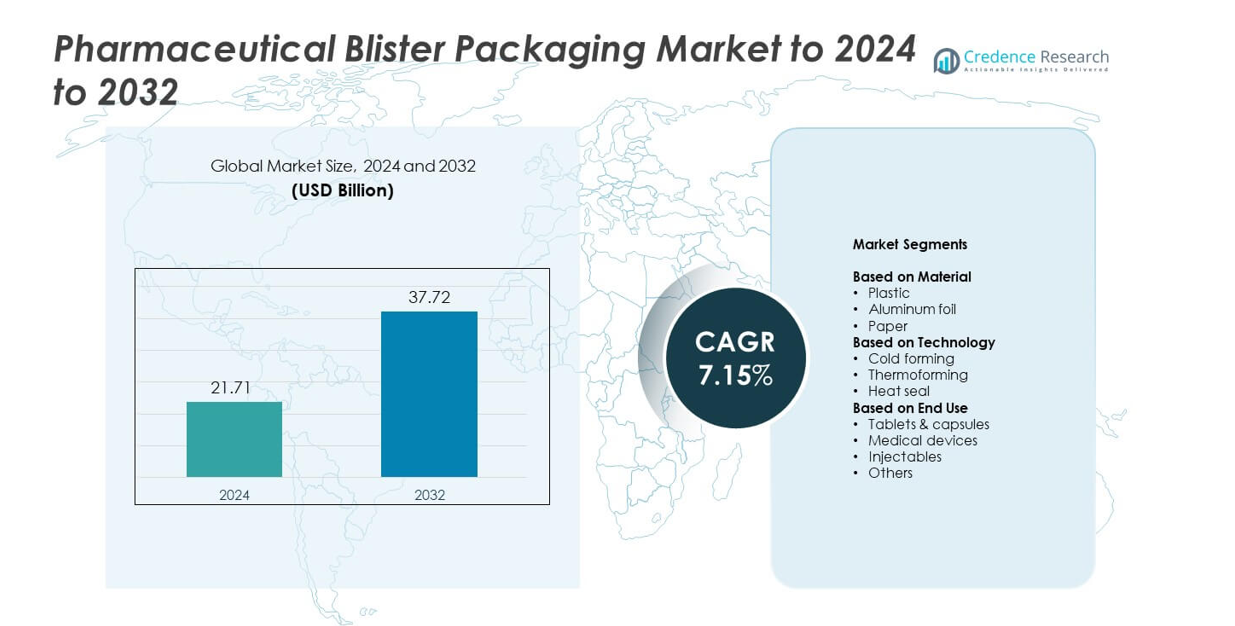
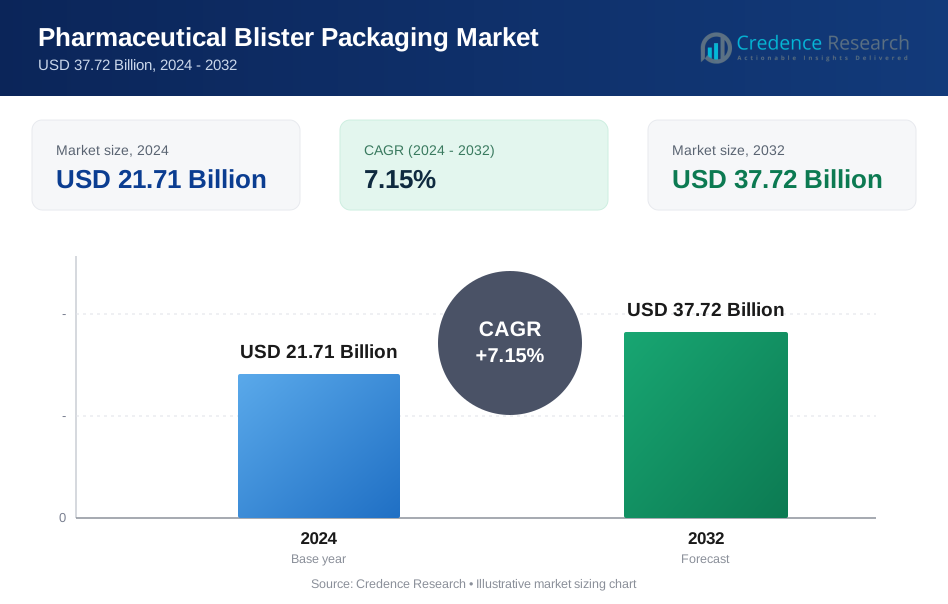
Pharmaceutical Blister Packaging Market size was valued USD 21.71 Billion in 2024 and is anticipated to reach USD 37.72 Billion by 2032, at a CAGR of 7.15% during the forecast period.
| REPORT ATTRIBUTE | DETAILS |
|---|---|
| Historical Period | 2020-2023 |
| Base Year | 2024 |
| Forecast Period | 2025-2032 |
| Pharmaceutical Blister Packaging Market Size 2024 | USD 21.71 Billion |
| Pharmaceutical Blister Packaging Market, CAGR | 7.15% |
| Pharmaceutical Blister Packaging Market Size 2032 | USD 37.72 Billion |
The Pharmaceutical Blister Packaging Market is driven by strong competition among leading players such as ACG, Amcor, Aptar, Borealis, Constantia, Carcano and Caprihans. These companies focus on high-barrier materials, sustainable laminates, and advanced thermoforming technologies to meet strict pharmaceutical safety and compliance requirements. North America leads the market with about 34.6 % share in 2024 due to its mature pharma sector and rapid adoption of unit-dose formats. Asia Pacific follows closely with nearly 34.45 % share, supported by large-scale drug production and expanding generic manufacturing. Europe holds around 24 % share, driven by stringent regulatory standards and strong adoption of recyclable blister solutions.
Market Insights
- The Pharmaceutical Blister Packaging Market reached USD 21.71 Billion in 2024 and is projected to hit USD 37.72 Billion by 2032, growing at a CAGR of 7.15 %. • Strong demand for safe unit-dose formats drives growth as tablets and capsules hold about 60.23 % share, supported by expanding generic drug production and patient-compliance needs. • High-barrier and sustainable blister materials shape key trends, while thermoforming leads the technology segment with nearly 73.24 % share due to faster production and flexible design. • Intense competition pushes companies to invest in recyclable laminates, upgraded blister lines and enhanced sealing systems amid rising regulatory pressure. • Regionally, North America leads with 34.6 % share, followed closely by Asia Pacific at 34.45 % and Europe at 24 %, while Latin America and Middle East & Africa record smaller but steady expansion.
Market Segmentation Analysis:
By Material
In the Pharmaceutical Blister Packaging Market, the plastic segment remains dominant, accounting for approximately 51.34 % of the market in 2024. This sub-segment leads due to its cost-efficiency, ease of thermoforming and sealing, and strong adoption for solid oral dose applications. Growth drivers for plastic include rising demand for lightweight packaging, regulatory emphasis on integrity and tamper-evidence, and expansion of generic drugs, which favour plastic blister formats for high-volume production. Aluminum foil and paper segments are also growing, but from smaller bases.
- For instance, ACG Worldwide has completed more than 20,000 machine installations worldwide, according to official company sources and general business information.
By Technology
Within the technology segmentation, the thermoforming sub-segment captured around 73.24 % of the Pharmaceutical Blister Packaging Market in 2024. Thermoforming is preferred because it offers high line speeds, superior visual clarity of packs, and lower tooling costs compared to cold forming. Key growth drivers are increased production of solid oral dosage forms, demand for customised cavity designs and rising volume of over-the-counter and daily-use medications that benefit from this method. Cold forming and heat seal technologies are gaining momentum especially where barrier protection is critical.
- For instance, IMA Group’s C40 blister packaging machine is designed for pharmaceutical and nutraceutical applications and can produce up to 525 blisters per minute.
By End Use
For end-use in the Pharmaceutical Blister Packaging Market, the tablets & capsules sub-segment held approximately 60.23 % share in 2024. This dominance stems from the fact that tablets remain the most common dosage form globally and blister packs offer convenience, compliance benefits and product protection. Growth in this segment is driven by the expansion of generic oral solid medications, increasing pharmaceutical consumption in emerging markets, and the need for tamper-evident, individually dosed packages. Medical devices, injectables and other end-uses are expanding but from smaller bases.
Key Growth Drivers
Rising Demand for Secure Unit-Dose Packaging
Pharmaceutical blister packaging grows due to the rising need for safe and precise unit-dose formats. Drug makers rely on blisters to reduce contamination risks and improve adherence for tablets and capsules. The format supports tamper-evident sealing and stable protection against moisture and oxygen. Expansion of prescription and OTC oral solid dosage drugs strengthens this demand. Growth also accelerates in emerging markets where blister formats replace bulk bottles due to improved safety, portability and dosing accuracy.
- For instance, WestRock’s Shellpak Renew adherence packaging has been dispensed by more than 5 600 pharmacies, with over 500 000 000 Shellpak packages supplied to patients to date.
Growth of Generic and High-Volume Drug Production
The rise of generics boosts demand for blister packaging because manufacturers need fast, economical and high-output packaging systems. Blister lines allow efficient mass production with strong sealing integrity and flexible cavity designs. Regulatory approvals for generic drugs continue to climb worldwide, driving very large packaging volumes. Pharmaceutical companies prefer blister packs due to reduced material use, faster line changeovers and lower operational costs. This supports sustained demand across both mature and developing pharmaceutical hubs.
- For instance, the Romaco Noack Unity 600 high-speed blister packaging line, in its standard double-lane configuration, reaches a maximum output of 600 blisters.
Increasing Focus on Patient Compliance and Safety
Blister packaging adoption expands as companies prioritise compliance-supporting formats for chronic therapies. Blisters help patients track daily doses and improve accuracy in self-administration. The push for senior-friendly and child-resistant formats also boosts development of advanced blister designs. Healthcare professionals promote pack-based dosing to minimise medication errors in clinical and home settings. These compliance-driven needs encourage pharmaceutical brands to transition from bulk containers to calendarised or clearly compartmentalised blister formats.
Key Trends & Opportunities
Shift Toward High-Barrier and Sustainable Materials
A major trend is the shift to advanced barrier structures and eco-designed materials. Rising humidity-sensitive and biologic drug formulations require high-barrier laminates, which increases adoption of cold-form and enhanced foil systems. At the same time, sustainability policies push companies to lower plastic usage and adopt recyclable or bio-based materials. This dual need creates opportunities for new multi-layer films and mono-material designs. Packaging providers investing in barrier-plus-sustainable solutions gain strong long-term advantages.
- For instance, in July 2021 Huhtamaki and Syntegon launched the Push Tab paper tablet blister, a paper-based solution using advanced barrier coatings on renewable paper sourced from FSC-certified European suppliers. The solution, which won the 2021 German Packaging Award for sustainability, is made of more than 75% paper-based material and utilizes Syntegon's unique paper shaping technology for processing and forming the material.
Automation and Digitalisation of Blister Packaging Lines
Automation is expanding as companies aim for higher accuracy, productivity and traceability. Advanced blister machines now integrate vision inspection, real-time monitoring and automated rejection systems to support compliance with strict global regulations. Digital printing and serialisation create new opportunities for personalised therapies, anti-counterfeiting and small-batch production. Pharmaceutical firms benefit from lower labour costs, fewer errors and faster changeovers. This trend strengthens investment in smart blister packaging systems across global plants.
- For instance, Syntegon’s Versynta microBatch, which won the German Packaging Award Gold in 2022, is a fully automated production cell that fills between 120 and 500 syringes per hour with integrated pharmaceutical processing and inspection.
Key Challenges
Rising Material Costs and Supply Chain Volatility
Material price volatility poses a significant challenge for blister packaging manufacturers. Costs for PVC, PVDC, aluminium and specialty laminates fluctuate due to energy prices, raw-material shortages and geopolitical pressures. These fluctuations raise production expenses and complicate long-term planning for pharmaceutical partners. Supply chain disruptions also delay delivery of films and foils, forcing companies to hold larger inventories or shift to alternative materials. Managing these pressures remains difficult for many packaging suppliers.
Strict Regulatory and Sustainability Compliance Pressure
Regulatory standards for pharmaceutical packaging continue to tighten worldwide, increasing compliance complexity. Requirements for barrier integrity, child-resistance, serialisation and recyclability demand continuous redesign of blister materials and tooling. Sustainability mandates add more pressure as companies must balance barrier performance with reduced environmental impact. Meeting these combined expectations requires high investment in R&D, testing and certification. Smaller manufacturers often struggle with these costs, slowing innovation and global expansion
Regional Analysis
North America
The North America region held a market share of around 34.6 % in the Pharmaceutical Blister Packaging Market in 2024. The region benefits from a well-established pharmaceutical industry, high healthcare spending, and strong regulatory frameworks that encourage unit-dose packaging. Manufacturers in the U.S. and Canada are adopting advanced blister technologies and sustainable materials to meet strict patient-safety and compliance requirements. Growth is driven by generic drug expansion, patient-centric packaging solutions, and rising adoption of outpatient and home-care therapies needing convenient dosing formats.
Europe
Europe captured approximately 24.0 % of the Pharmaceutical Blister Packaging Market in 2024. The region has a dense concentration of pharmaceutical manufacturing and rigorous regulations on packaging waste reduction and product traceability. These factors push packaging providers to invest in high-barrier materials, anti-counterfeiting features and recyclable formats. Market growth is supported by strong demand in Germany, France and the UK for tamper-evident and child-resistant blister packs. Sustainability initiatives and regulatory mandates around 2030 are further accelerating the transition to eco-friendly blister solutions.
Asia Pacific
Asia Pacific accounted for roughly 34.45 % of the Pharmaceutical Blister Packaging Market in 2024 and is the fastest-growing region. Rapid pharmaceutical production expansion in China, India and South‐East Asia fuels high blister demand. Market growth is underpinned by rising chronic disease prevalence, increasing healthcare access and low manufacturing costs. Governments support local production through favourable policies, which attracts major global packaging firms. The region also sees rising demand for sustainable and smart blister formats that meet both domestic and export requirements.
Latin America
Latin America held an estimated share around 7 % to 8 % of the Pharmaceutical Blister Packaging Market in 2024. Growth in the region is driven by expanding pharmaceutical access, rising healthcare expenditures and increasing generic drug penetration. Packaging converters are upgrading to comply with stricter regulation and adopt unit-dose blister systems. The market faces limitations from economic volatility and infrastructure gaps, but opportunities exist in Brazil, Mexico and Chile for packaging upgrades and increasing demand for cost-effective blister formats.
Middle East & Africa
The Middle East & Africa region represented an estimated share of about 6 % to 7 % of the Pharmaceutical Blister Packaging Market in 2024. Growth is driven by rising healthcare spending, expanding pharmaceutical manufacturing hubs in the Gulf region and increasing regulatory focus on patient-safe packaging. Developments in one-dose therapy formats and import-substitution strategies support blister uptake. Challenges include uneven infrastructure, limited local manufacturing capacity and regulatory inconsistencies, but sustainability and regional production investments offer notable opportunity.
Market Segmentations:
By Material
- Plastic
- Aluminum foil
- Paper
By Technology
- Cold forming
- Thermoforming
- Heat seal
By End Use
- Tablets & capsules
- Medical devices
- Injectables
- Others
By Geography
- North America
- U.S.
- Canada
- Mexico
- Europe
- Germany
- France
- U.K.
- Italy
- Spain
- Rest of Europe
- Asia Pacific
- China
- Japan
- India
- South Korea
- South-east Asia
- Rest of Asia Pacific
- Latin America
- Brazil
- Argentina
- Rest of Latin America
- Middle East & Africa
- GCC Countries
- South Africa
- Rest of the Middle East and Africa
Competitive Landscape
The Pharmaceutical Blister Packaging Market features active competition among Constantia, Borealis, ACG, Carcano, Aptar, Amcor and Caprihans. The competitive environment is shaped by continuous investment in high-barrier materials, improved forming technology and sustainable packaging formats. Companies focus on expanding thermoforming and cold-form capabilities to support the growing volume of oral solid dosage drugs and rising global compliance requirements. Many manufacturers strengthen regional presence through capacity additions, technical collaborations and upgrades in automated blister lines. Innovation in recyclable structures, reduced-plastic laminates and smarter sealing systems drives differentiation as regulatory pressure intensifies across major markets. Competitors also concentrate on enhancing quality control, integrating digital inspection and expanding customisation options for pharmaceutical clients seeking efficiency and reliability.
Key Player Analysis
- Constantia
- Borealis
- ACG
- Carcano
- Aptar
- Amcor
- Caprihans
Recent Developments
- In 2025, Amcor continued to promote AmSky™, a breakthrough mono-PE, PVC- and aluminum-free thermoform blister system compliant with PFAS regulations, designed for recycling in both rigid and flexible PE streams.
- In 2024, Bayer developed and launched a first-of-its-kind polyethylene terephthalate (PET) blister pack for its Aleve OTC drug brand, resulting in an 18% lighter package with a 38% reduction in carbon footprint by eliminating PVC.
- In 2023, Constantia Flexibles launched REGULA CIRC, a cold-form foil blister system that replaces PVC with a polyethylene sealing layer to cut plastic content and improve recyclability while preserving barrier performance.
Report Coverage
The research report offers an in-depth analysis based on Material, Technology, End-Use and Geography. It details leading market players, providing an overview of their business, product offerings, investments, revenue streams, and key applications. Additionally, the report includes insights into the competitive environment, SWOT analysis, current market trends, as well as the primary drivers and constraints. Furthermore, it discusses various factors that have driven market expansion in recent years. The report also explores market dynamics, regulatory scenarios, and technological advancements that are shaping the industry. It assesses the impact of external factors and global economic changes on market growth. Lastly, it provides strategic recommendations for new entrants and established companies to navigate the complexities of the market.
Future Outlook
- The market will expand as demand rises for safe and compliant unit-dose packaging.
- Adoption of high-barrier films will grow to support moisture-sensitive and complex drugs.
- Sustainability will shape new designs that reduce plastic use and support recyclability.
- Automation and smart packaging lines will increase output and lower operational errors.
- Blister formats will gain traction in emerging markets with rising generic drug production.
- Pharmaceutical companies will invest more in child-resistant and senior-friendly designs.
- Digital printing and serialisation will strengthen anti-counterfeiting measures.
- Demand for cold-form blister solutions will grow for high-protection drug needs.
- Global regulatory pressure will accelerate material innovation and safer packaging formats.
- Partnerships between pharma firms and packaging technology providers will intensify
Request a Free Sample
Fill in your details and we'll send you a free sample report.
- Sample data tables & charts
- Research methodology
Need a Custom Version of This Report?
Tailor the scope, geography, or segments to your exact requirements.
- Custom geography or segment scope
- Direct access to our analyst team
Frequently Asked Questions
What is the current market size for Pharmaceutical Blister Packaging Market, and what is its projected size in 2032?
At what Compound Annual Growth Rate is the Pharmaceutical Blister Packaging Market projected to grow between 2025 and 2032?
Which is the leading market for the pharmaceutical blister packaging market?
What are the key drivers for the growth of the pharmaceutical blister packaging market?
Which is the major segment in the pharmaceutical blister packaging market by component?
Which is the major segment in the pharmaceutical blister packaging market by type?
Who are the leading companies in the Pharmaceutical Blister Packaging Market?
Table of Content
Chapter 1. Report Introduction
- 1.1 Report Description & Purpose
- 1.1.1 Report Title & Market Definition
- 1.1.2 Unique Selling Propositions (USP) & Key Differentiators
- 1.1.3 Value Proposition for Stakeholders
- 1.2 Research Objectives
- 1.2.1 Market Sizing Objectives (Volume & Revenue)
- 1.2.2 Segmentation Objectives
- 1.2.3 Competitive Intelligence Objectives
- 1.2.4 Forecast & Scenario Objectives
- 1.3 Report Scope
- 1.3.1 Pharmaceutical Blister Packaging Scope – Types & Subtypes Covered
- 1.3.2 Geographic Scope – Regions & Countries Covered
- 1.3.3 Historical Period, Base Year & Forecast Period (2024; forecast to 2032)
- 1.3.4 Inclusions & Exclusions
- 1.4 HS Code & Classification Framework
- 1.5 Currency, Units & Pricing Basis
- 1.6 Target Stakeholders
- 1.7 Limitations & Assumptions
Chapter 2. Executive Summary
- 2.1 Global Pharmaceutical Blister Packaging Market Snapshot
- 2.1.1 Market Size – Historical (2024) & Forecast (2024-2032) (2024: USD 21.71 Billion → 2032: USD 37.72 Billion)
- 2.1.2 Volume & Revenue – Global Totals
- 2.1.3 Key Market Highlights – Top Five Facts
- 2.2 Pharmaceutical Blister Packaging Market Segmentation Snapshot
- 2.2.1 Market Split by Region – 2024 vs. 2032
- 2.3 Competitive Snapshot
- 2.3.1 Top 10 Players by Revenue Share – 2024
- 2.3.2 Top 10 Players by Volume Share – 2024
- 2.3.3 Recent Strategic Developments (18-Month Summary)
- 2.4 Key Investment Highlights & Strategic Conclusions
Chapter 3. Pharmaceutical Blister Packaging Market Dynamics & Industry Analysis
- 3.1 Market Overview & Context
- 3.1.1 Pharmaceutical Blister Packaging Market Position in the Broader Automotive Value Chain
- 3.1.2 OEM vs. Replacement Market Dynamics
- 3.1.3 Market Maturity & Development Stage by Region
- 3.2 Pharmaceutical Blister Packaging Market Drivers
- 3.3 Pharmaceutical Blister Packaging Market Restraints & Challenges
- 3.4 Pharmaceutical Blister Packaging Market Opportunities
- 3.5 Porter's Five Forces Analysis
- 3.5.1 Threat of New Entrants
- 3.5.2 Bargaining Power of Suppliers
- 3.5.3 Bargaining Power of Buyers
- 3.5.4 Threat of Substitutes
- 3.5.5 Competitive Rivalry – Intensity Assessment
- 3.6 Pharmaceutical Blister Packaging Value Chain Analysis
- 3.6.1 Upstream – Raw Material/Input Suppliers
- 3.6.1.1 Raw Material/Input 1
- 3.6.1.2 Raw Material/Input 2
- 3.6.1.3 Raw Material/Input 3
- 3.6.2 Midstream – Production/Manufacturing/Service Delivery
- 3.6.2.1 Production/Process Overview
- 3.6.2.2 Key Facility Locations & Capacity by Manufacturer
- 3.6.3 Downstream – Distribution & End Consumer
- 3.6.3.1 Primary Channel – B2B/OEM
- 3.6.3.2 Secondary Channels – Dealer, Retail, Online, Direct
- 3.6.4 Value Chain Profitability Analysis
- 3.6.1 Upstream – Raw Material/Input Suppliers
- 3.7 PESTEL Analysis
- 3.7.1 Political Factors
- 3.7.2 Economic Factors
- 3.7.3 Social Factors
- 3.7.4 Technological Factors
- 3.7.5 Environmental Factors
- 3.7.6 Legal Factors
- 3.8 Pharmaceutical Blister Packaging Supply Chain Analysis
- 3.8.1 Raw Material/Input Supply Risk Assessment
- 3.8.2 Manufacturing Concentration Risk (Geographic Exposure)
- 3.8.3 Trade Disruption Impact Analysis
- 3.9 Regulatory & Policy Landscape
Note: The regulatory and policy landscape section covers regulations based on their applicability to the market, Pharmaceutical Blister Packaging category, geography, and scope of the study. Only regulatory frameworks with a material impact on operations, compliance, trade, sustainability, or market access are analyzed in detail.
Chapter 4. Key Investment Pockets & Opportunity Analysis
- 4.1 Pharmaceutical Blister Packaging Market Attractiveness Analysis
- 4.1.1 By Region – Investment Attractiveness Matrix (Volume × CAGR)
- 4.2 Absolute Revenue Growth Opportunity
- 4.2.1 By Region – Absolute USD Growth Through 2032
- 4.3 Incremental Volume Opportunity
- 4.3.1 By Region – Incremental Volume Through 2032
- 4.3.2 Segment – Incremental Volume
- 4.4 Emerging Submarket Opportunity Deep Dive (Subject to Applicability)
- 4.5 Emerging Market Opportunity Scorecards
- 4.5.1 United States
- 4.5.2 Europe
- 4.5.3 Asia
- 4.5.4 Middle East & Africa
Note: Emerging Market Opportunity Scorecards will be included based on relevance and strategic importance. Regions listed are indicative and may vary depending on data availability and market dynamics.
Chapter 5. Pharmaceutical Blister Packaging Import-Export Analysis & Trade Flows
- 5.1 Global Trade Overview
- 5.1.1 Global Export Value by Country (2024)
- 5.1.2 Global Export Volume by Country (2024)
- 5.1.3 Global Import Value by Country (2024)
- 5.1.4 Global Import Volume by Country (2024)
- 5.1.5 Net Trade Balance by Country (2024)
- 5.2 Export Analysis – Segment
- 5.2.1 Type 1 (HS Code)
- 5.2.2 Type 2 (HS Code)
- 5.2.3 Type 3 (HS Code)
- 5.2.4 Type 4 (HS Code)
- 5.2.5 Type 5 (HS Code)
- 5.3 Import Analysis – Segment
- 5.3.1 Type 1 (HS Code)
- 5.3.2 Type 2 (HS Code)
- 5.3.3 Type 3 (HS Code)
- 5.3.4 Type 4 (HS Code)
- 5.3.5 Type 5 (HS Code)
- 5.4 Average Unit Trade Prices
- 5.4.1 Average Export Price – Segment & Country
- 5.4.2 Average Import Price – Segment & Source Country
- 5.4.3 Price Trends (2024)
- 5.5 Key Trade Route Analysis
- 5.5.1 Trade Route 1
- 5.5.2 Trade Route 2
- 5.5.3 Trade Route 3
- 5.5.4 Trade Route 4
- 5.5.5 Trade Route 5
- 5.6 Trade Policy Impact Assessment
- 5.6.1 US Anti-Dumping & Section 301 Tariffs
- 5.6.2 EU Customs Union Impact
- 5.6.3 Major Free Trade Agreements
- 5.6.4 USMCA Rules of Origin
Note: Trade policy analysis will be included only where relevant to the Pharmaceutical Blister Packaging market.
Chapter 6. Competitive Landscape & Company Benchmarking
- 6.1 Pharmaceutical Blister Packaging Market Concentration & Structure
- 6.1.1 Herfindahl-Hirschman Index (HHI) – vs. 2024
- 6.1.2 Tier 1, Tier 2 & Tier 3 Market Structure
- 6.1.3 Global, Regional & Local Player Dynamics
- 6.2 Pharmaceutical Blister Packaging Market Share Analysis – 2024
- 6.2.1 Global Revenue Share by Company
- 6.2.2 Global Volume Share by Company
- 6.2.3 Regional Revenue Share
- 6.2.4 Market Share Evolution ( vs. 2024)
- 6.2.5 OEM Segment Share by Company
- 6.2.6 Replacement Segment Share by Company
- 6.3 Production/Delivery Capacity & Facility Analysis
- 6.3.1 Global Installed Capacity
- 6.3.2 Capacity Utilization Rates
- 6.3.3 Production/Output Volume
- 6.3.4 Facility Locations & Capacity Map
- 6.3.5 Planned Capacity Additions
- 6.4 Pharmaceutical Blister Packaging Competitive Benchmarking Matrix
- 6.4.1 Revenue, Volume, CAGR & Profitability Comparison
- 6.4.2 Channel Revenue Mix
- 6.4.3 Geographic Revenue Exposure
- 6.4.4 R&D Intensity
- 6.4.5 Sustainability Maturity
- 6.5 Strategic Developments in Pharmaceutical Blister Packaging (Last 24 Months)
- 6.5.1 Mergers, Acquisitions & Divestments
- 6.5.2 New Pharmaceutical Blister Packaging Launches
- 6.5.3 Facility Expansions
- 6.5.4 Strategic Alliances, Joint Ventures & Partnerships
- 6.5.5 Distribution Expansion & Market Entry
- 6.5.6 Sustainability & ESG Initiatives
- 6.6 Competitive Strategy Mapping
- 6.6.1 Leader, Challenger, Follower & Niche Classification
- 6.6.2 Pricing Strategy Comparison
- 6.6.3 Channel Strategy Matrix
Note: Strategic developments are included based on their materiality and the availability of reliable information.
Chapter 7. Global Pharmaceutical Blister Packaging Market – By Distribution Channel
- 7.1 Segment Overview
- 7.1.1 Volume & Revenue Split by Channel (2024 & 2032)
- 7.1.2 Channel Mix Evolution (2024-2032)
Chapter 8. Regional Market Analysis – Global Overview
- 8.1 Global Regional Overview
- 8.1.1 Regional Volume Share
- 8.1.2 Regional Revenue Share
- 8.1.3 Regional Volume by Region
- 8.1.4 Regional Revenue by Region
- 8.1.5 Regional Forecast Through 2032
- 8.2 Cross-Regional Segment Analysis
- 8.2.1 By Distribution Channel
- 8.2.2 By Brand/Price Tier
Chapter 9. North America Pharmaceutical Blister Packaging Market
- 9.1 United States
- 9.2 Canada
- 9.3 Mexico
Chapter 10. Europe Pharmaceutical Blister Packaging Market
- 10.1 Germany
- 10.2 France
- 10.3 Italy
- 10.4 United Kingdom
- 10.5 Spain
- 10.6 Poland
- 10.7 Russia
- 10.8 Netherlands
- 10.9 Belgium
- 10.10 Sweden
- 10.11 Denmark
- 10.12 Norway
- 10.13 Rest of Europe
Chapter 11. Asia Pacific Pharmaceutical Blister Packaging Market
- 11.1 China
- 11.2 India
- 11.3 Japan
- 11.4 South Korea
- 11.5 Thailand
- 11.6 Indonesia
- 11.7 Vietnam
- 11.8 Malaysia
- 11.9 Australia
- 11.10 Rest of Asia Pacific
Chapter 12. Latin America Pharmaceutical Blister Packaging Market
- 12.1 Brazil
- 12.2 Argentina
- 12.3 Colombia
- 12.4 Chile
- 12.5 Rest of Latin America
Chapter 13. Middle East Pharmaceutical Blister Packaging Market
- 13.1 Saudi Arabia
- 13.2 United Arab Emirates
- 13.3 Turkey
- 13.4 Israel
- 13.5 Iran
- 13.6 Rest of the Middle East
Chapter 14. Africa Pharmaceutical Blister Packaging Market
- 14.1 South Africa
- 14.2 Egypt
- 14.3 Nigeria
- 14.4 Morocco
- 14.5 Rest of Africa
Chapter 15. Pharmaceutical Blister Packaging Company Profiles
- 15.1 [Company 01]
- 15.1.1 Company Overview
- 15.1.2 Key Management Personnel
- 15.1.3 Products & Services Portfolio
- 15.1.4 Financial Performance
- 15.1.5 Key Market Focus & Geographic Presence
- 15.1.6 Recent Developments & Strategic Initiatives
Note: The company profile list is preliminary and may change based on research findings, market developments, data availability, and client requirements.
Chapter 16. Appendices
- Appendix A – List of Abbreviations & Acronyms
- Appendix B – Industry Classification Code Reference – Full Series
- Appendix C – Production & Capacity Data Tables
- Appendix D – End-Use & Demand Base Tables
- Appendix E – Consumption & Replacement Rate Assumptions
- Appendix F – ASP Reference Tables
- Appendix G – Manufacturing & Facility Database
- Appendix H – Import-Export Data Tables
- Appendix I – Regulatory Summary Tables
- Appendix J – Primary Research Participant List (Anonymized)
- Appendix K – Primary Research Questionnaire Framework
- Appendix L – Data Sources & Bibliography
- Appendix M – Market Size Divergence & Source Comparison
Chapter 17. Research Methodology
- 17.1 Research Framework & Philosophy
- 17.2 Secondary Research – Sources, Hierarchy & Data Extraction
- 17.3 Data Modeling – Bottom-Up & Top-Down Market Sizing
- 17.4 Primary Research – Stakeholder Framework, LOI & Sample Sizes
- 17.5 Forecast Methodology – Regression, Scenario & Sensitivity Analysis
- 17.6 Quality Control – Four-Layer Validation Framework
- 17.7 Limitations & Standard Assumptions
- 17.8 Disclaimer
