
| REPORT ATTRIBUTE | DETAILS |
|---|---|
| Historical Period | 2019-2022 |
| Base Year | 2023 |
| Forecast Period | 2024-2032 |
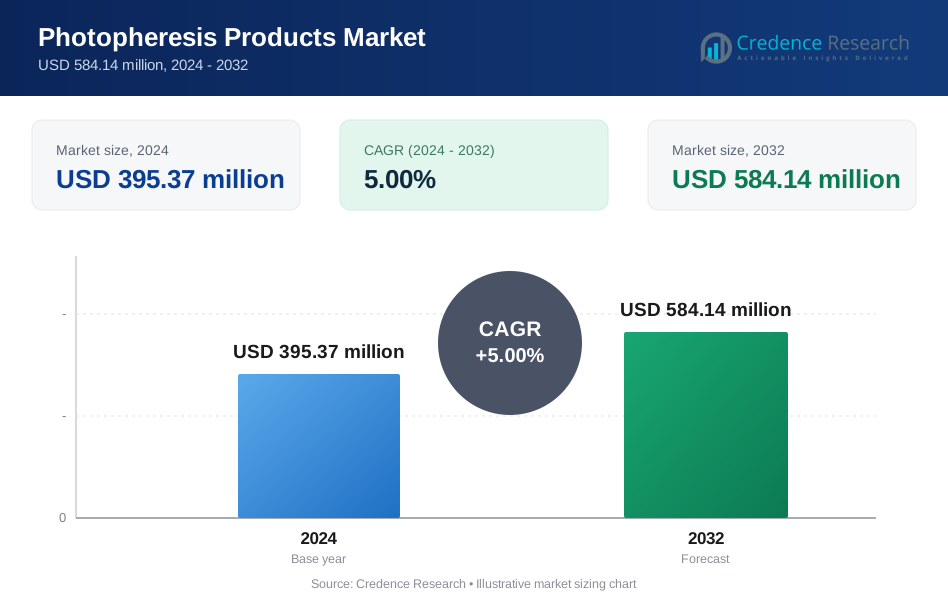
| Photopheresis Products Market Size 2024 | USD 395.37 Million |
| Photopheresis Products Market, CAGR | 5.00% |
| Photopheresis Products Market Size 2032 | USD 584.14 Million |
Market Overview
The photopheresis products market is projected to grow from USD 395.37 million in 2024 to USD 584.14 million by 2032, reflecting a compound annual growth rate (CAGR) of 5.00%.
The photopheresis products market is driven by the increasing prevalence of chronic diseases, such as cutaneous T-cell lymphoma and graft-versus-host disease, which necessitate effective treatment options. Advancements in technology and rising awareness about the benefits of photopheresis, including its minimally invasive nature and fewer side effects compared to traditional therapies, further boost demand. Additionally, the growing focus on personalized medicine and improved healthcare infrastructure are significant trends that support market expansion. As healthcare providers increasingly adopt innovative treatment modalities, the photopheresis products market is poised for sustained growth in the coming years.
The photopheresis products market shows robust growth across North America and Europe, driven by advanced healthcare infrastructure and favorable reimbursement policies, with North America holding the largest market share due to high adoption rates and significant R&D investment. Europe follows closely, benefiting from an increasing prevalence of autoimmune diseases and organ transplants. Key players, including Haemonetics Corporation, Fresenius Kabi, Terumo Corporation, and Therakos, actively drive market expansion through innovation, strategic collaborations, and enhanced product offerings. These companies are focused on improving accessibility and advancing photopheresis technology to meet the rising demand globally.
Market Drivers
Increasing Prevalence of Autoimmune Diseases
The rising incidence of autoimmune diseases, including rheumatoid arthritis, lupus, and inflammatory bowel disease, is a significant driver of demand for effective treatment options like photopheresis. For instance, the Autoimmune Registry reports that autoimmune diseases affect approximately 10% of the population, with higher prevalence in women. This therapy is designed to modulate the immune system and reduce inflammation, making it a valuable tool in managing these challenging conditions. As more patients seek innovative therapies to control their symptoms and improve their quality of life, the utilization of photopheresis is expected to grow, supporting its market expansion.
Growth in Organ Transplantation
The increasing number of organ transplants worldwide has led to a higher risk of graft-versus-host disease (GVHD), a serious complication that occurs when transplanted immune cells attack the recipient's body. According to the Global Observatory on Donation and Transplantation, there were approximately 144,302 solid organ transplants performed globally in 2021. Photopheresis has emerged as a well-established treatment for GVHD, effectively managing this condition and contributing to the growth of the photopheresis products market. As organ transplantation rates continue to rise, so too does the need for effective therapies, positioning photopheresis as a critical solution in post-transplant care.
Favorable Reimbursement Policies and Technological Advancements
Government reimbursement policies and expanded private healthcare insurance coverage for photopheresis treatments have made this therapy more accessible to patients. Such favorable financial conditions significantly boost market demand for photopheresis products. Concurrently, continuous advancements in photopheresis devices and techniques are enhancing the treatment's efficiency and effectiveness. These innovations drive market growth by making photopheresis not only more accessible but also more affordable for healthcare providers and patients alike.
Expanding Clinical Applications and Key Players
Ongoing research is exploring the potential of photopheresis in treating a wider range of diseases, including certain types of cancer and skin conditions. This expansion of clinical applications can further fuel market growth as healthcare providers adopt photopheresis for various therapeutic uses. Additionally, leading pharmaceutical and medical device companies are investing in research and development of photopheresis products. Collaborations among these companies can accelerate innovation and facilitate market expansion, ensuring the continued relevance and efficacy of photopheresis in modern medicine.
Market Trends
Market Growth and Expanding Applications
The photopheresis products market is witnessing remarkable growth, primarily fueled by the rising prevalence of autoimmune diseases, increasing organ transplantation procedures, and a growing geriatric population. For instance, the National Institute of Environmental Health Sciences (NIEHS) reports that autoimmune diseases are on the rise, affecting millions globally. As these factors converge, the demand for effective treatment options, such as photopheresis, continues to expand. The market is projected to grow at a steady compound annual growth rate (CAGR) during the forecast period, reflecting a positive outlook for stakeholders in the industry. Moreover, research is actively exploring the potential of photopheresis in treating a broader array of diseases, including certain types of cancer and various skin conditions. This expansion into new therapeutic areas not only enhances the treatment landscape but also significantly contributes to the overall market growth, making photopheresis a versatile and increasingly essential option in modern healthcare.
Technological Innovations and Collaboration Dynamics
In addition to market growth, innovations in photopheresis devices and techniques are enhancing the efficiency and effectiveness of treatments. Closed-system devices are gaining traction due to their reduced risk of contamination, ensuring safer treatment protocols for patients. The development of miniaturized and portable devices is also underway, aiming to improve the accessibility of photopheresis therapy for patients in diverse settings. These technological advancements signify a commitment to improving patient care while making treatments more user-friendly and efficient. Furthermore, favorable reimbursement policies from governments and expanded private healthcare insurance coverage are making photopheresis therapies more accessible to patients. This financial support can significantly boost the demand for photopheresis products, encouraging wider adoption across healthcare systems. Leading pharmaceutical and medical device companies are actively investing in research and development of photopheresis products, fostering a collaborative environment that accelerates innovation and market expansion.
Market Challenges Analysis
High Treatment Costs and Reimbursement Challenges
One of the primary challenges facing the photopheresis products market is the high cost associated with treatment. For instance, a study published in the Journal of Health Economics and Outcomes Research found that the cost of extracorporeal photopheresis (ECP) can be significant, impacting its accessibility. Photopheresis is a complex and specialized procedure that requires advanced technology and trained personnel, which contributes to its relatively expensive nature. This high cost can significantly limit access to therapy, particularly for patients in developing countries where healthcare resources are often constrained. While efforts are underway to improve reimbursement policies, challenges persist in securing coverage for all eligible patients. Variations in reimbursement policies across different healthcare systems can complicate access, leading to disparities in treatment availability and hindering the adoption of photopheresis. These financial barriers may discourage both patients and healthcare providers from pursuing photopheresis as a viable treatment option, ultimately impacting patient outcomes and market growth.
Limited Accessibility and Awareness Issues
Another significant challenge is the limited availability of specialized centers equipped to perform photopheresis. The procedure requires not only specialized equipment but also trained healthcare professionals, which can restrict its availability, especially in rural or underserved areas. This geographical disparity presents a considerable barrier for patients seeking this treatment, as they may have to travel long distances to access care. Additionally, many healthcare providers and patients may lack awareness of the benefits and applications of photopheresis, which further limits its adoption. Educating healthcare professionals about the therapy's potential advantages is crucial for expanding its use. Moreover, the regulatory hurdles associated with the approval process for new photopheresis devices and techniques can be time-consuming and costly, delaying the introduction of innovative products to the market. These regulatory challenges can stifle advancements in treatment options, ultimately impacting patient care and the overall growth of the photopheresis market. Addressing these challenges through enhanced awareness, improved access, and streamlined regulatory processes is essential to fostering a more robust photopheresis landscape.
Market Segmentation Analysis:
By Product Type:
The photopheresis products market can be segmented by product type into closed and open systems. Closed systems are gaining traction due to their minimized contamination risk, offering an enclosed environment that helps safeguard patient safety during the photopheresis process. These systems appeal especially to healthcare facilities seeking higher safety standards and efficiency, thus driving their demand in both developed and developing healthcare sectors. Open systems, while less common, are still used in certain settings where lower upfront costs may be prioritized. This segment division allows healthcare providers to choose systems based on specific clinical needs, patient safety priorities, and budget considerations, which collectively support the photopheresis market's growth.
By Application:
In terms of application, photopheresis products serve a range of medical needs, including graft-versus-host disease (GVHD), autoimmune diseases, cutaneous T-cell lymphoma, and transplant rejections. As a life-saving treatment for GVHD, photopheresis plays a critical role in immunosuppression and has become widely recognized for its therapeutic effectiveness. Additionally, autoimmune diseases like rheumatoid arthritis benefit from photopheresis’ immunomodulatory effects, expanding its clinical value. The growing number of transplants and subsequent rejection cases underscores the importance of photopheresis in providing a non-invasive treatment option, enhancing patient outcomes across multiple health conditions.
Segments:
Based on Product Type
- Closed system
- Open system
Based on Application
- Graft versus host disease
- Autoimmune diseases
- Cutaneous T-cell lymphoma
- Transplant rejections
Based on End-use
- Hospitals
- Ambulatory surgical centres
- Others
Based on the Geography:
- North America
- U.S.
- Canada
- Mexico
- Europe
- Germany
- France
- U.K.
- Italy
- Spain
- Rest of Europe
- Asia Pacific
- China
- Japan
- India
- South Korea
- South-east Asia
- Rest of Asia Pacific
- Latin America
- Brazil
- Argentina
- Rest of Latin America
- Middle East & Africa
- GCC Countries
- South Africa
- Rest of the Middle East and Africa
Regional Analysis
North America
North America accounts for approximately 35% of the global photopheresis products market share, driven by advanced healthcare systems, higher rates of autoimmune diseases, and an aging population. The United States leads the region, benefiting from significant investments in medical technology and innovation, as well as supportive reimbursement policies that make photopheresis therapies more accessible to patients. Additionally, North America's strong research and development activities by key healthcare providers and increased awareness of photopheresis as an effective treatment option further strengthen the region’s dominance in the global market.
Europe
Europe holds around 25% of the global photopheresis products market share, with countries such as Germany, France, and the United Kingdom leading adoption. Favorable healthcare policies, robust government healthcare expenditure, and an aging population across the region contribute to this substantial share. Europe’s commitment to innovation, with numerous research initiatives focusing on chronic and immune-related diseases, supports the uptake of photopheresis products. The presence of major medical device manufacturers and a well-established regulatory framework for advanced therapies further drive market growth in Europe, ensuring accessibility in both public and private healthcare systems.
Key Player Analysis
- Haemonetics Corporation
- Fresenius Kabi
- Terumo Corporation
- Macopharma
- Mallinckrodt Pharmaceuticals
- Med Tech Solutions GmbH
- Thermo Fisher Scientific
- Spectranetics
- Therakos
Competitive Analysis
The competitive landscape of the photopheresis products market is characterized by innovation, strategic partnerships, and a focus on expanding therapeutic applications. Leading players, including Haemonetics Corporation, Fresenius Kabi, Terumo Corporation, Macopharma, Mallinckrodt Pharmaceuticals, Med Tech Solutions GmbH, Thermo Fisher Scientific, Spectranetics, and Therakos, leverage advanced technologies to enhance treatment efficacy and patient outcomes. These companies focus on developing closed-system devices that reduce contamination risks and improve procedural efficiency. Additionally, extensive R&D efforts and collaborations with healthcare providers have helped these key players broaden their product portfolios and geographic reach. As demand grows, companies are concentrating on affordability and accessibility, especially in regions with developing healthcare infrastructures, while adhering to rigorous regulatory standards. This dynamic environment propels innovation and enhances the global availability of photopheresis therapies, positioning these companies as market leaders.
Recent Developments
- In September 2022, The Abu Dhabi Health Services Company (SEHA) and Mayo Clinic partnership witnessed the opening of a new apheresis unit in the Sheikh Shakhbout Medical City (SSMC). The range of disorders that can be treated in Sheikh Shakhbout Medical City has been broadened, including the rare cutaneous lymphoma.
- In August 2022, Ikaria Australia Pty Ltd, a Mallinckrodt Pharmaceuticals company, launched THERAKOS CELLEX Photopheresis System to the Australian market. The CELLEX instrument performs the extraction, treatment, and reinfusion of white blood cells for an integrated, closed photopheresis procedure.
Market Concentration & Characteristics
The photopheresis products market exhibits a moderate to high concentration, with key players dominating the industry through established brand presence, extensive distribution networks, and significant R&D investments. Market concentration is largely shaped by a few major companies, including Haemonetics Corporation, Fresenius Kabi, and Terumo Corporation, who drive innovation and set industry standards with advanced, closed-system devices aimed at increasing procedural safety and efficiency. The market also displays high entry barriers due to the stringent regulatory requirements for device approval and the specialized expertise required for photopheresis procedures. Additionally, companies within this market prioritize collaborative research and clinical trials to validate and expand the therapeutic applications of photopheresis, which currently serves critical treatments for graft-versus-host disease, autoimmune disorders, and certain cancers. As these established players expand their geographical footprint and form partnerships, they enhance the accessibility of photopheresis products, further consolidating their influence in this niche yet vital therapeutic area.
Report Coverage
The research report offers an in-depth analysis based on Product Type, Application, End-Use and Geography. It details leading market players, providing an overview of their business, product offerings, investments, revenue streams, and key applications. Additionally, the report includes insights into the competitive environment, SWOT analysis, current market trends, as well as the primary drivers and constraints. Furthermore, it discusses various factors that have driven market expansion in recent years. The report also explores market dynamics, regulatory scenarios, and technological advancements that are shaping the industry. It assesses the impact of external factors and global economic changes on market growth. Lastly, it provides strategic recommendations for new entrants and established companies to navigate the complexities of the market.
Future Outlook
- The photopheresis products market is expected to see steady growth driven by rising cases of autoimmune diseases and transplant procedures.
- Advancements in closed-system devices will likely improve safety and operational efficiency, supporting broader adoption in healthcare facilities.
- Expanded clinical applications for conditions such as cutaneous T-cell lymphoma and organ transplant rejection are anticipated to fuel demand.
- Increased investments in R&D by key players will introduce innovative and more accessible photopheresis devices.
- Efforts to educate healthcare providers on photopheresis benefits are likely to enhance awareness and adoption of the therapy.
- Strategic collaborations between companies may accelerate the development of next-generation photopheresis solutions.
- Reimbursement policies are expected to improve, making photopheresis treatments more affordable and accessible to patients globally.
- Growth in emerging markets could increase due to rising healthcare infrastructure and awareness of advanced treatments.
- Miniaturized and portable photopheresis devices may broaden therapy access in outpatient and remote settings.
- Regulatory approvals for newer technologies will play a crucial role in expanding market reach and meeting growing patient needs.
Request a Free Sample
Fill in your details and we'll send you a free sample report.
- Sample data tables & charts
- Research methodology
Market Dynamics
Increasing Prevalence of Autoimmune Diseases
The rising incidence of autoimmune diseases such as rheumatoid arthritis, lupus, and inflammatory bowel disease is driving demand for photopheresis as an effective immunomodulatory therapy, supporting market growth as more patients seek advanced treatment options.
Growth in Organ Transplantation
The global increase in organ transplant procedures has led to a higher incidence of graft-versus-host disease, for which photopheresis is a well-established treatment, thereby boosting demand for photopheresis products in post-transplant care.
Favorable Reimbursement Policies and Technological Advancements
Expanded insurance coverage and government reimbursement for photopheresis treatments, combined with ongoing innovations in device technology, are making these therapies more accessible and affordable, encouraging broader adoption in healthcare settings.
Expanding Clinical Applications
Ongoing research is broadening the use of photopheresis beyond traditional indications to include certain cancers and skin conditions, increasing the therapy’s relevance and driving market expansion as new applications are validated.
Improved Healthcare Infrastructure and Awareness
Investments in healthcare infrastructure and targeted educational initiatives are increasing awareness among providers and patients about the benefits of photopheresis, leading to higher adoption rates, especially in emerging markets.
Need a Custom Version of This Report?
Tailor the scope, geography, or segments to your exact requirements.
- Custom geography or segment scope
- Direct access to our analyst team
Frequently Asked Questions
What is the current size of the Photopheresis Products market?
What factors are driving the growth of the Photopheresis Products market?
What are the key segments within the Photopheresis Products market?
What are some challenges faced by the Photopheresis Products market?
Who are the major players in the Photopheresis Products market?
Table of Content
Chapter 1 Market Segmentation
- 1.1 Segmentation Framework
- 1.1.1 Product and Service Classification
- 1.1.2 Application and End-Use Classification
- 1.1.3 Technology and Solution Classification
- 1.1.4 Customer and Distribution Channel Classification
- 1.1.5 Geographic Segmentation
- 1.1.6 Market Segment Definitions and Boundaries
- 1.2 By End-use
- 1.2.1 Hospitals
- 1.2.2 Ambulatory surgical centres
- 1.2.3 Others
- 1.3 By Application
- 1.3.1 Graft versus host disease
- 1.3.2 Autoimmune diseases
- 1.3.3 Cutaneous T-cell lymphoma
- 1.3.4 Transplant rejections
- 1.4 By Product Type
- 1.4.1 Closed system
- 1.4.2 Open system
Chapter 2 Introduction
- 2.1 Report Objectives and Scope
- 2.2 Product Definition and Industry Terminology
- 2.3 Market Inclusions and Exclusions
- 2.4 Research Process
- 2.4.1 Primary Research and Expert Interviews
- 2.4.2 Secondary Research and Source Review
- 2.4.3 Top-Down and Bottom-Up Estimation
- 2.4.4 Data Triangulation and Verification
- 2.5 Market Size Measurement Basis
- 2.5.1 2024: USD 395.37 million → 2032: USD 584.14 million
- 2.6 Historical and Forecast Reference Periods
- 2.6.1 Base Year: 2024
- 2.6.2 Forecast Period: 2024-2032
- 2.7 Research Assumptions and Limitations
Chapter 3 Executive Summary
- 3.1 Market Snapshot and Key Findings
- 3.2 Base-Year Market Size, 2024
- 3.3 Forecast Market Size, 2032
- 3.4 Revenue and Volume Growth Outlook
- 3.5 Key Demand and Supply Indicators
- 3.6 Leading Market Segments
- 3.7 Fastest-Growing Market Opportunities
- 3.8 Regional Performance Highlights
- 3.9 Technology and Industry Transformation
- 3.10 Competitive Landscape Summary
- 3.11 Analyst View and Strategic Implications
Chapter 4 Global Photopheresis Products Market Trends and Developments
- 4.1 Historical Industry Development
- 4.2 Recent Market Trends and Developments
- 4.3 Demand and Customer Behavior Trends
- 4.4 Technology and Product Innovation
- 4.5 Artificial Intelligence, Automation and Digitalization
- 4.6 Local Manufacturing and Supply Chain Realignment
- 4.7 Industry Partnerships, Mergers and Acquisitions
- 4.8 Sustainability and Circular Economy Developments
- 4.9 Government and Private Sector Investment Trends
- 4.10 Emerging Business Models and Commercialization
- 4.11 Industry Developments and Announcements
Chapter 5 Global Photopheresis Products Market Production, Supply and Demand Analysis
- 5.1 Demand Trend and Consumption Analysis
- 5.2 Demand Forecast, 2024-2032
- 5.3 Production and Output Trend
- 5.4 Production and Output Forecast, 2024-2032
- 5.5 Installed Capacity and Capacity Utilization
- 5.6 Company-Wise Production Plants and Statistics
- 5.6.1 Installed Production Capacity
- 5.6.2 Actual Production
- 5.6.3 Planned Capacity and Expansion Targets
- 5.7 Supply Chain Structure and Procurement Trends
- 5.8 Supply-Demand Gap and Bottlenecks
- 5.9 Import Dependence and Sourcing Structure
- 5.10 Contract Manufacturing and Outsourcing
- 5.11 Regional Supply and Demand Concentration
Chapter 6 Global Photopheresis Products Market Pricing Analysis
- 6.1 Pricing Structure and Measurement
- 6.2 Historical Pricing Trends
- 6.3 Pricing Outlook, 2024-2032
- 6.4 Average Selling Price and Unit Economics
- 6.5 Pricing by Product and Market Segment
- 6.6 Geographic Pricing Differences
- 6.7 Key Input, Energy, Labor and Logistics Costs
- 6.8 Contract Pricing and Purchasing Models
- 6.9 Pricing Sensitivity and Competitive Positioning
- 6.10 Price, Margin and Profitability Implications
Chapter 7 Global Photopheresis Products Market Dynamics
- 7.1 Market Growth Drivers
- 7.1.1 Demand-Side Drivers
- 7.1.2 Technology and Innovation Drivers
- 7.1.3 Infrastructure and Investment Drivers
- 7.1.4 Regulatory and Policy Drivers
- 7.2 Market Restraints
- 7.2.1 Cost and Affordability Constraints
- 7.2.2 Technology and Adoption Barriers
- 7.2.3 Supply Chain and Operational Constraints
- 7.3 Market Challenges
- 7.3.1 Competitive Pressure and Margin Erosion
- 7.3.2 Skills, Infrastructure and Implementation Gaps
- 7.4 Emerging Market Opportunities
- 7.5 Market Dynamics Impact and Time-Horizon Assessment
Chapter 8 Global Photopheresis Products Value Chain Analysis
- 8.1 Industry Value Chain Overview
- 8.2 Upstream Suppliers and Critical Inputs
- 8.3 Technology and Component Providers
- 8.4 Manufacturing or Service Delivery
- 8.5 Distribution, Channel Partners and Integrators
- 8.6 Downstream Applications and End Users
- 8.7 Value Addition and Profit Pools
- 8.8 Vertical Integration and Outsourcing
- 8.9 Supplier Concentration and Risk
- 8.10 Supply Chain Localization and Resilience
Chapter 9 Global Photopheresis Products Market Regulations and Policies
- 9.1 Relevant Laws, Standards and Compliance Frameworks
- 9.2 Product, Service, Safety and Quality Requirements
- 9.3 Government Policies, Incentives and Subsidies
- 9.4 Imports, Exports and Trade Barriers
- 9.5 Public Procurement and Local Content Requirements
- 9.6 Environmental and Sustainability Compliance
- 9.7 Upcoming Policy Changes and Market Implications
Chapter 10 Global Photopheresis Products Market Hotspots and Opportunities
- 10.1 Market Opportunity Mapping and Growth Hotspots
- 10.2 High-Growth Applications and Customer Groups
- 10.3 Underserved Markets and White-Space Opportunities
- 10.4 Emerging Technology and Product Opportunities
- 10.5 New Capacity and Investment Hotspots
- 10.6 Market Entry and Expansion Opportunities
- 10.7 Distribution and Partnership Opportunities
- 10.8 Near-Term and Long-Term Commercial Potential
- 10.9 Opportunity Attractiveness and Execution Risks
Chapter 11 Global Photopheresis Products Market Outlook, 2024-2032
- 11.1 Market Size and Analysis
- 11.1.1 Revenue (Market Measurement: 2024: USD 395.37 million → 2032: USD 584.14 million)
- 11.1.2 Market Volume and Quantity Sold
- 11.1.3 Historical Market Size
- 11.1.4 Base-Year Market Size, 2024
- 11.2 Market Forecast, 2024-2032
- 11.2.1 Revenue Forecast to 2032
- 11.2.2 Volume Forecast to 2032
- 11.2.3 CAGR and Year-on-Year Growth
- 11.2.4 Incremental Revenue Opportunity
- 11.3 Forecast Assumptions and Scenario Analysis
- 11.3.1 Base-Case Forecast
- 11.3.2 Optimistic and Conservative Scenarios
- 11.3.3 Technology, Pricing and Policy Sensitivities
- 11.4 Market Attractiveness and Growth Outlook
Chapter 12 Global Photopheresis Products Market Segmentation and Outlook
- 12.1 Segmentation Summary and Market Shares, 2024
- 12.2 Largest and Fastest-Growing Segments
- 12.3 By End-use - Market Size and Forecast, 2024-2032
- 12.3.1 Segment Definition and Scope
- 12.3.2 Historical Market Size
- 12.3.3 Revenue Forecast, 2024-2032
- 12.3.4 Volume Forecast, 2024-2032
- 12.3.5 Base-Year Market Share, 2024
- 12.3.6 Segment CAGR and Growth Drivers
- 12.3.7 Subsegment Market Size and Forecast
- 12.3.7.1 Hospitals
- 12.3.7.2 Ambulatory surgical centres
- 12.3.7.3 Others
- 12.3.8 Subsegment Pricing and Adoption Trends
- 12.3.9 Leading Suppliers and Competition
- 12.3.10 Regional Demand and Opportunities
- 12.4 By Application - Market Size and Forecast, 2024-2032
- 12.4.1 Segment Definition and Scope
- 12.4.2 Historical Market Size
- 12.4.3 Revenue Forecast, 2024-2032
- 12.4.4 Volume Forecast, 2024-2032
- 12.4.5 Base-Year Market Share, 2024
- 12.4.6 Segment CAGR and Growth Drivers
- 12.4.7 Subsegment Market Size and Forecast
- 12.4.7.1 Graft versus host disease
- 12.4.7.2 Autoimmune diseases
- 12.4.7.3 Cutaneous T-cell lymphoma
- 12.4.7.4 Transplant rejections
- 12.4.8 Subsegment Pricing and Adoption Trends
- 12.4.9 Leading Suppliers and Competition
- 12.4.10 Regional Demand and Opportunities
- 12.5 By Product Type - Market Size and Forecast, 2024-2032
- 12.5.1 Segment Definition and Scope
- 12.5.2 Historical Market Size
- 12.5.3 Revenue Forecast, 2024-2032
- 12.5.4 Volume Forecast, 2024-2032
- 12.5.5 Base-Year Market Share, 2024
- 12.5.6 Segment CAGR and Growth Drivers
- 12.5.7 Subsegment Market Size and Forecast
- 12.5.7.1 Closed system
- 12.5.7.2 Open system
- 12.5.8 Subsegment Pricing and Adoption Trends
- 12.5.9 Leading Suppliers and Competition
- 12.5.10 Regional Demand and Opportunities
- 12.6 Segment Growth Comparison
- 12.7 Segment Attractiveness and Priority Matrix
Chapter 13 Global Photopheresis Products End-Use and Application Market Outlook
- 13.1 End-Use Industry and Customer Demand Structure
- 13.2 Leading Applications and Customer Groups
- 13.3 End-Use Market Size, Share and Forecast
- 13.4 Major End-Use Industry Deep Dives
- 13.4.1 Customer Requirements and Use Cases
- 13.4.2 Demand and Replacement Cycles
- 13.4.3 Technical and Regulatory Considerations
- 13.4.4 Purchasing and Procurement Models
- 13.4.5 Leading Vendors and Distribution Channels
- 13.4.6 Forecast and Commercial Opportunities
- 13.5 Emerging Applications and Cross-Segment Demand
- 13.6 End-Use Industry Investment Priorities
Chapter 14 Global Photopheresis Products Geographic Market Outlook, 2024-2032
- 14.1 Regional Market Size and Share, 2024
- 14.2 Regional Market Forecast, 2024-2032
- 14.3 Regional Pricing, Production and Demand Differences
- 14.4 North America
- 14.4.1 United States
- 14.4.2 Canada
- 14.4.3 Mexico
- 14.5 Europe
- 14.5.1 Germany
- 14.5.2 France
- 14.5.3 Italy
- 14.5.4 United Kingdom
- 14.5.5 Spain
- 14.5.6 Poland
- 14.5.7 Russia
- 14.5.8 Netherlands
- 14.5.9 Belgium
- 14.5.10 Sweden
- 14.5.11 Denmark
- 14.5.12 Norway
- 14.5.13 Rest of Europe
- 14.6 Asia Pacific
- 14.6.1 China
- 14.6.2 India
- 14.6.3 Japan
- 14.6.4 South Korea
- 14.6.5 Thailand
- 14.6.6 Indonesia
- 14.6.7 Vietnam
- 14.6.8 Malaysia
- 14.6.9 Australia
- 14.6.10 Rest of Asia Pacific
- 14.7 Latin America
- 14.7.1 Brazil
- 14.7.2 Argentina
- 14.7.3 Colombia
- 14.7.4 Chile
- 14.7.5 Rest of Latin America
- 14.8 Middle East
- 14.8.1 Saudi Arabia
- 14.8.2 United Arab Emirates
- 14.8.3 Turkey
- 14.8.4 Israel
- 14.8.5 Iran
- 14.8.6 Rest of the Middle East
- 14.9 Africa
- 14.9.1 South Africa
- 14.9.2 Egypt
- 14.9.3 Nigeria
- 14.9.4 Morocco
- 14.9.5 Rest of Africa
- 14.10 Regional Investment, Policy and Supply Chain Differences
- 14.11 Regional Competitive Landscape
- 14.12 Geographic Growth Hotspots
Chapter 15 Global Photopheresis Products Technology, Innovation and Sustainability Outlook
- 15.1 Technology Landscape and Maturity
- 15.2 Product, Process and Service Innovation
- 15.3 AI, Automation and Digital Tools in the Industry
- 15.4 Technology Adoption and Performance Benchmarking
- 15.5 Innovation Pipeline and R&D Investment
- 15.6 Patent and Intellectual Property Trends
- 15.7 Energy Efficiency and Resource Management
- 15.8 Sustainability, Recycling and Circularity
- 15.9 Technology Roadmap, 2024-2032
- 15.10 Risks of Obsolescence and Technology Substitution
Chapter 16 Global Photopheresis Products Market Key Strategic Imperatives
- 16.1 Growth and Market Entry Priorities
- 16.2 High-Return Products and Segments
- 16.3 Pricing, Profitability and Cost Optimization
- 16.4 Technology Investment and Product Differentiation
- 16.5 Supply Chain Localization and Resilience
- 16.6 Distribution and Customer Acquisition
- 16.7 Partnership, Acquisition and Capacity Strategy
- 16.8 Regional Expansion Priorities
- 16.9 Short-, Medium- and Long-Term Actions
Chapter 17 Competition Outlook
- 17.1 Industry Competition Characteristics
- 17.2 Market Structure and Concentration
- 17.3 Market Share and Competitive Positioning, 2024
- 17.4 Company-Wise Revenue and Product Benchmarking
- 17.5 Production and Service Capacity Benchmarking
- 17.6 Technology, Pricing and Differentiation
- 17.7 Regional Footprint and Distribution Strength
- 17.8 Mergers, Acquisitions and Strategic Alliances
- 17.9 New Entrants and Competitive Threats
- 17.10 Porter's Five Forces and Industry Attractiveness
- 17.11 Competitive Outlook, 2024-2032
Chapter 18 Company Profiles
- 18.1 Company Coverage and Selection Criteria
- 18.2 Haemonetics Corporation
- 18.2.1 Business Description
- 18.2.2 Company Ownership and Geographic Presence
- 18.2.3 Product and Service Portfolio
- 18.2.4 Manufacturing and Operating Footprint
- 18.2.5 Production Capacity and Expansion Plans
- 18.2.6 Financial Performance and Investment
- 18.2.7 Market Share and Competitive Position
- 18.2.8 Technology and Innovation Capabilities
- 18.2.9 Strategic Alliances or Partnerships
- 18.2.10 Recent Developments
- 18.2.11 Growth Strategy and Outlook
- 18.3 Fresenius Kabi
- 18.4 Terumo Corporation
- 18.5 Macopharma
- 18.6 Mallinckrodt Pharmaceuticals
- 18.7 Med Tech Solutions GmbH
- 18.8 Thermo Fisher Scientific
- 18.9 Spectranetics
- 18.10 Therakos
- 18.11 Other Relevant Market Participants
Note: Every listed company is profiled on the structure shown under the first company. The company list is preliminary and may change based on research findings, market developments, data availability and client requirements.
Chapter 19 Disclaimer
- 19.1 Research and Forecast Disclaimer
- 19.2 Data Source and Estimation Limitations
Note: The depth of individual sections depends on data availability for this market. Volume, capacity, trade and other unit-based metrics are included where applicable.

