Market Overview
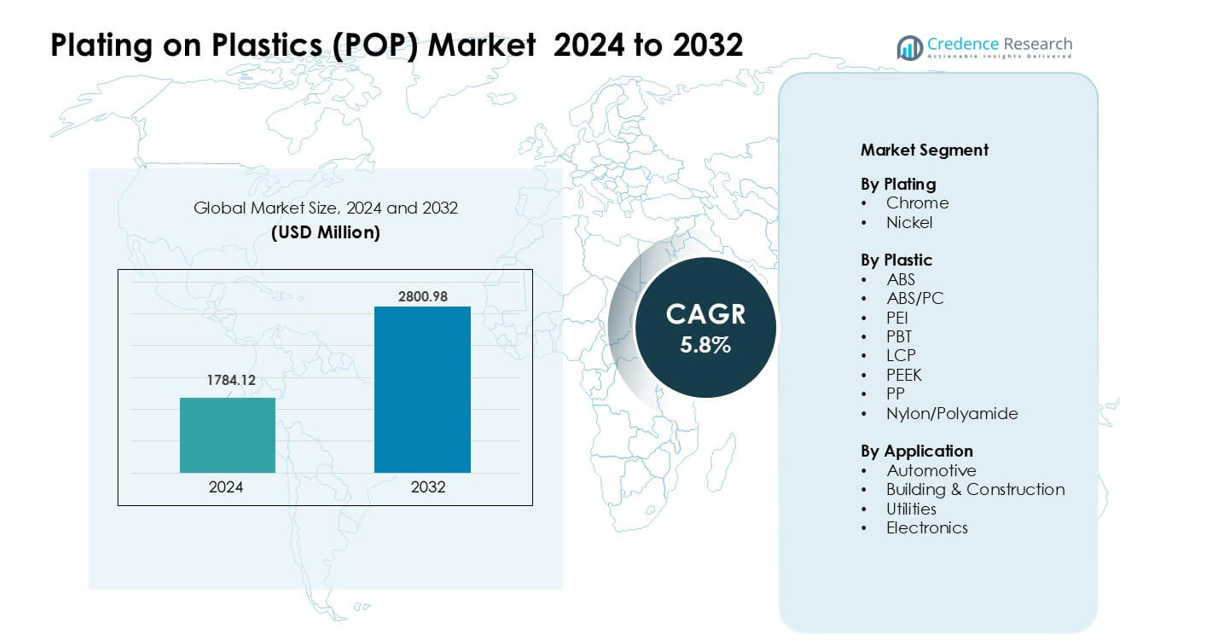
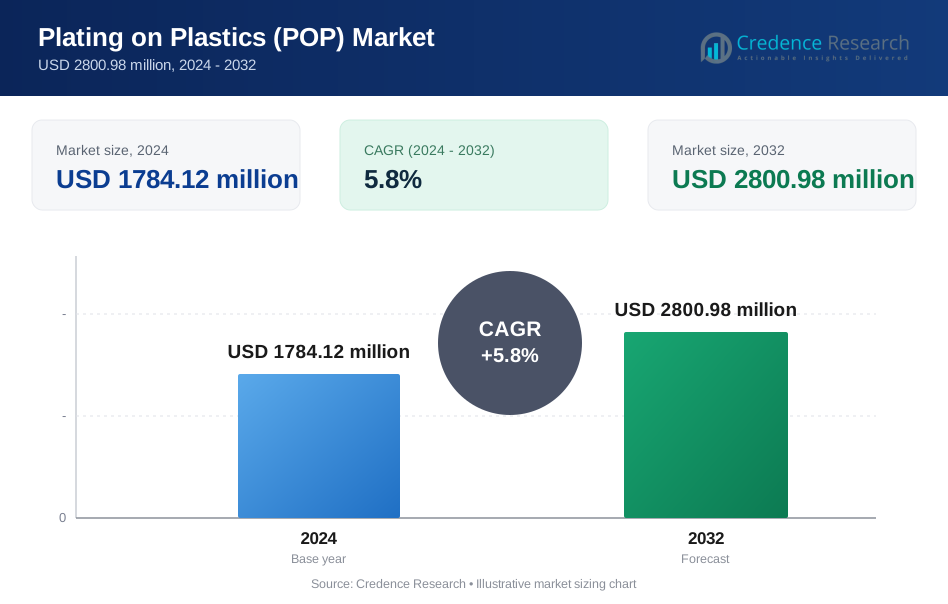
Plating on Plastics (POP) Market was valued at USD 1784.12 million in 2024 and is anticipated to reach USD 2800.98 million by 2032, growing at a CAGR of 5.8 % during the forecast period.
| REPORT ATTRIBUTE | DETAILS |
|---|---|
| Historical Period | 2020-2023 |
| Base Year | 2024 |
| Forecast Period | 2025-2032 |
| Plating on Plastics (POP) Market Size 2024 | USD 1784.12 million |
| Plating on Plastics (POP) Market , CAGR | 5.8% |
| Plating on Plastics (POP) Market Size 2032 | USD 2800.98 million |
The Plating on Plastics (POP) Market is shaped by leading companies such as ENS Technology, Dymax, Sharrets Plating Inc., DuPont, Cybershield Inc., JCU Corporation, Leader Plating on Plastic Ltd., Element Solutions Inc., MPC Plating Inc., and Quality Plated Products Ltd. These firms strengthened their positions through advanced plating chemistries, improved adhesion technologies, and wider adoption of trivalent chrome solutions. Strong partnerships with automotive and electronics OEMs supported steady demand. Asia Pacific emerged as the leading region with nearly 36% share in 2024, driven by large-scale electronics production, expanding automotive output, and cost-efficient manufacturing capabilities.
Market Insights
- The Plating on Plastics (POP) Market reached USD 1784.12 million in 2024 and is projected to hit USD 2800.98 million by 2032 at a CAGR of 5.8%.
- Strong demand from automotive OEMs drove growth, as chrome-plated ABS components held the largest segment share due to lightweight design and premium surface appeal.
- Key trends included rising adoption of trivalent chrome solutions, eco-friendly chemistries, and increased use of engineering plastics such as ABS/PC and PBT across electronics.
- Leading companies such as ENS Technology, Dymax, DuPont, Cybershield, and Element Solutions Inc. advanced through process automation, high-precision plating, and stronger OEM partnerships.
- Asia Pacific led the global market with nearly 36% share, followed by Europe at about 32% and North America at 28%, supported by strong automotive and electronics output.
Market Segmentation Analysis:
By Plating
Chrome plating held the dominant share in the Plating on Plastics (POP) Market in 2024 with about 62%. Chrome gained strong traction due to its bright finish, high durability, and strong corrosion resistance. Automakers used chrome to upgrade trim parts and boost exterior styling. Nickel plating grew at a steady pace as firms adopted it for functional layers that improve adhesion and wear strength in electrical and industrial parts. Rising use of chrome-coated components in EVs and premium vehicles continued to drive demand across global markets.
- For instance, a recent industrial‑scale study of chrome‑plated Acrylonitrile Butadiene Styrene (ABS) front‑grille frames, molded for a commercial‑van application, was chrome‑electroplated with a final chrome layer of about 1.65 ± 0.4 µm over copper and nickel base layers demonstrating that chrome plating on ABS yields a metal‑like, durable finish even on complex plastic geometries.
By Plastic
ABS accounted for the largest share of about 68% in 2024, leading the POP Market due to its strong plating ability, smooth surface, and low processing cost. Its wide use in automotive grills, handles, and interior trims strengthened the segment’s dominance. ABS/PC blends followed as firms adopted these materials for better heat resistance and impact strength. Engineering plastics like PBT, PEEK, LCP, and PA gained gradual adoption in high-performance electronics and industrial units where strength and thermal stability remained essential.
- For instance, ABS/PC blends followed as firms adopted these materials for better heat resistance and impact strength. Engineering plastics like PBT, PEEK, LCP, and PA gained gradual adoption in high‑performance electronics and industrial units where strength and thermal stability remained essential.
By Application
Automotive remained the dominant segment with nearly 71% share in 2024. Vehicle makers used plated plastics for trims, emblems, bezels, and functional parts that demand lightweight design and appealing surfaces. Growth in EV models and premium interiors supported higher adoption of chrome-finished components. Electronics formed the next key segment as brands used plated plastics in connectors and decorative covers. Construction and utilities saw moderate growth as firms adopted corrosion-resistant plated surfaces for fixtures, switches, and architectural elements.
Key Growth Drivers
Rising Automotive Demand for Lightweight Decorative Components
Automotive manufacturers increased their reliance on plated plastic parts as lightweight design became a key priority. Plated plastics replaced heavier metal components in grills, trims, handles, bezels, and interior accents, helping automakers reduce vehicle weight and improve fuel efficiency. Growing EV production also boosted adoption because electric models require light structural and decorative elements to optimize battery range. Automakers valued the premium look of chrome- and nickel-plated plastics, which offered metal-like aesthetics without heavy mass. Expanding premium car sales, strong interior customization trends, and higher design flexibility continued to push plated plastics deeper into global automotive supply chains.
- For instance, a recently published overview of modern Plating on Plastics (POP) in automotive design noted that OEMs now specify plastics coatings compatible with high‑performance polymers such as polyamide, polyphenylene sulfide, and polyetherimide signaling that even exterior decorative parts like grilles and bezels are being produced using advanced plastics rather than conventional metal casting.
Expanding Use of Engineering Plastics in Electronics and Industrial Units
Electronics makers increased the use of advanced plastics such as ABS/PC, PBT, PEEK, and LCP for components that require heat resistance, durability, and high surface finish. Plating enhanced these materials by adding conductivity, EMI shielding, and decorative appeal, which supported broader application in connectors, sensor housings, switches, and handheld devices. Industrial equipment manufacturers also used plated plastics to meet corrosion resistance and dimensional stability needs in harsh environments. The transition toward compact, lightweight devices reinforced the demand for metallized surfaces. Growth in smart consumer electronics, IoT devices, and high-performance industrial modules further strengthened the push toward plated engineering resins.
- For instance, a specialized conductive‑plastic technology from a major supplier allows stainless‑steel‑fiber fillers to be compounded into engineering thermoplastics (e.g. PBT, PA, PPS). When molded, even with low filler loading (as little as 0.25% by volume), these molded parts deliver effective EMI/ESD shielding enabling housings for industrial controllers or communications enclosures to replace metal boxes with lighter plastic ones while preserving shielding performance.
Advancements in Surface Treatment and Eco-friendly Plating Technologies
New chemical etching, electroless plating, and surface activation processes improved coating adhesion on complex geometries, supporting higher-quality finishes and reduced defect rates. Innovations in trivalent chrome, low-VOC chemicals, and alternative electrolytes allowed companies to meet strict environmental regulations. These advancements lowered operational risks, cut waste generation, and improved production efficiency for large plating facilities. Automotive and electronics OEMs favored suppliers who adopted cleaner processes due to tightening global standards. Improved plating chemistry also enabled consistent finishing on mixed and high-temperature plastics, broadening material compatibility. These technical gains reinforced expansion in high-value decorative and functional plating applications.
Key Trends & Opportunities
Growing Shift Toward Sustainable and Trivalent Chrome Solutions
Environmental regulations across Europe, North America, and Asia encouraged manufacturers to move away from hexavalent chrome toward safer trivalent chrome technologies. This shift allowed companies to maintain surface quality while aligning with sustainability goals. Brands highlighted environmentally compliant plating as a selling point, especially in automotive and consumer electronics. Investments in closed-loop systems, low-emission chemistries, and recyclable plastics accelerated adoption. As OEMs pushed for green supply chains, demand increased for suppliers capable of large-scale, low-toxicity plating. This trend created opportunities to develop next-generation eco-friendly coatings with improved durability, reduced energy use, and enhanced performance stability.
- For instance, Atotech’s “TriChrome” decorative Cr(III) plating line has been used for over 30 years worldwide and is specifically designed to be ELV, WEEE, RoHS and REACH‑compliant, enabling OEMs to replace traditional Cr(VI) decorative finishes with eco‑friendly Cr(III) without sacrificing appearance or corrosion resistance.
Rising Adoption of Plated Plastics in Electric Vehicles and Smart Devices
EV makers sought advanced lightweight materials that support energy efficiency and enhance external styling. Plated plastics enabled sleek, premium finishes while reducing total weight compared with metal components. EV interiors also used plated surfaces for touchpoints, switches, and accent elements to differentiate cabin design. In smart electronics, plated plastics supported growing demand for EMI shielding, signal protection, and high-grade decorative parts. Rapid growth in connected homes, wearable devices, and compact electronics created broad opportunities for functional plating. Suppliers able to deliver high-precision, defect-free coatings gained strong traction as electronics and EV production scaled globally.
- For instance, plastic‑plating providers such as CYH Plastic Plating offer trivalent chromium plating processes suitable for substrates like ABS and ABS/PC blends, specifically targeting automotive exterior trim parts (door handles, grilles) and interior components enabling EV manufacturers to meet both lightweight design and environmental‑ compliance requirements using the same plating line.
Increasing Customization and Premium Design Demand in Consumer Goods
Consumers sought products with refined surfaces and visually appealing finishes across home appliances, personal care items, and lifestyle goods. Plated plastics offered flexible styling options, enabling glossy, metallic, matte, or textured effects at lower cost than metal components. Manufacturers explored multi-layer decorative plating to enhance durability and brand differentiation. Growing demand for mid-range and premium appliances supported wider use of chrome-finished trims and control panels. As brands expanded design variations within short product cycles, plated plastics gained relevance due to lower tooling costs and faster development timelines. These factors expanded opportunities across multiple consumer goods categories.
Key Challenge
Environmental Compliance and Transition Costs for Hexavalent Chrome Alternatives
Stricter regulations on hazardous substances pushed companies to phase out hexavalent chrome, but transitioning to trivalent chrome or alternative methods remained costly and complex. Many facilities required major upgrades to plating lines, wastewater systems, and chemical handling equipment. Achieving equivalent surface quality and durability also required re-engineering process chemistry, leading to longer validation cycles with OEMs. Smaller manufacturers faced financial pressure due to investment needs and certification timelines. Meeting diverse regional regulations added further compliance burden. These challenges slowed adoption rates and increased operational risks for firms lacking scale or advanced technical capabilities.
High Material and Processing Costs for Engineering Plastics
Although engineering plastics enabled high-performance plating, their cost profile restricted broader market penetration. Materials such as PEEK, LCP, and high-grade ABS/PC blends carried higher prices, making them less attractive for cost-sensitive applications. Processing these materials required tighter temperature control and specialized equipment, which increased production expenses. Achieving consistent adhesion across complex shapes also demanded precise surface preparation, raising operational complexity. Automotive and electronics OEMs often evaluated cost-benefit tradeoffs carefully, slowing adoption in mid-range product categories. These constraints limited use to high-value applications where performance justified material and processing costs.
Regional Analysis
North America
North America held about 28% share of the Plating on Plastics (POP) Market in 2024. The region benefited from strong automotive production, particularly in premium vehicles that use chrome-plated trims and interior accents. Electronics makers in the U.S. and Canada also increased demand for plated plastic components in connectors and device housings. Rising interest in sustainable trivalent chrome solutions supported upgrades across plating facilities. Growing EV adoption further pushed the need for lightweight decorative parts. Steady investments in advanced plating technologies helped maintain the region’s competitive position.
Europe
Europe accounted for roughly 32% share in 2024, making it the largest regional market. The region’s leadership came from strict environmental regulations that accelerated the shift toward trivalent chrome and cleaner plating chemistries. Germany, France, and the U.K. recorded strong demand from luxury automotive brands that rely on premium chrome finishes. Electronics and appliance manufacturers also adopted plated plastics to enhance product aesthetics. EU-wide sustainability goals encouraged modernization of plating infrastructure. The region sustained high-quality standards, supporting strong adoption across automotive interiors, exteriors, and consumer devices.
Asia Pacific
Asia Pacific dominated with nearly 36% share in 2024, driven by large-scale electronics manufacturing and rapid automotive expansion in China, Japan, South Korea, and India. The region benefited from its strong plastics supply chain, cost-efficient production, and rising consumer demand for decorative and functional finishes. EV growth in China accelerated use of plated plastics in exterior accents and control modules. Electronics brands increased demand for EMI-shielded and decorative housings. Investments in advanced plating technologies and expanding industrial output helped Asia Pacific maintain its leadership.
Latin America
Latin America held close to 3% share in 2024, with Brazil and Mexico leading adoption. The automotive sector remained the main driver as regional assembly units used plated plastics for trims, bezels, and exterior accents. Appliance production also increased use of decorative plated parts. Limited plating infrastructure and reliance on imported chemicals slowed growth. However, rising vehicle demand and expansion of local assembly operations created steady opportunities. Growing interest in cost-effective ABS plating supported modest market expansion across the region.
Middle East & Africa
The Middle East & Africa captured about 1% share in 2024, reflecting gradual adoption. Automotive aftermarket customization, construction hardware, and consumer appliances were key demand sources. GCC countries increased use of plated plastics in premium interiors and decorative building elements. Africa showed slow but rising demand from appliance manufacturers. Limited technical expertise and fewer plating facilities constrained growth. However, ongoing urban development projects and rising interest in modern design elements continued to support steady POP adoption across select nations.
Market Segmentations:
By Plating
- Chrome
- Nickel
By Plastic
- ABS
- ABS/PC
- PEI
- PBT
- LCP
- PEEK
- PP
- Nylon/Polyamide
By Application
- Automotive
- Building & Construction
- Utilities
- Electronics
By Geography
- North America
- U.S.
- Canada
- Mexico
- Europe
- Germany
- France
- U.K.
- Italy
- Spain
- Rest of Europe
- Asia Pacific
- China
- Japan
- India
- South Korea
- South-east Asia
- Rest of Asia Pacific
- Latin America
- Brazil
- Argentina
- Rest of Latin America
- Middle East & Africa
- GCC Countries
- South Africa
- Rest of the Middle East and Africa
Competitive Landscape
The competitive landscape of the Plating on Plastics (POP) Market features active strategies from ENS Technology, Dymax, Sharrets Plating Inc., DuPont, Cybershield, Inc., JCU Corporation, Leader Plating on Plastc Ltd., Element Solutions Inc, MPC Plating Inc, and Quality Plated Products Ltd. These companies expanded through stronger plating chemistry portfolios, higher adhesion performance, and wider adoption of trivalent chrome systems across automotive, electronics, and consumer hardware uses. Many suppliers improved pre-treatment steps to support complex plastic substrates such as ABS, ABS/PC, PEEK, and nylon. Several players advanced automation in POP lines to cut defects and raise output for large-volume automotive trim production. Partnership models grew as OEMs sought consistent finish quality and tighter compliance with global environmental rules. Firms also invested in customization services, allowing brands to match texture, reflectivity, and durability for premium components. This shift helped major producers protect share and grow long-term contracts across core sectors.
Key Player Analysis
- ENS Technology
- Dymax
- Sharrets Plating Inc.
- DuPont
- Cybershield, Inc.
- JCU CORPORATION
- Leader Plating on Plastc Ltd.
- Element Solutions Inc
- MPC Plating Inc
- Quality Plated Products Ltd
Recent Developments
- In November 2025, Dymax announced multiple trade-show appearances in 2025 where it showcased new light-curing adhesives and dispensers aimed at electronics and medical-assembly applications technologies that are commonly used in POP-related manufacturing lines for bonding, masking and protection (e.g., SMTA International and COMPAMED press releases). These product and event announcements (Oct–Nov 2025) signal Dymax’s continued push to supply UV/LED curing consumables and equipment that support high-throughput POP assembly and post-processing.
- In May 2025, JCU CORPORATION JCU a long-standing supplier of POP surface-treatment chemicals issued a corporate update in May 2025 revising numerical targets in its medium-term management plan; JCU’s published financial/briefing materials also continue to call out POP (plating-on-plastics) chemicals (etching, copper/nickel/chrome plating chemistries) as a core product line supporting automotive and faucet components. These filings and briefing materials show JCU maintaining strategic emphasis on POP chemicals and related businesses through 2024–2025.
- In May 2024, Cybershield, Inc. Cybershield publicly partnered with SABIC to validate and demonstrate electroless-plating and metallization of high-temperature ULTEM™ (PEI) resins, with plated connector backshells shown as part of the collaboration at AIX/NPE events in 2024. This work highlights Cybershield’s expansion of POP capabilities into higher-temperature engineering resins and EMI-shielding applications.
Report Coverage
The research report offers an in-depth analysis based on Plating, Plastic, Application and Geography. It details leading market players, providing an overview of their business, product offerings, investments, revenue streams, and key applications. Additionally, the report includes insights into the competitive environment, SWOT analysis, current market trends, as well as the primary drivers and constraints. Furthermore, it discusses various factors that have driven market expansion in recent years. The report also explores market dynamics, regulatory scenarios, and technological advancements that are shaping the industry. It assesses the impact of external factors and global economic changes on market growth. Lastly, it provides strategic recommendations for new entrants and established companies to navigate the complexities of the market.
Future Outlook
- Demand for plated plastics will rise as automakers expand lightweight and premium design features.
- Trivalent chrome adoption will accelerate as global regulations tighten and sustainability targets grow.
- Electronics manufacturers will increase use of plated engineering plastics for EMI shielding and decorative surfaces.
- EV production growth will drive higher demand for plated trims, bezels, and interior accents.
- Advancements in adhesion chemistry will improve plating quality on complex geometries and high-performance polymers.
- Automation in plating lines will expand to enhance precision, reduce defects, and lower operating costs.
- More companies will invest in closed-loop systems to reduce waste and improve environmental compliance.
- Consumer appliances will adopt more chrome-finished parts to support premium design trends.
- Regional players in Asia Pacific will gain stronger market presence due to cost-efficient production capacity.
- Strategic partnerships between plating firms and OEMs will shape long-term technology development and supply stability.
Request a Free Sample
Fill in your details and we'll send you a free sample report.
- Sample data tables & charts
- Research methodology
Need a Custom Version of This Report?
Tailor the scope, geography, or segments to your exact requirements.
- Custom geography or segment scope
- Direct access to our analyst team
Frequently Asked Questions
What is the current market size for Plating on Plastics (POP) Market, and what is its projected size in 2032?
At what Compound Annual Growth Rate is Plating on Plastics (POP) Market projected to grow between 2024 and 2032?
Which Plating on Plastics (POP) Market segment held the largest share in 2024?
What are the primary factors fueling the growth of Plating on Plastics (POP) Market?
Who are the leading companies in Plating on Plastics (POP) Market?
Table of Content
Chapter 1 Market Segmentation
- 1.1 Segmentation Framework
- 1.1.1 Product and Service Classification
- 1.1.2 Application and End-Use Classification
- 1.1.3 Technology and Solution Classification
- 1.1.4 Customer and Distribution Channel Classification
- 1.1.5 Geographic Segmentation
- 1.1.6 Market Segment Definitions and Boundaries
Chapter 2 Introduction
- 2.1 Report Objectives and Scope
- 2.2 Product Definition and Industry Terminology
- 2.3 Market Inclusions and Exclusions
- 2.4 Research Process
- 2.4.1 Primary Research and Expert Interviews
- 2.4.2 Secondary Research and Source Review
- 2.4.3 Top-Down and Bottom-Up Estimation
- 2.4.4 Data Triangulation and Verification
- 2.5 Market Size Measurement Basis
- 2.5.1 2024: USD 1784.12 million → 2032: USD 2800.98 million
- 2.6 Historical and Forecast Reference Periods
- 2.6.1 Base Year: 2024
- 2.6.2 Forecast Period: 2024-2032
- 2.7 Research Assumptions and Limitations
Chapter 3 Executive Summary
- 3.1 Market Snapshot and Key Findings
- 3.2 Base-Year Market Size, 2024
- 3.3 Forecast Market Size, 2032
- 3.4 Revenue and Volume Growth Outlook
- 3.5 Key Demand and Supply Indicators
- 3.6 Leading Market Segments
- 3.7 Fastest-Growing Market Opportunities
- 3.8 Regional Performance Highlights
- 3.9 Technology and Industry Transformation
- 3.10 Competitive Landscape Summary
- 3.11 Analyst View and Strategic Implications
Chapter 4 Global Plating on Plastics (POP) Market Trends and Developments
- 4.1 Historical Industry Development
- 4.2 Recent Market Trends and Developments
- 4.3 Demand and Customer Behavior Trends
- 4.4 Technology and Product Innovation
- 4.5 Artificial Intelligence, Automation and Digitalization
- 4.6 Local Manufacturing and Supply Chain Realignment
- 4.7 Industry Partnerships, Mergers and Acquisitions
- 4.8 Sustainability and Circular Economy Developments
- 4.9 Government and Private Sector Investment Trends
- 4.10 Emerging Business Models and Commercialization
- 4.11 Industry Developments and Announcements
Chapter 5 Global Plating on Plastics (POP) Market Production, Supply and Demand Analysis
- 5.1 Demand Trend and Consumption Analysis
- 5.2 Demand Forecast, 2024-2032
- 5.3 Production and Output Trend
- 5.4 Production and Output Forecast, 2024-2032
- 5.5 Installed Capacity and Capacity Utilization
- 5.6 Company-Wise Production Plants and Statistics
- 5.6.1 Installed Production Capacity
- 5.6.2 Actual Production
- 5.6.3 Planned Capacity and Expansion Targets
- 5.7 Supply Chain Structure and Procurement Trends
- 5.8 Supply-Demand Gap and Bottlenecks
- 5.9 Import Dependence and Sourcing Structure
- 5.10 Contract Manufacturing and Outsourcing
- 5.11 Regional Supply and Demand Concentration
Chapter 6 Global Plating on Plastics (POP) Market Pricing Analysis
- 6.1 Pricing Structure and Measurement
- 6.2 Historical Pricing Trends
- 6.3 Pricing Outlook, 2024-2032
- 6.4 Average Selling Price and Unit Economics
- 6.5 Pricing by Product and Market Segment
- 6.6 Geographic Pricing Differences
- 6.7 Key Input, Energy, Labor and Logistics Costs
- 6.8 Contract Pricing and Purchasing Models
- 6.9 Pricing Sensitivity and Competitive Positioning
- 6.10 Price, Margin and Profitability Implications
Chapter 7 Global Plating on Plastics (POP) Market Dynamics
- 7.1 Market Growth Drivers
- 7.1.1 Demand-Side Drivers
- 7.1.2 Technology and Innovation Drivers
- 7.1.3 Infrastructure and Investment Drivers
- 7.1.4 Regulatory and Policy Drivers
- 7.2 Market Restraints
- 7.2.1 Cost and Affordability Constraints
- 7.2.2 Technology and Adoption Barriers
- 7.2.3 Supply Chain and Operational Constraints
- 7.3 Market Challenges
- 7.3.1 Competitive Pressure and Margin Erosion
- 7.3.2 Skills, Infrastructure and Implementation Gaps
- 7.4 Emerging Market Opportunities
- 7.5 Market Dynamics Impact and Time-Horizon Assessment
Chapter 8 Global Plating on Plastics (POP) Value Chain Analysis
- 8.1 Industry Value Chain Overview
- 8.2 Upstream Suppliers and Critical Inputs
- 8.3 Technology and Component Providers
- 8.4 Manufacturing or Service Delivery
- 8.5 Distribution, Channel Partners and Integrators
- 8.6 Downstream Applications and End Users
- 8.7 Value Addition and Profit Pools
- 8.8 Vertical Integration and Outsourcing
- 8.9 Supplier Concentration and Risk
- 8.10 Supply Chain Localization and Resilience
Chapter 9 Global Plating on Plastics (POP) Market Regulations and Policies
- 9.1 Relevant Laws, Standards and Compliance Frameworks
- 9.2 Product, Service, Safety and Quality Requirements
- 9.3 Government Policies, Incentives and Subsidies
- 9.4 Imports, Exports and Trade Barriers
- 9.5 Public Procurement and Local Content Requirements
- 9.6 Environmental and Sustainability Compliance
- 9.7 Upcoming Policy Changes and Market Implications
Chapter 10 Global Plating on Plastics (POP) Market Hotspots and Opportunities
- 10.1 Market Opportunity Mapping and Growth Hotspots
- 10.2 High-Growth Applications and Customer Groups
- 10.3 Underserved Markets and White-Space Opportunities
- 10.4 Emerging Technology and Product Opportunities
- 10.5 New Capacity and Investment Hotspots
- 10.6 Market Entry and Expansion Opportunities
- 10.7 Distribution and Partnership Opportunities
- 10.8 Near-Term and Long-Term Commercial Potential
- 10.9 Opportunity Attractiveness and Execution Risks
Chapter 11 Global Plating on Plastics (POP) Market Outlook, 2024-2032
- 11.1 Market Size and Analysis
- 11.1.1 Revenue (Market Measurement: 2024: USD 1784.12 million → 2032: USD 2800.98 million)
- 11.1.2 Market Volume and Quantity Sold
- 11.1.3 Historical Market Size
- 11.1.4 Base-Year Market Size, 2024
- 11.2 Market Forecast, 2024-2032
- 11.2.1 Revenue Forecast to 2032
- 11.2.2 Volume Forecast to 2032
- 11.2.3 CAGR and Year-on-Year Growth
- 11.2.4 Incremental Revenue Opportunity
- 11.3 Forecast Assumptions and Scenario Analysis
- 11.3.1 Base-Case Forecast
- 11.3.2 Optimistic and Conservative Scenarios
- 11.3.3 Technology, Pricing and Policy Sensitivities
- 11.4 Market Attractiveness and Growth Outlook
Chapter 12 Global Plating on Plastics (POP) Market Segmentation and Outlook
- 12.1 Segmentation Summary and Market Shares, 2024
- 12.2 Largest and Fastest-Growing Segments
- 12.3 Segment Growth Comparison
- 12.4 Segment Attractiveness and Priority Matrix
Chapter 13 Global Plating on Plastics (POP) Geographic Market Outlook, 2024-2032
- 13.1 Regional Market Size and Share, 2024
- 13.2 Regional Market Forecast, 2024-2032
- 13.3 Regional Pricing, Production and Demand Differences
- 13.4 North America
- 13.4.1 United States
- 13.4.2 Canada
- 13.4.3 Mexico
- 13.5 Europe
- 13.5.1 Germany
- 13.5.2 France
- 13.5.3 Italy
- 13.5.4 United Kingdom
- 13.5.5 Spain
- 13.5.6 Poland
- 13.5.7 Russia
- 13.5.8 Netherlands
- 13.5.9 Belgium
- 13.5.10 Sweden
- 13.5.11 Denmark
- 13.5.12 Norway
- 13.5.13 Rest of Europe
- 13.6 Asia Pacific
- 13.6.1 China
- 13.6.2 India
- 13.6.3 Japan
- 13.6.4 South Korea
- 13.6.5 Thailand
- 13.6.6 Indonesia
- 13.6.7 Vietnam
- 13.6.8 Malaysia
- 13.6.9 Australia
- 13.6.10 Rest of Asia Pacific
- 13.7 Latin America
- 13.7.1 Brazil
- 13.7.2 Argentina
- 13.7.3 Colombia
- 13.7.4 Chile
- 13.7.5 Rest of Latin America
- 13.8 Middle East
- 13.8.1 Saudi Arabia
- 13.8.2 United Arab Emirates
- 13.8.3 Turkey
- 13.8.4 Israel
- 13.8.5 Iran
- 13.8.6 Rest of the Middle East
- 13.9 Africa
- 13.9.1 South Africa
- 13.9.2 Egypt
- 13.9.3 Nigeria
- 13.9.4 Morocco
- 13.9.5 Rest of Africa
- 13.10 Regional Investment, Policy and Supply Chain Differences
- 13.11 Regional Competitive Landscape
- 13.12 Geographic Growth Hotspots
Chapter 14 Global Plating on Plastics (POP) Technology, Innovation and Sustainability Outlook
- 14.1 Technology Landscape and Maturity
- 14.2 Product, Process and Service Innovation
- 14.3 AI, Automation and Digital Tools in the Industry
- 14.4 Technology Adoption and Performance Benchmarking
- 14.5 Innovation Pipeline and R&D Investment
- 14.6 Patent and Intellectual Property Trends
- 14.7 Energy Efficiency and Resource Management
- 14.8 Sustainability, Recycling and Circularity
- 14.9 Technology Roadmap, 2024-2032
- 14.10 Risks of Obsolescence and Technology Substitution
Chapter 15 Global Plating on Plastics (POP) Market Key Strategic Imperatives
- 15.1 Growth and Market Entry Priorities
- 15.2 High-Return Products and Segments
- 15.3 Pricing, Profitability and Cost Optimization
- 15.4 Technology Investment and Product Differentiation
- 15.5 Supply Chain Localization and Resilience
- 15.6 Distribution and Customer Acquisition
- 15.7 Partnership, Acquisition and Capacity Strategy
- 15.8 Regional Expansion Priorities
- 15.9 Short-, Medium- and Long-Term Actions
Chapter 16 Competition Outlook
- 16.1 Industry Competition Characteristics
- 16.2 Market Structure and Concentration
- 16.3 Market Share and Competitive Positioning, 2024
- 16.4 Company-Wise Revenue and Product Benchmarking
- 16.5 Production and Service Capacity Benchmarking
- 16.6 Technology, Pricing and Differentiation
- 16.7 Regional Footprint and Distribution Strength
- 16.8 Mergers, Acquisitions and Strategic Alliances
- 16.9 New Entrants and Competitive Threats
- 16.10 Porter's Five Forces and Industry Attractiveness
- 16.11 Competitive Outlook, 2024-2032
Chapter 17 Company Profiles
- 17.1 Company Coverage and Selection Criteria
- 17.2 Leading Market Participants – Standard Profile Structure
- 17.2.1 Business Description
- 17.2.2 Company Ownership and Geographic Presence
- 17.2.3 Product and Service Portfolio
- 17.2.4 Manufacturing and Operating Footprint
- 17.2.5 Production Capacity and Expansion Plans
- 17.2.6 Financial Performance and Investment
- 17.2.7 Market Share and Competitive Position
- 17.2.8 Technology and Innovation Capabilities
- 17.2.9 Strategic Alliances or Partnerships
- 17.2.10 Recent Developments
- 17.2.11 Growth Strategy and Outlook
- 17.3 Other Relevant Market Participants
Note: Every listed company is profiled on the structure shown under the first company. The company list is preliminary and may change based on research findings, market developments, data availability and client requirements.
Chapter 18 Disclaimer
- 18.1 Research and Forecast Disclaimer
- 18.2 Data Source and Estimation Limitations
Note: The depth of individual sections depends on data availability for this market. Volume, capacity, trade and other unit-based metrics are included where applicable.