Market Overview
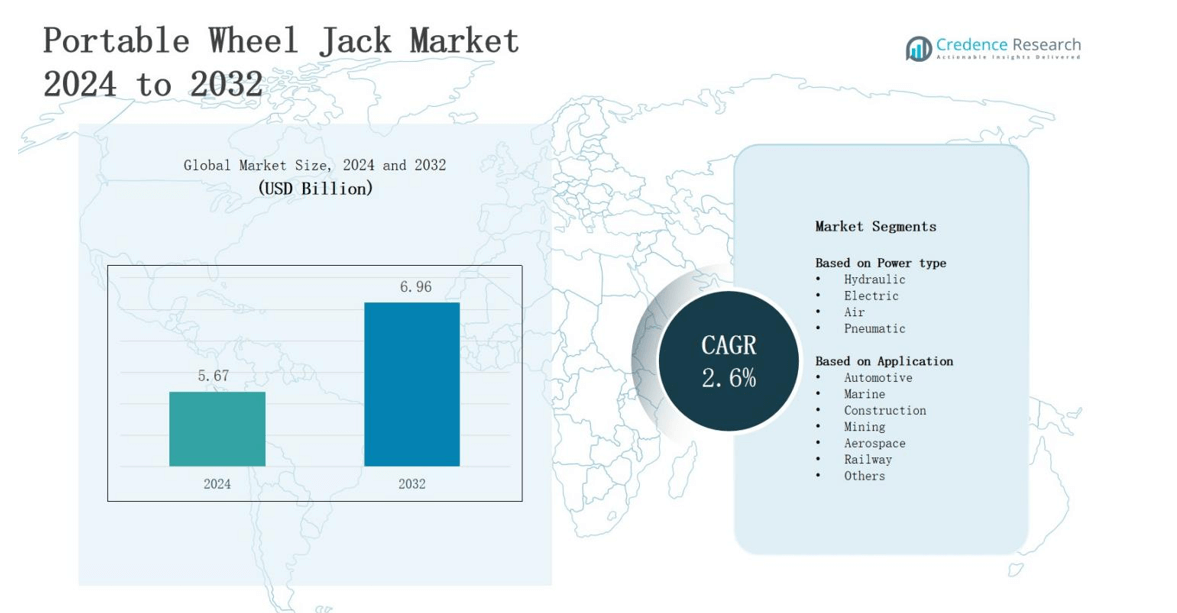
In the portable wheel jack market, revenue is expected to grow from USD 5.67 billion in 2024 to USD 6.96 billion by 2032, registering a CAGR of 2.6%.
| REPORT ATTRIBUTE | DETAILS |
|---|---|
| Historical Period | 2020-2023 |
| Base Year | 2024 |
| Forecast Period | 2025-2032 |
| Portable Wheel Jack Market Size 2024 | USD 5.67 billion |
| Portable Wheel Jack Market, CAGR | 2.6% |
| Portable Wheel Jack Market Size 2032 | USD 6.96 billion |
The portable wheel jack market is driven by the increasing demand for lightweight, compact, and easy-to-use automotive maintenance tools among consumers and professional mechanics. Rising vehicle ownership and the growth of the automotive aftermarket further support market expansion. Manufacturers are focusing on innovative designs, enhanced safety features, and high load capacity to meet diverse consumer needs. Trends such as the adoption of electric and hybrid vehicle-compatible jacks, integration of durable and corrosion-resistant materials, and the growing preference for battery-operated or hydraulic models are shaping the market. Continuous product innovation and accessibility through online retail channels also propel steady growth.
The portable wheel jack market demonstrates strong geographical diversity, with North America and Asia Pacific each holding 30% market share, Europe at 25%, and the Rest of the World at 15%. It experiences high demand in automotive, construction, mining, aerospace, and railway applications across these regions. Key players such as Horizon Global, Curt Manufacturing LLC, Lippert, Gray Manufacturing, Osaka Jack Co., Ltd, Tronair, Dutton-Lainson Company, Vestil Manufacturing Corp, HYDRO SYSTEMS GmbH & Co. KG, Autolift GmbH, and Emerson Electric, Co. drive growth through innovation, quality, and strong distribution networks.
Market Insights
- The portable wheel jack market is projected to grow from USD 5.67 billion in 2024 to USD 6.96 billion by 2032, registering a CAGR of 2.6%, driven by demand for compact, user-friendly tools.
- Hydraulic jacks dominate with a 45% share, providing high stability and lifting efficiency, while electric, pneumatic, air, and other types cater to diverse automotive and industrial applications.
- Automotive applications lead with 50% market share, supported by rising vehicle ownership, frequent maintenance, and aftermarket demand; construction, mining, aerospace, railway, marine, and other sectors drive additional growth.
- North America and Asia Pacific each hold 30% share, Europe 25%, and the Rest of the World 15%, benefiting from urbanization, high vehicle ownership, industrial growth, and widespread adoption of innovative jacks.
- Key players including Horizon Global, Curt Manufacturing LLC, Lippert, Gray Manufacturing, Osaka Jack Co., Tronair, Dutton-Lainson, Vestil, HYDRO SYSTEMS, Autolift, and Emerson Electric drive growth through innovation, quality, and strong distribution networks.
Market Drivers
Rising Vehicle Ownership and Automotive Aftermarket Expansion
The growth of the automotive sector significantly drives the portable wheel jack market. Increasing vehicle ownership worldwide boosts the demand for convenient maintenance tools. Consumers seek reliable equipment for emergency tire changes and routine maintenance. The expanding automotive aftermarket creates opportunities for manufacturers to target replacement and upgrade segments. It enables accessibility to a wide range of products at competitive prices. Professional mechanics and fleet operators also demand durable and high-capacity jacks for efficient service operations. Steady growth in passenger and commercial vehicles underpins long-term market potential.
Technological Advancements and Product Innovation
Technological improvements fuel the demand for portable wheel jacks across various vehicle segments. Manufacturers focus on enhancing load capacity, safety mechanisms, and ergonomic designs to attract consumers. It encourages the development of battery-operated, hydraulic, and compact models suitable for modern vehicles. Incorporating corrosion-resistant materials ensures product longevity and customer satisfaction. Innovations in design allow easy storage and transportation without compromising strength. The emphasis on quality and performance supports market credibility. Constant refinement of features strengthens brand differentiation and consumer loyalty.
- For instance, Snap-on’s patented Dual-Pump Hydraulic Service Jacks reduce lift time significantly, showcasing how compact yet powerful mechanisms improve workshop efficiency.
Consumer Preference for Safety and Convenience
Consumers increasingly prioritize safety and ease of use in automotive tools, driving demand for portable wheel jacks. It offers stability, controlled lifting, and reduced risk during vehicle maintenance. Compact and lightweight designs enable easy handling and storage, appealing to individual vehicle owners. Safety certifications and standards influence purchasing decisions. It helps mechanics and fleet operators enhance efficiency while reducing operational hazards. User-friendly designs with minimal maintenance requirements attract both professional and DIY customers. The focus on reliability and convenience sustains consistent market demand.
- For instance, Blackhawk Automotive’s B6350 service jack is designed with a built-in safety valve to prevent overloading, aligning with consumer demand for safer lifting solutions.
Online Retail Channels and Global Accessibility
The expansion of e-commerce platforms accelerates portable wheel jack market penetration globally. It allows manufacturers to reach diverse consumer segments across regions without significant physical presence. Digital marketing and online sales platforms enhance brand visibility and customer engagement. Consumers benefit from convenient comparison, reviews, and doorstep delivery, influencing purchase decisions. Retailers and distributors expand product portfolios to meet growing demand. Access to international markets encourages competitive pricing and product variety. Continuous growth in online channels drives market scalability and revenue generation.
Market Trends
Adoption of Hydraulic and Battery-Operated Models
The portable wheel jack market observes a strong shift toward hydraulic and battery-operated models. It delivers higher lifting efficiency and reduces physical effort for users. Consumers prefer tools that combine power, safety, and convenience for both professional and personal use. Manufacturers introduce compact designs that maintain performance while minimizing weight. The focus on advanced mechanisms enhances reliability and durability. Market players invest in research to meet evolving automotive maintenance requirements. This trend boosts product differentiation and customer preference.
- For instance, ARB’s Hydraulic Long Travel Jack integrates an internal safety stop and fast-lift action, addressing off-road vehicle requirements and proving highly popular among SUV and 4x4 owners.
Integration of Lightweight and Durable Materials
The demand for lightweight yet durable portable wheel jacks drives material innovation across the market. It utilizes high-strength alloys and corrosion-resistant components to increase longevity and performance. Lightweight designs improve portability and handling for individual consumers and service operators. It maintains load-bearing capacity without compromising structural integrity. Manufacturers emphasize quality assurance and compliance with safety standards to ensure reliability. Enhanced material technology contributes to product resilience. This trend strengthens consumer trust and market adoption.
- For instance, Arcan’s ALJ3T Aluminum Floor Jack uses aircraft‑grade aluminum, cutting overall weight compared to steel models while preserving a 3‑ton lifting capability, making it popular among mobile mechanics.
Expansion Through E-Commerce and Digital Platforms
The portable wheel jack market benefits from growing e-commerce adoption and digital retail strategies. It enables manufacturers and distributors to reach a broader audience without heavy reliance on physical stores. Consumers access detailed specifications, reviews, and price comparisons, influencing purchase decisions. Digital channels support brand visibility and customer engagement. Online marketplaces facilitate faster delivery and wider product availability. Retailers adjust inventory and marketing strategies to meet online demand. This trend accelerates global market penetration and revenue growth.
Focus on Multi-Functional and Compact Designs
Product versatility drives growth within the portable wheel jack market. It offers multi-functional features suitable for various vehicle types and maintenance tasks. Compact and foldable designs improve storage and portability, appealing to both individual and professional users. It integrates safety features, load indicators, and ergonomic handles to enhance user experience. Manufacturers emphasize innovation to meet consumer expectations and differentiate products. Enhanced functionality and convenience support consistent market demand. This trend reinforces brand loyalty and competitive advantage.
Market Challenges Analysis
High Production Costs and Material Limitations
The portable wheel jack market faces challenges due to high production costs and the limited availability of advanced materials. It relies on high-strength alloys and hydraulic components that increase manufacturing expenses. Price-sensitive consumers may prefer low-cost alternatives, reducing profitability for premium products. Maintaining quality while controlling costs remains a key concern for manufacturers. Material shortages and supply chain disruptions can delay production. It requires strategic sourcing and efficient production processes to sustain competitiveness. These factors constrain rapid market expansion and affect overall margins.
Safety Concerns and Regulatory Compliance
Safety issues and stringent regulatory standards present obstacles in the portable wheel jack market. It must comply with international safety certifications and local regulations, which require testing and certification. Faulty or low-quality products pose risks to users, potentially leading to recalls and brand damage. Continuous monitoring of evolving safety standards increases operational complexity. It demands investment in quality assurance and employee training. Consumer trust depends on consistent product reliability. These challenges hinder rapid adoption and necessitate careful risk management for market players.
Market Opportunities
Expansion in Emerging Automotive Markets
The portable wheel jack market presents significant opportunities in emerging automotive regions with increasing vehicle ownership. It can leverage rising demand for convenient and reliable maintenance tools among individual consumers and fleet operators. Growth in passenger and commercial vehicles creates a steady requirement for aftermarket products. Manufacturers can target tier-2 and tier-3 cities with affordable, high-quality jacks. It allows for strategic partnerships with local distributors and service centers to enhance market penetration. Focused marketing and tailored product features can strengthen brand presence. Expanding into these regions supports long-term revenue growth and competitive advantage.
Adoption of Advanced and Eco-Friendly Technologies
Innovation in advanced and environmentally friendly technologies offers growth potential for the portable wheel jack market. It encourages the development of battery-operated, hydraulic, and compact models that reduce manual effort and energy consumption. Sustainable materials and corrosion-resistant designs appeal to environmentally conscious consumers and industrial buyers. Manufacturers can introduce multi-functional jacks suitable for diverse vehicle types and applications. It supports differentiation in a competitive market and attracts both professional and DIY users. Continuous product improvement and eco-conscious initiatives can drive market expansion and customer loyalty.
Market Segmentation Analysis:
By Power Type
In the portable wheel jack market, the hydraulic segment leads with a 45% share in 2024, offering high lifting efficiency, stability, and durability for automotive and industrial use. Electric jacks hold 25%, favored for ease of use and compatibility with modern vehicles. Pneumatic and air-powered jacks account for 15% and 10%, supporting heavy-duty applications. Other types hold 5%, driven by compact, versatile designs.
- For instance, E-HEELP’s 12V portable electric car jack can lift up to 5 tons and is commonly used with SUVs and sedans, integrating both lifting and tire-changing functions.
By Application
The automotive segment dominates with a 50% share, driven by rising vehicle ownership, frequent maintenance, and aftermarket demand. Construction and mining hold 15% and 10%, requiring durable, high-capacity tools. Aerospace and railway account for 8% and 7%, focusing on precision and safety. Marine and other applications represent 10%, supporting specialized operations. Reliability, portability, and versatility continue to drive growth across all applications.
- For instance, Caterpillar integrates advanced hydraulic torque tools in its mining equipment to enhance durability in extreme conditions.
Segments:
Based on Power type
- Hydraulic
- Electric
- Air
- Pneumatic
Based on Application
- Automotive
- Marine
- Construction
- Mining
- Aerospace
- Railway
- Others
Based on the Geography:
- North America
- U.S.
- Canada
- Mexico
- Europe
- Germany
- France
- U.K.
- Italy
- Spain
- Rest of Europe
- Asia Pacific
- China
- Japan
- India
- South Korea
- South-east Asia
- Rest of Asia Pacific
- Latin America
- Brazil
- Argentina
- Rest of Latin America
- Middle East & Africa
- GCC Countries
- South Africa
- Rest of the Middle East and Africa
Regional Analysis
North America
North America holds 30% of the portable wheel jack market in 2024, driven by high vehicle ownership and a mature automotive aftermarket. It benefits from widespread adoption of advanced automotive maintenance tools among individual consumers and professional mechanics. Manufacturers focus on innovative hydraulic and electric models to meet safety and convenience standards. It also experiences strong demand in construction and mining applications. Strategic partnerships with distributors and service providers enhance market reach. Consumer preference for durable, efficient, and easy-to-use products supports steady growth. North America continues to lead due to technological adoption and organized retail channels.
Europe
Europe accounts for 25% of the portable wheel jack market in 2024, fueled by strict safety regulations and high demand for quality maintenance tools. It targets automotive, aerospace, and railway sectors requiring reliable lifting solutions. Manufacturers emphasize hydraulic and electric jacks with corrosion-resistant materials to meet local standards. It benefits from strong aftermarket services and growing fleet operations. Consumer awareness of safety and convenience drives product adoption. European distributors and online platforms improve accessibility. Market expansion continues through innovation and compliance with regional standards.
Asia Pacific
Asia Pacific holds 30% of the portable wheel jack market in 2024, supported by rapid urbanization and increasing vehicle sales in emerging economies. It experiences high demand in automotive, construction, and mining applications. Manufacturers introduce affordable, high-performance jacks tailored to local markets. It leverages growing e-commerce penetration to expand distribution. Rising middle-class consumers seek reliable and easy-to-handle products. Industrial growth in countries like China and India drives adoption. Market potential remains strong due to expanding vehicle ownership and aftermarket services.
Rest of the World
The Rest of the World contributes 15% of the portable wheel jack market in 2024, driven by niche industrial and transportation applications. It focuses on construction, mining, marine, and railway sectors requiring specialized lifting solutions. Manufacturers target regional distributors and service networks to increase accessibility. It benefits from demand for portable, high-capacity, and reliable jacks. Market growth is moderate but consistent due to increasing infrastructure development and vehicle maintenance needs. Expansion opportunities exist in underserved regions with growing industrial activity.
Key Player Analysis
- Dutton-Lainson Company (U.S.)
- Autolift GmbH (Austria)
- Tronair (U.S.)
- HYDRO SYSTEMS GmbH & Co. KG (Germany)
- Emerson Electric, Co. (U.S.)
- Horizon Global (U.S.)
- Lippert (U.S.)
- Osaka Jack Co., Ltd (Japan)
- Curt Manufacturing LLC (U.S.)
- Gray Manufacturing (U.S.)
- Vestil Manufacturing Corp (U.S.)
Competitive Analysis
The portable wheel jack market exhibits a highly competitive landscape, driven by innovation, product quality, and brand reputation. Key players such as Horizon Global, Curt Manufacturing LLC, Lippert, Gray Manufacturing, Osaka Jack Co., Ltd, Tronair, Dutton-Lainson Company, Vestil Manufacturing Corp, HYDRO SYSTEMS GmbH & Co. KG, Autolift GmbH, and Emerson Electric, Co. focus on developing durable, efficient, and user-friendly jacks for automotive, industrial, and specialized applications. It emphasizes hydraulic, electric, pneumatic, and air-powered models to meet diverse customer requirements. Manufacturers invest in research to enhance lifting capacity, safety features, and portability. Strong distribution networks, including e-commerce and aftermarket channels, allow it to reach global consumers efficiently. Competitive pricing strategies, coupled with continuous technological advancements, enable players to differentiate products and expand market share. It faces pressure from new entrants offering cost-effective alternatives, which drives ongoing innovation and quality improvement. Collaboration with service providers and distributors strengthens market presence. Focus on product reliability, regulatory compliance, and multi-functional designs ensures it meets evolving consumer expectations and maintains long-term competitiveness in the global market.
Recent Developments
- In May 2025, QuickJack launched a new certified portable wheel jack series approved by the Automotive Lift Institute (ALI). This launch represents a significant product innovation in the market.
- In January 2023, Horizon Global Corporation, a major manufacturer of trailering and towing equipment, revealed its merger with First Brands Group, LLC. Under the agreement, First Brands Group, a global leader in automotive parts for the aftermarket, will acquire Horizon Global, strengthening its market position
- In January 2025, Jackery unveiled its next-generation solar generators at CES, featuring compact designs and enhanced portability for home and outdoor use.
Market Concentration & Characteristics
The portable wheel jack market exhibits a moderately fragmented structure, with several established players and emerging manufacturers competing across regions. It is characterized by the presence of key global companies such as Horizon Global, Curt Manufacturing LLC, Lippert, Gray Manufacturing, Osaka Jack Co., Tronair, Dutton-Lainson Company, Vestil Manufacturing Corp, HYDRO SYSTEMS GmbH & Co. KG, Autolift GmbH, and Emerson Electric, Co., which focus on innovation, product quality, and strong distribution networks. Smaller regional manufacturers cater to niche industrial and aftermarket segments, offering cost-effective and specialized solutions. It emphasizes hydraulic, electric, pneumatic, and air-powered models to meet diverse customer requirements. Market competitiveness drives continuous improvements in safety features, load capacity, portability, and material durability. It benefits from robust automotive, construction, mining, aerospace, and railway demand. Strategic partnerships, online retail penetration, and multi-functional designs help players maintain market share and expand their global presence while meeting evolving consumer expectations.
Report Coverage
The research report offers an in-depth analysis based on Power Type, Application and Geography. It details leading market players, providing an overview of their business, product offerings, investments, revenue streams, and key applications. Additionally, the report includes insights into the competitive environment, SWOT analysis, current market trends, as well as the primary drivers and constraints. Furthermore, it discusses various factors that have driven market expansion in recent years. The report also explores market dynamics, regulatory scenarios, and technological advancements that are shaping the industry. It assesses the impact of external factors and global economic changes on market growth. Lastly, it provides strategic recommendations for new entrants and established companies to navigate the complexities of the market.
Future Outlook
- The portable wheel jack market will witness increased adoption of hydraulic and electric models for enhanced efficiency.
- Manufacturers will focus on compact, lightweight, and durable designs to meet consumer convenience.
- Battery-operated and hybrid-compatible jacks will gain popularity among automotive and industrial users.
- Online retail and e-commerce channels will expand market accessibility and global reach.
- Rising vehicle ownership in emerging economies will drive demand across automotive applications.
- Industrial sectors like construction, mining, aerospace, and railway will create specialized product demand.
- Product innovation will continue to focus on safety features and multi-functional capabilities.
- Regional expansion in Asia Pacific and North America will strengthen market presence.
- Collaborations with distributors and service providers will enhance brand visibility and customer trust.
- Sustainability and corrosion-resistant materials will influence product development and consumer preference.

Request a Free Sample
Fill in your details and we'll send you a free sample report.
- Sample data tables & charts
- Research methodology
Market Dynamics
Rising Vehicle Ownership and Automotive Aftermarket Expansion
Increasing global vehicle ownership and the growth of the automotive aftermarket are fueling demand for portable wheel jacks, as more consumers and professional mechanics require reliable tools for maintenance and emergency repairs.
Technological Advancements and Product Innovation
Manufacturers are introducing innovative features such as battery operation, enhanced safety mechanisms, and compact, lightweight designs, making portable wheel jacks more appealing and accessible to a broader range of users.
Consumer Preference for Safety and Convenience
End-users are prioritizing safety, ease of use, and portability, driving demand for jacks with advanced safety features, ergonomic designs, and certifications, which in turn supports steady market growth.
Expansion of Online Retail and E-Commerce Channels
The proliferation of e-commerce platforms allows manufacturers to reach a wider customer base, offering greater product variety and convenience, which accelerates market penetration and revenue growth.
Adoption of Lightweight and Durable Materials
The integration of high-strength, corrosion-resistant materials such as aluminum and advanced alloys enhances product longevity and portability, meeting consumer demand for durable and easy-to-handle jacks.
Need a Custom Version of This Report?
Tailor the scope, geography, or segments to your exact requirements.
- Custom geography or segment scope
- Direct access to our analyst team
Frequently Asked Questions
What is the current market size for portable wheel jack market, and what is its projected size in 2032?
Which portable wheel jack market segment held the largest share in 2024?
What are the primary factors fueling the growth of the portable wheel jack market?
Who are the leading companies in the portable wheel jack market?
Table of Content
Chapter 1 Market Segmentation
- 1.1 Segmentation Framework
- 1.1.1 Product and Service Classification
- 1.1.2 Application and End-Use Classification
- 1.1.3 Technology and Solution Classification
- 1.1.4 Customer and Distribution Channel Classification
- 1.1.5 Geographic Segmentation
- 1.1.6 Market Segment Definitions and Boundaries
- 1.2 By Material
- 1.2.1 Steel
- 1.2.2 Aluminum
- 1.2.3 Composite/Alloy
- 1.2.4 Other
- 1.3 By Power Type
- 1.3.1 Hydraulic
- 1.3.2 Electric
- 1.3.3 Air
- 1.3.4 Pneumatic
- 1.3.5 Other
- 1.4 By Application
- 1.4.1 Automotive
- 1.4.2 Construction
- 1.4.3 Mining
- 1.4.4 Aerospace
- 1.4.5 Railway
- 1.4.6 Marine
- 1.4.7 Others
Chapter 2 Introduction
- 2.1 Report Objectives and Scope
- 2.2 Product Definition and Industry Terminology
- 2.3 Market Inclusions and Exclusions
- 2.4 Research Process
- 2.4.1 Primary Research and Expert Interviews
- 2.4.2 Secondary Research and Source Review
- 2.4.3 Top-Down and Bottom-Up Estimation
- 2.4.4 Data Triangulation and Verification
- 2.5 Market Size Measurement Basis
- 2.5.1 2024: USD 5.67 billion → 2032: USD 6.96 billion
- 2.6 Historical and Forecast Reference Periods
- 2.6.1 Base Year: 2024
- 2.6.2 Forecast Period: 2024-2032
- 2.7 Research Assumptions and Limitations
Chapter 3 Executive Summary
- 3.1 Market Snapshot and Key Findings
- 3.2 Base-Year Market Size, 2024
- 3.3 Forecast Market Size, 2032
- 3.4 Revenue and Volume Growth Outlook
- 3.5 Key Demand and Supply Indicators
- 3.6 Leading Market Segments
- 3.7 Fastest-Growing Market Opportunities
- 3.8 Regional Performance Highlights
- 3.9 Technology and Industry Transformation
- 3.10 Competitive Landscape Summary
- 3.11 Analyst View and Strategic Implications
Chapter 4 Global Portable Wheel Jack Market Trends and Developments
- 4.1 Historical Industry Development
- 4.2 Recent Market Trends and Developments
- 4.3 Demand and Customer Behavior Trends
- 4.4 Technology and Product Innovation
- 4.5 Artificial Intelligence, Automation and Digitalization
- 4.6 Local Manufacturing and Supply Chain Realignment
- 4.7 Industry Partnerships, Mergers and Acquisitions
- 4.8 Sustainability and Circular Economy Developments
- 4.9 Government and Private Sector Investment Trends
- 4.10 Emerging Business Models and Commercialization
- 4.11 Industry Developments and Announcements
Chapter 5 Global Portable Wheel Jack Market Production, Supply and Demand Analysis
- 5.1 Demand Trend and Consumption Analysis
- 5.2 Demand Forecast, 2024-2032
- 5.3 Production and Output Trend
- 5.4 Production and Output Forecast, 2024-2032
- 5.5 Installed Capacity and Capacity Utilization
- 5.6 Company-Wise Production Plants and Statistics
- 5.6.1 Installed Production Capacity
- 5.6.2 Actual Production
- 5.6.3 Planned Capacity and Expansion Targets
- 5.7 Supply Chain Structure and Procurement Trends
- 5.8 Supply-Demand Gap and Bottlenecks
- 5.9 Import Dependence and Sourcing Structure
- 5.10 Contract Manufacturing and Outsourcing
- 5.11 Regional Supply and Demand Concentration
Chapter 6 Global Portable Wheel Jack Market Pricing Analysis
- 6.1 Pricing Structure and Measurement
- 6.2 Historical Pricing Trends
- 6.3 Pricing Outlook, 2024-2032
- 6.4 Average Selling Price and Unit Economics
- 6.5 Pricing by Product and Market Segment
- 6.6 Geographic Pricing Differences
- 6.7 Key Input, Energy, Labor and Logistics Costs
- 6.8 Contract Pricing and Purchasing Models
- 6.9 Pricing Sensitivity and Competitive Positioning
- 6.10 Price, Margin and Profitability Implications
Chapter 7 Global Portable Wheel Jack Market Dynamics
- 7.1 Market Growth Drivers
- 7.1.1 Demand-Side Drivers
- 7.1.2 Technology and Innovation Drivers
- 7.1.3 Infrastructure and Investment Drivers
- 7.1.4 Regulatory and Policy Drivers
- 7.2 Market Restraints
- 7.2.1 Cost and Affordability Constraints
- 7.2.2 Technology and Adoption Barriers
- 7.2.3 Supply Chain and Operational Constraints
- 7.3 Market Challenges
- 7.3.1 Competitive Pressure and Margin Erosion
- 7.3.2 Skills, Infrastructure and Implementation Gaps
- 7.4 Emerging Market Opportunities
- 7.5 Market Dynamics Impact and Time-Horizon Assessment
Chapter 8 Global Portable Wheel Jack Value Chain Analysis
- 8.1 Industry Value Chain Overview
- 8.2 Upstream Suppliers and Critical Inputs
- 8.3 Technology and Component Providers
- 8.4 Manufacturing or Service Delivery
- 8.5 Distribution, Channel Partners and Integrators
- 8.6 Downstream Applications and End Users
- 8.7 Value Addition and Profit Pools
- 8.8 Vertical Integration and Outsourcing
- 8.9 Supplier Concentration and Risk
- 8.10 Supply Chain Localization and Resilience
Chapter 9 Global Portable Wheel Jack Market Regulations and Policies
- 9.1 Relevant Laws, Standards and Compliance Frameworks
- 9.2 Product, Service, Safety and Quality Requirements
- 9.3 Government Policies, Incentives and Subsidies
- 9.4 Imports, Exports and Trade Barriers
- 9.5 Public Procurement and Local Content Requirements
- 9.6 Environmental and Sustainability Compliance
- 9.7 Upcoming Policy Changes and Market Implications
Chapter 10 Global Portable Wheel Jack Market Hotspots and Opportunities
- 10.1 Market Opportunity Mapping and Growth Hotspots
- 10.2 High-Growth Applications and Customer Groups
- 10.3 Underserved Markets and White-Space Opportunities
- 10.4 Emerging Technology and Product Opportunities
- 10.5 New Capacity and Investment Hotspots
- 10.6 Market Entry and Expansion Opportunities
- 10.7 Distribution and Partnership Opportunities
- 10.8 Near-Term and Long-Term Commercial Potential
- 10.9 Opportunity Attractiveness and Execution Risks
Chapter 11 Global Portable Wheel Jack Market Outlook, 2024-2032
- 11.1 Market Size and Analysis
- 11.1.1 Revenue (Market Measurement: 2024: USD 5.67 billion → 2032: USD 6.96 billion)
- 11.1.2 Market Volume and Quantity Sold
- 11.1.3 Historical Market Size
- 11.1.4 Base-Year Market Size, 2024
- 11.2 Market Forecast, 2024-2032
- 11.2.1 Revenue Forecast to 2032
- 11.2.2 Volume Forecast to 2032
- 11.2.3 CAGR and Year-on-Year Growth
- 11.2.4 Incremental Revenue Opportunity
- 11.3 Forecast Assumptions and Scenario Analysis
- 11.3.1 Base-Case Forecast
- 11.3.2 Optimistic and Conservative Scenarios
- 11.3.3 Technology, Pricing and Policy Sensitivities
- 11.4 Market Attractiveness and Growth Outlook
Chapter 12 Global Portable Wheel Jack Market Segmentation and Outlook
- 12.1 Segmentation Summary and Market Shares, 2024
- 12.2 Largest and Fastest-Growing Segments
- 12.3 By Material - Market Size and Forecast, 2024-2032
- 12.3.1 Segment Definition and Scope
- 12.3.2 Historical Market Size
- 12.3.3 Revenue Forecast, 2024-2032
- 12.3.4 Volume Forecast, 2024-2032
- 12.3.5 Base-Year Market Share, 2024
- 12.3.6 Segment CAGR and Growth Drivers
- 12.3.7 Subsegment Market Size and Forecast
- 12.3.7.1 Steel
- 12.3.7.2 Aluminum
- 12.3.7.3 Composite/Alloy
- 12.3.7.4 Other
- 12.3.8 Subsegment Pricing and Adoption Trends
- 12.3.9 Leading Suppliers and Competition
- 12.3.10 Regional Demand and Opportunities
- 12.4 By Power Type - Market Size and Forecast, 2024-2032
- 12.4.1 Segment Definition and Scope
- 12.4.2 Historical Market Size
- 12.4.3 Revenue Forecast, 2024-2032
- 12.4.4 Volume Forecast, 2024-2032
- 12.4.5 Base-Year Market Share, 2024
- 12.4.6 Segment CAGR and Growth Drivers
- 12.4.7 Subsegment Market Size and Forecast
- 12.4.7.1 Hydraulic
- 12.4.7.2 Electric
- 12.4.7.3 Air
- 12.4.7.4 Pneumatic
- 12.4.7.5 Other
- 12.4.8 Subsegment Pricing and Adoption Trends
- 12.4.9 Leading Suppliers and Competition
- 12.4.10 Regional Demand and Opportunities
- 12.5 By Application - Market Size and Forecast, 2024-2032
- 12.5.1 Segment Definition and Scope
- 12.5.2 Historical Market Size
- 12.5.3 Revenue Forecast, 2024-2032
- 12.5.4 Volume Forecast, 2024-2032
- 12.5.5 Base-Year Market Share, 2024
- 12.5.6 Segment CAGR and Growth Drivers
- 12.5.7 Subsegment Market Size and Forecast
- 12.5.7.1 Automotive
- 12.5.7.2 Construction
- 12.5.7.3 Mining
- 12.5.7.4 Aerospace
- 12.5.7.5 Railway
- 12.5.7.6 Marine
- 12.5.7.7 Others
- 12.5.8 Subsegment Pricing and Adoption Trends
- 12.5.9 Leading Suppliers and Competition
- 12.5.10 Regional Demand and Opportunities
- 12.6 Segment Growth Comparison
- 12.7 Segment Attractiveness and Priority Matrix
Chapter 13 Global Portable Wheel Jack End-Use and Application Market Outlook
- 13.1 End-Use Industry and Customer Demand Structure
- 13.2 Leading Applications and Customer Groups
- 13.3 End-Use Market Size, Share and Forecast
- 13.4 Major End-Use Industry Deep Dives
- 13.4.1 Customer Requirements and Use Cases
- 13.4.2 Demand and Replacement Cycles
- 13.4.3 Technical and Regulatory Considerations
- 13.4.4 Purchasing and Procurement Models
- 13.4.5 Leading Vendors and Distribution Channels
- 13.4.6 Forecast and Commercial Opportunities
- 13.5 Emerging Applications and Cross-Segment Demand
- 13.6 End-Use Industry Investment Priorities
Chapter 14 Global Portable Wheel Jack Geographic Market Outlook, 2024-2032
- 14.1 Regional Market Size and Share, 2024
- 14.2 Regional Market Forecast, 2024-2032
- 14.3 Regional Pricing, Production and Demand Differences
- 14.4 North America
- 14.4.1 United States
- 14.4.2 Canada
- 14.4.3 Mexico
- 14.5 Europe
- 14.5.1 Germany
- 14.5.2 France
- 14.5.3 Italy
- 14.5.4 United Kingdom
- 14.5.5 Spain
- 14.5.6 Poland
- 14.5.7 Russia
- 14.5.8 Netherlands
- 14.5.9 Belgium
- 14.5.10 Sweden
- 14.5.11 Denmark
- 14.5.12 Norway
- 14.5.13 Rest of Europe
- 14.6 Asia Pacific
- 14.6.1 China
- 14.6.2 India
- 14.6.3 Japan
- 14.6.4 South Korea
- 14.6.5 Thailand
- 14.6.6 Indonesia
- 14.6.7 Vietnam
- 14.6.8 Malaysia
- 14.6.9 Australia
- 14.6.10 Rest of Asia Pacific
- 14.7 Latin America
- 14.7.1 Brazil
- 14.7.2 Argentina
- 14.7.3 Colombia
- 14.7.4 Chile
- 14.7.5 Rest of Latin America
- 14.8 Middle East
- 14.8.1 Saudi Arabia
- 14.8.2 United Arab Emirates
- 14.8.3 Turkey
- 14.8.4 Israel
- 14.8.5 Iran
- 14.8.6 Rest of the Middle East
- 14.9 Africa
- 14.9.1 South Africa
- 14.9.2 Egypt
- 14.9.3 Nigeria
- 14.9.4 Morocco
- 14.9.5 Rest of Africa
- 14.10 Regional Investment, Policy and Supply Chain Differences
- 14.11 Regional Competitive Landscape
- 14.12 Geographic Growth Hotspots
Chapter 15 Global Portable Wheel Jack Technology, Innovation and Sustainability Outlook
- 15.1 Technology Landscape and Maturity
- 15.2 Product, Process and Service Innovation
- 15.3 AI, Automation and Digital Tools in the Industry
- 15.4 Technology Adoption and Performance Benchmarking
- 15.5 Innovation Pipeline and R&D Investment
- 15.6 Patent and Intellectual Property Trends
- 15.7 Energy Efficiency and Resource Management
- 15.8 Sustainability, Recycling and Circularity
- 15.9 Technology Roadmap, 2024-2032
- 15.10 Risks of Obsolescence and Technology Substitution
Chapter 16 Global Portable Wheel Jack Market Key Strategic Imperatives
- 16.1 Growth and Market Entry Priorities
- 16.2 High-Return Products and Segments
- 16.3 Pricing, Profitability and Cost Optimization
- 16.4 Technology Investment and Product Differentiation
- 16.5 Supply Chain Localization and Resilience
- 16.6 Distribution and Customer Acquisition
- 16.7 Partnership, Acquisition and Capacity Strategy
- 16.8 Regional Expansion Priorities
- 16.9 Short-, Medium- and Long-Term Actions
Chapter 17 Competition Outlook
- 17.1 Industry Competition Characteristics
- 17.2 Market Structure and Concentration
- 17.3 Market Share and Competitive Positioning, 2024
- 17.4 Company-Wise Revenue and Product Benchmarking
- 17.5 Production and Service Capacity Benchmarking
- 17.6 Technology, Pricing and Differentiation
- 17.7 Regional Footprint and Distribution Strength
- 17.8 Mergers, Acquisitions and Strategic Alliances
- 17.9 New Entrants and Competitive Threats
- 17.10 Porter's Five Forces and Industry Attractiveness
- 17.11 Competitive Outlook, 2024-2032
Chapter 18 Company Profiles
- 18.1 Company Coverage and Selection Criteria
- 18.2 Horizon Global
- 18.2.1 Business Description
- 18.2.2 Company Ownership and Geographic Presence
- 18.2.3 Product and Service Portfolio
- 18.2.4 Manufacturing and Operating Footprint
- 18.2.5 Production Capacity and Expansion Plans
- 18.2.6 Financial Performance and Investment
- 18.2.7 Market Share and Competitive Position
- 18.2.8 Technology and Innovation Capabilities
- 18.2.9 Strategic Alliances or Partnerships
- 18.2.10 Recent Developments
- 18.2.11 Growth Strategy and Outlook
- 18.3 Curt Manufacturing LLC
- 18.4 Lippert
- 18.5 Gray Manufacturing
- 18.6 Osaka Jack Co., Ltd
- 18.7 Tronair
- 18.8 Dutton-Lainson Company
- 18.9 Vestil Manufacturing Corp
- 18.10 HYDRO SYSTEMS GmbH & Co. KG
- 18.11 Emerson Electric Co.
- 18.12 Other Relevant Market Participants
Note: Every listed company is profiled on the structure shown under the first company. The company list is preliminary and may change based on research findings, market developments, data availability and client requirements.
Chapter 19 Disclaimer
- 19.1 Research and Forecast Disclaimer
- 19.2 Data Source and Estimation Limitations
Note: The depth of individual sections depends on data availability for this market. Volume, capacity, trade and other unit-based metrics are included where applicable.