
Market Overview:
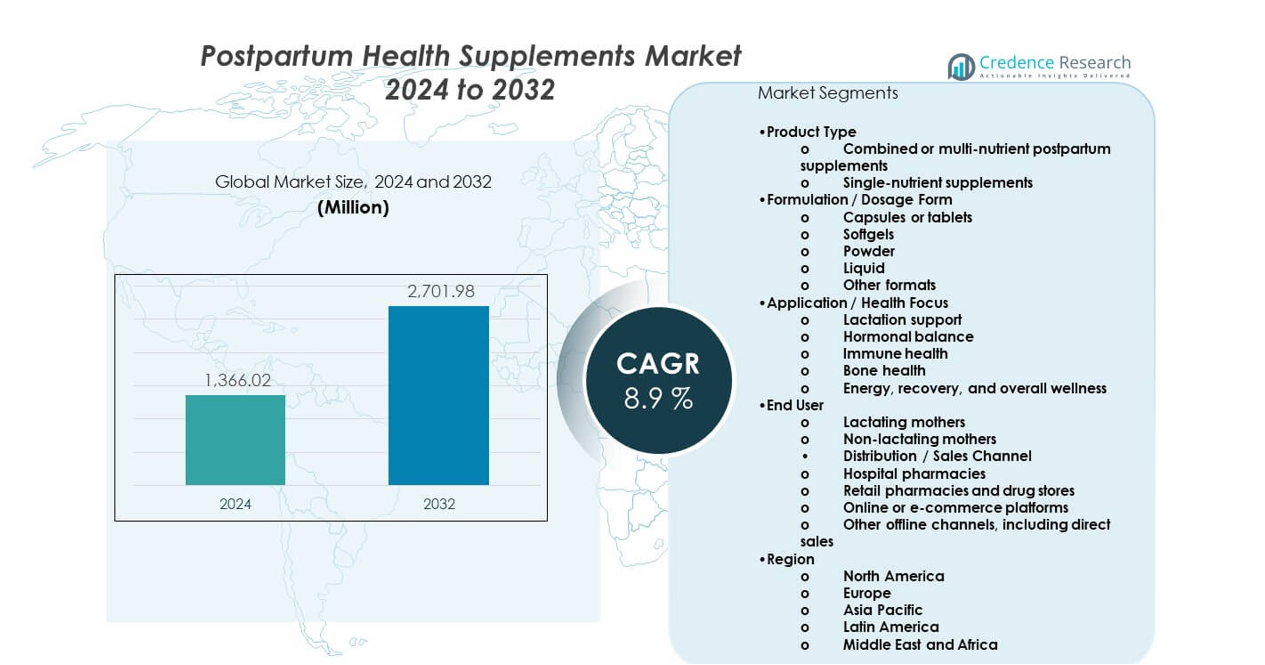
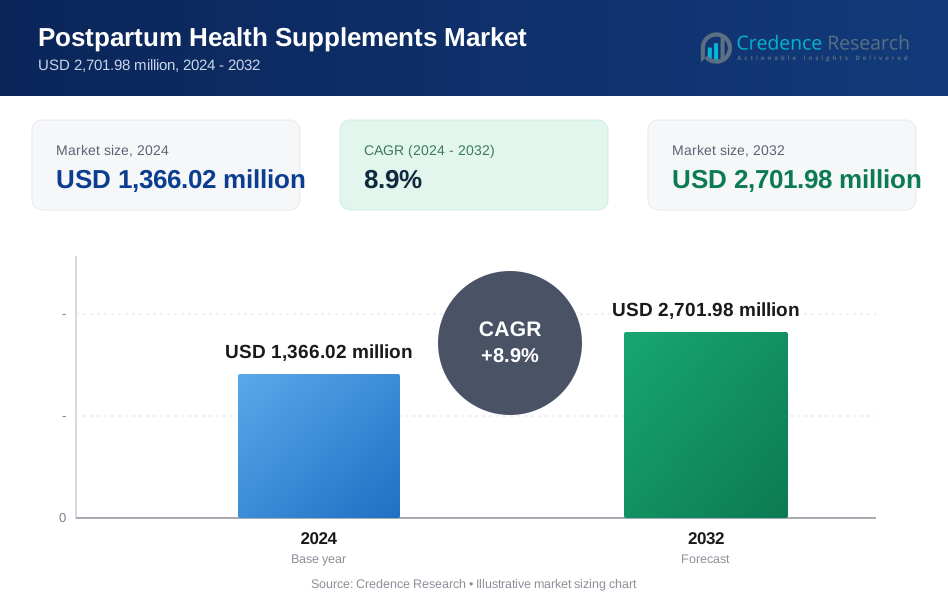
The Postpartum Health Supplements Market is projected to grow from USD 1,366.02 million in 2024 to an estimated USD 2,701.98 million by 2032, at a CAGR of 8.9% from 2024 to 2032.
| REPORT ATTRIBUTE | DETAILS |
|---|---|
| Historical Period | 2020-2023 |
| Base Year | 2024 |
| Forecast Period | 2025-2032 |
| Postpartum Health Supplements Market Size 2024 | USD 1,366.02 million |
| Postpartum Health Supplements Market, CAGR | 8.9% |
| Postpartum Health Supplements Market Size 2032 | USD 2,701.98 million |
Market growth is driven by higher focus on postnatal recovery and nutrition. Mothers seek support for energy, immunity, and lactation. Doctors recommend supplements to address nutrient gaps. Urban lifestyles increase reliance on convenient nutrition formats. Clean-label products gain trust among new parents. E-commerce improves access and product education. Social media shapes awareness and peer guidance. Rising birth rates in select regions support demand. Innovation improves taste, absorption, and dosage compliance.
North America leads due to strong awareness and clinical guidance. The United States shows high adoption through retail and online sales. Europe follows with demand for regulated, clean products. Asia-Pacific is emerging fast due to urbanization and maternal education. India and China see rising acceptance through digital health platforms. Latin America grows steadily with improving healthcare access. Middle East and Africa remain early-stage due to access gaps. Policy support and education will shape regional growth.
Market Insights:
- The market reached USD 1,366.02 million in 2024 and is projected to hit USD 2,701.98 million by 2032, registering an 8.9% CAGR due to rising postnatal nutrition awareness.
- North America leads with ~36% share, followed by Europe at ~29% and Asia Pacific at ~24%, driven by healthcare access, clinical guidance, and consumer awareness.
- Asia Pacific is the fastest-growing region with ~24% share, supported by high birth rates, urbanization, and expanding e-commerce access.
- By product type, combined or multi-nutrient supplements hold ~62% share, while single-nutrient supplements account for ~38% due to targeted clinical use.
- By distribution channel, retail pharmacies contribute ~34% share, while online platforms account for ~31%, reflecting trust-based purchases and rising digital adoption.
Market Drivers:
Rising Focus On Maternal Recovery And Postnatal Nutrition Needs
Mothers place stronger focus on recovery after childbirth. Nutrient gaps remain common during postnatal stages. Doctors advise supplements to restore strength and immunity. Fatigue control supports daily childcare needs. Breastfeeding increases vitamin and mineral demand. Awareness programs stress postnatal nutrition value. The Postpartum Health Supplements Market benefits from this shift. It supports structured recovery routines.
- For instance, Ritual Postnatal includes 350 mg DHA per serving, aligned with breastfeeding needs.
Higher Clinical Guidance And Professional Recommendations After Delivery
Healthcare teams guide postnatal nutrition plans. Hospitals include supplements in discharge advice. Diet gaps receive formal medical attention. Physicians stress iron, calcium, and vitamin intake. Counseling improves trust in supplement use. The Postpartum Health Supplements Market gains from professional support. It builds confidence among new mothers. Clinical advice improves usage consistency.
- For instance, Nature Made Iron provides 65 mg elemental iron per tablet, often advised for deficiency.
Lifestyle Shifts And Need For Convenient Nutritional Support Products
Urban lifestyles reduce time for balanced meals. New mothers manage family and work roles. Ready supplements offer daily nutrition support. Capsules and powders simplify intake routines. Busy homes prefer easy health solutions. The Postpartum Health Supplements Market fits this demand. It aligns with modern care habits. Convenience supports repeat purchases.
Growing Awareness Through Digital Health Education And Parenting Platforms
Digital platforms spread postnatal health knowledge. Parenting forums discuss supplement benefits. Influencers share recovery experiences responsibly. Educational content improves product understanding. Reviews shape buying confidence. The Postpartum Health Supplements Market benefits from digital reach. It gains visibility among first-time mothers. Awareness supports early adoption.
Market Trends:
Shift Toward Clean Label And Naturally Sourced Supplement Formulations
Consumers prefer simple ingredient lists. Natural sources replace synthetic blends. Transparency builds trust with new parents. Brands highlight plant-based inputs clearly. Safety perception improves with clean labels. The Postpartum Health Supplements Market reflects this trend. It supports premium positioning. Clean labels strengthen loyalty.
- For instance, Garden of Life Postnatal uses organic plant-based vitamins with non-GMO certification.
Growth Of Personalized And Condition-Specific Postnatal Nutrition Products
Brands launch targeted nutrient blends. Products address lactation, immunity, or energy needs. Custom packs suit recovery stages. Personal focus improves perceived value. Digital tools guide product choice. The Postpartum Health Supplements Market adopts tailored solutions. It improves user satisfaction. Targeted formulas raise differentiation.
- For instance, Perelel Postpartum Packs separate daily doses into five capsules matched to recovery needs.
Expansion Of Online And Direct-To-Consumer Distribution Channels
Online sales gain strong traction. Mothers value home delivery convenience. Digital stores offer education and reviews. Subscription models support routine intake. Mobile access eases ordering. The Postpartum Health Supplements Market expands online. It reaches wider regions. Digital trust improves conversion.
Integration Of Supplements With Holistic Postnatal Wellness Programs
Brands link supplements with wellness plans. Programs include diet and recovery advice. Holistic care improves outcomes. Mothers seek complete postnatal solutions. Wellness bundles raise perceived value. The Postpartum Health Supplements Market aligns with this approach. It deepens brand engagement. Integrated care supports retention.
Market Challenges Analysis:
Regulatory Compliance And Product Safety Assurance Across Regions
Regulations vary across countries and regions. Brands face complex approval processes. Safety claims require strong clinical backing. Label rules differ by market. Compliance raises development costs. The Postpartum Health Supplements Market faces entry barriers. It slows new product launches. Trust depends on strict quality control.
Consumer Skepticism And Uneven Awareness In Emerging Markets
Some mothers question supplement need. Cultural beliefs influence postnatal care choices. Limited education restricts product acceptance. Misinformation affects buying decisions. Healthcare access remains uneven. The Postpartum Health Supplements Market faces awareness gaps. It limits growth in early-stage regions. Education efforts remain essential.
Market Opportunities:
Product Innovation Focused On Specific Postnatal Health Conditions
Brands can address unmet recovery needs. Formulas may target anemia or bone health. Research-backed blends improve outcomes. Innovation builds medical trust. Condition focus supports premium pricing. The Postpartum Health Supplements Market can expand scope. It supports differentiated portfolios. Innovation drives long-term growth.
Rising Demand Across Emerging Economies With Improving Maternal Care
Emerging markets improve maternal health focus. Urbanization raises nutrition awareness. Healthcare access continues to expand. Digital education supports product discovery. Local brands adapt global formats. The Postpartum Health Supplements Market finds new demand pockets. It gains volume growth potential. Regional expansion supports scale.
Market Segmentation Analysis:
Product Type
Combined or multi-nutrient postpartum supplements hold strong demand due to convenience. These products address multiple nutrient gaps in one dose. Single-nutrient supplements serve targeted needs like iron deficiency or omega-3 intake. Doctors recommend single nutrients for specific clinical gaps. Consumer choice depends on recovery stage and medical advice. The Postpartum Health Supplements Market reflects balanced demand across both product types. It supports both preventive and corrective nutrition use.
- For instance, One A Day Postnatal delivers over 20 vitamins and minerals in one daily serving.
Formulation / Dosage Form
Capsules and tablets remain widely preferred due to familiarity and storage ease. Softgels attract users seeking better absorption and comfort. Powders support flexible dosing and mixing with foods. Liquid formats suit mothers with swallowing difficulty. Gummies and sachets appeal to taste and portability needs. Format choice links closely with lifestyle and tolerance levels.
- For instance, SmartyPants Postnatal Gummies supply 60 mg omega-3 DHA per daily serving. The total Omega-3 Fatty Acid content is 113 mg, which also includes 30 mg of EPA.
Application / Health Focus
Lactation support remains a primary focus due to breastfeeding needs. Hormonal balance products support mood and cycle regulation. Immune health supplements gain relevance during recovery periods. Bone health products address calcium depletion concerns. Energy and overall wellness segments serve fatigue management and daily functioning. Demand varies by postpartum phase.
End User
Lactating mothers represent the core consumer base due to higher nutrition demand. Non-lactating mothers seek recovery and wellness support. Product positioning differs based on feeding status. Clinical guidance influences segment penetration. Both groups drive sustained market volume.
Distribution / Sales Channel
Hospital pharmacies benefit from physician trust and early-stage adoption. Retail pharmacies offer accessibility and brand variety. Online platforms grow through convenience and education tools. Direct sales support personalized guidance and repeat purchases. Channel mix shapes brand visibility and reach.
Segmentation:
- By Product Type
- Combined or multi-nutrient postpartum supplements
- Single-nutrient supplements, including vitamins, minerals, omega-3, iron, calcium, and probiotics
- By Formulation / Dosage Form
- Capsules or tablets
- Softgels
- Powder
- Liquid
- Other formats, including gummies and sachets
- By Application / Health Focus
- Lactation support
- Hormonal balance
- Immune health
- Bone health
- Energy, recovery, and overall wellness
- By End User
- Lactating mothers
- Non-lactating mothers
- By Distribution / Sales Channel
- Hospital pharmacies
- Retail pharmacies and drug stores
- Online or e-commerce platforms
- Other offline channels, including direct sales
- By Region
- North America
- U.S.
- Canada
- Mexico
- Europe
- Germany
- France
- U.K.
- Italy
- Spain
- Rest of Europe
- Asia Pacific
- China
- Japan
- India
- South Korea
- South-east Asia
- Rest of Asia Pacific
- Latin America
- Brazil
- Argentina
- Rest of Latin America
- Middle East & Africa
- GCC Countries
- South Africa
- Rest of the Middle East and Africa
- North America
Regional Analysis:
North America And Europe
North America holds the largest share of the Postpartum Health Supplements Market, accounting for about 38% of global demand. Strong clinical guidance and high health awareness support supplement use after childbirth. The United States leads due to wide retail access and online adoption. Europe follows with nearly 28–30% market share. Countries such as Germany, the United Kingdom, and France drive demand through regulated maternal care systems. Clean-label preference shapes product selection across the region. Pharmacy-led distribution strengthens consumer trust.
Asia Pacific
Asia Pacific represents around 22% of the Postpartum Health Supplements Market and shows the fastest growth pace. China and India lead due to high birth volumes and rising maternal awareness. Urbanization improves access to supplements and digital health content. Japan and South Korea support demand through preventive healthcare culture. Traditional postnatal practices blend with modern supplements. E-commerce plays a key role in regional expansion. Local brands adapt formulations to cultural needs.
Latin America And Middle East & Africa
Latin America accounts for nearly 6% market share, led by Brazil and Mexico. Improving maternal care access supports gradual adoption. Retail pharmacies remain the main sales channel in the region. Middle East & Africa hold about 4–5% share with early-stage development. Gulf countries show higher uptake due to premium healthcare services. Awareness gaps limit faster growth in parts of Africa. Public health education will influence long-term regional demand.
Key Player Analysis:
-
- Nestlé S.A.
- Abbott Laboratories
- Bayer AG / Bayer HealthCare
- Pfizer Inc.
- Wyeth
- DSM-Firmenich
- Glanbia plc
- Herbalife Nutrition Ltd.
- Amway Corp.
- Church & Dwight Co., Inc.
- New Chapter, Inc.
- Mama’s Select
- ACTIF USA
- Anya (Anya Healthcare)
- Pink Stork
- Mommy’s Bliss, Inc.
- The Honest Company, Inc.
- Nordic Naturals
Competitive Analysis:
The Postpartum Health Supplements Market shows moderate competition with global nutrition firms and specialist maternal brands. Large players leverage strong R&D, clinical backing, and wide distribution networks. Specialist brands compete through clean labels and postpartum-focused formulations. Brand trust and medical endorsement shape competitive strength. Product differentiation relies on formulation quality and safety claims. E-commerce presence improves competitive reach. Strategic pricing supports penetration across income groups. Innovation pace defines long-term positioning. It remains driven by brand credibility and portfolio breadth.
Recent Developments:
- In December 2025, Church & Dwight announced a definitive agreement to sell its Vitafusion and L'il Critters gummy vitamin brands to Piping Rock Health Products, effectively exiting the gummy supplement business to focus on its core "power brands". Despite this divestiture, the company retains its First Response brand, which continues to offer reproductive health products, though the sale marks a significant shift away from its direct manufacturing of general gummy supplements.
- In July 2025, Herbalife Nutrition launched MultiBurn™, a new multi-action dietary supplement formulated with clinically studied botanicals like Morosil™ and Metabolaid to support metabolic health and weight management. This launch complements the February 2024 introduction of the Herbalife GLP-1 Nutrition Companion, a range of food and supplement product combos designed to support the nutritional needs of individuals on weight-loss medications, addressing a growing area of interest for postpartum weight management.
- In January 2025, Amway launched the Nutrilite Begin 30 Holistic Wellness Program, a 30-day regimen focused on gut health and healthy habits. The program features a suite of products including Nutrilite Begin Daily GI Primer, Balance Within Probiotic, and Organics Plant Protein Powder, supported by a digital app for tracking wellness goals. This initiative targets overall holistic health, including the nutritional needs of women seeking to reset their health.
Report Coverage:
The research report offers an in-depth analysis based on product type and formulation type. It details leading market players, providing an overview of their business, product offerings, investments, revenue streams, and key applications. Additionally, the report includes insights into the competitive environment, SWOT analysis, current market trends, as well as the primary drivers and constraints. Furthermore, it discusses various factors that have driven market expansion in recent years. The report also explores market dynamics, regulatory scenarios, and technological advancements that are shaping the industry. It assesses the impact of external factors and global economic changes on market growth. Lastly, it provides strategic recommendations for new entrants and established companies to navigate the complexities of the market.
Future Outlook:
- Demand will rise with higher focus on structured postnatal recovery care.
- Clean-label and natural formulations will gain wider acceptance.
- Personalized nutrition solutions will see stronger adoption.
- E-commerce channels will expand product reach globally.
- Medical guidance will continue to shape purchase behavior.
- Emerging markets will offer new volume growth opportunities.
- Product innovation will focus on absorption and tolerance.
- Brand education will influence consumer trust levels.
- Partnerships with health platforms will increase visibility.
- Regulatory clarity will support product standardization.
Request a Free Sample
Fill in your details and we'll send you a free sample report.
- Sample data tables & charts
- Research methodology
Need a Custom Version of This Report?
Tailor the scope, geography, or segments to your exact requirements.
- Custom geography or segment scope
- Direct access to our analyst team
Frequently Asked Questions
What is the current market size for Postpartum Health Supplements Market, and what is its projected size in 2032?
At what Compound Annual Growth Rate is the Postpartum Health Supplements Market projected to grow between 2025 and 2032?
Which Postpartum Health Supplements Market segment held the largest share in 2024?
What are the primary factors fueling the growth of the Postpartum Health Supplements Market?
Who are the leading companies in the Postpartum Health Supplements Market?
Table of Content
Chapter 1. Report Introduction
- 1.1 Report Description & Purpose
- 1.1.1 Report Title & Market Definition
- 1.1.2 Unique Selling Propositions (USP) & Key Differentiators
- 1.1.3 Value Proposition for Stakeholders
- 1.2 Research Objectives
- 1.2.1 Market Sizing Objectives (Volume & Revenue)
- 1.2.2 Segmentation Objectives
- 1.2.3 Competitive Intelligence Objectives
- 1.2.4 Forecast & Scenario Objectives
- 1.3 Report Scope
- 1.3.1 Postpartum Health Supplements Scope – Types & Subtypes Covered
- 1.3.2 Geographic Scope – Regions & Countries Covered
- 1.3.3 Historical Period, Base Year & Forecast Period (2024; forecast to 2032)
- 1.3.4 Inclusions & Exclusions
- 1.4 HS Code & Classification Framework
- 1.5 Currency, Units & Pricing Basis
- 1.6 Target Stakeholders
- 1.7 Limitations & Assumptions
Chapter 2. Executive Summary
- 2.1 Global Postpartum Health Supplements Market Snapshot
- 2.1.1 Market Size – Historical (2024) & Forecast (2024-2032) (2024: USD 1,366.02 million → 2032: USD 2,701.98 million)
- 2.1.2 Volume & Revenue – Global Totals
- 2.1.3 Key Market Highlights – Top Five Facts
- 2.2 Postpartum Health Supplements Market Segmentation Snapshot
- 2.2.1 Market Split by Region – 2024 vs. 2032
- 2.3 Competitive Snapshot
- 2.3.1 Top 10 Players by Revenue Share – 2024
- 2.3.2 Top 10 Players by Volume Share – 2024
- 2.3.3 Recent Strategic Developments (18-Month Summary)
- 2.4 Key Investment Highlights & Strategic Conclusions
Chapter 3. Postpartum Health Supplements Market Dynamics & Industry Analysis
- 3.1 Market Overview & Context
- 3.1.1 Postpartum Health Supplements Market Position in the Broader Automotive Value Chain
- 3.1.2 OEM vs. Replacement Market Dynamics
- 3.1.3 Market Maturity & Development Stage by Region
- 3.2 Postpartum Health Supplements Market Drivers
- 3.3 Postpartum Health Supplements Market Restraints & Challenges
- 3.4 Postpartum Health Supplements Market Opportunities
- 3.5 Porter's Five Forces Analysis
- 3.5.1 Threat of New Entrants
- 3.5.2 Bargaining Power of Suppliers
- 3.5.3 Bargaining Power of Buyers
- 3.5.4 Threat of Substitutes
- 3.5.5 Competitive Rivalry – Intensity Assessment
- 3.6 Postpartum Health Supplements Value Chain Analysis
- 3.6.1 Upstream – Raw Material/Input Suppliers
- 3.6.1.1 Raw Material/Input 1
- 3.6.1.2 Raw Material/Input 2
- 3.6.1.3 Raw Material/Input 3
- 3.6.2 Midstream – Production/Manufacturing/Service Delivery
- 3.6.2.1 Production/Process Overview
- 3.6.2.2 Key Facility Locations & Capacity by Manufacturer
- 3.6.3 Downstream – Distribution & End Consumer
- 3.6.3.1 Primary Channel – B2B/OEM
- 3.6.3.2 Secondary Channels – Dealer, Retail, Online, Direct
- 3.6.4 Value Chain Profitability Analysis
- 3.6.1 Upstream – Raw Material/Input Suppliers
- 3.7 PESTEL Analysis
- 3.7.1 Political Factors
- 3.7.2 Economic Factors
- 3.7.3 Social Factors
- 3.7.4 Technological Factors
- 3.7.5 Environmental Factors
- 3.7.6 Legal Factors
- 3.8 Postpartum Health Supplements Supply Chain Analysis
- 3.8.1 Raw Material/Input Supply Risk Assessment
- 3.8.2 Manufacturing Concentration Risk (Geographic Exposure)
- 3.8.3 Trade Disruption Impact Analysis
- 3.9 Regulatory & Policy Landscape
Note: The regulatory and policy landscape section covers regulations based on their applicability to the market, Postpartum Health Supplements category, geography, and scope of the study. Only regulatory frameworks with a material impact on operations, compliance, trade, sustainability, or market access are analyzed in detail.
Chapter 4. Key Investment Pockets & Opportunity Analysis
- 4.1 Postpartum Health Supplements Market Attractiveness Analysis
- 4.1.1 By Region – Investment Attractiveness Matrix (Volume × CAGR)
- 4.2 Absolute Revenue Growth Opportunity
- 4.2.1 By Region – Absolute USD Growth Through 2032
- 4.3 Incremental Volume Opportunity
- 4.3.1 By Region – Incremental Volume Through 2032
- 4.3.2 Segment – Incremental Volume
- 4.4 Emerging Submarket Opportunity Deep Dive (Subject to Applicability)
- 4.5 Emerging Market Opportunity Scorecards
- 4.5.1 United States
- 4.5.2 Europe
- 4.5.3 Asia
- 4.5.4 Middle East & Africa
Note: Emerging Market Opportunity Scorecards will be included based on relevance and strategic importance. Regions listed are indicative and may vary depending on data availability and market dynamics.
Chapter 5. Postpartum Health Supplements Import-Export Analysis & Trade Flows
- 5.1 Global Trade Overview
- 5.1.1 Global Export Value by Country (2024)
- 5.1.2 Global Export Volume by Country (2024)
- 5.1.3 Global Import Value by Country (2024)
- 5.1.4 Global Import Volume by Country (2024)
- 5.1.5 Net Trade Balance by Country (2024)
- 5.2 Export Analysis – Segment
- 5.2.1 Type 1 (HS Code)
- 5.2.2 Type 2 (HS Code)
- 5.2.3 Type 3 (HS Code)
- 5.2.4 Type 4 (HS Code)
- 5.2.5 Type 5 (HS Code)
- 5.3 Import Analysis – Segment
- 5.3.1 Type 1 (HS Code)
- 5.3.2 Type 2 (HS Code)
- 5.3.3 Type 3 (HS Code)
- 5.3.4 Type 4 (HS Code)
- 5.3.5 Type 5 (HS Code)
- 5.4 Average Unit Trade Prices
- 5.4.1 Average Export Price – Segment & Country
- 5.4.2 Average Import Price – Segment & Source Country
- 5.4.3 Price Trends (2024)
- 5.5 Key Trade Route Analysis
- 5.5.1 Trade Route 1
- 5.5.2 Trade Route 2
- 5.5.3 Trade Route 3
- 5.5.4 Trade Route 4
- 5.5.5 Trade Route 5
- 5.6 Trade Policy Impact Assessment
- 5.6.1 US Anti-Dumping & Section 301 Tariffs
- 5.6.2 EU Customs Union Impact
- 5.6.3 Major Free Trade Agreements
- 5.6.4 USMCA Rules of Origin
Note: Trade policy analysis will be included only where relevant to the Postpartum Health Supplements market.
Chapter 6. Competitive Landscape & Company Benchmarking
- 6.1 Postpartum Health Supplements Market Concentration & Structure
- 6.1.1 Herfindahl-Hirschman Index (HHI) – vs. 2024
- 6.1.2 Tier 1, Tier 2 & Tier 3 Market Structure
- 6.1.3 Global, Regional & Local Player Dynamics
- 6.2 Postpartum Health Supplements Market Share Analysis – 2024
- 6.2.1 Global Revenue Share by Company
- 6.2.2 Global Volume Share by Company
- 6.2.3 Regional Revenue Share
- 6.2.4 Market Share Evolution ( vs. 2024)
- 6.2.5 OEM Segment Share by Company
- 6.2.6 Replacement Segment Share by Company
- 6.3 Production/Delivery Capacity & Facility Analysis
- 6.3.1 Global Installed Capacity
- 6.3.2 Capacity Utilization Rates
- 6.3.3 Production/Output Volume
- 6.3.4 Facility Locations & Capacity Map
- 6.3.5 Planned Capacity Additions
- 6.4 Postpartum Health Supplements Competitive Benchmarking Matrix
- 6.4.1 Revenue, Volume, CAGR & Profitability Comparison
- 6.4.2 Channel Revenue Mix
- 6.4.3 Geographic Revenue Exposure
- 6.4.4 R&D Intensity
- 6.4.5 Sustainability Maturity
- 6.5 Strategic Developments in Postpartum Health Supplements (Last 24 Months)
- 6.5.1 Mergers, Acquisitions & Divestments
- 6.5.2 New Postpartum Health Supplements Launches
- 6.5.3 Facility Expansions
- 6.5.4 Strategic Alliances, Joint Ventures & Partnerships
- 6.5.5 Distribution Expansion & Market Entry
- 6.5.6 Sustainability & ESG Initiatives
- 6.6 Competitive Strategy Mapping
- 6.6.1 Leader, Challenger, Follower & Niche Classification
- 6.6.2 Pricing Strategy Comparison
- 6.6.3 Channel Strategy Matrix
Note: Strategic developments are included based on their materiality and the availability of reliable information.
Chapter 7. Global Postpartum Health Supplements Market – By Distribution Channel
- 7.1 Segment Overview
- 7.1.1 Volume & Revenue Split by Channel (2024 & 2032)
- 7.1.2 Channel Mix Evolution (2024-2032)
Chapter 8. Regional Market Analysis – Global Overview
- 8.1 Global Regional Overview
- 8.1.1 Regional Volume Share
- 8.1.2 Regional Revenue Share
- 8.1.3 Regional Volume by Region
- 8.1.4 Regional Revenue by Region
- 8.1.5 Regional Forecast Through 2032
- 8.2 Cross-Regional Segment Analysis
- 8.2.1 By Distribution Channel
- 8.2.2 By Brand/Price Tier
Chapter 9. North America Postpartum Health Supplements Market
- 9.1 United States
- 9.2 Canada
- 9.3 Mexico
Chapter 10. Europe Postpartum Health Supplements Market
- 10.1 Germany
- 10.2 France
- 10.3 Italy
- 10.4 United Kingdom
- 10.5 Spain
- 10.6 Poland
- 10.7 Russia
- 10.8 Netherlands
- 10.9 Belgium
- 10.10 Sweden
- 10.11 Denmark
- 10.12 Norway
- 10.13 Rest of Europe
Chapter 11. Asia Pacific Postpartum Health Supplements Market
- 11.1 China
- 11.2 India
- 11.3 Japan
- 11.4 South Korea
- 11.5 Thailand
- 11.6 Indonesia
- 11.7 Vietnam
- 11.8 Malaysia
- 11.9 Australia
- 11.10 Rest of Asia Pacific
Chapter 12. Latin America Postpartum Health Supplements Market
- 12.1 Brazil
- 12.2 Argentina
- 12.3 Colombia
- 12.4 Chile
- 12.5 Rest of Latin America
Chapter 13. Middle East Postpartum Health Supplements Market
- 13.1 Saudi Arabia
- 13.2 United Arab Emirates
- 13.3 Turkey
- 13.4 Israel
- 13.5 Iran
- 13.6 Rest of the Middle East
Chapter 14. Africa Postpartum Health Supplements Market
- 14.1 South Africa
- 14.2 Egypt
- 14.3 Nigeria
- 14.4 Morocco
- 14.5 Rest of Africa
Chapter 15. Postpartum Health Supplements Company Profiles
- 15.1 [Company 01]
- 15.1.1 Company Overview
- 15.1.2 Key Management Personnel
- 15.1.3 Products & Services Portfolio
- 15.1.4 Financial Performance
- 15.1.5 Key Market Focus & Geographic Presence
- 15.1.6 Recent Developments & Strategic Initiatives
Note: The company profile list is preliminary and may change based on research findings, market developments, data availability, and client requirements.
Chapter 16. Appendices
- Appendix A – List of Abbreviations & Acronyms
- Appendix B – Industry Classification Code Reference – Full Series
- Appendix C – Production & Capacity Data Tables
- Appendix D – End-Use & Demand Base Tables
- Appendix E – Consumption & Replacement Rate Assumptions
- Appendix F – ASP Reference Tables
- Appendix G – Manufacturing & Facility Database
- Appendix H – Import-Export Data Tables
- Appendix I – Regulatory Summary Tables
- Appendix J – Primary Research Participant List (Anonymized)
- Appendix K – Primary Research Questionnaire Framework
- Appendix L – Data Sources & Bibliography
- Appendix M – Market Size Divergence & Source Comparison
Chapter 17. Research Methodology
- 17.1 Research Framework & Philosophy
- 17.2 Secondary Research – Sources, Hierarchy & Data Extraction
- 17.3 Data Modeling – Bottom-Up & Top-Down Market Sizing
- 17.4 Primary Research – Stakeholder Framework, LOI & Sample Sizes
- 17.5 Forecast Methodology – Regression, Scenario & Sensitivity Analysis
- 17.6 Quality Control – Four-Layer Validation Framework
- 17.7 Limitations & Standard Assumptions
- 17.8 Disclaimer
