
Market Overview
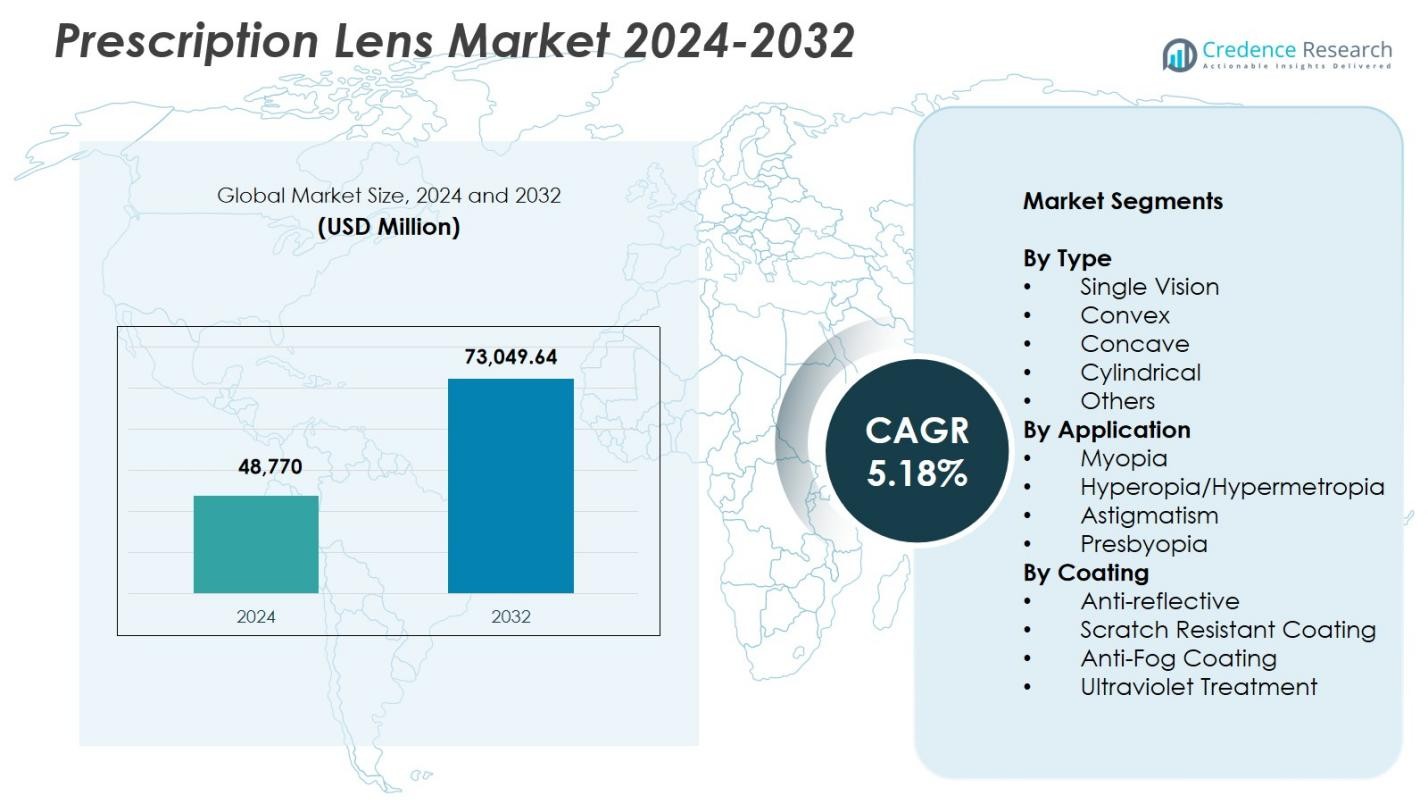
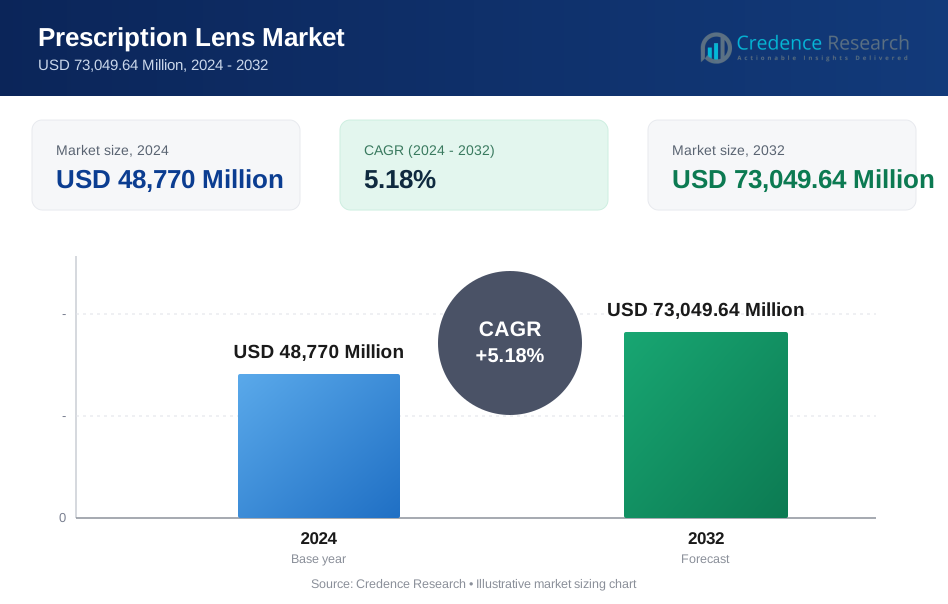
Prescription Lens Market size was valued at USD 48,770 Million in 2024 and is anticipated to reach USD 73,049.64 Million by 2032, at a CAGR of 5.18% during the forecast period.
| REPORT ATTRIBUTE | DETAILS |
|---|---|
| Historical Period | 2020-2023 |
| Base Year | 2024 |
| Forecast Period | 2025-2032 |
| Prescription Lens Market Size 2024 | USD 48,770 Million |
| Prescription Lens Market, CAGR | 5.18% |
| Prescription Lens Market Size 2032 | USD 73,049.64 Million |
Prescription Lens Market is driven by leading players such as EssilorLuxottica SA, Carl Zeiss Vision International GmbH, HOYA Corporation, Nikon Corporation, Rodenstock GmbH, Seiko Optical Products Co., Ltd., Shamir Optical Industry Ltd., BBGR SA, Vision-Ease Lens Technologies, Inc., and Younger Optics, Inc., all of which strengthen product portfolios with advanced coatings, digital surfacing, and personalized lens technologies. These companies focus on innovation, quality enhancement, and wider distribution to meet rising global vision correction needs. Regionally, North America led with 33.4% share in 2024, supported by strong adoption of premium lenses, followed by Europe and Asia Pacific, which continue to expand due to growing myopia prevalence and increased access to optical care.
Market Insights
- Prescription Lens Market reached USD 48,770 Million in 2024 and will grow at a CAGR of 5.18% to reach USD 73,049.64 Million by 2032.
- Strong demand is driven by rising cases of myopia, hyperopia, and presbyopia, with single-vision lenses holding 42.6% share due to widespread corrective needs across all age groups.
- Key trends include rapid adoption of blue-light protection, premium coatings, and personalized free-form lenses as consumers seek greater comfort, clarity, and digital eye-strain reduction.
- Leading players such as EssilorLuxottica, Carl Zeiss, HOYA, Nikon, and Rodenstock expand portfolios through innovation, advanced materials, and wider distribution networks to strengthen global presence.
- North America led with 33.4% share in 2024, followed by Europe at 28.7% and Asia Pacific at 26.9%, reflecting strong optical infrastructure, rising screen exposure, and expanding access to eye-care services across major regions.
 Market Segmentation Analysis:
By Type:
In the Prescription Lens Market, the Single Vision segment dominated with 42.6% share in 2024, driven by rising cases of myopia and hyperopia among adults and children. Growing digital device usage increases visual strain, supporting the demand for single-vision corrective lenses. Convex and concave lenses continue gaining adoption due to improved optical designs and customization options, while cylindrical lenses address rising astigmatism prevalence. The “Others” category benefits from niche requirements such as occupational and sports lenses. Advancements in lightweight materials and digitally surfaced lens technologies further support segment-wide growth.
- For instance, ZEISS Single Vision Superb lenses employ advanced freeform technology to eliminate optical compromises in conventional designs, providing sharp focus across the entire lens surface
By Application:
The Myopia segment held the largest share at 47.3% in 2024, primarily driven by the global surge in near-work activities, prolonged screen exposure, and rising childhood myopia rates. The market also benefits from strong adoption of advanced corrective lenses offering wider fields of vision and reduced distortion. Hyperopia/Hypermetropia and Presbyopia segments expand steadily with aging populations, while Astigmatism lenses grow due to improved toric designs. Increasing awareness of eye health and wider access to optometric services further reinforce demand across all application categories.
- For instance, EssilorLuxottica's Stellest lenses slowed myopia progression by 1.95 D (57%) and axial elongation by 0.81 mm (52%) on average over six years in clinical studies.
By Coating:
The Prescription Lens Market saw the Anti-reflective coating segment lead with 39.8% share in 2024, supported by its ability to enhance visual clarity, reduce glare, and improve night-time visibility. Demand is amplified by the growing need for digital screen protection and comfort during extended work hours. Scratch-resistant coatings record strong adoption due to durability requirements, while anti-fog coatings gain traction in healthcare, industrial, and humid environments. Ultraviolet treatment lenses maintain steady demand as consumers prioritize long-term eye protection, driven by increasing awareness of UV-related ocular risks.
Key Growth Drivers
Rising Prevalence of Vision Disorders
The Prescription Lens Market experiences strong growth due to the increasing prevalence of myopia, hyperopia, astigmatism, and presbyopia across global populations. Prolonged screen exposure, urban lifestyle changes, and reduced outdoor activities significantly elevate the incidence of refractive errors among both adults and children. This trend drives consistent demand for corrective lenses, particularly single-vision and advanced digital lenses. Expanding optometric screening programs and rising awareness of preventive eye care further strengthen market adoption, ensuring sustained long-term growth across developed and emerging regions.
- For instance, HOYA employs Integrated Dual Side freeform technology in its iD Single Vision lenses, enabling bi-aspheric designs with pixel-perfect precision calculated for every point on the lens surface to deliver clear eyesight and maximum comfort.
Technological Advancements in Lens Materials and Designs
Continuous innovation in lens manufacturing technologies drives market expansion by improving optical performance, comfort, and durability. Digitally surfaced lenses, blue-light-filter coatings, lightweight polycarbonate materials, and adaptive photochromic solutions enhance customer preference for premium prescription lenses. These advancements address modern lifestyle needs, including digital strain reduction and improved night vision. Manufacturers increasingly invest in customization technologies for precise correction, offering personalized visual experiences. The transition toward smart lens designs and enhanced protective coatings further boosts product differentiation and market penetration.
- For instance, Transitions Gen 8 lenses adapt fastest to UV light, darkening outdoors for glare reduction and filtering harmful blue light indoors across single-vision, bifocal, and progressive prescriptions.
Growing Aging Population and Increased Eye Care Awareness
Global demographic shifts, particularly the expansion of the aging population, significantly increase demand for presbyopia-correcting lenses and advanced multifocal solutions. Older consumers prioritize superior optical clarity, comfort, and specialized coatings for vision stability. Enhanced awareness initiatives by healthcare organizations and optical retailers encourage regular eye examinations, supporting earlier diagnosis of refractive errors. Rising disposable incomes and expanded access to vision care services in developing economies further stimulate lens purchases. Collectively, these factors position the aging population as a pivotal long-term driver for sustained market growth.
Key Trends & Opportunities
Expansion of Digital Lenses and Blue-Light Protection
A major trend reshaping the Prescription Lens Market is the rapid adoption of digital lenses and advanced blue-light-filter technologies. As consumers spend increasing hours on smartphones, tablets, and computers, demand intensifies for lenses that reduce digital eye strain and improve visual comfort. This shift creates opportunities for manufacturers offering next-generation coatings optimized for screen-heavy lifestyles. Retailers leverage this trend by promoting task-specific lenses engineered for office work, gaming, and e-learning environments. The continued digitalization of daily activities ensures prolonged market relevance for such innovations.
- For instance, CooperVision's MyDay Energys contact lenses integrate DigitalBoost technology, an aspheric design supplying a +0.3D boost to ease ciliary muscle stress and accommodative burden when shifting focus from digital devices to the real world.
Growth of Customized and Premium Lens Solutions
The market sees growing opportunities in personalized and premium prescription lenses tailored to individual visual needs. Innovations in free-form manufacturing, AI-powered eye measurements, and adaptive focusing technologies enhance precision and user experience. Premium coatings, lightweight materials, and high-index lenses attract consumers seeking superior aesthetics and performance. Additionally, expanding e-commerce platforms support online customization and virtual try-on tools, improving accessibility. As consumers increasingly prefer differentiated and high-quality vision solutions, manufacturers that invest in advanced customization capabilities gain a strong competitive edge.
- For instance, Rodenstock uses its DNEye Scanner to measure over 7,000 points on the eye, including pupil reactions and aberrations, for biometric single vision and progressive lenses. This creates individualized lenses with sharper contrast, better night vision, and larger fields of clear sight.
Key Challenges
High Cost of Premium Lens Technologies
One of the major challenges in the Prescription Lens Market is the high cost associated with advanced lens materials, specialized coatings, and precision manufacturing technologies. Premium solutions such as progressive digital lenses or blue-light-filter coatings often remain unaffordable for price-sensitive consumers. Limited insurance coverage in several regions further restricts adoption. Manufacturers face pressure to balance innovation with affordability while sustaining margins. This cost barrier creates disparities in access to high-quality vision correction, particularly in low-income markets where cost-driven alternatives remain dominant.
Rising Competition from Low-Cost Alternatives
The increasing presence of low-cost lens manufacturers, particularly in emerging economies, creates pricing pressure and challenges brand differentiation for established players. Budget optical chains and online retailers offer inexpensive prescription lenses that attract cost-conscious consumers, reducing the demand for premium offerings. This intensifies competition and forces established brands to enhance product value through innovation, service quality, and brand positioning. Additionally, counterfeit and substandard lenses entering the market pose risks to consumer safety and erode trust. These dynamics make maintaining market share more challenging for premium manufacturers.
Regional Analysis
North America
North America dominated the Prescription Lens Market with 33.4% share in 2024, driven by high prevalence of refractive errors, strong adoption of premium lenses, and widespread access to advanced optometric services. The region benefits from extensive insurance coverage for vision care and rapid uptake of digital, blue-light, and anti-reflective lenses among working professionals. Major manufacturers and retail chains expand their portfolios with customized and high-index lenses, enhancing consumer choice. Growing awareness of preventive eye health and rising diagnoses of myopia among younger populations further strengthen regional demand.
Europe
Europe accounted for 28.7% share in 2024, supported by a mature optical industry, expanding geriatric population, and high adoption of multifocal and progressive lenses. Countries such as Germany, France, and the U.K. exhibit strong penetration of premium coatings and technologically advanced lens materials. Regulatory support for eye care accessibility and regular vision screenings boosts demand across the region. The presence of globally recognized lens manufacturers enhances innovation and product variety. Increasing digital device usage continues to elevate the need for specialized blue-light and ergonomic prescription lenses.
Asia Pacific
Asia Pacific emerged as the fastest-growing region with 26.9% share in 2024, propelled by rising myopia prevalence, large population base, and rapid urbanization. Countries such as China, Japan, South Korea, and India witness strong demand for single-vision correction lenses and advanced coatings due to high digital screen exposure. Expanding middle-class income levels and improving access to optometric services support continued market penetration. Local manufacturing expansion and partnerships with global brands further strengthen supply capabilities. Government initiatives promoting routine eye examinations also contribute to sustained growth across the region.
Latin America
Latin America captured 6.1% share in 2024, driven by increasing awareness of vision correction and growing availability of affordable prescription lenses. Countries such as Brazil, Mexico, and Argentina show rising adoption of single-vision and anti-reflective lenses as digital device usage surges. Expansion of optical retail chains and e-commerce platforms improves accessibility and supports market penetration. Investments in local optical manufacturing enhance product affordability. However, limited insurance coverage and price sensitivity among consumers continue to shape purchasing behavior across the region.
Middle East & Africa
The Middle East & Africa region accounted for 4.9% share in 2024, supported by rising urbanization, improving healthcare infrastructure, and increasing screening for refractive errors. Countries such as the UAE, Saudi Arabia, and South Africa show growing demand for anti-reflective and UV-protective lenses due to harsh climatic conditions. Expanding optical retail networks and partnerships with global brands enhance product availability. However, economic disparities and limited access to specialized eye care services in rural areas continue to challenge market growth, leading to slower adoption of premium lens solutions.
Market Segmentations:
By Type
- Single Vision
- Convex
- Concave
- Cylindrical
- Others
By Application
- Myopia
- Hyperopia/Hypermetropia
- Astigmatism
- Presbyopia
By Coating
- Anti-reflective
- Scratch Resistant Coating
- Anti-Fog Coating
- Ultraviolet Treatment
By Geography
- North America
- U.S.
- Canada
- Mexico
- Europe
- Germany
- France
- U.K.
- Italy
- Spain
- Rest of Europe
- Asia Pacific
- China
- Japan
- India
- South Korea
- South-east Asia
- Rest of Asia Pacific
- Latin America
- Brazil
- Argentina
- Rest of Latin America
- Middle East & Africa
- GCC Countries
- South Africa
- Rest of the Middle East and Africa
Competitive Landscape
Competitive landscape in the Prescription Lens Market is shaped by leading companies such as EssilorLuxottica SA, Carl Zeiss Vision International GmbH, HOYA Corporation, Nikon Corporation, Rodenstock GmbH, Seiko Optical Products Co., Ltd., BBGR SA, Shamir Optical Industry Ltd., Vision-Ease Lens Technologies, Inc., and Younger Optics, Inc. These players strengthen their market positions through continuous advancements in lens materials, digital surfacing technologies, and premium coatings that enhance visual comfort and clarity. Companies actively expand their global footprints by investing in R&D, introducing customized and blue-light-filter solutions, and accelerating production of high-index and lightweight lenses. Strategic partnerships with optical retailers, e-commerce channels, and eye-care professionals enable broader consumer reach and brand visibility. Many manufacturers also focus on sustainability initiatives, integrating eco-friendly materials and energy-efficient manufacturing practices. Growing demand for personalized vision correction encourages companies to enhance precision measurement technologies and offer tailored lens designs, further intensifying competition across global markets.
Key Player Analysis
- Vision-Ease Lens Technologies, Inc.
- EssilorLuxottica SA
- Seiko Optical Products Co., Ltd.
- Shamir Optical Industry Ltd.
- Carl Zeiss Vision International GmbH
- Nikon Corporation
- Younger Optics, Inc.
- BBGR SA
- HOYA Corporation
- Rodenstock GmbH
Recent Developments
- In June 2025, Carl Zeiss Vision International GmbH announced the acquisition of Brighten Optix, bringing its specialty contact lens and myopia-management portfolio into Zeiss Vision Care.
- In September 2025, HOYA Corporation launched its new stock-lens outlet, LensesByHOYA.us, offering a wide range of HOYA lens designs, materials and treatments to eye-care professionals with high availability and fast supply.
- In June 2025, EssilorLuxottica SA signed an agreement to acquire major Malaysian optical-retail chain A‑Look / Seen / OWL stores, expanding its regional retail footprint in Southeast Asia.
- In July 2025, HOYA introduced a new line of polarized prescription lenses under the name Lumacore, aimed at offering enhanced lens performance and aesthetic appeal for polarized lens users.
Report Coverage
The research report offers an in-depth analysis based on Type, Application, Coating and Geography. It details leading market players, providing an overview of their business, product offerings, investments, revenue streams, and key applications. Additionally, the report includes insights into the competitive environment, SWOT analysis, current market trends, as well as the primary drivers and constraints. Furthermore, it discusses various factors that have driven market expansion in recent years. The report also explores market dynamics, regulatory scenarios, and technological advancements that are shaping the industry. It assesses the impact of external factors and global economic changes on market growth. Lastly, it provides strategic recommendations for new entrants and established companies to navigate the complexities of the market.
Future Outlook
- Demand for advanced prescription lenses will rise as digital screen usage continues to increase globally.
- Adoption of blue-light protection and digital strain–reducing coatings will expand in both developed and emerging markets.
- Personalized and free-form lenses will gain stronger traction due to consumer preference for tailored visual correction.
- Photochromic and adaptive lenses will see higher uptake as users seek convenience and multifunctional solutions.
- Premium progressive and multifocal lenses will grow rapidly with the expanding aging population.
- E-commerce platforms will play a larger role in prescription lens distribution and customization.
- Smart lens technologies will emerge as manufacturers integrate sensors and digital features into optical products.
- Sustainable and eco-friendly lens materials will gain importance as companies prioritize green manufacturing.
- Increasing awareness of regular eye examinations will support early detection and higher prescription lens adoption.
- Partnerships between optical brands and technology companies will accelerate innovation and product diversification.
Request a Free Sample
Fill in your details and we'll send you a free sample report.
- Sample data tables & charts
- Research methodology
Need a Custom Version of This Report?
Tailor the scope, geography, or segments to your exact requirements.
- Custom geography or segment scope
- Direct access to our analyst team
Frequently Asked Questions
What is the current market size for Prescription Lens Market, and what is its projected size in 2032?
At what Compound Annual Growth Rate is the Prescription Lens Market projected to grow between 2024 and 2032?
Which Prescription Lens Market segment held the largest share in 2024?
What are the primary factors fueling the growth of the Prescription Lens Market?
Who are the leading companies in the Prescription Lens Market?
Which region commanded the largest share of the Prescription Lens Market in 2024?
Table of Content
Chapter 1 Market Segmentation
- 1.1 Segmentation Framework
- 1.1.1 Product and Service Classification
- 1.1.2 Application and End-Use Classification
- 1.1.3 Technology and Solution Classification
- 1.1.4 Customer and Distribution Channel Classification
- 1.1.5 Geographic Segmentation
- 1.1.6 Market Segment Definitions and Boundaries
Chapter 2 Introduction
- 2.1 Report Objectives and Scope
- 2.2 Product Definition and Industry Terminology
- 2.3 Market Inclusions and Exclusions
- 2.4 Research Process
- 2.4.1 Primary Research and Expert Interviews
- 2.4.2 Secondary Research and Source Review
- 2.4.3 Top-Down and Bottom-Up Estimation
- 2.4.4 Data Triangulation and Verification
- 2.5 Market Size Measurement Basis
- 2.5.1 2024: USD 48,770 Million → 2032: USD 73,049.64 Million
- 2.6 Historical and Forecast Reference Periods
- 2.6.1 Base Year: 2024
- 2.6.2 Forecast Period: 2024-2032
- 2.7 Research Assumptions and Limitations
Chapter 3 Executive Summary
- 3.1 Market Snapshot and Key Findings
- 3.2 Base-Year Market Size, 2024
- 3.3 Forecast Market Size, 2032
- 3.4 Revenue and Volume Growth Outlook
- 3.5 Key Demand and Supply Indicators
- 3.6 Leading Market Segments
- 3.7 Fastest-Growing Market Opportunities
- 3.8 Regional Performance Highlights
- 3.9 Technology and Industry Transformation
- 3.10 Competitive Landscape Summary
- 3.11 Analyst View and Strategic Implications
Chapter 4 Global Prescription Lens Market Trends and Developments
- 4.1 Historical Industry Development
- 4.2 Recent Market Trends and Developments
- 4.3 Demand and Customer Behavior Trends
- 4.4 Technology and Product Innovation
- 4.5 Artificial Intelligence, Automation and Digitalization
- 4.6 Local Manufacturing and Supply Chain Realignment
- 4.7 Industry Partnerships, Mergers and Acquisitions
- 4.8 Sustainability and Circular Economy Developments
- 4.9 Government and Private Sector Investment Trends
- 4.10 Emerging Business Models and Commercialization
- 4.11 Industry Developments and Announcements
Chapter 5 Global Prescription Lens Market Production, Supply and Demand Analysis
- 5.1 Demand Trend and Consumption Analysis
- 5.2 Demand Forecast, 2024-2032
- 5.3 Production and Output Trend
- 5.4 Production and Output Forecast, 2024-2032
- 5.5 Installed Capacity and Capacity Utilization
- 5.6 Company-Wise Production Plants and Statistics
- 5.6.1 Installed Production Capacity
- 5.6.2 Actual Production
- 5.6.3 Planned Capacity and Expansion Targets
- 5.7 Supply Chain Structure and Procurement Trends
- 5.8 Supply-Demand Gap and Bottlenecks
- 5.9 Import Dependence and Sourcing Structure
- 5.10 Contract Manufacturing and Outsourcing
- 5.11 Regional Supply and Demand Concentration
Chapter 6 Global Prescription Lens Market Pricing Analysis
- 6.1 Pricing Structure and Measurement
- 6.2 Historical Pricing Trends
- 6.3 Pricing Outlook, 2024-2032
- 6.4 Average Selling Price and Unit Economics
- 6.5 Pricing by Product and Market Segment
- 6.6 Geographic Pricing Differences
- 6.7 Key Input, Energy, Labor and Logistics Costs
- 6.8 Contract Pricing and Purchasing Models
- 6.9 Pricing Sensitivity and Competitive Positioning
- 6.10 Price, Margin and Profitability Implications
Chapter 7 Global Prescription Lens Market Dynamics
- 7.1 Market Growth Drivers
- 7.1.1 Demand-Side Drivers
- 7.1.2 Technology and Innovation Drivers
- 7.1.3 Infrastructure and Investment Drivers
- 7.1.4 Regulatory and Policy Drivers
- 7.2 Market Restraints
- 7.2.1 Cost and Affordability Constraints
- 7.2.2 Technology and Adoption Barriers
- 7.2.3 Supply Chain and Operational Constraints
- 7.3 Market Challenges
- 7.3.1 Competitive Pressure and Margin Erosion
- 7.3.2 Skills, Infrastructure and Implementation Gaps
- 7.4 Emerging Market Opportunities
- 7.5 Market Dynamics Impact and Time-Horizon Assessment
Chapter 8 Global Prescription Lens Value Chain Analysis
- 8.1 Industry Value Chain Overview
- 8.2 Upstream Suppliers and Critical Inputs
- 8.3 Technology and Component Providers
- 8.4 Manufacturing or Service Delivery
- 8.5 Distribution, Channel Partners and Integrators
- 8.6 Downstream Applications and End Users
- 8.7 Value Addition and Profit Pools
- 8.8 Vertical Integration and Outsourcing
- 8.9 Supplier Concentration and Risk
- 8.10 Supply Chain Localization and Resilience
Chapter 9 Global Prescription Lens Market Regulations and Policies
- 9.1 Relevant Laws, Standards and Compliance Frameworks
- 9.2 Product, Service, Safety and Quality Requirements
- 9.3 Government Policies, Incentives and Subsidies
- 9.4 Imports, Exports and Trade Barriers
- 9.5 Public Procurement and Local Content Requirements
- 9.6 Environmental and Sustainability Compliance
- 9.7 Upcoming Policy Changes and Market Implications
Chapter 10 Global Prescription Lens Market Hotspots and Opportunities
- 10.1 Market Opportunity Mapping and Growth Hotspots
- 10.2 High-Growth Applications and Customer Groups
- 10.3 Underserved Markets and White-Space Opportunities
- 10.4 Emerging Technology and Product Opportunities
- 10.5 New Capacity and Investment Hotspots
- 10.6 Market Entry and Expansion Opportunities
- 10.7 Distribution and Partnership Opportunities
- 10.8 Near-Term and Long-Term Commercial Potential
- 10.9 Opportunity Attractiveness and Execution Risks
Chapter 11 Global Prescription Lens Market Outlook, 2024-2032
- 11.1 Market Size and Analysis
- 11.1.1 Revenue (Market Measurement: 2024: USD 48,770 Million → 2032: USD 73,049.64 Million)
- 11.1.2 Market Volume and Quantity Sold
- 11.1.3 Historical Market Size
- 11.1.4 Base-Year Market Size, 2024
- 11.2 Market Forecast, 2024-2032
- 11.2.1 Revenue Forecast to 2032
- 11.2.2 Volume Forecast to 2032
- 11.2.3 CAGR and Year-on-Year Growth
- 11.2.4 Incremental Revenue Opportunity
- 11.3 Forecast Assumptions and Scenario Analysis
- 11.3.1 Base-Case Forecast
- 11.3.2 Optimistic and Conservative Scenarios
- 11.3.3 Technology, Pricing and Policy Sensitivities
- 11.4 Market Attractiveness and Growth Outlook
Chapter 12 Global Prescription Lens Market Segmentation and Outlook
- 12.1 Segmentation Summary and Market Shares, 2024
- 12.2 Largest and Fastest-Growing Segments
- 12.3 Segment Growth Comparison
- 12.4 Segment Attractiveness and Priority Matrix
Chapter 13 Global Prescription Lens Geographic Market Outlook, 2024-2032
- 13.1 Regional Market Size and Share, 2024
- 13.2 Regional Market Forecast, 2024-2032
- 13.3 Regional Pricing, Production and Demand Differences
- 13.4 North America
- 13.4.1 United States
- 13.4.2 Canada
- 13.4.3 Mexico
- 13.5 Europe
- 13.5.1 Germany
- 13.5.2 France
- 13.5.3 Italy
- 13.5.4 United Kingdom
- 13.5.5 Spain
- 13.5.6 Poland
- 13.5.7 Russia
- 13.5.8 Netherlands
- 13.5.9 Belgium
- 13.5.10 Sweden
- 13.5.11 Denmark
- 13.5.12 Norway
- 13.5.13 Rest of Europe
- 13.6 Asia Pacific
- 13.6.1 China
- 13.6.2 India
- 13.6.3 Japan
- 13.6.4 South Korea
- 13.6.5 Thailand
- 13.6.6 Indonesia
- 13.6.7 Vietnam
- 13.6.8 Malaysia
- 13.6.9 Australia
- 13.6.10 Rest of Asia Pacific
- 13.7 Latin America
- 13.7.1 Brazil
- 13.7.2 Argentina
- 13.7.3 Colombia
- 13.7.4 Chile
- 13.7.5 Rest of Latin America
- 13.8 Middle East
- 13.8.1 Saudi Arabia
- 13.8.2 United Arab Emirates
- 13.8.3 Turkey
- 13.8.4 Israel
- 13.8.5 Iran
- 13.8.6 Rest of the Middle East
- 13.9 Africa
- 13.9.1 South Africa
- 13.9.2 Egypt
- 13.9.3 Nigeria
- 13.9.4 Morocco
- 13.9.5 Rest of Africa
- 13.10 Regional Investment, Policy and Supply Chain Differences
- 13.11 Regional Competitive Landscape
- 13.12 Geographic Growth Hotspots
Chapter 14 Global Prescription Lens Technology, Innovation and Sustainability Outlook
- 14.1 Technology Landscape and Maturity
- 14.2 Product, Process and Service Innovation
- 14.3 AI, Automation and Digital Tools in the Industry
- 14.4 Technology Adoption and Performance Benchmarking
- 14.5 Innovation Pipeline and R&D Investment
- 14.6 Patent and Intellectual Property Trends
- 14.7 Energy Efficiency and Resource Management
- 14.8 Sustainability, Recycling and Circularity
- 14.9 Technology Roadmap, 2024-2032
- 14.10 Risks of Obsolescence and Technology Substitution
Chapter 15 Global Prescription Lens Market Key Strategic Imperatives
- 15.1 Growth and Market Entry Priorities
- 15.2 High-Return Products and Segments
- 15.3 Pricing, Profitability and Cost Optimization
- 15.4 Technology Investment and Product Differentiation
- 15.5 Supply Chain Localization and Resilience
- 15.6 Distribution and Customer Acquisition
- 15.7 Partnership, Acquisition and Capacity Strategy
- 15.8 Regional Expansion Priorities
- 15.9 Short-, Medium- and Long-Term Actions
Chapter 16 Competition Outlook
- 16.1 Industry Competition Characteristics
- 16.2 Market Structure and Concentration
- 16.3 Market Share and Competitive Positioning, 2024
- 16.4 Company-Wise Revenue and Product Benchmarking
- 16.5 Production and Service Capacity Benchmarking
- 16.6 Technology, Pricing and Differentiation
- 16.7 Regional Footprint and Distribution Strength
- 16.8 Mergers, Acquisitions and Strategic Alliances
- 16.9 New Entrants and Competitive Threats
- 16.10 Porter's Five Forces and Industry Attractiveness
- 16.11 Competitive Outlook, 2024-2032
Chapter 17 Company Profiles
- 17.1 Company Coverage and Selection Criteria
- 17.2 Leading Market Participants – Standard Profile Structure
- 17.2.1 Business Description
- 17.2.2 Company Ownership and Geographic Presence
- 17.2.3 Product and Service Portfolio
- 17.2.4 Manufacturing and Operating Footprint
- 17.2.5 Production Capacity and Expansion Plans
- 17.2.6 Financial Performance and Investment
- 17.2.7 Market Share and Competitive Position
- 17.2.8 Technology and Innovation Capabilities
- 17.2.9 Strategic Alliances or Partnerships
- 17.2.10 Recent Developments
- 17.2.11 Growth Strategy and Outlook
- 17.3 Other Relevant Market Participants
Note: Every listed company is profiled on the structure shown under the first company. The company list is preliminary and may change based on research findings, market developments, data availability and client requirements.
Chapter 18 Disclaimer
- 18.1 Research and Forecast Disclaimer
- 18.2 Data Source and Estimation Limitations
Note: The depth of individual sections depends on data availability for this market. Volume, capacity, trade and other unit-based metrics are included where applicable.
