
Market Overviews
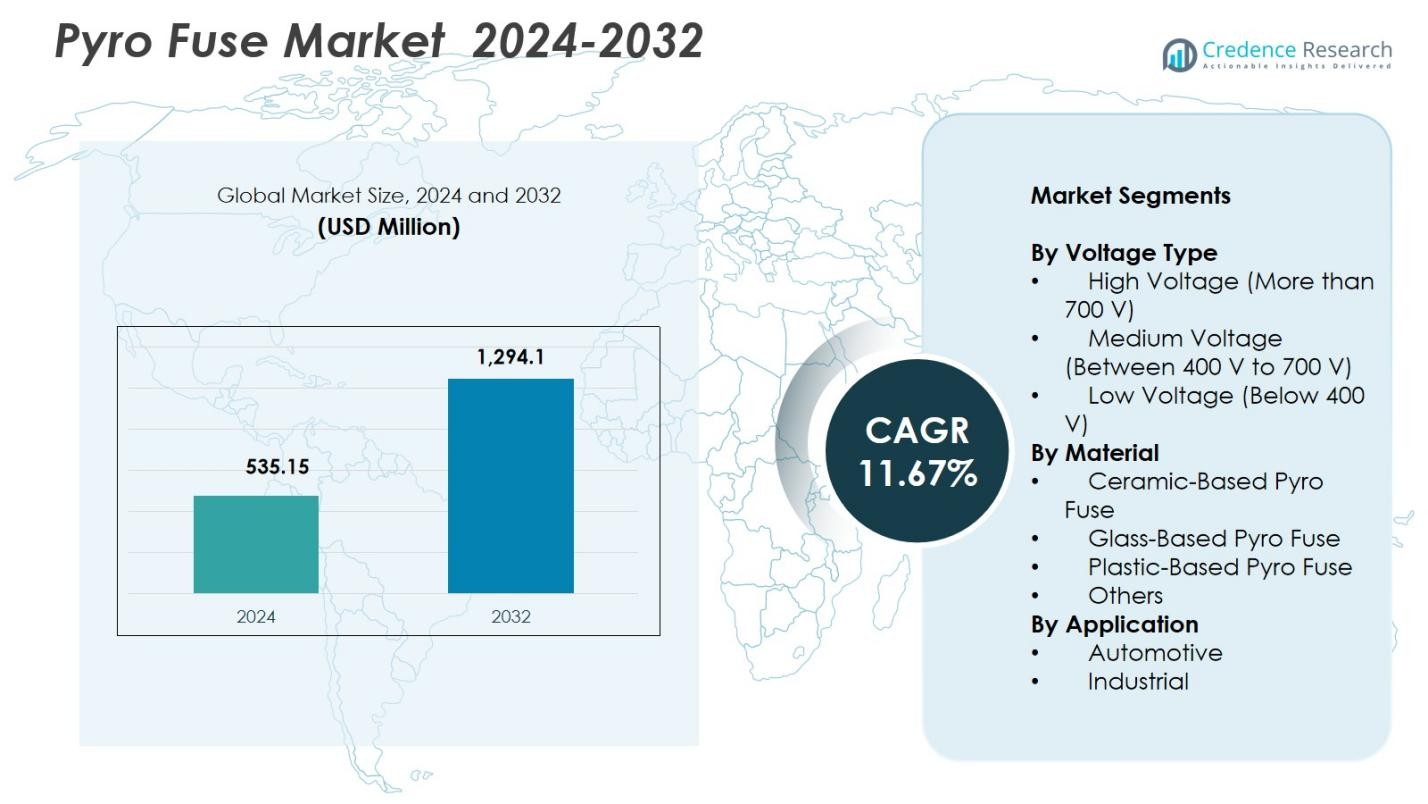
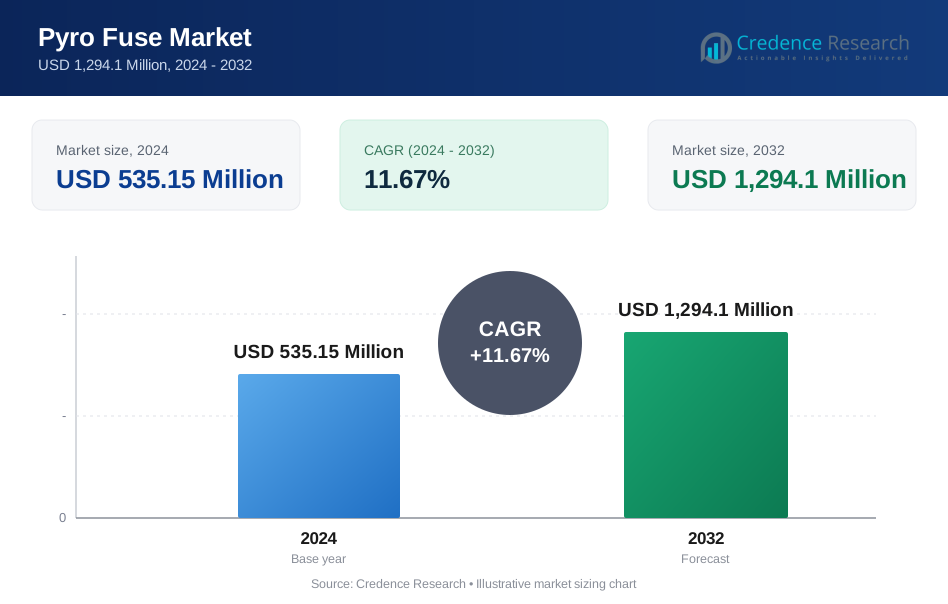
Pyro Fuse Market size was valued at USD 535.15 Million in 2024 and is anticipated to reach USD 1,294.1 Million by 2032, at a CAGR of 11.67% during the forecast period.
| REPORT ATTRIBUTE | DETAILS |
|---|---|
| Historical Period | 2020-2023 |
| Base Year | 2024 |
| Forecast Period | 2025-2032 |
| Pyro Fuse Market Size 2024 | USD 535.15 Million |
| Pyro Fuse Market, CAGR | 11.67% |
| Pyro Fuse Market Size 2032 | USD 1,294.1 Million |
Pyro Fuse Market is driven by major players such as Joyson Electronic, MTA Group, Eaton, Hangzhou Chauron Technology, Daicel Corporation, Littelfuse, Mersen, Miba AG, Xi’an Sinofuse Electric, and Pacific Engineering Corporation (PEC), all focusing on advanced high-voltage protection solutions for EVs, industrial systems, and energy storage applications. These companies strengthen their positions through product innovation, safety-focused designs, and expanded manufacturing capabilities to meet rising global electrification demands. Asia-Pacific leads the Pyro Fuse Market with 33.9% share in 2024, followed by North America at 31.4%, supported by strong EV adoption, battery production, and rapid integration of high-voltage architectures.
Market Insights
- Pyro Fuse Market was valued at USD 535.15 Million in 2024 and will grow at a CAGR of 11.67% through 2032.
- Market growth is driven by rising EV production, adoption of high-voltage powertrains, and increased deployment of energy storage systems, boosting demand for rapid-response circuit isolation solutions.
- Key trends include advancement in solid-state protection, miniaturized fuse designs, and integration of smart diagnostic features aligned with next-generation battery architectures.
- Leading players such as Joyson Electronic, MTA Group, Eaton, Daicel Corporation, Littelfuse, and Mersen enhance their positions through product innovation, material upgrades, and expanded OEM partnerships, with the High Voltage segment holding 46.8% share in 2024.
- Asia-Pacific commands 33.9% regional share, North America holds 31.4%, and Europe captures 28.7%, supported by strong EV penetration, regulatory safety mandates, and rapid industrial electrification across major economies.
Market Segmentation Analysis:
By Voltage Type:
The Pyro Fuse Market by voltage type is dominated by the High Voltage segment, holding 46.8% share in 2024, driven by rising adoption of high-voltage electric powertrains in EVs, hybrid vehicles, and advanced industrial systems requiring fast-disconnect protection. High-voltage pyro fuses support reliable isolation during thermal or electrical faults, enhancing safety standards across automotive OEMs and energy storage systems. Medium Voltage accounts for 33.4% share, supported by its role in commercial EVs and industrial automation, while Low Voltage, with 19.8% share, caters to auxiliary circuits and compact electronic protection applications.
- For instance, Daicel's Pyro-Fuse delivers instantaneous shutdown of high-voltage currents in EV battery systems, supporting up to 1000Vdc architectures for rapid fault isolation and enhanced vehicle safety.
By Material:
The Ceramic-Based Pyro Fuse segment leads the market with 41.2% share in 2024, driven by its superior thermal resistance, mechanical strength, and ability to withstand high fault currents in EV battery packs and industrial energy systems. Glass-Based fuses hold 27.6% share, benefiting from stable insulation properties and precise rupture control in controlled environments. Plastic-Based fuses capture 21.5% share due to their lightweight and cost-efficient structure, while the Others category accounts for 9.7% share, addressing niche requirements in specialty electronics and emerging safety designs.
- For instance, Mersen employs ceramic external isolation in its EV/HEV pyro fuses, paired with silver, copper, or tin conductive elements and sand filler, enabling use as main battery fuses with reliable performance in high-voltage setups.
By Application:
The Automotive segment dominates the Pyro Fuse Market with 58.3% share in 2024, propelled by accelerating global EV production, stringent vehicle safety mandates, and increasing deployment of high-capacity lithium-ion batteries requiring rapid isolation during thermal runaway. Automakers integrate pyro fuses to protect battery modules, power electronics, and charging systems. The Industrial segment holds 41.7% share, supported by rising demand for protective components in robotics, renewable energy installations, heavy machinery, and energy storage systems, where reliable fault interruption and operational safety remain critical performance drivers.
Key Growth Drivers
Rising Adoption of Electric and Hybrid Vehicles
The rapid expansion of global EV and hybrid vehicle manufacturing significantly drives the Pyro Fuse Market, as automakers prioritize advanced safety systems for high-capacity lithium-ion batteries and power electronics. Pyro fuses provide instantaneous circuit isolation during thermal runaway or collision events, aligning with stringent automotive safety regulations. Increasing integration of high-voltage platforms, fast-charging architectures, and energy-dense battery modules strengthens demand for robust fault-protection components. As EV penetration accelerates across passenger cars, commercial fleets, and autonomous mobility, pyro fuses gain wider adoption as essential battery safety mechanisms.
- For instance, Daicel Corporation's Pyro-Fuse instantly interrupts high-voltage currents in emergencies, leveraging airbag inflator technology to prevent electric shock and secondary accidents in EVs with larger-capacity batteries.
Expansion of Energy Storage and Renewable Power Systems
Growth in stationary energy storage systems and renewable energy installations fuels demand for reliable high-voltage protection, positioning pyro fuses as critical components in safeguarding battery arrays and power conversion units. Their ability to rapidly disconnect circuits under abnormal current conditions supports operational stability and prevents cascading system failures. Grid modernization initiatives, rising deployment of utility-scale storage, and microgrid expansion further stimulate adoption. As global decarbonization efforts intensify, energy infrastructure operators increasingly rely on advanced pyro fuse technologies to enhance safety, efficiency, and long-term system resilience.
- For instance, Mersen's χp hybrid pyro-fuse series targets battery energy storage and PV installations, offering self-triggering operation up to 1000V DC and 800A with breaking capacities from 0 to 30kA in a compact footprint.
Increasing Focus on Vehicle and Industrial Safety Standards
Tightening global safety frameworks across automotive and industrial sectors boosts demand for pyro fuses due to their precision-driven fault response and ability to prevent catastrophic failures. Automakers integrate these devices to meet evolving crash-safety protocols, battery protection guidelines, and high-voltage isolation requirements. In industrial environments, stricter equipment protection mandates and rising automation reinforce adoption in robots, power systems, and heavy machinery. Continuous regulatory upgrades and OEM-driven design standardization ensure sustained market growth, as pyro fuses become indispensable for meeting compliance and performance expectations.
Key Trends & Opportunities
Advancement of Solid-State and Smart Safety Technologies
A major trend shaping the Pyro Fuse Market is the integration of smart sensing and solid-state switching capabilities that enhance accuracy, response time, and diagnostic functionality. Manufacturers increasingly embed intelligent monitoring to detect micro-faults, thermal deviations, or abnormal current spikes, enabling predictive protection in EVs and industrial systems. Miniaturized designs and adaptive architectures support compatibility with next-generation battery packs and compact power modules. This technological shift creates strong opportunities for high-performance, digitally enabled pyro fuses that align with connected vehicle and Industry 4.0 ecosystems.
- For instance, Eaton launched its dual-trigger pyro fuse (F40A model) in 2025, which combines battery management system (BMS) triggering with a self-triggering backup function to separate short circuits independently, mimicking thermal fuse behavior for added EV safety layers.
Growing Opportunity in High-Voltage EV Platforms and Fast-Charging Systems
The transition toward 800-volt and 1000-volt EV architectures presents a significant opportunity for pyro fuse manufacturers, as higher system voltages require advanced protection elements with superior thermal and mechanical durability. Rapid expansion of ultra-fast charging infrastructure and high-output battery systems further increases the need for precise, high-capacity fault-isolation components. OEM investments in premium safety solutions and new EV platforms create a favorable environment for pyro fuse advancements. Companies offering high-voltage-rated, lightweight, and thermally stable fuses are well positioned to capture emerging demand.
- For instance, Sensata Technologies' STPS500 series PyroFuse handles up to 1000V with a high breaking capacity of 18kA at 10µH and continuous current up to 500A. Launched for high-voltage safety in automotive and charging systems, it achieves disconnection in less than 1ms with post-interruption insulation resistance exceeding 50MΩ at 1000V.
Key Challenges
High Manufacturing Complexity and Cost Constraints
The Pyro Fuse Market faces challenges arising from sophisticated engineering requirements, precision materials, and stringent quality validation processes that increase production costs. Manufacturers must ensure flawless operation during high-energy fault events, necessitating rigorous testing and advanced fabrication technologies. This elevates overall component cost, limiting adoption among budget-sensitive OEMs and industrial users. Balancing high performance with cost-efficiency remains a persistent challenge, especially as EV and energy storage applications scale rapidly and require affordable yet highly reliable protection solutions.
Limited Standardization and Design Integration Issues
A major challenge is the lack of uniform standards for pyro fuse integration across diverse EV platforms, battery chemistries, and industrial architectures. Variations in powertrain design, voltage ratings, and system layouts require customized fuse configurations, increasing design complexity and extending product development cycles. Inconsistent global regulatory frameworks further complicate standardization. These hurdles impact large-scale adoption and create compatibility issues for manufacturers seeking broader market penetration. Enhanced industry collaboration and harmonized safety norms are necessary to streamline integration and reduce engineering barriers.
Regional Analysis
North America
North America holds 31.4% share of the Pyro Fuse Market in 2024, driven by strong electric vehicle adoption, advanced battery manufacturing capabilities, and increasing deployment of stationary energy storage systems. The U.S. leads regional growth with expanding EV production lines, government-backed clean energy initiatives, and heightened safety requirements for high-voltage systems. Automakers and industrial operators integrate pyro fuses to enhance fault protection across power electronics and energy infrastructure. Growing R&D investment in next-generation EV platforms and grid modernization projects further strengthens regional demand for high-performance, high-voltage pyro fuse solutions.
Europe
Europe accounts for 28.7% share in 2024, supported by stringent automotive safety regulations, rapid electrification across passenger and commercial fleets, and expansion of renewable power installations. Countries such as Germany, France, and the U.K. accelerate EV production and battery ecosystem development, increasing adoption of pyro fuses for enhanced battery protection and compliance with high-voltage safety standards. Industrial automation and renewable integration also contribute to market demand. Strong policy mandates targeting carbon neutrality and the rise of 800-volt EV architectures position Europe as a critical hub for advanced pyro fuse deployment.
Asia-Pacific
Asia-Pacific dominates the global Pyro Fuse Market with 33.9% share in 2024, driven by large-scale EV manufacturing, significant battery production capacity, and rapid industrial expansion. China leads with strong domestic OEM activity and extensive deployment of high-voltage platforms, followed by Japan and South Korea with robust R&D ecosystems and advanced semiconductor and materials capabilities. The region benefits from strong government incentives for electrification and renewable energy integration. Growing demand for power storage systems, fast-charging networks, and industrial automation reinforces Asia-Pacific’s position as the fastest-growing market for pyro fuses.
Rest of the World
The Rest of the World holds 6.0% share in 2024, with growth driven by increasing electrification initiatives across Latin America, the Middle East, and Africa. Expanding renewable energy projects, adoption of utility-scale energy storage systems, and rising interest in EV infrastructure support market penetration. Industrial modernization in emerging economies contributes to the demand for high-voltage protection components. While development rates vary across countries, improving regulatory frameworks and growing investment in clean energy technologies create long-term opportunities for pyro fuse suppliers targeting new and underserved markets.
Market Segmentations:
By Voltage Type
- High Voltage (More than 700 V)
- Medium Voltage (Between 400 V to 700 V)
- Low Voltage (Below 400 V)
By Material
- Ceramic-Based Pyro Fuse
- Glass-Based Pyro Fuse
- Plastic-Based Pyro Fuse
- Others
By Application
- Automotive
- Industrial
By Geography
- North America
- U.S.
- Canada
- Mexico
- Europe
- Germany
- France
- U.K.
- Italy
- Spain
- Rest of Europe
- Asia Pacific
- China
- Japan
- India
- South Korea
- South-east Asia
- Rest of Asia Pacific
- Latin America
- Brazil
- Argentina
- Rest of Latin America
- Middle East & Africa
- GCC Countries
- South Africa
- Rest of the Middle East and Africa
Competitive Landscape
The Pyro Fuse Market features key players including Joyson Electronic, MTA Group, Eaton, Hangzhou Chauron Technology, Daicel Corporation, Xi’an Sinofuse Electric, Miba AG, Littelfuse, Mersen, and Pacific Engineering Corporation (PEC) leading advancements in high-voltage protection technologies. Market participants focus on developing compact, high-response pyro fuses tailored for electric vehicles, energy storage systems, and industrial power applications. Companies increasingly invest in material innovation, precision engineering, and automated manufacturing to enhance reliability and thermal endurance. Strategic collaborations with automotive OEMs and battery manufacturers strengthen product integration, while expansions in testing facilities help meet evolving global safety standards. As EV platforms shift toward 800-volt and higher architectures, manufacturers emphasize performance optimization, lightweight designs, and extended lifecycle validation. Continuous R&D, portfolio diversification, and geographic expansion remain central strategies as companies work to capture growing demand from electrification, industrial automation, and renewable power sectors.
Key Player Analysis
- Joyson Electronic
- MTA Group
- Eaton
- Hangzhou Chauron Technology
- Daicel Corporation
- Xi’an Sinofuse Electric
- Miba AG
- Littelfuse
- Mersen
- Pacific Engineering Corporation (PEC)
Recent Developments
- In April 2025, Sensata Technologies launched its STPS500 series PyroFuse to enhance high-voltage safety in automotive, industrial, and charging applications.
- In September 2025, Littelfuse introduced its 828 and 827 Series high-voltage fuses rated up to 1,000 VDC for onboard chargers and EV power distribution units.
- In April 2025 Eaton introduced a new dual-trigger pyro fuse to its EV circuit protection line, enhancing safety and reliability for electric vehicles.
Report Coverage
The research report offers an in-depth analysis based on Voltage Type, Material, Application and Geography. It details leading market players, providing an overview of their business, product offerings, investments, revenue streams, and key applications. Additionally, the report includes insights into the competitive environment, SWOT analysis, current market trends, as well as the primary drivers and constraints. Furthermore, it discusses various factors that have driven market expansion in recent years. The report also explores market dynamics, regulatory scenarios, and technological advancements that are shaping the industry. It assesses the impact of external factors and global economic changes on market growth. Lastly, it provides strategic recommendations for new entrants and established companies to navigate the complexities of the market.
Future Outlook
- The market will expand as global EV production accelerates and high-voltage safety requirements strengthen.
- Adoption of 800-volt and next-generation EV architectures will increase demand for advanced high-performance pyro fuses.
- Energy storage systems and renewable installations will drive higher integration of pyro fuses for fault protection.
- Material innovations will enhance thermal resistance, durability, and miniaturization of fuse structures.
- Smart and sensor-enabled pyro fuses will gain traction for real-time monitoring and predictive safety functions.
- Manufacturers will strengthen partnerships with automotive OEMs and battery suppliers for platform-level integration.
- Rapid grid modernization and industrial automation will boost usage in high-capacity power systems.
- Regulatory upgrades will promote adoption of precise fault-isolation components across safety-critical applications.
- Production expansion in Asia-Pacific will reshape supply chains and reduce manufacturing costs.
- R&D efforts will increasingly focus on solid-state switching and hybrid protection technologies for emerging applications.
Request a Free Sample
Fill in your details and we'll send you a free sample report.
- Sample data tables & charts
- Research methodology
Need a Custom Version of This Report?
Tailor the scope, geography, or segments to your exact requirements.
- Custom geography or segment scope
- Direct access to our analyst team
Frequently Asked Questions
What is the current market size for Pyro Fuse Market, and what is its projected size in 2032?
At what Compound Annual Growth Rate is the Pyro Fuse Market projected to grow between 2025 and 2032?
Which Pyro Fuse Market segment held the largest share in 2024?
What are the primary factors fueling the growth of the Pyro Fuse Market?
Who are the leading companies in the Pyro Fuse Market?
Which region commanded the largest share of the Pyro Fuse Market in 2024?
Table of Content
Chapter 1. Report Introduction
- 1.1 Report Description & Purpose
- 1.1.1 Report Title & Market Definition
- 1.1.2 Unique Selling Propositions (USP) & Key Differentiators
- 1.1.3 Value Proposition for Stakeholders
- 1.2 Research Objectives
- 1.2.1 Market Sizing Objectives (Volume & Revenue)
- 1.2.2 Segmentation Objectives
- 1.2.3 Competitive Intelligence Objectives
- 1.2.4 Forecast & Scenario Objectives
- 1.3 Report Scope
- 1.3.1 Pyro Fuse Scope – Types & Subtypes Covered
- 1.3.2 Geographic Scope – Regions & Countries Covered
- 1.3.3 Historical Period, Base Year & Forecast Period (2024; forecast to 2032)
- 1.3.4 Inclusions & Exclusions
- 1.4 HS Code & Classification Framework
- 1.5 Currency, Units & Pricing Basis
- 1.6 Target Stakeholders
- 1.7 Limitations & Assumptions
Chapter 2. Executive Summary
- 2.1 Global Pyro Fuse Market Snapshot
- 2.1.1 Market Size – Historical (2024) & Forecast (2024-2032) (2024: USD 535.15 Million → 2032: USD 1,294.1 Million)
- 2.1.2 Volume & Revenue – Global Totals
- 2.1.3 Key Market Highlights – Top Five Facts
- 2.2 Pyro Fuse Market Segmentation Snapshot
- 2.2.1 Market Split by Region – 2024 vs. 2032
- 2.3 Competitive Snapshot
- 2.3.1 Top 10 Players by Revenue Share – 2024
- 2.3.2 Top 10 Players by Volume Share – 2024
- 2.3.3 Recent Strategic Developments (18-Month Summary)
- 2.4 Key Investment Highlights & Strategic Conclusions
Chapter 3. Pyro Fuse Market Dynamics & Industry Analysis
- 3.1 Market Overview & Context
- 3.1.1 Pyro Fuse Market Position in the Broader Automotive Value Chain
- 3.1.2 OEM vs. Replacement Market Dynamics
- 3.1.3 Market Maturity & Development Stage by Region
- 3.2 Pyro Fuse Market Drivers
- 3.3 Pyro Fuse Market Restraints & Challenges
- 3.4 Pyro Fuse Market Opportunities
- 3.5 Porter's Five Forces Analysis
- 3.5.1 Threat of New Entrants
- 3.5.2 Bargaining Power of Suppliers
- 3.5.3 Bargaining Power of Buyers
- 3.5.4 Threat of Substitutes
- 3.5.5 Competitive Rivalry – Intensity Assessment
- 3.6 Pyro Fuse Value Chain Analysis
- 3.6.1 Upstream – Raw Material/Input Suppliers
- 3.6.1.1 Raw Material/Input 1
- 3.6.1.2 Raw Material/Input 2
- 3.6.1.3 Raw Material/Input 3
- 3.6.2 Midstream – Production/Manufacturing/Service Delivery
- 3.6.2.1 Production/Process Overview
- 3.6.2.2 Key Facility Locations & Capacity by Manufacturer
- 3.6.3 Downstream – Distribution & End Consumer
- 3.6.3.1 Primary Channel – B2B/OEM
- 3.6.3.2 Secondary Channels – Dealer, Retail, Online, Direct
- 3.6.4 Value Chain Profitability Analysis
- 3.6.1 Upstream – Raw Material/Input Suppliers
- 3.7 PESTEL Analysis
- 3.7.1 Political Factors
- 3.7.2 Economic Factors
- 3.7.3 Social Factors
- 3.7.4 Technological Factors
- 3.7.5 Environmental Factors
- 3.7.6 Legal Factors
- 3.8 Pyro Fuse Supply Chain Analysis
- 3.8.1 Raw Material/Input Supply Risk Assessment
- 3.8.2 Manufacturing Concentration Risk (Geographic Exposure)
- 3.8.3 Trade Disruption Impact Analysis
- 3.9 Regulatory & Policy Landscape
Note: The regulatory and policy landscape section covers regulations based on their applicability to the market, Pyro Fuse category, geography, and scope of the study. Only regulatory frameworks with a material impact on operations, compliance, trade, sustainability, or market access are analyzed in detail.
Chapter 4. Key Investment Pockets & Opportunity Analysis
- 4.1 Pyro Fuse Market Attractiveness Analysis
- 4.1.1 By Region – Investment Attractiveness Matrix (Volume × CAGR)
- 4.2 Absolute Revenue Growth Opportunity
- 4.2.1 By Region – Absolute USD Growth Through 2032
- 4.3 Incremental Volume Opportunity
- 4.3.1 By Region – Incremental Volume Through 2032
- 4.3.2 Segment – Incremental Volume
- 4.4 Emerging Submarket Opportunity Deep Dive (Subject to Applicability)
- 4.5 Emerging Market Opportunity Scorecards
- 4.5.1 United States
- 4.5.2 Europe
- 4.5.3 Asia
- 4.5.4 Middle East & Africa
Note: Emerging Market Opportunity Scorecards will be included based on relevance and strategic importance. Regions listed are indicative and may vary depending on data availability and market dynamics.
Chapter 5. Pyro Fuse Import-Export Analysis & Trade Flows
- 5.1 Global Trade Overview
- 5.1.1 Global Export Value by Country (2024)
- 5.1.2 Global Export Volume by Country (2024)
- 5.1.3 Global Import Value by Country (2024)
- 5.1.4 Global Import Volume by Country (2024)
- 5.1.5 Net Trade Balance by Country (2024)
- 5.2 Export Analysis – Segment
- 5.2.1 Type 1 (HS Code)
- 5.2.2 Type 2 (HS Code)
- 5.2.3 Type 3 (HS Code)
- 5.2.4 Type 4 (HS Code)
- 5.2.5 Type 5 (HS Code)
- 5.3 Import Analysis – Segment
- 5.3.1 Type 1 (HS Code)
- 5.3.2 Type 2 (HS Code)
- 5.3.3 Type 3 (HS Code)
- 5.3.4 Type 4 (HS Code)
- 5.3.5 Type 5 (HS Code)
- 5.4 Average Unit Trade Prices
- 5.4.1 Average Export Price – Segment & Country
- 5.4.2 Average Import Price – Segment & Source Country
- 5.4.3 Price Trends (2024)
- 5.5 Key Trade Route Analysis
- 5.5.1 Trade Route 1
- 5.5.2 Trade Route 2
- 5.5.3 Trade Route 3
- 5.5.4 Trade Route 4
- 5.5.5 Trade Route 5
- 5.6 Trade Policy Impact Assessment
- 5.6.1 US Anti-Dumping & Section 301 Tariffs
- 5.6.2 EU Customs Union Impact
- 5.6.3 Major Free Trade Agreements
- 5.6.4 USMCA Rules of Origin
Note: Trade policy analysis will be included only where relevant to the Pyro Fuse market.
Chapter 6. Competitive Landscape & Company Benchmarking
- 6.1 Pyro Fuse Market Concentration & Structure
- 6.1.1 Herfindahl-Hirschman Index (HHI) – vs. 2024
- 6.1.2 Tier 1, Tier 2 & Tier 3 Market Structure
- 6.1.3 Global, Regional & Local Player Dynamics
- 6.2 Pyro Fuse Market Share Analysis – 2024
- 6.2.1 Global Revenue Share by Company
- 6.2.2 Global Volume Share by Company
- 6.2.3 Regional Revenue Share
- 6.2.4 Market Share Evolution ( vs. 2024)
- 6.2.5 OEM Segment Share by Company
- 6.2.6 Replacement Segment Share by Company
- 6.3 Production/Delivery Capacity & Facility Analysis
- 6.3.1 Global Installed Capacity
- 6.3.2 Capacity Utilization Rates
- 6.3.3 Production/Output Volume
- 6.3.4 Facility Locations & Capacity Map
- 6.3.5 Planned Capacity Additions
- 6.4 Pyro Fuse Competitive Benchmarking Matrix
- 6.4.1 Revenue, Volume, CAGR & Profitability Comparison
- 6.4.2 Channel Revenue Mix
- 6.4.3 Geographic Revenue Exposure
- 6.4.4 R&D Intensity
- 6.4.5 Sustainability Maturity
- 6.5 Strategic Developments in Pyro Fuse (Last 24 Months)
- 6.5.1 Mergers, Acquisitions & Divestments
- 6.5.2 New Pyro Fuse Launches
- 6.5.3 Facility Expansions
- 6.5.4 Strategic Alliances, Joint Ventures & Partnerships
- 6.5.5 Distribution Expansion & Market Entry
- 6.5.6 Sustainability & ESG Initiatives
- 6.6 Competitive Strategy Mapping
- 6.6.1 Leader, Challenger, Follower & Niche Classification
- 6.6.2 Pricing Strategy Comparison
- 6.6.3 Channel Strategy Matrix
Note: Strategic developments are included based on their materiality and the availability of reliable information.
Chapter 7. Global Pyro Fuse Market – By Distribution Channel
- 7.1 Segment Overview
- 7.1.1 Volume & Revenue Split by Channel (2024 & 2032)
- 7.1.2 Channel Mix Evolution (2024-2032)
Chapter 8. Regional Market Analysis – Global Overview
- 8.1 Global Regional Overview
- 8.1.1 Regional Volume Share
- 8.1.2 Regional Revenue Share
- 8.1.3 Regional Volume by Region
- 8.1.4 Regional Revenue by Region
- 8.1.5 Regional Forecast Through 2032
- 8.2 Cross-Regional Segment Analysis
- 8.2.1 By Distribution Channel
- 8.2.2 By Brand/Price Tier
Chapter 9. North America Pyro Fuse Market
- 9.1 United States
- 9.2 Canada
- 9.3 Mexico
Chapter 10. Europe Pyro Fuse Market
- 10.1 Germany
- 10.2 France
- 10.3 Italy
- 10.4 United Kingdom
- 10.5 Spain
- 10.6 Poland
- 10.7 Russia
- 10.8 Netherlands
- 10.9 Belgium
- 10.10 Sweden
- 10.11 Denmark
- 10.12 Norway
- 10.13 Rest of Europe
Chapter 11. Asia Pacific Pyro Fuse Market
- 11.1 China
- 11.2 India
- 11.3 Japan
- 11.4 South Korea
- 11.5 Thailand
- 11.6 Indonesia
- 11.7 Vietnam
- 11.8 Malaysia
- 11.9 Australia
- 11.10 Rest of Asia Pacific
Chapter 12. Latin America Pyro Fuse Market
- 12.1 Brazil
- 12.2 Argentina
- 12.3 Colombia
- 12.4 Chile
- 12.5 Rest of Latin America
Chapter 13. Middle East Pyro Fuse Market
- 13.1 Saudi Arabia
- 13.2 United Arab Emirates
- 13.3 Turkey
- 13.4 Israel
- 13.5 Iran
- 13.6 Rest of the Middle East
Chapter 14. Africa Pyro Fuse Market
- 14.1 South Africa
- 14.2 Egypt
- 14.3 Nigeria
- 14.4 Morocco
- 14.5 Rest of Africa
Chapter 15. Pyro Fuse Company Profiles
- 15.1 [Company 01]
- 15.1.1 Company Overview
- 15.1.2 Key Management Personnel
- 15.1.3 Products & Services Portfolio
- 15.1.4 Financial Performance
- 15.1.5 Key Market Focus & Geographic Presence
- 15.1.6 Recent Developments & Strategic Initiatives
Note: The company profile list is preliminary and may change based on research findings, market developments, data availability, and client requirements.
Chapter 16. Appendices
- Appendix A – List of Abbreviations & Acronyms
- Appendix B – Industry Classification Code Reference – Full Series
- Appendix C – Production & Capacity Data Tables
- Appendix D – End-Use & Demand Base Tables
- Appendix E – Consumption & Replacement Rate Assumptions
- Appendix F – ASP Reference Tables
- Appendix G – Manufacturing & Facility Database
- Appendix H – Import-Export Data Tables
- Appendix I – Regulatory Summary Tables
- Appendix J – Primary Research Participant List (Anonymized)
- Appendix K – Primary Research Questionnaire Framework
- Appendix L – Data Sources & Bibliography
- Appendix M – Market Size Divergence & Source Comparison
Chapter 17. Research Methodology
- 17.1 Research Framework & Philosophy
- 17.2 Secondary Research – Sources, Hierarchy & Data Extraction
- 17.3 Data Modeling – Bottom-Up & Top-Down Market Sizing
- 17.4 Primary Research – Stakeholder Framework, LOI & Sample Sizes
- 17.5 Forecast Methodology – Regression, Scenario & Sensitivity Analysis
- 17.6 Quality Control – Four-Layer Validation Framework
- 17.7 Limitations & Standard Assumptions
- 17.8 Disclaimer
