
| REPORT ATTRIBUTE | DETAILS |
|---|---|
| Historical Period | 2019-2022 |
| Base Year | 2023 |
| Forecast Period | 2024-2032 |
| Supervisory Control and Data Acquisition (SCADA) Market Size 2023 | USD 9681.2 Million |
| Supervisory Control and Data Acquisition (SCADA) Market, CAGR | 11.50% |
| Supervisory Control and Data Acquisition (SCADA) Market Size 2032 | USD 25787.12 Million |
Market Insights
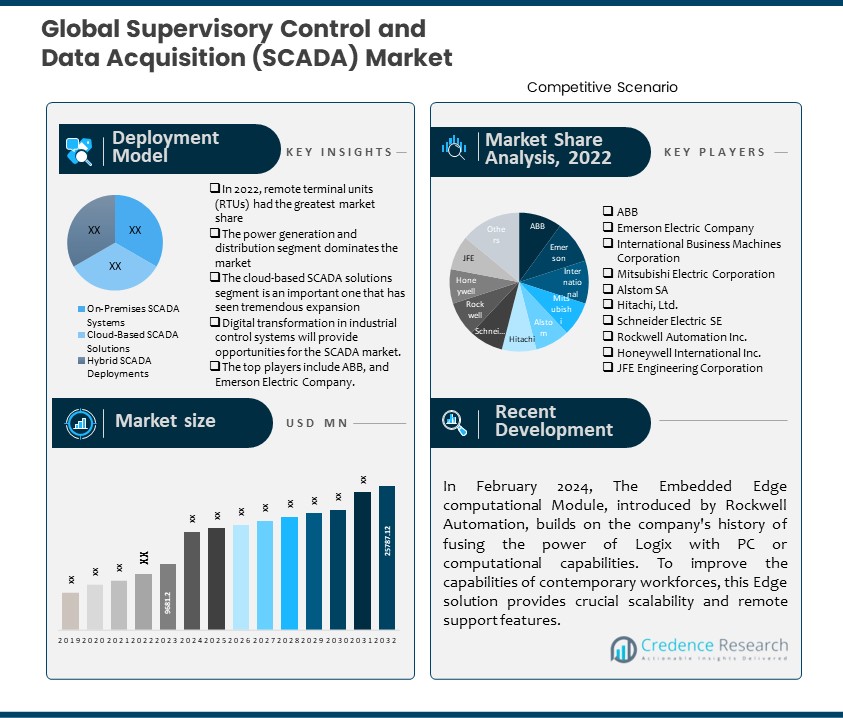
- The global market for supervisory control and data acquisition (SCADA) is expected to develop at a compound annual growth rate (CAGR) of 11.50% between 2024 and 2032, from its estimated USD 9681.2 million in 2023 to USD 25787.12 million in 2032.
- The largest category is remote terminal units (RTUs). Programmable logic controllers (PLCs), on the other hand, are expected to grow at a strong CAGR.
- The power generation and distribution category will expand at a rapid rate of growth.
- The CAGR for cloud-based SCADA solutions is expected to be the highest during the projection period.
- North America dominated the supervisory control and data acquisition (SCADA) market.
- Europe is expected to come second in terms of the market share of supervisory control and data acquisition (SCADA).
- In the supervisory control and data acquisition (SCADA) market, Asia Pacific is anticipated to grow fastest.
- The expansion of industrial automation, the increase in energy demand, and the modernization of infrastructure are among the factors propelling the growth of the global market.
- IoT integration, the need for remote monitoring, and smart grid projects may affect the supervisory control and data acquisition (SCADA) industry.
Executive Summary
Market Definition
A system of hardware and software components called supervisory control and data acquisition, or SCADA interfaces directly with plant-floor machinery to provide real-time data visualization and control over industrial operations for businesses. For industrial businesses, SCADA systems are essential because they provide efficient maintenance, data processing for informed decision-making, and system issue communication to save downtime.
Market Overview
The supervisory control and data acquisition (SCADA) sector is estimated to develop at an 11.50% compound annual growth rate (CAGR) between 2024 and 2032, maintaining its current upward trend. The market will continue to develop, rising from its estimated USD 9681.2 million in 2023 to USD 25787.12 million in 2032.
There is increasing potential for SCADA system development into new industry verticals, even though they have historically been utilized in areas like energy, oil and gas, water and wastewater, and manufacturing. SCADA is becoming increasingly popular as a means of enhancing operational visibility, control, and efficiency in industries like transportation, smart buildings, and agriculture.
SCADA systems, for example, increase the efficiency of transportation systems by automating procedures, optimizing resource use, and consuming less energy. SCADA improves operational efficiency and expedites transportation procedures by remotely monitoring and controlling a variety of components, including traffic lights, trains, buses, bridges, tunnels, and airports. SCADA systems are essential for early problem detection and diagnosis, increased system dependability, and reduced downtime. Through its real-time monitoring and control features, SCADA aids in problem-solving, risk mitigation, and the seamless functioning of transportation networks.
Segmentation by Component Type
- Remote terminal units (RTUs) are the market leader in terms of component type. SCADA systems rely heavily on these electronic components as their structural core. The main use for SCADA systems in the oil and gas sector, which is geographically distributed, relies heavily on remote data collection, which is an area in which RTUs thrive. They function by gathering data from field devices and sensors, converting it into a format that can be transmitted, and then transmitting it to the central SCADA system in a dependable manner for analysis and monitoring.
- The programmable logic controllers (PLCs) category will exhibit a sizable CAGR during the projected period. A PLC is a digital computer of the highest caliber intended for use in commercial and industrial settings, specifically for controlling tasks. PLCs were developed as an affordable substitute for relay-based systems because they are able to operate continuously, around the clock.
- Other component types, including human-machine interface (HMI), communication infrastructure, data acquisition software, supervisory control software, and SCADA security solutions, also support the need for supervisory control and data acquisition (SCADA).
Segmentation by End-User Industry
- Power generation and distribution industries dominated the market. Power-producing facilities, including wind farms, solar installations, hydroelectric dams, and thermal power plants, are continuously monitored by SCADA systems. They gather information on variables such as fuel levels, temperature, voltage, current, and power output.
- The oil and gas industry category will likely register a significant CAGR during forecasting. SCADA systems gather information on variables, including production rates, fluid composition, temperature, pressure, and other factors, to monitor the functioning of oil and gas wells. Operators use this data to remotely diagnose well problems, identify abnormalities, and maximize production.
- Other end-user industries, such as water and wastewater management, manufacturing and industrial automation, transportation and logistics, and telecommunications, also contribute to the demand for supervisory control and data acquisition (SCADA).
Segmentation by Deployment Model
- The cloud-based SCADA solutions category is projected to grow faster over the projection period. Cloud-based SCADA solutions eliminate the requirement for an initial capital investment in hardware and equipment. Rather, they function through a subscription-based framework, enabling entities to just pay for the resources and services they utilize. Big businesses and smaller, tighter-budget groups find this economic strategy appealing.
- Other deployment models, including on-premises SCADA systems and hybrid SCADA deployments, influence the need for supervisory control and data acquisition (SCADA).
Segmentation by Region
- North America leads the supervisory control and data acquisition (SCADA) industry. Superior automation of industrial facility operations and the significant presence of well-known and established market players are the two main factors driving market development in North America.
- Europe is estimated to rank second in the supervisory control and data acquisition (SCADA) market size.
- The supervisory control and data acquisition (SCADA) industry is predicted to flourish rapidly in Asia Pacific.
- Regions such as Africa, the Middle East, and Latin America cover the remaining requirement for supervisory control and data acquisition (SCADA).
Smart building systems use SCADA. Through the digital transmission of data from remote terminal units (RTUs) to the human-machine interface (HMI), real-time information on the devices and processes in smart buildings is offered. With the precise monitoring and control that this accurate information transfer ensures, there is no longer a need for manual data entry or interpretation. SCADA data enables early intervention before small faults escalate, facilitating proactive maintenance in smart buildings. SCADA systems assist in streamlining maintenance procedures and averting expensive downtime by detecting malfunctioning parts and enabling remote modifications.
Based on projections, North America is anticipated to control the supervisory control and data acquisition (SCADA) market. A major contributing reason to the region's respectable success is the key firms' robust presence and well-connected distribution network throughout the area. Additionally, to cut costs on wages, industrial facility owners in the area are attempting to decrease the number of employees at their establishments, which is having an impact on their profit margin.
The supervisory control and data acquisition (SCADA) market in Asia Pacific is anticipated to expand fastest throughout the forecast. Asia Pacific is anticipated to gain significant market share, driven primarily by the growth of the SCADA industry in nations like China, India, and Japan. Furthermore, it is anticipated that the growth of industrial clusters in emerging markets like India will support regional product demand.
Key Highlights of the Report
The global supervisory control and data acquisition (SCADA) market is segmented by component type, end-user industry, deployment model, and region. As far as the component type is concerned, remote terminal units (RTUs) are the market spearhead. Power generation and distribution are the top category. The cloud-based SCADA solutions category is anticipated to increase at the highest CAGR throughout the projection period. The supervisory control and data acquisition (SCADA) market is expanding mostly in North America.
SCADA systems are becoming increasingly prevalent in agriculture. By giving real-time data on agricultural growth parameters, including soil moisture, temperature, and humidity, SCADA systems facilitate precision farming. By using this information, farmers may reduce waste and increase crop output by making well-informed decisions about the use of water, fertilizer, and pesticides. Farmers may remotely monitor and manage irrigation systems, fertilizer applications, and other agricultural machinery from a single place because of SCADA, which automates manual labor in agriculture. By reducing the need for manual intervention and saving time and money, this automation improves operational efficiency. Businesses like SCADACore, a Canada-based provider of cloud-ready industrial monitoring solutions, online SCADA, and IIoT, provide a solution called SCADACore Live that enables remote agriculture monitoring for digital agricultural applications.
North America is expected to account for the largest supervisory control and data acquisition (SCADA) market globally. Corporations are prioritizing the integration of various automation systems and relying on data-driven operations at their plants to strategically cut labor and automate processes. The Asia Pacific region is also assumed to have the market's sharpest growth. The well-established and advanced manufacturing clusters in China and Japan offer a promising outlook for the product's sales in the Asia Pacific region. Together, these nations provide over 70% of the region's income due to their exceptional manufacturing performances.
Which Key Factors Are Driving The Global Supervisory Control and Data Acquisition (SCADA) Market?
The market for supervisory control and data acquisition (SCADA) is expanding due to a number of factors, including the emphasis on operational efficiency, fast urbanization and industrial growth, and the digital revolution.
What Are The Main Challenges Confronting The Global Supervisory Control and Data Acquisition (SCADA) Market?
The supervisory control and data acquisition (SCADA) industry is facing several major obstacles, such as high implementation costs, sophisticated integration, and a shortage of experienced labor.
What Market Opportunities Exist For Supervisory Control and Data Acquisition (SCADA) Globally?
The necessity for real-time monitoring, asset management, water management solutions, and the use of SCADA systems in the oil and gas industry's exploration and production creates market opportunities for the supervisory control and data acquisition (SCADA) market.
Market Drivers
Multiple factors propel the supervisory control and data acquisition (SCADA) industry across the globe. The primary factors propelling the global supervisory control and data acquisition (SCADA) market are as follows:
Increased SCADA Compliance in Portable Equipment to Boost Sales
The main purpose of supervisory control and data acquisition systems is to keep an eye on and manage industrial process operations. The expanding trend of automation and wireless networking has given these systems the ability to provide virtual control notable momentum with clients. Nowadays, as employees use their phones more frequently, the idea of portable workstations has become widely accepted in a variety of end-use industries. Furthermore, real-time data gathering, warning, and reporting at almost any position via a mobile phone will provide the operator with more control and enable them to operate the floor of operations with higher efficiency.
Market Restraints
There are several obstacles that the global supervisory control and data acquisition (SCADA) market must overcome to continue growing. Among them are the following:
High Initial Costs Could Impede the Growth of the Market
During the project's early phases, significant investments are required for the installation and use of SCADA systems. Additional significant financial outlays are required for the installation of software and the acquisition of hardware. Also, because of the system's complexity, the facility managers need programmers, analysts, and operators who are extremely knowledgeable and experienced in order to operate and maintain the SCADA system. Hiring a crew with the necessary skills and training also raised the industrial facility's overhead operating costs. This particular situation is exacerbating the difficulty associated with system integration.
Opportunities
There are plenty of potential prospects in the global supervisory control and data acquisition (SCADA) industry. Among these are the following:
Government Support for the Implementation of SCADA is Growing
The adoption and development of SCADA systems are greatly aided by government initiatives, especially in fields that are essential to public services and the nation's infrastructure. To maintain public health and environmental sustainability, governments are concentrating on improving wastewater treatment and water resource management. To operate pumping stations, identify leaks, monitor water quality, and maximize resource use, SCADA systems are installed in water treatment facilities and distribution networks. As an illustration, in September 2023, the Rajasthan State Water Informatic Centre in India-which functions under the State Water Resources Department (WRD)-was getting ready to incorporate SCADA technology into the Indira Gandhi Canal. It was anticipated that the use of SCADA would facilitate prompt information sharing, transparent water distribution, and guarantee water supply for all parties involved. These improvements are essential for managing irrigation water effectively.
The implementation of SCADA systems with improved security features is a government priority for safeguarding key defense infrastructure and national security assets. To provide resilience against hostile activities and cyber threats, SCADA is utilized in cybersecurity operations, border monitoring, and military sites. Additionally, governments are quickly stepping up the cybersecurity of SCADA systems utilized in vital defense infrastructure and national security assets. To enhance the cyber security of SCADA networks nationwide, for example, the US Department of Energy announced 21 actions. Stricter laws are being developed and put into effect by governments to secure SCADA systems in critical infrastructure industries. Certain security procedures, vulnerability analyses, and incident response plans are frequently required by these laws.
Competitive Landscape
Key Players
Several major competitors exist in the fiercely competitive global supervisory control and data acquisition (SCADA) market. The following are a few of the leading market participants and their market shares:
- ABB
- Emerson Electric Company
- International Business Machines Corporation
- Mitsubishi Electric Corporation
- Alstom SA
- Hitachi, Ltd.
- Schneider Electric SE
- Rockwell Automation Inc.
- Honeywell International Inc.
- JFE Engineering Corporation
- Others
These companies prioritize product innovation, distribution channel expansion, mergers, and acquisitions to remain competitive.
The largest suppliers in the global supervisory control and data acquisition (SCADA) market continuously work to stay one step ahead of the competition by developing innovative concepts and products.
In February 2024, Emerson Electric Co. introduced the PACSystems IPC 2010 Compact Industrial PC (IPC), the newest model in its lineup. This PC is designed to meet the demands of a variety of machine and discrete part production automation operations. This strong solution supports OEM machine builders and manufacturing facilities that need a space-efficient, resilient IPC to effectively and affordably support their digital transformation projects and Industrial Internet of Things (IIoT) initiatives.
In September 2022, PLC and SCADA software for nuclear plants and ISRO centers was introduced by Electronics Corporation of India Limited (ECIL), a public sector enterprise under the Department of Atomic Energy.
In May 2022, American industrial automation supplier Rockwell Automation released updated versions of its FactoryTalk View Site software, V13. Through FactoryTalk ViewPoints web points, the recently released product provides enhanced interaction with the logic controller while efficiently controlling HMI animation for automated diagnostics.
In September 2021, The integration of an all-in-one SCADA solution into its global renewable energy projects has been announced by Ingeteam Wind Energy. The company works in power conversion technology and electrical control systems. It is anticipated that the program will lead to a greater market uptake of the indicated technology.
How are Companies Performing in the Supervisory Control and Data Acquisition (SCADA) Market?
Companies operating in the Supervisory Control and Data Acquisition (SCADA) sector are successful because of a number of critical factors. Companies are utilizing SCADA systems to increase overall productivity, equipment efficiency, product and process quality, degree of autonomy, and overall flexibility in order to achieve intelligent management of manufacturing activities. Emerson, for example, created and introduced a brand-new industrial software platform. This software platform will assist in the development of a sophisticated and technologically superior SCADA system. It will also be scalable software that will improve operations through improved decision-making, problem-solving, and general industrial facility management.
Companies like Emerson Electric, Schneider Electric, Omron Corporation, and others are attempting to expand their market share in the world by utilizing both organic and inorganic strategies. These strategies include investing in R&D, diversifying their product offerings through creative product launches, and pursuing mergers and acquisitions to expand their footprint across regions with numerous opportunities.
Companies have formed collaborations to enhance their skills in response to the spike in demand for SCADA. For example, in May 2023, Hexagon joined up with Zealand-based Scada Systems, Ltd. to provide a comprehensive engineering and design solution for projects requiring electrical and instrumentation.
Significant Companies in the market have begun to acquire companies in order to increase their market penetration and reach as a result of increased competition. For example, in September 2022, Schneider Electric acquired AVEVA in order to accelerate the company's software growth strategy and drive digital transformation for industrial organizations managing complex operational processes. The acquisition was made in order to drive digital transformation for these organizations.
Summary of Key Findings
- The implementation of SCADA technologies for infrastructure management and patient care is growing in healthcare facilities.
- The market is segmented by component type, end-user industry, deployment model, and region.
- In the market, remote terminal units (RTUs) are the most widely used component type.
- Power generation and distribution are the foremost end-user industry category.
- Cloud-based SCADA solutions are expected to grow fastest in terms of CAGR during the forecast period.
- North America is leading market development; the market is highly competitive with key players including ABB, Emerson Electric Company, International Business Machines Corporation, Mitsubishi Electric Corporation, Alstom SA, Hitachi, Ltd., Schneider Electric SE, Rockwell Automation Inc., Honeywell International Inc., JFE Engineering Corporation, and Others.
Future Outlook
- The supervisory control and data acquisition (SCADA) industry is expected to increase significantly in North America, and its outlook is positive worldwide.
- Constant improvements in SCADA technology boost system performance and propel industry expansion.
- Compatibility problems between distinct SCADA systems and devices from different vendors might impede seamless integration and data interchange.
- To stay ahead of the competition, key enterprises must develop new products, expand their market reach, and keep their prices competitive.
How CXOs Can Benefit from the Credence Research Supervisory Control and Data Acquisition (SCADA) Market Report
CXOs may get a detailed picture of the market in the Credence Research Supervisory Control and Data Acquisition (SCADA) Market Report, which includes:
- Market size and growth forecast: The report provides detailed estimates of the global supervisory control and data acquisition (SCADA) market size, segmented by component type, end-user industry, deployment model, and region. It also includes forecasts for the market through 2032 based on key trends and drivers.
- Market segmentation: The research report breaks down the market for supervisory control and data acquisition (SCADA) into segments based on component type, end-user industry, deployment model, and region. This segmentation provides CXOs with a granular understanding of the market and the opportunities in each segment.
- Competitive landscape: The research report offers a detailed analysis of the major companies in the supervisory control and data acquisition (SCADA) industry, including information on their business plans, product lines, and earnings. CXOs can use this information to evaluate and identify their competitors.
- Key trends and drivers: The research report identifies and evaluates the main trends and factors influencing the supervisory control and data acquisition (SCADA) market. CXOs can use this information to make well-informed choices regarding their plans and investments.
CXOs can use the insights from the Credence Research Supervisory Control and Data Acquisition (SCADA) Market Report to:
- Identify growth opportunities: This analysis may help CXOs identify new growth opportunities in the supervisory control and data acquisition (SCADA) sector. For example, the report identifies the growing demand for supervisory control and data acquisition (SCADA) from the oil and gas sector as a key opportunity.
- Make informed investment decisions: The report helps CXOs wisely choose supervisory control and data acquisition (SCADA). For example, the research study provides information on the critical factors to consider when selecting supervisory control and data acquisition (SCADA) solutions and evaluating suppliers.
- Develop competitive strategies: CXOs can use the research report to develop competitive strategies for their supervisory control and data acquisition (SCADA) businesses. For example, the research paper outlines the main strategies that supervisory control and data acquisition (SCADA) suppliers utilize to differentiate themselves from competitors.
- Track market developments: This research report may help CXOs stay ahead of the curve by tracking market developments. For instance, it offers insights into the most recent developments and trends in the supervisory control and data acquisition (SCADA) market.
CXOs seeking to expand their industry knowledge and spot growth prospects will find the Credence Research Supervisory Control and Data Acquisition (SCADA) Market Report useful.
Segmentation
- By Component Type
- Human-machine interface (HMI)
- Remote Terminal Units (RTUs)
- Programmable Logic Controllers (PLCs)
- Communication Infrastructure
- Data Acquisition Software
- Supervisory Control Software
- SCADA Security Solutions
- By End-User Industry
- Oil and Gas
- Water and Wastewater Management
- Power Generation and Distribution
- Manufacturing and Industrial Automation
- Transportation and Logistics
- Telecommunications
- By Deployment Model
- On-Premises SCADA Systems
- Cloud-Based SCADA Solutions
- Hybrid SCADA Deployments
- By Region
- North America
- The U.S.
- Canada
- Mexico
- Europe
- Germany
- France
- The U.K.
- Italy
- Spain
- Rest of Europe
- Asia Pacific
- China
- Japan
- India
- South Korea
- South-east Asia
- Rest of Asia Pacific
- Latin America
- Brazil
- Argentina
- Rest of Latin America
- Middle East & Africa
- GCC Countries
- South Africa
- The Rest of the Middle East and Africa
- North America

Request a Free Sample
Fill in your details and we'll send you a free sample report.
- Sample data tables & charts
- Research methodology
Market Dynamics
Expansion of Industrial Automation
The increasing adoption of automation across industries such as manufacturing, energy, and utilities is driving demand for SCADA systems, which enable real-time monitoring and control of complex processes, improving operational efficiency and reducing downtime.
Rising Energy Demand and Smart Grid Initiatives
Growing global energy consumption and the modernization of power infrastructure, including the deployment of smart grids, require advanced SCADA solutions for efficient grid management, remote monitoring, and rapid fault detection.
Integration of IoT and Cloud Technologies
The integration of Internet of Things (IoT) devices and the shift toward cloud-based SCADA solutions are enabling more scalable, flexible, and cost-effective system deployments, supporting remote access and advanced analytics.
Government Support and Infrastructure Modernization
Government initiatives to upgrade water, energy, and transportation infrastructure, along with stricter regulations for critical infrastructure monitoring and cybersecurity, are accelerating the adoption of SCADA systems in both developed and emerging markets.
Need for Remote Monitoring and Operational Visibility
The increasing need for remote monitoring, especially in geographically dispersed operations such as oil & gas pipelines and renewable energy installations, is boosting the demand for SCADA systems that provide centralized, real-time data and control capabilities.
Need a Custom Version of This Report?
Tailor the scope, geography, or segments to your exact requirements.
- Custom geography or segment scope
- Direct access to our analyst team
Frequently Asked Questions
What is the current size of the Supervisory Control and Data Acquisition (SCADA) software market?
What factors are driving the growth of the Supervisory Control and Data Acquisition (SCADA) software market?
In terms of component type, which market category is leading?
Regarding the end-user industry, which market category is in the lead?
Who are the main players globally in the supervisory control and data acquisition (SCADA) industry?
Table of Content
Chapter 1 Market Segmentation
- 1.1 Segmentation Framework
- 1.1.1 Product and Service Classification
- 1.1.2 Application and End-Use Classification
- 1.1.3 Technology and Solution Classification
- 1.1.4 Customer and Distribution Channel Classification
- 1.1.5 Geographic Segmentation
- 1.1.6 Market Segment Definitions and Boundaries
- 1.2 By Component Type
- 1.2.1 Human-machine interface (HMI)
- 1.2.2 Remote Terminal Units (RTUs)
- 1.2.3 Programmable Logic Controllers (PLCs)
- 1.2.4 Communication Infrastructure
- 1.2.5 Data Acquisition Software
- 1.2.6 Supervisory Control Software
- 1.2.7 SCADA Security Solutions
- 1.3 By Deployment Model
- 1.3.1 On-Premises SCADA Systems
- 1.3.2 Cloud-Based SCADA Solutions
- 1.3.3 Hybrid SCADA Deployments
- 1.4 By End-User Industry
- 1.4.1 Oil and Gas
- 1.4.2 Water and Wastewater Management
- 1.4.3 Power Generation and Distribution
- 1.4.4 Manufacturing and Industrial Automation
- 1.4.5 Transportation and Logistics
- 1.4.6 Telecommunications
Chapter 2 Introduction
- 2.1 Report Objectives and Scope
- 2.2 Product Definition and Industry Terminology
- 2.3 Market Inclusions and Exclusions
- 2.4 Research Process
- 2.4.1 Primary Research and Expert Interviews
- 2.4.2 Secondary Research and Source Review
- 2.4.3 Top-Down and Bottom-Up Estimation
- 2.4.4 Data Triangulation and Verification
- 2.5 Market Size Measurement Basis
- 2.5.1 2023: USD 9,681.2 million → 2032: USD 25,787.12 million
- 2.6 Historical and Forecast Reference Periods
- 2.6.1 Base Year: 2023
- 2.6.2 Forecast Period: 2023-2032
- 2.7 Research Assumptions and Limitations
Chapter 3 Executive Summary
- 3.1 Market Snapshot and Key Findings
- 3.2 Base-Year Market Size, 2023
- 3.3 Forecast Market Size, 2032
- 3.4 Revenue and Volume Growth Outlook
- 3.5 Key Demand and Supply Indicators
- 3.6 Leading Market Segments
- 3.7 Fastest-Growing Market Opportunities
- 3.8 Regional Performance Highlights
- 3.9 Technology and Industry Transformation
- 3.10 Competitive Landscape Summary
- 3.11 Analyst View and Strategic Implications
Chapter 4 Global Supervisory Control and Data Acquisition (SCADA) Market Trends and Developments
- 4.1 Historical Industry Development
- 4.2 Recent Market Trends and Developments
- 4.3 Demand and Customer Behavior Trends
- 4.4 Technology and Product Innovation
- 4.5 Artificial Intelligence, Automation and Digitalization
- 4.6 Local Manufacturing and Supply Chain Realignment
- 4.7 Industry Partnerships, Mergers and Acquisitions
- 4.8 Sustainability and Circular Economy Developments
- 4.9 Government and Private Sector Investment Trends
- 4.10 Emerging Business Models and Commercialization
- 4.11 Industry Developments and Announcements
Chapter 5 Global Supervisory Control and Data Acquisition (SCADA) Market Production, Supply and Demand Analysis
- 5.1 Demand Trend and Consumption Analysis
- 5.2 Demand Forecast, 2023-2032
- 5.3 Production and Output Trend
- 5.4 Production and Output Forecast, 2023-2032
- 5.5 Installed Capacity and Capacity Utilization
- 5.6 Company-Wise Production Plants and Statistics
- 5.6.1 Installed Production Capacity
- 5.6.2 Actual Production
- 5.6.3 Planned Capacity and Expansion Targets
- 5.7 Supply Chain Structure and Procurement Trends
- 5.8 Supply-Demand Gap and Bottlenecks
- 5.9 Import Dependence and Sourcing Structure
- 5.10 Contract Manufacturing and Outsourcing
- 5.11 Regional Supply and Demand Concentration
Chapter 6 Global Supervisory Control and Data Acquisition (SCADA) Market Pricing Analysis
- 6.1 Pricing Structure and Measurement
- 6.2 Historical Pricing Trends
- 6.3 Pricing Outlook, 2023-2032
- 6.4 Average Selling Price and Unit Economics
- 6.5 Pricing by Product and Market Segment
- 6.6 Geographic Pricing Differences
- 6.7 Key Input, Energy, Labor and Logistics Costs
- 6.8 Contract Pricing and Purchasing Models
- 6.9 Pricing Sensitivity and Competitive Positioning
- 6.10 Price, Margin and Profitability Implications
Chapter 7 Global Supervisory Control and Data Acquisition (SCADA) Market Dynamics
- 7.1 Market Growth Drivers
- 7.1.1 Demand-Side Drivers
- 7.1.2 Technology and Innovation Drivers
- 7.1.3 Infrastructure and Investment Drivers
- 7.1.4 Regulatory and Policy Drivers
- 7.2 Market Restraints
- 7.2.1 Cost and Affordability Constraints
- 7.2.2 Technology and Adoption Barriers
- 7.2.3 Supply Chain and Operational Constraints
- 7.3 Market Challenges
- 7.3.1 Competitive Pressure and Margin Erosion
- 7.3.2 Skills, Infrastructure and Implementation Gaps
- 7.4 Emerging Market Opportunities
- 7.5 Market Dynamics Impact and Time-Horizon Assessment
Chapter 8 Global Supervisory Control and Data Acquisition (SCADA) Value Chain Analysis
- 8.1 Industry Value Chain Overview
- 8.2 Upstream Suppliers and Critical Inputs
- 8.3 Technology and Component Providers
- 8.4 Manufacturing or Service Delivery
- 8.5 Distribution, Channel Partners and Integrators
- 8.6 Downstream Applications and End Users
- 8.7 Value Addition and Profit Pools
- 8.8 Vertical Integration and Outsourcing
- 8.9 Supplier Concentration and Risk
- 8.10 Supply Chain Localization and Resilience
Chapter 9 Global Supervisory Control and Data Acquisition (SCADA) Market Regulations and Policies
- 9.1 Relevant Laws, Standards and Compliance Frameworks
- 9.2 Product, Service, Safety and Quality Requirements
- 9.3 Government Policies, Incentives and Subsidies
- 9.4 Imports, Exports and Trade Barriers
- 9.5 Public Procurement and Local Content Requirements
- 9.6 Environmental and Sustainability Compliance
- 9.7 Data Protection, AI and Cybersecurity Compliance
- 9.8 Upcoming Policy Changes and Market Implications
Chapter 10 Global Supervisory Control and Data Acquisition (SCADA) Market Hotspots and Opportunities
- 10.1 Market Opportunity Mapping and Growth Hotspots
- 10.2 High-Growth Applications and Customer Groups
- 10.3 Underserved Markets and White-Space Opportunities
- 10.4 Emerging Technology and Product Opportunities
- 10.5 New Capacity and Investment Hotspots
- 10.6 Market Entry and Expansion Opportunities
- 10.7 Distribution and Partnership Opportunities
- 10.8 Near-Term and Long-Term Commercial Potential
- 10.9 Opportunity Attractiveness and Execution Risks
Chapter 11 Global Supervisory Control and Data Acquisition (SCADA) Market Outlook, 2023-2032
- 11.1 Market Size and Analysis
- 11.1.1 Revenue (Market Measurement: 2023: USD 9,681.2 million → 2032: USD 25,787.12 million)
- 11.1.2 Market Volume and Quantity Sold
- 11.1.3 Historical Market Size
- 11.1.4 Base-Year Market Size, 2023
- 11.2 Market Forecast, 2023-2032
- 11.2.1 Revenue Forecast to 2032
- 11.2.2 Volume Forecast to 2032
- 11.2.3 CAGR and Year-on-Year Growth
- 11.2.4 Incremental Revenue Opportunity
- 11.3 Forecast Assumptions and Scenario Analysis
- 11.3.1 Base-Case Forecast
- 11.3.2 Optimistic and Conservative Scenarios
- 11.3.3 Technology, Pricing and Policy Sensitivities
- 11.4 Market Attractiveness and Growth Outlook
Chapter 12 Global Supervisory Control and Data Acquisition (SCADA) Market Segmentation and Outlook
- 12.1 Segmentation Summary and Market Shares, 2023
- 12.2 Largest and Fastest-Growing Segments
- 12.3 By Component Type - Market Size and Forecast, 2023-2032
- 12.3.1 Segment Definition and Scope
- 12.3.2 Historical Market Size
- 12.3.3 Revenue Forecast, 2023-2032
- 12.3.4 Volume Forecast, 2023-2032
- 12.3.5 Base-Year Market Share, 2023
- 12.3.6 Segment CAGR and Growth Drivers
- 12.3.7 Subsegment Market Size and Forecast
- 12.3.7.1 Human-machine interface (HMI)
- 12.3.7.2 Remote Terminal Units (RTUs)
- 12.3.7.3 Programmable Logic Controllers (PLCs)
- 12.3.7.4 Communication Infrastructure
- 12.3.7.5 Data Acquisition Software
- 12.3.7.6 Supervisory Control Software
- 12.3.7.7 SCADA Security Solutions
- 12.3.8 Subsegment Pricing and Adoption Trends
- 12.3.9 Leading Suppliers and Competition
- 12.3.10 Regional Demand and Opportunities
- 12.4 By Deployment Model - Market Size and Forecast, 2023-2032
- 12.4.1 Segment Definition and Scope
- 12.4.2 Historical Market Size
- 12.4.3 Revenue Forecast, 2023-2032
- 12.4.4 Volume Forecast, 2023-2032
- 12.4.5 Base-Year Market Share, 2023
- 12.4.6 Segment CAGR and Growth Drivers
- 12.4.7 Subsegment Market Size and Forecast
- 12.4.7.1 On-Premises SCADA Systems
- 12.4.7.2 Cloud-Based SCADA Solutions
- 12.4.7.3 Hybrid SCADA Deployments
- 12.4.8 Subsegment Pricing and Adoption Trends
- 12.4.9 Leading Suppliers and Competition
- 12.4.10 Regional Demand and Opportunities
- 12.5 By End-User Industry - Market Size and Forecast, 2023-2032
- 12.5.1 Segment Definition and Scope
- 12.5.2 Historical Market Size
- 12.5.3 Revenue Forecast, 2023-2032
- 12.5.4 Volume Forecast, 2023-2032
- 12.5.5 Base-Year Market Share, 2023
- 12.5.6 Segment CAGR and Growth Drivers
- 12.5.7 Subsegment Market Size and Forecast
- 12.5.7.1 Oil and Gas
- 12.5.7.2 Water and Wastewater Management
- 12.5.7.3 Power Generation and Distribution
- 12.5.7.4 Manufacturing and Industrial Automation
- 12.5.7.5 Transportation and Logistics
- 12.5.7.6 Telecommunications
- 12.5.8 Subsegment Pricing and Adoption Trends
- 12.5.9 Leading Suppliers and Competition
- 12.5.10 Regional Demand and Opportunities
- 12.6 Segment Growth Comparison
- 12.7 Segment Attractiveness and Priority Matrix
Chapter 13 Global Supervisory Control and Data Acquisition (SCADA) End-Use and Application Market Outlook
- 13.1 End-Use Industry and Customer Demand Structure
- 13.2 Leading Applications and Customer Groups
- 13.3 End-Use Market Size, Share and Forecast
- 13.4 Major End-Use Industry Deep Dives
- 13.4.1 Customer Requirements and Use Cases
- 13.4.2 Demand and Replacement Cycles
- 13.4.3 Technical and Regulatory Considerations
- 13.4.4 Purchasing and Procurement Models
- 13.4.5 Leading Vendors and Distribution Channels
- 13.4.6 Forecast and Commercial Opportunities
- 13.5 Emerging Applications and Cross-Segment Demand
- 13.6 End-Use Industry Investment Priorities
Chapter 14 Global Supervisory Control and Data Acquisition (SCADA) Geographic Market Outlook, 2023-2032
- 14.1 Regional Market Size and Share, 2023
- 14.2 Regional Market Forecast, 2023-2032
- 14.3 Regional Pricing, Production and Demand Differences
- 14.4 North America
- 14.4.1 United States
- 14.4.2 Canada
- 14.4.3 Mexico
- 14.5 Europe
- 14.5.1 Germany
- 14.5.2 France
- 14.5.3 Italy
- 14.5.4 United Kingdom
- 14.5.5 Spain
- 14.5.6 Poland
- 14.5.7 Russia
- 14.5.8 Netherlands
- 14.5.9 Belgium
- 14.5.10 Sweden
- 14.5.11 Denmark
- 14.5.12 Norway
- 14.5.13 Rest of Europe
- 14.6 Asia Pacific
- 14.6.1 China
- 14.6.2 India
- 14.6.3 Japan
- 14.6.4 South Korea
- 14.6.5 Thailand
- 14.6.6 Indonesia
- 14.6.7 Vietnam
- 14.6.8 Malaysia
- 14.6.9 Australia
- 14.6.10 Rest of Asia Pacific
- 14.7 Latin America
- 14.7.1 Brazil
- 14.7.2 Argentina
- 14.7.3 Colombia
- 14.7.4 Chile
- 14.7.5 Rest of Latin America
- 14.8 Middle East
- 14.8.1 Saudi Arabia
- 14.8.2 United Arab Emirates
- 14.8.3 Turkey
- 14.8.4 Israel
- 14.8.5 Iran
- 14.8.6 Rest of the Middle East
- 14.9 Africa
- 14.9.1 South Africa
- 14.9.2 Egypt
- 14.9.3 Nigeria
- 14.9.4 Morocco
- 14.9.5 Rest of Africa
- 14.10 Regional Investment, Policy and Supply Chain Differences
- 14.11 Regional Competitive Landscape
- 14.12 Geographic Growth Hotspots
Chapter 15 Global Supervisory Control and Data Acquisition (SCADA) Technology, Innovation and Sustainability Outlook
- 15.1 Technology Landscape and Maturity
- 15.2 Product, Process and Service Innovation
- 15.3 AI, Automation and Digital Tools in the Industry
- 15.4 Technology Adoption and Performance Benchmarking
- 15.5 Innovation Pipeline and R&D Investment
- 15.6 Patent and Intellectual Property Trends
- 15.7 Energy Efficiency and Resource Management
- 15.8 Sustainability, Recycling and Circularity
- 15.9 Technology Roadmap, 2023-2032
- 15.10 Risks of Obsolescence and Technology Substitution
Chapter 16 Global Supervisory Control and Data Acquisition (SCADA) Market Key Strategic Imperatives
- 16.1 Growth and Market Entry Priorities
- 16.2 High-Return Products and Segments
- 16.3 Pricing, Profitability and Cost Optimization
- 16.4 Technology Investment and Product Differentiation
- 16.5 Supply Chain Localization and Resilience
- 16.6 Distribution and Customer Acquisition
- 16.7 Partnership, Acquisition and Capacity Strategy
- 16.8 Regional Expansion Priorities
- 16.9 Short-, Medium- and Long-Term Actions
Chapter 17 Competition Outlook
- 17.1 Industry Competition Characteristics
- 17.2 Market Structure and Concentration
- 17.3 Market Share and Competitive Positioning, 2023
- 17.4 Company-Wise Revenue and Product Benchmarking
- 17.5 Production and Service Capacity Benchmarking
- 17.6 Technology, Pricing and Differentiation
- 17.7 Regional Footprint and Distribution Strength
- 17.8 Mergers, Acquisitions and Strategic Alliances
- 17.9 New Entrants and Competitive Threats
- 17.10 Porter's Five Forces and Industry Attractiveness
- 17.11 Competitive Outlook, 2023-2032
Chapter 18 Company Profiles
- 18.1 Company Coverage and Selection Criteria
- 18.2 ABB
- 18.2.1 Business Description
- 18.2.2 Company Ownership and Geographic Presence
- 18.2.3 Product and Service Portfolio
- 18.2.4 Manufacturing and Operating Footprint
- 18.2.5 Production Capacity and Expansion Plans
- 18.2.6 Financial Performance and Investment
- 18.2.7 Market Share and Competitive Position
- 18.2.8 Technology and Innovation Capabilities
- 18.2.9 Strategic Alliances or Partnerships
- 18.2.10 Recent Developments
- 18.2.11 Growth Strategy and Outlook
- 18.3 Emerson Electric Company
- 18.4 Schneider Electric SE
- 18.5 Honeywell International Inc.
- 18.6 Rockwell Automation Inc.
- 18.7 Mitsubishi Electric Corporation
- 18.8 Hitachi, Ltd.
- 18.9 Alstom SA
- 18.10 International Business Machines Corporation
- 18.11 JFE Engineering Corporation
- 18.12 Other Relevant Market Participants
Note: Every listed company is profiled on the structure shown under the first company. The company list is preliminary and may change based on research findings, market developments, data availability and client requirements.
Chapter 19 Disclaimer
- 19.1 Research and Forecast Disclaimer
- 19.2 Data Source and Estimation Limitations
Note: The depth of individual sections depends on data availability for this market. Volume, capacity, trade and other unit-based metrics are included where applicable.

