
Market Overview
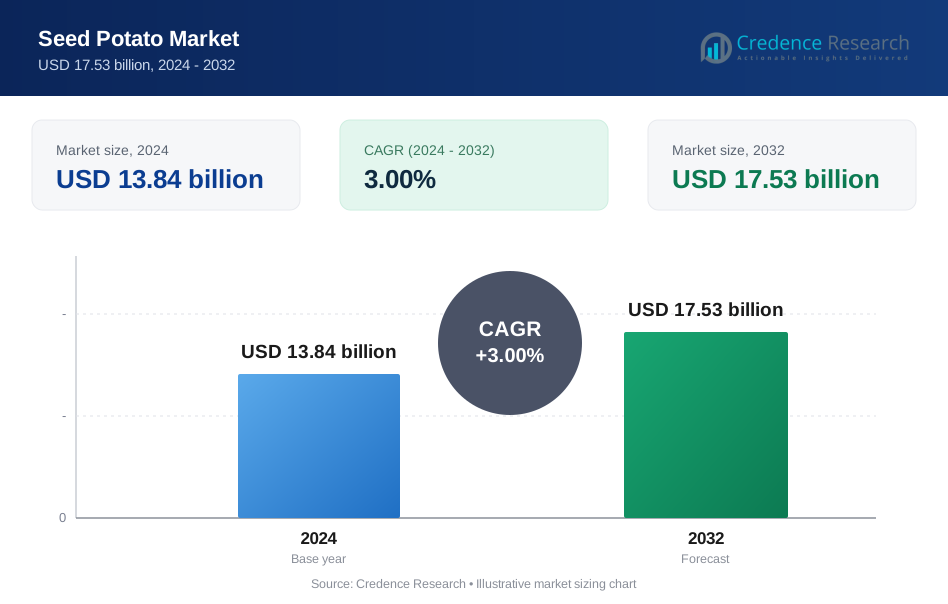
The Seed Potato Market reached USD 13.84 billion in 2024. The market is projected to grow to USD 17.53 billion by 2032, supported by a CAGR of 3% during the forecast period.
| REPORT ATTRIBUTE | DETAILS |
|---|---|
| Historical Period | 2020-2023 |
| Base Year | 2024 |
| Forecast Period | 2025-2032 |
| Seed Potato Market Size 2024 | USD 13.84 Billion |
| Seed Potato Market, CAGR | 3% |
| Seed Potato Market Size 2032 | USD 17.53 Billion |
The top players in the Seed Potato market include HZPC Holland BV, Agrico, Germicopa, Solana Group, Europlant Pflanzenzucht GmbH, Meijer Potato, Norika Nordring, IPM Potato Group, Neiker Tecnalia, and Albert Bartlett & Sons Ltd. These companies expand their presence through advanced breeding programs, large-scale certified seed production, and strong international distribution networks. North America leads the market with a 32% share, supported by well-structured seed certification systems and strong demand from processing industries. Europe follows with a 28% share, driven by export-oriented seed production, while Asia Pacific holds 27%, supported by rising commercial potato farming and rapid adoption of improved seed varieties.
 Market Insights
- The Seed Potato market reached USD 13.84 billion in 2024 and will grow at a CAGR of 3 percent through 2032, supported by rising demand for high-quality planting materials.
- Growing adoption of certified seed potatoes drives market expansion, with the certified segment holding a 46 percent share due to higher yield reliability and stronger disease resistance.
- Tissue culture seeds, climate-resilient varieties, and digital farming tools shape key market trends as producers invest in advanced breeding and cleaner multiplication systems.
- Competition among HZPC, Agrico, Germicopa, Solana, Europlant, Meijer, Norika, IPM Potato Group, Neiker, and Albert Bartlett strengthens innovation, while high seed costs and limited farmer awareness remain major restraints.
- North America leads the market with a 32 percent share, followed by Europe at 28 percent and Asia Pacific at 27 percent, while commercial farming dominates application demand with a 52 percent market share.
Market Segmentation Analysis:
By Type
Certified seed potatoes hold the lead with a 46% market share, driven by strong demand for disease-free and high-yield planting material in commercial agriculture. Farmers prefer certified seeds because they offer better germination rates, improved resistance to viral and bacterial infections, and higher productivity per acre. Tissue-culture seed potatoes gain traction as producers adopt clean planting material for premium and export-grade crops. Conventional seed potatoes remain relevant for small farms due to lower costs, while GM seed potatoes grow gradually in regions adopting biotech solutions. Rising awareness of quality planting inputs supports steady growth across all seed types.
- For instance, Mahindra HZPC Pvt. Ltd. (a joint venture involving HZPC Holland BV) launched an aeroponics facility capable of generating 3 million minitubers per year. The company also planned to launch six new potato varieties.
By Potato Variety
Russet potatoes dominate the market with a 39% share, supported by high demand in processing industries for fries, wedges, and dehydrated products. Their strong shelf life, starch content, and uniform size make them ideal for large-scale commercial buyers. Yellow varieties gain momentum due to rising consumer preference for creamy texture and improved cooking quality. Red potatoes remain popular in fresh markets for salads and table consumption. Other niche varieties, including fingerlings and specialty types, grow steadily as premium retail and gourmet food channels expand. Diversification in food habits strengthens demand across multiple varieties.
- For instance, Germicopa conducts extensive breeding trials in its French research station and international network to select individuals that meet customer expectations, specifically evaluating characteristics like dry matter content and frying color stability for processing varieties.
By Application
Commercial farming leads with a 52% market share, driven by large-scale cultivation, mechanization, and rising adoption of certified and tissue-culture seed potatoes. Farmers invest in high-quality seed materials to increase yield consistency and reduce crop losses from pests and diseases. The processing industry follows, supported by strong demand from manufacturers of chips, fries, and dehydrated potato products. Table consumption shows stable growth in domestic markets due to expanding urban demand for fresh potatoes. Seed production grows as governments and private firms expand breeding programs and quality-certified seed farms to improve national productivity.
Key Growth Drivers
Growing Demand for High-Quality and Disease-Free Seed Potatoes
Demand for certified and disease-free seed potatoes rises as farmers aim to improve yield, reduce crop losses, and enhance overall plant health. Viral, fungal, and bacterial infections significantly impact productivity, pushing growers toward reliable planting materials. Governments promote quality certification programs and offer subsidies to increase adoption among commercial producers. The shift toward structured seed multiplication systems strengthens supply chains. Rising awareness of the benefits of clean seeds supports large-scale cultivation and boosts long-term productivity across major potato-producing regions.
- For instance, HZPC uses advanced, high-tech laboratory environments and innovative processes, including aeroponics and tissue culture, to produce high-quality, virus-free minitubers under controlled conditions.
Expansion of Commercial Farming and Processing Industries
The growth of commercial potato farming and the expansion of processing sectors such as chips, fries, and dehydrated products drive strong demand for consistent, high-yield seed varieties. Large farms increasingly rely on certified and tissue-culture seeds to meet industry standards for size, shape, and dry matter content. Processing companies prefer varieties like Russet that provide uniformity and efficiency in industrial lines. Rising investments in contract farming and cold-storage infrastructure further strengthen demand. These developments increase the need for reliable seed sources to support continuous processing operations.
- For instance, IPM Potato Group supplied 6,500 tonnes of contract-grade seed to large processors seeking consistent tuber dimensions for continuous-line operations.
Increasing Adoption of Tissue Culture and Advanced Breeding Technologies
Tissue culture technology gains momentum as producers adopt clean, virus-free planting materials that offer improved vigor and yield. Advanced breeding techniques help develop varieties with better drought tolerance, pest resistance, and higher nutritional value. Research institutes and private seed developers invest in micropropagation labs to support rapid multiplication and consistent seed quality. The rise of biotechnology allows faster introduction of traits that meet commercial and environmental needs. These innovations enhance productivity and reduce dependence on traditional seed multiplication methods.
Key Trends & Opportunities
Rising Focus on Productivity Enhancement and Climate-Resilient Varieties
Climate change increases the need for potato varieties that can withstand extreme temperatures, irregular rainfall, and emerging pests. Seed developers focus on breeding stress-tolerant cultivars with improved adaptability. Farmers adopt high-yield seeds to optimize land use and overcome declining soil fertility. Governments support R&D initiatives and partner with global breeding centers to introduce improved varieties. These advancements offer strong opportunities for companies supplying premium seed types tailored to diverse agro-climatic zones.
- For instance, CIP developed new elite potato clones with heat tolerance and other resistances to address climate change. In a separate study, researchers found that canopy temperature provided novel insights into potato yields and efficient water use in water-restricted environments.
Expansion of Organized Seed Distribution and Contract Farming Models
Organized distribution networks grow as cooperatives, private seed firms, and government agencies strengthen supply chains for certified seeds. Contract farming models become more common, ensuring assured markets for farmers and consistent raw material supply for processors. Digital platforms support seed traceability, demand forecasting, and booking systems for timely delivery. These advancements create strong market opportunities by improving accessibility, reducing supply gaps, and enabling structured planning for large-scale growers and processors.
- For instance, Europlant Pflanzenzucht GmbH uses an integrated production system that covers the entire value chain from research and breeding to multiplication and distribution to control the quality of its seed potatoes.
Key Challenges
High Cost of Quality Seed Potatoes and Limited Farmer Awareness
Certified and tissue-culture seeds cost significantly more than conventional planting materials, limiting adoption among small and marginal farmers. Awareness gaps regarding the long-term productivity benefits of clean seeds hinder market penetration. In several regions, farmers rely on saved or informal seed sources, leading to lower yields and higher disease incidence. Addressing these challenges requires targeted training programs, financial support schemes, and improved advisory services.
Complex Supply Chain and Vulnerability to Disease Contamination
Seed potato production involves multi-stage multiplication, making the supply chain vulnerable to contamination at several stages. Viral diseases spread quickly through seed tubers, impacting quality and availability. Seasonal storage limitations and inadequate cold-chain systems further constrain supply. These challenges increase the risk of shortages and affect seed reliability. Strengthening quality controls, improving storage infrastructure, and enforcing certification standards are essential to support long-term market stability.
Regional Analysis
North America
North America holds a 32% market share, driven by strong commercial potato farming, advanced seed certification systems, and high adoption of disease-free planting materials. The region benefits from well-developed cold storage, organized seed distribution, and strong demand from processing industries producing chips, fries, and dehydrated products. U.S. and Canadian growers increasingly use tissue-culture and high-yield varieties to support large-scale mechanized farming. Government-backed research programs improve varietal development and disease control. Rising consumer demand for processed potato products continues to strengthen the region’s need for reliable and high-quality seed potatoes.
Europe
Europe accounts for a 28% share, supported by structured seed production frameworks, strict quality regulations, and strong demand for certified seed potatoes. Countries such as the Netherlands, Germany, France, and the U.K. lead in exporting premium seed varieties globally. The region focuses on high-yield, disease-resistant, and climate-adapted potato types to meet both table and processing requirements. Advanced breeding centers and EU-backed agricultural programs enhance innovation and sustainable seed production. Strong demand from processing industries and rising emphasis on disease-free seeds sustain Europe’s leading role in global seed potato supply.
Asia Pacific
Asia Pacific holds a 27% market share, driven by expanding commercial agriculture, rising potato consumption, and the rapid shift toward certified and improved seed varieties. Countries such as China, India, and Pakistan invest in modern seed multiplication programs to support domestic demand. Growing reliance on high-yield and stress-tolerant varieties helps farmers improve productivity in diverse climatic zones. Increasing adoption of tissue-culture seeds supports premium output for fresh and processing markets. Government support for seed distribution, farmer training, and infrastructure development strengthens long-term growth across the region.
Latin America
Latin America represents a 9% share, supported by expanding potato cultivation in countries including Brazil, Mexico, Peru, and Argentina. The region shows rising adoption of certified and improved seed varieties as farmers seek to boost yield and reduce disease-related losses. Local seed production improves gradually through public–private partnerships and government extension programs. Growing demand from domestic processing industries for chips, fries, and dehydrated products supports market expansion. However, limited access to advanced seed technologies in rural areas slows adoption, although modernization efforts continue to strengthen regional output.
Middle East & Africa
The Middle East & Africa region accounts for a 4% market share, driven by steady growth in potato farming and rising demand for certified seed potatoes to improve yield in challenging climatic conditions. Countries such as Egypt, South Africa, and Algeria increase investments in structured seed production and import high-quality varieties to meet domestic needs. Developing cold-chain systems and farming support programs enhance seed availability. Despite constraints such as limited seed infrastructure and dependence on imports, rising food security initiatives and expanding processing industries support gradual market growth across the region.
Market Segmentations:
By Type
- Conventional Seed Potatoes
- Certified Seed Potatoes
- Tissue Culture Seed Potatoes
- Genetically Modified (GM) Seed Potatoes
By Potato Variety
- Russet
- Red
- Yellow
- Others
By Application
- Commercial Farming
- Processing Industry (Chips, Fries, Dehydrated Products)
- Table Consumption
- Seed Production
By Sales Channel
- Direct Sales
- Cooperatives
- Agricultural Retail Stores
- Online Platforms
By Geography
- North America
- U.S.
- Canada
- Mexico
- Europe
- Germany
- France
- U.K.
- Italy
- Spain
- Rest of Europe
- Asia Pacific
- China
- Japan
- India
- South Korea
- South-east Asia
- Rest of Asia Pacific
- Latin America
- Brazil
- Argentina
- Rest of Latin America
- Middle East & Africa
- GCC Countries
- South Africa
- Rest of the Middle East and Africa
Competitive Landscape
The competitive landscape features major players such as HZPC Holland BV, Agrico, Germicopa, Solana Group, Europlant Pflanzenzucht GmbH, Meijer Potato, Norika Nordring, IPM Potato Group, Neiker Tecnalia, and Albert Bartlett & Sons Ltd. These companies strengthen their market position through advanced breeding programs, large-scale seed multiplication, and strong distribution networks across major potato-producing regions. Many players focus on developing high-yield, disease-resistant, and climate-resilient varieties to meet rising demand from commercial farming and processing industries. Investments in tissue culture, micropropagation technologies, and strict certification systems enhance seed quality and consistency. Strategic partnerships with research institutions and government agencies support varietal development and disease control initiatives. Companies also expand their global footprint by increasing exports of premium certified seed potatoes to emerging markets. Continuous innovation, improved supply chain efficiency, and expansion of high-quality seed portfolios drive competitive intensity across the global seed potato market.
Key Player Analysis
- HZPC Holland BV
- Agrico
- Germicopa
- Solana Group
- Europlant Pflanzenzucht GmbH
- Meijer Potato
- Norika Nordring
- IPM Potato Group
- Neiker Tecnalia
- Albert Bartlett & Sons Ltd.
Recent Developments
- In November 2025, Agrico emphasised its commitment to strengthening the potato sector through its variety portfolio during a Varieties and Seedling Show.
- In October 2025, NEIKER hosted a review of global seed-potato standards, showcasing its germplasm bank (with over 300 potato varieties) and aeroponic facilities producing first-generation seed potatoes.
Report Coverage
The research report offers an in-depth analysis based on Type, Potato Variety, Application, Sales Channel and Geography. It details leading market players, providing an overview of their business, product offerings, investments, revenue streams, and key applications. Additionally, the report includes insights into the competitive environment, SWOT analysis, current market trends, as well as the primary drivers and constraints. Furthermore, it discusses various factors that have driven market expansion in recent years. The report also explores market dynamics, regulatory scenarios, and technological advancements that are shaping the industry. It assesses the impact of external factors and global economic changes on market growth. Lastly, it provides strategic recommendations for new entrants and established companies to navigate the complexities of the market.
Future Outlook
- Adoption of certified and disease-free seed potatoes will continue to rise across commercial farms.
- Tissue culture and micropropagation technologies will expand due to demand for clean planting materials.
- Breeding programs will focus more on climate-resilient and high-yield potato varieties.
- Processing industries will drive demand for uniform varieties suited for chips, fries, and dehydrated products.
- Governments will strengthen seed certification systems to improve quality and traceability.
- Digital agriculture tools will support better seed planning, monitoring, and disease management.
- Contract farming models will increase seed distribution efficiency for large farming groups.
- Emerging markets will invest more in structured seed multiplication and cold-chain systems.
- Export of premium seed potatoes will grow as global demand for certified varieties increases.
- Producers will adopt sustainable and low-input seed varieties to address resource challenges.
Request a Free Sample
Fill in your details and we'll send you a free sample report.
- Sample data tables & charts
- Research methodology
Need a Custom Version of This Report?
Tailor the scope, geography, or segments to your exact requirements.
- Custom geography or segment scope
- Direct access to our analyst team
Frequently Asked Questions
What is the current market size for the Seed Potato market, and what is its projected size in 2032?
At what Compound Annual Growth Rate is the Seed Potato market projected to grow between 2025 and 2032?
Which Seed Potato market segment held the largest share in 2024?
What are the primary factors fueling the growth of the Seed Potato market?
Who are the leading companies in the Seed Potato market?
Which region commanded the largest share of the Seed Potato market in 2024?
Table of Content
Chapter 1 Market Segmentation
- 1.1 Segmentation Framework
- 1.1.1 Product and Service Classification
- 1.1.2 Application and End-Use Classification
- 1.1.3 Technology and Solution Classification
- 1.1.4 Customer and Distribution Channel Classification
- 1.1.5 Geographic Segmentation
- 1.1.6 Market Segment Definitions and Boundaries
Chapter 2 Introduction
- 2.1 Report Objectives and Scope
- 2.2 Product Definition and Industry Terminology
- 2.3 Market Inclusions and Exclusions
- 2.4 Research Process
- 2.4.1 Primary Research and Expert Interviews
- 2.4.2 Secondary Research and Source Review
- 2.4.3 Top-Down and Bottom-Up Estimation
- 2.4.4 Data Triangulation and Verification
- 2.5 Market Size Measurement Basis
- 2.5.1 2024: USD 13.84 billion → 2032: USD 17.53 billion
- 2.6 Historical and Forecast Reference Periods
- 2.6.1 Base Year: 2024
- 2.6.2 Forecast Period: 2024-2032
- 2.7 Research Assumptions and Limitations
Chapter 3 Executive Summary
- 3.1 Market Snapshot and Key Findings
- 3.2 Base-Year Market Size, 2024
- 3.3 Forecast Market Size, 2032
- 3.4 Revenue and Volume Growth Outlook
- 3.5 Key Demand and Supply Indicators
- 3.6 Leading Market Segments
- 3.7 Fastest-Growing Market Opportunities
- 3.8 Regional Performance Highlights
- 3.9 Technology and Industry Transformation
- 3.10 Competitive Landscape Summary
- 3.11 Analyst View and Strategic Implications
Chapter 4 Global Seed Potato Market Trends and Developments
- 4.1 Historical Industry Development
- 4.2 Recent Market Trends and Developments
- 4.3 Demand and Customer Behavior Trends
- 4.4 Technology and Product Innovation
- 4.5 Artificial Intelligence, Automation and Digitalization
- 4.6 Local Manufacturing and Supply Chain Realignment
- 4.7 Industry Partnerships, Mergers and Acquisitions
- 4.8 Sustainability and Circular Economy Developments
- 4.9 Government and Private Sector Investment Trends
- 4.10 Emerging Business Models and Commercialization
- 4.11 Industry Developments and Announcements
Chapter 5 Global Seed Potato Market Production, Supply and Demand Analysis
- 5.1 Demand Trend and Consumption Analysis
- 5.2 Demand Forecast, 2024-2032
- 5.3 Production and Output Trend
- 5.4 Production and Output Forecast, 2024-2032
- 5.5 Installed Capacity and Capacity Utilization
- 5.6 Company-Wise Production Plants and Statistics
- 5.6.1 Installed Production Capacity
- 5.6.2 Actual Production
- 5.6.3 Planned Capacity and Expansion Targets
- 5.7 Supply Chain Structure and Procurement Trends
- 5.8 Supply-Demand Gap and Bottlenecks
- 5.9 Import Dependence and Sourcing Structure
- 5.10 Contract Manufacturing and Outsourcing
- 5.11 Regional Supply and Demand Concentration
Chapter 6 Global Seed Potato Market Pricing Analysis
- 6.1 Pricing Structure and Measurement
- 6.2 Historical Pricing Trends
- 6.3 Pricing Outlook, 2024-2032
- 6.4 Average Selling Price and Unit Economics
- 6.5 Pricing by Product and Market Segment
- 6.6 Geographic Pricing Differences
- 6.7 Key Input, Energy, Labor and Logistics Costs
- 6.8 Contract Pricing and Purchasing Models
- 6.9 Pricing Sensitivity and Competitive Positioning
- 6.10 Price, Margin and Profitability Implications
Chapter 7 Global Seed Potato Market Dynamics
- 7.1 Market Growth Drivers
- 7.1.1 Demand-Side Drivers
- 7.1.2 Technology and Innovation Drivers
- 7.1.3 Infrastructure and Investment Drivers
- 7.1.4 Regulatory and Policy Drivers
- 7.2 Market Restraints
- 7.2.1 Cost and Affordability Constraints
- 7.2.2 Technology and Adoption Barriers
- 7.2.3 Supply Chain and Operational Constraints
- 7.3 Market Challenges
- 7.3.1 Competitive Pressure and Margin Erosion
- 7.3.2 Skills, Infrastructure and Implementation Gaps
- 7.4 Emerging Market Opportunities
- 7.5 Market Dynamics Impact and Time-Horizon Assessment
Chapter 8 Global Seed Potato Value Chain Analysis
- 8.1 Industry Value Chain Overview
- 8.2 Upstream Suppliers and Critical Inputs
- 8.3 Technology and Component Providers
- 8.4 Manufacturing or Service Delivery
- 8.5 Distribution, Channel Partners and Integrators
- 8.6 Downstream Applications and End Users
- 8.7 Value Addition and Profit Pools
- 8.8 Vertical Integration and Outsourcing
- 8.9 Supplier Concentration and Risk
- 8.10 Supply Chain Localization and Resilience
Chapter 9 Global Seed Potato Market Regulations and Policies
- 9.1 Relevant Laws, Standards and Compliance Frameworks
- 9.2 Product, Service, Safety and Quality Requirements
- 9.3 Government Policies, Incentives and Subsidies
- 9.4 Imports, Exports and Trade Barriers
- 9.5 Public Procurement and Local Content Requirements
- 9.6 Environmental and Sustainability Compliance
- 9.7 Upcoming Policy Changes and Market Implications
Chapter 10 Global Seed Potato Market Hotspots and Opportunities
- 10.1 Market Opportunity Mapping and Growth Hotspots
- 10.2 High-Growth Applications and Customer Groups
- 10.3 Underserved Markets and White-Space Opportunities
- 10.4 Emerging Technology and Product Opportunities
- 10.5 New Capacity and Investment Hotspots
- 10.6 Market Entry and Expansion Opportunities
- 10.7 Distribution and Partnership Opportunities
- 10.8 Near-Term and Long-Term Commercial Potential
- 10.9 Opportunity Attractiveness and Execution Risks
Chapter 11 Global Seed Potato Market Outlook, 2024-2032
- 11.1 Market Size and Analysis
- 11.1.1 Revenue (Market Measurement: 2024: USD 13.84 billion → 2032: USD 17.53 billion)
- 11.1.2 Market Volume and Quantity Sold
- 11.1.3 Historical Market Size
- 11.1.4 Base-Year Market Size, 2024
- 11.2 Market Forecast, 2024-2032
- 11.2.1 Revenue Forecast to 2032
- 11.2.2 Volume Forecast to 2032
- 11.2.3 CAGR and Year-on-Year Growth
- 11.2.4 Incremental Revenue Opportunity
- 11.3 Forecast Assumptions and Scenario Analysis
- 11.3.1 Base-Case Forecast
- 11.3.2 Optimistic and Conservative Scenarios
- 11.3.3 Technology, Pricing and Policy Sensitivities
- 11.4 Market Attractiveness and Growth Outlook
Chapter 12 Global Seed Potato Market Segmentation and Outlook
- 12.1 Segmentation Summary and Market Shares, 2024
- 12.2 Largest and Fastest-Growing Segments
- 12.3 Segment Growth Comparison
- 12.4 Segment Attractiveness and Priority Matrix
Chapter 13 Global Seed Potato Geographic Market Outlook, 2024-2032
- 13.1 Regional Market Size and Share, 2024
- 13.2 Regional Market Forecast, 2024-2032
- 13.3 Regional Pricing, Production and Demand Differences
- 13.4 North America
- 13.4.1 United States
- 13.4.2 Canada
- 13.4.3 Mexico
- 13.5 Europe
- 13.5.1 Germany
- 13.5.2 France
- 13.5.3 Italy
- 13.5.4 United Kingdom
- 13.5.5 Spain
- 13.5.6 Poland
- 13.5.7 Russia
- 13.5.8 Netherlands
- 13.5.9 Belgium
- 13.5.10 Sweden
- 13.5.11 Denmark
- 13.5.12 Norway
- 13.5.13 Rest of Europe
- 13.6 Asia Pacific
- 13.6.1 China
- 13.6.2 India
- 13.6.3 Japan
- 13.6.4 South Korea
- 13.6.5 Thailand
- 13.6.6 Indonesia
- 13.6.7 Vietnam
- 13.6.8 Malaysia
- 13.6.9 Australia
- 13.6.10 Rest of Asia Pacific
- 13.7 Latin America
- 13.7.1 Brazil
- 13.7.2 Argentina
- 13.7.3 Colombia
- 13.7.4 Chile
- 13.7.5 Rest of Latin America
- 13.8 Middle East
- 13.8.1 Saudi Arabia
- 13.8.2 United Arab Emirates
- 13.8.3 Turkey
- 13.8.4 Israel
- 13.8.5 Iran
- 13.8.6 Rest of the Middle East
- 13.9 Africa
- 13.9.1 South Africa
- 13.9.2 Egypt
- 13.9.3 Nigeria
- 13.9.4 Morocco
- 13.9.5 Rest of Africa
- 13.10 Regional Investment, Policy and Supply Chain Differences
- 13.11 Regional Competitive Landscape
- 13.12 Geographic Growth Hotspots
Chapter 14 Global Seed Potato Technology, Innovation and Sustainability Outlook
- 14.1 Technology Landscape and Maturity
- 14.2 Product, Process and Service Innovation
- 14.3 AI, Automation and Digital Tools in the Industry
- 14.4 Technology Adoption and Performance Benchmarking
- 14.5 Innovation Pipeline and R&D Investment
- 14.6 Patent and Intellectual Property Trends
- 14.7 Energy Efficiency and Resource Management
- 14.8 Sustainability, Recycling and Circularity
- 14.9 Technology Roadmap, 2024-2032
- 14.10 Risks of Obsolescence and Technology Substitution
Chapter 15 Global Seed Potato Market Key Strategic Imperatives
- 15.1 Growth and Market Entry Priorities
- 15.2 High-Return Products and Segments
- 15.3 Pricing, Profitability and Cost Optimization
- 15.4 Technology Investment and Product Differentiation
- 15.5 Supply Chain Localization and Resilience
- 15.6 Distribution and Customer Acquisition
- 15.7 Partnership, Acquisition and Capacity Strategy
- 15.8 Regional Expansion Priorities
- 15.9 Short-, Medium- and Long-Term Actions
Chapter 16 Competition Outlook
- 16.1 Industry Competition Characteristics
- 16.2 Market Structure and Concentration
- 16.3 Market Share and Competitive Positioning, 2024
- 16.4 Company-Wise Revenue and Product Benchmarking
- 16.5 Production and Service Capacity Benchmarking
- 16.6 Technology, Pricing and Differentiation
- 16.7 Regional Footprint and Distribution Strength
- 16.8 Mergers, Acquisitions and Strategic Alliances
- 16.9 New Entrants and Competitive Threats
- 16.10 Porter's Five Forces and Industry Attractiveness
- 16.11 Competitive Outlook, 2024-2032
Chapter 17 Company Profiles
- 17.1 Company Coverage and Selection Criteria
- 17.2 Leading Market Participants – Standard Profile Structure
- 17.2.1 Business Description
- 17.2.2 Company Ownership and Geographic Presence
- 17.2.3 Product and Service Portfolio
- 17.2.4 Manufacturing and Operating Footprint
- 17.2.5 Production Capacity and Expansion Plans
- 17.2.6 Financial Performance and Investment
- 17.2.7 Market Share and Competitive Position
- 17.2.8 Technology and Innovation Capabilities
- 17.2.9 Strategic Alliances or Partnerships
- 17.2.10 Recent Developments
- 17.2.11 Growth Strategy and Outlook
- 17.3 Other Relevant Market Participants
Note: Every listed company is profiled on the structure shown under the first company. The company list is preliminary and may change based on research findings, market developments, data availability and client requirements.
Chapter 18 Disclaimer
- 18.1 Research and Forecast Disclaimer
- 18.2 Data Source and Estimation Limitations
Note: The depth of individual sections depends on data availability for this market. Volume, capacity, trade and other unit-based metrics are included where applicable.
