
| REPORT ATTRIBUTE | DETAILS |
|---|---|
| Historical Period | 2020-2023 |
| Base Year | 2024 |
| Forecast Period | 2025-2032 |
| Social Media Listening And Monitoring Tool Market Size 2024 | USD 8,150 Million |
| Social Media Listening And Monitoring Tool Market, CAGR | 13.6% |
| Social Media Listening And Monitoring Tool Market Size 2032 | USD 22,604 Million |
Market Overview:
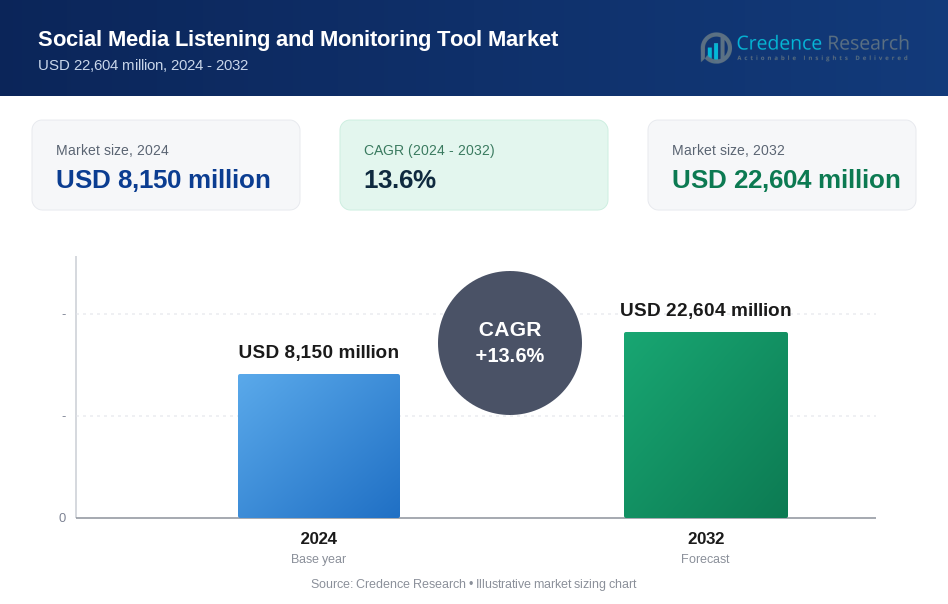
Social Media Listening And Monitoring Tool Market size was valued at USD 8,150 million in 2024 and is anticipated to reach USD 22,604 million by 2032, at a CAGR of 13.6% during the forecast period (2024-2032).
The key drivers of this market include the rapid expansion of social media platforms, the increasing importance of customer experience management, and the growing need for real-time data to make informed business decisions. As consumers spend more time on social media, businesses are increasingly leveraging social media listening tools to capture valuable insights related to brand perception, market trends, and consumer preferences. These insights are vital for creating more personalized marketing strategies and enhancing customer engagement. Furthermore, the rising demand for data-driven decision-making and targeted advertising is driving the adoption of these tools across industries such as retail, healthcare, and entertainment, enabling brands to respond proactively to customer needs and emerging market trends.
Regionally, North America holds the largest market share, accounting for over 40% of the total market value, driven by the high adoption of advanced technologies and the presence of key players in the region. The United States, in particular, continues to lead the market due to its robust digital infrastructure and a large number of tech-savvy businesses leveraging social media for marketing and customer engagement. Europe follows closely due to the increasing digitalization and growing number of businesses adopting social media analytics tools. The region’s strong regulatory environment regarding data privacy also pushes companies to rely on advanced tools for compliance and customer insights. The Asia-Pacific region is expected to witness the highest growth during the forecast period, fueled by the increasing number of social media users, growing smartphone penetration, and expanding digital infrastructure across emerging markets such as China, India, and Japan. The increasing smartphone usage in these countries is accelerating the adoption of social media listening tools to better understand consumer behavior and sentiment. These regions are witnessing a significant rise in the need for social media listening tools to track consumer sentiments and enhance brand management strategies.
Market Insights:
- The Social Media Listening and Monitoring Tool Market was valued at USD 8,150 million in 2024 and is expected to reach USD 22,604 million by 2032.
- Key market drivers include the rapid expansion of social media platforms and the growing need for real-time data insights to drive informed decision-making.
- As consumers increasingly engage on social media, businesses are utilizing these tools to capture valuable insights into brand perception, market trends, and consumer preferences.
- The market is witnessing a rise in demand across industries like retail, healthcare, entertainment, and finance, with social listening tools helping brands track consumer sentiment and refine their marketing strategies.
- North America leads the market, accounting for 40% of the total market share, driven by the high adoption of advanced technologies and the presence of major industry players.
- Europe follows closely, with a 30% market share, propelled by increased digitalization and strong regulatory frameworks such as GDPR that emphasize data privacy and compliance.
- The Asia-Pacific region is expected to see the highest growth, with emerging markets like China, India, and Japan driving demand due to rising smartphone usage and expanding digital infrastructure.
Market Drivers:
Rapid Expansion of Social Media Platforms:
The rapid growth of social media platforms is one of the primary drivers for the Social Media Listening and Monitoring Tool Market. With the proliferation of platforms like Facebook, Twitter, Instagram, LinkedIn, and newer platforms such as TikTok, businesses have gained unprecedented access to vast amounts of consumer data. These platforms continue to evolve with more users joining and engaging daily. This exponential increase in social media activity creates vast amounts of unstructured data, providing a rich source of information for businesses. Social media listening tools are crucial for extracting actionable insights from this data, enabling companies to monitor brand sentiment, consumer opinions, and emerging trends in real time.
Growing Focus on Customer Experience Management:
As businesses increasingly recognize the importance of customer experience, social media listening tools are becoming essential in helping brands understand and improve customer interactions. For instance, Zappos has long used social listening to directly engage with customers who have questions about sizing or returns, responding in real time and even sending out survey mailers to gather more feedback, which has helped them refine their service and build a loyal customer base. Social media platforms provide customers with a direct channel to voice their opinions, making them an invaluable source of feedback. Through real-time monitoring, businesses can identify customer pain points, address complaints quickly, and enhance the overall customer experience. The ability to engage with customers in real time allows businesses to build stronger relationships, ultimately leading to improved customer satisfaction and loyalty, which are key to long-term business success.
Demand for Real-Time Data and Competitive Intelligence:
Another significant driver of the market is the growing need for real-time data and competitive intelligence. In today’s fast-paced digital environment, businesses must be agile and make decisions based on up-to-date information. For instance, Samsung leverages advanced social listening tools to monitor billions of conversations across multiple markets, enabling their teams to spot viral trends-such as the viral washing machine jingle on TikTok-and respond with timely, relevant content that resonates with consumers. Social media listening tools provide businesses with the ability to track consumer behavior, competitor activities, and market trends in real time. This dynamic data helps companies make informed decisions quickly, stay ahead of competitors, and develop more effective marketing and advertising campaigns. Furthermore, these tools enable businesses to monitor the effectiveness of their campaigns, ensuring they can adjust strategies based on live feedback.
Increasing Adoption Across Various Industries:
The adoption of social media listening tools is expanding across a wide range of industries, including retail, healthcare, entertainment, and finance. As more companies recognize the value of social media insights for improving brand management, marketing strategies, and customer relationships, the demand for these tools has surged. Retailers use social media listening to monitor consumer preferences and improve product offerings. Healthcare companies utilize these tools for patient sentiment analysis, while entertainment industries track audience reactions to content releases. This broad application across diverse sectors underscores the importance and versatility of social media listening tools in today’s digital landscape.
Market Trends:
Integration of Generative AI and Visual Listening:
Social media listening tools are increasingly incorporating generative AI to enhance data analysis and reporting. Platforms now use AI to summarize conversations, detect sentiment, and identify emerging trends, enabling brands to respond proactively to customer needs and market shifts. Additionally, the integration of visual listening capabilities allows brands to monitor images and videos for brand mentions, providing a more comprehensive understanding of consumer interactions with their content.
Shift Towards Platform-Specific Strategies:
With younger audiences gravitating towards fewer social media platforms, brands are focusing their efforts on platforms that resonate most with their target demographics. Social listening tools help identify where audiences are most active and engaged, allowing brands to tailor their strategies accordingly. For instance, LinkedIn has gained prominence among public relations professionals, surpassing other platforms as a preferred space for professional engagement.
Emphasis on Real-Time Crisis Management:
The ability to monitor social media conversations in real time has become crucial for brands to manage their reputation and address potential crises promptly. Social listening tools enable brands to detect negative sentiment or emerging issues early, allowing for swift intervention and mitigation. For instance, when KFC UK & Ireland faced a chicken shortage due to a delivery failure, the brand responded quickly and transparently on social media, using humor and regular updates to keep customers informed. This proactive approach helps maintain consumer trust and brand integrity during critical situations, reducing the risk of reputational damage.
Expansion into Multilingual and Multiregional Monitoring:
As businesses operate on a global scale, the need for multilingual and multiregional social listening has grown. Tools now offer capabilities to monitor conversations across various languages and regions, providing brands with insights into diverse markets. This expanded reach supports more informed decision-making and localized marketing strategies, ensuring relevance and resonance with global audiences.
Market Challenges Analysis:
Data Privacy and Security Concerns:
One of the key challenges faced by the Social Media Listening and Monitoring Tool Market is data privacy and security. As these tools gather vast amounts of data from public and private social media accounts, there is an increasing concern over the ethical handling and protection of user information. For instance, Sprout Social has implemented robust privacy and security protocols within its platform, ensuring that data collected from social channels is handled in compliance with global privacy standards such as the General Data Protection Regulation (GDPR). Companies must navigate complex privacy laws and regulations, such as the General Data Protection Regulation (GDPR) in Europe, which mandates strict guidelines on data usage and storage. Non-compliance can result in significant financial penalties and reputational damage, making it crucial for businesses to ensure that social listening tools are fully compliant with global data privacy standards. Additionally, there is a growing risk of cyberattacks and data breaches, which can compromise sensitive information. As a result, organizations need to implement robust security measures to safeguard consumer data and prevent unauthorized access.
Accuracy and Data Overload:
Another challenge is the accuracy of data analysis and the issue of information overload. Social media platforms generate an overwhelming volume of content, making it difficult for brands to separate valuable insights from irrelevant noise. While social listening tools leverage AI to process and analyze data, they are still prone to errors in sentiment analysis, context interpretation, and distinguishing between sarcasm or irony. As a result, businesses may receive inaccurate insights that lead to misguided decision-making. Furthermore, the sheer volume of data collected from multiple social platforms can overwhelm organizations, making it challenging to extract actionable insights in a timely manner. To overcome this challenge, businesses must invest in advanced algorithms and continuously refine their tools to enhance data accuracy and reduce noise. Additionally, employing human oversight can further ensure the quality and relevance of the data being analyzed.
Market Opportunities:
The Social Media Listening and Monitoring Tool Market presents significant opportunities as businesses increasingly recognize the value of social media insights in shaping their strategies. With the growing integration of artificial intelligence (AI) and machine learning (ML) in these tools, companies now have access to more accurate, actionable insights than ever before. AI can help automate sentiment analysis, identify emerging trends, and offer real-time feedback, enabling businesses to make faster and more informed decisions. As the need for personalized customer experiences rises, social media listening tools can assist companies in tailoring their products, services, and marketing campaigns based on real-time customer feedback and preferences. The ability to measure brand health and track competitor activities further provides businesses with the necessary tools to maintain a competitive edge in crowded markets.
Moreover, the expanding digital landscape, particularly in emerging markets, presents another key opportunity. Social media penetration continues to grow rapidly in regions such as Asia-Pacific, Latin America, and Africa, offering untapped potential for businesses to leverage social listening tools to understand new consumer behaviors. These regions also present opportunities for companies to localize their strategies based on the unique needs and preferences of their diverse populations. Additionally, the rise of e-commerce and digital marketing campaigns has further amplified the demand for real-time insights, positioning social media listening tools as essential components in optimizing marketing efforts and improving brand engagement. As these tools continue to evolve and adapt to new technologies, they will become increasingly indispensable to businesses across industries.
Market Segmentation Analysis:
By Type
The Social Media Listening and Monitoring Tool Market is segmented by type into social listening tools, social monitoring tools, and social media analytics tools. Social listening tools focus on monitoring online conversations to capture trends, sentiments, and customer feedback. These tools help businesses identify emerging trends and potential issues before they escalate. Social monitoring tools, on the other hand, track brand mentions and measure engagement across various platforms, enabling brands to manage their reputation effectively. Social media analytics tools provide in-depth data analysis, offering businesses valuable insights into campaign performance, audience behavior, and ROI.
By Enterprise Size
The market is also divided based on enterprise size into small and medium-sized enterprises (SMEs) and large enterprises. SMEs are increasingly adopting social media listening and monitoring tools to gain insights into consumer behavior and improve marketing strategies. These tools provide cost-effective solutions for small businesses to compete in a digital-first world. Large enterprises, with their complex needs, leverage advanced social media listening platforms to manage extensive online presences, track global brand sentiment, and integrate social listening data with other business systems for actionable insights.
By Solution
The solution segment includes both cloud-based and on-premise solutions. Cloud-based solutions dominate the market due to their scalability, ease of use, and cost-effectiveness, offering real-time data access and integration capabilities. On-premise solutions are preferred by organizations that require more control over their data security and compliance requirements. The adoption of cloud-based solutions continues to rise, driven by the increasing demand for flexibility and real-time insights.
Segmentations:
By Type
- Social Listening Tools
- Social Monitoring Tools
- Social Media Analytics Tools
By Enterprise Size
- Small and Medium-sized Enterprises (SMEs)
- Large Enterprises
By Solution
- Cloud-based Solutions
- On-premise Solutions
By Application
- Brand Monitoring
- Sentiment Analysis
- Competitive Intelligence
- Market Research
- Crisis Management
By Industry
- Retail
- Healthcare
- Media and Entertainment
- BFSI (Banking, Financial Services, and Insurance)
- Telecommunications
- Government and Public Sector
- Automotive
- Travel and Hospitality
By Region
- North America
- U.S.
- Canada
- Mexico
- Europe
- UK
- France
- Germany
- Italy
- Spain
- Russia
- Belgium
- Netherlands
- Austria
- Sweden
- Poland
- Denmark
- Switzerland
- Rest of Europe
- Asia Pacific
- China
- Japan
- South Korea
- India
- Australia
- Thailand
- Indonesia
- Vietnam
- Malaysia
- Philippines
- Taiwan
- Rest of Asia Pacific
- Latin America
- Brazil
- Argentina
- Peru
- Chile
- Colombia
- Rest of Latin America
- Middle East
- UAE
- KSA
- Israel
- Turkey
- Iran
- Rest of Middle East
- Africa
- Egypt
- Nigeria
- Algeria
- Morocco
- Rest of Africa
Regional Analysis:
North America
North America holds the largest market share in the Social Media Listening and Monitoring Tool Market, accounting for 40% of the total market value. The dominance of North America is driven by the high adoption rate of advanced technologies, a large number of businesses leveraging social media for marketing and customer engagement, and the presence of key industry players. The United States, in particular, plays a significant role in shaping market dynamics due to its robust digital infrastructure and the widespread use of social media platforms across various sectors. Furthermore, the increasing focus on customer experience and data-driven decision-making in the region amplifies the adoption of these tools. North American companies are quick to adopt innovative social listening tools that provide insights into brand health, customer sentiment, and emerging market trends.
Europe
Europe holds the second-largest market share, accounting for 30% of the total market value. The region’s growth is fueled by the increasing digitalization of businesses and the rising importance of social media in brand management and marketing strategies. Countries like the United Kingdom, Germany, and France are at the forefront of adopting social media listening tools, driven by their mature digital markets and strong regulatory environments. The European Union’s stringent data protection laws, such as the General Data Protection Regulation (GDPR), have also encouraged businesses to invest in compliant and secure social media monitoring tools. With a growing focus on data privacy and consumer insights, European companies are increasingly relying on social listening tools to enhance customer engagement and make data-driven decisions, positioning these tools as indispensable in competitive industries.
Asia-Pacific
The Asia-Pacific region is experiencing the highest growth in the Social Media Listening and Monitoring Tool Market, with a market share of 20%. This growth is driven by the rapid increase in social media users and the expanding digital infrastructure in emerging markets such as China, India, and Japan. The region’s growing adoption of smartphones and the internet has led to an influx of social media activity, creating a wealth of consumer data that businesses are eager to analyze. Moreover, the rise of e-commerce and digital marketing in the region is fueling the demand for social listening tools, as companies seek real-time insights to optimize their marketing campaigns and improve brand performance. As digital penetration continues to rise, the demand for social media listening tools in the Asia-Pacific region is expected to accelerate further, presenting significant opportunities for growth in these emerging markets.
Key Player Analysis:
- Awario
- Brandwatch
- Critical Mention, Inc.
- LexisNexis
- Listen First Media Inc.
- Digimind
- Hootsuite Inc.
- Sendible
- SharpSpring
- Sprinklr
- HubSpot, Inc.
- Meltwater
- Mention
- Salesforce
- Sprout Social
Competitive Analysis:
The Social Media Listening and Monitoring Tool Market is highly competitive, with several key players dominating the landscape. Leading companies such as Brandwatch, Sprout Social, Hootsuite, and Meltwater are at the forefront, offering a range of advanced tools designed to analyze social media content, track brand sentiment, and monitor consumer behavior. These players leverage artificial intelligence and machine learning technologies to enhance their tools’ capabilities, providing businesses with actionable insights in real time. As the demand for social listening tools increases, new entrants are also emerging, offering innovative solutions with specialized features such as sentiment analysis, competitor monitoring, and multilingual capabilities. The market is witnessing a trend of strategic partnerships and acquisitions, as companies aim to expand their service offerings and improve their technological capabilities. To remain competitive, these firms are continuously investing in research and development to enhance the accuracy, scalability, and ease of use of their platforms.
Recent Developments:
- In December 2024, Digimind (now part of Onclusive) integrated Bluesky into its social listening platform, expanding its coverage to include this emerging social network and maintaining leadership in source coverage.
- In March 2025, Sendible launched TikTok reporting and Threads scheduling, allowing users to access TikTok analytics within the platform and plan Threads posts in advance, supporting multi-platform consistency and efficiency.
- In April 2024, Hootsuite acquired Talkwalker and integrated its AI-powered social listening and analytics into the Hootsuite dashboard, including Blue Silk™ AI for summarizing millions of conversations, image/logo recognition, and predictive trend analysis.
Market Concentration & Characteristics:
The Social Media Listening and Monitoring Tool Market exhibits a moderate to high concentration, with several dominant players holding significant market share, including Brandwatch, Sprout Social, and Hootsuite. These companies offer comprehensive platforms that cater to various industries, providing tools for sentiment analysis, brand monitoring, and real-time data insights. While large players continue to lead, the market also sees the emergence of smaller, specialized vendors offering niche functionalities, such as advanced AI-driven analytics or multilingual capabilities. The market characteristics reflect a growing demand for tools that integrate seamlessly with other marketing technologies and offer scalable solutions to businesses of all sizes. The increasing focus on customer experience management and data-driven decision-making is driving innovation within the sector. As a result, companies are continuously enhancing their platforms with features like AI-powered insights, predictive analytics, and enhanced user interfaces, aiming to cater to the evolving needs of businesses worldwide.
Report Coverage:
The research report offers an in-depth analysis based on Type, Enterprise Size, Solution, Application, Industry and Region. It details leading market players, providing an overview of their business, product offerings, investments, revenue streams, and key applications. Additionally, the report includes insights into the competitive environment, SWOT analysis, current market trends, as well as the primary drivers and constraints. Furthermore, it discusses various factors that have driven market expansion in recent years. The report also explores market dynamics, regulatory scenarios, and technological advancements that are shaping the industry. It assesses the impact of external factors and global economic changes on market growth. Lastly, it provides strategic recommendations for new entrants and established companies to navigate the complexities of the market.
Future Outlook:
- The integration of generative AI is enhancing sentiment analysis and trend forecasting capabilities.
- Real-time monitoring is becoming essential for proactive crisis management and brand reputation control.
- Social listening tools are increasingly being integrated with CRM and business intelligence systems to provide a unified view of customer interactions.
- There is a growing emphasis on visual content monitoring, including image and video analysis, to capture brand mentions across platforms like Instagram and TikTok.
- Predictive analytics is being utilized to anticipate market trends and consumer behavior, enabling businesses to make data-driven decisions.
- The demand for multilingual and multicultural monitoring is rising as businesses expand into diverse global markets.
- Social listening is increasingly being used to inform product development and innovation by analyzing consumer feedback and preferences.
- The convergence of social listening with e-commerce platforms is facilitating real-time consumer insights that drive sales strategies.
- There is a shift towards mobile-first social listening tools to cater to the growing use of mobile devices for social media engagement.
- The market is witnessing increased consolidation, with larger firms acquiring specialized social listening companies to enhance their service offerings.
Request a Free Sample
Fill in your details and we'll send you a free sample report.
- Sample data tables & charts
- Research methodology
Market Dynamics
Rapid Expansion of Social Media Platforms
The proliferation of platforms like Facebook, Twitter, Instagram, and TikTok has led to an explosion of user-generated content, providing businesses with vast data sources to analyze consumer sentiment and trends using social media listening tools.
Growing Focus on Customer Experience Management
Businesses are increasingly leveraging social media listening tools to monitor and improve customer interactions in real time, enabling them to address complaints, gather feedback, and enhance overall customer satisfaction and loyalty.
Demand for Real-Time Data and Competitive Intelligence
The need for up-to-date insights into consumer behavior, competitor activities, and market trends is driving adoption, as these tools enable companies to make agile, data-driven decisions and optimize marketing strategies.
Increasing Adoption Across Industries
Sectors such as retail, healthcare, entertainment, and finance are utilizing social media listening tools to track brand perception, monitor sentiment, and refine product offerings, broadening the market’s reach and relevance.
Integration of AI and Advanced Analytics
The incorporation of AI and machine learning into social media listening platforms is improving the accuracy of sentiment analysis, trend detection, and predictive analytics, making these tools more valuable for strategic business decision-making.
Need a Custom Version of This Report?
Tailor the scope, geography, or segments to your exact requirements.
- Custom geography or segment scope
- Direct access to our analyst team
Frequently Asked Questions
What is the current size of the Social Media Listening and Monitoring Tool Market?
What is the expected growth of the Social Media Listening and Monitoring Tool Market?
What are the key drivers of the Social Media Listening and Monitoring Tool Market?
Which region holds the largest market share for social media listening tools?
Which region is expected to grow the fastest in the Social Media Listening and Monitoring Tool Market?
Table of Content
Chapter 1 Market Segmentation
- 1.1 Segmentation Framework
- 1.1.1 Product and Service Classification
- 1.1.2 Application and End-Use Classification
- 1.1.3 Technology and Solution Classification
- 1.1.4 Customer and Distribution Channel Classification
- 1.1.5 Geographic Segmentation
- 1.1.6 Market Segment Definitions and Boundaries
- 1.2 By Type
- 1.2.1 Social Listening Tools
- 1.2.2 Social Monitoring Tools
- 1.2.3 Social Media Analytics Tools
- 1.3 By Solution
- 1.3.1 Cloud-based Solutions
- 1.3.2 On-premise Solutions
- 1.4 By Application
- 1.4.1 Brand Monitoring
- 1.4.2 Sentiment Analysis
- 1.4.3 Competitive Intelligence
- 1.4.4 Market Research
- 1.4.5 Crisis Management
- 1.5 By Enterprise Size
- 1.5.1 Small and Medium-sized Enterprises (SMEs)
- 1.5.2 Large Enterprises
Chapter 2 Introduction
- 2.1 Report Objectives and Scope
- 2.2 Product Definition and Industry Terminology
- 2.3 Market Inclusions and Exclusions
- 2.4 Research Process
- 2.4.1 Primary Research and Expert Interviews
- 2.4.2 Secondary Research and Source Review
- 2.4.3 Top-Down and Bottom-Up Estimation
- 2.4.4 Data Triangulation and Verification
- 2.5 Market Size Measurement Basis
- 2.5.1 2024: USD 8,150 million → 2032: USD 22,604 million
- 2.6 Historical and Forecast Reference Periods
- 2.6.1 Base Year: 2024
- 2.6.2 Forecast Period: 2024-2032
- 2.7 Research Assumptions and Limitations
Chapter 3 Executive Summary
- 3.1 Market Snapshot and Key Findings
- 3.2 Base-Year Market Size, 2024
- 3.3 Forecast Market Size, 2032
- 3.4 Revenue and Volume Growth Outlook
- 3.5 Key Demand and Supply Indicators
- 3.6 Leading Market Segments
- 3.7 Fastest-Growing Market Opportunities
- 3.8 Regional Performance Highlights
- 3.9 Technology and Industry Transformation
- 3.10 Competitive Landscape Summary
- 3.11 Analyst View and Strategic Implications
Chapter 4 Global Social Media Listening and Monitoring Tool Market Trends and Developments
- 4.1 Historical Industry Development
- 4.2 Recent Market Trends and Developments
- 4.3 Demand and Customer Behavior Trends
- 4.4 Technology and Product Innovation
- 4.5 Artificial Intelligence, Automation and Digitalization
- 4.6 Local Manufacturing and Supply Chain Realignment
- 4.7 Industry Partnerships, Mergers and Acquisitions
- 4.8 Sustainability and Circular Economy Developments
- 4.9 Government and Private Sector Investment Trends
- 4.10 Emerging Business Models and Commercialization
- 4.11 Industry Developments and Announcements
Chapter 5 Global Social Media Listening and Monitoring Tool Market Production, Supply and Demand Analysis
- 5.1 Demand Trend and Consumption Analysis
- 5.2 Demand Forecast, 2024-2032
- 5.3 Production and Output Trend
- 5.4 Production and Output Forecast, 2024-2032
- 5.5 Installed Capacity and Capacity Utilization
- 5.6 Company-Wise Production Plants and Statistics
- 5.6.1 Installed Production Capacity
- 5.6.2 Actual Production
- 5.6.3 Planned Capacity and Expansion Targets
- 5.7 Supply Chain Structure and Procurement Trends
- 5.8 Supply-Demand Gap and Bottlenecks
- 5.9 Import Dependence and Sourcing Structure
- 5.10 Contract Manufacturing and Outsourcing
- 5.11 Regional Supply and Demand Concentration
Chapter 6 Global Social Media Listening and Monitoring Tool Market Pricing Analysis
- 6.1 Pricing Structure and Measurement
- 6.2 Historical Pricing Trends
- 6.3 Pricing Outlook, 2024-2032
- 6.4 Average Selling Price and Unit Economics
- 6.5 Pricing by Product and Market Segment
- 6.6 Geographic Pricing Differences
- 6.7 Key Input, Energy, Labor and Logistics Costs
- 6.8 Contract Pricing and Purchasing Models
- 6.9 Pricing Sensitivity and Competitive Positioning
- 6.10 Price, Margin and Profitability Implications
Chapter 7 Global Social Media Listening and Monitoring Tool Market Dynamics
- 7.1 Market Growth Drivers
- 7.1.1 Demand-Side Drivers
- 7.1.2 Technology and Innovation Drivers
- 7.1.3 Infrastructure and Investment Drivers
- 7.1.4 Regulatory and Policy Drivers
- 7.2 Market Restraints
- 7.2.1 Cost and Affordability Constraints
- 7.2.2 Technology and Adoption Barriers
- 7.2.3 Supply Chain and Operational Constraints
- 7.3 Market Challenges
- 7.3.1 Competitive Pressure and Margin Erosion
- 7.3.2 Skills, Infrastructure and Implementation Gaps
- 7.4 Emerging Market Opportunities
- 7.5 Market Dynamics Impact and Time-Horizon Assessment
Chapter 8 Global Social Media Listening and Monitoring Tool Value Chain Analysis
- 8.1 Industry Value Chain Overview
- 8.2 Upstream Suppliers and Critical Inputs
- 8.3 Technology and Component Providers
- 8.4 Manufacturing or Service Delivery
- 8.5 Distribution, Channel Partners and Integrators
- 8.6 Downstream Applications and End Users
- 8.7 Value Addition and Profit Pools
- 8.8 Vertical Integration and Outsourcing
- 8.9 Supplier Concentration and Risk
- 8.10 Supply Chain Localization and Resilience
Chapter 9 Global Social Media Listening and Monitoring Tool Market Regulations and Policies
- 9.1 Relevant Laws, Standards and Compliance Frameworks
- 9.2 Product, Service, Safety and Quality Requirements
- 9.3 Government Policies, Incentives and Subsidies
- 9.4 Imports, Exports and Trade Barriers
- 9.5 Public Procurement and Local Content Requirements
- 9.6 Environmental and Sustainability Compliance
- 9.7 Data Protection, AI and Cybersecurity Compliance
- 9.8 Upcoming Policy Changes and Market Implications
Chapter 10 Global Social Media Listening and Monitoring Tool Market Hotspots and Opportunities
- 10.1 Market Opportunity Mapping and Growth Hotspots
- 10.2 High-Growth Applications and Customer Groups
- 10.3 Underserved Markets and White-Space Opportunities
- 10.4 Emerging Technology and Product Opportunities
- 10.5 New Capacity and Investment Hotspots
- 10.6 Market Entry and Expansion Opportunities
- 10.7 Distribution and Partnership Opportunities
- 10.8 Near-Term and Long-Term Commercial Potential
- 10.9 Opportunity Attractiveness and Execution Risks
Chapter 11 Global Social Media Listening and Monitoring Tool Market Outlook, 2024-2032
- 11.1 Market Size and Analysis
- 11.1.1 Revenue (Market Measurement: 2024: USD 8,150 million → 2032: USD 22,604 million)
- 11.1.2 Market Volume and Quantity Sold
- 11.1.3 Historical Market Size
- 11.1.4 Base-Year Market Size, 2024
- 11.2 Market Forecast, 2024-2032
- 11.2.1 Revenue Forecast to 2032
- 11.2.2 Volume Forecast to 2032
- 11.2.3 CAGR and Year-on-Year Growth
- 11.2.4 Incremental Revenue Opportunity
- 11.3 Forecast Assumptions and Scenario Analysis
- 11.3.1 Base-Case Forecast
- 11.3.2 Optimistic and Conservative Scenarios
- 11.3.3 Technology, Pricing and Policy Sensitivities
- 11.4 Market Attractiveness and Growth Outlook
Chapter 12 Global Social Media Listening and Monitoring Tool Market Segmentation and Outlook
- 12.1 Segmentation Summary and Market Shares, 2024
- 12.2 Largest and Fastest-Growing Segments
- 12.3 By Type - Market Size and Forecast, 2024-2032
- 12.3.1 Segment Definition and Scope
- 12.3.2 Historical Market Size
- 12.3.3 Revenue Forecast, 2024-2032
- 12.3.4 Volume Forecast, 2024-2032
- 12.3.5 Base-Year Market Share, 2024
- 12.3.6 Segment CAGR and Growth Drivers
- 12.3.7 Subsegment Market Size and Forecast
- 12.3.7.1 Social Listening Tools
- 12.3.7.2 Social Monitoring Tools
- 12.3.7.3 Social Media Analytics Tools
- 12.3.8 Subsegment Pricing and Adoption Trends
- 12.3.9 Leading Suppliers and Competition
- 12.3.10 Regional Demand and Opportunities
- 12.4 By Solution - Market Size and Forecast, 2024-2032
- 12.4.1 Segment Definition and Scope
- 12.4.2 Historical Market Size
- 12.4.3 Revenue Forecast, 2024-2032
- 12.4.4 Volume Forecast, 2024-2032
- 12.4.5 Base-Year Market Share, 2024
- 12.4.6 Segment CAGR and Growth Drivers
- 12.4.7 Subsegment Market Size and Forecast
- 12.4.7.1 Cloud-based Solutions
- 12.4.7.2 On-premise Solutions
- 12.4.8 Subsegment Pricing and Adoption Trends
- 12.4.9 Leading Suppliers and Competition
- 12.4.10 Regional Demand and Opportunities
- 12.5 By Application - Market Size and Forecast, 2024-2032
- 12.5.1 Segment Definition and Scope
- 12.5.2 Historical Market Size
- 12.5.3 Revenue Forecast, 2024-2032
- 12.5.4 Volume Forecast, 2024-2032
- 12.5.5 Base-Year Market Share, 2024
- 12.5.6 Segment CAGR and Growth Drivers
- 12.5.7 Subsegment Market Size and Forecast
- 12.5.7.1 Brand Monitoring
- 12.5.7.2 Sentiment Analysis
- 12.5.7.3 Competitive Intelligence
- 12.5.7.4 Market Research
- 12.5.7.5 Crisis Management
- 12.5.8 Subsegment Pricing and Adoption Trends
- 12.5.9 Leading Suppliers and Competition
- 12.5.10 Regional Demand and Opportunities
- 12.6 By Enterprise Size - Market Size and Forecast, 2024-2032
- 12.6.1 Segment Definition and Scope
- 12.6.2 Historical Market Size
- 12.6.3 Revenue Forecast, 2024-2032
- 12.6.4 Volume Forecast, 2024-2032
- 12.6.5 Base-Year Market Share, 2024
- 12.6.6 Segment CAGR and Growth Drivers
- 12.6.7 Subsegment Market Size and Forecast
- 12.6.7.1 Small and Medium-sized Enterprises (SMEs)
- 12.6.7.2 Large Enterprises
- 12.6.8 Subsegment Pricing and Adoption Trends
- 12.6.9 Leading Suppliers and Competition
- 12.6.10 Regional Demand and Opportunities
- 12.7 Segment Growth Comparison
- 12.8 Segment Attractiveness and Priority Matrix
Chapter 13 Global Social Media Listening and Monitoring Tool End-Use and Application Market Outlook
- 13.1 End-Use Industry and Customer Demand Structure
- 13.2 Leading Applications and Customer Groups
- 13.3 End-Use Market Size, Share and Forecast
- 13.4 Major End-Use Industry Deep Dives
- 13.4.1 Customer Requirements and Use Cases
- 13.4.2 Demand and Replacement Cycles
- 13.4.3 Technical and Regulatory Considerations
- 13.4.4 Purchasing and Procurement Models
- 13.4.5 Leading Vendors and Distribution Channels
- 13.4.6 Forecast and Commercial Opportunities
- 13.5 Emerging Applications and Cross-Segment Demand
- 13.6 End-Use Industry Investment Priorities
Chapter 14 Global Social Media Listening and Monitoring Tool Geographic Market Outlook, 2024-2032
- 14.1 Regional Market Size and Share, 2024
- 14.2 Regional Market Forecast, 2024-2032
- 14.3 Regional Pricing, Production and Demand Differences
- 14.4 North America
- 14.4.1 United States
- 14.4.2 Canada
- 14.4.3 Mexico
- 14.5 Europe
- 14.5.1 Germany
- 14.5.2 France
- 14.5.3 Italy
- 14.5.4 United Kingdom
- 14.5.5 Spain
- 14.5.6 Poland
- 14.5.7 Russia
- 14.5.8 Netherlands
- 14.5.9 Belgium
- 14.5.10 Sweden
- 14.5.11 Denmark
- 14.5.12 Norway
- 14.5.13 Rest of Europe
- 14.6 Asia Pacific
- 14.6.1 China
- 14.6.2 India
- 14.6.3 Japan
- 14.6.4 South Korea
- 14.6.5 Thailand
- 14.6.6 Indonesia
- 14.6.7 Vietnam
- 14.6.8 Malaysia
- 14.6.9 Australia
- 14.6.10 Rest of Asia Pacific
- 14.7 Latin America
- 14.7.1 Brazil
- 14.7.2 Argentina
- 14.7.3 Colombia
- 14.7.4 Chile
- 14.7.5 Rest of Latin America
- 14.8 Middle East
- 14.8.1 Saudi Arabia
- 14.8.2 United Arab Emirates
- 14.8.3 Turkey
- 14.8.4 Israel
- 14.8.5 Iran
- 14.8.6 Rest of the Middle East
- 14.9 Africa
- 14.9.1 South Africa
- 14.9.2 Egypt
- 14.9.3 Nigeria
- 14.9.4 Morocco
- 14.9.5 Rest of Africa
- 14.10 Regional Investment, Policy and Supply Chain Differences
- 14.11 Regional Competitive Landscape
- 14.12 Geographic Growth Hotspots
Chapter 15 Global Social Media Listening and Monitoring Tool Technology, Innovation and Sustainability Outlook
- 15.1 Technology Landscape and Maturity
- 15.2 Product, Process and Service Innovation
- 15.3 AI, Automation and Digital Tools in the Industry
- 15.4 Technology Adoption and Performance Benchmarking
- 15.5 Innovation Pipeline and R&D Investment
- 15.6 Patent and Intellectual Property Trends
- 15.7 Energy Efficiency and Resource Management
- 15.8 Sustainability, Recycling and Circularity
- 15.9 Technology Roadmap, 2024-2032
- 15.10 Risks of Obsolescence and Technology Substitution
Chapter 16 Global Social Media Listening and Monitoring Tool Market Key Strategic Imperatives
- 16.1 Growth and Market Entry Priorities
- 16.2 High-Return Products and Segments
- 16.3 Pricing, Profitability and Cost Optimization
- 16.4 Technology Investment and Product Differentiation
- 16.5 Supply Chain Localization and Resilience
- 16.6 Distribution and Customer Acquisition
- 16.7 Partnership, Acquisition and Capacity Strategy
- 16.8 Regional Expansion Priorities
- 16.9 Short-, Medium- and Long-Term Actions
Chapter 17 Competition Outlook
- 17.1 Industry Competition Characteristics
- 17.2 Market Structure and Concentration
- 17.3 Market Share and Competitive Positioning, 2024
- 17.4 Company-Wise Revenue and Product Benchmarking
- 17.5 Production and Service Capacity Benchmarking
- 17.6 Technology, Pricing and Differentiation
- 17.7 Regional Footprint and Distribution Strength
- 17.8 Mergers, Acquisitions and Strategic Alliances
- 17.9 New Entrants and Competitive Threats
- 17.10 Porter's Five Forces and Industry Attractiveness
- 17.11 Competitive Outlook, 2024-2032
Chapter 18 Company Profiles
- 18.1 Company Coverage and Selection Criteria
- 18.2 Brandwatch
- 18.2.1 Business Description
- 18.2.2 Company Ownership and Geographic Presence
- 18.2.3 Product and Service Portfolio
- 18.2.4 Manufacturing and Operating Footprint
- 18.2.5 Production Capacity and Expansion Plans
- 18.2.6 Financial Performance and Investment
- 18.2.7 Market Share and Competitive Position
- 18.2.8 Technology and Innovation Capabilities
- 18.2.9 Strategic Alliances or Partnerships
- 18.2.10 Recent Developments
- 18.2.11 Growth Strategy and Outlook
- 18.3 Sprout Social
- 18.4 Hootsuite
- 18.5 Meltwater
- 18.6 Awario
- 18.7 Digimind
- 18.8 Mention
- 18.9 Sprinklr
- 18.10 HubSpot
- 18.11 Salesforce
- 18.12 Other Relevant Market Participants
Note: Every listed company is profiled on the structure shown under the first company. The company list is preliminary and may change based on research findings, market developments, data availability and client requirements.
Chapter 19 Disclaimer
- 19.1 Research and Forecast Disclaimer
- 19.2 Data Source and Estimation Limitations
Note: The depth of individual sections depends on data availability for this market. Volume, capacity, trade and other unit-based metrics are included where applicable.

