
Market Overview:
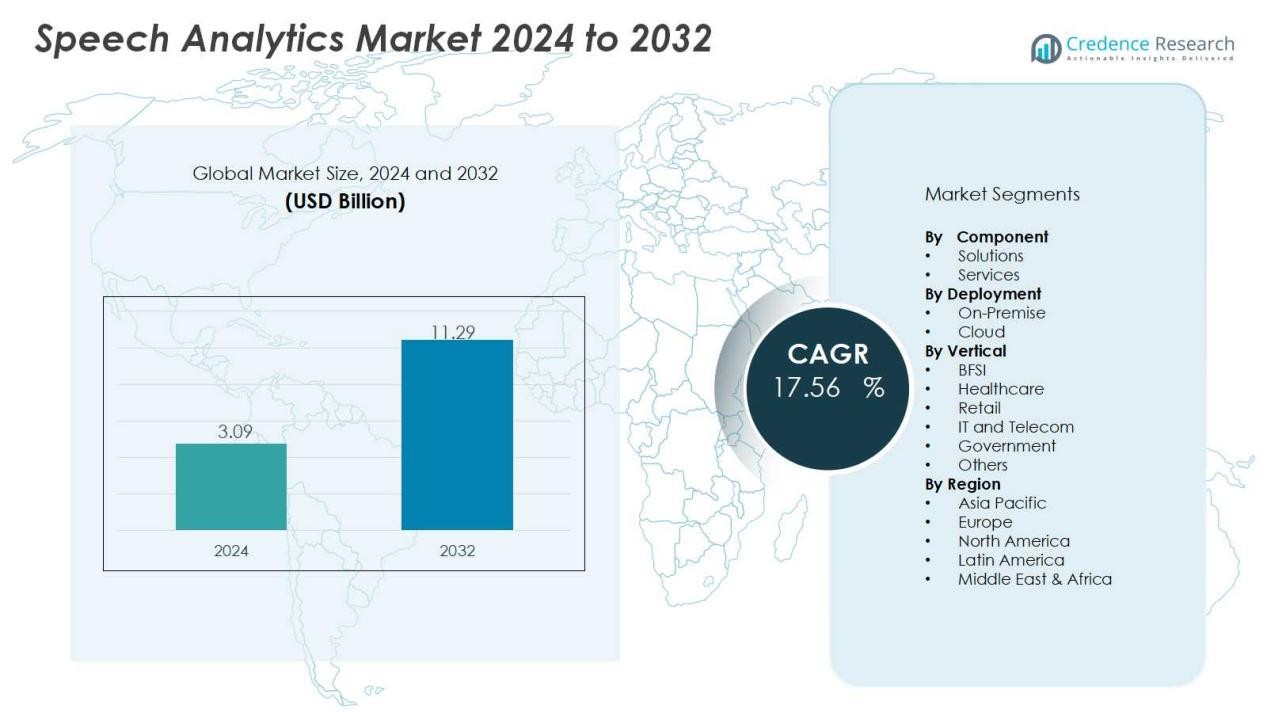
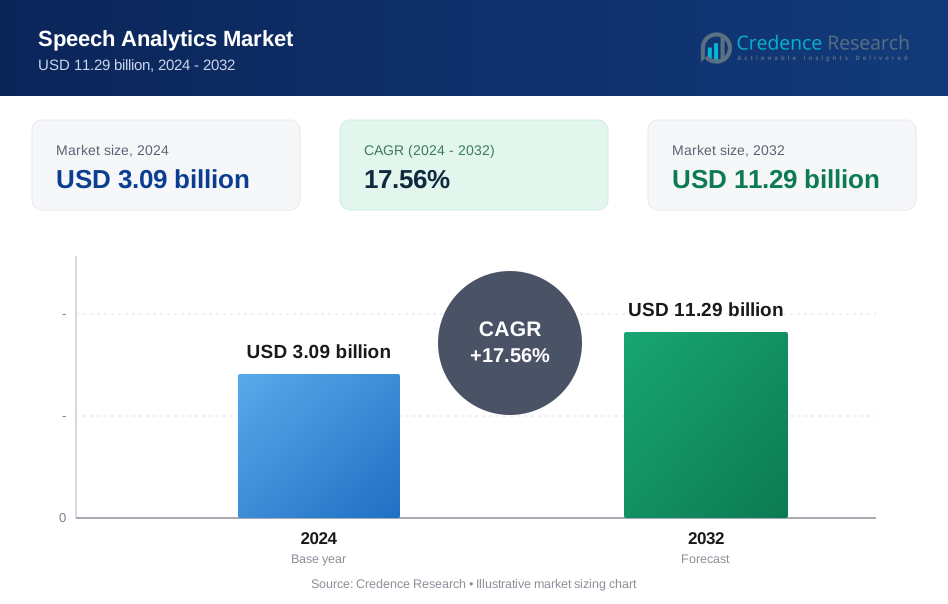
The speech analytics market size was valued at USD 3.09 billion in 2024 and is anticipated to reach USD 11.29 billion by 2032, at a CAGR of 17.56 % during the forecast period.
| REPORT ATTRIBUTE | DETAILS |
|---|---|
| Historical Period | 2020-2023 |
| Base Year | 2024 |
| Forecast Period | 2025-2032 |
| Speech Analytics Market Size 2024 | USD 3.09 Billion |
| Speech Analytics Market, CAGR | 17.56 % |
| Speech Analytics Market Size 2032 | USD 11.29 Billion |
Key drivers include the need for improved customer experience, regulatory compliance, and operational efficiency. Organizations are leveraging speech analytics to track customer sentiment, detect fraud, and enhance agent performance. The integration of advanced technologies such as natural language processing (NLP), machine learning, and real-time analytics is accelerating adoption across industries including BFSI, healthcare, retail, and telecommunications. Rising demand for omnichannel analytics also supports market expansion.
Regionally, North America leads the market, driven by advanced technology infrastructure and strong adoption among enterprises. Europe follows with increasing emphasis on compliance and customer service optimization. Asia-Pacific is expected to witness the fastest growth due to rising digital transformation, rapid call center expansion, and the growing need for customer engagement tools in countries like India and China. Meanwhile, Latin America and the Middle East & Africa show emerging opportunities as enterprises modernize customer support operations.
Market Insights:
- The speech analytics market was valued at USD 3.09 billion in 2024 and is expected to reach USD 11.29 billion by 2032, growing at a CAGR of 17.56%.
- Enterprises are adopting speech analytics to enhance customer satisfaction, detect fraud, and improve agent performance.
- Artificial intelligence, natural language processing, and real-time analytics are driving greater accuracy and contextual insights.
- High implementation costs and data security risks remain major barriers, especially for small and mid-sized enterprises.
- North America led with 41% share in 2024, supported by advanced adoption in the United States and Canada.
- Europe held 28% share, fueled by strict compliance mandates and demand for customer-centric service models.
- Asia-Pacific captured 22% share in 2024 and is forecasted to grow fastest, led by China, India, Japan, and South Korea.
Market Drivers:
Rising Demand for Customer Experience Optimization:
The speech analytics market benefits from enterprises focusing on improving customer satisfaction and loyalty. Companies use analytics to assess tone, sentiment, and keywords within conversations to identify pain points. This enables businesses to resolve issues faster and strengthen service quality. It empowers organizations to turn raw voice data into actionable insights for customer engagement strategies.
- For instance, SESTEK's speech analytics implementation at Halkbank resulted in a 25-second decrease in ticketed call duration, demonstrating how voice data analysis directly improves operational efficiency.
Increasing Role of Compliance and Risk Management:
Regulatory frameworks in industries such as BFSI and healthcare drive adoption of speech analytics. Companies must monitor and record calls to meet strict standards for transparency and accountability. The technology supports automated monitoring that reduces human error in compliance checks. It also helps detect fraud, misconduct, or policy violations in real time, strengthening trust and governance.
- For Instance, JPMorgan Chase has deployed AI-driven fraud detection systems, like its proprietary OmniAI platform, that analyze billions of transactions in real-time within milliseconds.
Integration of Artificial Intelligence and Natural Language Processing:
Artificial intelligence and NLP integration is reshaping how organizations leverage speech analytics market solutions. These tools improve accuracy in voice recognition and sentiment analysis. They allow systems to understand context, dialects, and customer intent more effectively. It ensures businesses capture detailed insights from conversations that enhance decision-making across departments.
Expansion of Remote Work and Omnichannel Communication:
The global shift toward remote work and digital-first customer interactions has boosted demand for analytics tools. Enterprises need solutions that track quality across voice, video, and digital channels. The speech analytics market responds by offering platforms that unify omnichannel data into one framework. It enables consistent monitoring of service standards regardless of communication method or location.
Market Trends:
Adoption of Real-Time Analytics and Cloud-Based Platforms:
The speech analytics market is witnessing a shift toward real-time solutions that deliver instant insights during customer interactions. Companies are moving away from batch processing toward systems that analyze conversations as they happen. It allows agents to respond proactively, reduce churn, and boost first-call resolution rates. Cloud deployment models are also expanding adoption by offering scalability, lower upfront costs, and faster integration with enterprise systems. Industries such as telecom, retail, and financial services use these tools to enhance responsiveness and streamline operations. Vendors are focusing on flexible platforms that combine scalability with advanced features to attract global enterprises.
- For instance, in January 2024, NICE launched its Enlighten Copilot for CXone, which leverages real-time speech analytics to support over 1 million agent interactions per day across global enterprise users, enabling proactive intervention during live calls.
Growing Integration with AI-Driven Insights and Omnichannel Strategies:
Artificial intelligence continues to shape speech analytics with enhanced sentiment analysis, predictive modeling, and contextual understanding. It supports organizations in identifying patterns within large data sets and applying insights across sales, compliance, and customer support. The speech analytics market also reflects a strong move toward omnichannel capabilities that unify data from voice, chat, video, and social platforms. Enterprises recognize the value of consolidated analytics to maintain consistent service quality across channels. Personalization is another trend, with analytics enabling tailored customer engagement strategies that increase loyalty and revenue. Vendors are expanding AI-driven features to ensure broader application in both large enterprises and SMEs.
- For instance, Cogito deployed its real-time conversation AI technology to a Fortune 25 telecommunications company's 30,000-agent workforce in 2023, the largest deployment of its kind, analyzing over 200 acoustic and lexical signals in milliseconds to provide live coaching guidance.
Market Challenges Analysis:
High Implementation Costs and Data Security Concerns:
The speech analytics market faces challenges related to the high costs of deployment and integration. Many small and mid-sized enterprises hesitate to invest due to limited budgets. It requires significant resources for infrastructure, training, and maintenance, making adoption complex. Data security also remains a major concern, with voice data often containing sensitive personal or financial information. Companies must invest in advanced encryption and compliance frameworks to address privacy risks. Rising cyber threats increase the pressure on organizations to secure data without slowing operations.
Accuracy Limitations and Integration Complexity:
Accuracy in speech recognition remains a challenge, particularly with diverse accents, dialects, and background noise. It reduces the reliability of insights and limits broader adoption in global operations. The speech analytics market also struggles with integration into legacy systems that many enterprises still use. Complex IT environments often require customization, which adds time and cost. Resistance from employees unfamiliar with advanced analytics further slows implementation. Vendors continue to address these challenges by improving algorithms and offering easier integration tools to boost adoption across industries.
Market Opportunities:
Expansion into Emerging Economies and New Industry Verticals:
The speech analytics market has strong opportunities in emerging economies where digital transformation is accelerating. Growing investments in call centers and customer service operations in Asia-Pacific, Latin America, and the Middle East create demand for advanced analytics solutions. It provides companies with tools to handle rising call volumes while improving efficiency. New industry verticals such as healthcare, education, and government are also adopting these systems to manage service quality and compliance. Vendors that tailor solutions for regional needs and cost structures can capture significant market share. Expanding into these sectors broadens revenue streams and diversifies growth opportunities.
Advancements in AI, NLP, and Predictive Analytics:
Rapid progress in artificial intelligence and natural language processing opens opportunities for more accurate and context-aware solutions. It allows enterprises to gain deeper insights into customer behavior, sentiment, and intent. The speech analytics market benefits from predictive analytics that can forecast customer needs and identify risks before escalation. Integration with omnichannel platforms ensures a seamless view of customer interactions across voice, chat, and digital channels. Small and medium-sized enterprises are showing interest in cloud-based models that lower entry barriers. Vendors offering AI-driven and scalable solutions are well positioned to capture long-term demand.
Market Segmentation Analysis:
By Component:
The speech analytics market by component is divided into solutions and services. Solutions hold a dominant position due to strong demand for software platforms that provide real-time insights, sentiment analysis, and compliance support. It enables organizations to monitor calls effectively and improve customer interactions. Services are gaining momentum, supported by growing need for consulting, integration, and training. Managed services are also seeing adoption among enterprises seeking to optimize operational costs. Vendors continue to expand service offerings to support implementation across industries.
- For instance, NICE Enlighten AI achieved a major technological milestone in March 2024 by managing 100 million customer interactions per month, demonstrating the scalability of modern speech analytics platforms.
By Deployment:
Deployment is segmented into on-premise and cloud models. On-premise remains relevant among large enterprises with strict data control requirements. The speech analytics market, however, is shifting toward cloud due to its scalability, flexibility, and lower upfront investment. It allows organizations to integrate analytics with CRM and omnichannel platforms efficiently. SMEs favor cloud models as they offer cost-effective access to advanced features. Vendors are prioritizing cloud-native solutions to cater to diverse enterprise demands.
- For Instance, NICE Ltd. launched its CXone Mpower platform, which integrates AI capabilities like speech analytics to enhance the CXone cloud platform. The company has reported successfully migrating numerous large enterprise clients from legacy platforms to the cloud, driven by demand for advanced AI solutions. NICE secured over 100 large enterprise clients in Q3 2024, with over 45 migrating from competitors.
By Vertical:
The market by vertical includes BFSI, healthcare, retail, IT and telecom, government, and others. BFSI leads adoption due to heavy reliance on compliance monitoring and fraud detection. It helps financial institutions enhance transparency and customer trust. Healthcare is expanding usage to improve patient interactions and ensure adherence to regulations. Retail and telecom also drive growth with demand for customer experience optimization. Government agencies are investing in analytics for improved service delivery and citizen engagement.
Segmentations:
By Component:
- Solutions
- Services
By Deployment:
- On-Premise
- Cloud
By Vertical:
- BFSI
- Healthcare
- Retail
- IT and Telecom
- Government
- Others
By Region:
- North America
- U.S.
- Canada
- Mexico
- Europe
- Germany
- France
- U.K.
- Italy
- Spain
- Rest of Europe
- Asia Pacific
- China
- Japan
- India
- South Korea
- South-east Asia
- Rest of Asia Pacific
- Latin America
- Brazil
- Argentina
- Rest of Latin America
- Middle East & Africa
- GCC Countries
- South Africa
- Rest of the Middle East and Africa
Regional Analysis:
North America:
North America accounted for 41% market share in 2024, driven by advanced enterprise adoption. The United States leads due to large-scale deployment of AI-powered analytics in contact centers. The speech analytics market in this region is fueled by investments from banking, retail, and telecom sectors. It benefits from regulatory frameworks that require detailed call monitoring and compliance reporting. Strong presence of global vendors and continuous innovation in AI and NLP solutions support expansion. Canada also contributes steadily with increased adoption in healthcare and government services.
Europe:
Europe held 28% market share in 2024, supported by strict data protection and compliance mandates. Countries such as the UK, Germany, and France drive adoption through emphasis on service quality and transparency. The speech analytics market in Europe benefits from rising demand for customer-centric strategies in financial services, retail, and public administration. It is also shaped by growing investments in digital platforms that unify omnichannel engagement. Enterprises are focusing on GDPR compliance, which further accelerates adoption of secure analytics platforms. Vendors with localized solutions are well positioned to expand across Western and Northern Europe.
Asia-Pacific:
Asia-Pacific captured 22% market share in 2024 and is projected to grow at the fastest rate. China and India lead the region with massive call center operations serving global clients. The speech analytics market benefits from rapid digitalization, increasing mobile penetration, and rising demand for personalized engagement. It supports businesses in scaling customer interactions while maintaining quality and compliance. Japan and South Korea also contribute significantly due to their advanced technology ecosystems. It creates opportunities for vendors to provide scalable cloud-based solutions to enterprises of all sizes.
Key Player Analysis:
- Avaya LLC
- CallMiner
- Qualtrics
- inContact, Inc.
- Calabrio, Inc.
- Genesys
- Verint Systems Inc.
- Hewlett Packard Enterprise Development LP
- NICE
Competitive Analysis:
The speech analytics market is highly competitive, with vendors focusing on innovation and strategic partnerships to strengthen their presence. Key players include Avaya LLC, CallMiner, Qualtrics, inContact, Inc., Calabrio, Inc., Genesys, and Verint Systems Inc. These companies invest in advanced technologies such as artificial intelligence and natural language processing to enhance accuracy and contextual understanding. It enables enterprises to achieve better customer insights, compliance monitoring, and operational efficiency. Vendors also emphasize expanding cloud-based solutions to meet rising demand for scalable and cost-effective platforms. Partnerships with enterprises across BFSI, healthcare, retail, and telecom sectors are critical to improving adoption. Continuous product development, combined with integration of omnichannel analytics, positions these companies to address evolving customer experience requirements.
Recent Developments:
- In June 2025, CallMiner acquired VOCALLS, a conversational AI and automation provider, expanding its platform with native voice and text AI capabilities for automated customer experience analytics.
- In July 2025, Qualtrics enhanced its Partner Network by introducing new tracks and tiers to foster customer success and accelerate global experience management programs.
Report Coverage:
The research report offers an in-depth analysis based on Component, Deployment, Vertical and Region. It details leading Market players, providing an overview of their business, product offerings, investments, revenue streams, and key applications. Additionally, the report includes insights into the competitive environment, SWOT analysis, current Market trends, as well as the primary drivers and constraints. Furthermore, it discusses various factors that have driven Market expansion in recent years. The report also explores Market dynamics, regulatory scenarios, and technological advancements that are shaping the industry. It assesses the impact of external factors and global economic changes on Market growth. Lastly, it provides strategic recommendations for new entrants and established companies to navigate the complexities of the Market.
Future Outlook:
- The speech analytics market will see stronger integration of AI and machine learning for contextual insights.
- Cloud-based deployment will expand further, enabling flexible, scalable, and cost-efficient adoption for enterprises.
- Real-time analytics will gain traction, allowing faster resolution of customer issues during live interactions.
- Omnichannel analytics will unify data from voice, chat, video, and social platforms into a single framework.
- Predictive analytics will play a larger role in forecasting customer behavior and identifying churn risks.
- Healthcare, education, and government sectors will adopt speech analytics to improve service quality and compliance.
- Vendors will focus on enhancing multilingual capabilities to support global enterprises and diverse customer bases.
- Data privacy and security features will become central to product development and enterprise adoption decisions.
- Small and medium-sized enterprises will increasingly adopt speech analytics through cloud-based subscription models.
- Strategic partnerships between technology providers and enterprises will drive innovation and broaden industry applications.
Request a Free Sample
Fill in your details and we'll send you a free sample report.
- Sample data tables & charts
- Research methodology
Need a Custom Version of This Report?
Tailor the scope, geography, or segments to your exact requirements.
- Custom geography or segment scope
- Direct access to our analyst team
Frequently Asked Questions
What is the current market size for the Speech Analytics Market, and what is its projected size in 2032?
At what Compound Annual Growth Rate is the Speech Analytics Market projected to grow between 2024 and 2032?
Which Speech Analytics Market segment held the largest share in 2024?
What are the primary factors fueling the growth of the Speech Analytics Market?
Who are the leading companies in the Speech Analytics Market?
Which region commanded the largest share of the Speech Analytics Market in 2024?
Table of Content
Chapter 1. Report Introduction
- 1.1 Report Description & Purpose
- 1.1.1 Report Title & Market Definition
- 1.1.2 Unique Selling Propositions (USP) & Key Differentiators
- 1.1.3 Value Proposition for Stakeholders
- 1.2 Research Objectives
- 1.2.1 Market Sizing Objectives (Volume & Revenue) (Volume Where Applicable)
- 1.2.2 Segmentation Objectives
- 1.2.3 Competitive Intelligence Objectives
- 1.2.4 Forecast & Scenario Objectives
- 1.3 Report Scope
- 1.3.1 Speech Analytics Scope – Segments & Subsegments Covered
- 1.3.2 Geographic Scope – Regions & Countries Covered
- 1.3.3 Historical Period, Base Year & Forecast Period (2024; forecast to 2032)
- 1.3.4 Inclusions & Exclusions
- 1.4 Industry Classification & Applicable Codes
- 1.5 Currency, Measurement Units & Valuation Basis
- 1.6 Target Stakeholders
- 1.7 Limitations & Assumptions
Chapter 2. Executive Summary
- 2.1 Global Speech Analytics Market Snapshot
- 2.1.1 Market Size – Historical (2024) & Forecast (2024-2032) (2024: USD 3.09 billion → 2032: USD 11.29 billion)
- 2.1.2 Volume & Revenue – Global Totals (Volume Where Applicable)
- 2.1.3 Key Market Highlights – Top Five Facts
- 2.2 Speech Analytics Market Segmentation Snapshot
- 2.2.1 Market Split by Region – 2024 vs. 2032
- 2.3 Competitive Snapshot
- 2.3.1 Top 10 Players by Revenue Share – 2024
- 2.3.2 Top 10 Players by Volume Share – 2024 (Volume Where Applicable)
- 2.3.3 Recent Strategic Developments (18-Month Summary)
- 2.4 Key Investment Highlights & Strategic Conclusions
Chapter 3. Speech Analytics Market Dynamics & Industry Analysis
- 3.1 Market Overview & Context
- 3.1.1 Speech Analytics Market Position in the Broader Industry Value Chain
- 3.1.2 Demand Structure & Purchasing Dynamics
- 3.1.3 Market Maturity & Development Stage by Region
- 3.2 Speech Analytics Market Drivers
- 3.3 Speech Analytics Market Restraints & Challenges
- 3.4 Speech Analytics Market Opportunities
- 3.5 Porter's Five Forces Analysis
- 3.5.1 Threat of New Entrants
- 3.5.2 Bargaining Power of Suppliers
- 3.5.3 Bargaining Power of Buyers
- 3.5.4 Threat of Substitutes
- 3.5.5 Competitive Rivalry – Intensity Assessment
- 3.6 Speech Analytics Value Chain Analysis
- 3.6.1 Upstream – Key Inputs, Resources & Suppliers
- 3.6.1.1 Key Input/Resource 1
- 3.6.1.2 Key Input/Resource 2
- 3.6.1.3 Key Input/Resource 3
- 3.6.2 Midstream – Core Operations & Value Creation
- 3.6.2.1 Operating Model & Process Overview
- 3.6.2.2 Key Operating Locations & Capabilities by Company
- 3.6.3 Downstream – Market Channels & End Users
- 3.6.3.1 Direct Sales & Customer Engagement Channels
- 3.6.3.2 Indirect Sales, Intermediaries & Partner Channels
- 3.6.4 Value Chain Profitability Analysis
- 3.6.1 Upstream – Key Inputs, Resources & Suppliers
- 3.7 PESTEL Analysis
- 3.7.1 Political Factors
- 3.7.2 Economic Factors
- 3.7.3 Social Factors
- 3.7.4 Technological Factors
- 3.7.5 Environmental Factors
- 3.7.6 Legal Factors
- 3.8 Speech Analytics Supply Chain Analysis
- 3.8.1 Critical Input & Resource Availability Risk Assessment
- 3.8.2 Supplier & Operational Concentration Risk (Geographic Exposure)
- 3.8.3 Supply & Service Disruption Impact Analysis
- 3.9 Regulatory & Policy Landscape
Note: The regulatory and policy landscape section covers regulations based on their applicability to the market, Speech Analytics category, geography, and scope of the study. Only regulatory frameworks with a material impact on operations, compliance, trade, sustainability, or market access are analyzed in detail.
Chapter 4. Key Investment Pockets & Opportunity Analysis
- 4.1 Speech Analytics Market Attractiveness Analysis
- 4.1.1 By Region – Investment Attractiveness Matrix (Market Size × CAGR)
- 4.2 Absolute Revenue Growth Opportunity
- 4.2.1 By Region – Absolute Revenue Growth Through 2032
- 4.3 Incremental Demand Opportunity
- 4.3.1 By Region – Incremental Demand Through 2032
- 4.3.2 Segment – Incremental Demand
- 4.4 Emerging Submarket Opportunity Deep Dive (Subject to Applicability)
- 4.5 Priority Market Opportunity Scorecards
- 4.5.1 United States
- 4.5.2 Europe
- 4.5.3 Asia
- 4.5.4 Middle East & Africa
Note: Priority market opportunity scorecards reflect the geographic scope and strategic relevance of the study. Listed markets are indicative and may be adapted to the industry.
Chapter 5. Speech Analytics Cross-Border Trade & Market Access Analysis
- 5.1 International Trade & Cross-Border Activity Overview
- 5.1.1 Global Export Value by Country (2024)
- 5.1.2 Global Export Volume by Country (2024) (Volume Where Applicable)
- 5.1.3 Global Import Value by Country (2024)
- 5.1.4 Global Import Volume by Country (2024) (Volume Where Applicable)
- 5.1.5 Net Trade Balance by Country (2024)
- 5.2 Export Analysis – Segment
- 5.2.1 Category 1 (Applicable Classification Code)
- 5.2.2 Category 2 (Applicable Classification Code)
- 5.2.3 Category 3 (Applicable Classification Code)
- 5.2.4 Category 4 (Applicable Classification Code)
- 5.2.5 Category 5 (Applicable Classification Code)
- 5.3 Import Analysis – Segment
- 5.3.1 Category 1 (Applicable Classification Code)
- 5.3.2 Category 2 (Applicable Classification Code)
- 5.3.3 Category 3 (Applicable Classification Code)
- 5.3.4 Category 4 (Applicable Classification Code)
- 5.3.5 Category 5 (Applicable Classification Code)
- 5.4 Cross-Border Pricing & Transaction Benchmarks
- 5.4.1 Export Pricing – Segment & Country
- 5.4.2 Import Pricing – Segment & Source Country
- 5.4.3 Price Trends (2024)
- 5.5 Key Cross-Border Trade & Delivery Routes
- 5.5.1 Cross-Border Trade/Delivery Route 1
- 5.5.2 Cross-Border Trade/Delivery Route 2
- 5.5.3 Cross-Border Trade/Delivery Route 3
- 5.5.4 Cross-Border Trade/Delivery Route 4
- 5.5.5 Cross-Border Trade/Delivery Route 5
- 5.6 Trade Policy & Market Access Impact Assessment
- 5.6.1 Tariff & Non-Tariff Barriers
- 5.6.2 Regional Trade & Economic Integration Frameworks
- 5.6.3 Bilateral & Multilateral Trade Agreements
- 5.6.4 Cross-Border Operating, Licensing & Localization Requirements
Note: This chapter applies where cross-border trade or delivery is relevant to Speech Analytics. Goods, services, and digital offerings are assessed using applicable classifications and transaction measures. Import-export volumes, trade balances, and route analyses are included only where meaningful to the market.
Chapter 6. Competitive Landscape & Company Benchmarking
- 6.1 Speech Analytics Market Concentration & Structure
- 6.1.1 Herfindahl-Hirschman Index (HHI) – the historical period vs. 2024
- 6.1.2 Leading, Mid-Sized & Emerging Player Structure
- 6.1.3 Global, Regional & Local Player Dynamics
- 6.2 Speech Analytics Market Share Analysis – 2024
- 6.2.1 Global Revenue Share by Company
- 6.2.2 Global Volume Share by Company (Volume Where Applicable)
- 6.2.3 Regional Revenue Share
- 6.2.4 Market Share Evolution (the historical period vs. 2024)
- 6.2.5 Company Market Share by Key Segment
- 6.2.6 Company Market Share by Customer Group
- 6.3 Operating Scale, Capacity & Infrastructure Analysis
- 6.3.1 Global Operating Scale & Supply Capacity
- 6.3.2 Resource Utilization & Operating Efficiency
- 6.3.3 Output, Service Delivery & Activity Metrics
- 6.3.4 Operating Footprint & Infrastructure Map
- 6.3.5 Planned Operational & Capacity Expansion
- 6.4 Speech Analytics Competitive Benchmarking Matrix
- 6.4.1 Revenue, Growth, Profitability & Operating Metric Comparison
- 6.4.2 Channel Revenue Mix
- 6.4.3 Geographic Revenue Exposure
- 6.4.4 R&D Intensity
- 6.4.5 Sustainability Maturity
- 6.5 Strategic Developments in Speech Analytics (Last 24 Months)
- 6.5.1 Mergers, Acquisitions & Divestments
- 6.5.2 New Products, Services & Solutions in Speech Analytics
- 6.5.3 Operational & Infrastructure Expansions
- 6.5.4 Strategic Alliances, Joint Ventures & Partnerships
- 6.5.5 Distribution Expansion & Market Entry
- 6.5.6 Sustainability & ESG Initiatives
- 6.6 Competitive Strategy Mapping
- 6.6.1 Leader, Challenger, Follower & Niche Classification
- 6.6.2 Pricing Strategy Comparison
- 6.6.3 Channel Strategy Matrix
Note: Strategic developments are included based on their materiality and the availability of reliable information.
Chapter 7. Global Speech Analytics Market – By Sales & Delivery Channel
- 7.1 Segment Overview
- 7.1.1 Volume & Revenue Split by Channel (2024 & 2032) (Volume Where Applicable)
- 7.1.2 Channel Mix Evolution (2024-2032)
Chapter 8. Regional Market Analysis – Global Overview
- 8.1 Global Regional Overview
- 8.1.1 Regional Volume Share (Volume Where Applicable)
- 8.1.2 Regional Revenue Share
- 8.1.3 Regional Volume by Region (Volume Where Applicable)
- 8.1.4 Regional Revenue by Region
- 8.1.5 Regional Forecast Through 2032
- 8.2 Cross-Regional Segment Analysis
- 8.2.1 By Sales & Delivery Channel
- 8.2.2 By Competitive Positioning & Price Tier
Chapter 9. North America Speech Analytics Market
- 9.1 United States
- 9.2 Canada
- 9.3 Mexico
Chapter 10. Europe Speech Analytics Market
- 10.1 Germany
- 10.2 France
- 10.3 Italy
- 10.4 United Kingdom
- 10.5 Spain
- 10.6 Poland
- 10.7 Russia
- 10.8 Netherlands
- 10.9 Belgium
- 10.10 Sweden
- 10.11 Denmark
- 10.12 Norway
- 10.13 Rest of Europe
Chapter 11. Asia Pacific Speech Analytics Market
- 11.1 China
- 11.2 India
- 11.3 Japan
- 11.4 South Korea
- 11.5 Thailand
- 11.6 Indonesia
- 11.7 Vietnam
- 11.8 Malaysia
- 11.9 Australia
- 11.10 Rest of Asia Pacific
Chapter 12. Latin America Speech Analytics Market
- 12.1 Brazil
- 12.2 Argentina
- 12.3 Colombia
- 12.4 Chile
- 12.5 Rest of Latin America
Chapter 13. Middle East Speech Analytics Market
- 13.1 Saudi Arabia
- 13.2 United Arab Emirates
- 13.3 Turkey
- 13.4 Israel
- 13.5 Iran
- 13.6 Rest of the Middle East
Chapter 14. Africa Speech Analytics Market
- 14.1 South Africa
- 14.2 Egypt
- 14.3 Nigeria
- 14.4 Morocco
- 14.5 Rest of Africa
Chapter 15. Speech Analytics Company Profiles
- 15.1 [Company 01]
- 15.1.1 Company Overview
- 15.1.2 Key Management Personnel
- 15.1.3 Products & Services Portfolio
- 15.1.4 Financial Performance
- 15.1.5 Key Market Focus & Geographic Presence
- 15.1.6 Recent Developments & Strategic Initiatives
Note: The company profile list is preliminary and may change based on research findings, market developments, data availability, and client requirements.
Chapter 16. Appendices
- Appendix A – List of Abbreviations & Acronyms
- Appendix B – Industry Classification Code Reference – Full Series
- Appendix C – Supply, Output & Operating Capacity Data Tables
- Appendix D – End-Use & Demand Base Tables
- Appendix E – Demand, Adoption & Usage Assumptions
- Appendix F – Pricing & Revenue Metric Reference Tables
- Appendix G – Company Operations & Infrastructure Database
- Appendix H – Cross-Border Trade & Activity Data Tables (Where Applicable)
- Appendix I – Regulatory Summary Tables
- Appendix J – Primary Research Participant List (Anonymized)
- Appendix K – Primary Research Questionnaire Framework
- Appendix L – Data Sources & Bibliography
- Appendix M – Market Size Divergence & Source Comparison
Chapter 17. Research Methodology
- 17.1 Research Framework & Philosophy
- 17.2 Secondary Research – Sources, Hierarchy & Data Extraction
- 17.3 Data Modeling – Bottom-Up & Top-Down Market Sizing
- 17.4 Primary Research – Stakeholder Framework, LOI & Sample Sizes
- 17.5 Forecast Methodology – Regression, Scenario & Sensitivity Analysis
- 17.6 Quality Control – Four-Layer Validation Framework
- 17.7 Limitations & Standard Assumptions
- 17.8 Disclaimer
