
Market Overview
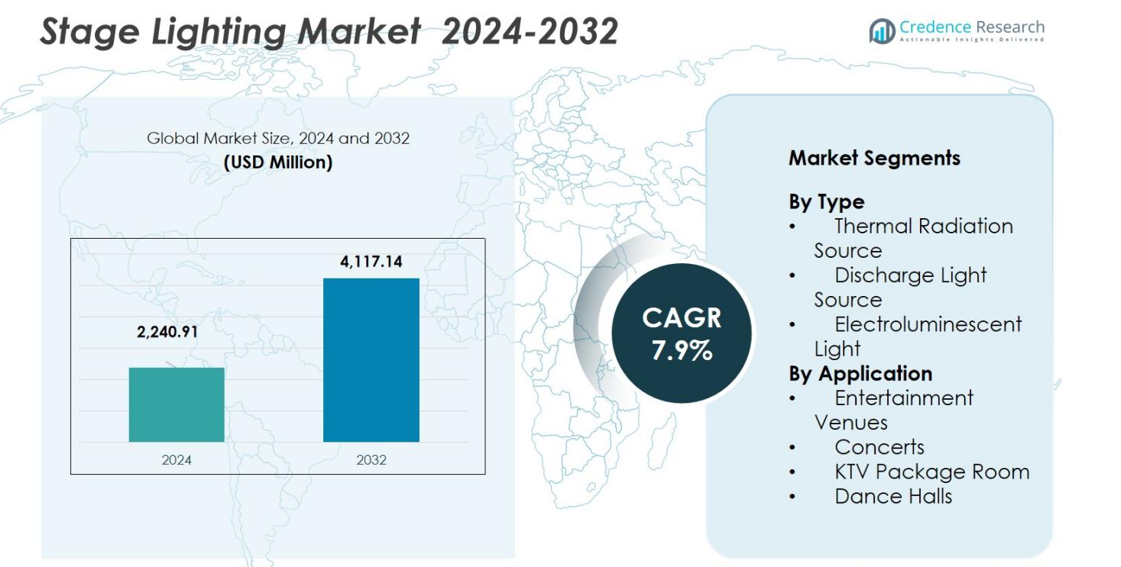
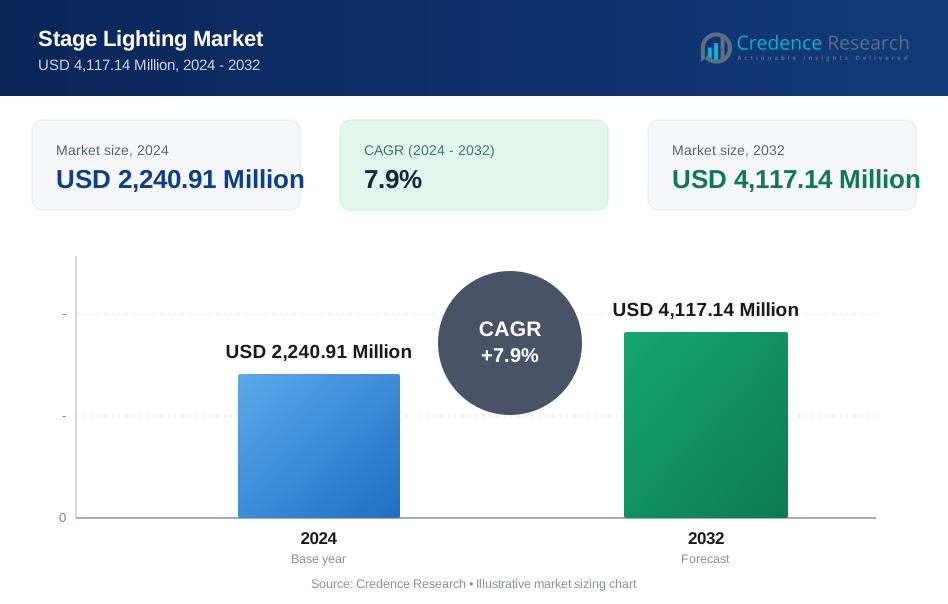
The Stage Lighting Market was valued at USD 2,240.91 Million in 2024 and is anticipated to reach USD 4,117.14 Million by 2032, at a CAGR of 7.9% during the forecast period.
| REPORT ATTRIBUTE | DETAILS |
|---|---|
| Historical Period | 2020-2023 |
| Base Year | 2024 |
| Forecast Period | 2025-2032 |
| Stage Lighting Market Size 2024 | USD 2,240.91 Million |
| Stage Lighting Market, CAGR | 7.9% |
| Stage Lighting Market Size 2032 | USD 4,117.14 Million |
The Stage Lighting Market is led by key players such as Robe, Martin, Chauvet, ADJ Group, JB, Stadio Due, ETC, Visage, SGM, and Yajiang Photoelectric. These companies dominate the market through technological advancements, product innovation, and strong distribution networks. The North American region holds the largest market share at 36%, driven by high demand from entertainment hubs and the widespread use of advanced lighting systems in concerts and theaters. Europe follows closely with a 31% market share, thanks to the region’s emphasis on energy-efficient and LED-based lighting solutions. The Asia Pacific region, accounting for 25% of the market, is experiencing rapid growth, especially in countries like China, India, and Japan, due to the expanding live entertainment sector and increasing investments in entertainment infrastructure. These regions collectively contribute to the strong growth of the global stage lighting market.
Market Insights
- The market overview indicates that the Stage Lighting Market was valued at USD 2,240.91 Million in 2024 and is projected to reach USD 4,117.14 Million by 2032, growing at a CAGR of 7.9 %.
- A major market driver is the surge in demand for live events and entertainment venues, which is fuelling increased investments in high‑performance lighting systems especially in large‑scale concerts and theatre presentations.
- A key trend is the rising adoption of LED, laser and automated lighting technologies, allowing lighting designers to deliver immersive, energy‑efficient experiences; for example the Discharge Light Source sub‑segment leads among types, and the Entertainment Venues application holds the largest segment share.
- A notable market restraint is the high initial investment cost and technological complexity of advanced lighting systems, which restricts uptake among smaller venues and in developing regions.
- Regional analysis shows North America commanding 36 % of the market, Europe 31 % and Asia Pacific 25 %, reflecting the predominance of mature entertainment infrastructure in the first two regions and rapid growth potential in the Asia Pacific.
Market Segmentation Analysis:
By Type
The Stage Lighting Market is primarily segmented into Thermal Radiation Source, Discharge Light Source, and Electroluminescent Light. Among these, Discharge Light Source holds the dominant share of the market due to its high efficiency, long lifespan, and ability to produce bright and consistent light. This sub-segment is widely used in concerts and entertainment venues, contributing to its significant market share. The growing demand for energy-efficient and durable lighting solutions in large-scale events is one of the key drivers for the growth of discharge light sources in the stage lighting market.
- For instance, Philips' MSR Gold FastFit series, used in major concert tours and theatrical productions, is known for its rapid lamp replacement and superior lumen output.
By Application
The Stage Lighting Market is extensively utilized in Entertainment Venues, Concerts, KTV Package Rooms, and Dance Halls. Entertainment Venues hold the largest share in the application segment, driven by the increasing demand for professional lighting solutions in theaters, clubs, and live performances. The rise in live events and cultural activities globally is boosting the demand for advanced stage lighting systems. As technology advances, entertainment venues continue to adopt more energy-efficient, customizable, and visually immersive lighting systems, strengthening their dominant market position.
- For instance, Martin Professional's advanced LED moving head fixtures are widely employed in theaters and live concert stages for their precision control over light intensity, color, and movement, enhancing the visual experience.
Key Growth Drivers
Increasing Demand for Live Events and Entertainment
The growing popularity of live events, concerts, and entertainment activities is a major growth driver for the Stage Lighting Market. As the demand for immersive, high-quality visual experiences at live performances escalates, event organizers are investing heavily in advanced stage lighting systems. This trend is seen across music festivals, theater performances, and corporate events, where lighting plays a crucial role in enhancing audience engagement. The surge in live performances worldwide is expected to fuel the adoption of innovative stage lighting technologies, contributing significantly to market expansion.
- For instance, Clay Paky unveiled the Arolla Aqua HP at PLASA 2025, featuring a powerful custom 1400W white LED engine with over 60,000 lumens. Its robust design and long-distance beam projection make it ideal for outdoor music festivals and touring events.
Advancements in LED Lighting Technology
Advancements in LED lighting technology have revolutionized the Stage Lighting Market, offering energy-efficient, durable, and high-performance solutions for stage lighting. LEDs provide bright, vivid colors and are capable of delivering superior performance over extended periods, reducing operational costs. This innovation also allows for greater control over lighting effects, enabling more dynamic and customizable displays. As the entertainment industry increasingly prioritizes sustainability and cost-efficiency, the demand for LED-based stage lighting solutions is expected to grow, becoming a primary driver for market development.
- For instance, Samsung LED has developed advanced LED products known for superior performance, energy efficiency, and long lifespan, contributing to highly customizable and dynamic stage lighting setups.
Rising Adoption of Intelligent and Automated Lighting Systems
The increasing adoption of intelligent and automated lighting systems is reshaping the Stage Lighting Market. With the integration of digital technologies such as smart sensors, remote controls, and wireless systems, automated stage lighting offers convenience, flexibility, and precision. This trend is particularly evident in large-scale venues and concert halls, where lighting effects need to be seamlessly adjusted to enhance the overall experience. The demand for automation and interactivity in stage lighting is poised to drive further growth in the market, as event organizers seek innovative, cost-effective solutions to enhance stage performances.
Key Trends & Opportunities
Integration of Artificial Intelligence and Lighting Automation
The integration of artificial intelligence (AI) and machine learning technologies in stage lighting systems presents significant opportunities in the market. AI-enabled lighting solutions offer features such as real-time adjustments, predictive maintenance, and dynamic lighting control based on audience engagement. These systems can analyze the environment and automatically adjust lighting effects to match the mood and rhythm of the performance. As AI technology continues to evolve, it opens up new possibilities for stage lighting, particularly in live events and theatrical performances, where customized lighting plays a pivotal role in creating immersive experiences.
- For instance, A.C. Lighting’s Follow-Me 3D system uses automated performer tracking to keep moving lights accurately focused on artists across the stage, reducing the need for multiple manual follow-spot operators while maintaining consistent coverage.
Sustainability and Eco-Friendly Lighting Solutions
Sustainability is a growing trend in the Stage Lighting Market, with a shift toward eco-friendly lighting solutions. Consumers and event organizers are increasingly prioritizing environmentally conscious practices, leading to higher demand for energy-efficient lighting options. Stage lighting systems with low energy consumption, such as LED and organic light-emitting diode (OLED) lights, are gaining popularity. Additionally, recyclable materials and energy-saving features in lighting fixtures are becoming essential considerations. The trend toward sustainable lighting solutions presents significant opportunities for growth, as the industry moves toward minimizing its environmental footprint while maintaining high-quality performance.
- For instance, Philips LED lights save up to 90% energy compared to traditional bulbs and offer lifespans up to 20,000 hours, significantly reducing waste and energy consumption.
Key Challenges
High Initial Investment Costs
One of the primary challenges facing the Stage Lighting Market is the high initial investment required for advanced stage lighting systems. While newer technologies such as LEDs and intelligent lighting solutions offer long-term savings, the upfront costs can be a barrier for smaller venues, independent event organizers, and developing regions. The adoption of high-end lighting technologies often requires significant capital investment in equipment, installation, and training, which can limit the accessibility of these systems for certain market segments. This challenge may slow down the overall growth rate in the short term, despite the long-term benefits.
Technological Complexity and Skill Requirements
The increasing complexity of stage lighting systems, especially those involving automation, AI, and intelligent controls, presents a significant challenge. Advanced lighting solutions require specialized knowledge and training for effective operation and maintenance. Event organizers and venue operators must invest in skilled personnel to ensure the proper functioning of these systems. The lack of trained professionals and the complexity of integrating multiple lighting technologies can hinder widespread adoption, particularly in regions with limited access to technical expertise. Addressing this challenge is crucial for the growth of the market, as it limits operational efficiency and increases operational costs.
Regional Analysis
North America
The North American region commands a 36% market share of the global stage lighting market. This dominance stems from robust infrastructure in major entertainment hubs, widespread adoption of advanced lighting technologies in concerts and theatres, and the strong purchasing power of event organizers. Market players are capitalizing on a high density of live events, including music festivals and corporate shows, which drive demand for high-performance lighting systems. The growth is further propelled by the shift toward smart, integrated lighting solutions and the presence of established equipment manufacturers headquartered in the region.
Europe
Europe holds 31% market share in the stage lighting market. Key factors include mature event markets across major countries, substantial investments in theatres and cultural venues, and the growing emphasis on energy-efficient and LED-driven stage lighting. Regulatory support for sustainable lighting practices and the adoption of next-generation lighting control systems bolster demand. While growth rates are moderate compared to emerging regions, the strategic importance of innovative lighting technologies and strong OEM presence in Europe ensures that the region remains highly competitive and critical for market participants.
Asia Pacific
The Asia Pacific region accounts for 25% market share in the global stage lighting market. Rapid expansion in live entertainment and concerts across countries like China, India, Japan, and South Korea drives this growth. Rising disposable incomes, increasing investments in entertainment infrastructure, and a growing number of event venues contribute significantly. The adoption of automated stage lighting systems and LED technology is accelerating, with market participants focusing on regional customization and cost-effective solutions to tap into these dynamic end-use segments.
Middle East & Africa
In the Middle East & Africa region, the stage lighting market secures 8% market share globally. Though smaller in comparison, the region is characterized by emerging investments in large-scale concerts, hotel resorts, and leisure destinations, particularly within the Gulf Cooperation Council countries. Growth is driven by tourism-led infrastructure expansions and demand for high-impact lighting systems in entertainment venues. However, slower rate of new venue development and economic variability in some countries temper growth potential relative to other regions.
Latin America
Latin America holds 4% market share of the global stage lighting market. While specific percentage values are less frequently published, market activity is steadily expanding driven by increasing live event frequencies and investment in cultural productions in countries such as Brazil and Argentina. Event organizers are gradually upgrading older lighting installations to more energy-efficient and dynamic systems, creating opportunities despite regional economic challenges and logistical constraints.
Market Segmentations:
By Type
- Thermal Radiation Source
- Discharge Light Source
- Electroluminescent Light
By Application
- Entertainment Venues
- Concerts
- KTV Package Room
- Dance Halls
By Region
- North America
- U.S.
- Canada
- Mexico
- Europe
- Germany
- France
- U.K.
- Italy
- Spain
- Rest of Europe
- Asia Pacific
- China
- Japan
- India
- South Korea
- South-east Asia
- Rest of Asia Pacific
- Latin America
- Brazil
- Argentina
- Rest of Latin America
- Middle East & Africa
- GCC Countries
- South Africa
- Rest of the Middle East and Africa
Competitive Landscape
The competitive landscape of the stage lighting market features prominent players such as Robe, Martin, Chauvet, ADJ Group, JB, Stadio Due, ETC, Visage, SGM and Yajiang Photoelectric. These companies are actively differentiating through technological advances in LED fixtures, wireless and remote‑control capabilities, and automated lighting systems, responding to rising demand for immersive stage experiences. They maintain varying regional footprints and product specialisations-some focusing on high‑end concert equipment, others on rental markets or club installations. The market is highly fragmented with numerous regional players, intensifying competition and pushing incumbents to pursue strategic partnerships, product innovation and cost‑efficient manufacturing. Continuous shifts in event formats, increasing expectations for visual experiences and shorter product life cycles require firms to refine value propositions and expand global reach to secure market presence.
Key Player Analysis
- Yajiang Photoelectric
- Martin
- Visage
- ETC
- JB
- Chauvet
- Robe
- Stadio Due
- SGM
- ADJ Group
Recent Developments
- In December 2024, Vari‑Lite (of Signify) launched the VLHive 151 Digital FX, billed as the world’s first all‑digital entertainment lighting fixture.
- In September 2025, ChamSys Ltd. (a subsidiary of Chauvet & Sons LLC) acquired the product and software portfolio of ArKaos SA, including MediaMaster, GrandVJ and KlingNet, to deliver a unified lighting, pixel‑mapping & media‑control solution.
- In May 2025, Blue Sea Lighting introduced three new IP‑rated professional stage lighting fixtures at the event Prolight+Sound Guangzhou 2025, including a waterproof outdoor 250 W LED module beam moving head light and other hybrid beam/spot/wash models.
- In March 2025, Claypaky announced the formation of Clay Paky Deutschland GmbH as a dedicated local organisation to serve its German customers, effective April 1 2025.
Report Coverage
The research report offers an in-depth analysis based on Type, Application and Region. It details leading market players, providing an overview of their business, product offerings, investments, revenue streams, and key applications. Additionally, the report includes insights into the competitive environment, SWOT analysis, current market trends, as well as the primary drivers and constraints. Furthermore, it discusses various factors that have driven market expansion in recent years. The report also explores market dynamics, regulatory scenarios, and technological advancements that are shaping the industry. It assesses the impact of external factors and global economic changes on market growth. Lastly, it provides strategic recommendations for new entrants and established companies to navigate the complexities of the market.
Future Outlook
- The market will expand as event organisers invest more in immersive lighting experiences that elevate live performances and brand activations.
- Smart and networked lighting systems will gain traction, enabling remote control, automation, and integration with audio‑visual platforms.
- LED and laser‑based fixtures will dominate replacements of older technologies, driven by lower energy consumption, longer lifespans and reduced maintenance.
- Demand will surge in emerging regions, where growing entertainment infrastructure and rising disposable incomes fuel adoption.
- Rental and touring markets will scale up, as production companies seek flexible lighting solutions for concerts, festivals and corporate events.
- Sustainability requirements will push manufacturers to develop eco‑friendly lighting fixtures, promoting materials recycling and low‑power operation.
- Collaboration between lighting, video and stage technologies will increase, creating unified systems that synchronise motion, colour and effects.
- Customisable lighting experiences tailored to venue size, event type and audience expectations will shape product development and service models.
- The supply‑chain will evolve, with component firms scaling production of high‑efficiency drives and wireless controllers to reduce cost and lead time.
- Training and service ecosystems will become critical, as more venues adopt advanced lighting platforms and require skilled personnel for operation and maintenance.
Request a Free Sample
Fill in your details and we'll send you a free sample report.
- Sample data tables & charts
- Research methodology
Need a Custom Version of This Report?
Tailor the scope, geography, or segments to your exact requirements.
- Custom geography or segment scope
- Direct access to our analyst team
Frequently Asked Questions
What is the current market size for Stage Lighting Market, and what is its projected size in 2032?
At what Compound Annual Growth Rate is the Stage Lighting Market projected to grow between 2025 and 2032?
Which is the leading region of the market for stage lighting?
What are the key drivers for the growth of the stage lighting market?
Which is the major segment in the Stage lighting market by application?
Who are the leading companies in the Stage Lighting Market?
Table of Content
Chapter 1. Report Introduction
- 1.1 Report Description & Purpose
- 1.1.1 Report Title & Market Definition
- 1.1.2 Unique Selling Propositions (USP) & Key Differentiators
- 1.1.3 Value Proposition for Stakeholders
- 1.2 Research Objectives
- 1.2.1 Market Sizing Objectives (Volume & Revenue)
- 1.2.2 Segmentation Objectives
- 1.2.3 Competitive Intelligence Objectives
- 1.2.4 Forecast & Scenario Objectives
- 1.3 Report Scope
- 1.3.1 Stage Lighting Scope – Types & Subtypes Covered
- 1.3.2 Geographic Scope – Regions & Countries Covered
- 1.3.3 Historical Period, Base Year & Forecast Period (2024; forecast to 2032)
- 1.3.4 Inclusions & Exclusions
- 1.4 HS Code & Classification Framework
- 1.5 Currency, Units & Pricing Basis
- 1.6 Target Stakeholders
- 1.7 Limitations & Assumptions
Chapter 2. Executive Summary
- 2.1 Global Stage Lighting Market Snapshot
- 2.1.1 Market Size – Historical (2024) & Forecast (2024-2032) (2024: USD 2,240.91 Million → 2032: USD 4,117.14 Million)
- 2.1.2 Volume & Revenue – Global Totals
- 2.1.3 Key Market Highlights – Top Five Facts
- 2.2 Stage Lighting Market Segmentation Snapshot
- 2.2.1 Market Split by Region – 2024 vs. 2032
- 2.3 Competitive Snapshot
- 2.3.1 Top 10 Players by Revenue Share – 2024
- 2.3.2 Top 10 Players by Volume Share – 2024
- 2.3.3 Recent Strategic Developments (18-Month Summary)
- 2.4 Key Investment Highlights & Strategic Conclusions
Chapter 3. Stage Lighting Market Dynamics & Industry Analysis
- 3.1 Market Overview & Context
- 3.1.1 Stage Lighting Market Position in the Broader Automotive Value Chain
- 3.1.2 OEM vs. Replacement Market Dynamics
- 3.1.3 Market Maturity & Development Stage by Region
- 3.2 Stage Lighting Market Drivers
- 3.3 Stage Lighting Market Restraints & Challenges
- 3.4 Stage Lighting Market Opportunities
- 3.5 Porter's Five Forces Analysis
- 3.5.1 Threat of New Entrants
- 3.5.2 Bargaining Power of Suppliers
- 3.5.3 Bargaining Power of Buyers
- 3.5.4 Threat of Substitutes
- 3.5.5 Competitive Rivalry – Intensity Assessment
- 3.6 Stage Lighting Value Chain Analysis
- 3.6.1 Upstream – Raw Material/Input Suppliers
- 3.6.1.1 Raw Material/Input 1
- 3.6.1.2 Raw Material/Input 2
- 3.6.1.3 Raw Material/Input 3
- 3.6.2 Midstream – Production/Manufacturing/Service Delivery
- 3.6.2.1 Production/Process Overview
- 3.6.2.2 Key Facility Locations & Capacity by Manufacturer
- 3.6.3 Downstream – Distribution & End Consumer
- 3.6.3.1 Primary Channel – B2B/OEM
- 3.6.3.2 Secondary Channels – Dealer, Retail, Online, Direct
- 3.6.4 Value Chain Profitability Analysis
- 3.6.1 Upstream – Raw Material/Input Suppliers
- 3.7 PESTEL Analysis
- 3.7.1 Political Factors
- 3.7.2 Economic Factors
- 3.7.3 Social Factors
- 3.7.4 Technological Factors
- 3.7.5 Environmental Factors
- 3.7.6 Legal Factors
- 3.8 Stage Lighting Supply Chain Analysis
- 3.8.1 Raw Material/Input Supply Risk Assessment
- 3.8.2 Manufacturing Concentration Risk (Geographic Exposure)
- 3.8.3 Trade Disruption Impact Analysis
- 3.9 Regulatory & Policy Landscape
Note: The regulatory and policy landscape section covers regulations based on their applicability to the market, Stage Lighting category, geography, and scope of the study. Only regulatory frameworks with a material impact on operations, compliance, trade, sustainability, or market access are analyzed in detail.
Chapter 4. Key Investment Pockets & Opportunity Analysis
- 4.1 Stage Lighting Market Attractiveness Analysis
- 4.1.1 By Region – Investment Attractiveness Matrix (Volume × CAGR)
- 4.2 Absolute Revenue Growth Opportunity
- 4.2.1 By Region – Absolute USD Growth Through 2032
- 4.3 Incremental Volume Opportunity
- 4.3.1 By Region – Incremental Volume Through 2032
- 4.3.2 Segment – Incremental Volume
- 4.4 Emerging Submarket Opportunity Deep Dive (Subject to Applicability)
- 4.5 Emerging Market Opportunity Scorecards
- 4.5.1 United States
- 4.5.2 Europe
- 4.5.3 Asia
- 4.5.4 Middle East & Africa
Note: Emerging Market Opportunity Scorecards will be included based on relevance and strategic importance. Regions listed are indicative and may vary depending on data availability and market dynamics.
Chapter 5. Stage Lighting Import-Export Analysis & Trade Flows
- 5.1 Global Trade Overview
- 5.1.1 Global Export Value by Country (2024)
- 5.1.2 Global Export Volume by Country (2024)
- 5.1.3 Global Import Value by Country (2024)
- 5.1.4 Global Import Volume by Country (2024)
- 5.1.5 Net Trade Balance by Country (2024)
- 5.2 Export Analysis – Segment
- 5.2.1 Type 1 (HS Code)
- 5.2.2 Type 2 (HS Code)
- 5.2.3 Type 3 (HS Code)
- 5.2.4 Type 4 (HS Code)
- 5.2.5 Type 5 (HS Code)
- 5.3 Import Analysis – Segment
- 5.3.1 Type 1 (HS Code)
- 5.3.2 Type 2 (HS Code)
- 5.3.3 Type 3 (HS Code)
- 5.3.4 Type 4 (HS Code)
- 5.3.5 Type 5 (HS Code)
- 5.4 Average Unit Trade Prices
- 5.4.1 Average Export Price – Segment & Country
- 5.4.2 Average Import Price – Segment & Source Country
- 5.4.3 Price Trends (2024)
- 5.5 Key Trade Route Analysis
- 5.5.1 Trade Route 1
- 5.5.2 Trade Route 2
- 5.5.3 Trade Route 3
- 5.5.4 Trade Route 4
- 5.5.5 Trade Route 5
- 5.6 Trade Policy Impact Assessment
- 5.6.1 US Anti-Dumping & Section 301 Tariffs
- 5.6.2 EU Customs Union Impact
- 5.6.3 Major Free Trade Agreements
- 5.6.4 USMCA Rules of Origin
Note: Trade policy analysis will be included only where relevant to the Stage Lighting market.
Chapter 6. Competitive Landscape & Company Benchmarking
- 6.1 Stage Lighting Market Concentration & Structure
- 6.1.1 Herfindahl-Hirschman Index (HHI) – vs. 2024
- 6.1.2 Tier 1, Tier 2 & Tier 3 Market Structure
- 6.1.3 Global, Regional & Local Player Dynamics
- 6.2 Stage Lighting Market Share Analysis – 2024
- 6.2.1 Global Revenue Share by Company
- 6.2.2 Global Volume Share by Company
- 6.2.3 Regional Revenue Share
- 6.2.4 Market Share Evolution ( vs. 2024)
- 6.2.5 OEM Segment Share by Company
- 6.2.6 Replacement Segment Share by Company
- 6.3 Production/Delivery Capacity & Facility Analysis
- 6.3.1 Global Installed Capacity
- 6.3.2 Capacity Utilization Rates
- 6.3.3 Production/Output Volume
- 6.3.4 Facility Locations & Capacity Map
- 6.3.5 Planned Capacity Additions
- 6.4 Stage Lighting Competitive Benchmarking Matrix
- 6.4.1 Revenue, Volume, CAGR & Profitability Comparison
- 6.4.2 Channel Revenue Mix
- 6.4.3 Geographic Revenue Exposure
- 6.4.4 R&D Intensity
- 6.4.5 Sustainability Maturity
- 6.5 Strategic Developments in Stage Lighting (Last 24 Months)
- 6.5.1 Mergers, Acquisitions & Divestments
- 6.5.2 New Stage Lighting Launches
- 6.5.3 Facility Expansions
- 6.5.4 Strategic Alliances, Joint Ventures & Partnerships
- 6.5.5 Distribution Expansion & Market Entry
- 6.5.6 Sustainability & ESG Initiatives
- 6.6 Competitive Strategy Mapping
- 6.6.1 Leader, Challenger, Follower & Niche Classification
- 6.6.2 Pricing Strategy Comparison
- 6.6.3 Channel Strategy Matrix
Note: Strategic developments are included based on their materiality and the availability of reliable information.
Chapter 7. Global Stage Lighting Market – By Distribution Channel
- 7.1 Segment Overview
- 7.1.1 Volume & Revenue Split by Channel (2024 & 2032)
- 7.1.2 Channel Mix Evolution (2024-2032)
Chapter 8. Regional Market Analysis – Global Overview
- 8.1 Global Regional Overview
- 8.1.1 Regional Volume Share
- 8.1.2 Regional Revenue Share
- 8.1.3 Regional Volume by Region
- 8.1.4 Regional Revenue by Region
- 8.1.5 Regional Forecast Through 2032
- 8.2 Cross-Regional Segment Analysis
- 8.2.1 By Distribution Channel
- 8.2.2 By Brand/Price Tier
Chapter 9. North America Stage Lighting Market
- 9.1 United States
- 9.2 Canada
- 9.3 Mexico
Chapter 10. Europe Stage Lighting Market
- 10.1 Germany
- 10.2 France
- 10.3 Italy
- 10.4 United Kingdom
- 10.5 Spain
- 10.6 Poland
- 10.7 Russia
- 10.8 Netherlands
- 10.9 Belgium
- 10.10 Sweden
- 10.11 Denmark
- 10.12 Norway
- 10.13 Rest of Europe
Chapter 11. Asia Pacific Stage Lighting Market
- 11.1 China
- 11.2 India
- 11.3 Japan
- 11.4 South Korea
- 11.5 Thailand
- 11.6 Indonesia
- 11.7 Vietnam
- 11.8 Malaysia
- 11.9 Australia
- 11.10 Rest of Asia Pacific
Chapter 12. Latin America Stage Lighting Market
- 12.1 Brazil
- 12.2 Argentina
- 12.3 Colombia
- 12.4 Chile
- 12.5 Rest of Latin America
Chapter 13. Middle East Stage Lighting Market
- 13.1 Saudi Arabia
- 13.2 United Arab Emirates
- 13.3 Turkey
- 13.4 Israel
- 13.5 Iran
- 13.6 Rest of the Middle East
Chapter 14. Africa Stage Lighting Market
- 14.1 South Africa
- 14.2 Egypt
- 14.3 Nigeria
- 14.4 Morocco
- 14.5 Rest of Africa
Chapter 15. Stage Lighting Company Profiles
- 15.1 [Company 01]
- 15.1.1 Company Overview
- 15.1.2 Key Management Personnel
- 15.1.3 Products & Services Portfolio
- 15.1.4 Financial Performance
- 15.1.5 Key Market Focus & Geographic Presence
- 15.1.6 Recent Developments & Strategic Initiatives
Note: The company profile list is preliminary and may change based on research findings, market developments, data availability, and client requirements.
Chapter 16. Appendices
- Appendix A – List of Abbreviations & Acronyms
- Appendix B – Industry Classification Code Reference – Full Series
- Appendix C – Production & Capacity Data Tables
- Appendix D – End-Use & Demand Base Tables
- Appendix E – Consumption & Replacement Rate Assumptions
- Appendix F – ASP Reference Tables
- Appendix G – Manufacturing & Facility Database
- Appendix H – Import-Export Data Tables
- Appendix I – Regulatory Summary Tables
- Appendix J – Primary Research Participant List (Anonymized)
- Appendix K – Primary Research Questionnaire Framework
- Appendix L – Data Sources & Bibliography
- Appendix M – Market Size Divergence & Source Comparison
Chapter 17. Research Methodology
- 17.1 Research Framework & Philosophy
- 17.2 Secondary Research – Sources, Hierarchy & Data Extraction
- 17.3 Data Modeling – Bottom-Up & Top-Down Market Sizing
- 17.4 Primary Research – Stakeholder Framework, LOI & Sample Sizes
- 17.5 Forecast Methodology – Regression, Scenario & Sensitivity Analysis
- 17.6 Quality Control – Four-Layer Validation Framework
- 17.7 Limitations & Standard Assumptions
- 17.8 Disclaimer
