Market Overview:
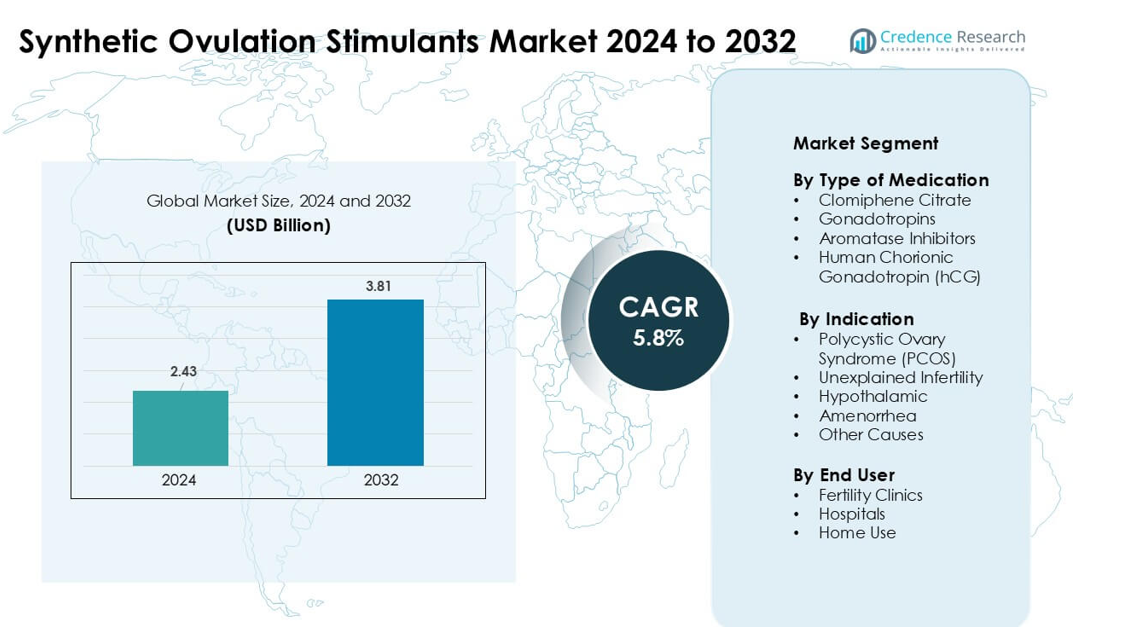
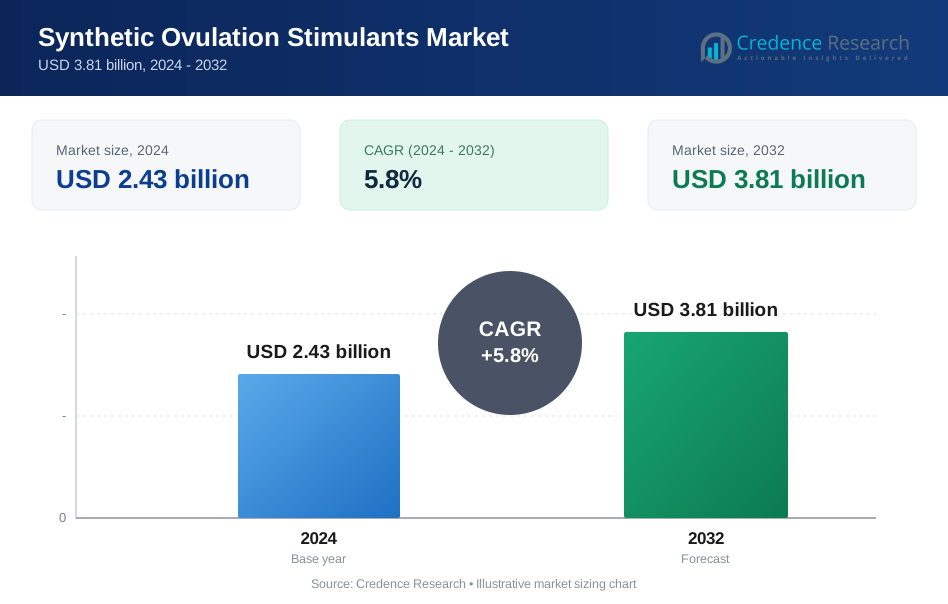
Synthetic Ovulation Stimulants Market was valued at USD 2.43 billion in 2024 and is anticipated to reach USD 3.81 billion by 2032, growing at a CAGR of 5.8 % during the forecast period.
| REPORT ATTRIBUTE | DETAILS |
|---|---|
| Historical Period | 2020-2023 |
| Base Year | 2024 |
| Forecast Period | 2025-2032 |
|
|
USD 2.43 billion |
| Synthetic Ovulation Stimulants Markett, CAGR | 5.8% |
| Synthetic Ovulation Stimulants Market Size 2032 | USD 3.81 billion |
The Synthetic Ovulation Stimulants Market features major companies such as Merck KGaA, Ferring Pharmaceuticals, Novartis AG, Sanofi Aventis Ltd., Serum Institute Pvt. Ltd., Merck & Co. Inc., AstraZeneca plc, Organon & Co., EMD Serono, Inc., and Kosher Pharmaceuticals. These firms compete through improved hormone formulations, wider clinical partnerships, and expanded global distribution. North America led the market in 2024 with an estimated 38% share, supported by strong fertility-clinic networks, high treatment awareness, and broader access to reproductive diagnostics. Continuous product innovation and rising infertility evaluations across the region reinforce its leadership in the global landscape.
Market Insights:
- The Synthetic Ovulation Stimulants Market was valued at USD 2.43 billion in 2024 and is projected to reach USD 3.81 billion by 2032, growing at a CAGR of 5.8%.
- Rising infertility cases driven by PCOS, lifestyle disorders, and delayed pregnancies lifted demand, with clomiphene citrate holding the largest share among medication types.
- Personalized hormone-based treatment protocols and digital cycle-tracking tools shaped market trends, while clinics adopted optimized dosing to improve ovulation success.
- Strong competition came from Merck KGaA, Ferring Pharmaceuticals, Novartis AG, Sanofi Aventis Ltd., and Merck & Co. Inc., as companies expanded clinical partnerships and enhanced formulation safety.
- North America led the market with a 38% share in 2024, followed by Europe, while Asia-Pacific grew fastest due to rising diagnostic access and expanding fertility clinics.
Market Segmentation Analysis:
By Type of Medication
Clomiphene citrate held the dominant share in 2024 with wide use as a first-line therapy. Doctors preferred this drug because it offered strong ovulation induction, low cost, and easy oral dosing. Demand stayed steady in regions with rising infertility assessments and broader access to reproductive care. Gonadotropins and aromatase inhibitors grew as second-line options for patients who showed limited response to clomiphene citrate. Human chorionic gonadotropin supported treatment cycles by triggering ovulation and helped improve overall protocol success rates across clinics.
- For instance, a randomized multicenter study comparing low-dose follicle‑stimulating hormone (gonadotropin) vs clomiphene citrate in women with Polycystic Ovary Syndrome (PCOS)‑related anovulation found that pregnancy rate per first treatment cycle was 30 % in the low-dose FSH group versus 14.6 % in the clomiphene citrate group.
By Indication
Polycystic ovary syndrome (PCOS) led the indication segment in 2024 with the highest share due to its strong link to anovulation. Clinics used ovulation stimulants to improve cycle regularity and enhance fertility in women with hormonal imbalance. Rising diagnosis rates, lifestyle-linked metabolic issues, and earlier reproductive consultations supported this leadership. Unexplained infertility and hypothalamic amenorrhea continued to expand as more couples sought detailed evaluations and evidence-based treatment plans.
- For instance, a global burden‑of‑disease analysis estimated that infertility attributable to PCOS reached approximately 12.13 million women worldwide by 2019 up from about 6.00 million in 1990 indicating a doubling of absolute case numbers over that period.
By End User
Fertility clinics dominated the end-user segment in 2024 as they handled most medically supervised ovulation-induction cycles. Clinics preferred controlled stimulation protocols and provided monitoring through ultrasound and hormonal tests. Higher treatment success rates, wider adoption of assisted reproductive technologies, and improved patient pathways reinforced their share. Hospitals supported complex cases requiring specialist care, while home-use options gained gradual traction as digital platforms promoted guided treatment and remote monitoring for select patient groups.
Key Growth Drivers:
Rising Global Infertility Prevalence
Growing infertility rates remain a major growth driver for the Synthetic Ovulation Stimulants Market. Many couples face delayed childbearing, lifestyle changes, metabolic disorders, and hormonal issues that raise ovulation-related problems. Higher cases of PCOS, thyroid imbalance, obesity, and stress-linked reproductive dysfunction increase demand for medical ovulation support. Women now seek earlier evaluation, while awareness campaigns highlight the benefits of timely fertility treatment. Clinics report more first-time consultations among women in their late twenties and early thirties. Rising availability of structured diagnostic pathways, broader insurance inclusion in select regions, and expanding fertility chains help more patients access care. These shifts push sustained adoption across both oral and injectable stimulants.
- For instance, the World Health Organization (WHO) estimates that about 1 in 6 people globally roughly 17.5% of the adult population will experience infertility at some point in their lives.
Increasing Access to Fertility Services and Specialized Clinics
The global expansion of fertility clinics continues to drive strong uptake of synthetic ovulation stimulants. Many regions now invest in reproductive-health infrastructure, making advanced care available outside major cities. Clinics offer standardized stimulation protocols, reliable monitoring tools, and tailored treatment plans that improve success rates. Growing teleconsultation platforms help reach women who previously lacked access to reproductive specialists. More clinics partner with diagnostic labs to support quick hormone testing and cycle tracking. The rise of medical tourism hubs also boosts treatment volumes, especially where procedures remain affordable. With better-trained specialists and higher adoption of evidence-based therapy, clinics prescribe more stimulants for first-line and second-line ovulation induction.
- For instance, a comprehensive global burden analysis utilizing data from the Global Burden of Disease Study 2021 (GBD 2021) and published in journals throughout 2025 reported that the number of women of childbearing age with PCOS worldwide reached 65.77 million in 2021, and among them, about 12.47 million women suffered from PCOS-related infertility, illustrating an expanding patient pool for fertility services.
Shift Toward Early Diagnosis and Proactive Fertility Management
A clear shift toward early fertility assessment supports market growth. Women increasingly monitor reproductive health through hormone tests, ovulation tracking apps, and routine gynecologic evaluations. Early detection of conditions like PCOS, hypothalamic dysfunction, and luteal phase issues leads to timely intervention using synthetic stimulants. Public health programs encourage fertility screening as part of women’s wellness plans, further increasing awareness. Many providers teach lifestyle modification and counsel patients on optimal timing, improving treatment outcomes. With proactive management gaining acceptance, more women begin therapy before conditions worsen. This reduces cycle failures, enhances ovulation predictability, and drives steady stimulant usage across global markets.
Key Trend & Opportunity:
Rising Use of Personalized and Protocol-Optimized Treatments
Personalized stimulation protocols show strong growth as clinics tailor medication dosing and cycle planning based on hormone levels, ovarian reserve, age, and comorbidities. Doctors rely on data-driven tools to choose between clomiphene, aromatase inhibitors, or gonadotropins to optimize success rates. Monitoring technologies, including automated hormone analyzers and ultrasound-based follicle tracking, help deliver safer, more precise cycles. As individualized care expands, more women prefer clinics offering protocol optimization. This trend reduces overstimulation risks, supports predictable outcomes, and strengthens trust in pharmaceutical options.
- For instance, a recent study introduced an AI-powered model that predicts individualized daily FSH doses for controlled ovarian stimulation with 73.7% accuracy significantly higher than conventional clinician‑guided dosing.
Integration of Digital Platforms and Remote Monitoring
Digital health tools support new opportunities for the Synthetic Ovulation Stimulants Market. Mobile apps now track follicular changes, predict ovulation windows, and send reminders for medication timing. Clinics use teleconsultations for follow-up visits, prescription adjustments, and cycle reviews. Wearable devices measure basal temperature and hormone fluctuations, helping doctors fine-tune medication plans. Remote support reduces travel needs and enables more women to manage therapy from home. As digital platforms expand, they improve adherence, reduce cycle dropouts, and increase overall treatment success.
- For instance, a 2025 qualitative systematic review, which examined findings across 29 relevant articles and papers, observed that users frequently employ digital fertility tools alongside clinical fertility treatments. This indicates an emerging trend toward hybrid care models that combine in-clinic and digital monitoring, although the authors cautioned that research is still nascent and poorly designed apps may pose risks to patients.
Growing Expansion in Emerging Healthcare Markets
Emerging regions present large growth potential due to rising infertility awareness and improving reproductive-care access. Governments invest in women’s health programs, while private clinics introduce affordable stimulation packages. Educational outreach reduces stigma and encourages timely treatment. Pharmaceutical firms expand distribution networks, making stimulants more widely available. As income levels increase and diagnostic services improve, more women pursue structured ovulation-induction therapy. This unlocks significant long-term expansion for market stakeholders.
Key Challenge:
High Cost of Advanced Treatment and Monitoring
Treatment with synthetic ovulation stimulants often requires frequent monitoring, hormone testing, and specialist visits. These steps raise overall costs, limiting access for women in low-income regions. Injectable stimulants such as gonadotropins also cost more, leading to affordability concerns. Many countries lack insurance coverage for fertility care, creating financial barriers for repeated cycles. Cost-related treatment discontinuation remains common and restricts consistent market adoption. Without broader reimbursement and low-cost alternatives, access gaps will persist across key regions.
Safety Concerns and Risk of Adverse Outcomes
Safety concerns pose another challenge for the Synthetic Ovulation Stimulants Market. Improper dosing may increase risks of ovarian hyperstimulation, multiple pregnancies, or cycle irregularities. Some women experience hormonal side effects that lead to early withdrawal from therapy. Clinics must ensure accurate monitoring, yet resource-limited areas often lack advanced diagnostic tools. Concerns about complex protocols also discourage some patients from starting treatment. These factors highlight the need for safer dosing strategies, clearer guidance, and wider clinical oversight to maintain patient confidence.
Regional Analysis
North America – ~38% Market Share (2024)
North America held the largest share of about 38% in 2024, supported by strong infertility awareness and wide access to reproductive specialists. Clinics used structured diagnostic steps and advanced monitoring tools, which raised demand for synthetic ovulation stimulants. Rising PCOS cases, delayed pregnancies, and broader insurance coverage also pushed growth. The United States led due to large clinic networks and high treatment adoption. Canada showed steady uptake driven by more fertility consultations and better care access.
Europe – ~30% Market Share (2024)
Europe captured around 30% of the market in 2024, supported by robust healthcare systems and a strong focus on reproductive health. Germany, France, and the U.K. recorded more treatment cycles due to delayed family planning and higher PCOS rates. Public health programs encouraged early fertility checks, supporting stimulant prescriptions. Broader access to fertility clinics and structured monitoring improved treatment success. Southern and Eastern Europe saw higher demand as private clinics expanded services and improved affordability.
Asia-Pacific – ~22% Market Share (2024)
Asia-Pacific held nearly 22% of the market in 2024, with rapid growth driven by rising infertility rates and lifestyle changes. China, India, and Japan led adoption as urban women sought early evaluations and evidence-based treatment. Expanding fertility chains, medical tourism hubs, and wider hormone testing supported this rise. Affordability improved as local clinics offered cost-effective stimulation plans. Broader diagnostic access and increasing PCOS incidence strengthened long-term demand.
Latin America – ~6% Market Share (2024)
Latin America accounted for about 6% of the market in 2024, supported by improved infertility awareness and broader clinic networks. Brazil, Mexico, and Argentina recorded higher treatment adoption due to rising reproductive consultations and structured care. Private fertility centers offered affordable ovulation-stimulation options, making care more accessible. Economic pressures slowed uptake in some areas, yet expanding diagnostics and growing PCOS rates helped the region gain share.
Middle East & Africa – ~4% Market Share (2024)
The Middle East & Africa region held roughly 4% of the market in 2024, with gradual growth driven by rising demand for fertility services. Gulf countries invested in advanced reproductive centers and attracted cross-border patients. Awareness programs improved early diagnosis of ovulation issues, increasing stimulant use. In Africa, adoption stayed limited due to cost and infrastructure gaps, but urban clinics expanded access. Growing PCOS cases and wider consultation options supported long-term growth potential.
Market Segmentations:
By Type of Medication
- Clomiphene Citrate
- Gonadotropins
- Aromatase Inhibitors
- Human Chorionic Gonadotropin (hCG)
By Indication
- Polycystic Ovary Syndrome (PCOS)
- Unexplained Infertility
- Hypothalamic
- Amenorrhea
- Other Causes
By End User
- Fertility Clinics
- Hospitals
- Home Use
By Geography
- North America
- U.S.
- Canada
- Mexico
- Europe
- Germany
- France
- U.K.
- Italy
- Spain
- Rest of Europe
- Asia Pacific
- China
- Japan
- India
- South Korea
- South-east Asia
- Rest of Asia Pacific
- Latin America
- Brazil
- Argentina
- Rest of Latin America
- Middle East & Africa
- GCC Countries
- South Africa
- Rest of the Middle East and Africa
Competitive Landscape:
The Synthetic Ovulation Stimulants Market features leading players such as Merck KGaA, Ferring Pharmaceuticals, Novartis AG, Sanofi Aventis Ltd., Serum Institute Pvt. Ltd., Merck & Co. Inc., AstraZeneca plc, Organon & Co., EMD Serono, Inc., and Kosher Pharmaceuticals. These companies strengthen their position by expanding product portfolios, improving hormone-based formulations, and supporting evidence-based ovulation-induction protocols used in fertility clinics. Many firms invest in research to refine dosing accuracy, reduce side effects, and enhance success rates for women with PCOS, unexplained infertility, and hormonal imbalance. Strategic partnerships with fertility centers and diagnostic networks help widen patient access across developed and emerging regions. Continuous improvement in oral and injectable stimulants, along with global distribution expansion, supports strong competition
Key Player Analysis:
- Merck KGaA
- Ferring Pharmaceuticals
- Novartis AG
- Sanofi Aventis Ltd.
- Serum Institute Pvt. Ltd.
- Merck & Co. Inc.
- AstraZeneca, plc
- Organon & Co.
- EMD Serono, Inc.
- Kosher Pharmaceuticals
Recent Developments:
- In October 2025, EMD Serono signed an agreement with the U.S. government to offer its full IVF-therapy portfolio including ovulation stimulants such as Gonal‑F, Ovidrel, and Cetrotide via the new TrumpRx.gov direct-purchase platform. This move will allow eligible patients to obtain these therapies at up to 84% discount off list price.
- In May 2025, Ferring Pharmaceuticals: Presented results from the IRIS study (individualised vs conventional dosing of follitropin delta) showing comparable efficacy and safety and numerically higher ongoing pregnancy/live-birth rates for follitropin delta in an Indian IVF population; results were presented at ASPIRE (adds clinical real-world evidence supporting Ferring’s follitropin-delta portfolio).
Report Coverage:
The research report offers an in-depth analysis based on Type of medication, Indication, End-User and Geography. It details leading market players, providing an overview of their business, product offerings, investments, revenue streams, and key applications. Additionally, the report includes insights into the competitive environment, SWOT analysis, current market trends, as well as the primary drivers and constraints. Furthermore, it discusses various factors that have driven market expansion in recent years. The report also explores market dynamics, regulatory scenarios, and technological advancements that are shaping the industry. It assesses the impact of external factors and global economic changes on market growth. Lastly, it provides strategic recommendations for new entrants and established companies to navigate the complexities of the market.
Future Outlook:
- Demand will rise as infertility assessments increase across emerging and developed regions.
- Clinics will adopt more personalized stimulation protocols based on hormone profiles.
- Digital cycle-tracking tools will support better adherence and dosing accuracy.
- Access to fertility services will expand through new clinic networks and teleconsultations.
- Safer formulations with fewer side effects will gain stronger clinical preference.
- Early diagnosis of PCOS and hormonal disorders will drive higher treatment volumes.
- Home-based monitoring devices will support selected stimulation cycles.
- Partnerships between pharma companies and reproductive centers will strengthen distribution.
- Awareness campaigns will encourage earlier reproductive health evaluations.
- Growth will remain strong as more women delay childbirth and seek structured fertility care.
Request a Free Sample
Fill in your details and we'll send you a free sample report.
- Sample data tables & charts
- Research methodology
Market Dynamics
Rising Global Infertility Prevalence
Increasing rates of infertility due to factors such as PCOS, lifestyle disorders, and delayed pregnancies are driving demand for synthetic ovulation stimulants. More women are seeking earlier evaluation and treatment, expanding the patient pool for these therapies.
Expansion of Fertility Clinics and Services
The global proliferation of fertility clinics and improved access to reproductive diagnostics are making ovulation induction therapies more widely available. This infrastructure growth supports higher treatment volumes and adoption of synthetic stimulants.
Shift Toward Early Diagnosis and Proactive Fertility Management
Growing awareness and use of hormone tests, cycle-tracking apps, and routine gynecologic evaluations are leading to earlier detection of ovulatory disorders. Early intervention with synthetic stimulants improves outcomes and increases market uptake.
Personalized and Protocol-Optimized Treatments
Clinics are increasingly adopting individualized stimulation protocols based on patient hormone profiles and ovarian reserve, which enhances success rates and reduces side effects. This trend is boosting clinical preference for advanced synthetic ovulation stimulants.
Integration of Digital Platforms and Remote Monitoring
The adoption of digital health tools, such as mobile apps and teleconsultations, is improving patient adherence and access to ovulation induction therapies. These technologies support hybrid care models and expand the reach of fertility treatments.
Need a Custom Version of This Report?
Tailor the scope, geography, or segments to your exact requirements.
- Custom geography or segment scope
- Direct access to our analyst team
Frequently Asked Questions
What is the current market size for Synthetic Ovulation Stimulants Market, and what is its projected size in 2032?
At what Compound Annual Growth Rate is Synthetic Ovulation Stimulants Market projected to grow between 2024 and 2032?
Who are the major players in the global Synthetic Ovulation Stimulants Market?
What are the major market drivers of the Synthetic Ovulation Stimulants industry?
What are the major market restraints of the Synthetic Ovulation Stimulants industry?
What are the major market opportunities of the Synthetic Ovulation Stimulants industry?
Who are the leading companies in Synthetic Ovulation Stimulants Market?
Table of Content
Chapter 1 Market Segmentation
- 1.1 Segmentation Framework
- 1.1.1 Product and Service Classification
- 1.1.2 Application and End-Use Classification
- 1.1.3 Technology and Solution Classification
- 1.1.4 Customer and Distribution Channel Classification
- 1.1.5 Geographic Segmentation
- 1.1.6 Market Segment Definitions and Boundaries
- 1.2 By End User
- 1.2.1 Fertility Clinics
- 1.2.2 Hospitals
- 1.2.3 Home Use
- 1.3 By Indication
- 1.3.1 Polycystic Ovary Syndrome (PCOS)
- 1.3.2 Unexplained Infertility
- 1.3.3 Hypothalamic Amenorrhea
- 1.3.4 Other Causes
- 1.4 By Type of Medication
- 1.4.1 Clomiphene Citrate
- 1.4.2 Gonadotropins
- 1.4.3 Aromatase Inhibitors
- 1.4.4 Human Chorionic Gonadotropin (hCG)
Chapter 2 Introduction
- 2.1 Report Objectives and Scope
- 2.2 Product Definition and Industry Terminology
- 2.3 Market Inclusions and Exclusions
- 2.4 Research Process
- 2.4.1 Primary Research and Expert Interviews
- 2.4.2 Secondary Research and Source Review
- 2.4.3 Top-Down and Bottom-Up Estimation
- 2.4.4 Data Triangulation and Verification
- 2.5 Market Size Measurement Basis
- 2.5.1 2024: USD 2.43 billion → 2032: USD 3.81 billion
- 2.6 Historical and Forecast Reference Periods
- 2.6.1 Base Year: 2024
- 2.6.2 Forecast Period: 2024-2032
- 2.7 Research Assumptions and Limitations
Chapter 3 Executive Summary
- 3.1 Market Snapshot and Key Findings
- 3.2 Base-Year Market Size, 2024
- 3.3 Forecast Market Size, 2032
- 3.4 Revenue and Volume Growth Outlook
- 3.5 Key Demand and Supply Indicators
- 3.6 Leading Market Segments
- 3.7 Fastest-Growing Market Opportunities
- 3.8 Regional Performance Highlights
- 3.9 Technology and Industry Transformation
- 3.10 Competitive Landscape Summary
- 3.11 Analyst View and Strategic Implications
Chapter 4 Global Synthetic Ovulation Stimulants Market Trends and Developments
- 4.1 Historical Industry Development
- 4.2 Recent Market Trends and Developments
- 4.3 Demand and Customer Behavior Trends
- 4.4 Technology and Product Innovation
- 4.5 Artificial Intelligence, Automation and Digitalization
- 4.6 Local Manufacturing and Supply Chain Realignment
- 4.7 Industry Partnerships, Mergers and Acquisitions
- 4.8 Sustainability and Circular Economy Developments
- 4.9 Government and Private Sector Investment Trends
- 4.10 Emerging Business Models and Commercialization
- 4.11 Industry Developments and Announcements
Chapter 5 Global Synthetic Ovulation Stimulants Market Production, Supply and Demand Analysis
- 5.1 Demand Trend and Consumption Analysis
- 5.2 Demand Forecast, 2024-2032
- 5.3 Production and Output Trend
- 5.4 Production and Output Forecast, 2024-2032
- 5.5 Installed Capacity and Capacity Utilization
- 5.6 Company-Wise Production Plants and Statistics
- 5.6.1 Installed Production Capacity
- 5.6.2 Actual Production
- 5.6.3 Planned Capacity and Expansion Targets
- 5.7 Supply Chain Structure and Procurement Trends
- 5.8 Supply-Demand Gap and Bottlenecks
- 5.9 Import Dependence and Sourcing Structure
- 5.10 Contract Manufacturing and Outsourcing
- 5.11 Regional Supply and Demand Concentration
Chapter 6 Global Synthetic Ovulation Stimulants Market Pricing Analysis
- 6.1 Pricing Structure and Measurement
- 6.2 Historical Pricing Trends
- 6.3 Pricing Outlook, 2024-2032
- 6.4 Average Selling Price and Unit Economics
- 6.5 Pricing by Product and Market Segment
- 6.6 Geographic Pricing Differences
- 6.7 Key Input, Energy, Labor and Logistics Costs
- 6.8 Contract Pricing and Purchasing Models
- 6.9 Pricing Sensitivity and Competitive Positioning
- 6.10 Price, Margin and Profitability Implications
Chapter 7 Global Synthetic Ovulation Stimulants Market Dynamics
- 7.1 Market Growth Drivers
- 7.1.1 Demand-Side Drivers
- 7.1.2 Technology and Innovation Drivers
- 7.1.3 Infrastructure and Investment Drivers
- 7.1.4 Regulatory and Policy Drivers
- 7.2 Market Restraints
- 7.2.1 Cost and Affordability Constraints
- 7.2.2 Technology and Adoption Barriers
- 7.2.3 Supply Chain and Operational Constraints
- 7.3 Market Challenges
- 7.3.1 Competitive Pressure and Margin Erosion
- 7.3.2 Skills, Infrastructure and Implementation Gaps
- 7.4 Emerging Market Opportunities
- 7.5 Market Dynamics Impact and Time-Horizon Assessment
Chapter 8 Global Synthetic Ovulation Stimulants Value Chain Analysis
- 8.1 Industry Value Chain Overview
- 8.2 Upstream Suppliers and Critical Inputs
- 8.3 Technology and Component Providers
- 8.4 Manufacturing or Service Delivery
- 8.5 Distribution, Channel Partners and Integrators
- 8.6 Downstream Applications and End Users
- 8.7 Value Addition and Profit Pools
- 8.8 Vertical Integration and Outsourcing
- 8.9 Supplier Concentration and Risk
- 8.10 Supply Chain Localization and Resilience
Chapter 9 Global Synthetic Ovulation Stimulants Market Regulations and Policies
- 9.1 Relevant Laws, Standards and Compliance Frameworks
- 9.2 Product, Service, Safety and Quality Requirements
- 9.3 Government Policies, Incentives and Subsidies
- 9.4 Imports, Exports and Trade Barriers
- 9.5 Public Procurement and Local Content Requirements
- 9.6 Environmental and Sustainability Compliance
- 9.7 Upcoming Policy Changes and Market Implications
Chapter 10 Global Synthetic Ovulation Stimulants Market Hotspots and Opportunities
- 10.1 Market Opportunity Mapping and Growth Hotspots
- 10.2 High-Growth Applications and Customer Groups
- 10.3 Underserved Markets and White-Space Opportunities
- 10.4 Emerging Technology and Product Opportunities
- 10.5 New Capacity and Investment Hotspots
- 10.6 Market Entry and Expansion Opportunities
- 10.7 Distribution and Partnership Opportunities
- 10.8 Near-Term and Long-Term Commercial Potential
- 10.9 Opportunity Attractiveness and Execution Risks
Chapter 11 Global Synthetic Ovulation Stimulants Market Outlook, 2024-2032
- 11.1 Market Size and Analysis
- 11.1.1 Revenue (Market Measurement: 2024: USD 2.43 billion → 2032: USD 3.81 billion)
- 11.1.2 Market Volume and Quantity Sold
- 11.1.3 Historical Market Size
- 11.1.4 Base-Year Market Size, 2024
- 11.2 Market Forecast, 2024-2032
- 11.2.1 Revenue Forecast to 2032
- 11.2.2 Volume Forecast to 2032
- 11.2.3 CAGR and Year-on-Year Growth
- 11.2.4 Incremental Revenue Opportunity
- 11.3 Forecast Assumptions and Scenario Analysis
- 11.3.1 Base-Case Forecast
- 11.3.2 Optimistic and Conservative Scenarios
- 11.3.3 Technology, Pricing and Policy Sensitivities
- 11.4 Market Attractiveness and Growth Outlook
Chapter 12 Global Synthetic Ovulation Stimulants Market Segmentation and Outlook
- 12.1 Segmentation Summary and Market Shares, 2024
- 12.2 Largest and Fastest-Growing Segments
- 12.3 By End User - Market Size and Forecast, 2024-2032
- 12.3.1 Segment Definition and Scope
- 12.3.2 Historical Market Size
- 12.3.3 Revenue Forecast, 2024-2032
- 12.3.4 Volume Forecast, 2024-2032
- 12.3.5 Base-Year Market Share, 2024
- 12.3.6 Segment CAGR and Growth Drivers
- 12.3.7 Subsegment Market Size and Forecast
- 12.3.7.1 Fertility Clinics
- 12.3.7.2 Hospitals
- 12.3.7.3 Home Use
- 12.3.8 Subsegment Pricing and Adoption Trends
- 12.3.9 Leading Suppliers and Competition
- 12.3.10 Regional Demand and Opportunities
- 12.4 By Indication - Market Size and Forecast, 2024-2032
- 12.4.1 Segment Definition and Scope
- 12.4.2 Historical Market Size
- 12.4.3 Revenue Forecast, 2024-2032
- 12.4.4 Volume Forecast, 2024-2032
- 12.4.5 Base-Year Market Share, 2024
- 12.4.6 Segment CAGR and Growth Drivers
- 12.4.7 Subsegment Market Size and Forecast
- 12.4.7.1 Polycystic Ovary Syndrome (PCOS)
- 12.4.7.2 Unexplained Infertility
- 12.4.7.3 Hypothalamic Amenorrhea
- 12.4.7.4 Other Causes
- 12.4.8 Subsegment Pricing and Adoption Trends
- 12.4.9 Leading Suppliers and Competition
- 12.4.10 Regional Demand and Opportunities
- 12.5 By Type of Medication - Market Size and Forecast, 2024-2032
- 12.5.1 Segment Definition and Scope
- 12.5.2 Historical Market Size
- 12.5.3 Revenue Forecast, 2024-2032
- 12.5.4 Volume Forecast, 2024-2032
- 12.5.5 Base-Year Market Share, 2024
- 12.5.6 Segment CAGR and Growth Drivers
- 12.5.7 Subsegment Market Size and Forecast
- 12.5.7.1 Clomiphene Citrate
- 12.5.7.2 Gonadotropins
- 12.5.7.3 Aromatase Inhibitors
- 12.5.7.4 Human Chorionic Gonadotropin (hCG)
- 12.5.8 Subsegment Pricing and Adoption Trends
- 12.5.9 Leading Suppliers and Competition
- 12.5.10 Regional Demand and Opportunities
- 12.6 Segment Growth Comparison
- 12.7 Segment Attractiveness and Priority Matrix
Chapter 13 Global Synthetic Ovulation Stimulants End-Use and Application Market Outlook
- 13.1 End-Use Industry and Customer Demand Structure
- 13.2 Leading Applications and Customer Groups
- 13.3 End-Use Market Size, Share and Forecast
- 13.4 Major End-Use Industry Deep Dives
- 13.4.1 Customer Requirements and Use Cases
- 13.4.2 Demand and Replacement Cycles
- 13.4.3 Technical and Regulatory Considerations
- 13.4.4 Purchasing and Procurement Models
- 13.4.5 Leading Vendors and Distribution Channels
- 13.4.6 Forecast and Commercial Opportunities
- 13.5 Emerging Applications and Cross-Segment Demand
- 13.6 End-Use Industry Investment Priorities
Chapter 14 Global Synthetic Ovulation Stimulants Geographic Market Outlook, 2024-2032
- 14.1 Regional Market Size and Share, 2024
- 14.2 Regional Market Forecast, 2024-2032
- 14.3 Regional Pricing, Production and Demand Differences
- 14.4 North America
- 14.4.1 United States
- 14.4.2 Canada
- 14.4.3 Mexico
- 14.5 Europe
- 14.5.1 Germany
- 14.5.2 France
- 14.5.3 Italy
- 14.5.4 United Kingdom
- 14.5.5 Spain
- 14.5.6 Poland
- 14.5.7 Russia
- 14.5.8 Netherlands
- 14.5.9 Belgium
- 14.5.10 Sweden
- 14.5.11 Denmark
- 14.5.12 Norway
- 14.5.13 Rest of Europe
- 14.6 Asia Pacific
- 14.6.1 China
- 14.6.2 India
- 14.6.3 Japan
- 14.6.4 South Korea
- 14.6.5 Thailand
- 14.6.6 Indonesia
- 14.6.7 Vietnam
- 14.6.8 Malaysia
- 14.6.9 Australia
- 14.6.10 Rest of Asia Pacific
- 14.7 Latin America
- 14.7.1 Brazil
- 14.7.2 Argentina
- 14.7.3 Colombia
- 14.7.4 Chile
- 14.7.5 Rest of Latin America
- 14.8 Middle East
- 14.8.1 Saudi Arabia
- 14.8.2 United Arab Emirates
- 14.8.3 Turkey
- 14.8.4 Israel
- 14.8.5 Iran
- 14.8.6 Rest of the Middle East
- 14.9 Africa
- 14.9.1 South Africa
- 14.9.2 Egypt
- 14.9.3 Nigeria
- 14.9.4 Morocco
- 14.9.5 Rest of Africa
- 14.10 Regional Investment, Policy and Supply Chain Differences
- 14.11 Regional Competitive Landscape
- 14.12 Geographic Growth Hotspots
Chapter 15 Global Synthetic Ovulation Stimulants Technology, Innovation and Sustainability Outlook
- 15.1 Technology Landscape and Maturity
- 15.2 Product, Process and Service Innovation
- 15.3 AI, Automation and Digital Tools in the Industry
- 15.4 Technology Adoption and Performance Benchmarking
- 15.5 Innovation Pipeline and R&D Investment
- 15.6 Patent and Intellectual Property Trends
- 15.7 Energy Efficiency and Resource Management
- 15.8 Sustainability, Recycling and Circularity
- 15.9 Technology Roadmap, 2024-2032
- 15.10 Risks of Obsolescence and Technology Substitution
Chapter 16 Global Synthetic Ovulation Stimulants Market Key Strategic Imperatives
- 16.1 Growth and Market Entry Priorities
- 16.2 High-Return Products and Segments
- 16.3 Pricing, Profitability and Cost Optimization
- 16.4 Technology Investment and Product Differentiation
- 16.5 Supply Chain Localization and Resilience
- 16.6 Distribution and Customer Acquisition
- 16.7 Partnership, Acquisition and Capacity Strategy
- 16.8 Regional Expansion Priorities
- 16.9 Short-, Medium- and Long-Term Actions
Chapter 17 Competition Outlook
- 17.1 Industry Competition Characteristics
- 17.2 Market Structure and Concentration
- 17.3 Market Share and Competitive Positioning, 2024
- 17.4 Company-Wise Revenue and Product Benchmarking
- 17.5 Production and Service Capacity Benchmarking
- 17.6 Technology, Pricing and Differentiation
- 17.7 Regional Footprint and Distribution Strength
- 17.8 Mergers, Acquisitions and Strategic Alliances
- 17.9 New Entrants and Competitive Threats
- 17.10 Porter's Five Forces and Industry Attractiveness
- 17.11 Competitive Outlook, 2024-2032
Chapter 18 Company Profiles
- 18.1 Company Coverage and Selection Criteria
- 18.2 Merck KGaA
- 18.2.1 Business Description
- 18.2.2 Company Ownership and Geographic Presence
- 18.2.3 Product and Service Portfolio
- 18.2.4 Manufacturing and Operating Footprint
- 18.2.5 Production Capacity and Expansion Plans
- 18.2.6 Financial Performance and Investment
- 18.2.7 Market Share and Competitive Position
- 18.2.8 Technology and Innovation Capabilities
- 18.2.9 Strategic Alliances or Partnerships
- 18.2.10 Recent Developments
- 18.2.11 Growth Strategy and Outlook
- 18.3 Ferring Pharmaceuticals
- 18.4 Novartis AG
- 18.5 Sanofi Aventis Ltd.
- 18.6 Serum Institute Pvt. Ltd.
- 18.7 Merck & Co. Inc.
- 18.8 AstraZeneca plc
- 18.9 Organon & Co.
- 18.10 EMD Serono, Inc.
- 18.11 Kosher Pharmaceuticals
- 18.12 Other Relevant Market Participants
Note: Every listed company is profiled on the structure shown under the first company. The company list is preliminary and may change based on research findings, market developments, data availability and client requirements.
Chapter 19 Disclaimer
- 19.1 Research and Forecast Disclaimer
- 19.2 Data Source and Estimation Limitations
Note: The depth of individual sections depends on data availability for this market. Volume, capacity, trade and other unit-based metrics are included where applicable.