
Market Overview
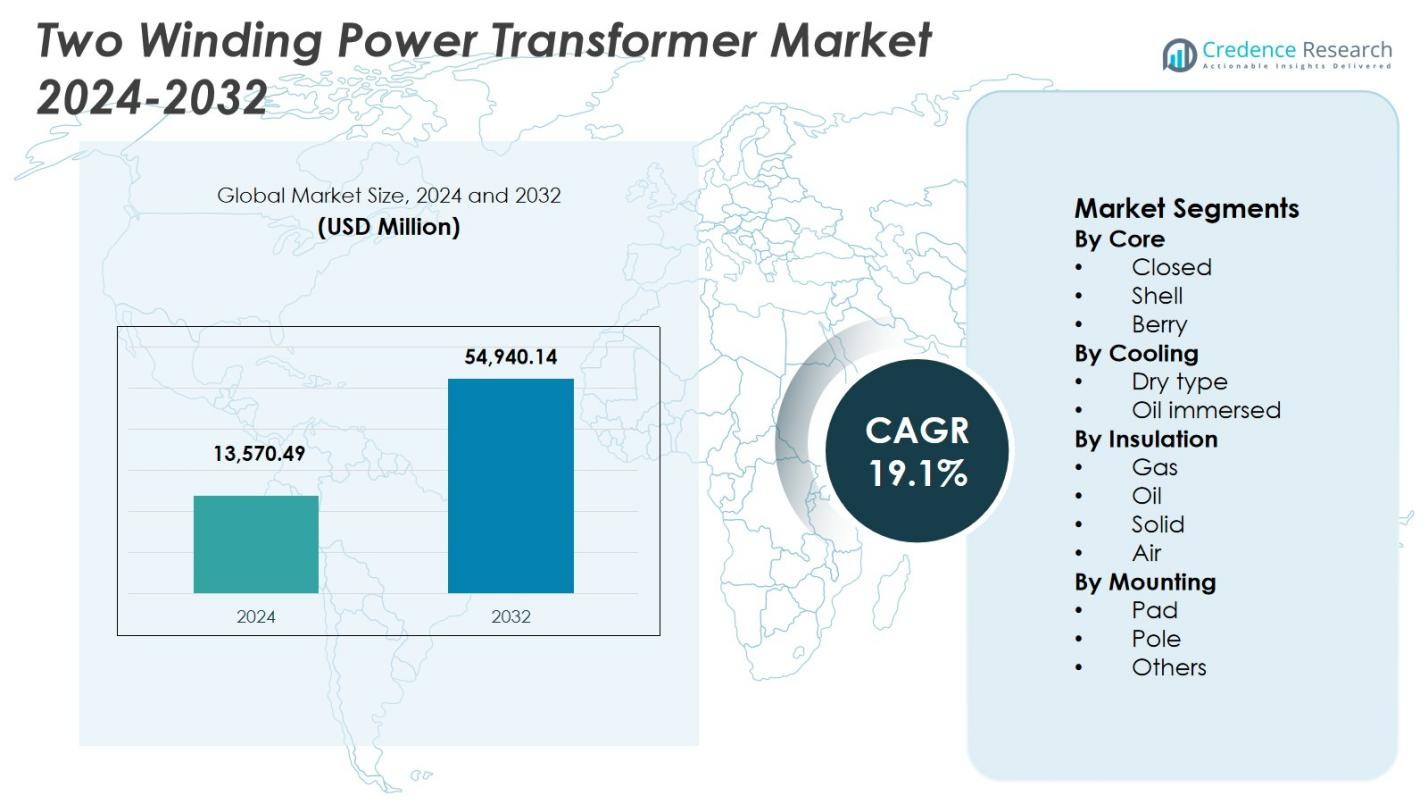
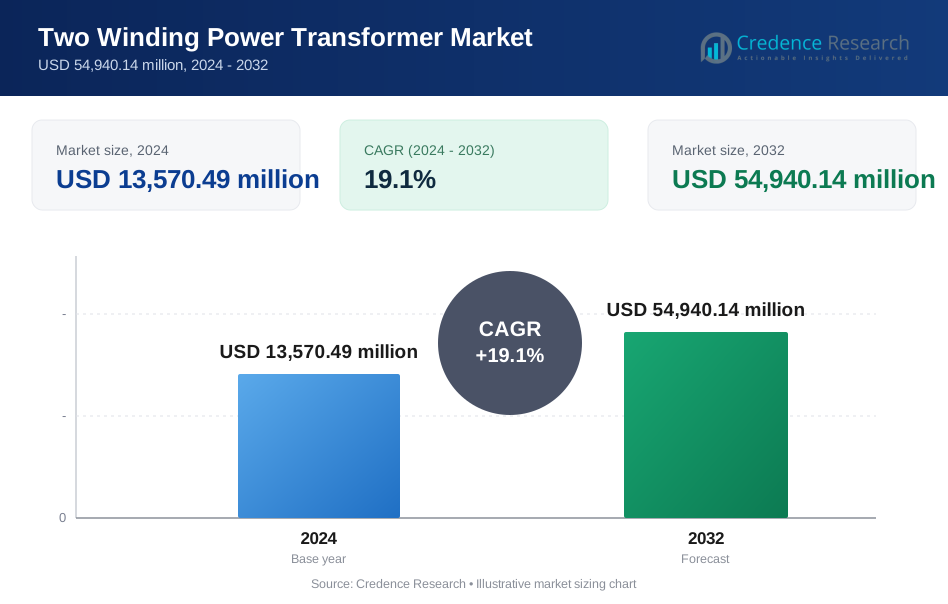
Two Winding Power Transformer Market size was valued at USD 13,570.49 million in 2024 and is anticipated to reach USD 54,940.14 million by 2032, at a CAGR of 19.1% during the forecast period.
| REPORT ATTRIBUTE | DETAILS |
|---|---|
| Historical Period | 2020-2023 |
| Base Year | 2024 |
| Forecast Period | 2025-2032 |
| Two Winding Power Transformer Market Size 2024 | USD 13,570.49 Million |
| Two Winding Power Transformer Market, CAGR | 19.1% |
| Two Winding Power Transformer Market Size 2032 | USD 54,940.14 Million |
Two Winding Power Transformer Market is characterized by the strong presence of established global and regional manufacturers such as ABB, Hitachi Energy Ltd., General Electric, Mitsubishi Electric Corporation, CG Power & Industrial Solutions Ltd., Hyundai Electric & Energy Systems Co., Ltd., Hyosung Heavy Industries, Bharat Heavy Electricals Limited (BHEL), Celme S.r.l., and JSHP Transformer. These players focus on high-efficiency designs, large-capacity transformers, and advanced insulation and cooling technologies to meet evolving grid requirements. Asia Pacific leads the market with a 38.6% share in 2024, driven by large-scale transmission projects, rapid urbanization, and renewable energy expansion in China, India, and Southeast Asia. North America and Europe follow, supported by grid modernization and replacement of aging infrastructure.
Market Insights
- Two Winding Power Transformer Market was valued at USD 13,570.49 million in 2024 and is projected to reach USD 54,940.14 million by 2032, growing at a CAGR of 19.1%, supported by long-term investments in power infrastructure and grid expansion projects.
- Expansion of transmission and distribution networks, replacement of aging grid assets, and rising electricity demand from industrialization and urbanization act as key drivers, with utilities increasing deployment of high-capacity two winding power transformers to ensure reliable voltage regulation and efficient power flow.
- Oil-immersed cooling dominates with a 9% segment share, while closed core designs lead core types with 47.6% share, reflecting strong preference for high thermal efficiency, low losses, and suitability for high-voltage applications across utility-scale projects.
- Leading players such as ABB, Hitachi Energy Ltd., General Electric, Mitsubishi Electric Corporation, CG Power & Industrial Solutions Ltd., and Hyundai Electric focus on efficiency improvement, digital monitoring, and large-scale project execution to strengthen market presence.
- Asia Pacific leads with a 6% regional share, followed by North America at 26.8% and Europe at 24.1%, driven by grid modernization, renewable integration, and large transmission investments.
Market Segmentation Analysis:
By Core:
The Two Winding Power Transformer Market, by core type, is led by the closed core segment, which accounted for 47.6% market share in 2024. Closed core transformers dominate due to their superior magnetic efficiency, reduced flux leakage, and lower core losses compared to shell and berry core designs. Utilities and transmission operators increasingly prefer closed core configurations for high-voltage and extra-high-voltage applications, where energy efficiency and long-term operational reliability are critical. Rising investments in grid modernization, replacement of aging transmission infrastructure, and growing renewable energy integration continue to reinforce demand for closed core two winding power transformers.
- For instance, Hitachi Energy will supply 765 kV transformers to Power Grid Corporation of India, featuring closed core designs that enable efficient bulk power transfer over long distances with reduced losses.
By Cooling:
By cooling type, the oil-immersed segment held the dominant share of 72.9% in 2024 in the Two Winding Power Transformer Market. Oil-immersed transformers are widely adopted due to their higher thermal performance, longer service life, and suitability for high-capacity power transmission applications. They offer efficient heat dissipation, making them ideal for substations, power plants, and industrial grids operating under heavy load conditions. Expanding transmission networks, rising electricity demand, and increasing deployment of high-voltage transformers across utility-scale projects are the key drivers supporting the strong dominance of oil-immersed cooling systems.
- For instance, Mahati manufactured a 2500 kVA oil-immersed power transformer for an industrial facility requiring low-maintenance and high efficiency. The custom design complies with IEC and ISO standards, addressing outdated equipment issues by reducing heat losses and downtime.
By Insulation:
Based on insulation type, the oil insulation segment dominated the Two Winding Power Transformer Market with a 58.3% share in 2024. Oil insulation is preferred for its excellent dielectric strength, effective cooling properties, and proven performance in high-voltage environments. Utilities and industrial users favor oil-insulated transformers for long-distance power transmission and bulk electricity distribution. Growing investments in cross-border transmission lines, renewable power evacuation infrastructure, and large-scale grid expansion projects are driving adoption. Additionally, advancements in insulating oil formulations that enhance safety and thermal stability further support the segment’s continued dominance.
Key Growth Drivers
Expansion of Power Transmission and Distribution Infrastructure
The Two Winding Power Transformer Market is driven by sustained investments in transmission and distribution infrastructure across both developed and emerging economies. Utilities are modernizing aging grids to enhance reliability, reduce technical losses, and accommodate rising electricity demand. Large-scale projects such as new substations, high-voltage transmission corridors, and cross-border interconnections increase the deployment of two winding power transformers. These transformers play a vital role in voltage regulation and efficient power transfer, making them essential for grid expansion and long-term power system resilience.
- For instance, Siemens Energy supports the Viking Link project, a 765-kilometer high-voltage direct current (HVDC) interconnector between Denmark and the UK with 1,400 megawatts capacity, enabling bidirectional clean power flow to stabilize grids.
Growing Integration of Renewable Energy Sources
Increasing integration of renewable energy significantly supports growth in the Two Winding Power Transformer Market. Solar, wind, and hydropower projects require reliable voltage transformation to connect generation assets to transmission networks. Two winding power transformers enable efficient evacuation and distribution of renewable electricity while maintaining grid stability. Government decarbonization targets, renewable capacity additions, and energy transition policies continue to stimulate transformer demand, particularly for high-capacity units capable of handling variable and intermittent power generation profiles.
- For instance, Daelim Transformer supplies double-winding step-up units rated at 1000 kVA for single 1 MW solar power generation systems, ensuring electrical isolation between inverters to reduce interference and enhance power quality.
Rising Electricity Demand from Industrialization and Urbanization
Rapid industrialization and urban expansion are key drivers shaping the Two Winding Power Transformer Market. Growing manufacturing activity, expanding data centers, transportation electrification, and commercial infrastructure development increase the need for stable and uninterrupted power supply. Two winding power transformers support voltage conversion across industrial and urban grids, ensuring efficient energy distribution. Population growth and urban electrification further elevate load requirements, encouraging utilities to deploy higher-capacity and more reliable transformer solutions.
Key Trends & Opportunities
Adoption of Smart and Digitally Enabled Transformers
Digital transformation represents a major trend and opportunity in the Two Winding Power Transformer Market. Utilities increasingly deploy transformers equipped with sensors, monitoring systems, and digital communication capabilities. These features enable real-time performance monitoring, predictive maintenance, and early fault detection, reducing downtime and lifecycle costs. Integration with smart grid platforms enhances operational efficiency and grid visibility. Manufacturers offering digitally enabled two winding power transformers are well positioned to capture growing demand for intelligent power infrastructure.
- For instance, Zetwerk equips its power transformers with IoT-enabled monitoring, featuring sensors for real-time tracking of load, temperature, oil levels, and predictive alerts on insulation health. These integrate via SCADA for seamless smart grid connectivity and minimal retrofitting needs.
Shift Toward Energy-Efficient and Low-Loss Designs
The focus on energy efficiency is creating strong opportunities within the Two Winding Power Transformer Market. Utilities and regulators emphasize reducing transmission losses to improve overall grid efficiency and sustainability. Advances in core materials, winding techniques, and insulation systems enable the development of low-loss transformer designs. Adoption of energy-efficient transformers lowers operational costs and supports compliance with stringent efficiency standards, driving long-term demand for high-performance two winding power transformers.
- For instance, GE Vernova offers green power transformers from 10 to 500 MVA and up to 550 kV, using natural ester insulation like VG-100 fluid for biodegradability and overload capability. These hermetically sealed designs with vacuum-switch on-load tap-changers reduce maintenance by preventing oil contact with humidity.
Key Challenges
High Capital Investment and Extended Project Timelines
High capital requirements pose a significant challenge in the Two Winding Power Transformer Market. Manufacturing large-capacity transformers involves high costs for raw materials, engineering precision, and rigorous testing. In addition, lengthy project approval processes and extended procurement cycles delay deployment and revenue realization. Budget constraints among utilities can further slow replacement and upgrade initiatives, affecting short-term market growth and increasing financial pressure on manufacturers.
Supply Chain Disruptions and Raw Material Price Volatility
Supply chain instability and raw material price volatility present ongoing challenges for the Two Winding Power Transformer Market. Critical inputs such as copper, electrical steel, and insulating materials are subject to frequent price fluctuations, impacting production costs and margins. Global logistics disruptions and geopolitical uncertainties further affect component availability and lead times. These factors complicate production planning and project execution, requiring manufacturers to adopt robust sourcing and risk management strategies.
Regional Analysis
North America
North America accounted for 26.8% market share in 2024 in the Two Winding Power Transformer Market, supported by strong investments in grid modernization and replacement of aging transmission infrastructure. Utilities across the United States and Canada focus on upgrading substations and expanding high-voltage transmission networks to improve reliability and resilience. Rising integration of renewable energy and growing electricity demand from data centers and industrial facilities further drive transformer deployment. Regulatory emphasis on energy efficiency and grid security continues to support demand for advanced two winding power transformers across the region.
Europe
Europe held 24.1% market share in 2024 in the Two Winding Power Transformer Market, driven by extensive renewable energy integration and cross-border transmission projects. Countries across Western and Northern Europe invest heavily in upgrading transmission networks to support offshore wind, solar power, and interconnection initiatives. Aging grid infrastructure replacement and stringent efficiency regulations increase demand for high-performance transformers. Additionally, electrification of transportation and industrial decarbonization programs contribute to sustained transformer installations, reinforcing Europe’s strong position in the global market.
Asia Pacific
Asia Pacific dominated the Two Winding Power Transformer Market with a 38.6% market share in 2024, supported by rapid urbanization, industrial expansion, and large-scale grid development projects. China, India, and Southeast Asian countries invest heavily in new transmission lines, substations, and renewable energy capacity additions. Rising electricity consumption, expansion of manufacturing hubs, and rural electrification initiatives drive high transformer demand. Government-backed infrastructure programs and increasing deployment of high-capacity power networks position Asia Pacific as the fastest-growing and largest regional market.
Latin America
Latin America captured 6.1% market share in 2024 in the Two Winding Power Transformer Market, supported by power infrastructure expansion and renewable energy projects. Countries such as Brazil, Chile, and Mexico continue to invest in transmission upgrades to support wind, solar, and hydropower generation. Grid expansion in remote and industrial regions drives demand for reliable two winding power transformers. Although investment levels remain lower than in developed regions, improving energy access and modernization initiatives contribute to steady regional market growth.
Middle East & Africa
The Middle East & Africa region accounted for 4.4% market share in 2024 in the Two Winding Power Transformer Market. Growth is driven by power generation and transmission investments linked to urban development, industrialization, and renewable energy projects. Gulf countries focus on grid expansion to support large-scale infrastructure and diversification initiatives, while African nations invest in electrification and transmission upgrades. Increasing demand for stable power supply across utilities and industrial sectors supports gradual adoption of two winding power transformers across the region.
Market Segmentations:
By Core
- Closed
- Shell
- Berry
By Cooling
- Dry type
- Oil immersed
By Insulation
- Gas
- Oil
- Solid
- Air
By Mounting
- Pad
- Pole
- Others
By Geography
- North America
- U.S.
- Canada
- Mexico
- Europe
- Germany
- France
- U.K.
- Italy
- Spain
- Rest of Europe
- Asia Pacific
- China
- Japan
- India
- South Korea
- South-east Asia
- Rest of Asia Pacific
- Latin America
- Brazil
- Argentina
- Rest of Latin America
- Middle East & Africa
- GCC Countries
- South Africa
- Rest of the Middle East and Africa
Competitive Landscape
Competitive landscape analysis of the Two Winding Power Transformer Market highlights the presence of major players including ABB, Bharat Heavy Electricals Limited (BHEL), CG Power & Industrial Solutions Ltd., General Electric, Hitachi Energy Ltd., Hyundai Electric & Energy Systems Co., Ltd., Hyosung Heavy Industries, Mitsubishi Electric Corporation, Celme S.r.l., and JSHP Transformer. These companies compete through technological innovation, capacity expansion, and strong regional distribution networks. Leading manufacturers focus on developing high-efficiency, low-loss transformers to meet stringent grid performance and regulatory requirements. Strategic initiatives such as new product launches, localization of manufacturing facilities, and long-term supply agreements with utilities strengthen market positioning. Players also invest in digital monitoring, advanced insulation systems, and customized transformer solutions to address diverse voltage and application needs. Additionally, partnerships with power utilities and EPC contractors enable companies to secure large-scale infrastructure projects, intensifying competition while supporting long-term market growth.
Key Player Analysis
- CG Power & Industrial Solutions Ltd.
- General Electric
- Hyundai Electric & Energy Systems Co., Ltd.
- Hyosung Heavy Industries
- Hitachi Energy Ltd.
- JSHP Transformer
- Mitsubishi Electric Corporation
- ABB
- Bharat Heavy Electricals Limited (BHEL)
- Celme S.r.l.
Recent Developments
- In October 2025, Premier Energies Ltd acquired a 51% stake in Transcon Ind Ltd, marking its strategic entry into the power transformer manufacturing segment to expand its footprint in transformer production.
- In September 2025, Hitachi Energy announced a major investment to expand its large power transformer manufacturing capacity in Varennes, Quebec, nearly tripling production output to address growing global demand.
- In May 2025, Nextalia SGR acquired Westrafo, a leading producer of electrical transformers including power types for the energy industry.
Report Coverage
The research report offers an in-depth analysis based on Core, Cooling, Insulation, Mounting and Geography. It details leading market players, providing an overview of their business, product offerings, investments, revenue streams, and key applications. Additionally, the report includes insights into the competitive environment, SWOT analysis, current market trends, as well as the primary drivers and constraints. Furthermore, it discusses various factors that have driven market expansion in recent years. The report also explores market dynamics, regulatory scenarios, and technological advancements that are shaping the industry. It assesses the impact of external factors and global economic changes on market growth. Lastly, it provides strategic recommendations for new entrants and established companies to navigate the complexities of the market.
Future Outlook
- The Two Winding Power Transformer Market will continue to benefit from sustained investments in transmission and distribution infrastructure upgrades.
- Rising renewable energy integration will drive demand for high-capacity transformers supporting grid stability and power evacuation.
- Utilities will increasingly replace aging transformer fleets to improve reliability and reduce technical losses.
- Adoption of energy-efficient and low-loss transformer designs will accelerate to meet stricter regulatory standards.
- Digital monitoring and smart transformer technologies will gain wider adoption across utility networks.
- Growing industrialization and urban electrification will support long-term transformer demand.
- Expansion of cross-border transmission projects will increase deployment of high-voltage transformer systems.
- Manufacturers will focus on localization of production to improve supply chain resilience.
- Custom-designed transformers for specific voltage and load requirements will see higher adoption.
- Emerging economies will play a critical role in driving future market expansion.
Request a Free Sample
Fill in your details and we'll send you a free sample report.
- Sample data tables & charts
- Research methodology
Need a Custom Version of This Report?
Tailor the scope, geography, or segments to your exact requirements.
- Custom geography or segment scope
- Direct access to our analyst team
Frequently Asked Questions
What is the current market size for the Two Winding Power Transformer Market, and what is its projected size in 2032?
At what Compound Annual Growth Rate is the Two Winding Power Transformer Market projected to grow between 2024 and 2032?
Which Two Winding Power Transformer Market segment held the largest share in 2024?
What are the primary factors fueling the growth of the Two Winding Power Transformer Market?
Who are the leading companies in the Two Winding Power Transformer Market?
Which region commanded the largest share of the Two Winding Power Transformer Market in 2024?
Table of Content
Chapter 1. Report Introduction
- 1.1 Report Description & Purpose
- 1.1.1 Report Title & Market Definition
- 1.1.2 Unique Selling Propositions (USP) & Key Differentiators
- 1.1.3 Value Proposition for Stakeholders
- 1.2 Research Objectives
- 1.2.1 Market Sizing Objectives (Volume & Revenue)
- 1.2.2 Segmentation Objectives
- 1.2.3 Competitive Intelligence Objectives
- 1.2.4 Forecast & Scenario Objectives
- 1.3 Report Scope
- 1.3.1 Two Winding Power Transformer Scope – Types & Subtypes Covered
- 1.3.2 Geographic Scope – Regions & Countries Covered
- 1.3.3 Historical Period, Base Year & Forecast Period (2024; forecast to 2032)
- 1.3.4 Inclusions & Exclusions
- 1.4 HS Code & Classification Framework
- 1.5 Currency, Units & Pricing Basis
- 1.6 Target Stakeholders
- 1.7 Limitations & Assumptions
Chapter 2. Executive Summary
- 2.1 Global Two Winding Power Transformer Market Snapshot
- 2.1.1 Market Size – Historical (2024) & Forecast (2024-2032) (2024: USD 13,570.49 million → 2032: USD 54,940.14 million)
- 2.1.2 Volume & Revenue – Global Totals
- 2.1.3 Key Market Highlights – Top Five Facts
- 2.2 Two Winding Power Transformer Market Segmentation Snapshot
- 2.2.1 Market Split by Region – 2024 vs. 2032
- 2.3 Competitive Snapshot
- 2.3.1 Top 10 Players by Revenue Share – 2024
- 2.3.2 Top 10 Players by Volume Share – 2024
- 2.3.3 Recent Strategic Developments (18-Month Summary)
- 2.4 Key Investment Highlights & Strategic Conclusions
Chapter 3. Two Winding Power Transformer Market Dynamics & Industry Analysis
- 3.1 Market Overview & Context
- 3.1.1 Two Winding Power Transformer Market Position in the Broader Automotive Value Chain
- 3.1.2 OEM vs. Replacement Market Dynamics
- 3.1.3 Market Maturity & Development Stage by Region
- 3.2 Two Winding Power Transformer Market Drivers
- 3.3 Two Winding Power Transformer Market Restraints & Challenges
- 3.4 Two Winding Power Transformer Market Opportunities
- 3.5 Porter's Five Forces Analysis
- 3.5.1 Threat of New Entrants
- 3.5.2 Bargaining Power of Suppliers
- 3.5.3 Bargaining Power of Buyers
- 3.5.4 Threat of Substitutes
- 3.5.5 Competitive Rivalry – Intensity Assessment
- 3.6 Two Winding Power Transformer Value Chain Analysis
- 3.6.1 Upstream – Raw Material/Input Suppliers
- 3.6.1.1 Raw Material/Input 1
- 3.6.1.2 Raw Material/Input 2
- 3.6.1.3 Raw Material/Input 3
- 3.6.2 Midstream – Production/Manufacturing/Service Delivery
- 3.6.2.1 Production/Process Overview
- 3.6.2.2 Key Facility Locations & Capacity by Manufacturer
- 3.6.3 Downstream – Distribution & End Consumer
- 3.6.3.1 Primary Channel – B2B/OEM
- 3.6.3.2 Secondary Channels – Dealer, Retail, Online, Direct
- 3.6.4 Value Chain Profitability Analysis
- 3.6.1 Upstream – Raw Material/Input Suppliers
- 3.7 PESTEL Analysis
- 3.7.1 Political Factors
- 3.7.2 Economic Factors
- 3.7.3 Social Factors
- 3.7.4 Technological Factors
- 3.7.5 Environmental Factors
- 3.7.6 Legal Factors
- 3.8 Two Winding Power Transformer Supply Chain Analysis
- 3.8.1 Raw Material/Input Supply Risk Assessment
- 3.8.2 Manufacturing Concentration Risk (Geographic Exposure)
- 3.8.3 Trade Disruption Impact Analysis
- 3.9 Regulatory & Policy Landscape
Note: The regulatory and policy landscape section covers regulations based on their applicability to the market, Two Winding Power Transformer category, geography, and scope of the study. Only regulatory frameworks with a material impact on operations, compliance, trade, sustainability, or market access are analyzed in detail.
Chapter 4. Key Investment Pockets & Opportunity Analysis
- 4.1 Two Winding Power Transformer Market Attractiveness Analysis
- 4.1.1 By Region – Investment Attractiveness Matrix (Volume × CAGR)
- 4.2 Absolute Revenue Growth Opportunity
- 4.2.1 By Region – Absolute USD Growth Through 2032
- 4.3 Incremental Volume Opportunity
- 4.3.1 By Region – Incremental Volume Through 2032
- 4.3.2 Segment – Incremental Volume
- 4.4 Emerging Submarket Opportunity Deep Dive (Subject to Applicability)
- 4.5 Emerging Market Opportunity Scorecards
- 4.5.1 United States
- 4.5.2 Europe
- 4.5.3 Asia
- 4.5.4 Middle East & Africa
Note: Emerging Market Opportunity Scorecards will be included based on relevance and strategic importance. Regions listed are indicative and may vary depending on data availability and market dynamics.
Chapter 5. Two Winding Power Transformer Import-Export Analysis & Trade Flows
- 5.1 Global Trade Overview
- 5.1.1 Global Export Value by Country (2024)
- 5.1.2 Global Export Volume by Country (2024)
- 5.1.3 Global Import Value by Country (2024)
- 5.1.4 Global Import Volume by Country (2024)
- 5.1.5 Net Trade Balance by Country (2024)
- 5.2 Export Analysis – Segment
- 5.2.1 Type 1 (HS Code)
- 5.2.2 Type 2 (HS Code)
- 5.2.3 Type 3 (HS Code)
- 5.2.4 Type 4 (HS Code)
- 5.2.5 Type 5 (HS Code)
- 5.3 Import Analysis – Segment
- 5.3.1 Type 1 (HS Code)
- 5.3.2 Type 2 (HS Code)
- 5.3.3 Type 3 (HS Code)
- 5.3.4 Type 4 (HS Code)
- 5.3.5 Type 5 (HS Code)
- 5.4 Average Unit Trade Prices
- 5.4.1 Average Export Price – Segment & Country
- 5.4.2 Average Import Price – Segment & Source Country
- 5.4.3 Price Trends (2024)
- 5.5 Key Trade Route Analysis
- 5.5.1 Trade Route 1
- 5.5.2 Trade Route 2
- 5.5.3 Trade Route 3
- 5.5.4 Trade Route 4
- 5.5.5 Trade Route 5
- 5.6 Trade Policy Impact Assessment
- 5.6.1 US Anti-Dumping & Section 301 Tariffs
- 5.6.2 EU Customs Union Impact
- 5.6.3 Major Free Trade Agreements
- 5.6.4 USMCA Rules of Origin
Note: Trade policy analysis will be included only where relevant to the Two Winding Power Transformer market.
Chapter 6. Competitive Landscape & Company Benchmarking
- 6.1 Two Winding Power Transformer Market Concentration & Structure
- 6.1.1 Herfindahl-Hirschman Index (HHI) – vs. 2024
- 6.1.2 Tier 1, Tier 2 & Tier 3 Market Structure
- 6.1.3 Global, Regional & Local Player Dynamics
- 6.2 Two Winding Power Transformer Market Share Analysis – 2024
- 6.2.1 Global Revenue Share by Company
- 6.2.2 Global Volume Share by Company
- 6.2.3 Regional Revenue Share
- 6.2.4 Market Share Evolution ( vs. 2024)
- 6.2.5 OEM Segment Share by Company
- 6.2.6 Replacement Segment Share by Company
- 6.3 Production/Delivery Capacity & Facility Analysis
- 6.3.1 Global Installed Capacity
- 6.3.2 Capacity Utilization Rates
- 6.3.3 Production/Output Volume
- 6.3.4 Facility Locations & Capacity Map
- 6.3.5 Planned Capacity Additions
- 6.4 Two Winding Power Transformer Competitive Benchmarking Matrix
- 6.4.1 Revenue, Volume, CAGR & Profitability Comparison
- 6.4.2 Channel Revenue Mix
- 6.4.3 Geographic Revenue Exposure
- 6.4.4 R&D Intensity
- 6.4.5 Sustainability Maturity
- 6.5 Strategic Developments in Two Winding Power Transformer (Last 24 Months)
- 6.5.1 Mergers, Acquisitions & Divestments
- 6.5.2 New Two Winding Power Transformer Launches
- 6.5.3 Facility Expansions
- 6.5.4 Strategic Alliances, Joint Ventures & Partnerships
- 6.5.5 Distribution Expansion & Market Entry
- 6.5.6 Sustainability & ESG Initiatives
- 6.6 Competitive Strategy Mapping
- 6.6.1 Leader, Challenger, Follower & Niche Classification
- 6.6.2 Pricing Strategy Comparison
- 6.6.3 Channel Strategy Matrix
Note: Strategic developments are included based on their materiality and the availability of reliable information.
Chapter 7. Global Two Winding Power Transformer Market – By Distribution Channel
- 7.1 Segment Overview
- 7.1.1 Volume & Revenue Split by Channel (2024 & 2032)
- 7.1.2 Channel Mix Evolution (2024-2032)
Chapter 8. Regional Market Analysis – Global Overview
- 8.1 Global Regional Overview
- 8.1.1 Regional Volume Share
- 8.1.2 Regional Revenue Share
- 8.1.3 Regional Volume by Region
- 8.1.4 Regional Revenue by Region
- 8.1.5 Regional Forecast Through 2032
- 8.2 Cross-Regional Segment Analysis
- 8.2.1 By Distribution Channel
- 8.2.2 By Brand/Price Tier
Chapter 9. North America Two Winding Power Transformer Market
- 9.1 United States
- 9.2 Canada
- 9.3 Mexico
Chapter 10. Europe Two Winding Power Transformer Market
- 10.1 Germany
- 10.2 France
- 10.3 Italy
- 10.4 United Kingdom
- 10.5 Spain
- 10.6 Poland
- 10.7 Russia
- 10.8 Netherlands
- 10.9 Belgium
- 10.10 Sweden
- 10.11 Denmark
- 10.12 Norway
- 10.13 Rest of Europe
Chapter 11. Asia Pacific Two Winding Power Transformer Market
- 11.1 China
- 11.2 India
- 11.3 Japan
- 11.4 South Korea
- 11.5 Thailand
- 11.6 Indonesia
- 11.7 Vietnam
- 11.8 Malaysia
- 11.9 Australia
- 11.10 Rest of Asia Pacific
Chapter 12. Latin America Two Winding Power Transformer Market
- 12.1 Brazil
- 12.2 Argentina
- 12.3 Colombia
- 12.4 Chile
- 12.5 Rest of Latin America
Chapter 13. Middle East Two Winding Power Transformer Market
- 13.1 Saudi Arabia
- 13.2 United Arab Emirates
- 13.3 Turkey
- 13.4 Israel
- 13.5 Iran
- 13.6 Rest of the Middle East
Chapter 14. Africa Two Winding Power Transformer Market
- 14.1 South Africa
- 14.2 Egypt
- 14.3 Nigeria
- 14.4 Morocco
- 14.5 Rest of Africa
Chapter 15. Two Winding Power Transformer Company Profiles
- 15.1 [Company 01]
- 15.1.1 Company Overview
- 15.1.2 Key Management Personnel
- 15.1.3 Products & Services Portfolio
- 15.1.4 Financial Performance
- 15.1.5 Key Market Focus & Geographic Presence
- 15.1.6 Recent Developments & Strategic Initiatives
Note: The company profile list is preliminary and may change based on research findings, market developments, data availability, and client requirements.
Chapter 16. Appendices
- Appendix A – List of Abbreviations & Acronyms
- Appendix B – Industry Classification Code Reference – Full Series
- Appendix C – Production & Capacity Data Tables
- Appendix D – End-Use & Demand Base Tables
- Appendix E – Consumption & Replacement Rate Assumptions
- Appendix F – ASP Reference Tables
- Appendix G – Manufacturing & Facility Database
- Appendix H – Import-Export Data Tables
- Appendix I – Regulatory Summary Tables
- Appendix J – Primary Research Participant List (Anonymized)
- Appendix K – Primary Research Questionnaire Framework
- Appendix L – Data Sources & Bibliography
- Appendix M – Market Size Divergence & Source Comparison
Chapter 17. Research Methodology
- 17.1 Research Framework & Philosophy
- 17.2 Secondary Research – Sources, Hierarchy & Data Extraction
- 17.3 Data Modeling – Bottom-Up & Top-Down Market Sizing
- 17.4 Primary Research – Stakeholder Framework, LOI & Sample Sizes
- 17.5 Forecast Methodology – Regression, Scenario & Sensitivity Analysis
- 17.6 Quality Control – Four-Layer Validation Framework
- 17.7 Limitations & Standard Assumptions
- 17.8 Disclaimer
