| REPORT ATTRIBUTE | DETAILS |
|---|---|
| Historical Period | 2020-2023 |
| Base Year | 2024 |
| Forecast Period | 2025-2032 |
| UAE Brush Cutters Market Size 2024 | USD 30.51 million |
| UAE Brush Cutters Market CAGR | 2.47% |
| UAE Brush Cutters Market Size 2032 | USD 37.07 million |
Market Overview:
The UAE Brush Cutters Market is projected to grow from USD 30.51 million in 2024 to an estimated USD 37.07 million by 2032, with a compound annual growth rate (CAGR) of 2.47% from 2024 to 2032.
Several factors are driving the growth of the brush cutters market in the UAE. The country's rapid urban development and infrastructure expansion have led to increased demand for landscaping and maintenance of green spaces, parks, and public gardens. Additionally, the UAE's emphasis on sustainability and environmental conservation has spurred the adoption of eco-friendly landscaping practices, further boosting the need for efficient brush cutting tools. Technological advancements, such as the introduction of battery-powered and electric brush cutters, offer quieter operation and lower emissions, aligning with the UAE's environmental goals and attracting both commercial and residential users. Moreover, the rising popularity of smart gardening tools and precision landscaping equipment is encouraging consumers to invest in modern brush cutters with advanced features.
Within the UAE, the demand for brush cutters is particularly strong in urban centers like Dubai and Abu Dhabi, where ongoing construction projects and urban beautification initiatives require extensive landscaping efforts. The government's commitment to enhancing the quality of life through green initiatives, such as the "Green Dubai" and "Abu Dhabi Urban Planning Vision," has led to increased investments in public parks and recreational areas, thereby driving the need for brush cutting equipment. Moreover, the country's favorable climate allows for year-round landscaping activities, sustaining consistent demand for brush cutters across seasons. The tourism sector also plays a pivotal role, as luxury resorts and hospitality establishments invest heavily in landscape maintenance to ensure aesthetic appeal for international visitors.
Market Insights:
- The UAE brush cutters market is projected to grow from USD 30.51 million in 2024 to USD 37.07 million by 2032, registering a CAGR of 2.47%.
- The Global Brush Cutters market is projected to grow from USD 4,376.82 million in 2024 to USD 6,180.02 million by 2032, registering a CAGR of 4.41%, driven by rising demand for efficient vegetation tools.
- Rapid urbanization and ongoing infrastructure projects in cities like Dubai, Abu Dhabi, and Sharjah are fueling consistent demand for land-clearing and vegetation management tools.
- Government-led initiatives such as “Green Dubai” and “Abu Dhabi Vision 2030” are driving the adoption of brush cutters by promoting green spaces and sustainable landscaping practices.
- Battery-powered and electric brush cutters are gaining traction due to their low noise, reduced emissions, and alignment with environmental regulations.
- The tourism and hospitality sectors significantly boost market growth, with luxury resorts and public venues requiring regular landscape maintenance.
- Market growth is challenged by high upfront costs, climate-related durability concerns, and a lack of skilled labor for operating advanced equipment.
- Regionally, Dubai leads the market, followed by Abu Dhabi, while Sharjah and the Northern Emirates are emerging with increasing adoption due to development activities.
Report scope
This report segment the united arab Emerates (UAE) Brush Cutters Market as follow;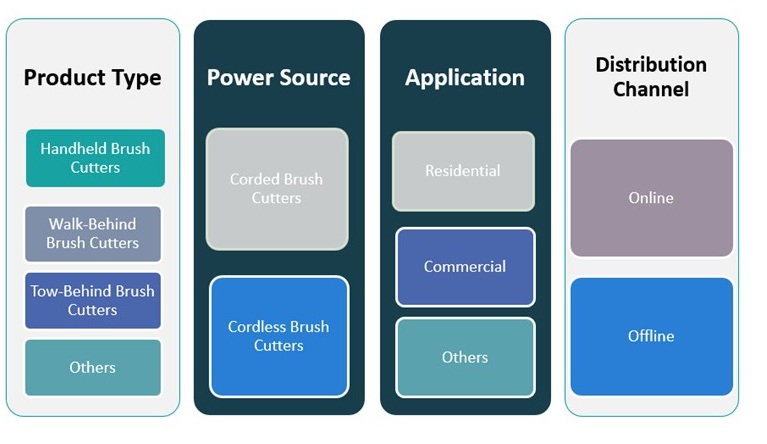
Market Drivers:
Urbanization and Infrastructure Expansion The rapid pace of urban development across the United Arab Emirates has significantly fueled the demand for landscaping tools, including brush cutters. As cities like Dubai, Abu Dhabi, and Sharjah continue to expand, large-scale residential, commercial, and infrastructural projects are being developed, all of which require extensive land clearing and vegetation management. Brush cutters have become essential for maintaining roadsides, parks, and public gardens, making them indispensable to municipal and construction-related landscaping activities. The rise in smart city initiatives and green infrastructure planning further strengthens the market’s foundation by emphasizing the importance of maintaining well-managed and visually appealing urban landscapes.
Government-Led Environmental and Landscaping Initiatives The UAE government’s strong focus on sustainability and environmental preservation is a major driver for the brush cutters market. For instance, initiatives like the “Green Dubai” campaign and the “Abu Dhabi Vision 2030” include comprehensive plans to increase green cover, plant more trees, and enhance urban biodiversity. These plans have accelerated the need for efficient and durable brush cutting equipment capable of maintaining both newly planted and existing green zones. Additionally, public-private partnerships in landscape development and maintenance have encouraged greater investment in high-performance brush cutters, thereby strengthening market growth across both urban and semi-urban areas.
Technological Advancements in Brush Cutter Equipment Technological innovation is playing a vital role in shaping the UAE brush cutters market. Manufacturers are increasingly offering lightweight, ergonomic, and fuel-efficient models to meet the evolving needs of both professionals and household users. Battery-operated and electric brush cutters are gaining popularity due to their quiet operation, zero emissions, and compliance with environmental regulations. The integration of smart features, such as variable speed control, anti-vibration systems, and low-maintenance designs, enhances user efficiency and comfort. For example, brush cutters with features like variable speed control, anti-vibration systems, and easy-start mechanisms are increasingly popular among both professionals and homeowners, enhancing user efficiency and comfort. These advancements not only appeal to end-users focused on performance and sustainability but also support broader government objectives related to environmental responsibility and innovation.
Growing Demand from Landscaping and Hospitality Sectors The expansion of the UAE’s tourism and hospitality sectors has directly influenced the demand for high-quality landscaping tools. Luxury hotels, resorts, golf courses, and private villas prioritize aesthetic landscaping as part of their brand identity, creating strong demand for reliable brush cutters. Landscaping service providers and property management companies are investing in durable and efficient tools to maintain client satisfaction and operational consistency. Moreover, as more residents in suburban communities and gated villas take an active interest in garden maintenance, the residential segment is also contributing to the growth of the brush cutters market. This convergence of commercial and domestic demand continues to propel the market forward.
Market Trends:
Rising Preference for Battery-Powered Equipment A notable trend in the UAE brush cutters market is the increasing preference for battery-powered and cordless models over conventional fuel-based options. This shift is driven by growing environmental awareness and the desire for cleaner, quieter, and more efficient outdoor equipment. With improvements in lithium-ion battery technology, modern brush cutters offer extended operation times and reduced maintenance needs. For example, Makita UAE offers the UR012G Cordless Brush Cutter, equipped with a 40Vmax X2 lithium-ion battery system, brushless motor, and three speed settings, delivering up to 2000W of power and a cutting width of up to 480 mm. Residential users, in particular, are showing interest in cordless models due to their ease of use and compatibility with smaller-scale landscaping tasks. As urban regulations begin to favor low-emission tools, this trend is expected to gain further momentum.
Expansion of DIY Landscaping Culture The UAE has witnessed a growing interest in do-it-yourself (DIY) gardening and landscaping, especially among homeowners in suburban communities and villa developments. The COVID-19 pandemic amplified this trend as people spent more time at home and invested in outdoor home improvement projects. Manufacturers are responding with user-friendly, lightweight models. For instance, Oleo-Mac’s BC300T petrol brush cutter, available in Dubai, weighs just 6.3 kg (dry weight) and features a cushioned single harness and handlebar grip for comfort and ease of use, catering to amateur users. This behavioral shift has led to higher sales of user-friendly brush cutters suitable for amateur or non-professional use. Manufacturers are responding by offering compact, lightweight models with intuitive controls to cater to this emerging customer base. The expansion of garden centers, hardware stores, and online retail platforms has further supported the accessibility and growth of this segment.
Integration of Smart Features and Connectivity As part of the broader digital transformation in the tools and machinery market, brush cutter manufacturers are incorporating smart technologies into their products. Features such as Bluetooth connectivity, maintenance alerts, and app-based performance monitoring are gaining popularity among commercial users. These innovations help landscaping professionals and facility managers track usage patterns, optimize fuel or battery consumption, and schedule timely maintenance, thereby extending the life of the equipment. In the UAE, where high-end landscaping services are common in commercial, hospitality, and government sectors, the adoption of connected brush cutter models reflects a move toward greater efficiency and data-driven operations.
Growth of Landscaping in Commercial and Public Projects The ongoing growth of commercial developments and large-scale public beautification projects across the UAE is driving a parallel rise in the demand for landscaping equipment. Government investments in tourism infrastructure, theme parks, waterfront promenades, and heritage zones have placed landscaping at the center of urban planning. For instance, projects like Dubai Creek Harbour and Abu Dhabi’s Al Qana have large outdoor recreational spaces that require regular upkeep. This growing emphasis on landscaped public environments is encouraging municipalities and private contractors to procure professional-grade brush cutters, thereby reinforcing the upward trajectory of the market.
Market Challenges Analysis:
High Initial Investment and Operating Costs
One of the primary restraints in the UAE brush cutters market is the high initial cost associated with acquiring advanced equipment, particularly models that incorporate eco-friendly or smart technologies. For instance, the Bonai Cordless Grass Trimmer (Model: BN-HK042), a battery-powered brush cutter available in the UAE, is priced at AED 190.00 and comes with features like a 168Vf 7.0Ah battery and 30,000 rpm cutting speed, but users must also consider the ongoing costs of battery replacements and spare parts. While battery-powered and electric brush cutters offer long-term savings and environmental benefits, their upfront prices can be prohibitive for small-scale landscaping businesses and residential users. Additionally, recurring costs such as battery replacements, servicing, and spare parts contribute to the overall expense of ownership. These financial constraints may deter potential buyers, especially in cost-sensitive segments of the market.
Skilled Labor Shortage and Training Gaps
The effective operation and maintenance of brush cutters require a certain level of skill and training, which presents a challenge in the UAE market. Despite the country’s reliance on a large expatriate workforce in the landscaping and maintenance sectors, there remains a noticeable gap in the availability of well-trained personnel proficient in handling technologically advanced brush cutters. Improper use not only reduces equipment lifespan but also raises safety concerns. The lack of structured training programs and limited awareness regarding safety protocols further compounds this issue, impacting overall market efficiency.
Weather Constraints and Equipment Durability
The harsh climatic conditions of the UAE, including high temperatures, humidity, and occasional sandstorms, can pose operational challenges for brush cutter performance and longevity. Equipment exposed to these elements is more prone to wear and tear, requiring frequent maintenance or replacement. This raises concerns among commercial users about the long-term durability and cost-effectiveness of such tools. Manufacturers need to invest in climate-resilient designs to ensure reliability under extreme conditions, which in turn can increase production costs and final pricing-adding another layer of complexity for end users and suppliers alike.
Market Opportunities:
The UAE brush cutters market presents substantial growth opportunities, driven by the country's strategic focus on urban development, environmental sustainability, and tourism expansion. As the government continues to invest in infrastructure and green initiatives under frameworks like the UAE Vision 2030 and Dubai Urban Master Plan 2040, there is a growing emphasis on expanding landscaped areas, public parks, and recreational zones. This has created a favorable environment for the increased adoption of brush cutters as essential tools for land clearing, vegetation control, and maintenance. Moreover, the rise of planned residential communities and commercial complexes with extensive green spaces further boosts the demand for landscaping equipment.
In addition, the increasing shift toward eco-conscious and smart landscaping solutions opens up opportunities for manufacturers to introduce innovative products tailored to the UAE’s unique climatic and regulatory landscape. Battery-operated, low-noise, and energy-efficient brush cutters are gaining traction among both professional landscapers and residential users. The growing popularity of smart cities and digital transformation within municipal services also offers scope for brush cutters with IoT integration and performance monitoring features. With rising consumer awareness, demand for durable, ergonomic, and environmentally friendly solutions is expected to rise, especially in premium residential and hospitality segments. Companies that align their offerings with sustainability goals and technological advancement are well-positioned to capitalize on these emerging market opportunities.
Market Segmentation Analysis:
The UAE brush cutters market can be segmented based on product type, power source, application, and distribution channel.
By product types, handheld brush cutters dominate the market due to their portability, ease of use, and suitability for small to medium-scale landscaping tasks, especially in residential and urban settings. Walk-behind brush cutters are also gaining traction, particularly in commercial landscaping and municipal applications, where higher efficiency and wider coverage are required. Tow-behind brush cutters, while less common, serve niche segments such as large estate maintenance and agricultural land clearing. The “Others” category includes multi-functional or hybrid brush cutter models that cater to specialized landscaping needs.
By power source, corded brush cutters maintain relevance for continuous, uninterrupted use in commercial operations. However, cordless brush cutters are witnessing rising demand, especially among residential users, due to their mobility, convenience, and eco-friendly appeal.
By application, the commercial segment leads the market, driven by ongoing urban development, tourism infrastructure, and landscaping services for luxury properties and public spaces. The residential segment is also growing steadily as homeowners invest in garden tools amid a shift toward outdoor home improvement.
By distribution channels, offline sales dominate due to customer preference for in-person product evaluation and after-sales support. However, the online segment is rapidly expanding, fueled by e-commerce growth, wider product availability, and the convenience of digital shopping platforms. As consumer confidence in online transactions increases, digital channels are expected to play a more significant role in market expansion.
Segmentation:
By Product Type
- Handheld Brush Cutters
- Walk-Behind Brush Cutters
- Tow-Behind Brush Cutters
- Others
By Power Source
- Corded Brush Cutters
- Cordless Brush Cutters
By Application
- Residential
- Commercial
- Others
By Distribution Channel
- Online
- Offline
Regional Analysis:
The UAE brush cutters market exhibits regional variations influenced by urban development, landscaping initiatives, and infrastructure projects across its emirates. While specific market share data by region within the UAE is limited, insights can be drawn from the broader outdoor power equipment market trends.
Dubai
Dubai, as a major urban center, leads in the adoption of brush cutters, driven by its extensive landscaping projects, public parks, and real estate developments. The city's commitment to sustainability and green spaces, exemplified by initiatives like the Dubai 2040 Urban Master Plan, has spurred demand for efficient landscaping tools. The commercial sector, including hotels, resorts, and golf courses, significantly contributes to the market, utilizing brush cutters for maintenance and aesthetic purposes.
Abu Dhabi
Abu Dhabi follows closely, with substantial investments in infrastructure and urban beautification projects. The emirate's focus on environmental sustainability and urban greenery, as part of its Vision 2030, has led to increased utilization of brush cutters in public parks, roadways, and residential areas. Government initiatives promoting green spaces have further bolstered the market.
Sharjah and Northern Emirates
Sharjah and the Northern Emirates, including Ajman, Umm Al Quwain, Ras Al Khaimah, and Fujairah, are experiencing gradual growth in the brush cutters market. Urbanization and development projects in these regions are driving demand for landscaping equipment. While the market share is currently smaller compared to Dubai and Abu Dhabi, ongoing infrastructure developments indicate potential for increased adoption of brush cutters in the near future.
Key Player Analysis:
- Afra Tools
- Makita
- Vermeer Middle East FZCO
- Al Shirawi Enterprises Group
- NAFFCO
Competitive Analysis:
The UAE brush cutters market is moderately competitive, with both international and regional players vying for market share through product innovation, distribution expansion, and after-sales service. Leading global manufacturers such as STIHL, Husqvarna, and Honda dominate the market by offering a broad range of durable and high-performance brush cutters tailored for commercial and residential use. These companies focus on integrating eco-friendly technologies, such as low-emission engines and battery-powered models, to align with the UAE’s sustainability goals. Regional suppliers and local distributors play a crucial role in servicing niche segments and ensuring timely product availability. Competitive differentiation largely hinges on product efficiency, ergonomic design, fuel economy, and compliance with safety and environmental regulations. Companies that offer value-added services, including product customization, training, and maintenance support, are better positioned to strengthen customer loyalty and sustain growth in a market increasingly driven by urban landscaping and smart infrastructure projects.
Recent Developments:
- In early 2025, STIHL rolled out a comprehensive lineup of new battery-powered outdoor tools, focusing on innovations in trimmers, blowers, mowers, and heavy-duty equipment. The 2025 catalog highlights models such as the HSA 140 T/R hedge trimmers, the KGA 770 battery-powered sweeper, and the TSA 300 battery-powered concrete saw, emphasizing improved performance and environmental friendliness. STIHL’s strategy this year is clearly geared toward expanding its battery-powered offerings, with more than 50 new products introduced to the market.
- In March 2025, DeWALT, a brand under Stanley Black & Decker, expanded its outdoor power equipment lineup by launching new gas and battery-powered products. Notable releases include the 60V MAX* Brushless Cordless Backpack Blower, new walk-behind mowers, and a range of handheld tools such as pole saws, chainsaws, and hedge trimmers. These products are designed to enhance productivity and cater to both residential and professional landscaping needs.
Market Concentration & Characteristics:
The UAE brush cutters market demonstrates a moderate to high level of concentration, with a few established global brands occupying a significant portion of the market share. Multinational players such as STIHL, Husqvarna, and Honda maintain a strong presence due to their wide product range, consistent quality, and advanced technological offerings. These companies benefit from well-established distribution networks and brand recognition, particularly in commercial landscaping and government procurement channels. The market is characterized by a growing preference for environmentally sustainable and ergonomically designed equipment, influenced by regulatory policies and urban development trends. Demand is segmented across commercial, residential, and municipal users, each requiring varied product specifications and service standards. While pricing remains a consideration, buyers increasingly value durability, efficiency, and low maintenance. The emergence of e-commerce and direct-to-consumer sales channels is gradually reshaping purchasing behavior, creating new avenues for both established players and emerging regional brands to capture customer interest.
Report Coverage:
The research report offers an in-depth analysis based on Product Type, Power Source, Application and Distribution Channel. It details leading market players, providing an overview of their business, product offerings, investments, revenue streams, and key applications. Additionally, the report includes insights into the competitive environment, SWOT analysis, current market trends, as well as the primary drivers and constraints. Furthermore, it discusses various factors that have driven market expansion in recent years. The report also explores market dynamics, regulatory scenarios, and technological advancements that are shaping the industry. It assesses the impact of external factors and global economic changes on market growth. Lastly, it provides strategic recommendations for new entrants and established companies to navigate the complexities of the market.
Future Outlook:
- The UAE brush cutters market is expected to grow steadily, supported by ongoing urbanization and infrastructure expansion.
- Increased government investment in green spaces and public landscaping will continue to drive equipment demand.
- Rising adoption of battery-powered brush cutters will gain traction due to sustainability goals and emission regulations.
- Technological advancements such as smart features and app-based monitoring will shape future product offerings.
- Growth in the residential gardening trend will expand the market for user-friendly, compact brush cutters.
- Commercial landscaping and tourism sectors will remain key revenue contributors across urban centers.
- E-commerce platforms will capture a larger share of product distribution through digital convenience and variety.
- Manufacturers will focus on weather-resilient, low-maintenance designs to cater to the UAE’s harsh climate.
- Training and after-sales service will become crucial differentiators amid rising demand for efficient operations.
- Entry of regional players offering competitively priced models may increase market fragmentation and competition.

Request a Free Sample
Fill in your details and we'll send you a free sample report.
- Sample data tables & charts
- Research methodology
Market Dynamics
Urbanization and Infrastructure Expansion
Rapid urban development in the UAE, especially in cities like Dubai and Abu Dhabi, is increasing the need for landscaping and vegetation management, directly boosting demand for brush cutters in municipal, commercial, and residential projects.
Government-Led Environmental and Landscaping Initiatives
Initiatives such as 'Green Dubai' and 'Abu Dhabi Vision 2030' are driving investments in green spaces and public parks, requiring efficient brush cutting equipment for ongoing maintenance and expansion of landscaped areas.
Technological Advancements in Brush Cutter Equipment
The introduction of battery-powered, electric, and smart brush cutters with features like low noise, reduced emissions, and app-based monitoring is attracting both commercial and residential users, aligning with the UAE's sustainability and innovation goals.
Growth in Tourism and Hospitality Sectors
Luxury resorts, hotels, and public venues in the UAE prioritize high-quality landscaping to enhance aesthetic appeal for international visitors, leading to consistent investment in advanced brush cutting tools for regular maintenance.
Expansion of DIY Landscaping Culture
A rising trend in home gardening and DIY landscaping, especially among suburban homeowners, is increasing demand for user-friendly, lightweight brush cutters suitable for non-professional use.
Need a Custom Version of This Report?
Tailor the scope, geography, or segments to your exact requirements.
- Custom geography or segment scope
- Direct access to our analyst team
Frequently Asked Questions
What is the current size of the UAE Brush Cutters Market?
What factors are driving the growth of the UAE Brush Cutters Market?
What are the key segments within the UAE Brush Cutters Market?
What are some challenges faced by the UAE Brush Cutters Market?
Table of Content
Chapter 1 Market Segmentation
- 1.1 Segmentation Framework
- 1.1.1 Product and Service Classification
- 1.1.2 Application and End-Use Classification
- 1.1.3 Technology and Solution Classification
- 1.1.4 Customer and Distribution Channel Classification
- 1.1.5 Geographic Segmentation
- 1.1.6 Market Segment Definitions and Boundaries
- 1.2 By Application
- 1.2.1 Residential
- 1.2.2 Commercial
- 1.2.3 Others
- 1.3 By Power Source
- 1.3.1 Corded Brush Cutters
- 1.3.2 Cordless Brush Cutters
- 1.4 By Product Type
- 1.4.1 Handheld Brush Cutters
- 1.4.2 Walk-Behind Brush Cutters
- 1.4.3 Tow-Behind Brush Cutters
- 1.4.4 Others
Chapter 2 Introduction
- 2.1 Report Objectives and Scope
- 2.2 Product Definition and Industry Terminology
- 2.3 Market Inclusions and Exclusions
- 2.4 Research Process
- 2.4.1 Primary Research and Expert Interviews
- 2.4.2 Secondary Research and Source Review
- 2.4.3 Top-Down and Bottom-Up Estimation
- 2.4.4 Data Triangulation and Verification
- 2.5 Market Size Measurement Basis
- 2.5.1 2024: USD 30.51 million → 2032: USD 37.07 million
- 2.6 Historical and Forecast Reference Periods
- 2.6.1 Base Year: 2024
- 2.6.2 Forecast Period: 2024-2032
- 2.7 Research Assumptions and Limitations
Chapter 3 Executive Summary
- 3.1 Market Snapshot and Key Findings
- 3.2 Base-Year Market Size, 2024
- 3.3 Forecast Market Size, 2032
- 3.4 Revenue and Volume Growth Outlook
- 3.5 Key Demand and Supply Indicators
- 3.6 Leading Market Segments
- 3.7 Fastest-Growing Market Opportunities
- 3.8 Regional Performance Highlights
- 3.9 Technology and Industry Transformation
- 3.10 Competitive Landscape Summary
- 3.11 Analyst View and Strategic Implications
Chapter 4 UAE Brush Cutters Market Trends and Developments
- 4.1 Historical Industry Development
- 4.2 Recent Market Trends and Developments
- 4.3 Demand and Customer Behavior Trends
- 4.4 Technology and Product Innovation
- 4.5 Artificial Intelligence, Automation and Digitalization
- 4.6 Local Manufacturing and Supply Chain Realignment
- 4.7 Industry Partnerships, Mergers and Acquisitions
- 4.8 Sustainability and Circular Economy Developments
- 4.9 Government and Private Sector Investment Trends
- 4.10 Emerging Business Models and Commercialization
- 4.11 Industry Developments and Announcements
Chapter 5 UAE Brush Cutters Market Production, Supply and Demand Analysis
- 5.1 Demand Trend and Consumption Analysis
- 5.2 Demand Forecast, 2024-2032
- 5.3 Production and Output Trend
- 5.4 Production and Output Forecast, 2024-2032
- 5.5 Installed Capacity and Capacity Utilization
- 5.6 Company-Wise Production Plants and Statistics
- 5.6.1 Installed Production Capacity
- 5.6.2 Actual Production
- 5.6.3 Planned Capacity and Expansion Targets
- 5.7 Supply Chain Structure and Procurement Trends
- 5.8 Supply-Demand Gap and Bottlenecks
- 5.9 Import Dependence and Sourcing Structure
- 5.10 Contract Manufacturing and Outsourcing
- 5.11 Regional Supply and Demand Concentration
Chapter 6 UAE Brush Cutters Market Pricing Analysis
- 6.1 Pricing Structure and Measurement
- 6.2 Historical Pricing Trends
- 6.3 Pricing Outlook, 2024-2032
- 6.4 Average Selling Price and Unit Economics
- 6.5 Pricing by Product and Market Segment
- 6.6 Geographic Pricing Differences
- 6.7 Key Input, Energy, Labor and Logistics Costs
- 6.8 Contract Pricing and Purchasing Models
- 6.9 Pricing Sensitivity and Competitive Positioning
- 6.10 Price, Margin and Profitability Implications
Chapter 7 UAE Brush Cutters Market Dynamics
- 7.1 Market Growth Drivers
- 7.1.1 Demand-Side Drivers
- 7.1.2 Technology and Innovation Drivers
- 7.1.3 Infrastructure and Investment Drivers
- 7.1.4 Regulatory and Policy Drivers
- 7.2 Market Restraints
- 7.2.1 Cost and Affordability Constraints
- 7.2.2 Technology and Adoption Barriers
- 7.2.3 Supply Chain and Operational Constraints
- 7.3 Market Challenges
- 7.3.1 Competitive Pressure and Margin Erosion
- 7.3.2 Skills, Infrastructure and Implementation Gaps
- 7.4 Emerging Market Opportunities
- 7.5 Market Dynamics Impact and Time-Horizon Assessment
Chapter 8 UAE Brush Cutters Value Chain Analysis
- 8.1 Industry Value Chain Overview
- 8.2 Upstream Suppliers and Critical Inputs
- 8.3 Technology and Component Providers
- 8.4 Manufacturing or Service Delivery
- 8.5 Distribution, Channel Partners and Integrators
- 8.6 Downstream Applications and End Users
- 8.7 Value Addition and Profit Pools
- 8.8 Vertical Integration and Outsourcing
- 8.9 Supplier Concentration and Risk
- 8.10 Supply Chain Localization and Resilience
Chapter 9 UAE Brush Cutters Market Regulations and Policies
- 9.1 Relevant Laws, Standards and Compliance Frameworks
- 9.2 Product, Service, Safety and Quality Requirements
- 9.3 Government Policies, Incentives and Subsidies
- 9.4 Imports, Exports and Trade Barriers
- 9.5 Public Procurement and Local Content Requirements
- 9.6 Environmental and Sustainability Compliance
- 9.7 Upcoming Policy Changes and Market Implications
Chapter 10 UAE Brush Cutters Market Hotspots and Opportunities
- 10.1 Market Opportunity Mapping and Growth Hotspots
- 10.2 High-Growth Applications and Customer Groups
- 10.3 Underserved Markets and White-Space Opportunities
- 10.4 Emerging Technology and Product Opportunities
- 10.5 New Capacity and Investment Hotspots
- 10.6 Market Entry and Expansion Opportunities
- 10.7 Distribution and Partnership Opportunities
- 10.8 Near-Term and Long-Term Commercial Potential
- 10.9 Opportunity Attractiveness and Execution Risks
Chapter 11 UAE Brush Cutters Market Outlook, 2024-2032
- 11.1 Market Size and Analysis
- 11.1.1 Revenue (Market Measurement: 2024: USD 30.51 million → 2032: USD 37.07 million)
- 11.1.2 Market Volume and Quantity Sold
- 11.1.3 Historical Market Size
- 11.1.4 Base-Year Market Size, 2024
- 11.2 Market Forecast, 2024-2032
- 11.2.1 Revenue Forecast to 2032
- 11.2.2 Volume Forecast to 2032
- 11.2.3 CAGR and Year-on-Year Growth
- 11.2.4 Incremental Revenue Opportunity
- 11.3 Forecast Assumptions and Scenario Analysis
- 11.3.1 Base-Case Forecast
- 11.3.2 Optimistic and Conservative Scenarios
- 11.3.3 Technology, Pricing and Policy Sensitivities
- 11.4 Market Attractiveness and Growth Outlook
Chapter 12 UAE Brush Cutters Market Segmentation and Outlook
- 12.1 Segmentation Summary and Market Shares, 2024
- 12.2 Largest and Fastest-Growing Segments
- 12.3 By Application - Market Size and Forecast, 2024-2032
- 12.3.1 Segment Definition and Scope
- 12.3.2 Historical Market Size
- 12.3.3 Revenue Forecast, 2024-2032
- 12.3.4 Volume Forecast, 2024-2032
- 12.3.5 Base-Year Market Share, 2024
- 12.3.6 Segment CAGR and Growth Drivers
- 12.3.7 Subsegment Market Size and Forecast
- 12.3.7.1 Residential
- 12.3.7.2 Commercial
- 12.3.7.3 Others
- 12.3.8 Subsegment Pricing and Adoption Trends
- 12.3.9 Leading Suppliers and Competition
- 12.3.10 Regional Demand and Opportunities
- 12.4 By Power Source - Market Size and Forecast, 2024-2032
- 12.4.1 Segment Definition and Scope
- 12.4.2 Historical Market Size
- 12.4.3 Revenue Forecast, 2024-2032
- 12.4.4 Volume Forecast, 2024-2032
- 12.4.5 Base-Year Market Share, 2024
- 12.4.6 Segment CAGR and Growth Drivers
- 12.4.7 Subsegment Market Size and Forecast
- 12.4.7.1 Corded Brush Cutters
- 12.4.7.2 Cordless Brush Cutters
- 12.4.8 Subsegment Pricing and Adoption Trends
- 12.4.9 Leading Suppliers and Competition
- 12.4.10 Regional Demand and Opportunities
- 12.5 By Product Type - Market Size and Forecast, 2024-2032
- 12.5.1 Segment Definition and Scope
- 12.5.2 Historical Market Size
- 12.5.3 Revenue Forecast, 2024-2032
- 12.5.4 Volume Forecast, 2024-2032
- 12.5.5 Base-Year Market Share, 2024
- 12.5.6 Segment CAGR and Growth Drivers
- 12.5.7 Subsegment Market Size and Forecast
- 12.5.7.1 Handheld Brush Cutters
- 12.5.7.2 Walk-Behind Brush Cutters
- 12.5.7.3 Tow-Behind Brush Cutters
- 12.5.7.4 Others
- 12.5.8 Subsegment Pricing and Adoption Trends
- 12.5.9 Leading Suppliers and Competition
- 12.5.10 Regional Demand and Opportunities
- 12.6 Segment Growth Comparison
- 12.7 Segment Attractiveness and Priority Matrix
Chapter 13 UAE Brush Cutters End-Use and Application Market Outlook
- 13.1 End-Use Industry and Customer Demand Structure
- 13.2 Leading Applications and Customer Groups
- 13.3 End-Use Market Size, Share and Forecast
- 13.4 Major End-Use Industry Deep Dives
- 13.4.1 Customer Requirements and Use Cases
- 13.4.2 Demand and Replacement Cycles
- 13.4.3 Technical and Regulatory Considerations
- 13.4.4 Purchasing and Procurement Models
- 13.4.5 Leading Vendors and Distribution Channels
- 13.4.6 Forecast and Commercial Opportunities
- 13.5 Emerging Applications and Cross-Segment Demand
- 13.6 End-Use Industry Investment Priorities
Chapter 14 UAE Brush Cutters Geographic Market Outlook, 2024-2032
- 14.1 Domestic Market Distribution and Demand Clusters
- 14.2 State- or Province-Wise Market Size and Forecast, 2024-2032
- 14.3 City and Metropolitan Market Outlook
- 14.4 Industrial, Manufacturing and Commercial Clusters
- 14.5 Geographic Concentration of Key End Users
- 14.6 Local Pricing and Purchasing Differences
- 14.7 Domestic Production Facilities and Capacity Map
- 14.8 Local Infrastructure and Project Pipeline
- 14.9 State-Level Policy and Incentive Differences
- 14.10 Subnational Investment Hotspots and Opportunities
- 14.11 Distribution and Logistics Networks
- 14.12 Domestic Competitive Footprint
Chapter 15 UAE Brush Cutters Technology, Innovation and Sustainability Outlook
- 15.1 Technology Landscape and Maturity
- 15.2 Product, Process and Service Innovation
- 15.3 AI, Automation and Digital Tools in the Industry
- 15.4 Technology Adoption and Performance Benchmarking
- 15.5 Innovation Pipeline and R&D Investment
- 15.6 Patent and Intellectual Property Trends
- 15.7 Energy Efficiency and Resource Management
- 15.8 Sustainability, Recycling and Circularity
- 15.9 Technology Roadmap, 2024-2032
- 15.10 Risks of Obsolescence and Technology Substitution
Chapter 16 UAE Brush Cutters Market Key Strategic Imperatives
- 16.1 Growth and Market Entry Priorities
- 16.2 High-Return Products and Segments
- 16.3 Pricing, Profitability and Cost Optimization
- 16.4 Technology Investment and Product Differentiation
- 16.5 Supply Chain Localization and Resilience
- 16.6 Distribution and Customer Acquisition
- 16.7 Partnership, Acquisition and Capacity Strategy
- 16.8 Regional Expansion Priorities
- 16.9 Short-, Medium- and Long-Term Actions
Chapter 17 Competition Outlook
- 17.1 Industry Competition Characteristics
- 17.2 Market Structure and Concentration
- 17.3 Market Share and Competitive Positioning, 2024
- 17.4 Company-Wise Revenue and Product Benchmarking
- 17.5 Production and Service Capacity Benchmarking
- 17.6 Technology, Pricing and Differentiation
- 17.7 Regional Footprint and Distribution Strength
- 17.8 Mergers, Acquisitions and Strategic Alliances
- 17.9 New Entrants and Competitive Threats
- 17.10 Porter's Five Forces and Industry Attractiveness
- 17.11 Competitive Outlook, 2024-2032
Chapter 18 Company Profiles
- 18.1 Company Coverage and Selection Criteria
- 18.2 STIHL
- 18.2.1 Business Description
- 18.2.2 Company Ownership and Geographic Presence
- 18.2.3 Product and Service Portfolio
- 18.2.4 Manufacturing and Operating Footprint
- 18.2.5 Production Capacity and Expansion Plans
- 18.2.6 Financial Performance and Investment
- 18.2.7 Market Share and Competitive Position
- 18.2.8 Technology and Innovation Capabilities
- 18.2.9 Strategic Alliances or Partnerships
- 18.2.10 Recent Developments
- 18.2.11 Growth Strategy and Outlook
- 18.3 Husqvarna
- 18.4 Makita
- 18.5 Honda
- 18.6 Afra Tools
- 18.7 Vermeer Middle East FZCO
- 18.8 Al Shirawi Enterprises Group
- 18.9 NAFFCO
- 18.10 DeWALT (Stanley Black & Decker)
- 18.11 Oleo-Mac
- 18.12 Other Relevant Market Participants
Note: Every listed company is profiled on the structure shown under the first company. The company list is preliminary and may change based on research findings, market developments, data availability and client requirements.
Chapter 19 Disclaimer
- 19.1 Research and Forecast Disclaimer
- 19.2 Data Source and Estimation Limitations
Note: The depth of individual sections depends on data availability for this market. Volume, capacity, trade and other unit-based metrics are included where applicable.