| REPORT ATTRIBUTE | DETAILS |
|---|---|
| Historical Period | 2020-2023 |
| Base Year | 2024 |
| Forecast Period | 2025-2032 |
| UK Brush Cutters Market Size 2023 | USD 221.82 million |
| UK Brush Cutters Market, CAGR | 4.24% |
| UK Brush Cutters Market Size 2032 | USD 309.32 million |
Market Overview:
The UK Brush Cutters Market is projected to grow from USD 221.82 million in 2024 to an estimated USD 309.32 million by 2032, with a compound annual growth rate (CAGR) of 4.24% from 2024 to 2032.
Several factors are propelling the growth of the brush cutters market in the UK. The increasing focus on maintaining public parks, gardens, and recreational areas has led to a surge in demand for efficient landscaping tools. Additionally, the rise in residential gardening activities, fueled by a growing interest in home improvement and outdoor aesthetics, has further boosted the market. Technological advancements have also played a pivotal role; the development of lightweight, battery-powered, and ergonomic brush cutters has made them more accessible and user-friendly, appealing to both professionals and hobbyists. Moreover, the UK's commitment to environmental sustainability has encouraged the adoption of electric and battery-operated brush cutters, aligning with the nation's green initiatives. The growing trend of eco-conscious consumer behavior is influencing purchasing decisions, favoring low-emission and noise-reducing models. Furthermore, the increasing adoption of robotic and smart brush cutter systems in commercial landscaping is gradually transforming operational efficiency in the market.
Within the UK, the demand for brush cutters varies across regions, influenced by factors such as urbanization, availability of green spaces, and agricultural activities. Urban areas like London and Manchester have seen increased adoption due to the maintenance needs of public parks and private gardens. In contrast, rural regions with extensive agricultural lands, such as parts of Scotland and Wales, utilize brush cutters primarily for managing overgrown vegetation and maintaining farmland boundaries. The diversity in application across different regions underscores the versatility and essential nature of brush cutters in the UK's landscape management practices. Areas with tourism-driven economies, such as the Lake District and coastal regions, also prioritize vegetation control to maintain scenic beauty and safety. Additionally, government-supported green infrastructure projects across regional councils are fueling localized demand for modern landscaping equipment.
Market Insights:
- The UK Brush Cutters Market is set to grow from USD 221.82 million in 2024 to USD 309.32 million by 2032, registering a CAGR of 4.24% during the forecast period.
- The Global Brush Cutters market is projected to grow from USD 4,376.82 million in 2024 to USD 6,180.02 million by 2032, registering a CAGR of 4.41%, driven by rising demand for efficient vegetation tools.
- Demand is surging due to increased maintenance of urban green spaces, including public parks, gardens, and recreational areas, particularly in cities like London and Manchester.
- Residential gardening and DIY landscaping trends are expanding the consumer base, especially for lightweight, battery-operated models suitable for home use.
- Advancements in cordless technology, ergonomic design, and smart brush cutter features are improving user experience and expanding adoption across sectors.
- Sustainability goals and emission regulations are pushing both public and private sectors to invest in electric and hybrid brush cutter solutions.
- Key challenges include high initial costs, limited battery run times for heavy-duty tasks, and the complexity of complying with evolving safety and environmental standards.
- Regional demand varies, with urban areas focusing on landscape aesthetics and rural regions like Scotland and Wales utilizing brush cutters for farmland and vegetation management.
Report scope
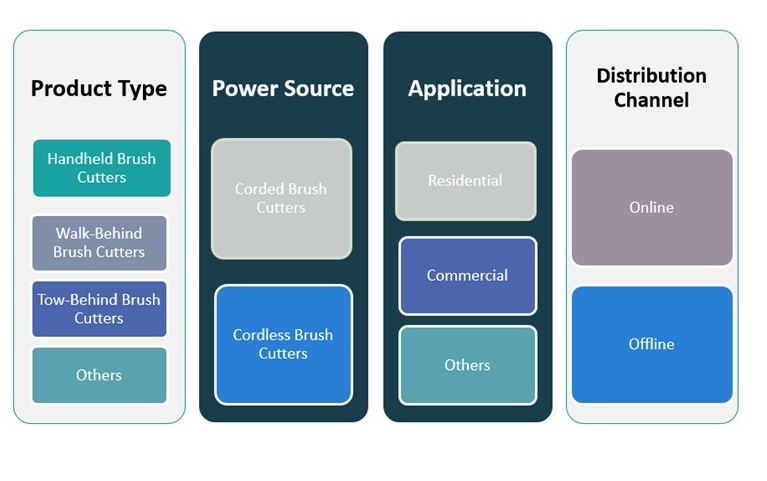
This report segments the UK Brush Cutters Market as follow
Market Drivers:
Increasing Demand for Landscape Maintenance
The rising emphasis on landscape aesthetics and green space maintenance across the United Kingdom is a primary driver for the brush cutters market. Urbanization has led to the expansion of public parks, recreational areas, and residential gardens, all of which require routine upkeep to manage overgrown vegetation. This has spurred demand for reliable and efficient landscaping tools, with brush cutters emerging as a preferred solution due to their versatility and effectiveness in tackling dense grass, shrubs, and undergrowth. For example, the Husqvarna 553RBX, described as the company’s strongest backpack brushcutter, is specifically developed for clearing tough grass and brush in difficult terrain, highlighting the demand for high-performance equipment in municipal and public sector maintenance. Local councils and municipal bodies are investing in maintenance equipment to enhance urban landscapes and support environmental well-being, further boosting market growth.
Growth in Home Gardening and DIY Landscaping Trends
The growing interest in home improvement and gardening, particularly following the pandemic-driven lifestyle shift, has significantly influenced the adoption of brush cutters among homeowners. Individuals are investing more in outdoor aesthetics and self-managed landscaping projects, creating a surge in demand for user-friendly and ergonomic garden tools. For instance, Honda offers brushcutters with 4-stroke engines that weigh between 5.4–7.2 kg, designed for effortless, extended use by homeowners. Brush cutters, especially lightweight and battery-operated models, are being widely purchased for residential use. This trend has also been fueled by increased awareness of sustainability and the health benefits of outdoor activities, encouraging more people to engage in home gardening, thereby expanding the customer base in the domestic market segment.
Technological Advancements in Brush Cutter Design
Continuous innovation in garden tool technology has enhanced the appeal and functionality of brush cutters in the UK market. Manufacturers are focusing on developing products that are not only energy-efficient but also environmentally friendly and easy to handle. The advent of cordless electric models, incorporating lithium-ion batteries, has addressed past concerns related to noise, emissions, and maneuverability. Moreover, smart features such as variable speed controls, anti-vibration systems, and easy-start mechanisms are making brush cutters more appealing to both professionals and casual users. These technological upgrades are positioning brush cutters as indispensable tools for precise and efficient vegetation management across diverse environments.
Focus on Environmental Sustainability and Emission Reduction
The UK’s strong commitment to environmental protection and carbon reduction goals has directly influenced market dynamics. Government regulations promoting low-emission and noise-compliant tools have encouraged a shift away from petrol-powered brush cutters toward electric and hybrid alternatives. As public and private sectors alike prioritize greener solutions in equipment procurement, manufacturers are aligning their product offerings with these evolving standards. In response, the market is witnessing a clear transition toward sustainable brush cutter models that meet regulatory and consumer expectations. This shift not only supports environmental initiatives but also creates opportunities for product differentiation and competitive advantage among suppliers.
Market Trends:
Rising Popularity of Battery-Powered Equipment
One of the most prominent trends shaping the UK brush cutters market is the growing preference for battery-powered models over traditional petrol-based variants. Consumers and commercial users alike are increasingly opting for cordless electric brush cutters due to their ease of use, low maintenance requirements, and eco-friendliness. For example, the GreenWorks Pro 60V cordless brush cutter delivers up to 50 minutes of run time on a fully charged 5Ah battery, offering a true petrol alternative with reduced noise, zero emissions, and minimal maintenance. The development of advanced lithium-ion batteries with extended run times and rapid charging capabilities has significantly improved the efficiency of these models. As a result, both residential users and landscaping contractors are adopting battery-powered brush cutters, particularly in urban and suburban regions where noise restrictions and emissions regulations are more stringent.
Expansion of Commercial Landscaping Services
The commercial landscaping sector in the UK is experiencing robust growth, driven by increased investments in infrastructure development, public housing projects, and hospitality landscaping. As businesses and property managers strive to maintain aesthetically pleasing surroundings, demand for professional-grade brush cutters has surged. Landscaping service providers are expanding their fleets to include powerful, heavy-duty brush cutters capable of handling varied terrains and vegetation types. This trend is further supported by government-led beautification initiatives and green infrastructure projects, which require the consistent upkeep of open spaces, road verges, and parklands throughout the year.
Integration of Ergonomic and Safety Features
Ergonomics and user safety have become key focus areas for manufacturers responding to consumer expectations in the UK market. Modern brush cutters now come equipped with enhanced safety harnesses, vibration-dampening systems, and adjustable handles designed to reduce operator fatigue and injury risks. Husqvarna, for instance, equips its brush cutters with adjustable handlebars and anti-vibration systems to reduce user fatigue and improve comfort during extended use. These features are especially important for professional users who rely on prolonged daily usage. Additionally, the introduction of brush cutters with smart throttle control and automatic shut-off functions has improved overall handling and safety. This trend aligns with the increasing regulatory emphasis on worker protection and tool safety standards across the country.
Growth in Online Retail and Direct-to-Consumer Sales
The digital transformation of the retail landscape is another significant trend impacting the UK brush cutters market. E-commerce platforms and direct-to-consumer (DTC) sales channels have witnessed considerable growth, offering customers convenient access to a wide range of brush cutter brands and models. Consumers are leveraging online reviews, product comparison tools, and virtual consultations to make informed purchasing decisions. As online retail channels continue to expand, manufacturers are investing in digital marketing strategies, e-commerce logistics, and after-sales support services to strengthen their presence. This shift is especially notable among younger, tech-savvy homeowners who prefer the ease of digital purchasing over traditional brick-and-mortar experiences.
Market Challenges Analysis:
High Initial Costs and Maintenance Requirements
One of the major restraints impacting the UK brush cutters market is the high upfront cost associated with quality equipment, especially commercial-grade or battery-powered models. While these models offer efficiency and environmental benefits, their initial price point may deter small-scale users or budget-conscious buyers. Additionally, ongoing maintenance expenses such as blade sharpening, part replacements, and battery replacements add to the total cost of ownership. For example, a full service for a brush cutter or strimmer in the UK typically costs £68.22 including VAT, covering labour and fixed service charges. This becomes particularly burdensome for small landscaping businesses and occasional residential users who may not require heavy-duty machinery on a regular basis.
Limited Battery Life and Performance Constraints
Although battery-powered brush cutters are gaining popularity, their limitations in run time and cutting power remain significant challenges, particularly for large-scale or rugged terrain applications. Despite advancements in lithium-ion battery technology, many users still report performance gaps when compared to petrol-powered models. Extended use on thick or woody vegetation often requires multiple battery swaps or recharges, which can disrupt workflow and increase operational downtime. This shortcoming limits the adoption of battery-powered options in rural or commercial settings where long, uninterrupted usage is critical.
Regulatory Compliance and Emissions Standards
Stringent environmental regulations in the UK aimed at reducing emissions and noise pollution have led to increased pressure on manufacturers and users to transition away from petrol-powered brush cutters. While this promotes sustainability, it also poses challenges for users accustomed to traditional models, particularly in regions lacking adequate charging infrastructure for electric alternatives. Moreover, ensuring compliance with evolving product certifications and safety standards adds complexity and cost to production and procurement processes. As a result, market players must continuously adapt to regulatory shifts, which may hinder innovation speed and market penetration in the short term.
Market Opportunities:
The UK brush cutters market presents significant opportunities driven by the increasing prioritization of green infrastructure development and sustainable landscape management. As public and private sectors invest in expanding and maintaining urban green spaces, there is growing demand for advanced vegetation control tools. This creates a substantial opportunity for manufacturers to introduce efficient, low-emission brush cutter models tailored for use in parks, nature reserves, residential zones, and roadside maintenance. Furthermore, the increasing frequency of seasonal storms and unpredictable weather conditions in the UK has led to the need for regular clearing of overgrown or damaged vegetation, amplifying the relevance of brush cutters in both emergency response and routine maintenance.
Another major opportunity lies in the ongoing electrification and digitalization of garden equipment. Consumer demand is steadily shifting toward quieter, battery-powered, and environmentally friendly alternatives to traditional petrol-based tools. This trend provides room for innovation in electric brush cutter designs, including longer-lasting batteries, smart features, and ergonomic enhancements. Additionally, the expansion of e-commerce platforms and direct-to-consumer channels allows brands to reach a wider audience while offering customized product bundles, virtual demos, and after-sales services. The growing DIY landscaping culture, coupled with an increasing number of amateur gardeners and hobbyists, opens further prospects for market growth in the residential segment. Companies that align with eco-conscious consumer behavior and emphasize product reliability, ease of use, and safety are well-positioned to capitalize on this evolving landscape.
Market Segmentation Analysis:
The UK brush cutters market is segmented by product type, power source, application, and distribution channel, each playing a vital role in shaping market dynamics.
By product type, handheld brush cutters dominate due to their affordability, portability, and suitability for small to medium-scale tasks in both residential and light commercial settings. Walk-behind brush cutters are gaining popularity in commercial landscaping and municipal maintenance owing to their ability to handle dense vegetation over large areas. Tow-behind models, while niche, are used primarily in agricultural and estate management applications. The “Others” segment includes multi-functional or robotic brush cutters, reflecting emerging innovations.
By power source, cordless brush cutters are witnessing rapid growth as users increasingly favor battery-powered solutions for their mobility, ease of use, and compliance with environmental standards. Corded models continue to serve users in settings with stable power access and are valued for their consistent performance during extended operations.
By application, the residential segment holds a considerable share, driven by the rise of home gardening and DIY landscaping activities. The commercial segment, however, is expanding steadily with the increasing demand from professional landscapers and public infrastructure maintenance teams.
By distribution channel, offline sales remain prominent, especially through hardware stores and specialized garden equipment retailers. However, the online channel is growing rapidly as consumers benefit from product comparisons, home delivery, and promotional pricing. Manufacturers are leveraging e-commerce platforms to enhance reach and improve customer engagement, further accelerating growth across market segments.
Segmentation:
By Product Type
- Handheld Brush Cutters
- Walk-Behind Brush Cutters
- Tow-Behind Brush Cutters
- Others
By Power Source
- Corded Brush Cutters
- Cordless Brush Cutters
By Application
- Residential
- Commercial
- Others
By Distribution Channel
- Online
- Offline
- North America
- U.S.
- Canada
- Mexico
- Europe
- Germany
- France
- U.K.
- Italy
- Spain
- Rest of Europe
- Asia Pacific
- China
- Japan
- India
- South Korea
- South-east Asia
- Rest of Asia Pacific
- Latin America
- Brazil
- Argentina
- Rest of Latin America
- Middle East & Africa
- GCC Countries
- South Africa
- Rest of the Middle East and Africa
Regional Analysis:
The UK brush cutters market exhibits regional variations influenced by factors such as urbanization, agricultural activities, and investment in green infrastructure. While specific regional market share data is limited, general trends can be observed across different areas.
England
England, particularly the South East and Greater London areas, represents a significant portion of the market. The high population density and emphasis on maintaining public parks and private gardens drive demand for brush cutters. Urban councils and landscaping businesses in these regions invest in advanced equipment to manage green spaces efficiently.
Scotland
Scotland's vast rural landscapes and agricultural activities contribute to its notable share in the brush cutters market. Farmers and landowners utilize brush cutters for managing overgrown vegetation and maintaining farmland boundaries. Additionally, the tourism sector's focus on preserving natural beauty areas like the Highlands necessitates regular landscape maintenance.
Wales Wales, with its mix of urban centers and rural areas, shows a balanced demand for brush cutters. The government's initiatives to promote environmental conservation and community gardening projects have spurred the adoption of brush cutters among both municipal bodies and private users.
Northern Ireland In Northern Ireland, agricultural practices dominate the use of brush cutters. The region's farming community relies on these tools for land management and crop preparation. Moreover, local councils' efforts to enhance public spaces contribute to the market's growth.
Key Player Analysis:
- GreenMech Ltd
- Timberwolf
- Tracmaster Ltd
- Ryetec Industrial Equipment Ltd
- Ferris Mowers
Competitive Analysis:
The UK brush cutters market is moderately fragmented, with the presence of both international brands and regional manufacturers competing on performance, pricing, and innovation. Leading players such as STIHL, Husqvarna, and Makita dominate the market with their wide product portfolios, strong brand recognition, and robust distribution networks. These companies continue to invest in battery-powered technologies and ergonomic designs to align with evolving consumer preferences and environmental standards. Meanwhile, local and emerging brands focus on affordable solutions and niche customization to capture price-sensitive segments. The competitive landscape is further influenced by growing e-commerce penetration, which enables newer entrants to access broader markets and challenge established players through direct-to-consumer strategies. To stay competitive, manufacturers are emphasizing product reliability, after-sales service, and sustainability features. Innovation, customer engagement, and strategic retail partnerships will remain key differentiators as companies vie for market share in this evolving landscape.
Recent Developments:
- In April 2025, GreenMech Ltd unveiled significant innovations at The Arb Show, introducing their new ‘SMART FEED Remote’ system designed to enhance the versatility and efficiency of their flagship EVO series woodchippers. This handheld remote allows operators to control key chipper functions-such as feed roller operation and engine speed-without standing next to the machine, optimizing both safety and workflow.
- In early 2025, STIHL rolled out a comprehensive lineup of new battery-powered outdoor tools, focusing on innovations in trimmers, blowers, mowers, and heavy-duty equipment. The 2025 catalog highlights models such as the HSA 140 T/R hedge trimmers, the KGA 770 battery-powered sweeper, and the TSA 300 battery-powered concrete saw, emphasizing improved performance and environmental friendliness. STIHL’s strategy this year is clearly geared toward expanding its battery-powered offerings, with more than 50 new products introduced to the market.
- In March 2025, DeWALT, a brand under Stanley Black & Decker, expanded its outdoor power equipment lineup by launching new gas and battery-powered products. Notable releases include the 60V MAX* Brushless Cordless Backpack Blower, new walk-behind mowers, and a range of handheld tools such as pole saws, chainsaws, and hedge trimmers. These products are designed to enhance productivity and cater to both residential and professional landscaping needs.
Market Concentration & Characteristics:
The UK brush cutters market demonstrates moderate market concentration, with a mix of well-established global brands and smaller domestic players operating across various price and performance tiers. International manufacturers such as Husqvarna, STIHL, and Makita hold a significant share due to their strong brand equity, technological expertise, and comprehensive product ranges catering to both residential and commercial users. However, the market also features a diverse array of local suppliers and private-label brands, particularly in the budget and mid-range segments. Product differentiation in terms of power source, ease of use, noise reduction, and environmental compliance is a defining characteristic of this market. The shift toward cordless electric brush cutters and growing consumer preference for sustainable tools further shape purchasing behavior. Distribution is balanced between offline retail outlets and a rapidly expanding online channel, highlighting convenience, competitive pricing, and accessibility as key characteristics of buyer engagement in the UK market.
Report Coverage:
The research report offers an in-depth analysis based on Product Type, Power Source, Application and Distribution Channel. It details leading market players, providing an overview of their business, product offerings, investments, revenue streams, and key applications. Additionally, the report includes insights into the competitive environment, SWOT analysis, current market trends, as well as the primary drivers and constraints. Furthermore, it discusses various factors that have driven market expansion in recent years. The report also explores market dynamics, regulatory scenarios, and technological advancements that are shaping the industry. It assesses the impact of external factors and global economic changes on market growth. Lastly, it provides strategic recommendations for new entrants and established companies to navigate the complexities of the market.
Future Outlook:
- The UK brush cutters market is expected to witness steady growth, supported by ongoing urban landscaping and infrastructure development.
- Rising demand for low-emission equipment will drive innovation in battery-powered and hybrid brush cutter models.
- Technological advancements will lead to more efficient, lightweight, and user-friendly designs suitable for both professionals and home users.
- Expansion of smart gardening tools and automation may introduce new product segments within the market.
- Government sustainability initiatives will continue to influence product compliance and accelerate the shift away from petrol-powered equipment.
- Online retail channels will gain greater traction as consumers seek convenience, product comparisons, and competitive pricing.
- Increasing adoption of brush cutters in the commercial sector, particularly among landscaping contractors and local councils, will enhance market penetration.
- Demand in rural regions will remain strong due to continued use in agriculture and land maintenance.
- Entry of new brands focusing on affordability and green technology may intensify competition.
- Strategic partnerships and localized distribution networks will play a key role in expanding brand reach and customer engagement.

Request a Free Sample
Fill in your details and we'll send you a free sample report.
- Sample data tables & charts
- Research methodology
Market Dynamics
Expansion of Urban Green Spaces
The increasing development and maintenance of public parks, gardens, and recreational areas in UK cities are driving demand for efficient brush cutters, as municipalities and contractors require reliable tools for landscape management.
Growth in Home Gardening and DIY Landscaping
A surge in residential gardening and DIY landscaping, especially post-pandemic, has expanded the consumer base for brush cutters, with homeowners seeking user-friendly, lightweight, and battery-powered models for personal use.
Technological Advancements in Brush Cutter Design
Innovations such as cordless electric models, ergonomic features, and smart controls are making brush cutters more accessible and appealing to both professionals and hobbyists, supporting broader market adoption.
Environmental Sustainability and Emission Regulations
The UK's commitment to reducing emissions and noise pollution is accelerating the shift from petrol-powered to electric and hybrid brush cutters, as both public and private sectors prioritize eco-friendly equipment.
Expansion of Commercial Landscaping Services
Increased investments in infrastructure, public housing, and hospitality landscaping are fueling demand for professional-grade brush cutters, as service providers require robust equipment for large-scale and varied terrain maintenance.
Need a Custom Version of This Report?
Tailor the scope, geography, or segments to your exact requirements.
- Custom geography or segment scope
- Direct access to our analyst team
Frequently Asked Questions
What is the current size of the UK Brush Cutters Market?
What factors are driving the growth of the UK Brush Cutters Market?
What are some challenges faced by the UK Brush Cutters Market?
Who are the major players in the UK Brush Cutters Market?
Table of Content
Chapter 1 Market Segmentation
- 1.1 Segmentation Framework
- 1.1.1 Product and Service Classification
- 1.1.2 Application and End-Use Classification
- 1.1.3 Technology and Solution Classification
- 1.1.4 Customer and Distribution Channel Classification
- 1.1.5 Geographic Segmentation
- 1.1.6 Market Segment Definitions and Boundaries
- 1.2 By Application
- 1.2.1 Residential
- 1.2.2 Commercial
- 1.2.3 Others
- 1.3 By Power Source
- 1.3.1 Corded Brush Cutters
- 1.3.2 Cordless Brush Cutters
- 1.4 By Product Type
- 1.4.1 Handheld Brush Cutters
- 1.4.2 Walk-Behind Brush Cutters
- 1.4.3 Tow-Behind Brush Cutters
- 1.4.4 Others
Chapter 2 Introduction
- 2.1 Report Objectives and Scope
- 2.2 Product Definition and Industry Terminology
- 2.3 Market Inclusions and Exclusions
- 2.4 Research Process
- 2.4.1 Primary Research and Expert Interviews
- 2.4.2 Secondary Research and Source Review
- 2.4.3 Top-Down and Bottom-Up Estimation
- 2.4.4 Data Triangulation and Verification
- 2.5 Market Size Measurement Basis
- 2.5.1 2024: USD 221.82 million → 2032: USD 309.32 million
- 2.6 Historical and Forecast Reference Periods
- 2.6.1 Base Year: 2024
- 2.6.2 Forecast Period: 2024-2032
- 2.7 Research Assumptions and Limitations
Chapter 3 Executive Summary
- 3.1 Market Snapshot and Key Findings
- 3.2 Base-Year Market Size, 2024
- 3.3 Forecast Market Size, 2032
- 3.4 Revenue and Volume Growth Outlook
- 3.5 Key Demand and Supply Indicators
- 3.6 Leading Market Segments
- 3.7 Fastest-Growing Market Opportunities
- 3.8 Regional Performance Highlights
- 3.9 Technology and Industry Transformation
- 3.10 Competitive Landscape Summary
- 3.11 Analyst View and Strategic Implications
Chapter 4 UK Brush Cutters Market Trends and Developments
- 4.1 Historical Industry Development
- 4.2 Recent Market Trends and Developments
- 4.3 Demand and Customer Behavior Trends
- 4.4 Technology and Product Innovation
- 4.5 Artificial Intelligence, Automation and Digitalization
- 4.6 Local Manufacturing and Supply Chain Realignment
- 4.7 Industry Partnerships, Mergers and Acquisitions
- 4.8 Sustainability and Circular Economy Developments
- 4.9 Government and Private Sector Investment Trends
- 4.10 Emerging Business Models and Commercialization
- 4.11 Industry Developments and Announcements
Chapter 5 UK Brush Cutters Market Production, Supply and Demand Analysis
- 5.1 Demand Trend and Consumption Analysis
- 5.2 Demand Forecast, 2024-2032
- 5.3 Production and Output Trend
- 5.4 Production and Output Forecast, 2024-2032
- 5.5 Installed Capacity and Capacity Utilization
- 5.6 Company-Wise Production Plants and Statistics
- 5.6.1 Installed Production Capacity
- 5.6.2 Actual Production
- 5.6.3 Planned Capacity and Expansion Targets
- 5.7 Supply Chain Structure and Procurement Trends
- 5.8 Supply-Demand Gap and Bottlenecks
- 5.9 Import Dependence and Sourcing Structure
- 5.10 Contract Manufacturing and Outsourcing
- 5.11 Regional Supply and Demand Concentration
Chapter 6 UK Brush Cutters Market Pricing Analysis
- 6.1 Pricing Structure and Measurement
- 6.2 Historical Pricing Trends
- 6.3 Pricing Outlook, 2024-2032
- 6.4 Average Selling Price and Unit Economics
- 6.5 Pricing by Product and Market Segment
- 6.6 Geographic Pricing Differences
- 6.7 Key Input, Energy, Labor and Logistics Costs
- 6.8 Contract Pricing and Purchasing Models
- 6.9 Pricing Sensitivity and Competitive Positioning
- 6.10 Price, Margin and Profitability Implications
Chapter 7 UK Brush Cutters Market Dynamics
- 7.1 Market Growth Drivers
- 7.1.1 Demand-Side Drivers
- 7.1.2 Technology and Innovation Drivers
- 7.1.3 Infrastructure and Investment Drivers
- 7.1.4 Regulatory and Policy Drivers
- 7.2 Market Restraints
- 7.2.1 Cost and Affordability Constraints
- 7.2.2 Technology and Adoption Barriers
- 7.2.3 Supply Chain and Operational Constraints
- 7.3 Market Challenges
- 7.3.1 Competitive Pressure and Margin Erosion
- 7.3.2 Skills, Infrastructure and Implementation Gaps
- 7.4 Emerging Market Opportunities
- 7.5 Market Dynamics Impact and Time-Horizon Assessment
Chapter 8 UK Brush Cutters Value Chain Analysis
- 8.1 Industry Value Chain Overview
- 8.2 Upstream Suppliers and Critical Inputs
- 8.3 Technology and Component Providers
- 8.4 Manufacturing or Service Delivery
- 8.5 Distribution, Channel Partners and Integrators
- 8.6 Downstream Applications and End Users
- 8.7 Value Addition and Profit Pools
- 8.8 Vertical Integration and Outsourcing
- 8.9 Supplier Concentration and Risk
- 8.10 Supply Chain Localization and Resilience
Chapter 9 UK Brush Cutters Market Regulations and Policies
- 9.1 Relevant Laws, Standards and Compliance Frameworks
- 9.2 Product, Service, Safety and Quality Requirements
- 9.3 Government Policies, Incentives and Subsidies
- 9.4 Imports, Exports and Trade Barriers
- 9.5 Public Procurement and Local Content Requirements
- 9.6 Environmental and Sustainability Compliance
- 9.7 Upcoming Policy Changes and Market Implications
Chapter 10 UK Brush Cutters Market Hotspots and Opportunities
- 10.1 Market Opportunity Mapping and Growth Hotspots
- 10.2 High-Growth Applications and Customer Groups
- 10.3 Underserved Markets and White-Space Opportunities
- 10.4 Emerging Technology and Product Opportunities
- 10.5 New Capacity and Investment Hotspots
- 10.6 Market Entry and Expansion Opportunities
- 10.7 Distribution and Partnership Opportunities
- 10.8 Near-Term and Long-Term Commercial Potential
- 10.9 Opportunity Attractiveness and Execution Risks
Chapter 11 UK Brush Cutters Market Outlook, 2024-2032
- 11.1 Market Size and Analysis
- 11.1.1 Revenue (Market Measurement: 2024: USD 221.82 million → 2032: USD 309.32 million)
- 11.1.2 Market Volume and Quantity Sold
- 11.1.3 Historical Market Size
- 11.1.4 Base-Year Market Size, 2024
- 11.2 Market Forecast, 2024-2032
- 11.2.1 Revenue Forecast to 2032
- 11.2.2 Volume Forecast to 2032
- 11.2.3 CAGR and Year-on-Year Growth
- 11.2.4 Incremental Revenue Opportunity
- 11.3 Forecast Assumptions and Scenario Analysis
- 11.3.1 Base-Case Forecast
- 11.3.2 Optimistic and Conservative Scenarios
- 11.3.3 Technology, Pricing and Policy Sensitivities
- 11.4 Market Attractiveness and Growth Outlook
Chapter 12 UK Brush Cutters Market Segmentation and Outlook
- 12.1 Segmentation Summary and Market Shares, 2024
- 12.2 Largest and Fastest-Growing Segments
- 12.3 By Application - Market Size and Forecast, 2024-2032
- 12.3.1 Segment Definition and Scope
- 12.3.2 Historical Market Size
- 12.3.3 Revenue Forecast, 2024-2032
- 12.3.4 Volume Forecast, 2024-2032
- 12.3.5 Base-Year Market Share, 2024
- 12.3.6 Segment CAGR and Growth Drivers
- 12.3.7 Subsegment Market Size and Forecast
- 12.3.7.1 Residential
- 12.3.7.2 Commercial
- 12.3.7.3 Others
- 12.3.8 Subsegment Pricing and Adoption Trends
- 12.3.9 Leading Suppliers and Competition
- 12.3.10 Regional Demand and Opportunities
- 12.4 By Power Source - Market Size and Forecast, 2024-2032
- 12.4.1 Segment Definition and Scope
- 12.4.2 Historical Market Size
- 12.4.3 Revenue Forecast, 2024-2032
- 12.4.4 Volume Forecast, 2024-2032
- 12.4.5 Base-Year Market Share, 2024
- 12.4.6 Segment CAGR and Growth Drivers
- 12.4.7 Subsegment Market Size and Forecast
- 12.4.7.1 Corded Brush Cutters
- 12.4.7.2 Cordless Brush Cutters
- 12.4.8 Subsegment Pricing and Adoption Trends
- 12.4.9 Leading Suppliers and Competition
- 12.4.10 Regional Demand and Opportunities
- 12.5 By Product Type - Market Size and Forecast, 2024-2032
- 12.5.1 Segment Definition and Scope
- 12.5.2 Historical Market Size
- 12.5.3 Revenue Forecast, 2024-2032
- 12.5.4 Volume Forecast, 2024-2032
- 12.5.5 Base-Year Market Share, 2024
- 12.5.6 Segment CAGR and Growth Drivers
- 12.5.7 Subsegment Market Size and Forecast
- 12.5.7.1 Handheld Brush Cutters
- 12.5.7.2 Walk-Behind Brush Cutters
- 12.5.7.3 Tow-Behind Brush Cutters
- 12.5.7.4 Others
- 12.5.8 Subsegment Pricing and Adoption Trends
- 12.5.9 Leading Suppliers and Competition
- 12.5.10 Regional Demand and Opportunities
- 12.6 Segment Growth Comparison
- 12.7 Segment Attractiveness and Priority Matrix
Chapter 13 UK Brush Cutters End-Use and Application Market Outlook
- 13.1 End-Use Industry and Customer Demand Structure
- 13.2 Leading Applications and Customer Groups
- 13.3 End-Use Market Size, Share and Forecast
- 13.4 Major End-Use Industry Deep Dives
- 13.4.1 Customer Requirements and Use Cases
- 13.4.2 Demand and Replacement Cycles
- 13.4.3 Technical and Regulatory Considerations
- 13.4.4 Purchasing and Procurement Models
- 13.4.5 Leading Vendors and Distribution Channels
- 13.4.6 Forecast and Commercial Opportunities
- 13.5 Emerging Applications and Cross-Segment Demand
- 13.6 End-Use Industry Investment Priorities
Chapter 14 UK Brush Cutters Geographic Market Outlook, 2024-2032
- 14.1 Domestic Market Distribution and Demand Clusters
- 14.2 State- or Province-Wise Market Size and Forecast, 2024-2032
- 14.3 City and Metropolitan Market Outlook
- 14.4 Industrial, Manufacturing and Commercial Clusters
- 14.5 Geographic Concentration of Key End Users
- 14.6 Local Pricing and Purchasing Differences
- 14.7 Domestic Production Facilities and Capacity Map
- 14.8 Local Infrastructure and Project Pipeline
- 14.9 State-Level Policy and Incentive Differences
- 14.10 Subnational Investment Hotspots and Opportunities
- 14.11 Distribution and Logistics Networks
- 14.12 Domestic Competitive Footprint
Chapter 15 UK Brush Cutters Technology, Innovation and Sustainability Outlook
- 15.1 Technology Landscape and Maturity
- 15.2 Product, Process and Service Innovation
- 15.3 AI, Automation and Digital Tools in the Industry
- 15.4 Technology Adoption and Performance Benchmarking
- 15.5 Innovation Pipeline and R&D Investment
- 15.6 Patent and Intellectual Property Trends
- 15.7 Energy Efficiency and Resource Management
- 15.8 Sustainability, Recycling and Circularity
- 15.9 Technology Roadmap, 2024-2032
- 15.10 Risks of Obsolescence and Technology Substitution
Chapter 16 UK Brush Cutters Market Key Strategic Imperatives
- 16.1 Growth and Market Entry Priorities
- 16.2 High-Return Products and Segments
- 16.3 Pricing, Profitability and Cost Optimization
- 16.4 Technology Investment and Product Differentiation
- 16.5 Supply Chain Localization and Resilience
- 16.6 Distribution and Customer Acquisition
- 16.7 Partnership, Acquisition and Capacity Strategy
- 16.8 Regional Expansion Priorities
- 16.9 Short-, Medium- and Long-Term Actions
Chapter 17 Competition Outlook
- 17.1 Industry Competition Characteristics
- 17.2 Market Structure and Concentration
- 17.3 Market Share and Competitive Positioning, 2024
- 17.4 Company-Wise Revenue and Product Benchmarking
- 17.5 Production and Service Capacity Benchmarking
- 17.6 Technology, Pricing and Differentiation
- 17.7 Regional Footprint and Distribution Strength
- 17.8 Mergers, Acquisitions and Strategic Alliances
- 17.9 New Entrants and Competitive Threats
- 17.10 Porter's Five Forces and Industry Attractiveness
- 17.11 Competitive Outlook, 2024-2032
Chapter 18 Company Profiles
- 18.1 Company Coverage and Selection Criteria
- 18.2 STIHL
- 18.2.1 Business Description
- 18.2.2 Company Ownership and Geographic Presence
- 18.2.3 Product and Service Portfolio
- 18.2.4 Manufacturing and Operating Footprint
- 18.2.5 Production Capacity and Expansion Plans
- 18.2.6 Financial Performance and Investment
- 18.2.7 Market Share and Competitive Position
- 18.2.8 Technology and Innovation Capabilities
- 18.2.9 Strategic Alliances or Partnerships
- 18.2.10 Recent Developments
- 18.2.11 Growth Strategy and Outlook
- 18.3 Husqvarna
- 18.4 Makita
- 18.5 GreenMech Ltd
- 18.6 Timberwolf
- 18.7 Tracmaster Ltd
- 18.8 Ryetec Industrial Equipment Ltd
- 18.9 Ferris Mowers
- 18.10 DeWALT (Stanley Black & Decker)
- 18.11 Honda
- 18.12 Other Relevant Market Participants
Note: Every listed company is profiled on the structure shown under the first company. The company list is preliminary and may change based on research findings, market developments, data availability and client requirements.
Chapter 19 Disclaimer
- 19.1 Research and Forecast Disclaimer
- 19.2 Data Source and Estimation Limitations
Note: The depth of individual sections depends on data availability for this market. Volume, capacity, trade and other unit-based metrics are included where applicable.