
| REPORT ATTRIBUTE | DETAILS |
|---|---|
| Historical Period | 2020-2023 |
| Base Year | 2024 |
| Forecast Period | 2025-2032 |
| UK Data Center Uninterruptable Power Supply (UPS) Market Size 2023 | USD 247.60 million |
| UK Data Center Uninterruptable Power Supply (UPS) Market, CAGR | 4.89% |
| UK Data Center Uninterruptable Power Supply (UPS) Market Size 2032 | USD 362.64 million |
Market Overview
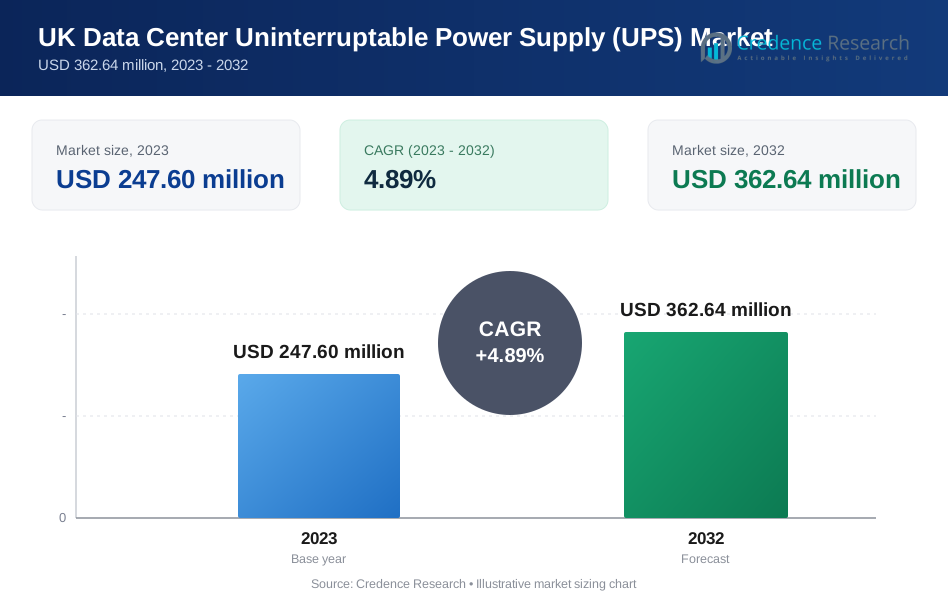
UK Data Center Uninterruptable Power Supply (UPS)) market size was valued at USD 247.60 million in 2023 and is anticipated to reach USD 362.64 million by 2032, at a CAGR of 4.89% during the forecast period (2023-2032).
The UK Data Center Uninterruptible Power Supply (UPS) market is driven by the growing need for reliable power systems to support the expanding data center industry. The increasing reliance on cloud computing, e-commerce, and digital services has amplified the demand for continuous, uninterrupted power to prevent downtime and ensure operational efficiency. Additionally, the rise in data traffic and the push for 24/7 services across industries further fuel the demand for robust UPS systems. Technological advancements, such as the integration of energy-efficient and scalable UPS solutions, are also contributing to market growth. The adoption of hybrid and multi-cloud environments is leading to higher power consumption, thus necessitating advanced UPS systems to safeguard critical infrastructure. Furthermore, increasing regulatory requirements for data protection and business continuity are pushing organizations to invest in high-performance UPS systems to mitigate risks and ensure operational resilience.
The UK Data Center Uninterruptible Power Supply (UPS) market is characterized by regional demand driven by the growth of digital infrastructure and data center development across key cities. London, Manchester, Birmingham, and Scotland are the primary regions witnessing substantial investments in UPS systems due to the increasing reliance on cloud services and digital transformation. Leading companies in the market, such as Hewlett Packard Enterprise (HPE), Eaton Corporation, Lenovo Group, ABB Ltd., and Schneider Electric, are at the forefront, offering innovative UPS solutions to meet the growing power demands of data centers. These key players are focusing on enhancing the efficiency, scalability, and reliability of their UPS products to support critical operations and ensure business continuity. The competition in the UK market is expected to intensify as the need for energy-efficient and robust UPS solutions continues to rise, particularly in response to the expanding data center ecosystem.
Market Insights
- The UK Data Center Uninterruptible Power Supply (UPS) market was valued at USD 247.60 million in 2023 and is projected to reach USD 362.64 million by 2032, growing at a CAGR of 4.89% during the forecast period.
- The demand for energy-efficient UPS systems is increasing due to the growing focus on sustainability and reducing operational costs.
- The integration of IoT and remote monitoring technologies is enhancing UPS system reliability and operational management.
- Modular UPS solutions are gaining popularity due to their scalability and flexibility, addressing the dynamic power requirements of data centers.
- Key players in the market include Hewlett Packard Enterprise (HPE), Eaton Corporation, and Schneider Electric, offering innovative, energy-efficient UPS solutions.
- The high initial investment and maintenance costs of advanced UPS systems present a significant challenge for small and medium-sized data centers.
- London, Manchester, and Birmingham are key regions driving demand for UPS systems, with increasing data center developments supporting market growth.
Market Drivers
Growing Demand for Data Centers and Cloud Services
The rapid expansion of data centers in the UK, driven by the increasing adoption of cloud computing, is a primary driver of the UPS market. As businesses increasingly rely on cloud services for data storage and processing, the need for uninterrupted power becomes more critical. Data centers house sensitive information and operate round-the-clock, necessitating UPS systems to avoid disruptions and ensure seamless operations. For instance, the UK government's push towards digital transformation has led to a significant increase in cloud service usage across various sectors, including public services, which now rely heavily on cloud infrastructure for their operations. The surge in demand for cloud-based services, e-commerce, and remote work solutions further reinforces the need for reliable UPS systems to support continuous data flow and prevent any downtime.
Technological Advancements in UPS Systems
Technological innovations in UPS systems have significantly enhanced their efficiency, scalability, and performance. Newer models feature energy-saving designs, compact sizes, and advanced battery technologies that cater to the evolving needs of modern data centers. Innovations such as lithium-ion batteries and modular UPS units allow for increased flexibility, longer operational life, and reduced maintenance costs. For example, companies like Schneider Electric have introduced modular UPS systems that can be easily scaled according to the data center's growth, providing a cost-effective solution for expanding operations. These advancements make UPS systems more appealing to data center operators, driving further adoption and investment in the market.
Regulatory and Compliance Requirements
Increased regulatory focus on data protection, business continuity, and operational resilience is another major driver of the UPS market. The UK has stringent regulations surrounding data protection and system uptime, such as those outlined by the General Data Protection Regulation (GDPR) and the National Cyber Security Centre (NCSC). These regulations compel organizations to implement reliable power backup solutions, including UPS systems, to avoid data loss, security breaches, and costly downtime. As a result, companies are investing in UPS systems to meet compliance standards and maintain business continuity.
Rising Power Consumption and Operational Demands
As data center operations scale up to accommodate growing data traffic and computational needs, power consumption has risen significantly. The need for energy-efficient and reliable power systems is critical to meet these demands. UPS systems play a key role in ensuring that data centers can handle increased power loads while maintaining operational efficiency. The growing need for high-performance UPS solutions capable of managing the rising power requirements of modern data centers is thus contributing to the market's growth.
Market Trends
Shift Towards Energy-Efficient UPS Solutions
A prominent trend in the UK Data Center UPS market is the increasing demand for energy-efficient solutions. With the rising focus on sustainability and cost reduction, data center operators are opting for UPS systems that offer high energy efficiency. Technologies like lithium-ion batteries and advanced power conversion techniques are gaining traction for their ability to reduce energy consumption, improve efficiency, and lower operating costs. These systems not only help in minimizing the carbon footprint but also ensure that data centers operate at optimal performance levels while complying with environmental standards.
Integration of IoT and Remote Monitoring
The integration of the Internet of Things (IoT) and remote monitoring capabilities is another key trend shaping the UPS market. Data centers are increasingly adopting UPS systems with built-in IoT connectivity, allowing for real-time monitoring and predictive maintenance. This enables operators to track UPS performance, battery health, and power quality remotely, improving system reliability and reducing downtime. For example, a report from the UK's National Cyber Security Centre highlights the growing use of IoT in critical infrastructure to enhance operational efficiency and security. Remote monitoring also allows for early detection of issues, ensuring timely maintenance and extending the lifespan of UPS units. This trend is contributing to more proactive, data-driven management of power infrastructure.
Adoption of Modular UPS Systems
Modular UPS systems are becoming increasingly popular in the UK data center market. These systems offer greater flexibility and scalability, enabling data center operators to add or remove UPS modules based on their changing power requirements. This adaptability makes modular UPS solutions ideal for the dynamic needs of data centers, particularly those that experience fluctuating workloads or plan for future growth. The ability to scale power capacity without investing in entirely new systems is a significant advantage, driving the adoption of modular UPS solutions across the industry.
Focus on Hybrid and Multi-Cloud Data Center Models
As businesses embrace hybrid and multi-cloud strategies, there is a growing need for UPS systems that can support these complex infrastructures. Data centers are increasingly operating in hybrid environments, where workloads are distributed across on-premise, private, and public cloud platforms. This trend is driving demand for UPS systems that can handle diverse power needs and provide reliable backup across multiple platforms. UPS solutions that can seamlessly integrate with cloud environments and support high-availability architectures are becoming more essential as the industry shifts toward these more complex data management models.
Market Challenges Analysis
High Initial Investment and Maintenance Costs
One of the key challenges in the UK Data Center UPS market is the high initial investment and ongoing maintenance costs. Advanced UPS systems, particularly those that feature lithium-ion batteries or modular designs, can be expensive to purchase and install. For instance, according to a survey by the UK's Department for Business, Energy & Industrial Strategy, businesses are increasingly investing in energy-efficient technologies to meet their environmental goals, with a notable emphasis on reducing energy waste in data centers. In addition to the upfront cost, the ongoing maintenance and operational costs can be significant, especially for larger data centers with higher power demands. UPS systems require regular servicing, battery replacements, and calibration to ensure they remain effective, which adds to the total cost of ownership. For many organizations, these expenses can be a significant barrier to adopting the most advanced power backup solutions, particularly for smaller or mid-sized data centers with limited budgets.
Space and Scalability Constraints
Another challenge is the space required for the installation and operation of UPS systems in data centers. Traditional, large-scale UPS solutions often require substantial physical space, which can be a constraint in environments where space is limited or at a premium. As data centers become more compact and energy-efficient, fitting large UPS systems into the available space without compromising other operations can be challenging. Furthermore, while modular UPS systems offer scalability, the physical footprint required to scale up power capacity may still pose challenges in constrained environments. This issue is compounded by the increasing power requirements of modern data centers, which demand more robust UPS solutions. Therefore, managing space effectively while ensuring adequate power backup is a critical concern for data center operators.
Market Opportunities
Expansion of Data Centers and Digital Infrastructure
The growing demand for data storage and processing in the UK presents significant opportunities for the Data Center Uninterruptible Power Supply (UPS) market. As more businesses transition to cloud-based services and digital operations, the need for reliable, uninterrupted power to support the increasing volume of data processing is escalating. The expansion of data center networks, including hyperscale and edge data centers, offers a prime opportunity for UPS providers to supply scalable, high-performance power solutions. Furthermore, the UK government’s push for digital transformation and increased reliance on e-commerce, telemedicine, and remote work services is further accelerating the need for UPS systems that ensure business continuity. This expanding market presents a favorable environment for companies offering cutting-edge UPS technologies.
Technological Advancements and Sustainability Initiatives
Advancements in UPS technology also provide significant opportunities for market growth. The integration of energy-efficient solutions, such as lithium-ion battery systems, energy recovery, and advanced power conversion technologies, aligns with the growing focus on sustainability and cost reduction in the data center sector. As data centers face increasing pressure to meet both environmental standards and operational demands, UPS providers can capitalize on the demand for green, low-emission solutions. The rise of modular UPS systems, which offer flexibility and scalability, further presents opportunities for addressing the evolving needs of data centers. Additionally, as the market gravitates toward IoT-enabled systems for remote monitoring and predictive maintenance, there is a growing opportunity for UPS manufacturers to integrate smart technologies that enhance performance and reduce operational downtime. These technological advancements position UPS solutions as essential for the future of data center operations in the UK.
Market Segmentation Analysis:
By UPS Type:
The UK Data Center Uninterruptible Power Supply (UPS) market is segmented by UPS type, with each offering unique benefits tailored to different operational needs. Standby UPS systems, also known as off-line UPS, provide basic power protection for small to medium-sized data centers by switching to battery power during power outages. Line Interactive UPS systems offer enhanced protection with automatic voltage regulation (AVR), making them suitable for medium-sized data centers that require more stability in power quality. Double Conversion UPS provides the highest level of protection, continuously converting incoming AC power to DC and then back to AC, which is ideal for large data centers that demand high-quality, uninterrupted power with minimal risk of downtime. Other UPS types include Flywheel UPS and Hybrid UPS, which cater to specific needs like reduced maintenance or improved efficiency. As data centers grow and their power needs increase, the demand for more advanced UPS systems, particularly double-conversion models, continues to rise.
By Data Center Size: The market for UPS systems in the UK is also segmented by data center size. Small data centers, typically with lower power demands, often rely on more compact and cost-effective UPS solutions, such as standby or line-interactive types. These systems provide sufficient protection while keeping operational costs in check. Medium-sized data centers typically have more critical operations that require a balance between cost-effectiveness and reliability, often opting for line-interactive or double-conversion UPS systems. In contrast, large data centers with complex infrastructure and high power consumption rely on advanced double-conversion UPS systems, which offer superior protection and scalability to ensure continuous operation. As large data centers continue to scale, there is a growing preference for modular and energy-efficient UPS solutions that can handle fluctuating power loads while maintaining high availability. This segmentation highlights the importance of aligning UPS technology with the specific needs and scale of each data center.
Segments:
Based on UPS Type:
- Standby
- Line Interactive
- Double Conversion
- Others
Based on Data Center Size:
- Small
- Medium
- Large
Based on Industry:
- BFSI
- IT & Telecom
- Healthcare
- Manufacturing
- Others
Based on the Geography:
- London
- Manchester
- Birmingham
- Scotland
Regional Analysis
London and Manchester The UK Data Center Uninterruptible Power Supply (UPS) market is heavily influenced by regional demand, with London and Manchester holding significant market shares. London, as the financial and technological hub of the UK, commands the largest share of the market. It accounts for approximately 40% of the total market, driven by the dense concentration of data centers supporting sectors such as finance, e-commerce, and technology. The city's continuous growth in digital infrastructure and its role as a global connectivity point further boost the demand for reliable UPS systems to ensure uninterrupted service. Manchester, with a market share of around 20%, is another key region in the UK UPS market. As a growing center for innovation, digital services, and IT industries, Manchester’s increasing number of data centers calls for robust UPS solutions to support operations. The region's strategic location and infrastructure developments are contributing to the rising demand for high-quality power backup solutions.
Birmingham Birmingham, the second-largest city in the UK, is witnessing rapid growth in its data center sector, which has led to an increase in demand for UPS systems. The city holds a market share of approximately 15% in the UK's UPS sector. Birmingham's expanding IT and telecommunications industries, combined with the growing adoption of cloud services, have resulted in a higher need for reliable power solutions. Its strategic location in the Midlands also serves as an attractive point for businesses looking to establish regional data centers that cater to both local and international clients. The demand for scalable and energy-efficient UPS systems in Birmingham is expected to rise as new data center projects continue to emerge, further strengthening the market’s position in the region.
Scotland Scotland, while not as dominant as London or Manchester, is showing promising growth in the UPS market, accounting for approximately 10% of the UK market share. With its increasing focus on renewable energy and digital infrastructure development, Scotland is positioning itself as a growing hub for data centers, especially in areas like Edinburgh and Glasgow. The Scottish government’s push for sustainability and green initiatives in data center operations aligns with the demand for energy-efficient UPS systems. As the region continues to attract investments in IT and telecom sectors, the demand for UPS solutions to ensure operational continuity in data centers is projected to rise steadily over the coming years.
Key Player Analysis
- Hewlett Packard Enterprise (HPE)
- Eaton Corporation
- Lenovo Group
- ABB Ltd.
- KSTAR
- Socomec
- Delta Electronics, Inc.
- Legrand
- Toshiba International Corporation
- Vertiv Group Corp.
- Clary Corp.
- Huawei Technologies
- Mitsubishi Electric Corporation
- Schneider-Electric
Competitive Analysis
The UK Data Center Uninterruptible Power Supply (UPS) market is highly competitive, with key players offering diverse and innovative solutions to cater to the growing demand for uninterrupted power supply systems. Leading companies such as Hewlett Packard Enterprise (HPE), Eaton Corporation, Lenovo Group, ABB Ltd., KSTAR, Socomec, Delta Electronics, Inc., Legrand, Toshiba International Corporation, Vertiv Group Corp., Clary Corp., Huawei Technologies, Mitsubishi Electric Corporation, and Schneider Electric are prominent in the market, each bringing unique strengths to the table. For instance, companies like Hewlett Packard Enterprise (HPE) and Eaton Corporation are known for their robust UPS systems designed to ensure business continuity while optimizing energy consumption. The competition is driven by the need for high-performance UPS systems that ensure business continuity while optimizing energy consumption. Companies in this sector differentiate themselves by integrating cutting-edge technologies such as modular designs, lithium-ion batteries, and intelligent power management systems. The emphasis on sustainability and reducing carbon footprints has led to the development of energy-efficient UPS solutions with improved battery life and remote monitoring capabilities. Additionally, businesses are expanding their product portfolios and strengthening their service networks to gain a competitive edge. Strategic partnerships, acquisitions, and investments in research and development play a crucial role in market positioning. As digital transformation accelerates and data centers expand, the competition in the UK UPS market is expected to intensify.
Recent Developments
- In December 2024, Vertiv launched the Vertiv PowerUPS 9000, a compact and energy-efficient uninterruptible power supply (UPS) system featuring high power density. Designed to support various IT applications, from traditional computing to high-density environments, this UPS is available globally in CE and UL models, with power capacities ranging from 250 to 1250 kW per unit.
- In May 2024, ABB unveiled the integration of nickel-zinc (NiZn) batteries into its MegaFlex line of high-power uninterruptible power supply (UPS) solutions designed for data centers and critical power applications. These batteries, sourced from ZincFive, provide a safe, resilient, and sustainable energy storage option compared to conventional battery technologies.
- In December 2023, Eaton launched a new UPS product, named Eaton 93T UPS to deliver stable power for critical applications, such as small data centers and server rooms. This solution is beneficial to industries, including IT sectors, finance, government, and healthcare.
- In July 2023, ABB India’s Electrification business launched a novel UPS solution known as MegaFlex DPA (Decentralized Parallel Architecture) UPS for data centers in the Indian Market. This solution offers notable sustainable power technology with reduced energy losses.
- In April 2023, Schneider Electric launched Easy UPS 3-Phase Modular. This UPS is designed to safeguard critical loads while providing Live Swap functionality.
Market Concentration & Characteristics
The UK Data Center Uninterruptible Power Supply (UPS) market is moderately concentrated, with a mix of global leaders and regional players competing to meet the increasing demand for reliable power solutions. The market is characterized by the presence of established companies that leverage advanced technology, strong distribution networks, and extensive industry experience to maintain their competitive edge. High barriers to entry, including significant capital investment, technological expertise, and regulatory compliance, limit the number of new entrants, further contributing to market concentration. A key characteristic of the market is the rising adoption of energy-efficient and modular UPS systems to support the growing data center infrastructure. The increasing demand for cloud computing, edge data centers, and colocation services is driving the need for scalable and flexible power backup solutions. Additionally, advancements in lithium-ion battery technology and intelligent power management systems are transforming UPS solutions, enhancing their reliability and performance. As sustainability becomes a priority, companies are also integrating eco-friendly designs to reduce energy consumption and carbon footprints. Strategic collaborations, product innovations, and service differentiation are shaping market dynamics, with companies focusing on enhancing operational efficiency and customer support. As the demand for uninterrupted power supply continues to rise, market concentration is expected to remain strong, driven by technological advancements and industry consolidation.
Report Coverage
The research report offers an in-depth analysis based on UPS Type, Data Center Size, Industry and Geography. It details leading market players, providing an overview of their business, product offerings, investments, revenue streams, and key applications. Additionally, the report includes insights into the competitive environment, SWOT analysis, current market trends, as well as the primary drivers and constraints. Furthermore, it discusses various factors that have driven market expansion in recent years. The report also explores market dynamics, regulatory scenarios, and technological advancements that are shaping the industry. It assesses the impact of external factors and global economic changes on market growth. Lastly, it provides strategic recommendations for new entrants and established companies to navigate the complexities of the market.
Future Outlook
- The UK Data Center Uninterruptible Power Supply (UPS) market is expected to grow steadily due to increasing data center expansions and rising digitalization.
- The demand for energy-efficient and sustainable UPS systems will drive innovation and the adoption of eco-friendly power solutions.
- Modular and scalable UPS solutions will gain traction as data centers seek flexible and cost-effective backup power systems.
- The integration of lithium-ion battery technology will enhance UPS efficiency, reduce maintenance costs, and improve performance.
- The adoption of artificial intelligence (AI) and remote monitoring capabilities will optimize power management and system reliability.
- Rising concerns over power outages and grid instability will increase investments in high-capacity UPS systems.
- The growing trend of edge computing will boost the need for compact and efficient UPS solutions for smaller data centers.
- Regulatory standards and sustainability goals will push companies to develop UPS systems with lower carbon footprints.
- Strategic partnerships and mergers will reshape the competitive landscape as companies seek to expand their market presence.
- Continuous advancements in digital infrastructure and cloud services will drive long-term demand for reliable UPS solutions in the UK.
Request a Free Sample
Fill in your details and we'll send you a free sample report.
- Sample data tables & charts
- Research methodology
Need a Custom Version of This Report?
Tailor the scope, geography, or segments to your exact requirements.
- Custom geography or segment scope
- Direct access to our analyst team
Frequently Asked Questions
What is the current size of the UK Data Center Uninterruptible Power Supply (UPS) market?
What factors are driving the growth of the UK Data Center Uninterruptible Power Supply (UPS) market?
What are the key segments within the UK Data Center Uninterruptible Power Supply (UPS) market?
Who are the major players in the UK Data Center Uninterruptible Power Supply (UPS) market?
Table of Content
Chapter 1. Report Introduction
- 1.1 Report Description & Purpose
- 1.1.1 Report Title & Market Definition
- 1.1.2 Unique Selling Propositions (USP) & Key Differentiators
- 1.1.3 Value Proposition for Stakeholders
- 1.2 Research Objectives
- 1.2.1 Market Sizing Objectives (Volume & Revenue)
- 1.2.2 Segmentation Objectives
- 1.2.3 Competitive Intelligence Objectives
- 1.2.4 Forecast & Scenario Objectives
- 1.3 Report Scope
- 1.3.1 UK Data Center Uninterruptable Power Supply (UPS) Scope – Types & Subtypes Covered
- 1.3.2 Geographic Scope – Regions & Countries Covered
- 1.3.3 Historical Period, Base Year & Forecast Period (2023; forecast to 2032)
- 1.3.4 Inclusions & Exclusions
- 1.4 HS Code & Classification Framework
- 1.5 Currency, Units & Pricing Basis
- 1.6 Target Stakeholders
- 1.7 Limitations & Assumptions
Chapter 2. Executive Summary
- 2.1 Global UK Data Center Uninterruptable Power Supply (UPS) Market Snapshot
- 2.1.1 Market Size – Historical (2023) & Forecast (2023-2032) (2023: USD 247.60 million → 2032: USD 362.64 million)
- 2.1.2 Volume & Revenue – Global Totals
- 2.1.3 Key Market Highlights – Top Five Facts
- 2.2 UK Data Center Uninterruptable Power Supply (UPS) Market Segmentation Snapshot
- 2.2.1 Market Split by Region – 2023 vs. 2032
- 2.3 Competitive Snapshot
- 2.3.1 Top 10 Players by Revenue Share – 2023
- 2.3.2 Top 10 Players by Volume Share – 2023
- 2.3.3 Recent Strategic Developments (18-Month Summary)
- 2.4 Key Investment Highlights & Strategic Conclusions
Chapter 3. UK Data Center Uninterruptable Power Supply (UPS) Market Dynamics & Industry Analysis
- 3.1 Market Overview & Context
- 3.1.1 UK Data Center Uninterruptable Power Supply (UPS) Market Position in the Broader Automotive Value Chain
- 3.1.2 OEM vs. Replacement Market Dynamics
- 3.1.3 Market Maturity & Development Stage by Region
- 3.2 UK Data Center Uninterruptable Power Supply (UPS) Market Drivers
- 3.3 UK Data Center Uninterruptable Power Supply (UPS) Market Restraints & Challenges
- 3.4 UK Data Center Uninterruptable Power Supply (UPS) Market Opportunities
- 3.5 Porter's Five Forces Analysis
- 3.5.1 Threat of New Entrants
- 3.5.2 Bargaining Power of Suppliers
- 3.5.3 Bargaining Power of Buyers
- 3.5.4 Threat of Substitutes
- 3.5.5 Competitive Rivalry – Intensity Assessment
- 3.6 UK Data Center Uninterruptable Power Supply (UPS) Value Chain Analysis
- 3.6.1 Upstream – Raw Material/Input Suppliers
- 3.6.1.1 Raw Material/Input 1
- 3.6.1.2 Raw Material/Input 2
- 3.6.1.3 Raw Material/Input 3
- 3.6.2 Midstream – Production/Manufacturing/Service Delivery
- 3.6.2.1 Production/Process Overview
- 3.6.2.2 Key Facility Locations & Capacity by Manufacturer
- 3.6.3 Downstream – Distribution & End Consumer
- 3.6.3.1 Primary Channel – B2B/OEM
- 3.6.3.2 Secondary Channels – Dealer, Retail, Online, Direct
- 3.6.4 Value Chain Profitability Analysis
- 3.6.1 Upstream – Raw Material/Input Suppliers
- 3.7 PESTEL Analysis
- 3.7.1 Political Factors
- 3.7.2 Economic Factors
- 3.7.3 Social Factors
- 3.7.4 Technological Factors
- 3.7.5 Environmental Factors
- 3.7.6 Legal Factors
- 3.8 UK Data Center Uninterruptable Power Supply (UPS) Supply Chain Analysis
- 3.8.1 Raw Material/Input Supply Risk Assessment
- 3.8.2 Manufacturing Concentration Risk (Geographic Exposure)
- 3.8.3 Trade Disruption Impact Analysis
- 3.9 Regulatory & Policy Landscape
Note: The regulatory and policy landscape section covers regulations based on their applicability to the market, UK Data Center Uninterruptable Power Supply (UPS) category, geography, and scope of the study. Only regulatory frameworks with a material impact on operations, compliance, trade, sustainability, or market access are analyzed in detail.
Chapter 4. Key Investment Pockets & Opportunity Analysis
- 4.1 UK Data Center Uninterruptable Power Supply (UPS) Market Attractiveness Analysis
- 4.1.1 By Region – Investment Attractiveness Matrix (Volume × CAGR)
- 4.2 Absolute Revenue Growth Opportunity
- 4.2.1 By Region – Absolute USD Growth Through 2032
- 4.3 Incremental Volume Opportunity
- 4.3.1 By Region – Incremental Volume Through 2032
- 4.3.2 Segment – Incremental Volume
- 4.4 Emerging Submarket Opportunity Deep Dive (Subject to Applicability)
- 4.5 Emerging Market Opportunity Scorecards
- 4.5.1 United States
- 4.5.2 Europe
- 4.5.3 Asia
- 4.5.4 Middle East & Africa
Note: Emerging Market Opportunity Scorecards will be included based on relevance and strategic importance. Regions listed are indicative and may vary depending on data availability and market dynamics.
Chapter 5. UK Data Center Uninterruptable Power Supply (UPS) Import-Export Analysis & Trade Flows
- 5.1 Global Trade Overview
- 5.1.1 Global Export Value by Country (2023)
- 5.1.2 Global Export Volume by Country (2023)
- 5.1.3 Global Import Value by Country (2023)
- 5.1.4 Global Import Volume by Country (2023)
- 5.1.5 Net Trade Balance by Country (2023)
- 5.2 Export Analysis – Segment
- 5.2.1 Type 1 (HS Code)
- 5.2.2 Type 2 (HS Code)
- 5.2.3 Type 3 (HS Code)
- 5.2.4 Type 4 (HS Code)
- 5.2.5 Type 5 (HS Code)
- 5.3 Import Analysis – Segment
- 5.3.1 Type 1 (HS Code)
- 5.3.2 Type 2 (HS Code)
- 5.3.3 Type 3 (HS Code)
- 5.3.4 Type 4 (HS Code)
- 5.3.5 Type 5 (HS Code)
- 5.4 Average Unit Trade Prices
- 5.4.1 Average Export Price – Segment & Country
- 5.4.2 Average Import Price – Segment & Source Country
- 5.4.3 Price Trends (2023)
- 5.5 Key Trade Route Analysis
- 5.5.1 Trade Route 1
- 5.5.2 Trade Route 2
- 5.5.3 Trade Route 3
- 5.5.4 Trade Route 4
- 5.5.5 Trade Route 5
- 5.6 Trade Policy Impact Assessment
- 5.6.1 US Anti-Dumping & Section 301 Tariffs
- 5.6.2 EU Customs Union Impact
- 5.6.3 Major Free Trade Agreements
- 5.6.4 USMCA Rules of Origin
Note: Trade policy analysis will be included only where relevant to the UK Data Center Uninterruptable Power Supply (UPS) market.
Chapter 6. Competitive Landscape & Company Benchmarking
- 6.1 UK Data Center Uninterruptable Power Supply (UPS) Market Concentration & Structure
- 6.1.1 Herfindahl-Hirschman Index (HHI) – vs. 2023
- 6.1.2 Tier 1, Tier 2 & Tier 3 Market Structure
- 6.1.3 Global, Regional & Local Player Dynamics
- 6.2 UK Data Center Uninterruptable Power Supply (UPS) Market Share Analysis – 2023
- 6.2.1 Global Revenue Share by Company
- 6.2.2 Global Volume Share by Company
- 6.2.3 Regional Revenue Share
- 6.2.4 Market Share Evolution ( vs. 2023)
- 6.2.5 OEM Segment Share by Company
- 6.2.6 Replacement Segment Share by Company
- 6.3 Production/Delivery Capacity & Facility Analysis
- 6.3.1 Global Installed Capacity
- 6.3.2 Capacity Utilization Rates
- 6.3.3 Production/Output Volume
- 6.3.4 Facility Locations & Capacity Map
- 6.3.5 Planned Capacity Additions
- 6.4 UK Data Center Uninterruptable Power Supply (UPS) Competitive Benchmarking Matrix
- 6.4.1 Revenue, Volume, CAGR & Profitability Comparison
- 6.4.2 Channel Revenue Mix
- 6.4.3 Geographic Revenue Exposure
- 6.4.4 R&D Intensity
- 6.4.5 Sustainability Maturity
- 6.5 Strategic Developments in UK Data Center Uninterruptable Power Supply (UPS) (Last 24 Months)
- 6.5.1 Mergers, Acquisitions & Divestments
- 6.5.2 New UK Data Center Uninterruptable Power Supply (UPS) Launches
- 6.5.3 Facility Expansions
- 6.5.4 Strategic Alliances, Joint Ventures & Partnerships
- 6.5.5 Distribution Expansion & Market Entry
- 6.5.6 Sustainability & ESG Initiatives
- 6.6 Competitive Strategy Mapping
- 6.6.1 Leader, Challenger, Follower & Niche Classification
- 6.6.2 Pricing Strategy Comparison
- 6.6.3 Channel Strategy Matrix
Note: Strategic developments are included based on their materiality and the availability of reliable information.
Chapter 7. Global UK Data Center Uninterruptable Power Supply (UPS) Market – By Distribution Channel
- 7.1 Segment Overview
- 7.1.1 Volume & Revenue Split by Channel (2023 & 2032)
- 7.1.2 Channel Mix Evolution (2023-2032)
Chapter 8. Regional Market Analysis – Global Overview
- 8.1 Global Regional Overview
- 8.1.1 Regional Volume Share
- 8.1.2 Regional Revenue Share
- 8.1.3 Regional Volume by Region
- 8.1.4 Regional Revenue by Region
- 8.1.5 Regional Forecast Through 2032
- 8.2 Cross-Regional Segment Analysis
- 8.2.1 By Distribution Channel
- 8.2.2 By Brand/Price Tier
Chapter 9. North America UK Data Center Uninterruptable Power Supply (UPS) Market
- 9.1 United States
- 9.2 Canada
- 9.3 Mexico
Chapter 10. Europe UK Data Center Uninterruptable Power Supply (UPS) Market
- 10.1 Germany
- 10.2 France
- 10.3 Italy
- 10.4 United Kingdom
- 10.5 Spain
- 10.6 Poland
- 10.7 Russia
- 10.8 Netherlands
- 10.9 Belgium
- 10.10 Sweden
- 10.11 Denmark
- 10.12 Norway
- 10.13 Rest of Europe
Chapter 11. Asia Pacific UK Data Center Uninterruptable Power Supply (UPS) Market
- 11.1 China
- 11.2 India
- 11.3 Japan
- 11.4 South Korea
- 11.5 Thailand
- 11.6 Indonesia
- 11.7 Vietnam
- 11.8 Malaysia
- 11.9 Australia
- 11.10 Rest of Asia Pacific
Chapter 12. Latin America UK Data Center Uninterruptable Power Supply (UPS) Market
- 12.1 Brazil
- 12.2 Argentina
- 12.3 Colombia
- 12.4 Chile
- 12.5 Rest of Latin America
Chapter 13. Middle East UK Data Center Uninterruptable Power Supply (UPS) Market
- 13.1 Saudi Arabia
- 13.2 United Arab Emirates
- 13.3 Turkey
- 13.4 Israel
- 13.5 Iran
- 13.6 Rest of the Middle East
Chapter 14. Africa UK Data Center Uninterruptable Power Supply (UPS) Market
- 14.1 South Africa
- 14.2 Egypt
- 14.3 Nigeria
- 14.4 Morocco
- 14.5 Rest of Africa
Chapter 15. UK Data Center Uninterruptable Power Supply (UPS) Company Profiles
- 15.1 [Company 01]
- 15.1.1 Company Overview
- 15.1.2 Key Management Personnel
- 15.1.3 Products & Services Portfolio
- 15.1.4 Financial Performance
- 15.1.5 Key Market Focus & Geographic Presence
- 15.1.6 Recent Developments & Strategic Initiatives
Note: The company profile list is preliminary and may change based on research findings, market developments, data availability, and client requirements.
Chapter 16. Appendices
- Appendix A – List of Abbreviations & Acronyms
- Appendix B – Industry Classification Code Reference – Full Series
- Appendix C – Production & Capacity Data Tables
- Appendix D – End-Use & Demand Base Tables
- Appendix E – Consumption & Replacement Rate Assumptions
- Appendix F – ASP Reference Tables
- Appendix G – Manufacturing & Facility Database
- Appendix H – Import-Export Data Tables
- Appendix I – Regulatory Summary Tables
- Appendix J – Primary Research Participant List (Anonymized)
- Appendix K – Primary Research Questionnaire Framework
- Appendix L – Data Sources & Bibliography
- Appendix M – Market Size Divergence & Source Comparison
Chapter 17. Research Methodology
- 17.1 Research Framework & Philosophy
- 17.2 Secondary Research – Sources, Hierarchy & Data Extraction
- 17.3 Data Modeling – Bottom-Up & Top-Down Market Sizing
- 17.4 Primary Research – Stakeholder Framework, LOI & Sample Sizes
- 17.5 Forecast Methodology – Regression, Scenario & Sensitivity Analysis
- 17.6 Quality Control – Four-Layer Validation Framework
- 17.7 Limitations & Standard Assumptions
- 17.8 Disclaimer
