
Market Overview:
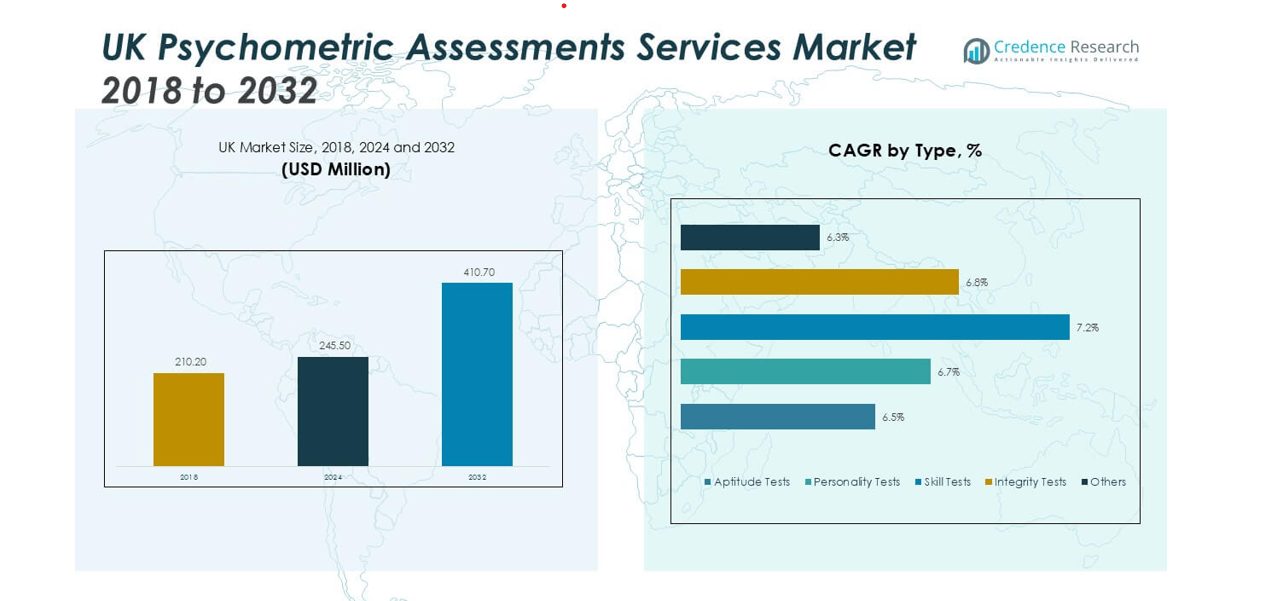
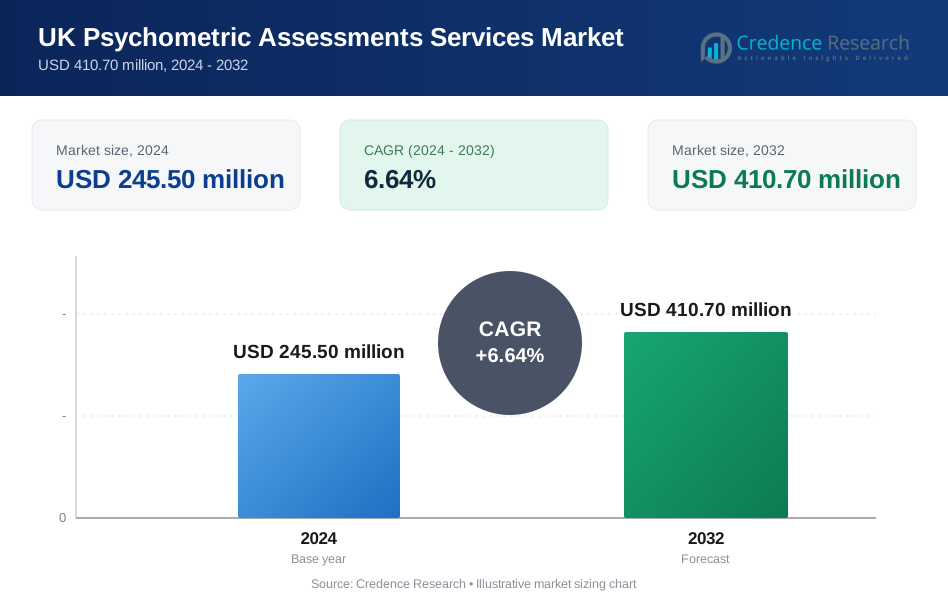
The UK Psychometric Assessments Services market size was valued at USD 210.20 million in 2018 and increased to USD 245.50 million in 2024. It is anticipated to reach USD 410.70 million by 2032, growing at a CAGR of 6.64% during the forecast period.
| REPORT ATTRIBUTE | DETAILS |
|---|---|
| Historical Period | 2020-2023 |
| Base Year | 2024 |
| Forecast Period | 2025-2032 |
| UK Psychometric Assessments Services Market Size 2024 | USD 245.50 million |
| UK Psychometric Assessments Services Market, CAGR | 6.64% |
| UK Psychometric Assessments Services Market Size 2032 | USD 410.70 million |
The UK psychometric assessments services market is led by major players such as SHL, Hogan Assessments, Aon Assessment Solutions, Talent Q (Korn Ferry), and Thomas International. These companies dominate through advanced digital testing platforms, validated psychometric tools, and AI-powered analytics that enhance recruitment and talent development. SHL holds the top position, driven by its extensive corporate partnerships and wide test portfolio. Aon and Hogan focus on leadership and behavioral assessments, while Thomas International emphasizes customizable business solutions. Regionally, England leads the market with a 67% share, supported by strong corporate adoption, followed by Scotland at 15%, Wales at 11%, and Northern Ireland at 7%.
Market Insights
- The UK psychometric assessments services market was valued at USD 245.50 million in 2024 and is projected to reach USD 410.70 million by 2032, growing at a CAGR of 6.64%.
- Market growth is driven by rising adoption of data-driven recruitment and AI-integrated assessment tools that enhance hiring accuracy and employee performance.
- Key trends include digital transformation, remote testing platforms, and increasing demand for mobile-friendly, adaptive psychometric solutions across corporate and educational sectors.
- The competitive landscape is dominated by SHL, Hogan Assessments, Aon Assessment Solutions, Talent Q (Korn Ferry), and Thomas International, with growing participation from SMEs offering niche solutions.
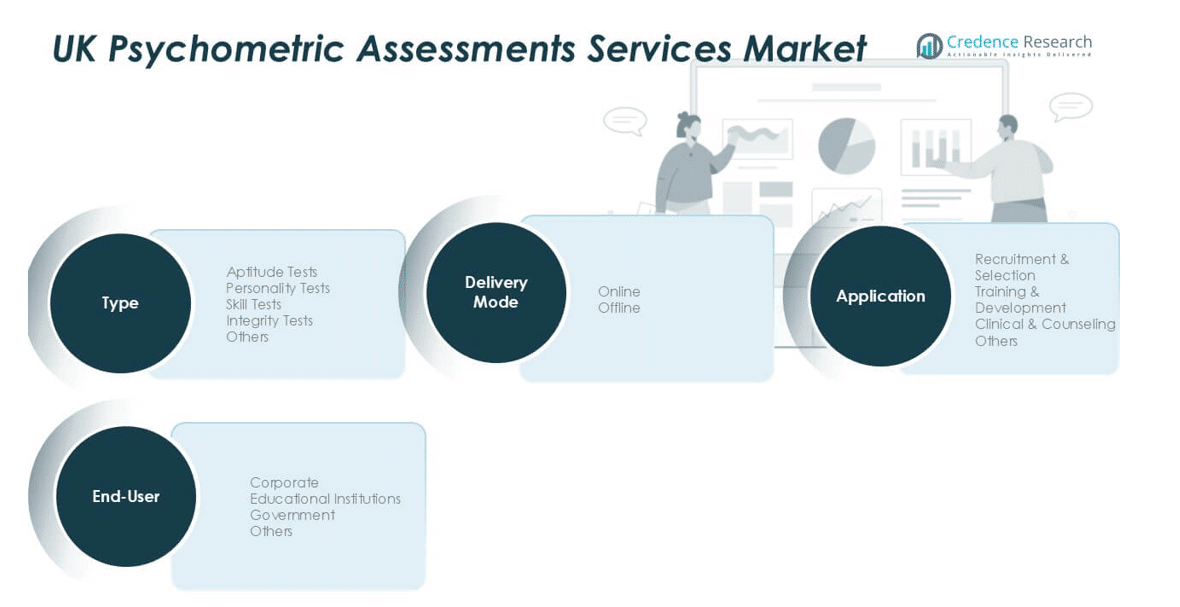
- Regionally, England holds 67% of the market, followed by Scotland with 15%, Wales with 11%, and Northern Ireland with 7%. Aptitude tests lead the type segment with 38% share, while recruitment and selection applications account for 46%, supported by strong corporate sector adoption at 52%.
Market Segmentation Analysis:
By Type
Aptitude tests dominated the UK psychometric assessments services market in 2024 with a 38% share. Their leadership stems from widespread adoption in corporate hiring to evaluate logical reasoning, problem-solving, and numerical skills. These tests provide standardized and objective insights into candidates’ cognitive abilities, helping employers improve talent selection accuracy. Growing digital integration and AI-based adaptive testing further enhance efficiency and scalability. Personality and skill tests also show steady growth, driven by demand for culture-fit analysis and role-based competency evaluations across diverse professional settings.
- For instance, in 2024, Saville Assessment integrated its Swift Analysis Aptitude tool into automated HR systems for faster candidate screening at UK enterprises. The company, founded by Professor Peter Saville, is a well-established provider of psychometric assessments for recruitment and development.
By Application
Recruitment and selection accounted for the largest 46% share of the UK market in 2024. Companies increasingly rely on psychometric tools to streamline hiring, reduce bias, and predict job performance. The growing need for data-driven human resource practices supports this dominance. Training and development applications are expanding rapidly, aided by personalized learning assessments and performance improvement initiatives. Clinical and counselling applications contribute moderately, focusing on behavioral profiling and mental health diagnostics in therapeutic settings. The integration of digital assessment platforms strengthens adoption across all applications.
- For instance, Thomas International's Personal Profile Analysis (PPA) tool is widely used by organizations to support their recruitment and hiring decisions. The company claims that its assessments have helped thousands of businesses to improve their hiring process and create better-fitting teams.
By End-User
The corporate sector led the market with a 52% share in 2024, driven by widespread psychometric use in recruitment, leadership evaluation, and workforce development. Businesses prioritize talent optimization, using these assessments to identify potential leaders and enhance employee retention. Educational institutions follow as key adopters, integrating aptitude and personality assessments into admission and career guidance systems. Government agencies are also embracing psychometric tools to standardize recruitment and competency evaluation. The corporate segment’s dominance reflects rising HR digitalization and a strong focus on evidence-based hiring practices.
Key Growth Drivers
Rising Adoption of Data-Driven Recruitment
Organizations across the UK are increasingly adopting data-driven recruitment strategies, fueling demand for psychometric assessment services. Companies use these tools to objectively evaluate cognitive skills, personality traits, and emotional intelligence during hiring. This approach minimizes human bias, enhances predictive hiring accuracy, and reduces turnover rates. As HR departments focus on measurable talent metrics, psychometric assessments have become integral to applicant screening and role alignment. The growing digitalization of recruitment processes, supported by AI-driven analytics and cloud-based testing platforms, further strengthens this trend. Employers now prioritize evidence-based decision-making, transforming psychometric testing from a supplementary to a core recruitment component.
- For instance, SHL processes candidate assessments for UK enterprises, using AI-based analytics to improve hiring prediction accuracy for its clients.
Expansion of Corporate Learning and Development Programs
The rapid expansion of corporate learning and development (L&D) initiatives significantly drives market growth. UK companies are investing heavily in employee assessment tools to improve workforce productivity, leadership identification, and team dynamics. Psychometric tests provide valuable insights into employees’ strengths, weaknesses, and behavioral tendencies, enabling tailored training modules. This alignment enhances skill development and overall organizational efficiency. The growing emphasis on reskilling and continuous learning, particularly amid hybrid and remote work environments, has boosted adoption rates. Moreover, L&D platforms now integrate psychometric analytics to personalize learning paths and monitor progress effectively. As businesses focus on retaining top talent and fostering agile workforces, psychometric assessments remain vital tools for capability enhancement.
- For instance, in 2024, Thomas International, a UK-based talent assessment platform provider, continued to deliver various employee development assessments to corporations. The company integrates behavioral analytics—based on the DISC model—to help organizations personalize training and support professional development. As of June 2024, Thomas International helps over 11,000 companies across 140 countries improve recruitment and development decisions.
Increasing Use in Educational and Clinical Applications
Psychometric assessments are gaining traction beyond corporate use, especially in educational and clinical sectors. Schools and universities employ aptitude and personality tests to guide career planning and identify learning styles. These tools help educators understand students’ cognitive patterns and behavioral responses, improving academic outcomes. In clinical settings, psychologists use psychometric evaluations for diagnosing mental health conditions, behavioral issues, and cognitive impairments. Rising awareness of mental health and emotional well-being in the UK supports this expansion. Digital platforms now offer secure, standardized testing environments, enhancing accessibility and precision. The convergence of technology with academic and psychological assessment needs is broadening the market’s overall scope and adoption base.
Key Trends & Opportunities
Integration of AI and Predictive Analytics
The integration of artificial intelligence and predictive analytics is reshaping psychometric assessment services in the UK. AI enhances test design, scoring accuracy, and behavioral interpretation by identifying hidden patterns in candidate responses. Predictive models use large datasets to forecast performance, retention likelihood, and cultural fit. This technology allows HR teams to make informed hiring and promotion decisions based on reliable behavioral insights. Vendors are introducing adaptive testing platforms that adjust question difficulty in real time, improving engagement and validity. The opportunity lies in expanding AI-driven assessments across industries such as finance, healthcare, and education, where data-centric decision-making is becoming essential.
- For example, Arctic Shores’s task-based assessment compiles over 12 000 data points per candidate and showed a 91 % completion rate among users.
Growth of Remote and Mobile-Based Assessment Platforms
The shift toward remote work has accelerated demand for online and mobile-enabled psychometric testing platforms. Cloud-based solutions offer flexibility, scalability, and secure data management, making them preferred among enterprises and educational institutions. Mobile-friendly tests enable candidates to complete assessments anytime, improving participation rates and user experience. Organizations benefit from centralized data access and instant reporting, streamlining recruitment and development cycles. Vendors are also integrating gamified assessments to enhance engagement while maintaining scientific validity. As hybrid work models persist, the opportunity for remote-friendly psychometric platforms will continue to expand, promoting inclusivity and accessibility across diverse user groups in the UK market.
Key Challenges
Concerns Over Test Validity and Cultural Bias
One major challenge facing the UK psychometric assessment market is ensuring test validity and eliminating cultural bias. Poorly designed assessments can yield inaccurate results, misrepresenting candidates’ abilities or favoring specific demographic groups. Such biases can undermine hiring fairness and corporate diversity initiatives. Organizations increasingly demand scientifically validated and norm-referenced tools that ensure reliability across varied populations. Vendors must invest in psychometric research, continuous validation, and localization to meet these expectations. Ensuring ethical test use, transparent scoring, and compliance with the British Psychological Society’s standards remains essential for maintaining trust and credibility among employers, educators, and professionals.
Data Privacy and Compliance Risks
Data privacy concerns represent another major obstacle for market participants. Psychometric assessments collect sensitive personal and behavioral information, requiring strict compliance with the UK’s GDPR regulations. Breaches or misuse of assessment data can lead to reputational damage and legal penalties. As digital testing platforms grow, ensuring secure data storage, encryption, and transparent consent mechanisms becomes critical. Many organizations hesitate to adopt third-party assessment tools due to privacy risks. Service providers must emphasize robust cybersecurity frameworks and transparent data governance policies to build client confidence. Addressing privacy challenges effectively is vital for sustaining long-term market growth and credibility.
Regional Analysis
England
England dominated the UK psychometric assessments services market in 2024 with a 67% share. The region leads due to the strong presence of multinational corporations, recruitment consultancies, and HR technology firms. Widespread adoption of psychometric testing in corporate hiring, leadership evaluation, and employee development drives growth. Major cities like London and Manchester host key service providers offering AI-integrated assessment platforms. Expanding use across financial services, healthcare, and education sectors further strengthens market expansion. Government initiatives promoting fair recruitment and workplace diversity also enhance demand for validated and standardized assessment solutions.
Scotland
Scotland accounted for a 15% share of the UK psychometric assessments services market in 2024. The region benefits from growing adoption in the education and public sectors, particularly in career guidance and competency evaluation. Universities and colleges increasingly use aptitude and personality tests for student admissions and learning development. Corporate adoption is also rising, supported by digital recruitment transformation across technology and energy industries. Psychologists and HR specialists in cities like Edinburgh and Glasgow are integrating data analytics and remote testing solutions. Continuous investment in workforce skill development further supports steady market growth in Scotland.
Wales
Wales held an 11% share of the UK psychometric assessments services market in 2024. The region’s growth is driven by increasing demand from small and medium enterprises focusing on efficient talent acquisition. The education sector also plays a key role, with institutions adopting psychometric tools for student assessment and career readiness programs. Public sector organizations are implementing standardized testing frameworks for recruitment transparency. Growing digital adoption and government-backed employment initiatives support market expansion. Local HR consultancies are partnering with tech vendors to offer affordable, online-based assessments tailored to Welsh workforce development needs.
Northern Ireland
Northern Ireland captured a 7% share of the UK psychometric assessments services market in 2024. The region’s demand is expanding in both private and public sectors, driven by a focus on merit-based recruitment and skill assessment. Educational institutions increasingly use psychometric tests for academic profiling and student counseling. Belfast has emerged as a growing hub for HR service innovation, with companies introducing digital and mobile-based assessment solutions. Efforts to align workforce capabilities with evolving job market demands are supporting steady adoption. The region’s emphasis on equality and inclusive hiring continues to encourage psychometric service deployment.
Market Segmentations:
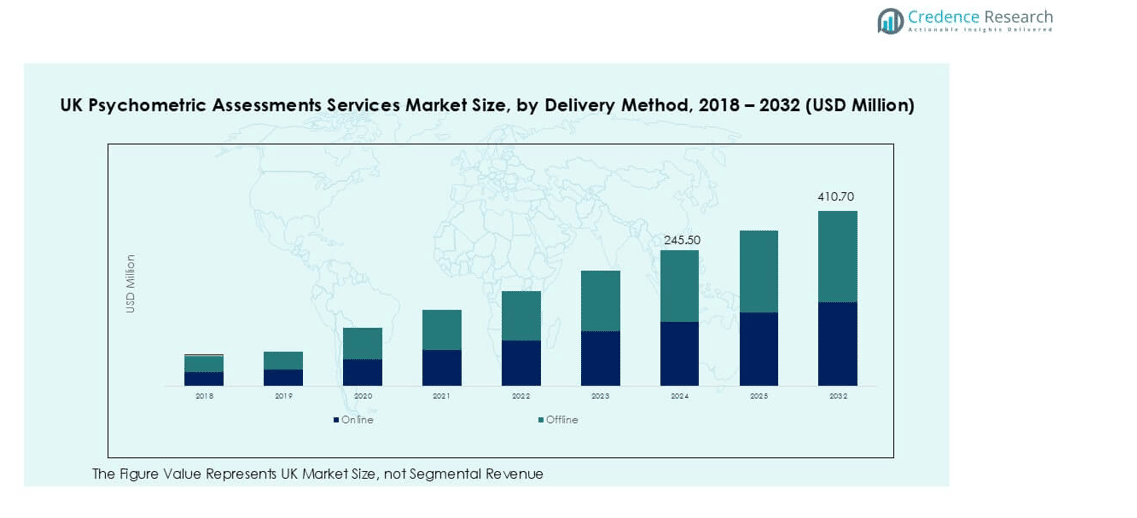
By Type
- Aptitude Tests
- Personality Tests
- Skill Tests
- Integrity Tests
- Others
By Application
- Recruitment & Selection
- Training & Development
- Clinical & Counselling
- Others
By End-User
- Corporate
- Educational Institutions
- Government
- Others
By Delivery Mode
- Online
- Offline
By Geography
- England
- Scotland
- Wales
- Northern Ireland
Competitive Landscape
The UK psychometric assessments services market is moderately consolidated, with key players including SHL, Hogan Assessments, Aon Assessment Solutions, Talent Q (Korn Ferry), and Thomas International. These companies maintain strong market positions through extensive product portfolios, validated testing frameworks, and advanced digital delivery platforms. SHL leads the market with broad adoption across corporate, educational, and government sectors, leveraging AI-driven analytics for candidate profiling. Aon and Hogan focus on behavioral and leadership assessments, enhancing predictive accuracy. Emerging firms such as Psychological Consultancy Ltd. and Quest Partnership Ltd. strengthen competition through customized solutions for SMEs. Continuous innovation, partnerships with HR tech platforms, and expansion into mobile-based and AI-integrated assessments define the competitive landscape. Vendors increasingly prioritize compliance, test validity, and user experience to retain client trust and expand their presence across diverse end-user segments in the UK.
Key Player Analysis
- SHL
- Hogan Assessments
- Aon Assessment Solutions
- Talent Q (Korn Ferry)
- Thomas International
- Psychological Consultancy Ltd. (PCL)
- Quest Partnership Ltd
- Insight HRC
- Omnicor
- Impact Consulting
Recent Developments
- In October 2025, SHL introduced a new Personality and Ability Assessment Training Program in Czechia, focusing on professional development for HR teams to increase self-sufficiency in test interpretation and talent evaluation. This initiative forms part of SHL’s updated global training calendar for advanced psychometric assessment methodologies.
- In April 2025, TalentSmartEQ launched its 2025 State of EQ Report, analyzing data from over 37,000 Emotional Intelligence Appraisal participants. The report highlighted a shift toward people-first leadership and the growing use of emotional intelligence training to support employee well-being and adaptability in dynamic workplaces.
- In 2025, Hogan Assessments focused on leveraging AI for deeper behavioral insights in its predictive personality assessments, as presented at the IPAC 2025 conference. This aligns with Hogan's emphasis on ethical AI and enhanced cross-cultural validity, a priority highlighted in their April 2025 Top Trends in Personality Assessment report. Hogan was also a platinum sponsor of the IPAC conference, which was held from July 27–30 in Atlanta.
- In March 2023, Talent Select AI, a Milwaukee-based company, announced the official launch of its ground-breaking, self-titled psychometric assessment tool.
Report Coverage
The research report offers an in-depth analysis based on Type, Application, End-User, Delivery Mode and Geography. It details leading market players, providing an overview of their business, product offerings, investments, revenue streams, and key applications. Additionally, the report includes insights into the competitive environment, SWOT analysis, current market trends, as well as the primary drivers and constraints. Furthermore, it discusses various factors that have driven market expansion in recent years. The report also explores market dynamics, regulatory scenarios, and technological advancements that are shaping the industry. It assesses the impact of external factors and global economic changes on market growth. Lastly, it provides strategic recommendations for new entrants and established companies to navigate the complexities of the market.
Future Outlook
- Demand for AI-driven and adaptive psychometric tools will continue to grow across industries.
- Corporate sectors will expand usage for leadership assessment, employee engagement, and retention strategies.
- Educational institutions will increasingly adopt psychometric testing for career guidance and student profiling.
- Integration with HR analytics and cloud-based recruitment platforms will enhance operational efficiency.
- Mobile-based and gamified assessments will gain traction for better candidate experience.
- Data privacy and compliance with UK GDPR will remain central to vendor strategies.
- SMEs will adopt affordable digital testing solutions to improve hiring accuracy.
- Expansion of clinical and counseling applications will support market diversification.
- Regional growth will be led by England, with strong contributions from Scotland and Wales.
- Continuous innovation and validation of assessment tools will strengthen market competitiveness and credibility.
Request a Free Sample
Fill in your details and we'll send you a free sample report.
- Sample data tables & charts
- Research methodology
Need a Custom Version of This Report?
Tailor the scope, geography, or segments to your exact requirements.
- Custom geography or segment scope
- Direct access to our analyst team
Frequently Asked Questions
What is the current market size for the UK Psychometric Assessments Services market, and what is its projected size in 2032?
At what Compound Annual Growth Rate is the UK Psychometric Assessments Services market projected to grow between 2025 and 2032?
Which UK Psychometric Assessments Services market segment held the largest share in 2024?
What are the primary factors fueling the growth of the UK Psychometric Assessments Services market?
Who are the leading companies in the UK Psychometric Assessments Services market?
Table of Content
Chapter 1. Report Introduction
- 1.1 Report Description & Purpose
- 1.1.1 Report Title & Market Definition
- 1.1.2 Unique Selling Propositions (USP) & Key Differentiators
- 1.1.3 Value Proposition for Stakeholders
- 1.2 Research Objectives
- 1.2.1 Market Sizing Objectives (Volume & Revenue)
- 1.2.2 Segmentation Objectives
- 1.2.3 Competitive Intelligence Objectives
- 1.2.4 Forecast & Scenario Objectives
- 1.3 Report Scope
- 1.3.1 UK Psychometric Assessments Services Scope – Types & Subtypes Covered
- 1.3.2 Geographic Scope – Regions & Countries Covered
- 1.3.3 Historical Period, Base Year & Forecast Period (2024; forecast to 2032)
- 1.3.4 Inclusions & Exclusions
- 1.4 HS Code & Classification Framework
- 1.5 Currency, Units & Pricing Basis
- 1.6 Target Stakeholders
- 1.7 Limitations & Assumptions
Chapter 2. Executive Summary
- 2.1 Global UK Psychometric Assessments Services Market Snapshot
- 2.1.1 Market Size – Historical (2024) & Forecast (2024-2032) (2024: USD 245.50 million → 2032: USD 410.70 million)
- 2.1.2 Volume & Revenue – Global Totals
- 2.1.3 Key Market Highlights – Top Five Facts
- 2.2 UK Psychometric Assessments Services Market Segmentation Snapshot
- 2.2.1 Market Split by Region – 2024 vs. 2032
- 2.3 Competitive Snapshot
- 2.3.1 Top 10 Players by Revenue Share – 2024
- 2.3.2 Top 10 Players by Volume Share – 2024
- 2.3.3 Recent Strategic Developments (18-Month Summary)
- 2.4 Key Investment Highlights & Strategic Conclusions
Chapter 3. UK Psychometric Assessments Services Market Dynamics & Industry Analysis
- 3.1 Market Overview & Context
- 3.1.1 UK Psychometric Assessments Services Market Position in the Broader Automotive Value Chain
- 3.1.2 OEM vs. Replacement Market Dynamics
- 3.1.3 Market Maturity & Development Stage by Region
- 3.2 UK Psychometric Assessments Services Market Drivers
- 3.3 UK Psychometric Assessments Services Market Restraints & Challenges
- 3.4 UK Psychometric Assessments Services Market Opportunities
- 3.5 Porter's Five Forces Analysis
- 3.5.1 Threat of New Entrants
- 3.5.2 Bargaining Power of Suppliers
- 3.5.3 Bargaining Power of Buyers
- 3.5.4 Threat of Substitutes
- 3.5.5 Competitive Rivalry – Intensity Assessment
- 3.6 UK Psychometric Assessments Services Value Chain Analysis
- 3.6.1 Upstream – Raw Material/Input Suppliers
- 3.6.1.1 Raw Material/Input 1
- 3.6.1.2 Raw Material/Input 2
- 3.6.1.3 Raw Material/Input 3
- 3.6.2 Midstream – Production/Manufacturing/Service Delivery
- 3.6.2.1 Production/Process Overview
- 3.6.2.2 Key Facility Locations & Capacity by Manufacturer
- 3.6.3 Downstream – Distribution & End Consumer
- 3.6.3.1 Primary Channel – B2B/OEM
- 3.6.3.2 Secondary Channels – Dealer, Retail, Online, Direct
- 3.6.4 Value Chain Profitability Analysis
- 3.6.1 Upstream – Raw Material/Input Suppliers
- 3.7 PESTEL Analysis
- 3.7.1 Political Factors
- 3.7.2 Economic Factors
- 3.7.3 Social Factors
- 3.7.4 Technological Factors
- 3.7.5 Environmental Factors
- 3.7.6 Legal Factors
- 3.8 UK Psychometric Assessments Services Supply Chain Analysis
- 3.8.1 Raw Material/Input Supply Risk Assessment
- 3.8.2 Manufacturing Concentration Risk (Geographic Exposure)
- 3.8.3 Trade Disruption Impact Analysis
- 3.9 Regulatory & Policy Landscape
Note: The regulatory and policy landscape section covers regulations based on their applicability to the market, UK Psychometric Assessments Services category, geography, and scope of the study. Only regulatory frameworks with a material impact on operations, compliance, trade, sustainability, or market access are analyzed in detail.
Chapter 4. Key Investment Pockets & Opportunity Analysis
- 4.1 UK Psychometric Assessments Services Market Attractiveness Analysis
- 4.1.1 By Region – Investment Attractiveness Matrix (Volume × CAGR)
- 4.2 Absolute Revenue Growth Opportunity
- 4.2.1 By Region – Absolute USD Growth Through 2032
- 4.3 Incremental Volume Opportunity
- 4.3.1 By Region – Incremental Volume Through 2032
- 4.3.2 Segment – Incremental Volume
- 4.4 Emerging Submarket Opportunity Deep Dive (Subject to Applicability)
- 4.5 Emerging Market Opportunity Scorecards
- 4.5.1 United States
- 4.5.2 Europe
- 4.5.3 Asia
- 4.5.4 Middle East & Africa
Note: Emerging Market Opportunity Scorecards will be included based on relevance and strategic importance. Regions listed are indicative and may vary depending on data availability and market dynamics.
Chapter 5. UK Psychometric Assessments Services Import-Export Analysis & Trade Flows
- 5.1 Global Trade Overview
- 5.1.1 Global Export Value by Country (2024)
- 5.1.2 Global Export Volume by Country (2024)
- 5.1.3 Global Import Value by Country (2024)
- 5.1.4 Global Import Volume by Country (2024)
- 5.1.5 Net Trade Balance by Country (2024)
- 5.2 Export Analysis – Segment
- 5.2.1 Type 1 (HS Code)
- 5.2.2 Type 2 (HS Code)
- 5.2.3 Type 3 (HS Code)
- 5.2.4 Type 4 (HS Code)
- 5.2.5 Type 5 (HS Code)
- 5.3 Import Analysis – Segment
- 5.3.1 Type 1 (HS Code)
- 5.3.2 Type 2 (HS Code)
- 5.3.3 Type 3 (HS Code)
- 5.3.4 Type 4 (HS Code)
- 5.3.5 Type 5 (HS Code)
- 5.4 Average Unit Trade Prices
- 5.4.1 Average Export Price – Segment & Country
- 5.4.2 Average Import Price – Segment & Source Country
- 5.4.3 Price Trends (2024)
- 5.5 Key Trade Route Analysis
- 5.5.1 Trade Route 1
- 5.5.2 Trade Route 2
- 5.5.3 Trade Route 3
- 5.5.4 Trade Route 4
- 5.5.5 Trade Route 5
- 5.6 Trade Policy Impact Assessment
- 5.6.1 US Anti-Dumping & Section 301 Tariffs
- 5.6.2 EU Customs Union Impact
- 5.6.3 Major Free Trade Agreements
- 5.6.4 USMCA Rules of Origin
Note: Trade policy analysis will be included only where relevant to the UK Psychometric Assessments Services market.
Chapter 6. Competitive Landscape & Company Benchmarking
- 6.1 UK Psychometric Assessments Services Market Concentration & Structure
- 6.1.1 Herfindahl-Hirschman Index (HHI) – vs. 2024
- 6.1.2 Tier 1, Tier 2 & Tier 3 Market Structure
- 6.1.3 Global, Regional & Local Player Dynamics
- 6.2 UK Psychometric Assessments Services Market Share Analysis – 2024
- 6.2.1 Global Revenue Share by Company
- 6.2.2 Global Volume Share by Company
- 6.2.3 Regional Revenue Share
- 6.2.4 Market Share Evolution ( vs. 2024)
- 6.2.5 OEM Segment Share by Company
- 6.2.6 Replacement Segment Share by Company
- 6.3 Production/Delivery Capacity & Facility Analysis
- 6.3.1 Global Installed Capacity
- 6.3.2 Capacity Utilization Rates
- 6.3.3 Production/Output Volume
- 6.3.4 Facility Locations & Capacity Map
- 6.3.5 Planned Capacity Additions
- 6.4 UK Psychometric Assessments Services Competitive Benchmarking Matrix
- 6.4.1 Revenue, Volume, CAGR & Profitability Comparison
- 6.4.2 Channel Revenue Mix
- 6.4.3 Geographic Revenue Exposure
- 6.4.4 R&D Intensity
- 6.4.5 Sustainability Maturity
- 6.5 Strategic Developments in UK Psychometric Assessments Services (Last 24 Months)
- 6.5.1 Mergers, Acquisitions & Divestments
- 6.5.2 New UK Psychometric Assessments Services Launches
- 6.5.3 Facility Expansions
- 6.5.4 Strategic Alliances, Joint Ventures & Partnerships
- 6.5.5 Distribution Expansion & Market Entry
- 6.5.6 Sustainability & ESG Initiatives
- 6.6 Competitive Strategy Mapping
- 6.6.1 Leader, Challenger, Follower & Niche Classification
- 6.6.2 Pricing Strategy Comparison
- 6.6.3 Channel Strategy Matrix
Note: Strategic developments are included based on their materiality and the availability of reliable information.
Chapter 7. Global UK Psychometric Assessments Services Market – By Distribution Channel
- 7.1 Segment Overview
- 7.1.1 Volume & Revenue Split by Channel (2024 & 2032)
- 7.1.2 Channel Mix Evolution (2024-2032)
Chapter 8. Regional Market Analysis – Global Overview
- 8.1 Global Regional Overview
- 8.1.1 Regional Volume Share
- 8.1.2 Regional Revenue Share
- 8.1.3 Regional Volume by Region
- 8.1.4 Regional Revenue by Region
- 8.1.5 Regional Forecast Through 2032
- 8.2 Cross-Regional Segment Analysis
- 8.2.1 By Distribution Channel
- 8.2.2 By Brand/Price Tier
Chapter 9. North America UK Psychometric Assessments Services Market
- 9.1 United States
- 9.2 Canada
- 9.3 Mexico
Chapter 10. Europe UK Psychometric Assessments Services Market
- 10.1 Germany
- 10.2 France
- 10.3 Italy
- 10.4 United Kingdom
- 10.5 Spain
- 10.6 Poland
- 10.7 Russia
- 10.8 Netherlands
- 10.9 Belgium
- 10.10 Sweden
- 10.11 Denmark
- 10.12 Norway
- 10.13 Rest of Europe
Chapter 11. Asia Pacific UK Psychometric Assessments Services Market
- 11.1 China
- 11.2 India
- 11.3 Japan
- 11.4 South Korea
- 11.5 Thailand
- 11.6 Indonesia
- 11.7 Vietnam
- 11.8 Malaysia
- 11.9 Australia
- 11.10 Rest of Asia Pacific
Chapter 12. Latin America UK Psychometric Assessments Services Market
- 12.1 Brazil
- 12.2 Argentina
- 12.3 Colombia
- 12.4 Chile
- 12.5 Rest of Latin America
Chapter 13. Middle East UK Psychometric Assessments Services Market
- 13.1 Saudi Arabia
- 13.2 United Arab Emirates
- 13.3 Turkey
- 13.4 Israel
- 13.5 Iran
- 13.6 Rest of the Middle East
Chapter 14. Africa UK Psychometric Assessments Services Market
- 14.1 South Africa
- 14.2 Egypt
- 14.3 Nigeria
- 14.4 Morocco
- 14.5 Rest of Africa
Chapter 15. UK Psychometric Assessments Services Company Profiles
- 15.1 [Company 01]
- 15.1.1 Company Overview
- 15.1.2 Key Management Personnel
- 15.1.3 Products & Services Portfolio
- 15.1.4 Financial Performance
- 15.1.5 Key Market Focus & Geographic Presence
- 15.1.6 Recent Developments & Strategic Initiatives
Note: The company profile list is preliminary and may change based on research findings, market developments, data availability, and client requirements.
Chapter 16. Appendices
- Appendix A – List of Abbreviations & Acronyms
- Appendix B – Industry Classification Code Reference – Full Series
- Appendix C – Production & Capacity Data Tables
- Appendix D – End-Use & Demand Base Tables
- Appendix E – Consumption & Replacement Rate Assumptions
- Appendix F – ASP Reference Tables
- Appendix G – Manufacturing & Facility Database
- Appendix H – Import-Export Data Tables
- Appendix I – Regulatory Summary Tables
- Appendix J – Primary Research Participant List (Anonymized)
- Appendix K – Primary Research Questionnaire Framework
- Appendix L – Data Sources & Bibliography
- Appendix M – Market Size Divergence & Source Comparison
Chapter 17. Research Methodology
- 17.1 Research Framework & Philosophy
- 17.2 Secondary Research – Sources, Hierarchy & Data Extraction
- 17.3 Data Modeling – Bottom-Up & Top-Down Market Sizing
- 17.4 Primary Research – Stakeholder Framework, LOI & Sample Sizes
- 17.5 Forecast Methodology – Regression, Scenario & Sensitivity Analysis
- 17.6 Quality Control – Four-Layer Validation Framework
- 17.7 Limitations & Standard Assumptions
- 17.8 Disclaimer
