
Market Overview:
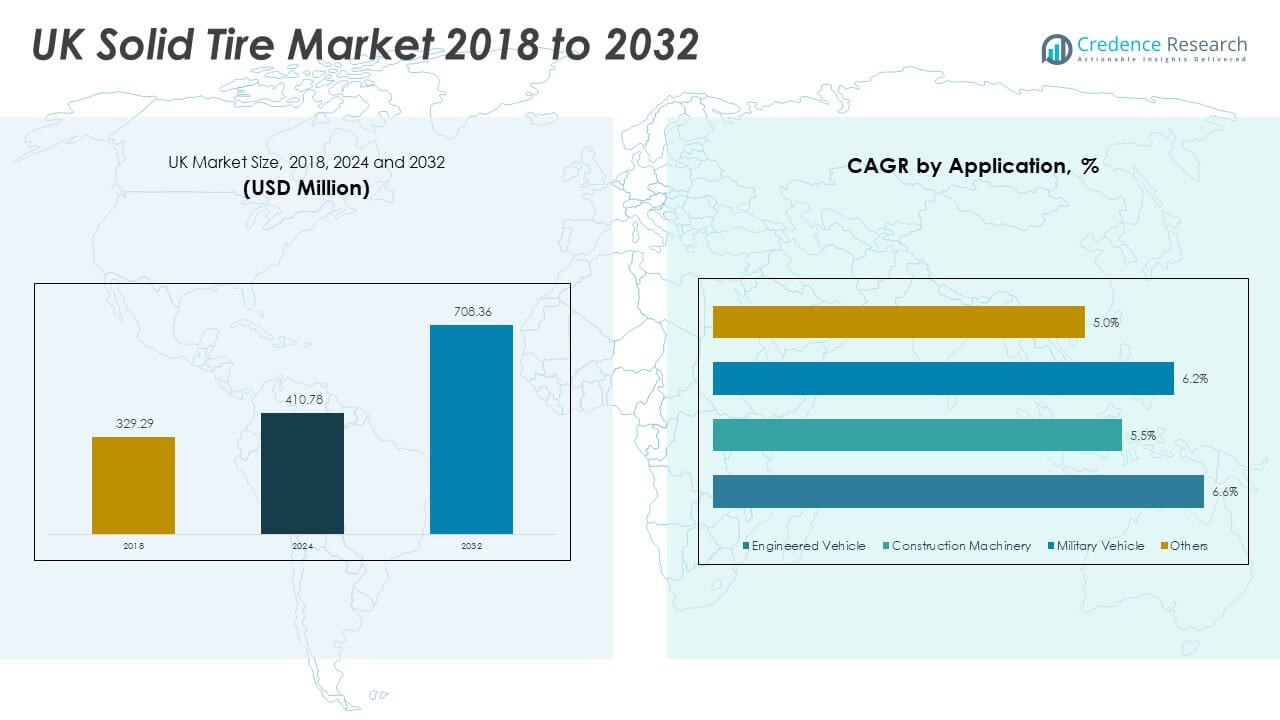
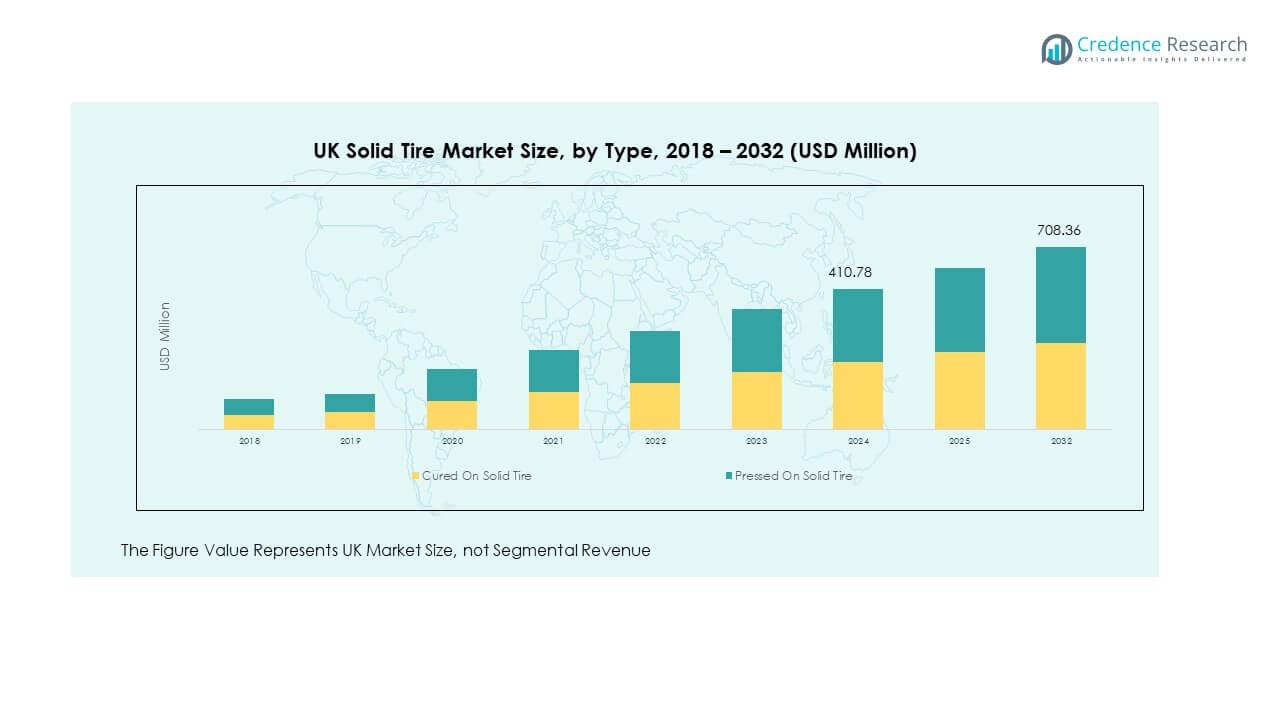
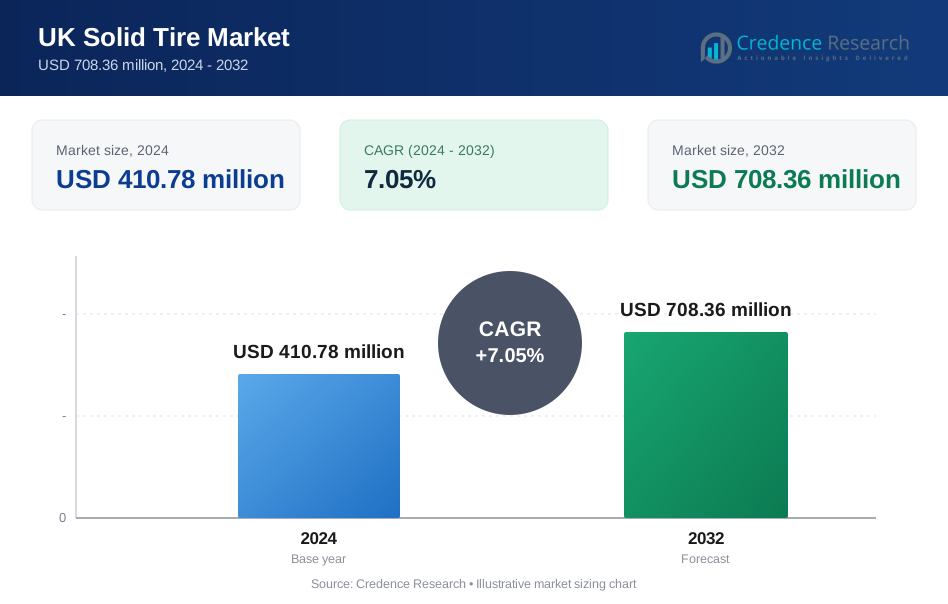
The UK Solid Tire Market size was valued at USD 329.29 million in 2018 to USD 410.78 million in 2024 and is anticipated to reach USD 708.36 million by 2032, at a CAGR of 7.05% during the forecast period.
| REPORT ATTRIBUTE | DETAILS |
|---|---|
| Historical Period | 2020-2023 |
| Base Year | 2024 |
| Forecast Period | 2025-2032 |
| UK Solid Tire Market Size 2024 | USD 410.78 Million |
| UK Solid Tire Market, CAGR | 7.05% |
| UK Solid Tire Market Size 2032 | USD 708.36 Million |
Market expansion is driven by the rise in warehouse automation, growth in construction activities, and the increasing adoption of material-handling equipment. Strong demand for resilient and puncture-proof tires in forklifts, port equipment, and military vehicles continues to push growth. The market also benefits from the steady rise of e-commerce and logistics sectors in the UK, which require dependable equipment for seamless operations.
Geographically, the UK market is highly developed, with strong adoption across industrial hubs such as the Midlands and Southeast England. These areas drive demand due to concentration of manufacturing and warehousing facilities. Emerging opportunities are observed in northern regions, where infrastructure development and logistics modernization are gaining momentum. The strong presence of global tire manufacturers in the UK further strengthens its market growth prospects.
Market Insights:
- The UK Solid Tire Market was valued at USD 329.29 million in 2018, USD 410.78 million in 2024, and is projected to reach USD 708.36 million by 2032, registering a CAGR of 7.05% during 2024–2032.
- Europe holds the largest share at 38%, driven by strong construction and logistics infrastructure, followed by North America at 29% due to robust warehousing demand, and Asia Pacific at 22% with rising industrialization and manufacturing.
- Asia Pacific is the fastest-growing region with 22% share, fueled by rapid urbanization, expanding e-commerce, and large-scale infrastructure projects in China and India.
- Cured-on solid tires accounted for nearly 57% of the UK market in 2024, favored for their durability in heavy-duty applications.
- Pressed-on solid tires held about 43% share in 2024, driven by forklifts and warehousing applications where easy replacement and compact use are critical.
Market Drivers:
Rising Demand for Durable and Low-Maintenance Tires:
The UK Solid Tire Market benefits from demand for tires that deliver durability and low maintenance. Industries such as construction and warehousing depend on tires that can handle heavy-duty usage without frequent replacement. Solid tires, known for puncture resistance, offer cost-effectiveness by reducing downtime. Growth in the e-commerce industry boosts material-handling equipment usage, further fueling tire demand. With companies aiming for operational efficiency, the adoption of long-lasting solid tires becomes essential. It supports overall productivity by minimizing disruptions in industrial workflows.
- For instance, the increased adoption of electric forklifts fitted with solid rubber tires significantly reduces maintenance and downtime in industrial logistics environments. Toyota Material Handling's deployment of Automated Guided Vehicles (AGVs) often uses similar puncture-proof tires, eliminating common tire-related interruptions.
Expansion of Construction and Infrastructure Projects:
Infrastructure growth in the UK is fueling higher adoption of solid tires in construction machinery. Heavy-duty vehicles such as loaders, cranes, and compact construction equipment rely on solid tires for better stability and performance on uneven terrain. Government investments in housing, transport networks, and renewable energy projects contribute to consistent demand. The resilience of these tires makes them suitable for long-term projects. Their reliability ensures safe operation under challenging site conditions. The construction sector’s ongoing expansion positions solid tires as an indispensable component in UK projects.
- For example, Trelleborg’s Brawler HPS Soft Ride solid tire provides 40% greater deflection compared to standard solid tires, improving operator comfort and tire life on waste management and recycling sites, which are part of the broader infrastructural network.
Growth in Warehousing and Logistics Sector:
The warehousing and logistics sector plays a pivotal role in driving tire demand. Rapid growth of e-commerce has increased the use of forklifts, yard chassis, and tow tractors in distribution centers. Solid tires are preferred due to their ability to endure continuous operation without frequent replacements. The UK’s shift toward automation in warehouses further increases reliance on these tires. Companies are adopting advanced handling systems where durability and uptime are critical. The logistics sector’s rapid modernization continues to ensure strong market prospects for solid tires.
Rising Adoption in Military and Specialized Vehicles:
The UK Solid Tire Market also sees traction in military and defense vehicles that require enhanced reliability. Solid tires offer safety in combat zones by resisting punctures from debris or sharp objects. They are also deployed in specialized vehicles used in mining and ports. The government’s focus on strengthening defense infrastructure supports steady demand. Military modernization programs encourage wider usage of solid tires in specialized fleets. Their safety features, low maintenance, and ruggedness align with the operational demands of these industries.
Market Trends:
Increasing Focus on Sustainable Tire Manufacturing:
Manufacturers in the UK Solid Tire Market are moving toward sustainable practices. Eco-friendly production methods, including recycled rubber and energy-efficient processes, are gaining traction. With rising environmental concerns, the demand for green products is rising. Companies are promoting sustainable tire innovations to align with government regulations. This trend supports brand reputation while appealing to eco-conscious buyers. Growing awareness of carbon footprints in the logistics sector enhances adoption of such solutions. It reflects a broader global trend in sustainable industrial goods.
- For instance, Nokian Tyres is pioneering in this field, constructing the world’s first net-zero carbon tire factory in Romania, powered by 100% CO2-free energy sources and holding the ISCC PLUS certification for sustainable raw materials use.
Advancements in Tire Technology and Design:
Technological innovation is reshaping the market. Manufacturers are introducing solid tires with improved tread patterns and advanced rubber compounds. These designs enhance grip, stability, and heat resistance. With digitalization, tire monitoring solutions are being integrated for predictive maintenance. Advanced tire compounds also reduce rolling resistance, improving energy efficiency in handling equipment. Enhanced designs ensure longer product lifespans and improved comfort for operators. Such technological advances are expanding adoption across industries that prioritize efficiency and safety.
- For instance, Swedish-based NIRA Dynamics developed the Tread Wear Indicator (TWI), which offers continuous real-time tread depth tracking and predictive analytics to reduce unplanned downtime by alerting fleet managers before maintenance is necessary. This digital integration improves safety, reduces costs, and extends tire life in logistics and industrial vehicle fleets, supporting efficiency and safety priorities across the markets it serves.
Customization for Industry-Specific Applications:
The UK Solid Tire Market is witnessing rising customization trends. Companies are developing specialized solid tires tailored for industries like ports, mining, and defense. This approach ensures performance optimization under specific operating conditions. For example, ports demand heavy-duty tires capable of handling extreme loads, while warehouses prefer smooth rolling for quiet operations. Customization helps manufacturers capture niche segments with precise solutions. It also increases customer loyalty and positions suppliers as key partners in industry-specific applications.
Growing Popularity of OEM Collaborations:
Collaboration between tire manufacturers and original equipment manufacturers (OEMs) is expanding. OEMs integrate solid tires into new forklifts, tractors, and other vehicles. Partnerships ensure compatibility and performance optimization, increasing adoption among end-users. These collaborations also help tire companies secure long-term contracts and steady revenue. Growing emphasis on ready-to-use solutions strengthens this trend. Such partnerships are particularly strong in the logistics and construction industries. The strategy enhances overall customer confidence in product quality and reliability.
Market Challenges Analysis:
High Upfront Costs and Replacement Limitations:
The UK Solid Tire Market faces challenges due to the higher upfront cost of solid tires compared to pneumatic alternatives. Many small-scale businesses prefer cheaper solutions despite long-term benefits of solid tires. Another concern is their limited replacement flexibility since solid tires require specialized fitting equipment. This makes tire replacement more complex and costlier, reducing attractiveness for budget-sensitive buyers. These factors may restrain adoption among smaller logistics firms and contractors, slowing overall market penetration.
Competition from Pneumatic and Advanced Alternatives:
Solid tires also face strong competition from pneumatic and hybrid tires that offer flexibility and comfort. Pneumatic tires remain widely used in sectors prioritizing operator comfort and speed. New airless tire technologies are emerging, further intensifying competition. While solid tires excel in durability, their ride comfort and adaptability remain concerns. Industries seeking versatile performance sometimes favor alternatives. Addressing these competitive pressures requires manufacturers to invest in innovation, balancing durability with enhanced operator experience.
Market Opportunities:
Rising Demand for Automation and E-Commerce Support:
Automation in warehouses and e-commerce expansion creates new opportunities for solid tires. Forklifts and automated guided vehicles require durable tires to ensure uninterrupted operation. Companies expanding fulfillment centers across the UK increase reliance on solid tire technology. Demand is expected to rise further with ongoing digitalization of logistics. This creates space for suppliers to introduce advanced designs supporting automation. The trend represents a strong opportunity for manufacturers to establish dominance in logistics-focused applications.
Expansion into Niche Applications and Export Markets:
The UK Solid Tire Market holds opportunities in niche sectors such as defense, ports, and mining. Export potential also grows, with manufacturers supplying neighboring European markets. Companies focusing on specialized applications can secure premium contracts. Innovation in tire design supports entry into high-demand industries. Leveraging the UK’s industrial base enables companies to build strong export strategies. Niche opportunities remain critical to long-term expansion. Tire manufacturers aligning with these markets can achieve sustainable revenue streams.
Market Segmentation Analysis:
Type
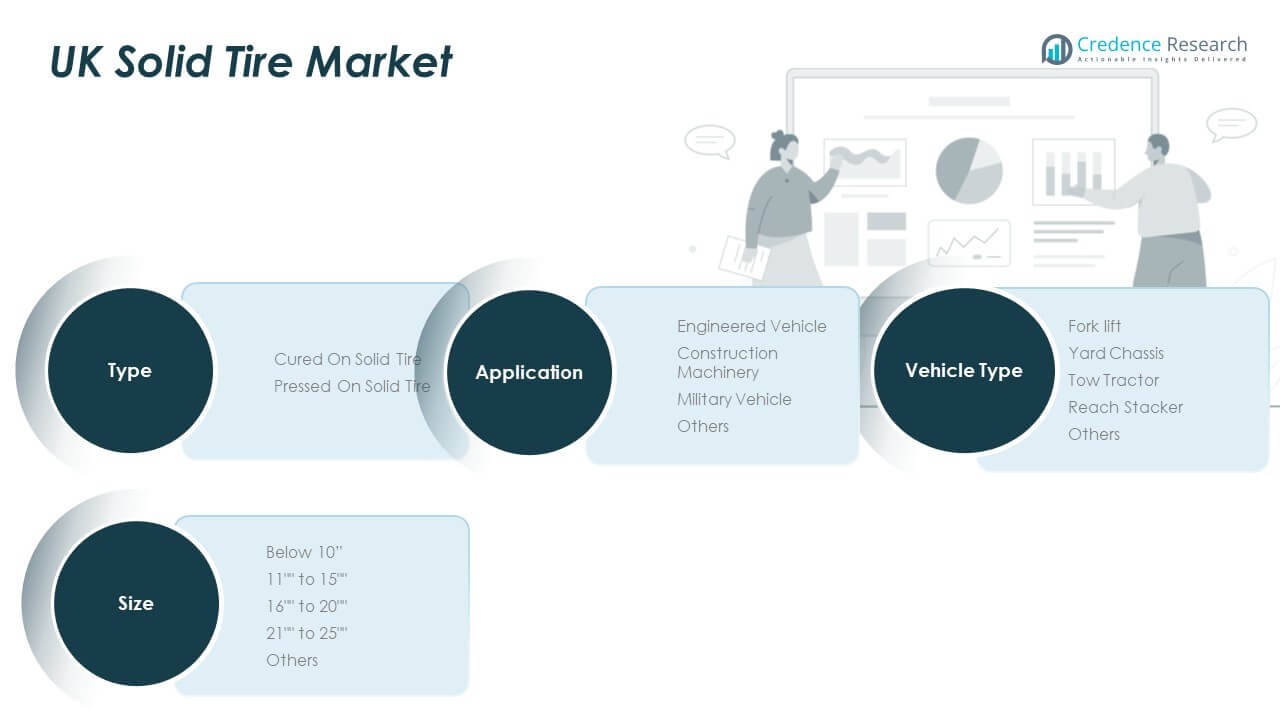
The UK Solid Tire Market is classified into cured-on and pressed-on solid tires. Cured-on tires hold a larger share due to their extended durability and ability to perform in high-intensity industrial environments. They are widely used in heavy construction machinery and port equipment, where safety and reliability are critical. Pressed-on tires, however, dominate warehouse and logistics applications. Their compact design and ease of replacement make them popular for forklifts and yard chassis. Manufacturers are enhancing both types with improved rubber compounds and tread patterns to maximize service life.
- For instance, Pressed-on tires dominate in warehouse applications where their compact design facilitates quick installation and replacement, supported by manufacturers continuously improving tread compounds and designs to maximize efficiency in high-turnover logistics environments.
Application
Applications include engineered vehicles, construction machinery, military vehicles, and others. Construction machinery leads the segment because of strong demand from infrastructure and building projects across the UK. Engineered vehicles, such as specialized port and mining equipment, also generate significant demand. Military vehicles rely on solid tires for their durability and puncture resistance in rough conditions. The "others" category covers smaller industrial and municipal vehicles. Growing diversity in applications highlights the adaptability of solid tires across both heavy-duty and niche sectors.
Size
The market is segmented by size into below 10”, 11–15”, 16–20”, 21–25”, and others. Tires in the 11–20” range dominate demand, primarily used in forklifts and loaders that operate intensively in warehouses and industrial facilities. Larger sizes, such as 21–25”, are applied in heavy-duty construction and mining equipment. Smaller sizes below 10” are used in compact industrial machinery, carts, and specialized handling equipment. Demand across different size ranges reflects the versatility of solid tires in meeting varied operational requirements.
Vehicle Type
Vehicle types include forklifts, yard chassis, tow tractors, reach stackers, and others. Forklifts account for the largest share, supported by rapid warehouse automation and rising e-commerce logistics activities. Yard chassis and tow tractors follow, particularly in ports and logistics yards where continuous operation is vital. Reach stackers are prominent in shipping and container handling, requiring highly durable solid tires. The "others" segment includes industrial tractors and municipal service vehicles. Broad usage across these categories ensures consistent demand across both urban and industrial landscapes.
Segmentation:
By Type- Cured On Solid Tire
- Pressed On Solid Tire
- Engineered Vehicle
- Construction Machinery
- Military Vehicle
- Others
- Below 10”
- 11”–15”
- 16”–20”
- 21”–25”
- Others
- Forklift
- Yard Chassis
- Tow Tractor
- Reach Stacker
- Others
Regional Analysis:
England – 65% Share
England holds the dominant 65% share of the UK Solid Tire Market, driven by its strong logistics, warehousing, and e-commerce sectors. The Midlands and Southeast act as industrial hubs, with high forklift and material-handling equipment usage. London’s continuous construction projects also strengthen demand for solid tires in heavy-duty machinery. The presence of global tire manufacturers such as Michelin and Continental further enhances accessibility and adoption. England’s industrial diversity and advanced infrastructure ensure it remains the largest contributor to market growth.
Scotland – 20% Share
Scotland accounts for around 20% of the UK Solid Tire Market, with demand supported by energy, infrastructure, and construction projects. Aberdeen’s oil and gas industry contributes significantly, requiring durable solid tires for specialized vehicles. Construction activities in cities such as Glasgow and Edinburgh also add to regional adoption. Logistics modernization is progressing, though at a smaller scale compared to England. Scotland’s strategic role in energy and heavy industries positions it as a consistent contributor to overall market demand.
Wales and Northern Ireland – 15% Combined Share
Wales and Northern Ireland together represent about 15% of the UK Solid Tire Market. Wales benefits from industrial estates and construction activity requiring forklifts and compact equipment. Northern Ireland shows strong adoption through port operations and logistics services, especially around Belfast. Infrastructure projects in both regions continue to support growth in construction machinery applications. Though smaller in share, both markets are witnessing steady modernization. Their combined role strengthens balanced nationwide demand, ensuring the overall resilience of the UK solid tire industry.
Key Player Analysis:
- CAMSO (Michelin)
- Continental AG
- Trelleborg AB
- Maxam Tire Europe Ltd. (UK)
- Global Rubber Industries (GRI)
- TY Cushion Tire
- Tube & Solid Tire
- Yantai Balsanse Rubber Co., Ltd.
- Superior Tire & Rubber Corp.
Competitive Analysis:
The UK Solid Tire Market is moderately concentrated, with several global and regional players competing for share. Companies like CAMSO, Continental AG, and Trelleborg AB maintain strong presence through extensive product portfolios and innovation. Local players such as Maxam Tire Europe Ltd. strengthen competition by catering to domestic demand. Partnerships with OEMs help leading firms secure stable contracts. Smaller manufacturers focus on niche markets such as defense and mining to stay competitive. Intense price competition and innovation in design remain key differentiators.
Recent Developments:
- CEAT acquired Michelin's Camso brand off-highway tires in September 2025, enhancing its product portfolio and manufacturing capabilities. This integration provides CEAT with access to a global customer base and two manufacturing plants in Sri Lanka, strengthening its position in high-margin off-highway tire segments.
- In the first half of 2025, Continental AG reported strong tire sales performance with a 3.7% increase in revenue to $3.69 billion in the U.S. and Europe. The company emphasized improving profitability with an EBIT margin rising to 13.4%. Continental continues investing in sustainable materials, aiming to raise the share of renewable and recycled materials in tire production by several percentage points in 2025, advancing product innovation and environmental goals.
- Trelleborg AB showcased advanced tire technologies at the ScotPlant Show in Scotland in mid-2024, introducing the Brawler Soft Ride compound designed for construction and recycling applications. This tire technology offers enhanced cut resistance, improved stability, reduced vibration, and better fuel efficiency, responding to the rigorous demands of UK construction sites.
Report Coverage:
The research report offers an in-depth analysis based on type, application, size, and vehicle type. It details leading market players, providing an overview of their business, product offerings, investments, revenue streams, and key applications. Additionally, the report includes insights into the competitive environment, SWOT analysis, current market trends, as well as the primary drivers and constraints. Furthermore, it discusses various factors that have driven market expansion in recent years. The report also explores market dynamics, regulatory scenarios, and technological advancements that are shaping the industry. It assesses the impact of external factors and global economic changes on market growth. Lastly, it provides strategic recommendations for new entrants and established companies to navigate the complexities of the market.
Future Outlook:
- Rising demand from logistics and e-commerce sectors.
- Expansion of construction projects across the UK.
- Growing automation in warehousing operations.
- Increased focus on sustainability in tire production.
- Wider adoption in defense and specialized vehicles.
- Stronger collaboration between OEMs and tire manufacturers.
- Customization for industry-specific needs driving growth.
- Export potential across Europe and Asia.
- Rising competition from hybrid and pneumatic alternatives.
- Continued innovation in design and durability.
Request a Free Sample
Fill in your details and we'll send you a free sample report.
- Sample data tables & charts
- Research methodology
Need a Custom Version of This Report?
Tailor the scope, geography, or segments to your exact requirements.
- Custom geography or segment scope
- Direct access to our analyst team
Frequently Asked Questions
What is the current market size for UK Solid Tire Market, and what is its projected size in 2032?
At what Compound Annual Growth Rate is the UK Solid Tire Market projected to grow between 2024 and 2032?
Which UK Solid Tire Market segment held the largest share in 2024?
What are the primary factors fueling the growth of the UK Solid Tire Market?
Who are the leading companies in the UK Solid Tire Market?
Which region commanded the largest share of the UK Solid Tire Market in 2024?
Table of Content
Chapter 1. Report Introduction
- 1.1 Report Description & Purpose
- 1.1.1 Report Title & Market Definition
- 1.1.2 Unique Selling Propositions (USP) & Key Differentiators
- 1.1.3 Value Proposition for Stakeholders
- 1.2 Research Objectives
- 1.2.1 Market Sizing Objectives (Volume & Revenue)
- 1.2.2 Segmentation Objectives
- 1.2.3 Competitive Intelligence Objectives
- 1.2.4 Forecast & Scenario Objectives
- 1.3 Report Scope
- 1.3.1 UK Solid Tire Scope – Types & Subtypes Covered
- 1.3.2 Geographic Scope – Regions & Countries Covered
- 1.3.3 Historical Period, Base Year & Forecast Period (2024; forecast to 2032)
- 1.3.4 Inclusions & Exclusions
- 1.4 HS Code & Classification Framework
- 1.5 Currency, Units & Pricing Basis
- 1.6 Target Stakeholders
- 1.7 Limitations & Assumptions
Chapter 2. Executive Summary
- 2.1 Global UK Solid Tire Market Snapshot
- 2.1.1 Market Size – Historical (2024) & Forecast (2024-2032) (2024: USD 410.78 million → 2032: USD 708.36 million)
- 2.1.2 Volume & Revenue – Global Totals
- 2.1.3 Key Market Highlights – Top Five Facts
- 2.2 UK Solid Tire Market Segmentation Snapshot
- 2.2.1 Market Split by Region – 2024 vs. 2032
- 2.3 Competitive Snapshot
- 2.3.1 Top 10 Players by Revenue Share – 2024
- 2.3.2 Top 10 Players by Volume Share – 2024
- 2.3.3 Recent Strategic Developments (18-Month Summary)
- 2.4 Key Investment Highlights & Strategic Conclusions
Chapter 3. UK Solid Tire Market Dynamics & Industry Analysis
- 3.1 Market Overview & Context
- 3.1.1 UK Solid Tire Market Position in the Broader Automotive Value Chain
- 3.1.2 OEM vs. Replacement Market Dynamics
- 3.1.3 Market Maturity & Development Stage by Region
- 3.2 UK Solid Tire Market Drivers
- 3.3 UK Solid Tire Market Restraints & Challenges
- 3.4 UK Solid Tire Market Opportunities
- 3.5 Porter's Five Forces Analysis
- 3.5.1 Threat of New Entrants
- 3.5.2 Bargaining Power of Suppliers
- 3.5.3 Bargaining Power of Buyers
- 3.5.4 Threat of Substitutes
- 3.5.5 Competitive Rivalry – Intensity Assessment
- 3.6 UK Solid Tire Value Chain Analysis
- 3.6.1 Upstream – Raw Material/Input Suppliers
- 3.6.1.1 Raw Material/Input 1
- 3.6.1.2 Raw Material/Input 2
- 3.6.1.3 Raw Material/Input 3
- 3.6.2 Midstream – Production/Manufacturing/Service Delivery
- 3.6.2.1 Production/Process Overview
- 3.6.2.2 Key Facility Locations & Capacity by Manufacturer
- 3.6.3 Downstream – Distribution & End Consumer
- 3.6.3.1 Primary Channel – B2B/OEM
- 3.6.3.2 Secondary Channels – Dealer, Retail, Online, Direct
- 3.6.4 Value Chain Profitability Analysis
- 3.6.1 Upstream – Raw Material/Input Suppliers
- 3.7 PESTEL Analysis
- 3.7.1 Political Factors
- 3.7.2 Economic Factors
- 3.7.3 Social Factors
- 3.7.4 Technological Factors
- 3.7.5 Environmental Factors
- 3.7.6 Legal Factors
- 3.8 UK Solid Tire Supply Chain Analysis
- 3.8.1 Raw Material/Input Supply Risk Assessment
- 3.8.2 Manufacturing Concentration Risk (Geographic Exposure)
- 3.8.3 Trade Disruption Impact Analysis
- 3.9 Regulatory & Policy Landscape
Note: The regulatory and policy landscape section covers regulations based on their applicability to the market, UK Solid Tire category, geography, and scope of the study. Only regulatory frameworks with a material impact on operations, compliance, trade, sustainability, or market access are analyzed in detail.
Chapter 4. Key Investment Pockets & Opportunity Analysis
- 4.1 UK Solid Tire Market Attractiveness Analysis
- 4.1.1 By Region – Investment Attractiveness Matrix (Volume × CAGR)
- 4.2 Absolute Revenue Growth Opportunity
- 4.2.1 By Region – Absolute USD Growth Through 2032
- 4.3 Incremental Volume Opportunity
- 4.3.1 By Region – Incremental Volume Through 2032
- 4.3.2 Segment – Incremental Volume
- 4.4 Emerging Submarket Opportunity Deep Dive (Subject to Applicability)
- 4.5 Emerging Market Opportunity Scorecards
- 4.5.1 United States
- 4.5.2 Europe
- 4.5.3 Asia
- 4.5.4 Middle East & Africa
Note: Emerging Market Opportunity Scorecards will be included based on relevance and strategic importance. Regions listed are indicative and may vary depending on data availability and market dynamics.
Chapter 5. UK Solid Tire Import-Export Analysis & Trade Flows
- 5.1 Global Trade Overview
- 5.1.1 Global Export Value by Country (2024)
- 5.1.2 Global Export Volume by Country (2024)
- 5.1.3 Global Import Value by Country (2024)
- 5.1.4 Global Import Volume by Country (2024)
- 5.1.5 Net Trade Balance by Country (2024)
- 5.2 Export Analysis – Segment
- 5.2.1 Type 1 (HS Code)
- 5.2.2 Type 2 (HS Code)
- 5.2.3 Type 3 (HS Code)
- 5.2.4 Type 4 (HS Code)
- 5.2.5 Type 5 (HS Code)
- 5.3 Import Analysis – Segment
- 5.3.1 Type 1 (HS Code)
- 5.3.2 Type 2 (HS Code)
- 5.3.3 Type 3 (HS Code)
- 5.3.4 Type 4 (HS Code)
- 5.3.5 Type 5 (HS Code)
- 5.4 Average Unit Trade Prices
- 5.4.1 Average Export Price – Segment & Country
- 5.4.2 Average Import Price – Segment & Source Country
- 5.4.3 Price Trends (2024)
- 5.5 Key Trade Route Analysis
- 5.5.1 Trade Route 1
- 5.5.2 Trade Route 2
- 5.5.3 Trade Route 3
- 5.5.4 Trade Route 4
- 5.5.5 Trade Route 5
- 5.6 Trade Policy Impact Assessment
- 5.6.1 US Anti-Dumping & Section 301 Tariffs
- 5.6.2 EU Customs Union Impact
- 5.6.3 Major Free Trade Agreements
- 5.6.4 USMCA Rules of Origin
Note: Trade policy analysis will be included only where relevant to the UK Solid Tire market.
Chapter 6. Competitive Landscape & Company Benchmarking
- 6.1 UK Solid Tire Market Concentration & Structure
- 6.1.1 Herfindahl-Hirschman Index (HHI) – vs. 2024
- 6.1.2 Tier 1, Tier 2 & Tier 3 Market Structure
- 6.1.3 Global, Regional & Local Player Dynamics
- 6.2 UK Solid Tire Market Share Analysis – 2024
- 6.2.1 Global Revenue Share by Company
- 6.2.2 Global Volume Share by Company
- 6.2.3 Regional Revenue Share
- 6.2.4 Market Share Evolution ( vs. 2024)
- 6.2.5 OEM Segment Share by Company
- 6.2.6 Replacement Segment Share by Company
- 6.3 Production/Delivery Capacity & Facility Analysis
- 6.3.1 Global Installed Capacity
- 6.3.2 Capacity Utilization Rates
- 6.3.3 Production/Output Volume
- 6.3.4 Facility Locations & Capacity Map
- 6.3.5 Planned Capacity Additions
- 6.4 UK Solid Tire Competitive Benchmarking Matrix
- 6.4.1 Revenue, Volume, CAGR & Profitability Comparison
- 6.4.2 Channel Revenue Mix
- 6.4.3 Geographic Revenue Exposure
- 6.4.4 R&D Intensity
- 6.4.5 Sustainability Maturity
- 6.5 Strategic Developments in UK Solid Tire (Last 24 Months)
- 6.5.1 Mergers, Acquisitions & Divestments
- 6.5.2 New UK Solid Tire Launches
- 6.5.3 Facility Expansions
- 6.5.4 Strategic Alliances, Joint Ventures & Partnerships
- 6.5.5 Distribution Expansion & Market Entry
- 6.5.6 Sustainability & ESG Initiatives
- 6.6 Competitive Strategy Mapping
- 6.6.1 Leader, Challenger, Follower & Niche Classification
- 6.6.2 Pricing Strategy Comparison
- 6.6.3 Channel Strategy Matrix
Note: Strategic developments are included based on their materiality and the availability of reliable information.
Chapter 7. Global UK Solid Tire Market – By Distribution Channel
- 7.1 Segment Overview
- 7.1.1 Volume & Revenue Split by Channel (2024 & 2032)
- 7.1.2 Channel Mix Evolution (2024-2032)
Chapter 8. Regional Market Analysis – Global Overview
- 8.1 Global Regional Overview
- 8.1.1 Regional Volume Share
- 8.1.2 Regional Revenue Share
- 8.1.3 Regional Volume by Region
- 8.1.4 Regional Revenue by Region
- 8.1.5 Regional Forecast Through 2032
- 8.2 Cross-Regional Segment Analysis
- 8.2.1 By Distribution Channel
- 8.2.2 By Brand/Price Tier
Chapter 9. North America UK Solid Tire Market
- 9.1 United States
- 9.2 Canada
- 9.3 Mexico
Chapter 10. Europe UK Solid Tire Market
- 10.1 Germany
- 10.2 France
- 10.3 Italy
- 10.4 United Kingdom
- 10.5 Spain
- 10.6 Poland
- 10.7 Russia
- 10.8 Netherlands
- 10.9 Belgium
- 10.10 Sweden
- 10.11 Denmark
- 10.12 Norway
- 10.13 Rest of Europe
Chapter 11. Asia Pacific UK Solid Tire Market
- 11.1 China
- 11.2 India
- 11.3 Japan
- 11.4 South Korea
- 11.5 Thailand
- 11.6 Indonesia
- 11.7 Vietnam
- 11.8 Malaysia
- 11.9 Australia
- 11.10 Rest of Asia Pacific
Chapter 12. Latin America UK Solid Tire Market
- 12.1 Brazil
- 12.2 Argentina
- 12.3 Colombia
- 12.4 Chile
- 12.5 Rest of Latin America
Chapter 13. Middle East UK Solid Tire Market
- 13.1 Saudi Arabia
- 13.2 United Arab Emirates
- 13.3 Turkey
- 13.4 Israel
- 13.5 Iran
- 13.6 Rest of the Middle East
Chapter 14. Africa UK Solid Tire Market
- 14.1 South Africa
- 14.2 Egypt
- 14.3 Nigeria
- 14.4 Morocco
- 14.5 Rest of Africa
Chapter 15. UK Solid Tire Company Profiles
- 15.1 [Company 01]
- 15.1.1 Company Overview
- 15.1.2 Key Management Personnel
- 15.1.3 Products & Services Portfolio
- 15.1.4 Financial Performance
- 15.1.5 Key Market Focus & Geographic Presence
- 15.1.6 Recent Developments & Strategic Initiatives
Note: The company profile list is preliminary and may change based on research findings, market developments, data availability, and client requirements.
Chapter 16. Appendices
- Appendix A – List of Abbreviations & Acronyms
- Appendix B – Industry Classification Code Reference – Full Series
- Appendix C – Production & Capacity Data Tables
- Appendix D – End-Use & Demand Base Tables
- Appendix E – Consumption & Replacement Rate Assumptions
- Appendix F – ASP Reference Tables
- Appendix G – Manufacturing & Facility Database
- Appendix H – Import-Export Data Tables
- Appendix I – Regulatory Summary Tables
- Appendix J – Primary Research Participant List (Anonymized)
- Appendix K – Primary Research Questionnaire Framework
- Appendix L – Data Sources & Bibliography
- Appendix M – Market Size Divergence & Source Comparison
Chapter 17. Research Methodology
- 17.1 Research Framework & Philosophy
- 17.2 Secondary Research – Sources, Hierarchy & Data Extraction
- 17.3 Data Modeling – Bottom-Up & Top-Down Market Sizing
- 17.4 Primary Research – Stakeholder Framework, LOI & Sample Sizes
- 17.5 Forecast Methodology – Regression, Scenario & Sensitivity Analysis
- 17.6 Quality Control – Four-Layer Validation Framework
- 17.7 Limitations & Standard Assumptions
- 17.8 Disclaimer
