
Market Overview:
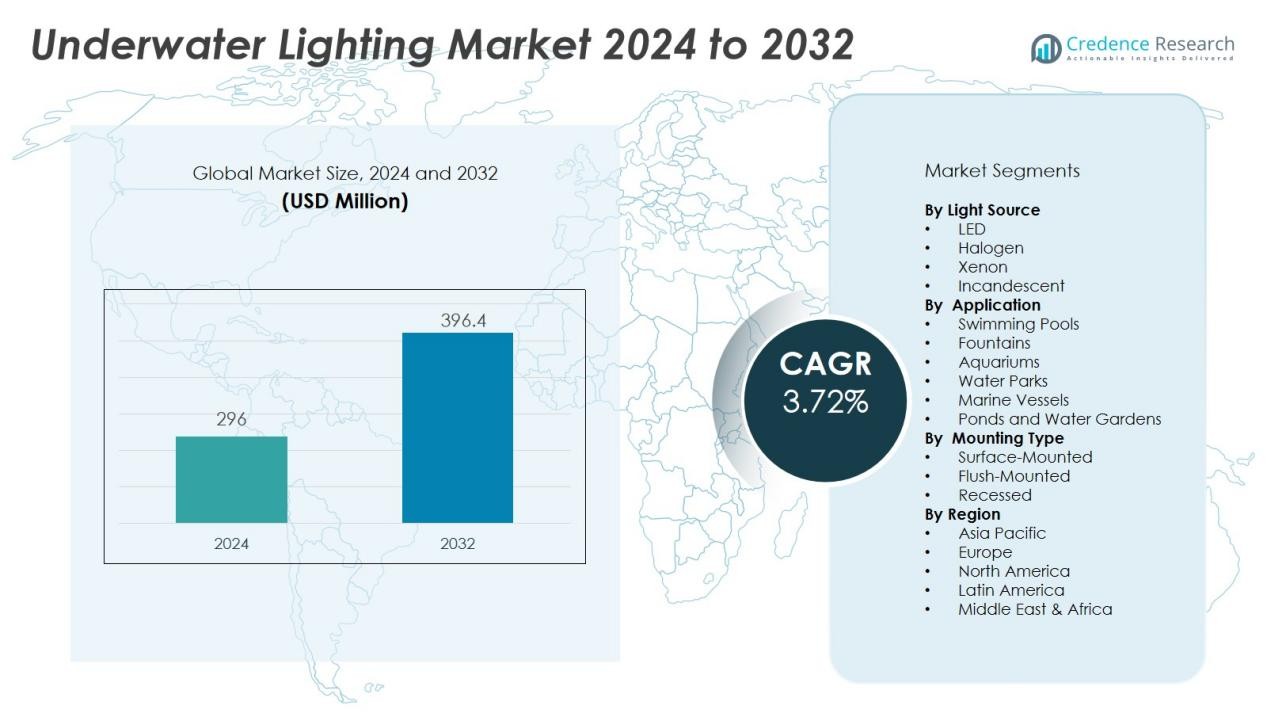
The Underwater lighting market size was valued at USD 296 million in 2024 and is anticipated to reach USD 396.4 million by 2032, at a CAGR of 3.72 % during the forecast period (2024-2032).
| REPORT ATTRIBUTE | DETAILS |
|---|---|
| Historical Period | 2020-2024 |
| Base Year | 2024 |
| Forecast Period | 2025-2032 |
| Underwater lighting market Size 2024 | USD 296 Million |
| Underwater lighting market, CAGR | 3.72 % |
| Underwater lighting market Size 2032 | USD 396.4 Million |
Key market drivers include the growing popularity of underwater lighting for aesthetic and safety purposes in swimming pools, fountains, aquariums, and architectural installations. The expansion of marine tourism, yachting, and offshore oil and gas activities further boosts product demand. Stringent safety regulations, advancements in waterproofing technology, and the rising trend of smart lighting systems also support market growth by improving product reliability and user convenience.
Regionally, North America leads the underwater lighting market, supported by robust marine infrastructure and a high concentration of luxury residential and commercial developments. Europe follows closely, fueled by increased investments in public amenities and recreational facilities. The Asia-Pacific region exhibits the fastest growth, driven by rapid urbanization, expanding hospitality sectors, and coastal development projects in countries such as China, India, and Australia.
Market Insights:
- The underwater lighting market reached USD 296 million in 2024 and is projected to grow to USD 396.4 million by 2032.
- Key demand drivers include growing use in swimming pools, fountains, aquariums, and marine installations for aesthetics and safety.
- The rise in marine tourism, yachting, and offshore activities accelerates the adoption of high-quality underwater lighting systems.
- Advanced LED technology and integration of smart controls increase product reliability, customization, and user convenience.
- Strict safety regulations and a focus on high-grade materials promote market growth and reinforce consumer trust.
- Technical complexities, high installation costs, and compliance requirements pose challenges for both new entrants and existing players.
- North America leads with a 34% market share, followed by Europe at 29% and Asia-Pacific at 27%, reflecting strong regional growth and innovation.
Market Drivers:
Rising Demand for Enhanced Aesthetics and Ambience in Pools and Fountains:
The underwater lighting market benefits from growing consumer preference for visually appealing pools, fountains, and water features. Property owners and developers invest in advanced lighting solutions to create vibrant, customizable environments in residential, commercial, and hospitality settings. LED technology offers a spectrum of color options and dynamic effects, making it easier to enhance ambiance and attract visitors. The trend towards luxury amenities in hotels, resorts, and private homes directly drives market adoption. It positions underwater lighting as a key component in delivering premium experiences.
Expansion of Marine Tourism and Recreational Boating Activities:
The surge in marine tourism and leisure boating activities supports robust demand for underwater lighting market solutions. Yachts, cruise ships, and recreational vessels require high-quality lighting to improve safety and visibility, especially during night navigation or underwater exploration. Operators choose energy-efficient LED fixtures for durability in harsh marine conditions. It creates new opportunities for manufacturers to supply specialized products that meet performance and safety standards. The expansion of charter services and waterfront attractions further accelerates market penetration.
- For instance, Lumishore’s SMX series underwater LED lights offer up to 7,000 fixture lumens with a wide 90° beam, enabling greater underwater visibility for boats of all sizes and enhancing both safety and ambiance at seanhanced safety and visibility at sea.
Technological Advancements and Smart Lighting Integration:
Continuous advancements in waterproofing materials, corrosion resistance, and energy efficiency propel the underwater lighting market forward. The integration of smart lighting controls, wireless connectivity, and remote management features attracts tech-savvy consumers and facility operators. These innovations allow users to customize light settings, schedules, and effects with greater flexibility and precision. It drives the adoption of intelligent underwater lighting systems across residential and commercial applications. The shift toward automation and sustainability encourages further investment in R&D.
- For instance, Lumitec’s Javelin 600X underwater light delivers over 6,000 lumens of RGBW spectrum output and supports full remote color control through the Poco Digital Lighting Control app, with Poco system compatibility for precise color scene creation.
Strict Safety Regulations and Emphasis on Quality Standards:
The underwater lighting market responds to rigorous safety standards and certification requirements imposed by regulatory authorities. Product reliability and user safety are prioritized, prompting manufacturers to use high-grade materials and advanced sealing techniques. Compliance with international standards ensures compatibility with a broad range of applications, from public swimming pools to offshore platforms. It strengthens consumer confidence and minimizes operational risks. The ongoing focus on quality assurance continues to influence product development and purchasing decisions.
Market Trends:
Adoption of Advanced LED Technology and Customization Features:
The underwater lighting market is witnessing a pronounced shift towards energy-efficient LED solutions that offer superior performance and design flexibility. Manufacturers focus on delivering compact, long-lasting products that operate reliably in submerged environments. Customization features such as RGB color-changing capabilities, programmable lighting sequences, and app-based controls are gaining popularity in both residential and commercial installations. The ability to adjust color temperature and brightness in real time enhances user experience and allows property owners to create distinct visual effects. Demand for maintenance-free and low-heat emission lighting options continues to increase, encouraging R&D investment in next-generation materials and optics. It positions advanced LED technology as the preferred choice across diverse end-user segments.
- For instance, Lumishore’s TRX802 retrofit underwater LED light delivers full-spectrum RGBW color control with a powerful 8,000 fixture lumens output and an ultra-wide 110° beam angle, enabled by 104 high-power LEDs in an advanced array, and offers a 50,000-hour typical LED life-supporting both residential and commercial applications reliably.
Integration of Smart Lighting Systems and Sustainable Practices:
The underwater lighting market demonstrates an increasing trend towards smart connectivity and environmentally responsible practices. Facility managers and homeowners prioritize systems that can be remotely monitored and controlled, using Wi-Fi or Bluetooth integration for seamless operation. Smart underwater lighting solutions improve convenience, reduce energy consumption, and offer enhanced security features such as automatic scheduling and motion detection. Sustainable design practices, including the use of recyclable materials and low-power electronics, are gaining traction as awareness of environmental impact grows. The expansion of green building certifications and eco-friendly construction standards further boosts demand for sustainable underwater lighting options. It aligns with the broader shift toward intelligent and responsible infrastructure development.
- For instance, Incredible Underwater LED Lights boast a life expectancy of over 50,000 hours and can save more than five times the monthly energy cost compared to traditional underwater lighting solutions.
Market Challenges Analysis:
Technical Limitations and High Installation Costs Impact Adoption:
The underwater lighting market faces significant challenges due to the technical complexity of designing and installing reliable submerged lighting systems. High-quality waterproofing, corrosion resistance, and thermal management increase production costs and often lead to higher retail prices. Many end users encounter barriers related to complex installation requirements, especially in retrofitting older pools, fountains, or marine vessels. Limited access to skilled installation professionals and the need for specialized maintenance can further deter widespread adoption. It places pressure on manufacturers to develop user-friendly solutions without compromising safety or durability.
Stringent Regulatory Compliance and Limited Product Differentiation:
Strict compliance with global and regional safety standards creates hurdles for new entrants in the underwater lighting market. Manufacturers must invest in certification and testing processes to ensure products meet rigorous requirements for electrical safety, environmental protection, and operational longevity. Intense competition among established brands often results in limited product differentiation, making it difficult for smaller players to gain market share. It can slow down innovation and reduce the pace of new product introductions, particularly in highly regulated markets. Evolving regulatory frameworks also demand ongoing investments in R&D and quality assurance.
Market Opportunities:
Growing Demand for Smart and Connected Lighting Solutions:
The underwater lighting market holds significant opportunities in the rapid adoption of smart and connected technologies. Facility managers, property developers, and homeowners increasingly seek lighting systems that offer remote monitoring, automation, and app-based controls. Integration with smart home and building management platforms creates value by enabling seamless operation and energy savings. It supports advanced features such as programmable lighting effects, real-time diagnostics, and energy usage tracking. Manufacturers that focus on IoT integration and user-friendly interfaces can capture growing interest across both residential and commercial segments.
Expansion into Emerging Markets and New Application Areas:
The underwater lighting market is well-positioned to benefit from infrastructure development in emerging economies. Rapid urbanization, rising disposable incomes, and expanding hospitality and tourism sectors in Asia-Pacific, Latin America, and the Middle East drive demand for high-quality lighting in pools, water parks, marinas, and coastal resorts. Opportunities also exist in niche segments, such as underwater research, aquaculture, and industrial inspection, where advanced lighting solutions enhance visibility and operational safety. It creates new revenue streams for manufacturers willing to diversify their product portfolios and customize offerings to local requirements. Strategic partnerships and localized distribution networks will further strengthen market penetration.
Market Segmentation Analysis:
By Light Source:
The underwater lighting market sees strong demand for LED-based products due to their superior energy efficiency, long lifespan, and low maintenance requirements. LEDs outperform traditional halogen and incandescent lights in submerged environments, making them the preferred choice for new installations and retrofits. Halogen lights maintain a niche presence where upfront costs are a priority, but LED adoption continues to rise in both residential and commercial segments.
- For instance, the DeepSea Power & Light LED SeaLite is capable of emitting up to 10,000 lumens and is reliably rated for operation at depths reaching 11,000 meters, showcasing both brightness and extreme pressure resilience.
By Application:
Swimming pools account for the largest share of the underwater lighting market, supported by ongoing investments in residential, hospitality, and recreational facilities. Fountains, aquariums, and water parks follow closely, with end users seeking advanced lighting effects for aesthetic enhancement and safety. Marine vessels-including yachts, commercial boats, and cruise ships-also represent a significant application segment, demanding robust lighting systems for navigation, ambiance, and underwater visibility.
By Mounting Type:
Surface-mounted underwater lighting dominates due to its easy installation, accessibility for maintenance, and suitability for most pool and fountain projects. Flush-mounted and recessed fixtures offer a sleek appearance and reduced water flow resistance, making them popular for high-end and custom designs. It allows end users to select mounting types that align with project requirements, aesthetic goals, and operational needs, supporting market growth across a wide range of installations.
- For instance, Pentair’s IntelliBrite 5g surface-mounted pool light delivers outstanding energy efficiency by consuming only 26W while maintaining high light output and is compatible with automated control systems.
Segmentations:
By Light Source:
- LED
- Halogen
- Xenon
- Incandescent
By Application:
- Swimming Pools
- Fountains
- Aquariums
- Water Parks
- Marine Vessels
- Ponds and Water Gardens
By Mounting Type:
- Surface-Mounted
- Flush-Mounted
- Recessed
By Region:
- North America
- U.S.
- Canada
- Mexico
- Europe
- Germany
- France
- U.K.
- Italy
- Spain
- Rest of Europe
- Asia Pacific
- China
- Japan
- India
- South Korea
- South-east Asia
- Rest of Asia Pacific
- Latin America
- Brazil
- Argentina
- Rest of Latin America
- Middle East & Africa
- GCC Countries
- South Africa
- Rest of the Middle East and Africa
Regional Analysis:
North America:
North America accounts for 34% share of the underwater lighting market, led by robust demand from the United States and Canada. The region benefits from widespread adoption of advanced pool, spa, and landscape lighting solutions in residential and commercial properties. High disposable incomes and a strong focus on luxury amenities support steady investments in modern lighting technologies. Marine and yachting industries in the coastal states further drive installations of high-performance underwater lighting on vessels and docks. It maintains a competitive environment among leading manufacturers and ensures consistent product innovation. Regulatory compliance and a mature distribution network reinforce North America’s position in the market.
Europe:
Europe secures a 29% share of the underwater lighting market, with significant activity in Germany, France, Italy, and the United Kingdom. Public infrastructure projects, tourism development, and increased focus on energy-efficient lighting solutions contribute to stable market expansion. European buyers value eco-friendly and low-maintenance lighting options for pools, fountains, and public spaces. The presence of established players and technological expertise encourages continuous upgrades and adoption of smart lighting systems. Maritime industries in the Mediterranean and Northern Europe generate steady demand for durable, corrosion-resistant products. It benefits from harmonized safety standards and a culture of quality assurance.
Asia-Pacific:
Asia-Pacific holds a 27% share of the underwater lighting market, supported by strong growth in China, India, Australia, and Southeast Asian countries. Rapid urbanization and rising disposable incomes drive large-scale pool, water park, and hospitality projects in urban centers and resort destinations. Coastal development and infrastructure investment create sustained opportunities for manufacturers of underwater lighting. The expanding middle class in Asia-Pacific fuels interest in home improvement and premium recreational facilities. Government support for tourism and smart city initiatives accelerates product adoption. It creates a dynamic environment for innovation and market entry.
Key Player Analysis:
- OceanLED Marine Ltd
- Lumishore
- Acuity Brands Inc
- Aqualuma LED Lighting
- Shadow Caster Inc
- Eaton Corporation Plc
- Hayward Industries Inc
- Attwood Corporation
- Signify Holding
- T -H Marine Supplies Inc
Competitive Analysis:
The underwater lighting market features strong competition among leading manufacturers focused on technological advancement and product reliability. Key players such as OceanLED Marine Ltd, Lumishore, Acuity Brands Inc, Aqualuma LED Lighting, Shadow Caster Inc, and Eaton Corporation Plc set high standards for innovation and quality. It rewards companies that invest in energy-efficient LED technology, smart connectivity, and durable waterproof designs. Market leaders expand their product portfolios to address diverse applications across pools, marine vessels, fountains, and aquariums. Strategic partnerships, robust distribution networks, and compliance with international safety standards drive brand reputation and market reach. The competitive landscape encourages continuous research and development to meet changing customer preferences and regional requirements. It enables established players to maintain strong market positions while new entrants face high barriers due to regulatory, technical, and brand-driven factors.
Recent Developments:
- In March 2025, OceanLED Marine Ltd launched the industry’s first upgrade kit for Pro-Series underwater lights, enabling upgrades to the newer Explore Series without hull modifications, which decreases costs and installation complexity.
- In October 2024, Lumishore was acquired by Garmin Ltd., expanding Garmin’s marine solutions with Lumishore’s high-performance marine lighting products.
- In May 2025, Acuity Brands Inc announced its acquisition of M3 Innovation, a sports lighting startup focused on lowering installation and operating costs, enhancing their Lithonia and Holophane offerings.
Market Concentration & Characteristics:
The underwater lighting market demonstrates moderate to high market concentration, with a few established players holding significant market share across major regions. It features strong competition driven by technological advancements, product durability, and stringent regulatory standards. Companies invest in research and development to enhance energy efficiency, waterproofing, and smart connectivity, aiming to differentiate their offerings. The market’s characteristics include a focus on LED technology, customized lighting solutions, and integration with smart control systems. It attracts demand from both residential and commercial sectors, supported by rising investments in luxury amenities, marine tourism, and infrastructure projects. Regional players compete by tailoring products to local regulations and consumer preferences.
Report Coverage:
The research report offers an in-depth analysis based on Light Source,Application, Mounting Type and Region. It details leading Market players, providing an overview of their business, product offerings, investments, revenue streams, and key applications. Additionally, the report includes insights into the competitive environment, SWOT analysis, current Market trends, as well as the primary drivers and constraints. Furthermore, it discusses various factors that have driven Market expansion in recent years. The report also explores Market dynamics, regulatory scenarios, and technological advancements that are shaping the industry. It assesses the impact of external factors and global economic changes on Market growth. Lastly, it provides strategic recommendations for new entrants and established companies to navigate the complexities of the Market.
Future Outlook:
- Market demand expands as property developers and hospitality operators invest in immersive water feature lighting across resorts, marine parks, and luxury residences.
- Manufacturers innovate LED fixtures with improved temperature control, waterproofing, and smart interfaces to cater to performance expectations.
- Industry adopts IoT connectivity and mobile control platforms, enabling remote operation, dynamic lighting schedules, and energy monitoring.
- Smart systems integrate with building management and home automation solutions, offering real-time diagnostics and preventive maintenance alerts.
- Growing emphasis on sustainability pushes companies to source recyclable materials and design low-power underwater lighting products.
- Technology convergence supports hybrid offerings combining lighting and sensor modules for underwater inspection, aquaculture, and research applications.
- Emerging regions such as Southeast Asia, Latin America, and Middle East offer fresh opportunities tied to coastal urbanization, tourism infrastructure, and recreational water facilities.
- Manufacturers collaborate with local partners to address market-specific requirements and regulatory compliance, expanding geographic reach.
- Rising consumer interest in custom lighting effects, programmable color schemes, and ambiance-driven designs drives demand for premium personalized solutions.
- Market consolidates through strategic mergers, acquisitions, and collaborations, promoting innovation while reinforcing quality standards.

Request a Free Sample
Fill in your details and we'll send you a free sample report.
- Sample data tables & charts
- Research methodology
Market Dynamics
Enhanced Aesthetics and Ambience in Water Features
Property owners and developers are increasingly investing in advanced underwater lighting to create visually appealing and customizable environments in pools, fountains, and water features, especially in luxury residential and hospitality settings. The availability of LED technology with dynamic color and effect options further boosts this trend.
Expansion of Marine Tourism and Recreational Boating
The growth of marine tourism, yachting, and recreational boating drives demand for robust underwater lighting systems that enhance safety and visibility for vessels, docks, and waterfront attractions. Energy-efficient and durable lighting solutions are increasingly required for night navigation and underwater exploration.
Technological Advancements and Smart Lighting Integration
Continuous improvements in waterproofing, corrosion resistance, and energy efficiency, along with the integration of smart controls and wireless connectivity, are making underwater lighting systems more reliable and user-friendly. These innovations attract tech-savvy consumers and commercial operators seeking customization and automation.
Stringent Safety Regulations and Quality Standards
Regulatory requirements for electrical safety and product reliability in submerged environments are prompting manufacturers to use high-grade materials and advanced sealing techniques. Compliance with international standards increases consumer trust and broadens the market for certified products.
Rapid Urbanization and Infrastructure Development in Emerging Markets
Accelerated urbanization and rising investments in hospitality, tourism, and coastal infrastructure in regions like Asia-Pacific, Latin America, and the Middle East are creating new opportunities for underwater lighting installations in pools, water parks, marinas, and resorts.
Need a Custom Version of This Report?
Tailor the scope, geography, or segments to your exact requirements.
- Custom geography or segment scope
- Direct access to our analyst team
Frequently Asked Questions
What is the current market size for the underwater lighting market, and what is its projected size in 2032?
At what Compound Annual Growth Rate is the underwater lighting market projected to grow between 2024 and 2032?
Which underwater lighting market segment held the largest share in 2024?
What are the primary factors fueling the growth of the underwater lighting market?
Who are the leading companies in the underwater lighting market?
Which region commanded the largest share of the underwater lighting market in 2024?
Table of Content
Chapter 1 Market Segmentation
- 1.1 Segmentation Framework
- 1.1.1 Product and Service Classification
- 1.1.2 Application and End-Use Classification
- 1.1.3 Technology and Solution Classification
- 1.1.4 Customer and Distribution Channel Classification
- 1.1.5 Geographic Segmentation
- 1.1.6 Market Segment Definitions and Boundaries
- 1.2 By Application
- 1.2.1 Swimming Pools
- 1.2.2 Fountains
- 1.2.3 Aquariums
- 1.2.4 Water Parks
- 1.2.5 Marine Vessels
- 1.2.6 Ponds and Water Gardens
- 1.3 By Light Source
- 1.3.1 LED
- 1.3.2 Halogen
- 1.3.3 Xenon
- 1.3.4 Incandescent
- 1.4 By Mounting Type
- 1.4.1 Surface-Mounted
- 1.4.2 Flush-Mounted
- 1.4.3 Recessed
Chapter 2 Introduction
- 2.1 Report Objectives and Scope
- 2.2 Product Definition and Industry Terminology
- 2.3 Market Inclusions and Exclusions
- 2.4 Research Process
- 2.4.1 Primary Research and Expert Interviews
- 2.4.2 Secondary Research and Source Review
- 2.4.3 Top-Down and Bottom-Up Estimation
- 2.4.4 Data Triangulation and Verification
- 2.5 Market Size Measurement Basis
- 2.5.1 2024: USD 296 million → 2032: USD 396.4 million
- 2.6 Historical and Forecast Reference Periods
- 2.6.1 Base Year: 2024
- 2.6.2 Forecast Period: 2024-2032
- 2.7 Research Assumptions and Limitations
Chapter 3 Executive Summary
- 3.1 Market Snapshot and Key Findings
- 3.2 Base-Year Market Size, 2024
- 3.3 Forecast Market Size, 2032
- 3.4 Revenue and Volume Growth Outlook
- 3.5 Key Demand and Supply Indicators
- 3.6 Leading Market Segments
- 3.7 Fastest-Growing Market Opportunities
- 3.8 Regional Performance Highlights
- 3.9 Technology and Industry Transformation
- 3.10 Competitive Landscape Summary
- 3.11 Analyst View and Strategic Implications
Chapter 4 Global Underwater Lighting Market Trends and Developments
- 4.1 Historical Industry Development
- 4.2 Recent Market Trends and Developments
- 4.3 Demand and Customer Behavior Trends
- 4.4 Technology and Product Innovation
- 4.5 Artificial Intelligence, Automation and Digitalization
- 4.6 Local Manufacturing and Supply Chain Realignment
- 4.7 Industry Partnerships, Mergers and Acquisitions
- 4.8 Sustainability and Circular Economy Developments
- 4.9 Government and Private Sector Investment Trends
- 4.10 Emerging Business Models and Commercialization
- 4.11 Industry Developments and Announcements
Chapter 5 Global Underwater Lighting Market Production, Supply and Demand Analysis
- 5.1 Demand Trend and Consumption Analysis
- 5.2 Demand Forecast, 2024-2032
- 5.3 Production and Output Trend
- 5.4 Production and Output Forecast, 2024-2032
- 5.5 Installed Capacity and Capacity Utilization
- 5.6 Company-Wise Production Plants and Statistics
- 5.6.1 Installed Production Capacity
- 5.6.2 Actual Production
- 5.6.3 Planned Capacity and Expansion Targets
- 5.7 Supply Chain Structure and Procurement Trends
- 5.8 Supply-Demand Gap and Bottlenecks
- 5.9 Import Dependence and Sourcing Structure
- 5.10 Contract Manufacturing and Outsourcing
- 5.11 Regional Supply and Demand Concentration
Chapter 6 Global Underwater Lighting Market Pricing Analysis
- 6.1 Pricing Structure and Measurement
- 6.2 Historical Pricing Trends
- 6.3 Pricing Outlook, 2024-2032
- 6.4 Average Selling Price and Unit Economics
- 6.5 Pricing by Product and Market Segment
- 6.6 Geographic Pricing Differences
- 6.7 Key Input, Energy, Labor and Logistics Costs
- 6.8 Contract Pricing and Purchasing Models
- 6.9 Pricing Sensitivity and Competitive Positioning
- 6.10 Price, Margin and Profitability Implications
Chapter 7 Global Underwater Lighting Market Dynamics
- 7.1 Market Growth Drivers
- 7.1.1 Demand-Side Drivers
- 7.1.2 Technology and Innovation Drivers
- 7.1.3 Infrastructure and Investment Drivers
- 7.1.4 Regulatory and Policy Drivers
- 7.2 Market Restraints
- 7.2.1 Cost and Affordability Constraints
- 7.2.2 Technology and Adoption Barriers
- 7.2.3 Supply Chain and Operational Constraints
- 7.3 Market Challenges
- 7.3.1 Competitive Pressure and Margin Erosion
- 7.3.2 Skills, Infrastructure and Implementation Gaps
- 7.4 Emerging Market Opportunities
- 7.5 Market Dynamics Impact and Time-Horizon Assessment
Chapter 8 Global Underwater Lighting Value Chain Analysis
- 8.1 Industry Value Chain Overview
- 8.2 Upstream Suppliers and Critical Inputs
- 8.3 Technology and Component Providers
- 8.4 Manufacturing or Service Delivery
- 8.5 Distribution, Channel Partners and Integrators
- 8.6 Downstream Applications and End Users
- 8.7 Value Addition and Profit Pools
- 8.8 Vertical Integration and Outsourcing
- 8.9 Supplier Concentration and Risk
- 8.10 Supply Chain Localization and Resilience
Chapter 9 Global Underwater Lighting Market Regulations and Policies
- 9.1 Relevant Laws, Standards and Compliance Frameworks
- 9.2 Product, Service, Safety and Quality Requirements
- 9.3 Government Policies, Incentives and Subsidies
- 9.4 Imports, Exports and Trade Barriers
- 9.5 Public Procurement and Local Content Requirements
- 9.6 Environmental and Sustainability Compliance
- 9.7 Upcoming Policy Changes and Market Implications
Chapter 10 Global Underwater Lighting Market Hotspots and Opportunities
- 10.1 Market Opportunity Mapping and Growth Hotspots
- 10.2 High-Growth Applications and Customer Groups
- 10.3 Underserved Markets and White-Space Opportunities
- 10.4 Emerging Technology and Product Opportunities
- 10.5 New Capacity and Investment Hotspots
- 10.6 Market Entry and Expansion Opportunities
- 10.7 Distribution and Partnership Opportunities
- 10.8 Near-Term and Long-Term Commercial Potential
- 10.9 Opportunity Attractiveness and Execution Risks
Chapter 11 Global Underwater Lighting Market Outlook, 2024-2032
- 11.1 Market Size and Analysis
- 11.1.1 Revenue (Market Measurement: 2024: USD 296 million → 2032: USD 396.4 million)
- 11.1.2 Market Volume and Quantity Sold
- 11.1.3 Historical Market Size
- 11.1.4 Base-Year Market Size, 2024
- 11.2 Market Forecast, 2024-2032
- 11.2.1 Revenue Forecast to 2032
- 11.2.2 Volume Forecast to 2032
- 11.2.3 CAGR and Year-on-Year Growth
- 11.2.4 Incremental Revenue Opportunity
- 11.3 Forecast Assumptions and Scenario Analysis
- 11.3.1 Base-Case Forecast
- 11.3.2 Optimistic and Conservative Scenarios
- 11.3.3 Technology, Pricing and Policy Sensitivities
- 11.4 Market Attractiveness and Growth Outlook
Chapter 12 Global Underwater Lighting Market Segmentation and Outlook
- 12.1 Segmentation Summary and Market Shares, 2024
- 12.2 Largest and Fastest-Growing Segments
- 12.3 By Application - Market Size and Forecast, 2024-2032
- 12.3.1 Segment Definition and Scope
- 12.3.2 Historical Market Size
- 12.3.3 Revenue Forecast, 2024-2032
- 12.3.4 Volume Forecast, 2024-2032
- 12.3.5 Base-Year Market Share, 2024
- 12.3.6 Segment CAGR and Growth Drivers
- 12.3.7 Subsegment Market Size and Forecast
- 12.3.7.1 Swimming Pools
- 12.3.7.2 Fountains
- 12.3.7.3 Aquariums
- 12.3.7.4 Water Parks
- 12.3.7.5 Marine Vessels
- 12.3.7.6 Ponds and Water Gardens
- 12.3.8 Subsegment Pricing and Adoption Trends
- 12.3.9 Leading Suppliers and Competition
- 12.3.10 Regional Demand and Opportunities
- 12.4 By Light Source - Market Size and Forecast, 2024-2032
- 12.4.1 Segment Definition and Scope
- 12.4.2 Historical Market Size
- 12.4.3 Revenue Forecast, 2024-2032
- 12.4.4 Volume Forecast, 2024-2032
- 12.4.5 Base-Year Market Share, 2024
- 12.4.6 Segment CAGR and Growth Drivers
- 12.4.7 Subsegment Market Size and Forecast
- 12.4.7.1 LED
- 12.4.7.2 Halogen
- 12.4.7.3 Xenon
- 12.4.7.4 Incandescent
- 12.4.8 Subsegment Pricing and Adoption Trends
- 12.4.9 Leading Suppliers and Competition
- 12.4.10 Regional Demand and Opportunities
- 12.5 By Mounting Type - Market Size and Forecast, 2024-2032
- 12.5.1 Segment Definition and Scope
- 12.5.2 Historical Market Size
- 12.5.3 Revenue Forecast, 2024-2032
- 12.5.4 Volume Forecast, 2024-2032
- 12.5.5 Base-Year Market Share, 2024
- 12.5.6 Segment CAGR and Growth Drivers
- 12.5.7 Subsegment Market Size and Forecast
- 12.5.7.1 Surface-Mounted
- 12.5.7.2 Flush-Mounted
- 12.5.7.3 Recessed
- 12.5.8 Subsegment Pricing and Adoption Trends
- 12.5.9 Leading Suppliers and Competition
- 12.5.10 Regional Demand and Opportunities
- 12.6 Segment Growth Comparison
- 12.7 Segment Attractiveness and Priority Matrix
Chapter 13 Global Underwater Lighting End-Use and Application Market Outlook
- 13.1 End-Use Industry and Customer Demand Structure
- 13.2 Leading Applications and Customer Groups
- 13.3 End-Use Market Size, Share and Forecast
- 13.4 Major End-Use Industry Deep Dives
- 13.4.1 Customer Requirements and Use Cases
- 13.4.2 Demand and Replacement Cycles
- 13.4.3 Technical and Regulatory Considerations
- 13.4.4 Purchasing and Procurement Models
- 13.4.5 Leading Vendors and Distribution Channels
- 13.4.6 Forecast and Commercial Opportunities
- 13.5 Emerging Applications and Cross-Segment Demand
- 13.6 End-Use Industry Investment Priorities
Chapter 14 Global Underwater Lighting Geographic Market Outlook, 2024-2032
- 14.1 Regional Market Size and Share, 2024
- 14.2 Regional Market Forecast, 2024-2032
- 14.3 Regional Pricing, Production and Demand Differences
- 14.4 North America
- 14.4.1 United States
- 14.4.2 Canada
- 14.4.3 Mexico
- 14.5 Europe
- 14.5.1 Germany
- 14.5.2 France
- 14.5.3 Italy
- 14.5.4 United Kingdom
- 14.5.5 Spain
- 14.5.6 Poland
- 14.5.7 Russia
- 14.5.8 Netherlands
- 14.5.9 Belgium
- 14.5.10 Sweden
- 14.5.11 Denmark
- 14.5.12 Norway
- 14.5.13 Rest of Europe
- 14.6 Asia Pacific
- 14.6.1 China
- 14.6.2 India
- 14.6.3 Japan
- 14.6.4 South Korea
- 14.6.5 Thailand
- 14.6.6 Indonesia
- 14.6.7 Vietnam
- 14.6.8 Malaysia
- 14.6.9 Australia
- 14.6.10 Rest of Asia Pacific
- 14.7 Latin America
- 14.7.1 Brazil
- 14.7.2 Argentina
- 14.7.3 Colombia
- 14.7.4 Chile
- 14.7.5 Rest of Latin America
- 14.8 Middle East
- 14.8.1 Saudi Arabia
- 14.8.2 United Arab Emirates
- 14.8.3 Turkey
- 14.8.4 Israel
- 14.8.5 Iran
- 14.8.6 Rest of the Middle East
- 14.9 Africa
- 14.9.1 South Africa
- 14.9.2 Egypt
- 14.9.3 Nigeria
- 14.9.4 Morocco
- 14.9.5 Rest of Africa
- 14.10 Regional Investment, Policy and Supply Chain Differences
- 14.11 Regional Competitive Landscape
- 14.12 Geographic Growth Hotspots
Chapter 15 Global Underwater Lighting Technology, Innovation and Sustainability Outlook
- 15.1 Technology Landscape and Maturity
- 15.2 Product, Process and Service Innovation
- 15.3 AI, Automation and Digital Tools in the Industry
- 15.4 Technology Adoption and Performance Benchmarking
- 15.5 Innovation Pipeline and R&D Investment
- 15.6 Patent and Intellectual Property Trends
- 15.7 Energy Efficiency and Resource Management
- 15.8 Sustainability, Recycling and Circularity
- 15.9 Technology Roadmap, 2024-2032
- 15.10 Risks of Obsolescence and Technology Substitution
Chapter 16 Global Underwater Lighting Market Key Strategic Imperatives
- 16.1 Growth and Market Entry Priorities
- 16.2 High-Return Products and Segments
- 16.3 Pricing, Profitability and Cost Optimization
- 16.4 Technology Investment and Product Differentiation
- 16.5 Supply Chain Localization and Resilience
- 16.6 Distribution and Customer Acquisition
- 16.7 Partnership, Acquisition and Capacity Strategy
- 16.8 Regional Expansion Priorities
- 16.9 Short-, Medium- and Long-Term Actions
Chapter 17 Competition Outlook
- 17.1 Industry Competition Characteristics
- 17.2 Market Structure and Concentration
- 17.3 Market Share and Competitive Positioning, 2024
- 17.4 Company-Wise Revenue and Product Benchmarking
- 17.5 Production and Service Capacity Benchmarking
- 17.6 Technology, Pricing and Differentiation
- 17.7 Regional Footprint and Distribution Strength
- 17.8 Mergers, Acquisitions and Strategic Alliances
- 17.9 New Entrants and Competitive Threats
- 17.10 Porter's Five Forces and Industry Attractiveness
- 17.11 Competitive Outlook, 2024-2032
Chapter 18 Company Profiles
- 18.1 Company Coverage and Selection Criteria
- 18.2 OceanLED Marine Ltd
- 18.2.1 Business Description
- 18.2.2 Company Ownership and Geographic Presence
- 18.2.3 Product and Service Portfolio
- 18.2.4 Manufacturing and Operating Footprint
- 18.2.5 Production Capacity and Expansion Plans
- 18.2.6 Financial Performance and Investment
- 18.2.7 Market Share and Competitive Position
- 18.2.8 Technology and Innovation Capabilities
- 18.2.9 Strategic Alliances or Partnerships
- 18.2.10 Recent Developments
- 18.2.11 Growth Strategy and Outlook
- 18.3 Lumishore
- 18.4 Acuity Brands Inc
- 18.5 Aqualuma LED Lighting
- 18.6 Shadow Caster Inc
- 18.7 Eaton Corporation Plc
- 18.8 Hayward Industries Inc
- 18.9 Attwood Corporation
- 18.10 Signify Holding
- 18.11 T-H Marine Supplies Inc
- 18.12 Other Relevant Market Participants
Note: Every listed company is profiled on the structure shown under the first company. The company list is preliminary and may change based on research findings, market developments, data availability and client requirements.
Chapter 19 Disclaimer
- 19.1 Research and Forecast Disclaimer
- 19.2 Data Source and Estimation Limitations
Note: The depth of individual sections depends on data availability for this market. Volume, capacity, trade and other unit-based metrics are included where applicable.

