Market Overview
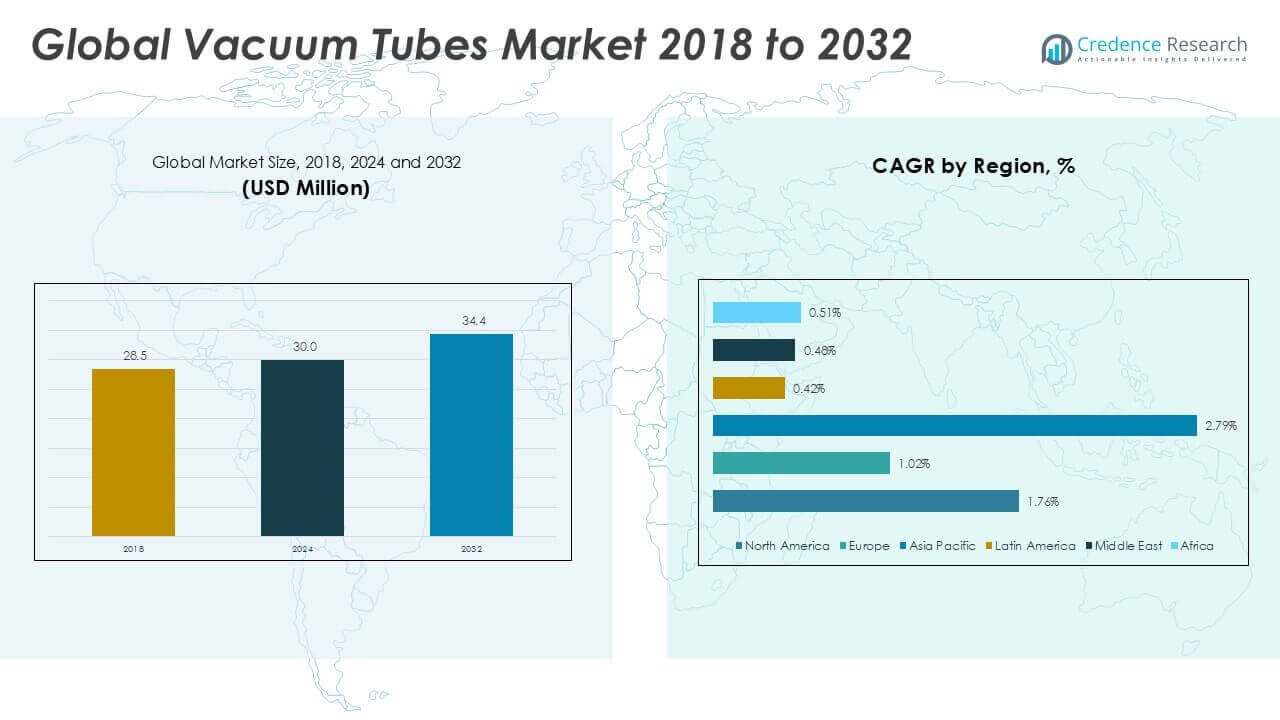
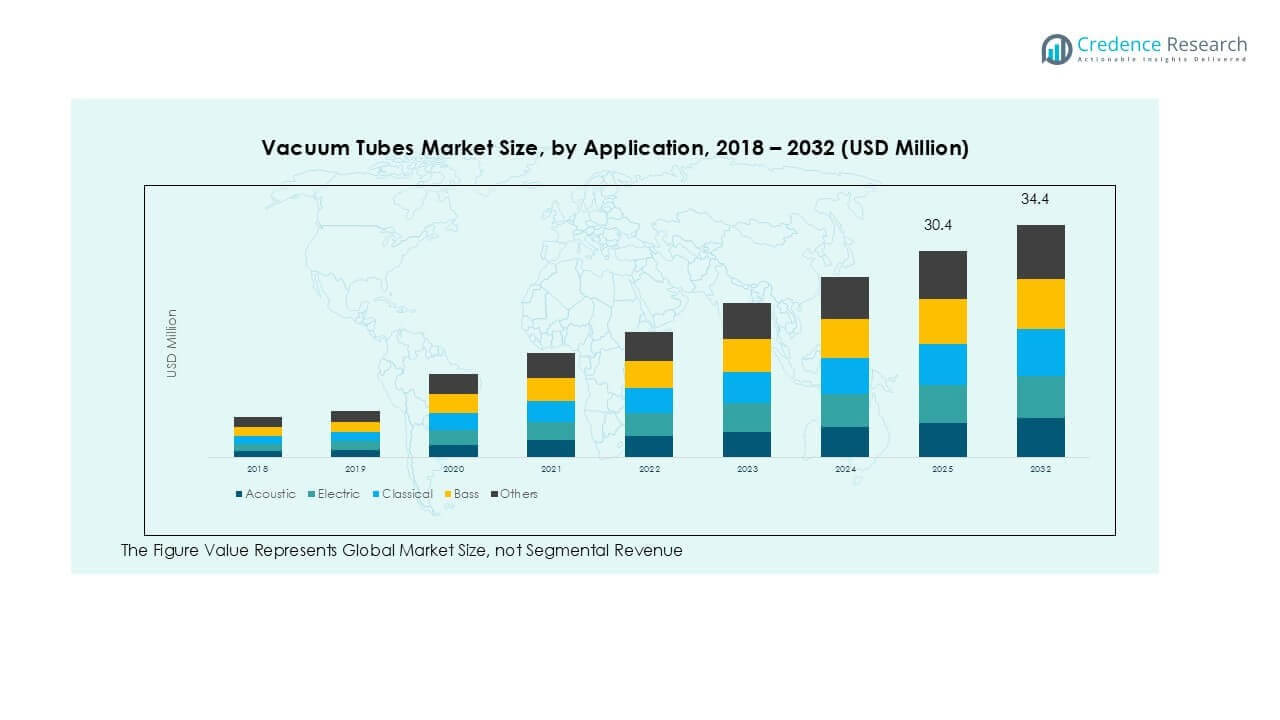
Global Vacuum Tubes Market size was valued at USD 28.5 million in 2018, reached USD 30.0 million in 2024, and is anticipated to reach USD 34.4 million by 2032, at a CAGR of 1.76% during the forecast period.
| REPORT ATTRIBUTE |
DETAILS |
| Historical Period |
2020-2023 |
| Base Year |
2024 |
| Forecast Period |
2025-2032 |
| Vacuum Tubes Market Size 2024 |
USD 30.0 Million |
| Vacuum Tubes Market, CAGR |
1.76% |
| Vacuum Tubes Market Size 2032 |
USD 34.4 Million |
The global vacuum tubes market is led by key players including Western Electric, JJ Electronic, Electro-Harmonix, Northern Electric, Sovtek, Russian Tubes, JAN Military, and Mullard. These companies focus on high-quality tube production for audio equipment, broadcasting, and custom lighting applications. Western Electric and JJ Electronic hold a strong position in premium and audiophile segments, while Electro-Harmonix and Sovtek cater to mass-market demand with diverse product offerings. North America dominates the market with a 33% share in 2024, supported by advanced music production infrastructure and strong demand for high-fidelity audio systems. Asia Pacific follows with 29% share, driven by rising electronics manufacturing and expanding broadcasting networks.
 Market Insights
- The global vacuum tubes market was valued at USD 30.0 million in 2024 and is projected to reach USD 34.4 million by 2032, growing at a CAGR of 1.76%.
- Rising demand for high-fidelity audio equipment and broadcasting applications is driving market growth, with electric applications holding over 40% share.
- Key trends include the revival of vintage-style audio products, growing use in custom lighting, and technological advancements improving tube lifespan and efficiency.
- Leading players such as Western Electric, JJ Electronic, and Electro-Harmonix focus on product innovation, reissued classic tubes, and expanding production capacity to meet global demand.
- North America leads with 33% share, followed by Asia Pacific with 29%, supported by strong manufacturing bases and growing music industry demand; the light segment dominates end-user share, driven by demand for decorative and custom lighting solutions.
Access crucial information at unmatched prices!
Request your sample report today & start making informed decisions powered by Credence Research Inc.!
Download Sample
Market Segmentation Analysis:
By Application
The global vacuum tubes market by application is dominated by the electric segment, holding over 40% market share in 2024. Electric applications remain popular due to rising demand in guitar amplifiers, audio systems, and broadcasting equipment. Vacuum tubes provide warm sound quality and reliability, making them preferred in high-end music production and professional audio setups. Acoustic and bass applications contribute steadily, driven by demand from musicians and niche audio enthusiasts. Classical applications maintain relevance for premium sound reproduction in orchestral performances. Growth is further supported by consumers seeking vintage-style audio experiences worldwide.
- For instance, JJ Electronic, one of the world’s remaining producers of vacuum tubes, produced a substantial number of tubes in 2024, with a large share used in guitar amplifiers and studio audio equipment globally.
By End-User
The light segment accounted for the largest share, exceeding 50% of the vacuum tubes market in 2024. Demand is driven by lighting applications in niche decorative fixtures, stage lighting, and specialized vintage equipment. Custom light solutions are gaining traction as designers use vacuum tubes for retro-style products that appeal to collectors and interior designers. The “others” segment includes industrial and educational uses, contributing moderate growth. The market is supported by rising interest in artisanal and premium-grade lighting, with manufacturers focusing on energy-efficient designs and durable tube components.
- For instance, Shuguang Electron Tube Factory continued to supply vacuum tubes primarily for audio amplifier applications, including newly manufactured tubes and upgraded versions of classic designs.
 Key Growth Drivers
Rising Demand for High-Fidelity Audio Equipment
The growing demand for premium audio systems is a major driver for the vacuum tubes market. Audiophiles and music professionals prefer vacuum tube amplifiers for their warm, natural sound reproduction. The rise in home studios and high-end sound systems is boosting consumption, particularly in electric and bass applications. Manufacturers are focusing on improving tube reliability and lifespan to meet consumer expectations. This demand is further strengthened by retro and vintage audio trends, which continue to influence purchasing decisions across North America, Europe, and Asia-Pacific markets.
- For instance, Electro-Harmonix continues to be a key player in the vacuum tube market, operating the Xpo-pul factory in Saratov, Russia, which manufactures tubes for brands such as Tung-Sol, Mullard, and Sovtek. However, the company’s ability to supply the market has faced significant challenges. In 2022, a Russian export ban on hundreds of products, including vacuum tubes, caused major disruptions and led to price increases.
Expansion in Broadcasting and Communication Applications
Broadcasting and communication sectors increasingly adopt vacuum tubes for high-frequency, high-power applications. Vacuum tubes remain critical in radio transmitters, military communication systems, and radar equipment where solid-state alternatives cannot match performance. Governments and private players are investing in upgrading communication infrastructure, indirectly fueling demand. The need for high-output devices in rural and remote transmission networks supports continued relevance. Companies are also innovating with compact, more energy-efficient tube designs, helping sustain their adoption despite the rise of semiconductor-based alternatives in several regions.
- For instance, Communications & Power Industries (CPI) is a leading manufacturer of high-power vacuum tubes and other electronic components used in critical defense and satellite communication projects for global broadcasting networks. In 2024, the company’s Electron Device Business was spun out to become a separate entity, the CPI Electron Device Business (CPI EDB), which was then acquired by TransDigm Inc.
Growing Demand for Custom and Decorative Lighting
Vacuum tubes are experiencing renewed demand in the custom lighting sector, driven by interior design trends. Retro and vintage-inspired lighting fixtures use vacuum tubes to create aesthetic appeal in residential, commercial, and hospitality spaces. The premium lighting market is embracing hand-crafted, artisanal tube designs that deliver both functional and decorative value. This has created opportunities for niche manufacturers to expand their portfolios with bespoke solutions. The combination of unique design appeal and the growing luxury décor market contributes significantly to the growth of this end-user segment.
Key Trend & Opportunity
Revival of Vintage and Retro Products
The global trend toward vintage audio and lighting equipment presents a key opportunity for vacuum tube makers. Musicians, collectors, and sound engineers are increasingly seeking equipment that delivers authentic analog sound. Similarly, interior designers and luxury consumers favor retro lighting solutions to add character to modern spaces. Manufacturers can capitalize by offering reissued classic tube models and partnering with brands targeting the premium segment. This trend supports both direct sales and aftermarket demand for replacement tubes across diverse applications.
- For instance, Western Electric continues to produce its reissued 300B vacuum tubes, meeting strong demand from the high-end audiophile and vintage amplifier markets worldwide.
Technological Advancements in Tube Design
Innovations in vacuum tube design are improving energy efficiency, durability, and performance. Companies are focusing on developing smaller, more robust tubes that meet modern safety and energy standards while maintaining desired sound and light output. Advanced manufacturing techniques enable consistent quality and longer product lifespan, attracting new buyers in both professional and consumer segments. These advancements also lower maintenance costs, making vacuum tubes a viable option in sectors where reliability is crucial, such as broadcasting and medical imaging systems.
Competition from Solid-State Devices
One of the major challenges for the vacuum tube market is competition from solid-state technologies. Semiconductor devices such as transistors offer smaller size, lower power consumption, and cost advantages. These factors limit vacuum tube adoption in mainstream electronics. The shift toward miniaturization and portable devices further constrains growth potential. Manufacturers must focus on niche applications where vacuum tubes outperform solid-state alternatives, such as high-power transmission, military radar, and premium audio equipment, to maintain market relevance and profitability.
High Production and Maintenance Costs
Vacuum tube manufacturing involves complex processes and expensive raw materials, resulting in high production costs. Their fragility and shorter operational life compared to solid-state devices lead to higher maintenance and replacement expenses. This poses challenges for cost-sensitive customers and restricts large-scale adoption. Additionally, supply chain issues and limited skilled labor in tube production can cause delays and price fluctuations. Manufacturers are investing in automation and improved material sourcing to reduce costs and enhance production efficiency in response to these constraints.
Regional Analysis
North America
North America leads the global vacuum tubes market, holding around 33% share in 2024. The market grew from USD 9.75 million in 2018 to USD 10.13 million in 2024 and is expected to reach USD 11.60 million by 2032, at a CAGR of 1.76%. Growth is driven by strong demand for high-fidelity audio systems, broadcasting applications, and custom lighting solutions. The U.S. contributes the largest share due to the presence of leading manufacturers and a well-developed entertainment industry. Rising adoption in music studios and premium audio setups continues to fuel steady regional growth.
Europe
Europe accounts for nearly 24% of the vacuum tubes market in 2024, supported by established broadcasting and audio equipment manufacturing sectors. The market increased from USD 7.24 million in 2018 to USD 7.31 million in 2024 and is projected to reach USD 7.91 million by 2032, growing at a CAGR of 1.02%. Demand is concentrated in Germany, the U.K., and France, where audiophile culture is strong. Growth is driven by retro audio demand, broadcasting infrastructure upgrades, and rising popularity of custom tube-based lighting products across residential and commercial spaces.
Asia Pacific
Asia Pacific is the fastest-growing region, capturing 29% of the global vacuum tubes market in 2024. The market expanded from USD 8.24 million in 2018 to USD 8.99 million in 2024 and is expected to reach USD 11.20 million by 2032, at a CAGR of 2.79%. Growth is led by China, Japan, and South Korea due to rising consumer electronics production, music industry growth, and expanding broadcasting networks. Demand for premium audio equipment and custom lighting applications is accelerating. The region’s manufacturing capabilities and cost advantages also make it a key supplier of vacuum tubes globally.
Latin America
Latin America represents a smaller share of the market, contributing roughly 4% in 2024. The market grew from USD 1.27 million in 2018 to USD 1.32 million in 2024 and is forecast to reach USD 1.35 million by 2032, with a modest CAGR of 0.42%. Brazil and Mexico dominate regional demand, driven by music production hubs and limited but growing interest in vintage audio equipment. Adoption in broadcasting applications is slow but steady, supported by government-led communication infrastructure programs. Price-sensitive consumers and limited availability of high-end products restrain faster growth in this region.
Middle East
The Middle East accounts for nearly 3.5% of the market in 2024, with demand primarily driven by niche broadcasting applications and decorative lighting. The market declined slightly from USD 1.08 million in 2018 to USD 1.07 million in 2024 but is expected to reach USD 1.10 million by 2032, reflecting a slow CAGR of 0.48%. Growth is concentrated in the UAE and Saudi Arabia, where luxury hospitality projects and premium entertainment venues use vacuum tubes in lighting designs. Limited manufacturing presence and reliance on imports restrain large-scale adoption across the region.
Africa
Africa holds approximately 3% market share in 2024, showing gradual growth over recent years. The market rose from USD 0.93 million in 2018 to USD 1.18 million in 2024 and is anticipated to reach USD 1.25 million by 2032, at a CAGR of 0.51%. South Africa leads demand, followed by Nigeria, driven by small-scale broadcasting networks and increasing interest in custom lighting solutions. Economic challenges and limited access to high-end audio systems constrain rapid adoption. However, the growing middle-class population and rising interest in premium entertainment products are expected to support steady market expansion.
 Market Segmentations:
By Application
- Acoustic
- Electric
- Classical
- Bass
- Others
By End-User
- Light
- Custom Light
- Others
By Geography
- North America
- Europe
- UK
- France
- Germany
- Italy
- Spain
- Russia
- Rest of Europe
- Asia Pacific
- China
- Japan
- South Korea
- India
- Australia
- Southeast Asia
- Rest of Asia Pacific
- Latin America
- Brazil
- Argentina
- Rest of Latin America
- Middle East
- GCC Countries
- Israel
- Turkey
- Rest of Middle East
- Africa
- South Africa
- Egypt
- Rest of Africa
Competitive Landscape
The global vacuum tubes market is moderately consolidated, with key players focusing on premium-quality products and niche applications. Leading companies such as Western Electric, JJ Electronic, Electro-Harmonix, Northern Electric, Sovtek, Russian Tubes, JAN Military, and Mullard dominate supply for high-fidelity audio, broadcasting, and custom lighting applications. These companies emphasize manufacturing consistency, extended tube lifespan, and superior sound reproduction to maintain a competitive edge. Recent strategies include reissuing classic tube models, expanding production capacity, and leveraging e-commerce channels to reach global audiophile and professional markets. Western Electric and JJ Electronic are known for their investment in modernizing production facilities, while Electro-Harmonix and Sovtek focus on product diversification to meet rising demand across music studios and consumer segments. Partnerships with amplifier and audio equipment manufacturers strengthen their market presence. The competitive landscape is driven by innovation, niche targeting, and efforts to preserve the heritage appeal of vacuum tube technology.
Shape Your Report to Specific Countries or Regions & Enjoy 30% Off!
Key Player Analysis
Recent Developments
- In December 2023, Western Electric celebrated eighty-five years of the iconic 300B electron tube and continued to innovate with the 91E Integrated Amplifier, which received several industry accolades as a high-end single-ended triode amplifier.
- In March 2022, Electro-Harmonix (EHX) was forced to halt new orders and back orders of vacuum tubes due to Russia’s export bans in response to sanctions (affecting all EHX and associated Russian brands, including Sovtek, Mullard, Tung-Sol)
Report Coverage
The research report offers an in-depth analysis based on Type, Application, End-User and Geography. It details leading market players, providing an overview of their business, product offerings, investments, revenue streams, and key applications. Additionally, the report includes insights into the competitive environment, SWOT analysis, current market trends, as well as the primary drivers and constraints. Furthermore, it discusses various factors that have driven market expansion in recent years. The report also explores market dynamics, regulatory scenarios, and technological advancements that are shaping the industry. It assesses the impact of external factors and global economic changes on market growth. Lastly, it provides strategic recommendations for new entrants and established companies to navigate the complexities of the market.
Future Outlook
- The global vacuum tubes market will see steady growth driven by audiophile and broadcasting demand.
- Electric applications will remain the dominant segment with rising adoption in music production.
- Custom lighting will gain traction, supported by retro and vintage décor trends.
- Technological advancements will improve tube durability and energy efficiency.
- Key players will invest in modernizing production facilities to meet rising global demand.
- Asia Pacific will witness the fastest growth due to expanding electronics and entertainment industries.
- North America will maintain its leadership position with strong demand for premium audio systems.
- Product reissues of classic tube models will attract collectors and enthusiasts.
- Online distribution channels will expand market reach and accessibility for niche buyers.
- Collaboration with amplifier and lighting manufacturers will strengthen brand presence and drive innovation.



