
| REPORT ATTRIBUTE | DETAILS |
|---|---|
| Historical Period | 2019-2022 |
| Base Year | 2023 |
| Forecast Period | 2024-2032 |
| Zero Turn Mowers Market Size 2024 | USD 1,107.22 Million |
| Zero Turn Mowers Market, CAGR | 5.9% |
| Zero Turn Mowers Market Size 2032 | USD 1,751.46 Million |
Market Overview
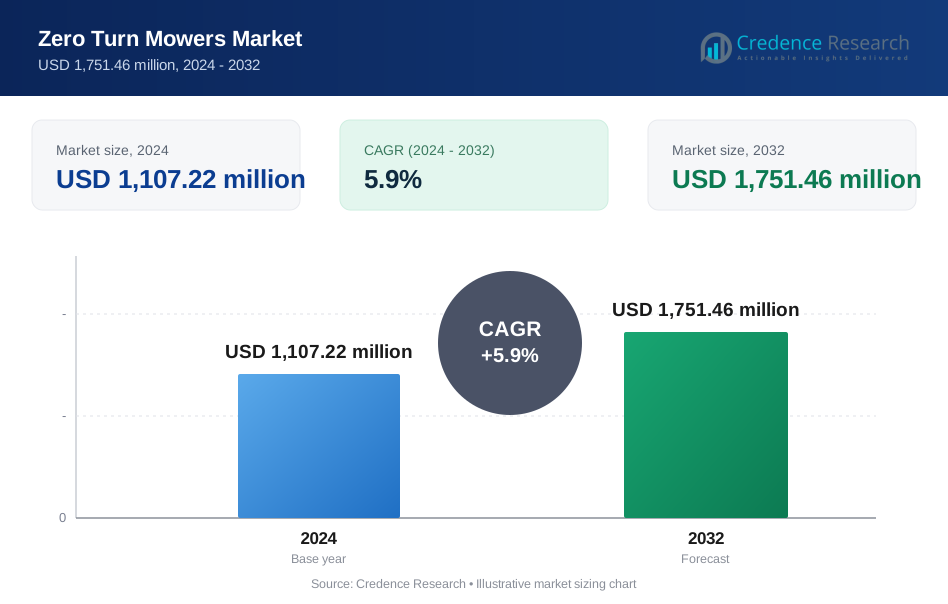
The Zero Turn Mowers Market is projected to grow from USD 1,107.22 million in 2024 to USD 1,751.46 million by 2032, achieving a CAGR of 5.9% over the forecast period.
The Zero Turn Mowers market is driven by rising demand for efficient landscaping solutions, particularly in residential and commercial sectors where precise and time-saving mowing is prioritized. Advancements in mower technology, including GPS-enabled and automated functionalities, enhance ease of use and efficiency, further spurring adoption. The trend toward eco-friendly, battery-operated models is also gaining traction, addressing consumer preferences for sustainable alternatives to traditional fuel-powered mowers. Additionally, the market benefits from increased spending on home improvement and outdoor aesthetics, making Zero Turn Mowers a preferred choice among professional landscapers and homeowners alike.
The geographical analysis of the zero-turn mower market highlights significant demand across North America and Europe, with North America accounting for nearly 40% of the market share due to a strong landscaping culture and high disposable incomes. Key players in this market include industry leaders such as Briggs & Stratton, The Toro Company, and Deere & Company, which are recognized for their innovative designs and advanced features. Other notable companies, including Husqvarna Group, KUBOTA Corporation, and ARIENS, also play vital roles in shaping market trends, focusing on sustainability and user-friendly technology to meet diverse consumer needs.
Market Drivers
Increasing Demand for Landscaping Services
The rapid pace of urbanization and a growing focus on enhancing outdoor aesthetics have significantly fueled the demand for landscaping services, contributing to the expansion of the zero-turn mower market. For instance, the landscaping industry employs over 1.1 million people in the United States. As more urban and suburban areas embrace green spaces and well-manicured lawns, there is an increased need for efficient and professional landscaping solutions. Zero-turn mowers, known for their maneuverability and high efficiency, have become the preferred choice among professional landscapers for their ability to provide clean and precise cuts. This trend underscores the expanding role of zero-turn mowers in meeting the evolving demands of urban landscaping projects.
Rising Disposable Income
With disposable incomes on the rise, homeowners are investing more in enhancing their outdoor spaces, including gardens and lawns, as part of their overall home improvement efforts. Zero-turn mowers offer a premium mowing experience with advanced features that provide ease and efficiency, appealing to homeowners who prioritize quality in lawn care. This willingness to invest in higher-quality lawn maintenance tools is driving increased adoption of zero-turn mowers in the residential sector, where homeowners view them as valuable assets for achieving professional-grade lawn aesthetics with minimal effort.
Technological Advancements
Continuous advancements in mower technology, such as improvements in engine efficiency, cutting deck design, and ergonomic features, have made zero-turn mowers more powerful, efficient, and comfortable to operate. For instance, modern zero-turn mowers incorporate hydraulic controls, electric motors, and lithium-ion batteries, enhancing their performance and energy efficiency. Enhanced performance and usability appeal to both commercial landscapers and residential users, who benefit from superior productivity and reduced operational fatigue. Innovations like GPS-enabled automation and battery-powered models also align with consumer demand for sustainability and ease of use. As a result, technological improvements are expanding the appeal of zero-turn mowers, supporting their growing popularity in diverse applications.
Emphasis on Lawn Care Quality
An increasing focus on achieving a high-quality, well-maintained lawn has driven demand for zero-turn mowers, as both homeowners and landscaping professionals prioritize precision in lawn care. The superior maneuverability and precision cutting capabilities of zero-turn mowers enable users to maintain an evenly trimmed lawn, creating an aesthetic appeal that meets high standards. Additionally, the mower’s ability to navigate around obstacles and provide a consistent cut highlights its value in delivering optimal lawn care quality.
Market Trends
Increasing Demand and Expanding Applications
The zero-turn mower market is experiencing substantial growth, fueled by a rising demand for efficient, maneuverable equipment that delivers a high-quality cut across various applications. Zero-turn mowers have become essential tools in both residential and commercial landscaping, where their ability to navigate tight spaces and tackle complex lawn layouts has made them indispensable for professionals. For instance, according to the National Association of Landscape Professionals, the landscaping services industry in the United States has been growing steadily, with an annual growth rate of 4.6% over the past five years. This growth aligns with the expanding popularity of landscaping services, as both private and public sectors prioritize well-maintained green spaces, leading to a boost in sales for commercial-grade models. Additionally, a broader product range is emerging, with manufacturers introducing specialized models for residential users, small-scale landscapers, and large commercial operators, thereby catering to a wide array of mowing needs. Online sales platforms further facilitate this growth, offering consumers easy access to a wide range of zero-turn mowers with the convenience of product comparisons and purchasing flexibility, which has accelerated market penetration.
Technological Advancements and Sustainability Trends
Advancements in zero-turn mower technology are propelling market growth, as manufacturers innovate with features such as GPS-guided mowing, remote control, and state-of-the-art engine designs. These advancements enhance productivity and operational ease, appealing to both homeowners and professional landscapers who benefit from improved performance and user experience. At the same time, a growing emphasis on sustainability is shifting market preferences toward electric and hybrid models, responding to increased environmental awareness and demand for reduced emissions. Battery-powered zero-turn mowers are gaining traction for their quieter operation and eco-friendly benefits, offering a sustainable alternative to traditional fuel-powered models. Additionally, manufacturers are focusing on operator comfort, incorporating ergonomic seating, suspension systems, and intuitive controls that make longer mowing sessions more manageable. This dual emphasis on technological innovation and eco-conscious options underscores the industry’s commitment to meeting diverse consumer needs while advancing sustainability goals.
Market Challenges Analysis
High Costs and Maintenance Complexity
Zero-turn mowers come with a high initial cost compared to traditional riding mowers, which limits their accessibility for cost-sensitive consumers, particularly homeowners with smaller budgets or those managing smaller lawns. For instance, the average cost of replacing blades on a zero-turn mower is typically around $20-$30, while the price range for replacing belts and pulleys can range from $20-$50. Despite their efficiency, the significant upfront investment can deter widespread adoption among residential users who may find conventional mowers more economical. Additionally, zero-turn mowers require frequent maintenance to perform optimally, including routine tasks like oil changes, filter replacements, and blade sharpening. This maintenance can be complex and time-consuming, often demanding specialized knowledge or professional services, which increases the long-term ownership cost and may dissuade less experienced users. To address these issues, manufacturers are exploring ways to offer entry-level models at more affordable price points and are working to simplify maintenance procedures, providing user-friendly guidelines and designing components for easier upkeep to make zero-turn mowers more accessible and practical for a broader audience.
Safety and Environmental Challenges Amid Competition
Safety concerns pose a notable challenge in the zero-turn mower market. Due to their speed and maneuverability, these mowers can be difficult to control for inexperienced users, increasing the risk of accidents, particularly in challenging terrains or near obstacles. For instance, approximately 4,200 injuries are reported annually from zero-turn mower accident. This issue raises potential liability concerns for manufacturers, who are responding by developing advanced safety features, such as automatic braking systems and operator presence detection, to enhance safe operation. Another challenge is the environmental impact of traditional gasoline-powered zero-turn mowers, which contribute to air and noise pollution, a growing concern in eco-conscious regions. While the market is beginning to see an emergence of electric and hybrid models, the transition to sustainable alternatives is still in its early stages. Adding to this, the rise of robotic lawn mowers offers a competitive alternative, particularly in the residential market, where consumers are drawn to the automation and ease of robotic options. To stay competitive, zero-turn mower manufacturers are investing in sustainable technology and targeting professional landscaping sectors where the unique capabilities of zero-turn mowers, such as precision and speed, offer distinct advantages over robotic mowers.
Market Segmentation Analysis:
By Product Type:
The zero-turn mower market is segmented by product type into three categories: less than 50 inches, 50-60 inches, and more than 60 inches. Models with cutting decks under 50 inches are favored in residential applications where lawn sizes are smaller and maneuverability is crucial. These compact mowers are popular among homeowners seeking precision on tighter landscapes. In contrast, the 50-60 inch segment caters to medium-sized lawns, striking a balance between coverage and efficiency, making it ideal for both residential and light commercial landscaping. The more than 60-inch segment targets larger properties and commercial applications, where speed and wide cutting capabilities are essential. These larger models are commonly used by landscaping professionals and organizations managing vast green spaces, including parks, golf courses, and corporate grounds. As demand for diverse lawn care solutions increases, manufacturers continue to expand and innovate within each product type to meet specific.
By Horsepower:
Zero-turn mowers are further segmented by horsepower, with options less than 25 HP and more than 25 HP. Mowers with less than 25 HP are generally lighter and are preferred by residential users or smaller commercial settings that don’t require extensive power. These models are suited for small- to medium-sized lawns, delivering sufficient power for efficient operation while remaining economical and easy to handle. On the other hand, mowers with over 25 HP are built for more demanding tasks and are highly sought after by professional landscapers who require durability and enhanced power for larger areas. These high-power mowers excel in commercial applications where frequent, heavy-duty mowing is necessary, such as in municipal parks, sports fields, and large estates. With varied horsepower options, the zero-turn mower market caters to a broad range of users, from residential homeowners with small lawns to commercial professionals managing expansive properties.
Segments:
Based on Product Type
- Less than 50 Inches
- 50-60 Inches
- More than 60 Inches
Based on Horsepower
- Less than 25 HP
- More than 25 HP
Based on Application
- Residential
- Commercial
Based on the Geography:
- North America
- U.S.
- Canada
- Mexico
- Europe
- Germany
- France
- U.K.
- Italy
- Spain
- Rest of Europe
- Asia Pacific
- China
- Japan
- India
- South Korea
- South-east Asia
- Rest of Asia Pacific
- Latin America
- Brazil
- Argentina
- Rest of Latin America
- Middle East & Africa
- GCC Countries
- South Africa
- Rest of the Middle East and Africa
Regional Analysis
North America
North America holds a significant share of the zero-turn mower market, driven by the widespread adoption of landscaping services and a strong demand for lawn maintenance equipment. North America accounted for nearly 40% of the global market share, supported by high disposable incomes and a cultural emphasis on well-kept lawns and outdoor spaces. The United States, in particular, contributes substantially to this share, as residential homeowners and commercial landscapers alike favor zero-turn mowers for their efficiency and performance. Additionally, the popularity of large residential properties and commercial landscaping in areas such as parks, golf courses, and corporate campuses drives demand for high-performance mowers. Manufacturers in this region focus on developing models with advanced features, such as automation and eco-friendly options, to cater to environmentally-conscious consumers, which further supports market growth.
Europe
Europe represents another substantial market for zero-turn mowers, holding around 25% of the global market share. The region's growth is primarily driven by increasing government initiatives to maintain green public spaces and growing environmental awareness among consumers. Countries such as Germany, the United Kingdom, and France are key contributors, where commercial landscaping services and public sector investments in parks and recreational areas fuel demand. Europe’s shift towards sustainable practices has also increased the demand for electric and hybrid zero-turn mowers as consumers seek quieter, emission-reducing options. This trend is especially prominent in urbanized areas where noise and pollution are critical concerns. Manufacturers catering to this region focus on developing versatile and environmentally-friendly mowers that align with Europe’s sustainability goals, appealing to both private homeowners and professional landscapers working in environmentally regulated areas.
Key Player Analysis
- SPARTAN MOWERS
- The Toro Company
- Husqvarna Group
- ARIENS
- KUBOTA Corporation
- BigDog Mower Co.
- Deere & Company
- Briggs & Stratton
- Swisher Inc.
- MTD Products Inc.
Competitive Analysis
The competitive landscape of the zero-turn mower market is characterized by several leading players, including Briggs & Stratton, The Toro Company, Deere & Company, Husqvarna Group, KUBOTA Corporation, ARIENS, BigDog Mower Co., MTD Products Inc., SPARTAN MOWERS, and Swisher Inc. These companies leverage advanced technology and innovative features to enhance product performance and user experience. One prominent strategy involves focusing on reliable engine technology and durability to meet the diverse needs of consumers. Many companies are also emphasizing efficiency, ensuring that their products deliver exceptional results in a variety of applications. Additionally, there is a significant push towards developing electric and hybrid models in response to the growing demand for environmentally friendly solutions. As sustainability becomes increasingly important, manufacturers are differentiating themselves by incorporating eco-friendly technologies and features. Overall, the competition remains fierce, with companies striving to enhance their offerings through technological advancements, product diversity, and superior customer service to capture a larger share of the market.
Recent Developments
- In May 2023, AriensCo, a manufacturer of outdoor power equipment, unveiled its latest addition to the Ariens brand, the Ikon Onyx. This exceptional zero-turn lawn mower showcases Ariens' dedication to innovation and producing top-notch products. With its advanced features and capabilities, including a 52-inch deck, the Ikon Onyx ensures efficient and precise lawn care. Ariens continues to demonstrate its commitment to meeting the demands of both homeowners and professionals by delivering high-quality and cutting-edge equipment.
- In March 2023, Husqvarna, a manufacturer of robotic lawnmowers, has recently announced its partnership as the main sponsor for the Volvo Car Scandinavian Mixed 2023 golf tournament. This collaboration marks a significant achievement for the Husqvarna Group as it expands the presence of the Husqvarna brand in the golf industry. This strategic alliance further strengthens Husqvarna's reputation and reinforces its dedication to innovation and excellence in outdoor power equipment.
- In February 2023, John Deere announced its latest product, the Z370R Electric ZTrak residential zero-turn mower. This new product comes when the outdoor power industry increasingly shifts towards battery-powered alternatives, moving away from traditional small spark-ignited off-road engines. The Environmental Protection Agency (EPA) has highlighted that these engines contribute approximately 5% of the total air pollutants in the U.S., with even higher levels in urban areas. By introducing the Z370R Electric ZTrak mower, John Deere addresses this environmental concern and offers a sustainable solution for residential lawn care.
- In November 2022, Husqvarna Group, a global outdoor lawn and garden product manufacturer, launched two new additions to its lineup of riding mowers for consumers: the Z350 and Z380 Xcit zero-turn mowers. These cutting-edge mowers incorporate state-of-the-art grass-cutting technology, setting a new standard in the industry. With a superior suspension system that outperforms competitors, industry-first on-stick controls and long-lasting blades designed to endure up to five years, users can experience the joy of a new cut season after season. Husqvarna Group's introduction of these innovative zero-turn mowers further solidifies their commitment to delivering exceptional quality and performance to their customers.
- In May 2022, STIHL and Briggs & Stratton unveiled a strategic manufacturing partnership to broaden the range of STIHL products available in the United States. STIHL will introduce a line of zero-turn mowers designed for professionals and homeowners as part of this collaboration. These new offerings will be accessible to customers through authorized STIHL dealers starting January 2023. By expanding its outdoor power solutions portfolio, which already encompasses landscaping, tree care, construction, cleaning, and gardening products, STIHL aims to cater to a wider customer base and enhance its presence in the market.
Market Concentration & Characteristics
The zero-turn mower market exhibits moderate concentration, characterized by a mix of established players and emerging companies striving to capture market share. Leading manufacturers dominate the market, leveraging strong brand recognition and extensive distribution networks to maintain their competitive edge. The industry is marked by continuous innovation, with companies investing in research and development to enhance product features such as cutting efficiency, user comfort, and environmental sustainability. Key characteristics of the market include a growing demand for electric and hybrid models, driven by increasing consumer awareness of environmental issues. Additionally, the market caters to both residential and commercial segments, with tailored solutions for various lawn sizes and applications. This diversification enhances competition, as manufacturers seek to address specific consumer needs while providing high-quality, durable products. Overall, the market is dynamic, evolving rapidly to adapt to changing consumer preferences and technological advancements.Top of Form
Report Coverage
The research report offers an in-depth analysis based on Product Type, Horsepower, Application and Geography. It details leading market players, providing an overview of their business, product offerings, investments, revenue streams, and key applications. Additionally, the report includes insights into the competitive environment, SWOT analysis, current market trends, as well as the primary drivers and constraints. Furthermore, it discusses various factors that have driven market expansion in recent years. The report also explores market dynamics, regulatory scenarios, and technological advancements that are shaping the industry. It assesses the impact of external factors and global economic changes on market growth. Lastly, it provides strategic recommendations for new entrants and established companies to navigate the complexities of the market.
Future Outlook
- The zero-turn mower market is expected to witness steady growth, driven by increasing demand for efficient lawn care solutions.
- Advancements in electric and hybrid technologies will shape the future landscape, promoting sustainable mowing options.
- Increased consumer focus on environmentally friendly products will lead to a rise in the adoption of battery-powered zero-turn mowers.
- Integration of smart technologies, such as GPS-guided systems and IoT capabilities, will enhance operational efficiency and user experience.
- The market will continue to diversify with specialized models catering to various lawn sizes and applications, from residential to commercial.
- Rising disposable incomes will encourage homeowners to invest in higher-quality, performance-driven zero-turn mowers.
- Manufacturers will prioritize user comfort and ergonomics, incorporating features like adjustable seating and intuitive controls.
- The growth of e-commerce platforms will facilitate easier access to zero-turn mowers, expanding their reach to a broader audience.
- Increased focus on safety features will address user concerns and enhance the overall operational experience.
- Competition will intensify as new entrants emerge, pushing established brands to innovate and differentiate their offerings continuously.
Request a Free Sample
Fill in your details and we'll send you a free sample report.
- Sample data tables & charts
- Research methodology
Market Dynamics
Growth in Landscaping Services
Urbanization and a heightened focus on outdoor aesthetics have increased the demand for professional landscaping, where zero-turn mowers are preferred for their efficiency and precision, especially in commercial and municipal applications.
Rising Disposable Incomes
Higher disposable incomes, particularly in North America and Europe, are enabling homeowners to invest in premium lawn care equipment like zero-turn mowers, boosting residential market growth.
Technological Advancements
Innovations such as GPS-enabled automation, battery-powered models, and ergonomic designs are making zero-turn mowers more efficient, sustainable, and user-friendly, attracting both commercial and residential buyers.
Emphasis on Lawn Care Quality
Consumers and professionals are increasingly prioritizing high-quality, well-maintained lawns, driving demand for zero-turn mowers due to their superior maneuverability and ability to deliver precise, consistent cuts.
Shift Toward Eco-Friendly Solutions
Growing environmental awareness and regulatory pressures are accelerating the adoption of battery-operated and hybrid zero-turn mowers, especially in regions with strict emissions and noise standards.
Need a Custom Version of This Report?
Tailor the scope, geography, or segments to your exact requirements.
- Custom geography or segment scope
- Direct access to our analyst team
Frequently Asked Questions
What is the current size of the Zero Turn Mowers market?
What factors are driving the growth of the Zero Turn Mowers market?
What are the key segments within the Zero Turn Mowers market?
What are some challenges faced by the Zero Turn Mowers market?
Who are the major players in the Zero Turn Mowers market?
Table of Content
Chapter 1 Market Segmentation
- 1.1 Segmentation Framework
- 1.1.1 Product and Service Classification
- 1.1.2 Application and End-Use Classification
- 1.1.3 Technology and Solution Classification
- 1.1.4 Customer and Distribution Channel Classification
- 1.1.5 Geographic Segmentation
- 1.1.6 Market Segment Definitions and Boundaries
- 1.2 By Horsepower
- 1.2.1 Less than 25 HP
- 1.2.2 More than 25 HP
- 1.3 By Application
- 1.3.1 Residential
- 1.3.2 Commercial
- 1.4 By Product Type
- 1.4.1 Less than 50 Inches
- 1.4.2 50-60 Inches
- 1.4.3 More than 60 Inches
Chapter 2 Introduction
- 2.1 Report Objectives and Scope
- 2.2 Product Definition and Industry Terminology
- 2.3 Market Inclusions and Exclusions
- 2.4 Research Process
- 2.4.1 Primary Research and Expert Interviews
- 2.4.2 Secondary Research and Source Review
- 2.4.3 Top-Down and Bottom-Up Estimation
- 2.4.4 Data Triangulation and Verification
- 2.5 Market Size Measurement Basis
- 2.5.1 2024: USD 1,107.22 million → 2032: USD 1,751.46 million
- 2.6 Historical and Forecast Reference Periods
- 2.6.1 Base Year: 2024
- 2.6.2 Forecast Period: 2024-2032
- 2.7 Research Assumptions and Limitations
Chapter 3 Executive Summary
- 3.1 Market Snapshot and Key Findings
- 3.2 Base-Year Market Size, 2024
- 3.3 Forecast Market Size, 2032
- 3.4 Revenue and Volume Growth Outlook
- 3.5 Key Demand and Supply Indicators
- 3.6 Leading Market Segments
- 3.7 Fastest-Growing Market Opportunities
- 3.8 Regional Performance Highlights
- 3.9 Technology and Industry Transformation
- 3.10 Competitive Landscape Summary
- 3.11 Analyst View and Strategic Implications
Chapter 4 Global Zero Turn Mowers Market Trends and Developments
- 4.1 Historical Industry Development
- 4.2 Recent Market Trends and Developments
- 4.3 Demand and Customer Behavior Trends
- 4.4 Technology and Product Innovation
- 4.5 Artificial Intelligence, Automation and Digitalization
- 4.6 Local Manufacturing and Supply Chain Realignment
- 4.7 Industry Partnerships, Mergers and Acquisitions
- 4.8 Sustainability and Circular Economy Developments
- 4.9 Government and Private Sector Investment Trends
- 4.10 Emerging Business Models and Commercialization
- 4.11 Industry Developments and Announcements
Chapter 5 Global Zero Turn Mowers Market Production, Supply and Demand Analysis
- 5.1 Demand Trend and Consumption Analysis
- 5.2 Demand Forecast, 2024-2032
- 5.3 Production and Output Trend
- 5.4 Production and Output Forecast, 2024-2032
- 5.5 Installed Capacity and Capacity Utilization
- 5.6 Company-Wise Production Plants and Statistics
- 5.6.1 Installed Production Capacity
- 5.6.2 Actual Production
- 5.6.3 Planned Capacity and Expansion Targets
- 5.7 Supply Chain Structure and Procurement Trends
- 5.8 Supply-Demand Gap and Bottlenecks
- 5.9 Import Dependence and Sourcing Structure
- 5.10 Contract Manufacturing and Outsourcing
- 5.11 Regional Supply and Demand Concentration
Chapter 6 Global Zero Turn Mowers Market Pricing Analysis
- 6.1 Pricing Structure and Measurement
- 6.2 Historical Pricing Trends
- 6.3 Pricing Outlook, 2024-2032
- 6.4 Average Selling Price and Unit Economics
- 6.5 Pricing by Product and Market Segment
- 6.6 Geographic Pricing Differences
- 6.7 Key Input, Energy, Labor and Logistics Costs
- 6.8 Contract Pricing and Purchasing Models
- 6.9 Pricing Sensitivity and Competitive Positioning
- 6.10 Price, Margin and Profitability Implications
Chapter 7 Global Zero Turn Mowers Market Dynamics
- 7.1 Market Growth Drivers
- 7.1.1 Demand-Side Drivers
- 7.1.2 Technology and Innovation Drivers
- 7.1.3 Infrastructure and Investment Drivers
- 7.1.4 Regulatory and Policy Drivers
- 7.2 Market Restraints
- 7.2.1 Cost and Affordability Constraints
- 7.2.2 Technology and Adoption Barriers
- 7.2.3 Supply Chain and Operational Constraints
- 7.3 Market Challenges
- 7.3.1 Competitive Pressure and Margin Erosion
- 7.3.2 Skills, Infrastructure and Implementation Gaps
- 7.4 Emerging Market Opportunities
- 7.5 Market Dynamics Impact and Time-Horizon Assessment
Chapter 8 Global Zero Turn Mowers Value Chain Analysis
- 8.1 Industry Value Chain Overview
- 8.2 Upstream Suppliers and Critical Inputs
- 8.3 Technology and Component Providers
- 8.4 Manufacturing or Service Delivery
- 8.5 Distribution, Channel Partners and Integrators
- 8.6 Downstream Applications and End Users
- 8.7 Value Addition and Profit Pools
- 8.8 Vertical Integration and Outsourcing
- 8.9 Supplier Concentration and Risk
- 8.10 Supply Chain Localization and Resilience
Chapter 9 Global Zero Turn Mowers Market Regulations and Policies
- 9.1 Relevant Laws, Standards and Compliance Frameworks
- 9.2 Product, Service, Safety and Quality Requirements
- 9.3 Government Policies, Incentives and Subsidies
- 9.4 Imports, Exports and Trade Barriers
- 9.5 Public Procurement and Local Content Requirements
- 9.6 Environmental and Sustainability Compliance
- 9.7 Upcoming Policy Changes and Market Implications
Chapter 10 Global Zero Turn Mowers Market Hotspots and Opportunities
- 10.1 Market Opportunity Mapping and Growth Hotspots
- 10.2 High-Growth Applications and Customer Groups
- 10.3 Underserved Markets and White-Space Opportunities
- 10.4 Emerging Technology and Product Opportunities
- 10.5 New Capacity and Investment Hotspots
- 10.6 Market Entry and Expansion Opportunities
- 10.7 Distribution and Partnership Opportunities
- 10.8 Near-Term and Long-Term Commercial Potential
- 10.9 Opportunity Attractiveness and Execution Risks
Chapter 11 Global Zero Turn Mowers Market Outlook, 2024-2032
- 11.1 Market Size and Analysis
- 11.1.1 Revenue (Market Measurement: 2024: USD 1,107.22 million → 2032: USD 1,751.46 million)
- 11.1.2 Market Volume and Quantity Sold
- 11.1.3 Historical Market Size
- 11.1.4 Base-Year Market Size, 2024
- 11.2 Market Forecast, 2024-2032
- 11.2.1 Revenue Forecast to 2032
- 11.2.2 Volume Forecast to 2032
- 11.2.3 CAGR and Year-on-Year Growth
- 11.2.4 Incremental Revenue Opportunity
- 11.3 Forecast Assumptions and Scenario Analysis
- 11.3.1 Base-Case Forecast
- 11.3.2 Optimistic and Conservative Scenarios
- 11.3.3 Technology, Pricing and Policy Sensitivities
- 11.4 Market Attractiveness and Growth Outlook
Chapter 12 Global Zero Turn Mowers Market Segmentation and Outlook
- 12.1 Segmentation Summary and Market Shares, 2024
- 12.2 Largest and Fastest-Growing Segments
- 12.3 By Horsepower - Market Size and Forecast, 2024-2032
- 12.3.1 Segment Definition and Scope
- 12.3.2 Historical Market Size
- 12.3.3 Revenue Forecast, 2024-2032
- 12.3.4 Volume Forecast, 2024-2032
- 12.3.5 Base-Year Market Share, 2024
- 12.3.6 Segment CAGR and Growth Drivers
- 12.3.7 Subsegment Market Size and Forecast
- 12.3.7.1 Less than 25 HP
- 12.3.7.2 More than 25 HP
- 12.3.8 Subsegment Pricing and Adoption Trends
- 12.3.9 Leading Suppliers and Competition
- 12.3.10 Regional Demand and Opportunities
- 12.4 By Application - Market Size and Forecast, 2024-2032
- 12.4.1 Segment Definition and Scope
- 12.4.2 Historical Market Size
- 12.4.3 Revenue Forecast, 2024-2032
- 12.4.4 Volume Forecast, 2024-2032
- 12.4.5 Base-Year Market Share, 2024
- 12.4.6 Segment CAGR and Growth Drivers
- 12.4.7 Subsegment Market Size and Forecast
- 12.4.7.1 Residential
- 12.4.7.2 Commercial
- 12.4.8 Subsegment Pricing and Adoption Trends
- 12.4.9 Leading Suppliers and Competition
- 12.4.10 Regional Demand and Opportunities
- 12.5 By Product Type - Market Size and Forecast, 2024-2032
- 12.5.1 Segment Definition and Scope
- 12.5.2 Historical Market Size
- 12.5.3 Revenue Forecast, 2024-2032
- 12.5.4 Volume Forecast, 2024-2032
- 12.5.5 Base-Year Market Share, 2024
- 12.5.6 Segment CAGR and Growth Drivers
- 12.5.7 Subsegment Market Size and Forecast
- 12.5.7.1 Less than 50 Inches
- 12.5.7.2 50-60 Inches
- 12.5.7.3 More than 60 Inches
- 12.5.8 Subsegment Pricing and Adoption Trends
- 12.5.9 Leading Suppliers and Competition
- 12.5.10 Regional Demand and Opportunities
- 12.6 Segment Growth Comparison
- 12.7 Segment Attractiveness and Priority Matrix
Chapter 13 Global Zero Turn Mowers End-Use and Application Market Outlook
- 13.1 End-Use Industry and Customer Demand Structure
- 13.2 Leading Applications and Customer Groups
- 13.3 End-Use Market Size, Share and Forecast
- 13.4 Major End-Use Industry Deep Dives
- 13.4.1 Customer Requirements and Use Cases
- 13.4.2 Demand and Replacement Cycles
- 13.4.3 Technical and Regulatory Considerations
- 13.4.4 Purchasing and Procurement Models
- 13.4.5 Leading Vendors and Distribution Channels
- 13.4.6 Forecast and Commercial Opportunities
- 13.5 Emerging Applications and Cross-Segment Demand
- 13.6 End-Use Industry Investment Priorities
Chapter 14 Global Zero Turn Mowers Geographic Market Outlook, 2024-2032
- 14.1 Regional Market Size and Share, 2024
- 14.2 Regional Market Forecast, 2024-2032
- 14.3 Regional Pricing, Production and Demand Differences
- 14.4 North America
- 14.4.1 United States
- 14.4.2 Canada
- 14.4.3 Mexico
- 14.5 Europe
- 14.5.1 Germany
- 14.5.2 France
- 14.5.3 Italy
- 14.5.4 United Kingdom
- 14.5.5 Spain
- 14.5.6 Poland
- 14.5.7 Russia
- 14.5.8 Netherlands
- 14.5.9 Belgium
- 14.5.10 Sweden
- 14.5.11 Denmark
- 14.5.12 Norway
- 14.5.13 Rest of Europe
- 14.6 Asia Pacific
- 14.6.1 China
- 14.6.2 India
- 14.6.3 Japan
- 14.6.4 South Korea
- 14.6.5 Thailand
- 14.6.6 Indonesia
- 14.6.7 Vietnam
- 14.6.8 Malaysia
- 14.6.9 Australia
- 14.6.10 Rest of Asia Pacific
- 14.7 Latin America
- 14.7.1 Brazil
- 14.7.2 Argentina
- 14.7.3 Colombia
- 14.7.4 Chile
- 14.7.5 Rest of Latin America
- 14.8 Middle East
- 14.8.1 Saudi Arabia
- 14.8.2 United Arab Emirates
- 14.8.3 Turkey
- 14.8.4 Israel
- 14.8.5 Iran
- 14.8.6 Rest of the Middle East
- 14.9 Africa
- 14.9.1 South Africa
- 14.9.2 Egypt
- 14.9.3 Nigeria
- 14.9.4 Morocco
- 14.9.5 Rest of Africa
- 14.10 Regional Investment, Policy and Supply Chain Differences
- 14.11 Regional Competitive Landscape
- 14.12 Geographic Growth Hotspots
Chapter 15 Global Zero Turn Mowers Technology, Innovation and Sustainability Outlook
- 15.1 Technology Landscape and Maturity
- 15.2 Product, Process and Service Innovation
- 15.3 AI, Automation and Digital Tools in the Industry
- 15.4 Technology Adoption and Performance Benchmarking
- 15.5 Innovation Pipeline and R&D Investment
- 15.6 Patent and Intellectual Property Trends
- 15.7 Energy Efficiency and Resource Management
- 15.8 Sustainability, Recycling and Circularity
- 15.9 Technology Roadmap, 2024-2032
- 15.10 Risks of Obsolescence and Technology Substitution
Chapter 16 Global Zero Turn Mowers Market Key Strategic Imperatives
- 16.1 Growth and Market Entry Priorities
- 16.2 High-Return Products and Segments
- 16.3 Pricing, Profitability and Cost Optimization
- 16.4 Technology Investment and Product Differentiation
- 16.5 Supply Chain Localization and Resilience
- 16.6 Distribution and Customer Acquisition
- 16.7 Partnership, Acquisition and Capacity Strategy
- 16.8 Regional Expansion Priorities
- 16.9 Short-, Medium- and Long-Term Actions
Chapter 17 Competition Outlook
- 17.1 Industry Competition Characteristics
- 17.2 Market Structure and Concentration
- 17.3 Market Share and Competitive Positioning, 2024
- 17.4 Company-Wise Revenue and Product Benchmarking
- 17.5 Production and Service Capacity Benchmarking
- 17.6 Technology, Pricing and Differentiation
- 17.7 Regional Footprint and Distribution Strength
- 17.8 Mergers, Acquisitions and Strategic Alliances
- 17.9 New Entrants and Competitive Threats
- 17.10 Porter's Five Forces and Industry Attractiveness
- 17.11 Competitive Outlook, 2024-2032
Chapter 18 Company Profiles
- 18.1 Company Coverage and Selection Criteria
- 18.2 Briggs & Stratton
- 18.2.1 Business Description
- 18.2.2 Company Ownership and Geographic Presence
- 18.2.3 Product and Service Portfolio
- 18.2.4 Manufacturing and Operating Footprint
- 18.2.5 Production Capacity and Expansion Plans
- 18.2.6 Financial Performance and Investment
- 18.2.7 Market Share and Competitive Position
- 18.2.8 Technology and Innovation Capabilities
- 18.2.9 Strategic Alliances or Partnerships
- 18.2.10 Recent Developments
- 18.2.11 Growth Strategy and Outlook
- 18.3 The Toro Company
- 18.4 Deere & Company
- 18.5 Husqvarna Group
- 18.6 KUBOTA Corporation
- 18.7 ARIENS
- 18.8 BigDog Mower Co.
- 18.9 MTD Products Inc.
- 18.10 SPARTAN MOWERS
- 18.11 Swisher Inc.
- 18.12 Other Relevant Market Participants
Note: Every listed company is profiled on the structure shown under the first company. The company list is preliminary and may change based on research findings, market developments, data availability and client requirements.
Chapter 19 Disclaimer
- 19.1 Research and Forecast Disclaimer
- 19.2 Data Source and Estimation Limitations
Note: The depth of individual sections depends on data availability for this market. Volume, capacity, trade and other unit-based metrics are included where applicable.
