
| REPORT ATTRIBUTE | DETAILS |
|---|---|
| Historical Period | 2019-2022 |
| Base Year | 2023 |
| Forecast Period | 2024-2032 |
| Bearings Market Size 2023 | USD 121514.2 Million |
| Bearings Market, CAGR | 9.80% |
| Bearings Market Size 2032 | USD 281869.50 Million |
Market Insights
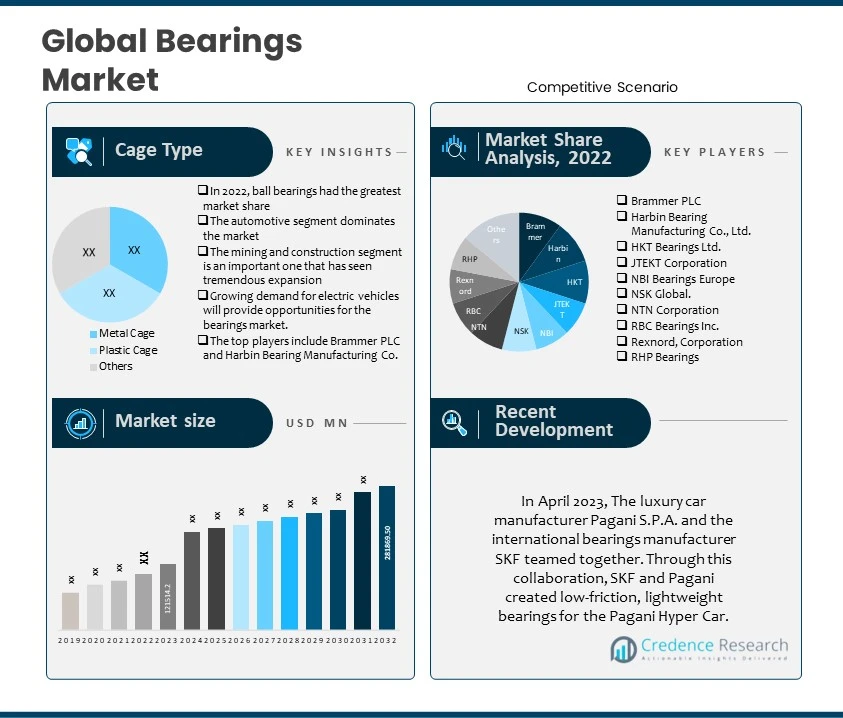
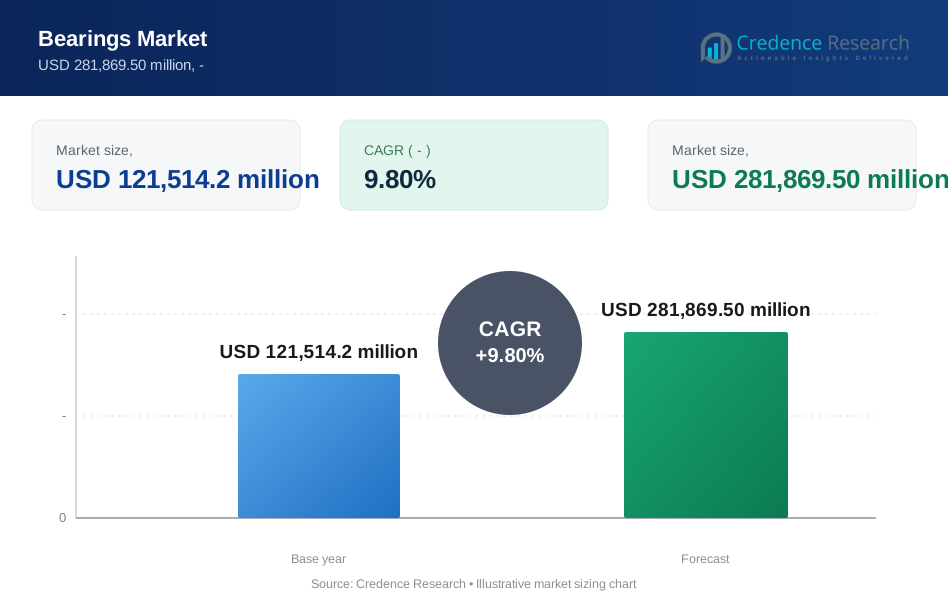
- The anticipated compound annual growth rate (CAGR) for the global market for bearings is 9.80% between 2024 and 2032, taking it from its predicted USD 121514.2 million in 2023 to USD 281869.50 million in 2032.
- The largest category is ball bearings. On the other hand, roller bearings are expected to grow at a strong CAGR.
- The leading application segment is automotive.
- The CAGR for mining and construction is expected to be the highest during the projection period.
- The original equipment manufacturers (OEMs) will have the highest CAGR throughout the prediction period.
- Metal bearings are estimated to have the greatest CAGR during the forecast period.
- The mounted bearings category is predicted to grow fastest over the projection period.
- The metal cage is the category with the fastest anticipated growth throughout the estimated time.
- During the estimated duration, the category with the strongest growth is expected to be linear motion bearings.
- Asia Pacific dominated the bearings market.
- Regarding the market share of bearings, Europe is expected to come second.
- In the bearings market, North America is anticipated to grow fastest.
- Increased industry automation, the growth of the automotive sector, the expansion of renewable energy sources, and the rise in electric vehicle sales, all of which raise demand for the bearings used in electric motors, are the main factors propelling the market's expansion.
- The demand for ceramic bearings, the rise of Industry 4.0, the electric vehicle revolution, and smart bearings are boosting the bearings market.
Executive Summary
Market Definition
The industry that deals with bearings' production, marketing, and distribution is known as the bearing market. By lowering friction between moving parts, bearings are mechanical parts that enable smooth rotation or movement. They are extensively utilized in many different types of machinery and equipment, such as appliances, industrial, automotive, and aerospace machinery.
Market Overview
The bearings sector is estimated to develop at a 9.80% compound annual growth rate (CAGR) between 2024 and 2032, maintaining its current upward trend. The market will keep developing, rising from its estimated value of USD 121514.2 million in 2023 to USD 281869.50 million in 2032.
Sensor-equipped smart bearings can keep an eye on several variables, including load, vibration, and temperature. This makes it possible to monitor conditions in real-time, which aids in the early identification of possible problems like wear, misalignment, or inadequate lubrication. Based on this data, predictive maintenance can shorten equipment downtime and prolong its lifespan. By analyzing the data that smart bearings collect, one can gain insights into the system's overall health and the equipment's performance. Companies may improve productivity, simplify procedures, and make wise decisions about maintenance schedules and component replacements using this information.
Incorporating intelligent bearings is consistent with Industry 4.0 concepts, which involve the communication and cooperation of intelligent, networked systems in production processes. Smart bearings are an integral part of industrial operations' digitalization. The Internet of Things (IoT) ecosystem may include smart bearings, enabling smooth communication between various system components. Users can access real-time data and make decisions from any location thanks to this connectivity, which also makes remote monitoring and control possible. Smart bearing adoption could greatly impact sectors like manufacturing, renewable energy, automotive, and aerospace. The need for these cutting-edge technologies may propel bearing market expansion.
Segmentation by Type
- Ball bearings are the market leader by type. Ball bearings are a rolling element bearing in which two races, or ring-like structures, hold spherical balls. Usually constructed of metal, the balls divide these races.
- The roller bearings category will exhibit a sizable CAGR during the projected period. Designed to enable smooth rotation between two components, roller bearings are a kind of rolling element bearing. Industrial machinery, aerospace, automotive, and other industries all make extensive use of them.
- The need for bearings is additionally supported by other types, including plain bearings and others (thrust bearings, magnetic bearings, etc.).
Segmentation by Application
- The main application is automotive. The industry that manufactures and distributes bearings intended for use in automobiles is known as the automotive bearing market. Mechanical parts called bearings allow rotating or oscillating parts in a machine to move smoothly. In the automotive industry, bearings are essential to many parts that enhance the overall performance and efficiency of cars.
- The aerospace category will likely register a significant CAGR during forecasting. Bearings are essential for aircraft engines because they sustain rotating shafts, like those in auxiliary power units and turbine engines. High-performance, precision bearings are necessary to withstand the extreme temperatures, loads, and speeds encountered in aviation.
- Other applications, such as industrial machinery, construction and mining, energy, agriculture, and others, also contribute to the demand for bearings.
Segmentation by End-Use Industry
- It is projected that the mining and construction category will grow at the fastest rate over the projection period. Massive, heavy machinery plays a vital role in the mining industry for tasks like mineral processing, transportation, and excavation. Conveyor systems, crushers, and grinding mills cannot operate properly without bearings.
- The need for bearings is also influenced by other end-use industries, including automotive, aerospace, agriculture, power transmission, railways, etc.
Segmentation by Distribution Channel
- The original equipment manufacturers (OEMs) category will likely have the highest CAGR during the projection period. Original equipment manufacturers (OEMs) are businesses that create and produce goods or parts that go into the final product of another business. OEMs are businesses that incorporate bearings into their machinery or equipment in the context of the bearing market.
- Other distribution channels, such as aftermarket, also contribute to the demand for bearings.
Segmentation by Material
- The metal bearings will be expected to have the foremost CAGR during the prediction period. Three key purposes of a ball bearing, a rolling element bearing, are to carry weights, lower friction, and position moving machine elements while facilitating motion. Ball bearings utilize balls to divide two "races," or bearing rings, to lessen surface contact and resistance across moving planes.
- Other materials, such as steel bearings, stainless steel bearings, plastic bearings, ceramic bearings, and others, also contribute to the demand for bearings.
Segmentation by Product Type
- Over the projected time frame, mounted bearings are anticipated to have the highest CAGR. Mounted bearings, sometimes referred to as bearing units or housed bearings, are parts that support and position rotating shafts in various machinery and equipment. Mounted bearings are simpler to install and maintain because they are pre-assembled in a housing, unlike standalone bearings.
- Other product types, such as unmounted bearings, also contribute to the demand for bearings.
Segmentation by Cage Type
- The highest CAGR is anticipated throughout the forecast period for the metal cage. Ball bearing cages, sometimes called ball bearing retainers or ball separators, are the parts of ball bearings that separate the balls, keep the balls spaced symmetrically, and, for the most part, keep the bearings together.
- Other cage types, such as plastic cages and others, also contribute to the demand for bearings.
Segmentation by Motion
- It is estimated that the category of linear motion bearings will have the most significant CAGR during the anticipated period. Bearings intended for precise and seamless motion in a straight line are known as linear motion bearings. In contrast to conventional rotary bearings, which allow for rotation, linear motion bearings allow for translation or linear movement along a single axis.
- Rotary motion bearings also contribute to the demand for the bearings market.
Segmentation by Region
- Asia Pacific leads the bearings industry. This is due to the increasing use of automation and the industrial Internet of Things in the bearing manufacturing process in the Asia Pacific.
- Europe is estimated to rank second in market size for bearings.
- The bearings industry is predicted to flourish rapidly in North America.
- The remaining requirement for bearings is covered by regions of the world such as Africa, the Middle East, and Latin America.
The significant increase in demand for tiny single-aisle airplanes and helicopters from emerging nations drives the bearings market's expansion. Several variables that contribute to the overall growth of this industry are driving this spike in demand. Above all, fast economic expansion in emerging economies is driving up demand for aviation and other forms of transportation. The short-haul regional travel needs of small single-aisle aircraft and helicopters are ideally suited to these economies' emerging infrastructure.
Based on projections, the bearings market is anticipated to be controlled by Asia Pacific. In the Asia-Pacific region, there has been significant growth in the automotive and industrial sectors, which are significant users of bearings. The need for machinery, equipment, and vehicles that use bearings has increased as the countries in the region continue to urbanize and industrialize. Over the previous several decades, the Asia-Pacific region has seen notable economic growth. Bearings are in high demand in industries like manufacturing, construction, and automobiles due to this growth's impact on industrialization and infrastructure development. The rise in the bearing market has been attributed to government policies and initiatives that support manufacturing, industrial development, and infrastructure projects. Occasionally, governments will enact laws to draw in foreign capital and encourage the expansion of bearing-related industries.
The bearings market in North America is anticipated to expand fastest throughout the forecast. The market dynamics may be impacted by the existence of significant bearing manufacturers and industry giants in North America. These businesses may dominate the region's bearing industry due to their substantial market shares, wide-ranging distribution networks, and worldwide reach. Companies in North America export a lot of bearings, which helps explain why the region is so dominant in the world market. International alliances and advantageous trade conditions can help them further solidify their position. In the global bearing market, meeting high standards and following industry regulations are essential. North American manufacturer's market dominance and reputation can be strengthened if they continue to produce goods to high standards.
Key Highlights of the Report
The global bearings market is segmented by type, application, end-use industry, distribution channel, material, product type, cage type, motion, and region. As far as the product type is concerned, ball bearings are the market spearhead. Automotive is the top application segment. The mining and construction category is anticipated to increase at the highest CAGR throughout the projection period. The linear motion bearings category will experience the highest CAGR during the forecast period. The bearings market is expanding mostly in Asia Pacific.
Wind turbines are crucial devices because they need bearings in the generator, gearbox, and primary rotor shaft. To support these components' movement and functionality, bearings are becoming more and more necessary as wind energy demand rises. Hydropower system components like generators and turbines require bearings to function properly. A major factor driving up-bearing demand is the expansion of global hydropower projects. The industry is growing due to government policies that support renewable energy projects and provide incentives. As the manufacturing and installation of renewable energy equipment rise, bearings demand rises. The continuous progress in technology for renewable energy systems frequently results in larger and more efficient apparatus creation. The application of more and larger bearings is frequently the result of these advancements.
Asia Pacific is expected to account for the largest bearings market globally. Many nations in the Asia Pacific region invest significantly in infrastructure development initiatives. This includes building railroads, roads, bridges, and other infrastructure that needs bearings for various uses. Manufacturers of bearings frequently grow their businesses to take advantage of the expanding Asia Pacific markets. Dominance in the market is influenced by investments in R&D and the construction of production facilities. The North American region is also assumed to have the market's sharpest growth. The demand for more modern and sophisticated bearing solutions may be fueled by technological advancements such as condition monitoring systems and smart bearings. Bearings market growth may be aided by North America's reputation for strongly emphasizing technological advancements.
Which Key Factors Are Driving The Global Bearings Market?
The primary factors driving the bearings market are the increase in off-highway vehicles, robotics and automation, demand in agriculture, and emphasis on lightweight materials.
What are The Main Challenges Confronting The Bearings Market Globally?
The growth of the bearings industry is hindered by several factors, including competition from alternative technologies, uncertainties in global trade, a decline in demand for automotive aftermarket products, and a slow adoption of e-mobility.
What Market Opportunities Exist For Bearings Globally?
Some factors propelling the bearings market include the incorporation of sensors and Internet of Things (IoT) capabilities into bearings, the growing demand for sealed bearings in various industries, and the growing use of bearings in surgical instruments and medical robotics.
Market Drivers
Multiple factors propel the bearings industry across the globe. The primary factors propelling the global bearings market are as follows:
Growing Need for Precision Bearings
The market's growth is anticipated to be considerably impacted by the rising demand for precision bearings. High levels of accuracy, dependability, and performance are provided by precision bearings, which are specialized parts used in a variety of industries. High benefits like smooth and accurate rotation are a major factor driving up demand for precision bearings in the automotive and heavy engineering sectors. To keep up with the demands of contemporary applications, these advancements necessitate ever more accurate and efficient components. Precision bearings lower energy consumption, guarantee precise and smooth rotation and improve overall performance. The increasing trend of automation in industrial and manufacturing processes is another factor contributing to the rise in demand for precision bearings. The need for precise movement decreases downtime, and increased productivity grows as automation spreads. Precision bearings are crucial parts of automated machinery and robotic systems because they offer the accuracy and dependability they need.
Market Restraints
There are several obstacles that the global bearings market must overcome to continue growing. Among them are the following:
Exorbitant Product Starting Costs
This industry's growth and profitability are hampered by the high maintenance cost and the volatility of raw material prices. Cost fluctuations for raw materials can have a big effect on this sector. Usually composed of polymers, steel, or ceramics, barings are volatile in price. The production costs of bearings are directly impacted by changes in the price of raw materials, which makes it difficult for producers to keep their profit margins and prices steady. Supply chain disruptions may result from manufacturers' inability to consistently find high-quality raw materials at reasonable prices. This industry also frequently has to deal with expensive maintenance costs. Bearings are prone to wear and tear, particularly in high-stress environments like industrial, automotive, and heavy machinery. Routine lubrication, replacement, and maintenance can be expensive for end users. Exorbitant maintenance expenses could deter prospective buyers from purchasing premium bearings, which would reduce demand and impede market expansion. This industry needs to enhance material sourcing tactics, streamline production procedures, and allocate resources to research and development to create more robust and affordable solutions to lessen these difficulties. Partnerships between suppliers and manufacturers can also lower the cost of raw materials and increase industry productivity.
Opportunities
There are plenty of potential prospects in the global bearings industry. Among these are the following:
Growing Utilization of Electric Vehicles
Electric motors are a major component of electric vehicle propulsion. These motors have many rotating parts, each needing strong, long-lasting bearings. High-performance bearings are needed to support the efficient operation of electric motors, and this demand is growing along with the popularity of electric vehicles. Compared to conventional internal combustion engine vehicles, electric vehicles are intended to be more energy-efficient and to meet higher performance standards because of the special difficulties presented by electric drivetrains, such as increased speeds, fluctuating loads, and quick acceleration calls for the use of sophisticated, premium bearings. Regarding challenges, electric drivetrains which include parts like the gearbox and powertrain are not like conventional internal combustion engines. Electric vehicle bearings must be able to manage special loads and function in various environments. Technological advancements have led to developing more powerful and efficient electric drivetrains, which characterize the EV industry. Bearing manufacturers have the chance to innovate and produce specialized bearings that can adapt to the changing needs of these cutting-edge systems as electric vehicle technology advances.
Competitive Landscape
Key Players
Several major competitors exist in the fiercely competitive global bearings market. The following are a few of the leading market participants and their market shares:
- Brammer PLC
- Harbin Bearing Manufacturing Co., Ltd.
- HKT Bearings Ltd.
- JTEKT Corporation
- NBI Bearings Europe
- NSK Global.
- NTN Corporation
- RBC Bearings Inc.
- Rexnord, Corporation
- RHP Bearings
- Schaeffler Group
- SKF Corporation
- The Timken Company
- Others
These companies prioritize product innovation, distribution channel expansion, mergers, and acquisitions to remain competitive.
The largest suppliers in the global bearings market continuously work to keep one step beyond the competition by developing innovative concepts and products.
In November 2023, The Timken Company effectively completed the purchase of Engineered Solutions Group, which is commonly known as iMECH, or Innovative Mechanical Solutions. With a staff of about 70 experts, iMECH is a leading manufacturer of thrust bearings, radial bearings, specialty coatings, and other parts mainly designed for the energy sector. For the calendar year 2023, the company anticipates making about USD 30 million in revenue. The company's reputation as a supplier of all-inclusive solutions for industrial motion and engineered bearings is greatly enhanced by this calculated acquisition.
In September 2023, By launching new products in the areas of torque motors, linear motors, and rotary table bearings, Schaeffler AG deliberately expanded the range of products it offers. Expanded bearing sizes for rotary table and rotary axis bearings are being added, and bearing-integrated angular measuring systems are also being included. The ability of the company to provide a wide range of superior solutions is further strengthened by the standardization of torque motors within the RKIB series, which are now available up to size 690.
Summary of Key Findings
- The market for bearings is being influenced by factors such as the growing manufacturing activities.
- The market is segmented by type, application, end-use industry, distribution channel, material, product type, cage type, motion, and region.
- The most popular product type in the market is ball bearings.
- Automotive is the foremost application category.
- Mining and construction industries are expected to grow fastest regarding CAGR during the forecast period.
- The category for original equipment manufacturers (OEMs) will likely see the highest CAGR during the anticipated time frame.
- Asia Pacific is leading market development; the market is highly competitive with key players including Brammer PLC, Harbin Bearing Manufacturing Co., Ltd., HKT Bearings Ltd., JTEKT Corporation, NBI Bearings Europe, NSK Global., NTN Corporation, RBC Bearings Inc., Rexnord, Corporation, RHP Bearings, Schaeffler Group, SKF Corporation, The Timken Company, and Others.
Future Outlook
- The bearings industry is expected to increase significantly in Asia Pacific and has a positive outlook worldwide.
- The global market is expanding due to the growing demand for ceramic bearings.
- During the projected time frame, one of the main challenges predicted to impede the growth of the bearings market is the substantial initial investment in technology.
- To stay ahead of the competition, key enterprises must develop new products, expand their market reach, and keep their prices competitive.
How CXOs Can Benefit from the Credence Research Bearings Market Report
CXOs may get a detailed picture of the market in the Credence Research Bearings Market Report, which includes:
- Market size and growth forecast: The report provides detailed estimates of the global bearings market size, segmented by type, application, end-use industry, distribution channel, material, product type, cage type, motion, and region. It also includes forecasts for the market through 2032 based on key trends and drivers.
- Market segmentation: The research report breaks down the market for bearings into segments based on type, application, end-use industry, distribution channel, material, product type, cage type, motion, and region. This segmentation provides CXOs with a granular understanding of the market and the opportunities in each segment.
- Competitive landscape: The research report offers a detailed analysis of the major companies in the bearings industry, including information on their business plans, line of products, and earnings. CXOs can use this information to evaluate and identify their competitors.
- Key trends and drivers: The research report identifies and evaluates the main trends and factors influencing the market for bearings. CXOs can use this information to make well-informed choices regarding their plans and investments.
CXOs can use the insights from the Credence Research Bearings Market Report to:
- Identify growth opportunities: With the help of this analysis, CXOs may identify new growth opportunities in the bearings sector. For example, the report identifies the growing demand for bearings from the aerospace industry as a key opportunity.
- Make informed investment decisions: With the help of the report, CXOs can choose bearings wisely. For example, the research study provides information on the critical factors to consider while selecting bearings solutions and evaluating bearings suppliers.
- Develop competitive strategies: The research report can be used by CXOs to develop competitive strategies for their bearings businesses. For example, the research paper outlines the main strategies suppliers of bearings utilize to differentiate themselves from competitors.
- Track market developments: CXOs may stay ahead of the curve by tracking market developments with the aid of this research report. For instance, the research report offers insights into the most recent developments and trends in the market for bearings.
In general, CXOs seeking to expand their industry knowledge and spot growth prospects will find the Credence Research Bearings Market Report a useful tool.
Segmentation
By Type- Ball bearings
- Deep Groove Ball Bearings
- Angular Contact Ball Bearings
- Others
- Roller Bearings
- Cylindrical Roller Bearings
- Tapered Roller Bearings
- Spherical Roller Bearings
- Needle Roller Bearings
- Others
- Plain Bearings
- Others (Thrust Bearings, Magnetic Bearings, etc.)
- Automotive
- Aerospace
- Industrial Machinery
- Construction and Mining
- Energy
- Agriculture
- Others
- Automotive
- Mining and Construction
- Aerospace
- Agriculture
- Power Transmission
- Railways
- Others
- Original Equipment Manufacturers (OEMs)
- Aftermarket
- Metal Bearings
- Steel Bearings
- Stainless Steel Bearings
- Plastic Bearings
- Ceramic Bearings
- Others
- Mounted Bearings
- Unmounted Bearings
- Metal Cage
- Plastic Cage
- Others
- Linear Motion Bearings
- Rotary Motion Bearings
- North America
- The U.S.
- Canada
- Mexico
- Europe
- Germany
- France
- The U.K.
- Italy
- Spain
- Rest of Europe
- Asia Pacific
- China
- Japan
- India
- South Korea
- South-east Asia
- Rest of Asia Pacific
- Latin America
- Brazil
- Argentina
- Rest of Latin America
- Middle East & Africa
- GCC Countries
- South Africa
- Rest of Middle East and Africa
Request a Free Sample
Fill in your details and we'll send you a free sample report.
- Sample data tables & charts
- Research methodology
Need a Custom Version of This Report?
Tailor the scope, geography, or segments to your exact requirements.
- Custom geography or segment scope
- Direct access to our analyst team
Frequently Asked Questions
How much does the global market currently hold for bearings?
What is the bearings market's projected growth rate between 2024 and 2032?
In terms of type, which market category is leading?
Which end-use industry segment is estimated to have the highest CAGR throughout the forecast period?
Who are the main players in the bearings industry globally?
Table of Content
Chapter 1. Report Introduction
- 1.1 Report Description & Purpose
- 1.1.1 Report Title & Market Definition
- 1.1.2 Unique Selling Propositions (USP) & Key Differentiators
- 1.1.3 Value Proposition for Stakeholders
- 1.2 Research Objectives
- 1.2.1 Market Sizing Objectives (Volume & Revenue)
- 1.2.2 Segmentation Objectives
- 1.2.3 Competitive Intelligence Objectives
- 1.2.4 Forecast & Scenario Objectives
- 1.3 Report Scope
- 1.3.1 Bearings Scope – Types & Subtypes Covered
- 1.3.2 Geographic Scope – Regions & Countries Covered
- 1.3.3 Historical Period, Base Year & Forecast Period (the historical period; forecast to the forecast period)
- 1.3.4 Inclusions & Exclusions
- 1.4 HS Code & Classification Framework
- 1.5 Currency, Units & Pricing Basis
- 1.6 Target Stakeholders
- 1.7 Limitations & Assumptions
Chapter 2. Executive Summary
- 2.1 Global Bearings Market Snapshot
- 2.1.1 Market Size – Historical (the historical period) & Forecast (the forecast period) (base year: USD 121,514.2 million → forecast year: USD 281,869.50 million)
- 2.1.2 Volume & Revenue – Global Totals
- 2.1.3 Key Market Highlights – Top Five Facts
- 2.2 Bearings Market Segmentation Snapshot
- 2.2.1 Market Split by Region – vs.
- 2.3 Competitive Snapshot
- 2.3.1 Top 10 Players by Revenue Share –
- 2.3.2 Top 10 Players by Volume Share –
- 2.3.3 Recent Strategic Developments (18-Month Summary)
- 2.4 Key Investment Highlights & Strategic Conclusions
Chapter 3. Bearings Market Dynamics & Industry Analysis
- 3.1 Market Overview & Context
- 3.1.1 Bearings Market Position in the Broader Automotive Value Chain
- 3.1.2 OEM vs. Replacement Market Dynamics
- 3.1.3 Market Maturity & Development Stage by Region
- 3.2 Bearings Market Drivers
- 3.3 Bearings Market Restraints & Challenges
- 3.4 Bearings Market Opportunities
- 3.5 Porter's Five Forces Analysis
- 3.5.1 Threat of New Entrants
- 3.5.2 Bargaining Power of Suppliers
- 3.5.3 Bargaining Power of Buyers
- 3.5.4 Threat of Substitutes
- 3.5.5 Competitive Rivalry – Intensity Assessment
- 3.6 Bearings Value Chain Analysis
- 3.6.1 Upstream – Raw Material/Input Suppliers
- 3.6.1.1 Raw Material/Input 1
- 3.6.1.2 Raw Material/Input 2
- 3.6.1.3 Raw Material/Input 3
- 3.6.2 Midstream – Production/Manufacturing/Service Delivery
- 3.6.2.1 Production/Process Overview
- 3.6.2.2 Key Facility Locations & Capacity by Manufacturer
- 3.6.3 Downstream – Distribution & End Consumer
- 3.6.3.1 Primary Channel – B2B/OEM
- 3.6.3.2 Secondary Channels – Dealer, Retail, Online, Direct
- 3.6.4 Value Chain Profitability Analysis
- 3.6.1 Upstream – Raw Material/Input Suppliers
- 3.7 PESTEL Analysis
- 3.7.1 Political Factors
- 3.7.2 Economic Factors
- 3.7.3 Social Factors
- 3.7.4 Technological Factors
- 3.7.5 Environmental Factors
- 3.7.6 Legal Factors
- 3.8 Bearings Supply Chain Analysis
- 3.8.1 Raw Material/Input Supply Risk Assessment
- 3.8.2 Manufacturing Concentration Risk (Geographic Exposure)
- 3.8.3 Trade Disruption Impact Analysis
- 3.9 Regulatory & Policy Landscape
Note: The regulatory and policy landscape section covers regulations based on their applicability to the market, Bearings category, geography, and scope of the study. Only regulatory frameworks with a material impact on operations, compliance, trade, sustainability, or market access are analyzed in detail.
Chapter 4. Key Investment Pockets & Opportunity Analysis
- 4.1 Bearings Market Attractiveness Analysis
- 4.1.1 By Region – Investment Attractiveness Matrix (Volume × CAGR)
- 4.2 Absolute Revenue Growth Opportunity
- 4.2.1 By Region – Absolute USD Growth Through the forecast period
- 4.3 Incremental Volume Opportunity
- 4.3.1 By Region – Incremental Volume Through the forecast period
- 4.3.2 Segment – Incremental Volume
- 4.4 Emerging Submarket Opportunity Deep Dive (Subject to Applicability)
- 4.5 Emerging Market Opportunity Scorecards
- 4.5.1 United States
- 4.5.2 Europe
- 4.5.3 Asia
- 4.5.4 Middle East & Africa
Note: Emerging Market Opportunity Scorecards will be included based on relevance and strategic importance. Regions listed are indicative and may vary depending on data availability and market dynamics.
Chapter 5. Bearings Import-Export Analysis & Trade Flows
- 5.1 Global Trade Overview
- 5.1.1 Global Export Value by Country (the historical period)
- 5.1.2 Global Export Volume by Country (the historical period)
- 5.1.3 Global Import Value by Country (the historical period)
- 5.1.4 Global Import Volume by Country (the historical period)
- 5.1.5 Net Trade Balance by Country (the historical period)
- 5.2 Export Analysis – Segment
- 5.2.1 Type 1 (HS Code)
- 5.2.2 Type 2 (HS Code)
- 5.2.3 Type 3 (HS Code)
- 5.2.4 Type 4 (HS Code)
- 5.2.5 Type 5 (HS Code)
- 5.3 Import Analysis – Segment
- 5.3.1 Type 1 (HS Code)
- 5.3.2 Type 2 (HS Code)
- 5.3.3 Type 3 (HS Code)
- 5.3.4 Type 4 (HS Code)
- 5.3.5 Type 5 (HS Code)
- 5.4 Average Unit Trade Prices
- 5.4.1 Average Export Price – Segment & Country
- 5.4.2 Average Import Price – Segment & Source Country
- 5.4.3 Price Trends (the historical period)
- 5.5 Key Trade Route Analysis
- 5.5.1 Trade Route 1
- 5.5.2 Trade Route 2
- 5.5.3 Trade Route 3
- 5.5.4 Trade Route 4
- 5.5.5 Trade Route 5
- 5.6 Trade Policy Impact Assessment
- 5.6.1 US Anti-Dumping & Section 301 Tariffs
- 5.6.2 EU Customs Union Impact
- 5.6.3 Major Free Trade Agreements
- 5.6.4 USMCA Rules of Origin
Note: Trade policy analysis will be included only where relevant to the Bearings market.
Chapter 6. Competitive Landscape & Company Benchmarking
- 6.1 Bearings Market Concentration & Structure
- 6.1.1 Herfindahl-Hirschman Index (HHI) – vs.
- 6.1.2 Tier 1, Tier 2 & Tier 3 Market Structure
- 6.1.3 Global, Regional & Local Player Dynamics
- 6.2 Bearings Market Share Analysis –
- 6.2.1 Global Revenue Share by Company
- 6.2.2 Global Volume Share by Company
- 6.2.3 Regional Revenue Share
- 6.2.4 Market Share Evolution ( vs. )
- 6.2.5 OEM Segment Share by Company
- 6.2.6 Replacement Segment Share by Company
- 6.3 Production/Delivery Capacity & Facility Analysis
- 6.3.1 Global Installed Capacity
- 6.3.2 Capacity Utilization Rates
- 6.3.3 Production/Output Volume
- 6.3.4 Facility Locations & Capacity Map
- 6.3.5 Planned Capacity Additions
- 6.4 Bearings Competitive Benchmarking Matrix
- 6.4.1 Revenue, Volume, CAGR & Profitability Comparison
- 6.4.2 Channel Revenue Mix
- 6.4.3 Geographic Revenue Exposure
- 6.4.4 R&D Intensity
- 6.4.5 Sustainability Maturity
- 6.5 Strategic Developments in Bearings (Last 24 Months)
- 6.5.1 Mergers, Acquisitions & Divestments
- 6.5.2 New Bearings Launches
- 6.5.3 Facility Expansions
- 6.5.4 Strategic Alliances, Joint Ventures & Partnerships
- 6.5.5 Distribution Expansion & Market Entry
- 6.5.6 Sustainability & ESG Initiatives
- 6.6 Competitive Strategy Mapping
- 6.6.1 Leader, Challenger, Follower & Niche Classification
- 6.6.2 Pricing Strategy Comparison
- 6.6.3 Channel Strategy Matrix
Note: Strategic developments are included based on their materiality and the availability of reliable information.
Chapter 7. Global Bearings Market – By Distribution Channel
- 7.1 Segment Overview
- 7.1.1 Volume & Revenue Split by Channel ( & )
- 7.1.2 Channel Mix Evolution (the forecast period)
Chapter 8. Regional Market Analysis – Global Overview
- 8.1 Global Regional Overview
- 8.1.1 Regional Volume Share
- 8.1.2 Regional Revenue Share
- 8.1.3 Regional Volume by Region
- 8.1.4 Regional Revenue by Region
- 8.1.5 Regional Forecast Through the forecast period
- 8.2 Cross-Regional Segment Analysis
- 8.2.1 By Distribution Channel
- 8.2.2 By Brand/Price Tier
Chapter 9. North America Bearings Market
- 9.1 United States
- 9.2 Canada
- 9.3 Mexico
Chapter 10. Europe Bearings Market
- 10.1 Germany
- 10.2 France
- 10.3 Italy
- 10.4 United Kingdom
- 10.5 Spain
- 10.6 Poland
- 10.7 Russia
- 10.8 Netherlands
- 10.9 Belgium
- 10.10 Sweden
- 10.11 Denmark
- 10.12 Norway
- 10.13 Rest of Europe
Chapter 11. Asia Pacific Bearings Market
- 11.1 China
- 11.2 India
- 11.3 Japan
- 11.4 South Korea
- 11.5 Thailand
- 11.6 Indonesia
- 11.7 Vietnam
- 11.8 Malaysia
- 11.9 Australia
- 11.10 Rest of Asia Pacific
Chapter 12. Latin America Bearings Market
- 12.1 Brazil
- 12.2 Argentina
- 12.3 Colombia
- 12.4 Chile
- 12.5 Rest of Latin America
Chapter 13. Middle East Bearings Market
- 13.1 Saudi Arabia
- 13.2 United Arab Emirates
- 13.3 Turkey
- 13.4 Israel
- 13.5 Iran
- 13.6 Rest of the Middle East
Chapter 14. Africa Bearings Market
- 14.1 South Africa
- 14.2 Egypt
- 14.3 Nigeria
- 14.4 Morocco
- 14.5 Rest of Africa
Chapter 15. Bearings Company Profiles
- 15.1 [Company 01]
- 15.1.1 Company Overview
- 15.1.2 Key Management Personnel
- 15.1.3 Products & Services Portfolio
- 15.1.4 Financial Performance
- 15.1.5 Key Market Focus & Geographic Presence
- 15.1.6 Recent Developments & Strategic Initiatives
Note: The company profile list is preliminary and may change based on research findings, market developments, data availability, and client requirements.
Chapter 16. Appendices
- Appendix A – List of Abbreviations & Acronyms
- Appendix B – Industry Classification Code Reference – Full Series
- Appendix C – Production & Capacity Data Tables
- Appendix D – End-Use & Demand Base Tables
- Appendix E – Consumption & Replacement Rate Assumptions
- Appendix F – ASP Reference Tables
- Appendix G – Manufacturing & Facility Database
- Appendix H – Import-Export Data Tables
- Appendix I – Regulatory Summary Tables
- Appendix J – Primary Research Participant List (Anonymized)
- Appendix K – Primary Research Questionnaire Framework
- Appendix L – Data Sources & Bibliography
- Appendix M – Market Size Divergence & Source Comparison
Chapter 17. Research Methodology
- 17.1 Research Framework & Philosophy
- 17.2 Secondary Research – Sources, Hierarchy & Data Extraction
- 17.3 Data Modeling – Bottom-Up & Top-Down Market Sizing
- 17.4 Primary Research – Stakeholder Framework, LOI & Sample Sizes
- 17.5 Forecast Methodology – Regression, Scenario & Sensitivity Analysis
- 17.6 Quality Control – Four-Layer Validation Framework
- 17.7 Limitations & Standard Assumptions
- 17.8 Disclaimer
