
Market Overview
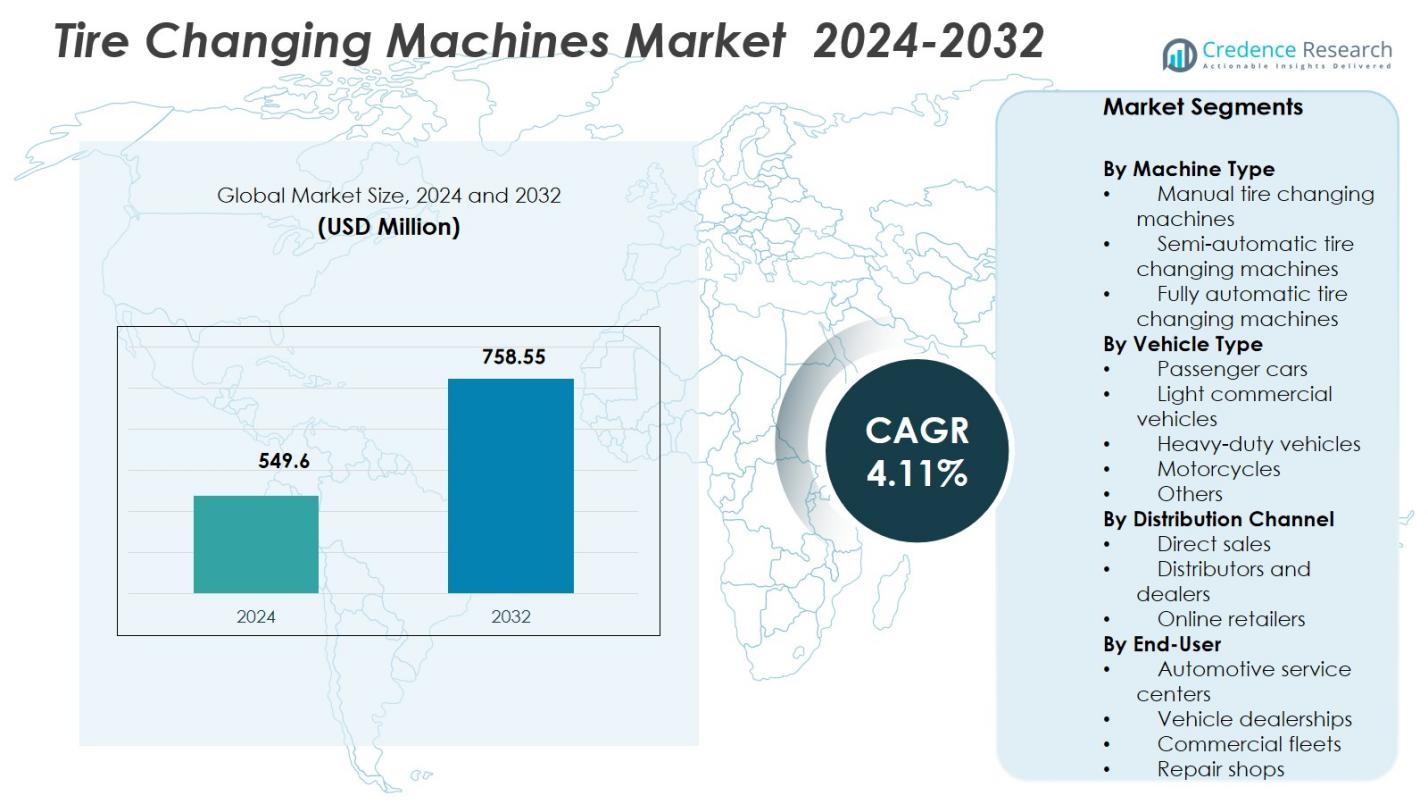
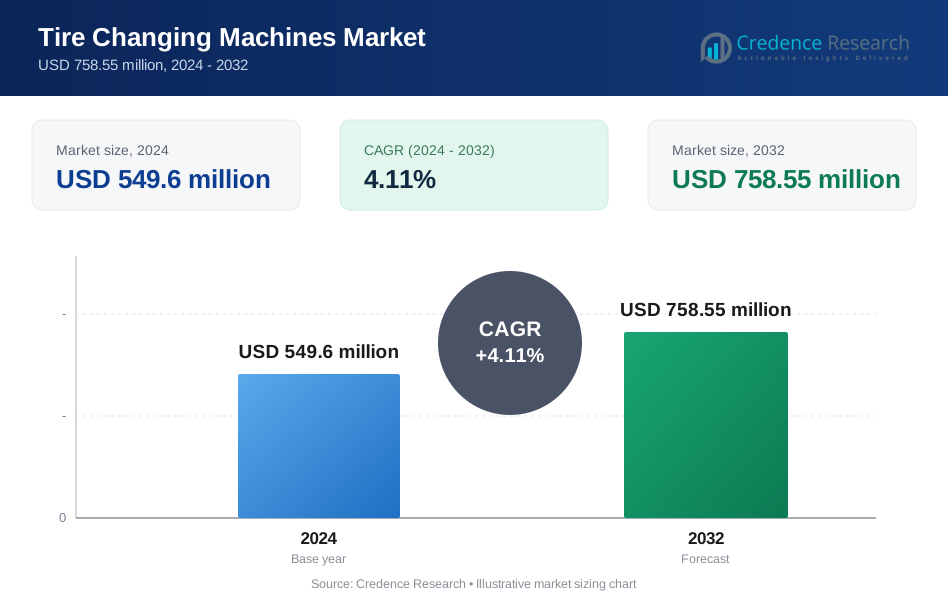
Tire Changing Machines Market size was valued at USD 549.6 million in 2024 and is anticipated to reach USD 758.55 million by 2032, expanding at a CAGR of 4.11% during the forecast period.
| REPORT ATTRIBUTE | DETAILS |
|---|---|
| Historical Period | 2020-2023 |
| Base Year | 2024 |
| Forecast Period | 2025-2032 |
| Tire Changing Machines Market Size 2024 | USD 549.6 Million |
| Tire Changing Machines Market, CAGR | 4.11% |
| Tire Changing Machines Market Size 2032 | USD 758.55 Million |
Tire Changing Machines Market is characterized by the strong presence of established manufacturers that focus on technology innovation, ergonomic design, and wide service networks. Key companies such as Hunter Engineering Company, Bosch Automotive Service Solutions, Snap-on Incorporated, Corghi S.p.A., Ravaglioli S.p.A., Hofmann Megaplan, Giuliano Group, SICE (SAE), Alpina Tyre Group Co., Ltd., and Twin Busch GmbH strengthen market positioning through advanced product portfolios and reliable after-sales support. These players emphasize automation, safety, and efficiency to address the evolving needs of automotive workshops. Regionally, North America leads with a 34.2% market share, supported by a mature aftermarket ecosystem and high equipment adoption, followed by Europe at 29.6% driven by regulatory compliance and service standardization, and Asia Pacific at 24.1% fueled by expanding vehicle fleets and service infrastructure.
Market Insights
- The Tire Changing Machines Market was valued at USD 549.6 million in 2024 and is projected to reach USD 758.55 million by 2032, expanding at a CAGR of 4.11% driven by steady growth in automotive aftermarket services.
- Rising global vehicle parc and increasing tire replacement frequency drive demand, with semi-automatic tire changing machines leading the market at a 44.6% share due to their cost-efficiency and operational flexibility.
- Automation, ergonomic design, and digital control integration shape market trends as workshops prioritize faster service turnaround and reduced labor dependency.
- Market participants such as Hunter Engineering Company, Bosch Automotive Service Solutions, Snap-on Incorporated, and Corghi S.p.A. strengthen positioning through product innovation, distributor expansion, and after-sales service focus.
- North America leads with a 34.2% share, followed by Europe at 29.6% and Asia Pacific at 24.1%, supported by mature service infrastructure, regulatory compliance, and expanding vehicle ownership.
Market Segmentation Analysis:
By Machine Type:
The Tire Changing Machines Market by machine type is led by semi-automatic tire changing machines, accounting for 44.6% market share in 2024. This dominance is driven by their optimal balance between affordability, efficiency, and ease of operation, making them widely preferred across small and mid-sized automotive workshops. Semi-automatic machines reduce manual effort while maintaining lower capital costs than fully automatic systems. Growing vehicle parc, rising tire replacement frequency, and increasing adoption among independent service centers continue to support demand. Manual machines retain relevance in cost-sensitive markets, while fully automatic systems gain traction in premium service environments.
- For instance, Hunter Engineering's Revolution offers fully automatic operation with a leverless tool head, 12-30 inch rim range, and 875 ft-lbs torque for diverse wheel assemblies. It eliminates skilled operator needs in premium workshops through consistent automated processes.
By Vehicle Type:
By vehicle type, passenger cars dominate the Tire Changing Machines Market with a 52.8% share, supported by the large global passenger vehicle fleet and frequent tire replacement cycles. High urbanization rates, increasing vehicle ownership, and growing demand for routine maintenance services strongly reinforce this segment’s leadership. Service centers prioritize equipment optimized for passenger cars due to high service volumes and faster turnaround requirements. Light commercial vehicles follow, driven by logistics growth, while heavy-duty vehicles rely on specialized equipment. Motorcycles and other vehicle categories contribute steadily, supported by expanding two-wheeler ownership in emerging economies.
- For instance, Ravaglioli's heavy-duty models like the G1190.30 use leverless tools for low-profile tires up to 24", with servo-assisted arms and inverter motors limited to 15 rpm for safe operation on LCV wheels.
By Distribution Channel:
The distribution channel landscape is led by distributors and dealers, holding a 47.3% market share, driven by their strong regional presence, installation support, and after-sales service capabilities. Workshops prefer dealer networks for technical assistance, training, and reliable spare part availability, which directly enhances equipment uptime. Direct sales remain significant among large service chains and OEM-aligned workshops seeking customization and bulk procurement advantages. Online retailers are expanding rapidly, supported by digital procurement trends and price transparency, although their adoption remains limited to smaller machines and replacement components rather than heavy-duty systems.
Key Growth Drivers
Rising Global Vehicle Parc and Aftermarket Service Demand
The growing global vehicle parc remains a fundamental driver for the Tire Changing Machines Market, supported by increasing ownership of passenger cars and light commercial vehicles. Higher vehicle utilization results in faster tire wear and more frequent replacement cycles, directly increasing demand for tire servicing equipment. Automotive workshops and multi-brand service centers invest in advanced tire changing machines to handle rising service volumes efficiently. Expansion of organized aftermarket networks and dealership-led service models further reinforces sustained demand for reliable and high-throughput tire changing solutions.
- For instance, Corghi's Artiglio Master FORCE employs hydraulic synchronized movements in its Smart Corghi System tool unit to eliminate tire-rim tension on low-profile and run-flat tires, allowing precise automation for faster servicing in organized aftermarket networks.
Expansion of Automotive Service Infrastructure
Rapid expansion of automotive service infrastructure significantly accelerates market growth, particularly across emerging economies. New dealership workshops, franchised service centers, and independent garages are being established to support rising vehicle populations. Tire changing machines are essential equipment in these facilities, encouraging consistent procurement and technology upgrades. Regulatory emphasis on road safety inspections and periodic vehicle maintenance further stimulates equipment demand. As service operations scale, workshops increasingly adopt semi-automatic and fully automatic systems to improve productivity and standardize service quality.
- For instance, Maruti Suzuki opened its 5,000th Arena Service outlet in Coimbatore, Tamil Nadu, expanding the nationwide network to over 5,640 touchpoints across 2,818 cities.
Increasing Focus on Operational Efficiency and Labor Optimization
Automotive service providers are increasingly focused on improving operational efficiency and reducing labor dependency. Rising labor costs and skilled technician shortages push workshops toward mechanized tire changing solutions. Modern machines reduce manual effort, minimize errors, and ensure faster service turnaround. These advantages directly enhance workshop profitability and customer satisfaction. High-volume service centers prioritize equipment upgrades to maintain consistent service output, making tire changing machines a strategic investment rather than a discretionary purchase.
Key Trends & Opportunities
Integration of Automation and Smart Technologies
Automation and smart technology integration represent a major trend shaping the Tire Changing Machines Market. Manufacturers are introducing digitally controlled systems, automated clamping, precision bead-breaking, and user-friendly interfaces. These features improve operational accuracy, reduce operator training time, and enhance safety. Smart diagnostics and connectivity enable predictive maintenance and higher equipment uptime. As workshops modernize and align with digital service models, demand for technologically advanced tire changing machines continues to strengthen.
- For instance, Giuliano Automotive's T-REC tire changer features intelligent software that automatically manages complete tire bead loosening and demounting cycles without operator intervention.
Expansion of Digital Sales and Equipment Accessibility
The growing use of digital sales platforms creates new opportunities by improving equipment accessibility for small and independent workshops. Online channels offer product transparency, competitive pricing, and faster procurement, particularly in regions with limited dealer presence. Manufacturers leveraging e-commerce benefit from broader market reach and direct customer engagement. Virtual demonstrations, remote technical support, and digital catalogs further support adoption, especially for compact and mid-range tire changing machines.
- For instance, Snap-on provides digital catalogs and remote product consultations for workshop equipment, allowing customers to compare machine features and service requirements without in-person visits.
Key Challenges
High Capital Investment and Cost Constraints
High capital investment requirements remain a critical challenge, especially for small and price-sensitive workshops. Advanced tire changing machines involve significant upfront costs, limiting adoption in developing markets. Budget-constrained service providers often rely on manual or refurbished equipment to manage expenses. Volatility in raw material prices also affects equipment pricing, influencing purchasing decisions. Longer return-on-investment cycles continue to restrict rapid penetration of high-end systems.
Technical Complexity and Maintenance Dependence
Technical complexity and maintenance dependency pose additional challenges for market growth. Advanced tire changing machines require skilled operators, routine servicing, and timely calibration to maintain performance. Limited availability of trained technicians and spare parts in certain regions increases downtime risks. Maintenance costs add to total ownership expenses, discouraging adoption among smaller workshops. These operational challenges slow penetration of automated systems, particularly in rural and emerging service markets.
Regional Analysis
North America
North America holds 34.2% market share in the Tire Changing Machines Market, driven by a mature automotive aftermarket and strong presence of organized service chains. High vehicle ownership rates, frequent tire replacement cycles, and widespread adoption of advanced workshop equipment support sustained demand. Service centers prioritize semi-automatic and fully automatic machines to improve throughput and ensure consistent service quality. Strong dealer networks, availability of skilled technicians, and early adoption of automation further strengthen the regional market. The United States remains the primary contributor, supported by a large passenger vehicle fleet and continuous investments in service infrastructure modernization.
Europe
Europe accounts for 29.6% market share, supported by stringent vehicle inspection regulations and a well-established automotive service ecosystem. High penetration of dealership workshops and multi-brand garages drives consistent demand for efficient tire changing equipment. European service providers emphasize safety, precision, and ergonomic solutions, supporting adoption of technologically advanced machines. Growth is further reinforced by a strong passenger car base, increasing seasonal tire change requirements, and rising replacement demand. Countries such as Germany, France, and Italy play a central role, supported by the presence of leading equipment manufacturers and robust distributor networks.
Asia Pacific
Asia Pacific represents 24.1% market share, driven by rapid growth in vehicle ownership and expanding automotive service infrastructure. Rising disposable incomes, urbanization, and increasing passenger car and two-wheeler populations significantly boost tire servicing demand. Independent garages and emerging organized service chains are investing in semi-automatic machines to balance cost and efficiency. China and India remain key growth engines due to large vehicle fleets and expanding aftermarket services. Increasing adoption of modern workshop equipment and gradual shift toward automation continue to strengthen long-term market potential across the region.
Latin America
Latin America holds 7.1% market share, supported by steady growth in vehicle parc and expanding independent automotive workshops. Demand is primarily driven by passenger cars and light commercial vehicles, with service centers favoring cost-effective semi-automatic and manual tire changing machines. Brazil and Mexico lead regional adoption due to higher vehicle density and improving service infrastructure. Growing awareness of preventive vehicle maintenance and gradual expansion of organized service formats contribute to equipment demand. However, price sensitivity and limited access to advanced systems moderate adoption of fully automated machines.
Middle East & Africa
The Middle East & Africa region accounts for 5.0% market share, driven by increasing vehicle imports and gradual expansion of automotive service facilities. Demand is supported by rising passenger car ownership and growth in commercial fleets, particularly in Gulf countries. Service centers focus on durable and easy-to-maintain tire changing machines suited to harsh operating environments. The presence of independent garages dominates the market, encouraging demand for semi-automatic solutions. While adoption of advanced systems remains limited, infrastructure development and growing automotive aftermarket activity continue to support steady regional growth.
Market Segmentations:
By Machine Type
- Manual tire changing machines
- Semi-automatic tire changing machines
- Fully automatic tire changing machines
By Vehicle Type
- Passenger cars
- Light commercial vehicles
- Heavy-duty vehicles
- Motorcycles
- Others
By Distribution Channel
- Direct sales
- Distributors and dealers
- Online retailers
By End-User
- Automotive service centers
- Vehicle dealerships
- Commercial fleets
- Repair shops
By Geography
- North America
- U.S.
- Canada
- Mexico
- Europe
- Germany
- France
- U.K.
- Italy
- Spain
- Rest of Europe
- Asia Pacific
- China
- Japan
- India
- South Korea
- South-east Asia
- Rest of Asia Pacific
- Latin America
- Brazil
- Argentina
- Rest of Latin America
- Middle East & Africa
- GCC Countries
- South Africa
- Rest of the Middle East and Africa
Competitive Landscape
Competitive landscape analysis of the Tire Changing Machines Market highlights a moderately consolidated structure characterized by strong brand presence, technological differentiation, and extensive distribution networks. Hunter Engineering Company, Bosch Automotive Service Solutions, Snap-on Incorporated, Corghi S.p.A., Ravaglioli S.p.A., Hofmann Megaplan, Giuliano Group, and SICE (SAE) dominate the market through continuous product innovation and global dealer coverage. Leading players focus on automation, ergonomic design, and digital controls to improve operational efficiency and reduce labor dependency for workshops. Strategic initiatives include product portfolio expansion, regional distributor partnerships, and enhanced after-sales service capabilities. Manufacturers increasingly target emerging markets by offering cost-optimized semi-automatic models while maintaining premium automated solutions for high-volume service centers. Competitive intensity is further shaped by investments in training, technical support, and customization, enabling key players to strengthen customer loyalty and sustain long-term market positioning.
Key Player Analysis
- Corghi S.p.A.
- Giuliano Group
- Hofmann Megaplan
- Alpina Tyre Group Co., Ltd.
- Snap-on Incorporated
- Twin Busch GmbH
- Bosch Automotive Service Solutions
- Hunter Engineering Company
- Ravaglioli S.p.A.
- SICE (SAE)
Recent Developments
- In November 2025, Hunter Engineering launched the TCX51C Pro tire changer at SEMA 2025, featuring a hybrid leverless mount head for handling large tires, a lower locking disc for bottom bead demounting, and the FastBlast inflation system for challenging fitments.
- In November 2025, Rotary Solutions demonstrated the R1250 tire changer at SEMA 2025, equipped with dual bead rollers, front-loading wheel lift, and variable speed control for challenging wheels.
- In February 2024, Rabaconda introduced its All-New Mini Tire Changers designed to quickly and easily change motorcycle tires from 10 to 17 inches, enhancing workshop versatility and service efficiency.
Report Coverage
The research report offers an in-depth analysis based on Machine Type, Vehicle Type, Distribution Channel, End User and Geography. It details leading market players, providing an overview of their business, product offerings, investments, revenue streams, and key applications. Additionally, the report includes insights into the competitive environment, SWOT analysis, current market trends, as well as the primary drivers and constraints. Furthermore, it discusses various factors that have driven market expansion in recent years. The report also explores market dynamics, regulatory scenarios, and technological advancements that are shaping the industry. It assesses the impact of external factors and global economic changes on market growth. Lastly, it provides strategic recommendations for new entrants and established companies to navigate the complexities of the market.
Future Outlook
- The market will benefit from sustained growth in global vehicle ownership and expanding automotive aftermarket services.
- Demand will increasingly shift toward semi-automatic and fully automatic machines to improve service speed and consistency.
- Workshops will prioritize equipment that reduces labor dependency and enhances operator safety and ergonomics.
- Automation and digital control features will gain wider adoption across organized service centers and dealerships.
- Manufacturers will focus on cost-optimized models to address price-sensitive independent workshops.
- Emerging economies will remain key growth engines due to expanding service infrastructure and vehicle fleets.
- Distributor and dealer networks will continue to play a critical role in market penetration and customer support.
- Equipment customization for different vehicle types will strengthen supplier differentiation.
- After-sales service, training, and technical support will become decisive factors in purchase decisions.
- Continuous product innovation will remain essential to sustain long-term competitiveness in the market.
Request a Free Sample
Fill in your details and we'll send you a free sample report.
- Sample data tables & charts
- Research methodology
Need a Custom Version of This Report?
Tailor the scope, geography, or segments to your exact requirements.
- Custom geography or segment scope
- Direct access to our analyst team
Frequently Asked Questions
What is the current market size for the Tire Changing Machines Market, and what is its projected size in 2032?
At what Compound Annual Growth Rate is the Tire Changing Machines Market projected to grow between 2024 and 2032?
Which Tire Changing Machines Market segment held the largest share in 2024?
What are the primary factors fueling the growth of the Tire Changing Machines Market?
Who are the leading companies in the Tire Changing Machines Market?
Which region commanded the largest share of the Tire Changing Machines Market in 2024?
Table of Content
Chapter 1. Report Introduction
- 1.1 Report Description & Purpose
- 1.1.1 Report Title & Market Definition
- 1.1.2 Unique Selling Propositions (USP) & Key Differentiators
- 1.1.3 Value Proposition for Stakeholders
- 1.2 Research Objectives
- 1.2.1 Market Sizing Objectives (Volume & Revenue) (Volume Where Applicable)
- 1.2.2 Segmentation Objectives
- 1.2.3 Competitive Intelligence Objectives
- 1.2.4 Forecast & Scenario Objectives
- 1.3 Report Scope
- 1.3.1 Tire Changing Machines Scope – Segments & Subsegments Covered
- 1.3.2 Geographic Scope – Regions & Countries Covered
- 1.3.3 Historical Period, Base Year & Forecast Period (2024; forecast to 2032)
- 1.3.4 Inclusions & Exclusions
- 1.4 Industry Classification & Applicable Codes
- 1.5 Currency, Measurement Units & Valuation Basis
- 1.6 Target Stakeholders
- 1.7 Limitations & Assumptions
Chapter 2. Executive Summary
- 2.1 Global Tire Changing Machines Market Snapshot
- 2.1.1 Market Size – Historical (2024) & Forecast (2024-2032) (2024: USD 549.6 million → 2032: USD 758.55 million)
- 2.1.2 Volume & Revenue – Global Totals (Volume Where Applicable)
- 2.1.3 Key Market Highlights – Top Five Facts
- 2.2 Tire Changing Machines Market Segmentation Snapshot
- 2.2.1 Market Split by Region – 2024 vs. 2032
- 2.3 Competitive Snapshot
- 2.3.1 Top 10 Players by Revenue Share – 2024
- 2.3.2 Top 10 Players by Volume Share – 2024 (Volume Where Applicable)
- 2.3.3 Recent Strategic Developments (18-Month Summary)
- 2.4 Key Investment Highlights & Strategic Conclusions
Chapter 3. Tire Changing Machines Market Dynamics & Industry Analysis
- 3.1 Market Overview & Context
- 3.1.1 Tire Changing Machines Market Position in the Broader Industry Value Chain
- 3.1.2 Demand Structure & Purchasing Dynamics
- 3.1.3 Market Maturity & Development Stage by Region
- 3.2 Tire Changing Machines Market Drivers
- 3.3 Tire Changing Machines Market Restraints & Challenges
- 3.4 Tire Changing Machines Market Opportunities
- 3.5 Porter's Five Forces Analysis
- 3.5.1 Threat of New Entrants
- 3.5.2 Bargaining Power of Suppliers
- 3.5.3 Bargaining Power of Buyers
- 3.5.4 Threat of Substitutes
- 3.5.5 Competitive Rivalry – Intensity Assessment
- 3.6 Tire Changing Machines Value Chain Analysis
- 3.6.1 Upstream – Key Inputs, Resources & Suppliers
- 3.6.1.1 Key Input/Resource 1
- 3.6.1.2 Key Input/Resource 2
- 3.6.1.3 Key Input/Resource 3
- 3.6.2 Midstream – Core Operations & Value Creation
- 3.6.2.1 Operating Model & Process Overview
- 3.6.2.2 Key Operating Locations & Capabilities by Company
- 3.6.3 Downstream – Market Channels & End Users
- 3.6.3.1 Direct Sales & Customer Engagement Channels
- 3.6.3.2 Indirect Sales, Intermediaries & Partner Channels
- 3.6.4 Value Chain Profitability Analysis
- 3.6.1 Upstream – Key Inputs, Resources & Suppliers
- 3.7 PESTEL Analysis
- 3.7.1 Political Factors
- 3.7.2 Economic Factors
- 3.7.3 Social Factors
- 3.7.4 Technological Factors
- 3.7.5 Environmental Factors
- 3.7.6 Legal Factors
- 3.8 Tire Changing Machines Supply Chain Analysis
- 3.8.1 Critical Input & Resource Availability Risk Assessment
- 3.8.2 Supplier & Operational Concentration Risk (Geographic Exposure)
- 3.8.3 Supply & Service Disruption Impact Analysis
- 3.9 Regulatory & Policy Landscape
Note: The regulatory and policy landscape section covers regulations based on their applicability to the market, Tire Changing Machines category, geography, and scope of the study. Only regulatory frameworks with a material impact on operations, compliance, trade, sustainability, or market access are analyzed in detail.
Chapter 4. Key Investment Pockets & Opportunity Analysis
- 4.1 Tire Changing Machines Market Attractiveness Analysis
- 4.1.1 By Region – Investment Attractiveness Matrix (Market Size × CAGR)
- 4.2 Absolute Revenue Growth Opportunity
- 4.2.1 By Region – Absolute Revenue Growth Through 2032
- 4.3 Incremental Demand Opportunity
- 4.3.1 By Region – Incremental Demand Through 2032
- 4.3.2 Segment – Incremental Demand
- 4.4 Emerging Submarket Opportunity Deep Dive (Subject to Applicability)
- 4.5 Priority Market Opportunity Scorecards
- 4.5.1 United States
- 4.5.2 Europe
- 4.5.3 Asia
- 4.5.4 Middle East & Africa
Note: Priority market opportunity scorecards reflect the geographic scope and strategic relevance of the study. Listed markets are indicative and may be adapted to the industry.
Chapter 5. Tire Changing Machines Cross-Border Trade & Market Access Analysis
- 5.1 International Trade & Cross-Border Activity Overview
- 5.1.1 Global Export Value by Country (2024)
- 5.1.2 Global Export Volume by Country (2024) (Volume Where Applicable)
- 5.1.3 Global Import Value by Country (2024)
- 5.1.4 Global Import Volume by Country (2024) (Volume Where Applicable)
- 5.1.5 Net Trade Balance by Country (2024)
- 5.2 Export Analysis – Segment
- 5.2.1 Category 1 (Applicable Classification Code)
- 5.2.2 Category 2 (Applicable Classification Code)
- 5.2.3 Category 3 (Applicable Classification Code)
- 5.2.4 Category 4 (Applicable Classification Code)
- 5.2.5 Category 5 (Applicable Classification Code)
- 5.3 Import Analysis – Segment
- 5.3.1 Category 1 (Applicable Classification Code)
- 5.3.2 Category 2 (Applicable Classification Code)
- 5.3.3 Category 3 (Applicable Classification Code)
- 5.3.4 Category 4 (Applicable Classification Code)
- 5.3.5 Category 5 (Applicable Classification Code)
- 5.4 Cross-Border Pricing & Transaction Benchmarks
- 5.4.1 Export Pricing – Segment & Country
- 5.4.2 Import Pricing – Segment & Source Country
- 5.4.3 Price Trends (2024)
- 5.5 Key Cross-Border Trade & Delivery Routes
- 5.5.1 Cross-Border Trade/Delivery Route 1
- 5.5.2 Cross-Border Trade/Delivery Route 2
- 5.5.3 Cross-Border Trade/Delivery Route 3
- 5.5.4 Cross-Border Trade/Delivery Route 4
- 5.5.5 Cross-Border Trade/Delivery Route 5
- 5.6 Trade Policy & Market Access Impact Assessment
- 5.6.1 Tariff & Non-Tariff Barriers
- 5.6.2 Regional Trade & Economic Integration Frameworks
- 5.6.3 Bilateral & Multilateral Trade Agreements
- 5.6.4 Cross-Border Operating, Licensing & Localization Requirements
Note: This chapter applies where cross-border trade or delivery is relevant to Tire Changing Machines. Goods, services, and digital offerings are assessed using applicable classifications and transaction measures. Import-export volumes, trade balances, and route analyses are included only where meaningful to the market.
Chapter 6. Competitive Landscape & Company Benchmarking
- 6.1 Tire Changing Machines Market Concentration & Structure
- 6.1.1 Herfindahl-Hirschman Index (HHI) – vs. 2024
- 6.1.2 Leading, Mid-Sized & Emerging Player Structure
- 6.1.3 Global, Regional & Local Player Dynamics
- 6.2 Tire Changing Machines Market Share Analysis – 2024
- 6.2.1 Global Revenue Share by Company
- 6.2.2 Global Volume Share by Company (Volume Where Applicable)
- 6.2.3 Regional Revenue Share
- 6.2.4 Market Share Evolution ( vs. 2024)
- 6.2.5 Company Market Share by Key Segment
- 6.2.6 Company Market Share by Customer Group
- 6.3 Operating Scale, Capacity & Infrastructure Analysis
- 6.3.1 Global Operating Scale & Supply Capacity
- 6.3.2 Resource Utilization & Operating Efficiency
- 6.3.3 Output, Service Delivery & Activity Metrics
- 6.3.4 Operating Footprint & Infrastructure Map
- 6.3.5 Planned Operational & Capacity Expansion
- 6.4 Tire Changing Machines Competitive Benchmarking Matrix
- 6.4.1 Revenue, Growth, Profitability & Operating Metric Comparison
- 6.4.2 Channel Revenue Mix
- 6.4.3 Geographic Revenue Exposure
- 6.4.4 R&D Intensity
- 6.4.5 Sustainability Maturity
- 6.5 Strategic Developments in Tire Changing Machines (Last 24 Months)
- 6.5.1 Mergers, Acquisitions & Divestments
- 6.5.2 New Products, Services & Solutions in Tire Changing Machines
- 6.5.3 Operational & Infrastructure Expansions
- 6.5.4 Strategic Alliances, Joint Ventures & Partnerships
- 6.5.5 Distribution Expansion & Market Entry
- 6.5.6 Sustainability & ESG Initiatives
- 6.6 Competitive Strategy Mapping
- 6.6.1 Leader, Challenger, Follower & Niche Classification
- 6.6.2 Pricing Strategy Comparison
- 6.6.3 Channel Strategy Matrix
Note: Strategic developments are included based on their materiality and the availability of reliable information.
Chapter 7. Global Tire Changing Machines Market – By Sales & Delivery Channel
- 7.1 Segment Overview
- 7.1.1 Volume & Revenue Split by Channel (2024 & 2032) (Volume Where Applicable)
- 7.1.2 Channel Mix Evolution (2024-2032)
Chapter 8. Regional Market Analysis – Global Overview
- 8.1 Global Regional Overview
- 8.1.1 Regional Volume Share (Volume Where Applicable)
- 8.1.2 Regional Revenue Share
- 8.1.3 Regional Volume by Region (Volume Where Applicable)
- 8.1.4 Regional Revenue by Region
- 8.1.5 Regional Forecast Through 2032
- 8.2 Cross-Regional Segment Analysis
- 8.2.1 By Sales & Delivery Channel
- 8.2.2 By Competitive Positioning & Price Tier
Chapter 9. North America Tire Changing Machines Market
- 9.1 United States
- 9.2 Canada
- 9.3 Mexico
Chapter 10. Europe Tire Changing Machines Market
- 10.1 Germany
- 10.2 France
- 10.3 Italy
- 10.4 United Kingdom
- 10.5 Spain
- 10.6 Poland
- 10.7 Russia
- 10.8 Netherlands
- 10.9 Belgium
- 10.10 Sweden
- 10.11 Denmark
- 10.12 Norway
- 10.13 Rest of Europe
Chapter 11. Asia Pacific Tire Changing Machines Market
- 11.1 China
- 11.2 India
- 11.3 Japan
- 11.4 South Korea
- 11.5 Thailand
- 11.6 Indonesia
- 11.7 Vietnam
- 11.8 Malaysia
- 11.9 Australia
- 11.10 Rest of Asia Pacific
Chapter 12. Latin America Tire Changing Machines Market
- 12.1 Brazil
- 12.2 Argentina
- 12.3 Colombia
- 12.4 Chile
- 12.5 Rest of Latin America
Chapter 13. Middle East Tire Changing Machines Market
- 13.1 Saudi Arabia
- 13.2 United Arab Emirates
- 13.3 Turkey
- 13.4 Israel
- 13.5 Iran
- 13.6 Rest of the Middle East
Chapter 14. Africa Tire Changing Machines Market
- 14.1 South Africa
- 14.2 Egypt
- 14.3 Nigeria
- 14.4 Morocco
- 14.5 Rest of Africa
Chapter 15. Tire Changing Machines Company Profiles
- 15.1 [Company 01]
- 15.1.1 Company Overview
- 15.1.2 Key Management Personnel
- 15.1.3 Products & Services Portfolio
- 15.1.4 Financial Performance
- 15.1.5 Key Market Focus & Geographic Presence
- 15.1.6 Recent Developments & Strategic Initiatives
Note: The company profile list is preliminary and may change based on research findings, market developments, data availability, and client requirements.
Chapter 16. Appendices
- Appendix A – List of Abbreviations & Acronyms
- Appendix B – Industry Classification Code Reference – Full Series
- Appendix C – Supply, Output & Operating Capacity Data Tables
- Appendix D – End-Use & Demand Base Tables
- Appendix E – Demand, Adoption & Usage Assumptions
- Appendix F – Pricing & Revenue Metric Reference Tables
- Appendix G – Company Operations & Infrastructure Database
- Appendix H – Cross-Border Trade & Activity Data Tables (Where Applicable)
- Appendix I – Regulatory Summary Tables
- Appendix J – Primary Research Participant List (Anonymized)
- Appendix K – Primary Research Questionnaire Framework
- Appendix L – Data Sources & Bibliography
- Appendix M – Market Size Divergence & Source Comparison
Chapter 17. Research Methodology
- 17.1 Research Framework & Philosophy
- 17.2 Secondary Research – Sources, Hierarchy & Data Extraction
- 17.3 Data Modeling – Bottom-Up & Top-Down Market Sizing
- 17.4 Primary Research – Stakeholder Framework, LOI & Sample Sizes
- 17.5 Forecast Methodology – Regression, Scenario & Sensitivity Analysis
- 17.6 Quality Control – Four-Layer Validation Framework
- 17.7 Limitations & Standard Assumptions
- 17.8 Disclaimer
