Market Overview:
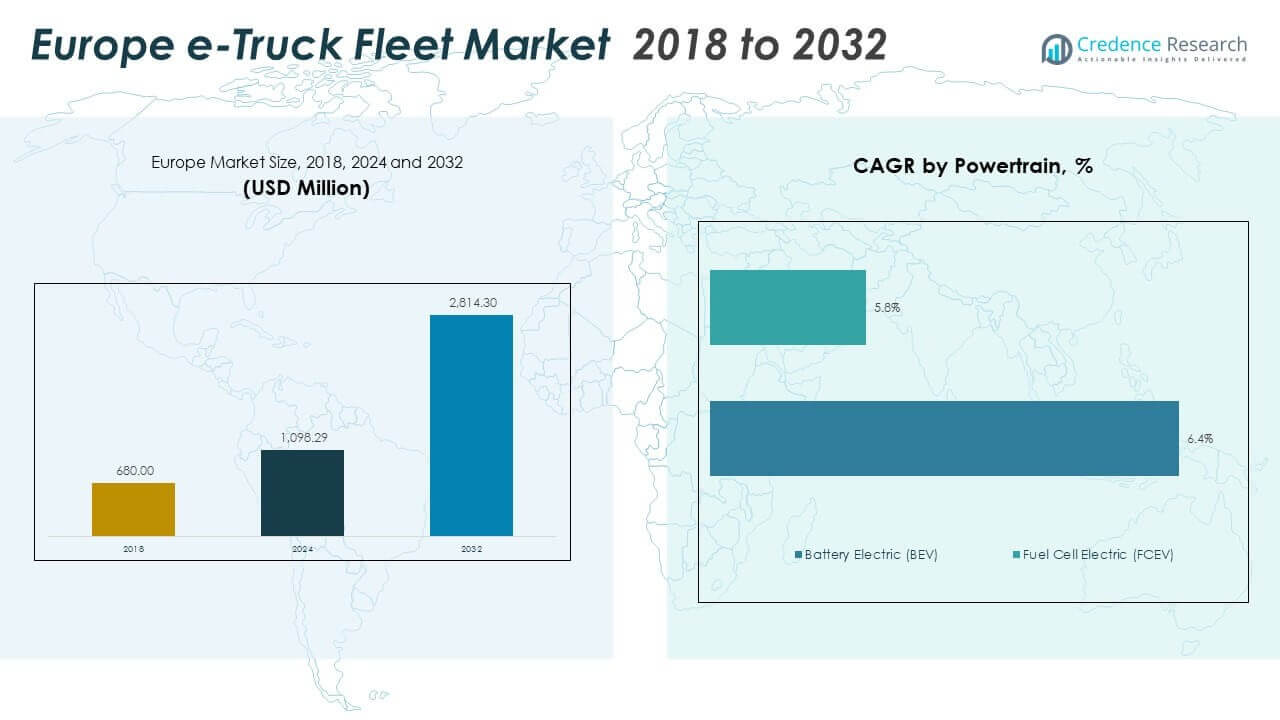
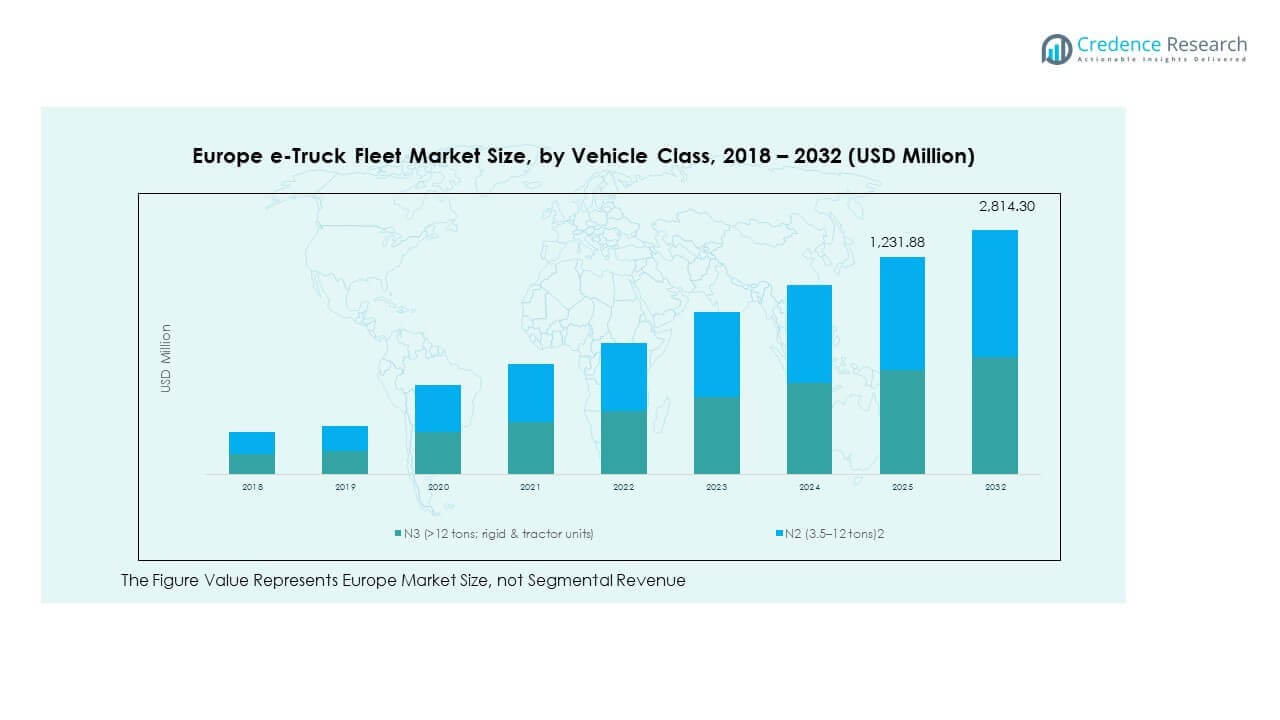
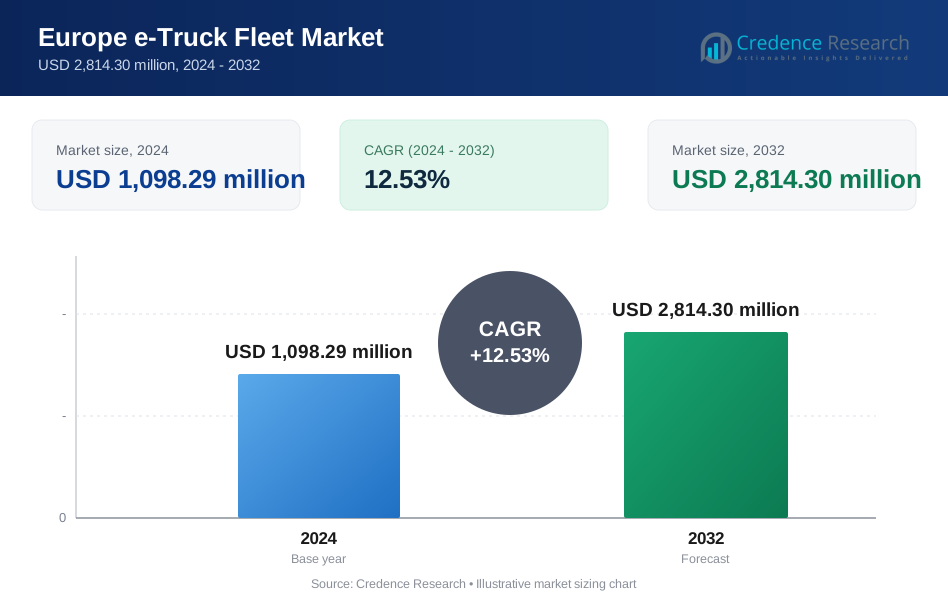
The Europe e-Truck Fleet Market size was valued at USD 680.00 million in 2018 to USD 1,098.29 million in 2024 and is anticipated to reach USD 2,814.30 million by 2032, at a CAGR of 12.53% during the forecast period.
| REPORT ATTRIBUTE | DETAILS |
|---|---|
| Historical Period | 2020-2023 |
| Base Year | 2024 |
| Forecast Period | 2025-2032 |
| Europe e-Truck Fleet Market Size 2024 | USD 1,098.29 million |
| Europe e-Truck Fleet Market, CAGR | 12.53% |
| Europe e-Truck Fleet Market Size 2032 | USD 2,814.30 million |
Strict emissions regulations across Europe, combined with growing ESG commitments from logistics firms, are driving strong adoption of electric trucks. Fleet operators are transitioning to battery electric and fuel cell vehicles to meet decarbonization targets and improve total cost of ownership. OEMs continue to expand electric offerings across N2 and N3 vehicle classes, while infrastructure investments support scalable charging access. Urban low-emission zones and subsidy-backed procurement are reinforcing market demand across public and private fleets.
Western Europe leads adoption due to mature infrastructure, regulatory enforcement, and large fleet operators. Countries like Germany, the Netherlands, and France support rapid deployment through incentives and zero-emission logistics zones. Northern Europe follows with strong public sector integration and renewable power availability. Southern and Eastern Europe are emerging markets, with growing investment in charging hubs and municipal fleet electrification. Regional growth varies with policy strength, logistics maturity, and access to funding programs.
Market Insights
- The Europe e-Truck Fleet Market was valued at USD 680.00 million in 2018, grew to USD 1,098.29 million in 2024, and is projected to reach USD 2,814.30 million by 2032, registering a CAGR of 12.53%.
- Western Europe leads with a 45% market share due to strong regulation, advanced logistics, and robust charging infrastructure; Northern Europe follows with 20% share driven by renewable energy use and public adoption; Southern Europe holds 20% supported by urban delivery and EU funding.
- Eastern Europe is the fastest-growing region with 15% share, gaining momentum through municipal fleet upgrades and cross-border freight modernization.
- Fuel Cell Electric Vehicles (FCEV) lead in growth rate at 6.4% CAGR, supported by long-haul suitability and hydrogen infrastructure expansion.
- Battery Electric Vehicles (BEV) follow with a 5.8% CAGR, driven by short- and mid-range urban logistics and wider OEM availability.
Market Drivers
Stringent EU Emissions Standards Prompt Fleets to Accelerate e-Truck Adoption
The Europe e-Truck Fleet Market benefits from increasingly strict CO₂ regulations across the region. The European Union’s targets for carbon neutrality push logistics companies to transition from diesel trucks to electric fleets. Governments apply emission-based restrictions and introduce urban low-emission zones, compelling businesses to comply. These regulatory frameworks drive both public and private fleet operators to prioritize sustainable mobility. Companies looking to maintain urban access must act on compliance, pushing electric truck demand higher. The shift aligns with Europe’s broader decarbonization efforts across transportation and logistics. Electrification also supports national targets under the European Green Deal. For e-truck OEMs and suppliers, this shift opens new opportunities for market penetration. The Europe e-Truck Fleet Market moves forward as policies tighten across both national and EU levels.
Rising Total Cost of Ownership Awareness Among Fleets Enhances Shift to Electric Trucks
Lower fuel and maintenance costs significantly improve the total cost of ownership (TCO) for electric trucks. Fleet operators across Europe now evaluate investments based on lifecycle costs, not just purchase price. Battery-powered trucks deliver operational savings by reducing fuel spend and wear-and-tear components. Maintenance frequency drops with fewer moving parts, unlike diesel engines that demand regular servicing. With rising fuel prices and carbon taxation, TCO comparisons increasingly favor electric alternatives. Financial modeling tools help fleet managers quantify these savings more clearly. Cost-conscious logistics providers prioritize long-term economic gains over short-term capital expenses. Incentives from governments also reduce upfront purchase costs, improving the business case. The Europe e-Truck Fleet Market sees demand strengthen as fleets adopt this TCO-centric mindset.
- For instance, Scania's battery electric trucks use 416-728 kWh capacities with 75-83% SoC windows, enabling up to 560 km range and fewer mechanical parts for reduced servicing needs.
OEM Investments in Electrification Drive Product Expansion Across Weight Classes
Major OEMs have expanded electric truck portfolios to include light, medium, and heavy-duty models. This diversification enables logistics firms to electrify across urban delivery, regional haul, and long-haul segments. Companies like Volvo, Daimler, and Renault offer scalable platforms tailored to European fleet needs. Investments in R&D and production help lower unit costs and improve battery performance. Longer ranges and higher payload capacities enhance operational flexibility for fleet operators. Increasingly, OEMs provide leasing, servicing, and battery management solutions to ease integration. Such full-service models reduce transition risks for conservative buyers. Collaborations between OEMs and fleet operators enable product validation in real-world conditions. The Europe e-Truck Fleet Market accelerates as robust OEM participation scales availability and builds buyer trust.
Infrastructure Support and Funding for Charging Networks Enable Scalable Deployment
Wider access to charging infrastructure removes one of the key bottlenecks for e-truck adoption. Governments and private firms continue investing in depot and public charging stations for commercial fleets. EU-backed projects fund the rollout of megawatt charging systems suited for heavy trucks. Urban logistics zones now include dedicated charging hubs to support last-mile fleets. OEMs also partner with energy providers to bundle trucks with charging solutions. Standardization of connectors and charging interfaces improves usability and interoperability. Subsidies and tax credits lower the installation costs for fleet depots. Real-time network management platforms optimize usage and reduce energy costs. The Europe e-Truck Fleet Market gains momentum as infrastructure investment keeps pace with fleet electrification.
- For instance, Scania’s electric trucks currently support CCS2 charging up to 375 kW and are MCS-ready for future ultra-fast charging integration, enabling faster turnaround for long-haul operations.
Market Trends
Fleet Electrification as a Strategic ESG Commitment Among Logistics Providers
Many European logistics companies now treat fleet electrification as part of their broader ESG mandates. Electric truck deployment supports sustainability reporting and helps attract clients focused on green supply chains. Large freight operators link zero-emission fleet goals with investor expectations and carbon disclosure ratings. Customers increasingly demand low-emission delivery, driving competitive differentiation. Firms also use electric fleets in branding campaigns to signal environmental responsibility. This trend moves beyond compliance, rooted in corporate image and stakeholder alignment. Logistics firms build long-term electrification strategies across multiple operating regions. Internal sustainability teams collaborate with procurement and fleet managers on implementation. The Europe e-Truck Fleet Market benefits from ESG-driven electrification among both multinationals and regional carriers.
- For example, DSV operates over 400 heavy-duty battery electric trucks across multiple European countries as part of its ESG commitments, targeting 2,000 by 2030 to align with sustainability reporting and investor expectations.
Growth of Urban Last-Mile Delivery Services Spurs Light Electric Truck Demand
Rising e-commerce activity boosts urban last-mile delivery volumes across European cities. To meet access restrictions and sustainability targets, fleet operators favor light electric trucks for short-haul routes. City centers impose zero-emission zones that make internal combustion engines impractical. Retailers and couriers use smaller electric trucks to manage frequent, time-sensitive deliveries. Quiet operation and reduced local emissions make them suitable for night-time logistics. Light-duty e-trucks also allow for easier parking and better maneuverability in dense city environments. Regulatory exemptions, including toll waivers and road priority, further incentivize their use. OEMs have responded by launching compact, high-efficiency electric models tailored to last-mile needs. The Europe e-Truck Fleet Market experiences sharp growth in this urban segment.
Fleet-as-a-Service and Truck Leasing Models Accelerate Adoption in Mid-Sized Firms
New service-based models enable smaller fleet operators to enter the e-truck space without high upfront costs. Fleet-as-a-Service providers offer electric trucks on subscription models that include maintenance and charging access. This lowers barriers for mid-sized transport firms with limited capital for vehicle purchases. Leasing options provide flexibility in testing electric models before full-scale adoption. These service structures often include data monitoring tools and battery health management. Truck OEMs and third-party firms collaborate to bundle financing, infrastructure, and servicing. Such integrated models reduce complexity and support easier transition for legacy operators. SMEs with regional or city delivery routes benefit from predictable operating costs. The Europe e-Truck Fleet Market expands rapidly through these asset-light fleet solutions.
- For instance, Volvo Trucks offers electric trucks through flexible leasing models that bundle servicing and charging support, making adoption easier for mid-sized European logistics firms.
Telematics Integration and Smart Fleet Software Support Performance Optimization
Electric truck fleets now rely heavily on digital tools to manage performance, range, and charging cycles. Telematics platforms track vehicle health, battery efficiency, and energy consumption. Fleet managers use this data to optimize routes and reduce energy waste. Predictive maintenance algorithms help prevent breakdowns and improve asset availability. Software platforms integrate with energy providers to schedule off-peak charging for lower costs. Driver performance analytics help reduce unnecessary energy use during acceleration or braking. Charging stations also use real-time data to manage load balancing across fleet depots. Cloud-based systems offer remote diagnostics and over-the-air updates for vehicle firmware. The Europe e-Truck Fleet Market becomes increasingly data-driven through embedded smart fleet technologies.
Market Challenges Analysis
Insufficient Long-Haul Charging Infrastructure Limits Cross-Border and Regional Freight Expansion
While depot charging works for short-haul urban fleets, long-distance freight faces major infrastructure gaps. High-power megawatt chargers remain limited on trans-European corridors used for heavy trucks. The lack of fast charging near logistics hubs, ports, and border crossings restricts route flexibility. Long recharging times still hinder operational efficiency compared to diesel alternatives. Energy supply reliability also poses concerns in remote or rural areas. Fleet operators hesitate to deploy heavy-duty e-trucks without charging confidence across entire routes. Coordination between EU states on infrastructure rollout remains slow and fragmented. Private sector involvement is growing but lacks scale and speed for mass electrification. The Europe e-Truck Fleet Market must overcome this hurdle to support full logistics decarbonization.
High Initial Vehicle Cost and Slow Return on Investment for Some Fleet Types
Electric trucks require higher upfront investment compared to diesel models, especially for heavy-duty segments. Battery costs still account for a major portion of the total vehicle price. Smaller fleet owners struggle with capital constraints, delaying adoption in rural and low-margin operations. Long payback periods discourage some operators who cannot leverage full TCO savings quickly. Financial aid schemes vary by country, leading to uneven cost competitiveness across Europe. Even with subsidies, total fleet upgrades require planning, training, and operational changes. Resale values remain uncertain, affecting long-term value calculations. The Europe e-Truck Fleet Market sees slower traction among risk-averse operators due to this financial barrier.
Market Opportunities
Emerging Demand from Regional Logistics and Municipal Fleets in Eastern and Southern Europe
Eastern and Southern European countries are expanding green mobility investments through EU-backed funding programs. Governments prioritize clean energy transportation in public fleets and regional logistics. Municipalities invest in electric refuse trucks, street sweepers, and last-mile delivery units. Smaller cities introduce emissions targets that encourage e-truck deployment at a local level. Fleet leasing and cross-border incentives make adoption more viable. The Europe e-Truck Fleet Market gains untapped potential in these newer regions as infrastructure improves.
Technology Partnerships and Battery Recycling Create New Business Avenues
OEMs and energy firms now collaborate on second-life battery solutions and energy storage applications. Used truck batteries find value in stationary storage, reducing environmental waste. Recycling innovations improve raw material recovery, enhancing supply chain sustainability. Technology providers offer integration solutions for AI-based route optimization. Battery-as-a-service models and smart grid integration create new revenue streams. The Europe e-Truck Fleet Market evolves as new tech ecosystems emerge around vehicle electrification.
Market Segmentation Analysis
By Vehicle Class
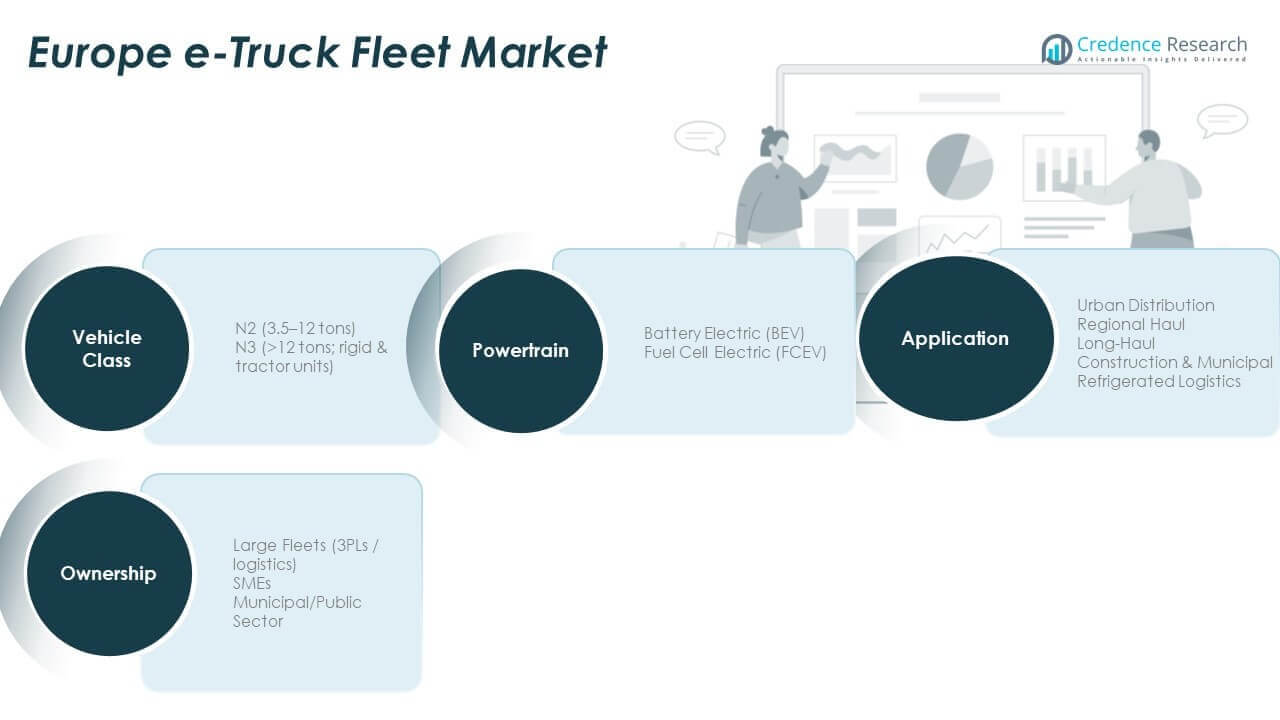
The Europe e-Truck Fleet Market includes two primary vehicle classes: N2 (3.5–12 tons) and N3 (>12 tons). N2 trucks serve urban and regional distribution due to their agility and size. N3 trucks dominate long-haul and heavy-duty applications with higher payload and range requirements. Demand for N3 class is rising with improvements in battery capacity and growing cross-border logistics. Fleet operators use both classes based on route type and cargo volume. Regulatory support targets both categories with differentiated incentives. OEMs have introduced N2 and N3 electric models to match use-case demands. Infrastructure planning supports both classes with depot and highway chargers. It drives balanced growth across both segments.
- For instance, Volvo Trucks’ FH Electric, equipped with a 540 kWh battery, offers up to 300 km of official range, supporting regional-haul operations with zero tailpipe emissions.
By Powertrain
Battery Electric Vehicles (BEVs) lead powertrain adoption in the Europe e-Truck Fleet Market. BEVs support last-mile and mid-range freight with lower operating costs and simpler charging. Fuel Cell Electric Vehicles (FCEVs) are gaining traction in long-haul transport where quick refueling and longer range matter. BEVs dominate urban and regional haul use cases. FCEVs appeal to fleets with established hydrogen infrastructure or government support. Both powertrains complement the EU’s zero-emission freight goals. Investments in charging and hydrogen refueling hubs improve adoption. Operators choose based on route, TCO, and infrastructure access.
By Application
Urban distribution holds the highest e-truck deployment due to city regulations and short routes. Regional haul and long-haul segments are growing with battery and fuel cell innovations. Municipalities adopt electric trucks for construction and sanitation services under sustainability programs. Refrigerated logistics adopt e-trucks to meet emission targets while maintaining temperature control. Applications align with infrastructure readiness and duty cycles. Fleets match vehicle type to cargo type, driving diverse application growth. Growth is strongest in regulated and high-volume freight corridors.
- For instance, Einride’s autonomous electric Pod, classified under N2, operates in Sweden with a 200 kWh battery and is designed for urban and regional routes of up to 200 km.
By Ownership
Large fleets, including 3PLs and logistics providers, lead ownership share in the Europe e-Truck Fleet Market. These operators have capital, infrastructure, and operational scale to electrify faster. SMEs adopt e-trucks with government incentives, leasing, and service-based models. Municipal and public sector fleets electrify to meet policy mandates and set sustainability benchmarks. Ownership patterns vary by region, with Western Europe seeing broader adoption across all groups. Public sector investment often catalyzes early infrastructure deployment. Fleet ownership structure shapes adoption pace and scale.
Segmentation
By Vehicle Class
- N2 (3.5–12 tons)
- N3 (>12 tons; rigid & tractor units)
By Powertrain
- Battery Electric Vehicle (BEV)
- Fuel Cell Electric Vehicle (FCEV)
By Application
- Urban Distribution
- Regional Haul
- Long-Haul
- Construction & Municipal
- Refrigerated Logistics
By Ownership
- Large Fleets (3PLs / logistics)
- SMEs
- Municipal / Public Sector
Regional Analysis
Western Europe holds the largest share at around 45% of the regional market. Germany, France, the Netherlands, and the Nordics lead adoption due to strict emission norms and mature logistics networks. Strong OEM presence and early infrastructure rollout support faster fleet electrification. Large logistics operators in this subregion invest heavily in N2 and N3 electric trucks. Urban low-emission zones accelerate deployment in city logistics. Public funding and private charging investments reinforce growth. The Europe e-Truck Fleet Market gains scale from this advanced subregion.
Northern Europe accounts for nearly 20% market share, led by Norway, Sweden, and Denmark. High renewable energy use improves the carbon benefit of electric fleets. Fleet operators adopt e-trucks to align with national climate goals and ESG targets. Government incentives and pilot corridors support long-haul electrification trials. Cold-climate battery performance improvements boost operator confidence. Municipal fleets also drive demand through electrified public services. This subregion shows high adoption intensity despite smaller population size.
Southern and Eastern Europe together represent about 35% of the market, with Southern Europe at 20% and Eastern Europe at 15%. Italy and Spain lead Southern Europe due to growing urban logistics and EU funding support. Eastern Europe shows steady growth as cross-border freight operators modernize fleets. Infrastructure gaps slow adoption but improvement plans are underway. Cost sensitivity keeps demand focused on light and medium-duty trucks. Public sector purchases support early market formation. These subregions offer long-term expansion potential.
Key Player Analysis
- Volvo Trucks
- Mercedes-Benz / Daimler Truck
- DAF (PACCAR)
- Scania (Traton Group)
- MAN (Volkswagen Group)
Competitive Analysis
The Europe e-Truck Fleet Market shows strong competition among established OEMs, new entrants, and technology-focused players. Major truck manufacturers leverage existing dealer networks and fleet relationships to scale electric portfolios. These players invest heavily in battery platforms, range optimization, and modular vehicle design. Product differentiation centers on payload capacity, charging speed, and service coverage. Partnerships with energy and charging companies strengthen value propositions. Competitive advantage depends on fleet-ready solutions rather than single vehicle sales. OEMs compete on total cost of ownership through bundled offerings that include financing, maintenance, and charging support. Leasing and subscription models help attract SMEs and regional operators. Software and telematics integration becomes a key competitive factor, improving fleet efficiency and uptime. Companies that provide end-to-end fleet solutions gain higher retention rates. Hydrogen truck developers focus on long-haul differentiation, targeting early adopters with infrastructure access. This creates a dual-track competition between BEV and FCEV strategies. Public sector tenders and large logistics contracts intensify price and service competition. Local manufacturing and EU sourcing improve eligibility for government-backed projects. Smaller players focus on niche segments such as municipal trucks or refrigerated logistics. Strategic alliances and pilot deployments help validate technology at scale.
Recent Developments
- In December 2025, Mercedes-Benz Trucks began production of the new eActros 400, expanding its electric portfolio for heavy-duty applications amid a strong 50% market share in Europe's heavy electric trucks.
- In November 2025, DSV, a major logistics company, announced it now operates more than 400 battery electric trucks across its European network, positioning it among the largest operators of electric heavy goods vehicles in the region.
- In June 2025, BRIGO, an Italian sustainable transport firm, expanded its fleet with five Mercedes-Benz eActros trucks three eActros 600 and two eActros 300 models from Daimler Truck, handed over at Milence's first Italian charging hub.
- In August 2024, Volvo Trucks secured an order for 300 zero-emission electric trucks from logistics firm DSV, including the new FH Aero Electric model with enhanced aerodynamics. These trucks, set for delivery between 2024 and 2026, will form one of Europe's largest heavy electric truck fleets as part of DSV's goal for 2,000 electric vehicles by 2030. The deal also covers 500 fuel-efficient diesel and gas trucks
- In August 2024, DAF delivered the first electric trucks from its new generation to leading Dutch transporters, building on its pioneering role as Europe's first fully electric truck maker since 2018. These include models like the XD Electric and XF Electric with ranges up to 500 km for national and long-haul use. DAF also expanded charging solutions via PACCAR Parts.
Report Coverage
The research report offers an in-depth analysis based on Vehicle Class, Powertrain, Application and Ownership. It details leading market players, providing an overview of their business, product offerings, investments, revenue streams, and key applications. Additionally, the report includes insights into the competitive environment, SWOT analysis, current market trends, as well as the primary drivers and constraints. Furthermore, it discusses various factors that have driven market expansion in recent years. The report also explores market dynamics, regulatory scenarios, and technological advancements that are shaping the industry. It assesses the impact of external factors and global economic changes on market growth. Lastly, it provides strategic recommendations for new entrants and established companies to navigate the complexities of the market.
Future Outlook
- Fleet electrification deepens across logistics as operators align sustainability goals with long-term cost discipline and regulatory readiness.
- OEM product roadmaps expand, improving range, payload, and reliability across medium and heavy-duty electric trucks.
- Charging ecosystems mature, with depot-centric models scaling first, followed by corridor solutions for regional freight.
- Digital fleet platforms gain traction, improving route planning, energy use control, and predictive maintenance outcomes.
- Service-led adoption grows as leasing, subscriptions, and bundled charging reduce upfront transition risk.
- Urban logistics remains a primary growth engine due to access rules and delivery density advantages.
- Hydrogen pathways advance selectively, supporting longer routes where charging time constraints persist.
- Public procurement accelerates adoption through municipal sanitation, construction, and utility fleets.
- Cross-border freight pilots increase, validating electric performance under varied climates and duty cycles.
- Supply chain localization and battery lifecycle management strengthen resilience and circular economy alignment.
Request a Free Sample
Fill in your details and we'll send you a free sample report.
- Sample data tables & charts
- Research methodology
Need a Custom Version of This Report?
Tailor the scope, geography, or segments to your exact requirements.
- Custom geography or segment scope
- Direct access to our analyst team
Frequently Asked Questions
What is the current market size for Europe e-Truck Fleet Market, and what is its projected size in 2032?
At what Compound Annual Growth Rate is the Europe e-Truck Fleet Market projected to grow between 2024 and 2032?
Which Europe e-Truck Fleet Market segment held the largest share in 2024?
What are the primary factors fueling the growth of the Europe e-Truck Fleet Market?
Who are the leading companies in the Europe e-Truck Fleet Market?
Which region commanded the largest share of the Europe e-Truck Fleet Market in 2024?
Table of Content
Chapter 1 Market Segmentation
- 1.1 Segmentation Framework
- 1.1.1 Product and Service Classification
- 1.1.2 Application and End-Use Classification
- 1.1.3 Technology and Solution Classification
- 1.1.4 Customer and Distribution Channel Classification
- 1.1.5 Geographic Segmentation
- 1.1.6 Market Segment Definitions and Boundaries
Chapter 2 Introduction
- 2.1 Report Objectives and Scope
- 2.2 Product Definition and Industry Terminology
- 2.3 Market Inclusions and Exclusions
- 2.4 Research Process
- 2.4.1 Primary Research and Expert Interviews
- 2.4.2 Secondary Research and Source Review
- 2.4.3 Top-Down and Bottom-Up Estimation
- 2.4.4 Data Triangulation and Verification
- 2.5 Market Size Measurement Basis
- 2.5.1 2024: USD 1,098.29 million → 2032: USD 2,814.30 million
- 2.6 Historical and Forecast Reference Periods
- 2.6.1 Base Year: 2024
- 2.6.2 Forecast Period: 2024-2032
- 2.7 Research Assumptions and Limitations
Chapter 3 Executive Summary
- 3.1 Market Snapshot and Key Findings
- 3.2 Base-Year Market Size, 2024
- 3.3 Forecast Market Size, 2032
- 3.4 Revenue and Volume Growth Outlook
- 3.5 Key Demand and Supply Indicators
- 3.6 Leading Market Segments
- 3.7 Fastest-Growing Market Opportunities
- 3.8 Regional Performance Highlights
- 3.9 Technology and Industry Transformation
- 3.10 Competitive Landscape Summary
- 3.11 Analyst View and Strategic Implications
Chapter 4 Europe e-Truck Fleet Market Trends and Developments
- 4.1 Historical Industry Development
- 4.2 Recent Market Trends and Developments
- 4.3 Demand and Customer Behavior Trends
- 4.4 Technology and Product Innovation
- 4.5 Artificial Intelligence, Automation and Digitalization
- 4.6 Local Manufacturing and Supply Chain Realignment
- 4.7 Industry Partnerships, Mergers and Acquisitions
- 4.8 Sustainability and Circular Economy Developments
- 4.9 Government and Private Sector Investment Trends
- 4.10 Emerging Business Models and Commercialization
- 4.11 Industry Developments and Announcements
Chapter 5 Europe e-Truck Fleet Market Production, Supply and Demand Analysis
- 5.1 Demand Trend and Consumption Analysis
- 5.2 Demand Forecast, 2024-2032
- 5.3 Production and Output Trend
- 5.4 Production and Output Forecast, 2024-2032
- 5.5 Installed Capacity and Capacity Utilization
- 5.6 Company-Wise Production Plants and Statistics
- 5.6.1 Installed Production Capacity
- 5.6.2 Actual Production
- 5.6.3 Planned Capacity and Expansion Targets
- 5.7 Supply Chain Structure and Procurement Trends
- 5.8 Supply-Demand Gap and Bottlenecks
- 5.9 Import Dependence and Sourcing Structure
- 5.10 Contract Manufacturing and Outsourcing
- 5.11 Regional Supply and Demand Concentration
Chapter 6 Europe e-Truck Fleet Market Pricing Analysis
- 6.1 Pricing Structure and Measurement
- 6.2 Historical Pricing Trends
- 6.3 Pricing Outlook, 2024-2032
- 6.4 Average Selling Price and Unit Economics
- 6.5 Pricing by Product and Market Segment
- 6.6 Geographic Pricing Differences
- 6.7 Key Input, Energy, Labor and Logistics Costs
- 6.8 Contract Pricing and Purchasing Models
- 6.9 Pricing Sensitivity and Competitive Positioning
- 6.10 Price, Margin and Profitability Implications
Chapter 7 Europe e-Truck Fleet Market Dynamics
- 7.1 Market Growth Drivers
- 7.1.1 Demand-Side Drivers
- 7.1.2 Technology and Innovation Drivers
- 7.1.3 Infrastructure and Investment Drivers
- 7.1.4 Regulatory and Policy Drivers
- 7.2 Market Restraints
- 7.2.1 Cost and Affordability Constraints
- 7.2.2 Technology and Adoption Barriers
- 7.2.3 Supply Chain and Operational Constraints
- 7.3 Market Challenges
- 7.3.1 Competitive Pressure and Margin Erosion
- 7.3.2 Skills, Infrastructure and Implementation Gaps
- 7.4 Emerging Market Opportunities
- 7.5 Market Dynamics Impact and Time-Horizon Assessment
Chapter 8 Europe e-Truck Fleet Value Chain Analysis
- 8.1 Industry Value Chain Overview
- 8.2 Upstream Suppliers and Critical Inputs
- 8.3 Technology and Component Providers
- 8.4 Manufacturing or Service Delivery
- 8.5 Distribution, Channel Partners and Integrators
- 8.6 Downstream Applications and End Users
- 8.7 Value Addition and Profit Pools
- 8.8 Vertical Integration and Outsourcing
- 8.9 Supplier Concentration and Risk
- 8.10 Supply Chain Localization and Resilience
Chapter 9 Europe e-Truck Fleet Market Regulations and Policies
- 9.1 Relevant Laws, Standards and Compliance Frameworks
- 9.2 Product, Service, Safety and Quality Requirements
- 9.3 Government Policies, Incentives and Subsidies
- 9.4 Imports, Exports and Trade Barriers
- 9.5 Public Procurement and Local Content Requirements
- 9.6 Environmental and Sustainability Compliance
- 9.7 Upcoming Policy Changes and Market Implications
Chapter 10 Europe e-Truck Fleet Market Hotspots and Opportunities
- 10.1 Market Opportunity Mapping and Growth Hotspots
- 10.2 High-Growth Applications and Customer Groups
- 10.3 Underserved Markets and White-Space Opportunities
- 10.4 Emerging Technology and Product Opportunities
- 10.5 New Capacity and Investment Hotspots
- 10.6 Market Entry and Expansion Opportunities
- 10.7 Distribution and Partnership Opportunities
- 10.8 Near-Term and Long-Term Commercial Potential
- 10.9 Opportunity Attractiveness and Execution Risks
Chapter 11 Europe e-Truck Fleet Market Outlook, 2024-2032
- 11.1 Market Size and Analysis
- 11.1.1 Revenue (Market Measurement: 2024: USD 1,098.29 million → 2032: USD 2,814.30 million)
- 11.1.2 Market Volume and Quantity Sold
- 11.1.3 Historical Market Size
- 11.1.4 Base-Year Market Size, 2024
- 11.2 Market Forecast, 2024-2032
- 11.2.1 Revenue Forecast to 2032
- 11.2.2 Volume Forecast to 2032
- 11.2.3 CAGR and Year-on-Year Growth
- 11.2.4 Incremental Revenue Opportunity
- 11.3 Forecast Assumptions and Scenario Analysis
- 11.3.1 Base-Case Forecast
- 11.3.2 Optimistic and Conservative Scenarios
- 11.3.3 Technology, Pricing and Policy Sensitivities
- 11.4 Market Attractiveness and Growth Outlook
Chapter 12 Europe e-Truck Fleet Market Segmentation and Outlook
- 12.1 Segmentation Summary and Market Shares, 2024
- 12.2 Largest and Fastest-Growing Segments
- 12.3 Segment Growth Comparison
- 12.4 Segment Attractiveness and Priority Matrix
Chapter 13 Europe e-Truck Fleet Geographic Market Outlook, 2024-2032
- 13.1 Regional Market Size and Country-Level Shares, 2024
- 13.2 Country Market Size Comparison, 2024
- 13.3 Country Market Forecasts, 2024-2032
- 13.4 Subregional Industrial and Demand Clusters
- 13.5 Intra-Regional Pricing and Cost Differences
- 13.6 Cross-Border Trade and Supply Networks
- 13.7 Regional Supply and Demand Balances
- 13.8 Country Opportunity Comparison and Prioritization
Note: Every listed country is covered on the structure shown under the first country.
Chapter 14 Europe e-Truck Fleet Technology, Innovation and Sustainability Outlook
- 14.1 Technology Landscape and Maturity
- 14.2 Product, Process and Service Innovation
- 14.3 AI, Automation and Digital Tools in the Industry
- 14.4 Technology Adoption and Performance Benchmarking
- 14.5 Innovation Pipeline and R&D Investment
- 14.6 Patent and Intellectual Property Trends
- 14.7 Energy Efficiency and Resource Management
- 14.8 Sustainability, Recycling and Circularity
- 14.9 Technology Roadmap, 2024-2032
- 14.10 Risks of Obsolescence and Technology Substitution
Chapter 15 Europe e-Truck Fleet Market Key Strategic Imperatives
- 15.1 Growth and Market Entry Priorities
- 15.2 High-Return Products and Segments
- 15.3 Pricing, Profitability and Cost Optimization
- 15.4 Technology Investment and Product Differentiation
- 15.5 Supply Chain Localization and Resilience
- 15.6 Distribution and Customer Acquisition
- 15.7 Partnership, Acquisition and Capacity Strategy
- 15.8 Regional Expansion Priorities
- 15.9 Short-, Medium- and Long-Term Actions
Chapter 16 Competition Outlook
- 16.1 Industry Competition Characteristics
- 16.2 Market Structure and Concentration
- 16.3 Market Share and Competitive Positioning, 2024
- 16.4 Company-Wise Revenue and Product Benchmarking
- 16.5 Production and Service Capacity Benchmarking
- 16.6 Technology, Pricing and Differentiation
- 16.7 Regional Footprint and Distribution Strength
- 16.8 Mergers, Acquisitions and Strategic Alliances
- 16.9 New Entrants and Competitive Threats
- 16.10 Porter's Five Forces and Industry Attractiveness
- 16.11 Competitive Outlook, 2024-2032
Chapter 17 Company Profiles
- 17.1 Company Coverage and Selection Criteria
- 17.2 Leading Market Participants – Standard Profile Structure
- 17.2.1 Business Description
- 17.2.2 Company Ownership and Geographic Presence
- 17.2.3 Product and Service Portfolio
- 17.2.4 Manufacturing and Operating Footprint
- 17.2.5 Production Capacity and Expansion Plans
- 17.2.6 Financial Performance and Investment
- 17.2.7 Market Share and Competitive Position
- 17.2.8 Technology and Innovation Capabilities
- 17.2.9 Strategic Alliances or Partnerships
- 17.2.10 Recent Developments
- 17.2.11 Growth Strategy and Outlook
- 17.3 Other Relevant Market Participants
Note: Every listed company is profiled on the structure shown under the first company. The company list is preliminary and may change based on research findings, market developments, data availability and client requirements.
Chapter 18 Disclaimer
- 18.1 Research and Forecast Disclaimer
- 18.2 Data Source and Estimation Limitations
Note: The depth of individual sections depends on data availability for this market. Volume, capacity, trade and other unit-based metrics are included where applicable.