
Market Insights
Bluetooth audio transceivers allow the transmission and reception of audio files between various types of media players and audio devices. These transceivers are small and portable, making them ideal for carrying around. In transmission mode, the Bluetooth audio transceiver needs to be connected to the media player with the use of an auxiliary, audio/video, or USB cable. When paired with Bluetooth headsets or earphones, the audio output of the media player gets seamlessly transmitted to the paired audio devices. Thereby, users can connect various types of electronics, such as TVs, home entertainment systems, and other media players, to their Bluetooth headsets and earphones. A Bluetooth audio transceiver in receiving mode can be connected to any wired headphones via a standard 3.5 mm audio jack. The transceiver can then connect with numerous Bluetooth-enabled devices, such as smartphones, music players, and other media players. The receiving mode enables users to enjoy a wireless experience without the need to buy a separate Bluetooth headset. In addition, users can make use of two transceivers to build a wireless connection between any two non-Bluetooth devices.
One of the major factors driving the demand for Bluetooth audio transceivers is the release of some of the latest flagship phones without a 3.5 mm audio jack. Leading manufacturers in the smartphone industry have removed the traditional 3.5 mm audio jack for various design and product development purposes. For instance, in September 2016, Apple, Inc. released its iPhone 7, which did not incorporate the universal 3.5 mm audio jack. The phone makes use of its Lighting technology, Apple's proprietary computer bus, and a power connector for connecting headphones. Similarly, Google, Inc. launched its flagship smartphone, the Pixel 2, in October 2017, which makes use of the USB-C audio port instead of the traditional audio jack. Furthermore, there are numerous other smartphone brands, such as Motorola and HTC, among others, that have adopted a similar strategy. Despite these companies' offering wired adapters to connect traditional headphones, users find it inconvenient to make use of such additional connectors.
Bluetooth audio transceivers have offered a viable solution for end-users to continue making use of their traditional headphones and headsets on their electronic devices. Furthermore, with the use of such adapters, users are able to enjoy a wireless experience while using their existing wired headphones. In addition, this has enabled users to use their high-end, expensive audio devices, which have the traditional 3.5 mm audio jack. Some of the other factors driving the popularity of such adapters are the introduction of advanced technologies such as Bluetooth 5.0 and aptX. Thereby, users can choose from a wide array of Bluetooth audio transceivers that offer optimum audio quality in both transmitting and receiving modes.
The research study titled "Global Bluetooth Audio Transceivers Market: Growth, Future Prospects, and Competitive Analysis, 2017–2025" provides strategic insights into the global Bluetooth audio transceivers market along with the market size and estimates for the duration of 2015–2025. The report offers market numbers for the years 2015 and 2016 (historical) and market estimates for a forecast period from 2017 to 2025.
The report further provides a competitive landscape, including leading providers of Bluetooth audio transceivers, along with market positioning and key market developments. Some of the leading providers of Bluetooth audio transceivers included in the study are Anker Technology Co. Limited, Avantree Technology Co., Ltd., BlueAnt Wireless Pty Ltd., Creative Technology Ltd., FiiO Electronics Technology Co., Ltd., Griffin Technology, LLC, Hama GmbH & Co. KG, iJumbl, JEDirect Corp., MPOW Technology Co., Ltd., The iTunes, and Wicked Audio, Inc.
The critical analysis included in the research study encompasses the following:
- Ongoing and expected market trends will help identify key growth markets within the Bluetooth audio transceivers industry.
- Market drivers, market restraints, and their impacts on market growth
- in-depth competitive environment analysis
- Trailing 2-year market size data (2015–2016)
Overall, the research study provides a holistic view of the Bluetooth audio transceivers market globally, offering market size and estimates for the period from 2017 to 2025, keeping in mind the above-mentioned factors.
The global market for Bluetooth audio transceivers has been segmented on the basis of geographical regions, as per the following regions and countries:
- North America
-
- U.S.
- rest of North America
- Europe
- U.K.
- Germany
- France
- Rest of Europe
- Asia Pacific
- Japan
- China
- India
- Rest of Asia Pacific
- Rest of the World (RoW)
- Middle East and Africa (MEA)
- Latin America
In 2016, Asia Pacific held the largest share in the overall Bluetooth audio transceivers market across the globe in terms of market value. The demand for Bluetooth audio transceivers in the region is largely driven by the large consumer bases in China and India. In addition, tech-savvy consumers from some of the developed economies, such as Japan, South Korea, and Singapore, among others, have contributed to the higher share of the Asia Pacific region in the overall market. With continued demand for advanced products and rising consumer spending capacity, the overall Asia Pacific Bluetooth audio transceivers market is expected to witness immense growth in the following years. The North American and Europe regions followed the Asia Pacific region in terms of market value. The regions are expected to exhibit steady growth due to demand from key markets such as the U.S., the UK, Germany, and France, among others.
Request a Free Sample
Fill in your details and we'll send you a free sample report.
- Sample data tables & charts
- Research methodology
Need a Custom Version of This Report?
Tailor the scope, geography, or segments to your exact requirements.
- Custom geography or segment scope
- Direct access to our analyst team
Frequently Asked Questions
What is the size of Bluetooth Audio Transceivers Market?
What is the Bluetooth Audio Transceivers Market CAGR?
What is the Forecast period considered for Bluetooth Audio Transceivers Market?
What is the base year considered for Bluetooth Audio Transceivers Market?
Which are the major players in this Market?
Table of Content
Chapter 1. Report Introduction
- 1.1 Report Description & Purpose
- 1.1.1 Report Title & Market Definition
- 1.1.2 Unique Selling Propositions (USP) & Key Differentiators
- 1.1.3 Value Proposition for Stakeholders
- 1.2 Research Objectives
- 1.2.1 Market Sizing Objectives (Volume & Revenue) (Volume Where Applicable)
- 1.2.2 Segmentation Objectives
- 1.2.3 Competitive Intelligence Objectives
- 1.2.4 Forecast & Scenario Objectives
- 1.3 Report Scope
- 1.3.1 Bluetooth Audio Transceivers Scope – Segments & Subsegments Covered
- 1.3.2 Geographic Scope – Regions & Countries Covered
- 1.3.3 Historical Period, Base Year & Forecast Period (the historical period; forecast to the forecast period)
- 1.3.4 Inclusions & Exclusions
- 1.4 Industry Classification & Applicable Codes
- 1.5 Currency, Measurement Units & Valuation Basis
- 1.6 Target Stakeholders
- 1.7 Limitations & Assumptions
Chapter 2. Executive Summary
- 2.1 Global Bluetooth Audio Transceivers Market Snapshot
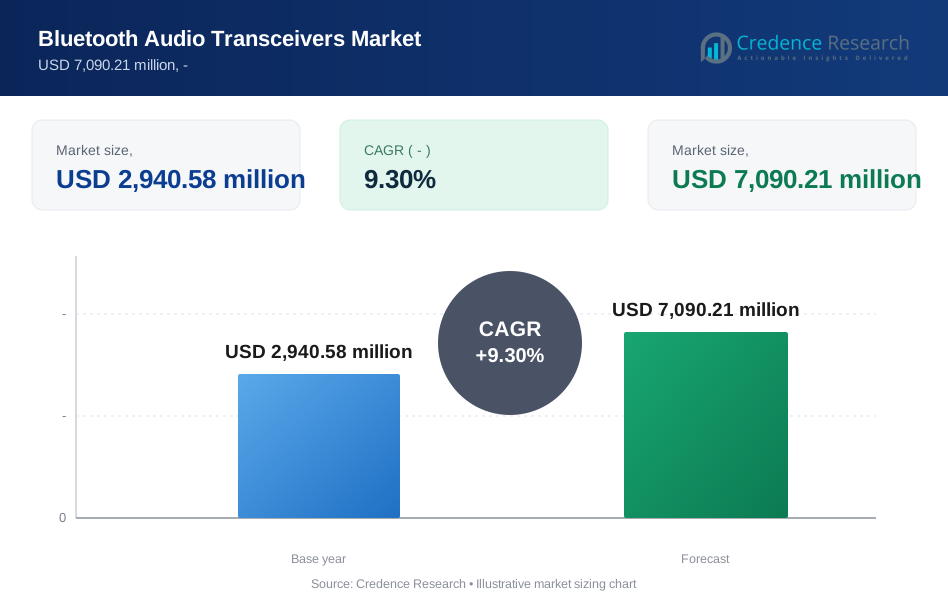
- 2.1.1 Market Size – Historical (the historical period) & Forecast (the forecast period) (base year: USD 2,940.58 million → forecast year: USD 7,090.21 million)
- 2.1.2 Volume & Revenue – Global Totals (Volume Where Applicable)
- 2.1.3 Key Market Highlights – Top Five Facts
- 2.2 Bluetooth Audio Transceivers Market Segmentation Snapshot
- 2.2.1 Market Split by Region – vs.
- 2.3 Competitive Snapshot
- 2.3.1 Top 10 Players by Revenue Share –
- 2.3.2 Top 10 Players by Volume Share – (Volume Where Applicable)
- 2.3.3 Recent Strategic Developments (18-Month Summary)
- 2.4 Key Investment Highlights & Strategic Conclusions
Chapter 3. Bluetooth Audio Transceivers Market Dynamics & Industry Analysis
- 3.1 Market Overview & Context
- 3.1.1 Bluetooth Audio Transceivers Market Position in the Broader Industry Value Chain
- 3.1.2 Demand Structure & Purchasing Dynamics
- 3.1.3 Market Maturity & Development Stage by Region
- 3.2 Bluetooth Audio Transceivers Market Drivers
- 3.3 Bluetooth Audio Transceivers Market Restraints & Challenges
- 3.4 Bluetooth Audio Transceivers Market Opportunities
- 3.5 Porter's Five Forces Analysis
- 3.5.1 Threat of New Entrants
- 3.5.2 Bargaining Power of Suppliers
- 3.5.3 Bargaining Power of Buyers
- 3.5.4 Threat of Substitutes
- 3.5.5 Competitive Rivalry – Intensity Assessment
- 3.6 Bluetooth Audio Transceivers Value Chain Analysis
- 3.6.1 Upstream – Key Inputs, Resources & Suppliers
- 3.6.1.1 Key Input/Resource 1
- 3.6.1.2 Key Input/Resource 2
- 3.6.1.3 Key Input/Resource 3
- 3.6.2 Midstream – Core Operations & Value Creation
- 3.6.2.1 Operating Model & Process Overview
- 3.6.2.2 Key Operating Locations & Capabilities by Company
- 3.6.3 Downstream – Market Channels & End Users
- 3.6.3.1 Direct Sales & Customer Engagement Channels
- 3.6.3.2 Indirect Sales, Intermediaries & Partner Channels
- 3.6.4 Value Chain Profitability Analysis
- 3.6.1 Upstream – Key Inputs, Resources & Suppliers
- 3.7 PESTEL Analysis
- 3.7.1 Political Factors
- 3.7.2 Economic Factors
- 3.7.3 Social Factors
- 3.7.4 Technological Factors
- 3.7.5 Environmental Factors
- 3.7.6 Legal Factors
- 3.8 Bluetooth Audio Transceivers Supply Chain Analysis
- 3.8.1 Critical Input & Resource Availability Risk Assessment
- 3.8.2 Supplier & Operational Concentration Risk (Geographic Exposure)
- 3.8.3 Supply & Service Disruption Impact Analysis
- 3.9 Regulatory & Policy Landscape
Note: The regulatory and policy landscape section covers regulations based on their applicability to the market, Bluetooth Audio Transceivers category, geography, and scope of the study. Only regulatory frameworks with a material impact on operations, compliance, trade, sustainability, or market access are analyzed in detail.
Chapter 4. Key Investment Pockets & Opportunity Analysis
- 4.1 Bluetooth Audio Transceivers Market Attractiveness Analysis
- 4.1.1 By Region – Investment Attractiveness Matrix (Market Size × CAGR)
- 4.2 Absolute Revenue Growth Opportunity
- 4.2.1 By Region – Absolute Revenue Growth Through the forecast period
- 4.3 Incremental Demand Opportunity
- 4.3.1 By Region – Incremental Demand Through the forecast period
- 4.3.2 Segment – Incremental Demand
- 4.4 Emerging Submarket Opportunity Deep Dive (Subject to Applicability)
- 4.5 Priority Market Opportunity Scorecards
- 4.5.1 United States
- 4.5.2 Europe
- 4.5.3 Asia
- 4.5.4 Middle East & Africa
Note: Priority market opportunity scorecards reflect the geographic scope and strategic relevance of the study. Listed markets are indicative and may be adapted to the industry.
Chapter 5. Bluetooth Audio Transceivers Cross-Border Trade & Market Access Analysis
- 5.1 International Trade & Cross-Border Activity Overview
- 5.1.1 Global Export Value by Country (the historical period)
- 5.1.2 Global Export Volume by Country (the historical period) (Volume Where Applicable)
- 5.1.3 Global Import Value by Country (the historical period)
- 5.1.4 Global Import Volume by Country (the historical period) (Volume Where Applicable)
- 5.1.5 Net Trade Balance by Country (the historical period)
- 5.2 Export Analysis – Segment
- 5.2.1 Category 1 (Applicable Classification Code)
- 5.2.2 Category 2 (Applicable Classification Code)
- 5.2.3 Category 3 (Applicable Classification Code)
- 5.2.4 Category 4 (Applicable Classification Code)
- 5.2.5 Category 5 (Applicable Classification Code)
- 5.3 Import Analysis – Segment
- 5.3.1 Category 1 (Applicable Classification Code)
- 5.3.2 Category 2 (Applicable Classification Code)
- 5.3.3 Category 3 (Applicable Classification Code)
- 5.3.4 Category 4 (Applicable Classification Code)
- 5.3.5 Category 5 (Applicable Classification Code)
- 5.4 Cross-Border Pricing & Transaction Benchmarks
- 5.4.1 Export Pricing – Segment & Country
- 5.4.2 Import Pricing – Segment & Source Country
- 5.4.3 Price Trends (the historical period)
- 5.5 Key Cross-Border Trade & Delivery Routes
- 5.5.1 Cross-Border Trade/Delivery Route 1
- 5.5.2 Cross-Border Trade/Delivery Route 2
- 5.5.3 Cross-Border Trade/Delivery Route 3
- 5.5.4 Cross-Border Trade/Delivery Route 4
- 5.5.5 Cross-Border Trade/Delivery Route 5
- 5.6 Trade Policy & Market Access Impact Assessment
- 5.6.1 Tariff & Non-Tariff Barriers
- 5.6.2 Regional Trade & Economic Integration Frameworks
- 5.6.3 Bilateral & Multilateral Trade Agreements
- 5.6.4 Cross-Border Operating, Licensing & Localization Requirements
Note: This chapter applies where cross-border trade or delivery is relevant to Bluetooth Audio Transceivers. Goods, services, and digital offerings are assessed using applicable classifications and transaction measures. Import-export volumes, trade balances, and route analyses are included only where meaningful to the market.
Chapter 6. Competitive Landscape & Company Benchmarking
- 6.1 Bluetooth Audio Transceivers Market Concentration & Structure
- 6.1.1 Herfindahl-Hirschman Index (HHI) – vs.
- 6.1.2 Leading, Mid-Sized & Emerging Player Structure
- 6.1.3 Global, Regional & Local Player Dynamics
- 6.2 Bluetooth Audio Transceivers Market Share Analysis –
- 6.2.1 Global Revenue Share by Company
- 6.2.2 Global Volume Share by Company (Volume Where Applicable)
- 6.2.3 Regional Revenue Share
- 6.2.4 Market Share Evolution ( vs. )
- 6.2.5 Company Market Share by Key Segment
- 6.2.6 Company Market Share by Customer Group
- 6.3 Operating Scale, Capacity & Infrastructure Analysis
- 6.3.1 Global Operating Scale & Supply Capacity
- 6.3.2 Resource Utilization & Operating Efficiency
- 6.3.3 Output, Service Delivery & Activity Metrics
- 6.3.4 Operating Footprint & Infrastructure Map
- 6.3.5 Planned Operational & Capacity Expansion
- 6.4 Bluetooth Audio Transceivers Competitive Benchmarking Matrix
- 6.4.1 Revenue, Growth, Profitability & Operating Metric Comparison
- 6.4.2 Channel Revenue Mix
- 6.4.3 Geographic Revenue Exposure
- 6.4.4 R&D Intensity
- 6.4.5 Sustainability Maturity
- 6.5 Strategic Developments in Bluetooth Audio Transceivers (Last 24 Months)
- 6.5.1 Mergers, Acquisitions & Divestments
- 6.5.2 New Products, Services & Solutions in Bluetooth Audio Transceivers
- 6.5.3 Operational & Infrastructure Expansions
- 6.5.4 Strategic Alliances, Joint Ventures & Partnerships
- 6.5.5 Distribution Expansion & Market Entry
- 6.5.6 Sustainability & ESG Initiatives
- 6.6 Competitive Strategy Mapping
- 6.6.1 Leader, Challenger, Follower & Niche Classification
- 6.6.2 Pricing Strategy Comparison
- 6.6.3 Channel Strategy Matrix
Note: Strategic developments are included based on their materiality and the availability of reliable information.
Chapter 7. Global Bluetooth Audio Transceivers Market – By Sales & Delivery Channel
- 7.1 Segment Overview
- 7.1.1 Volume & Revenue Split by Channel ( & ) (Volume Where Applicable)
- 7.1.2 Channel Mix Evolution (the forecast period)
Chapter 8. Regional Market Analysis – Global Overview
- 8.1 Global Regional Overview
- 8.1.1 Regional Volume Share (Volume Where Applicable)
- 8.1.2 Regional Revenue Share
- 8.1.3 Regional Volume by Region (Volume Where Applicable)
- 8.1.4 Regional Revenue by Region
- 8.1.5 Regional Forecast Through the forecast period
- 8.2 Cross-Regional Segment Analysis
- 8.2.1 By Sales & Delivery Channel
- 8.2.2 By Competitive Positioning & Price Tier
Chapter 9. North America Bluetooth Audio Transceivers Market
- 9.1 United States
- 9.2 Canada
- 9.3 Mexico
Chapter 10. Europe Bluetooth Audio Transceivers Market
- 10.1 Germany
- 10.2 France
- 10.3 Italy
- 10.4 United Kingdom
- 10.5 Spain
- 10.6 Poland
- 10.7 Russia
- 10.8 Netherlands
- 10.9 Belgium
- 10.10 Sweden
- 10.11 Denmark
- 10.12 Norway
- 10.13 Rest of Europe
Chapter 11. Asia Pacific Bluetooth Audio Transceivers Market
- 11.1 China
- 11.2 India
- 11.3 Japan
- 11.4 South Korea
- 11.5 Thailand
- 11.6 Indonesia
- 11.7 Vietnam
- 11.8 Malaysia
- 11.9 Australia
- 11.10 Rest of Asia Pacific
Chapter 12. Latin America Bluetooth Audio Transceivers Market
- 12.1 Brazil
- 12.2 Argentina
- 12.3 Colombia
- 12.4 Chile
- 12.5 Rest of Latin America
Chapter 13. Middle East Bluetooth Audio Transceivers Market
- 13.1 Saudi Arabia
- 13.2 United Arab Emirates
- 13.3 Turkey
- 13.4 Israel
- 13.5 Iran
- 13.6 Rest of the Middle East
Chapter 14. Africa Bluetooth Audio Transceivers Market
- 14.1 South Africa
- 14.2 Egypt
- 14.3 Nigeria
- 14.4 Morocco
- 14.5 Rest of Africa
Chapter 15. Bluetooth Audio Transceivers Company Profiles
- 15.1 [Company 01]
- 15.1.1 Company Overview
- 15.1.2 Key Management Personnel
- 15.1.3 Products & Services Portfolio
- 15.1.4 Financial Performance
- 15.1.5 Key Market Focus & Geographic Presence
- 15.1.6 Recent Developments & Strategic Initiatives
Note: The company profile list is preliminary and may change based on research findings, market developments, data availability, and client requirements.
Chapter 16. Appendices
- Appendix A – List of Abbreviations & Acronyms
- Appendix B – Industry Classification Code Reference – Full Series
- Appendix C – Supply, Output & Operating Capacity Data Tables
- Appendix D – End-Use & Demand Base Tables
- Appendix E – Demand, Adoption & Usage Assumptions
- Appendix F – Pricing & Revenue Metric Reference Tables
- Appendix G – Company Operations & Infrastructure Database
- Appendix H – Cross-Border Trade & Activity Data Tables (Where Applicable)
- Appendix I – Regulatory Summary Tables
- Appendix J – Primary Research Participant List (Anonymized)
- Appendix K – Primary Research Questionnaire Framework
- Appendix L – Data Sources & Bibliography
- Appendix M – Market Size Divergence & Source Comparison
Chapter 17. Research Methodology
- 17.1 Research Framework & Philosophy
- 17.2 Secondary Research – Sources, Hierarchy & Data Extraction
- 17.3 Data Modeling – Bottom-Up & Top-Down Market Sizing
- 17.4 Primary Research – Stakeholder Framework, LOI & Sample Sizes
- 17.5 Forecast Methodology – Regression, Scenario & Sensitivity Analysis
- 17.6 Quality Control – Four-Layer Validation Framework
- 17.7 Limitations & Standard Assumptions
- 17.8 Disclaimer
