
Car Rental Market Overview:
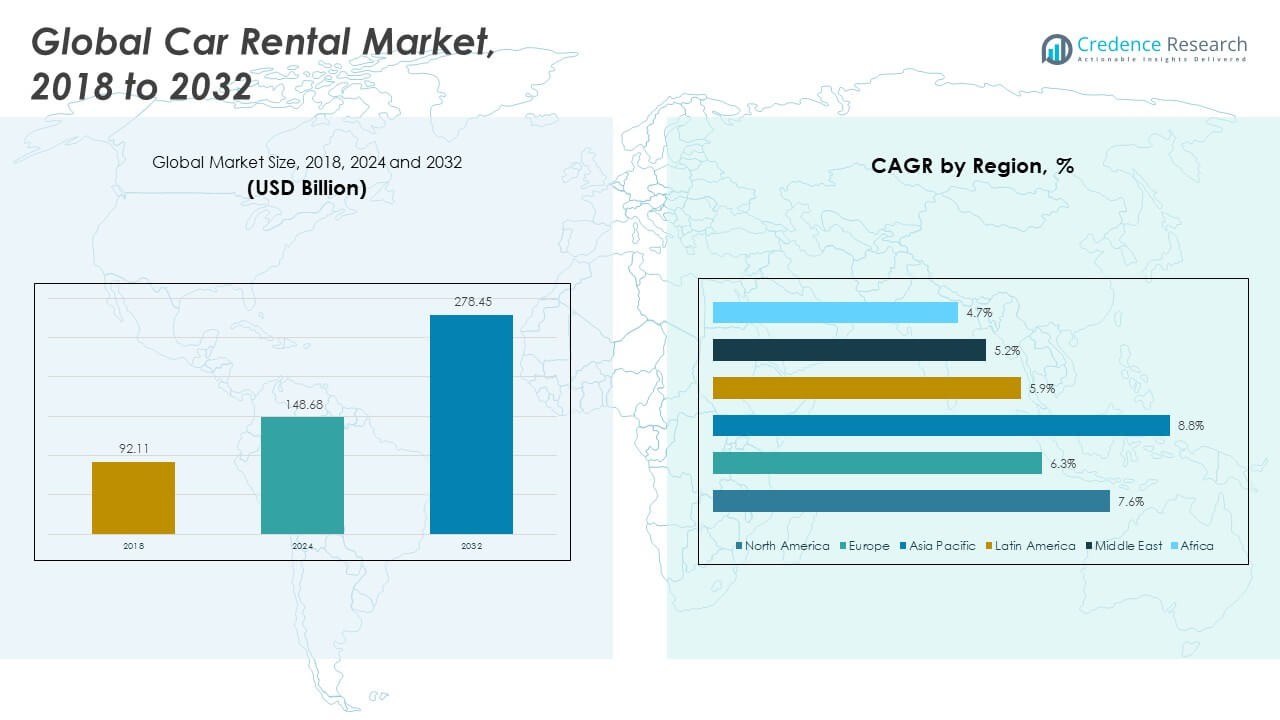
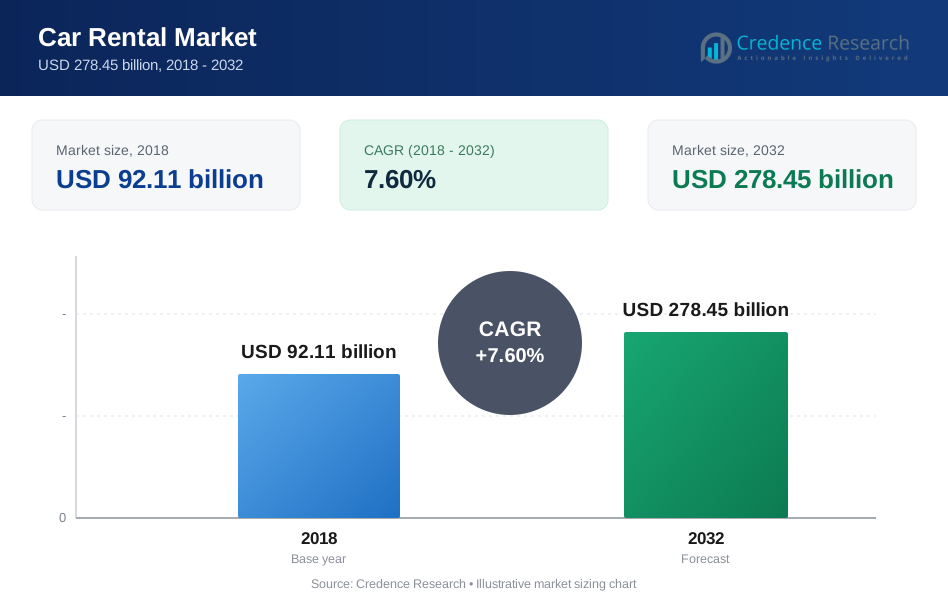
The Global Car Rental Market size was valued at USD 92.11 billion in 2018 to USD 148.68 billion in 2024 and is anticipated to reach USD 278.45 billion by 2032, at a CAGR of 7.60% during the forecast period.
| REPORT ATTRIBUTE | DETAILS |
|---|---|
| Historical Period | 2020-2023 |
| Base Year | 2024 |
| Forecast Period | 2025-2032 |
| Car Rental Market Size 2024 | USD 148.68 billion |
| Car Rental Market, CAGR | 7.60% |
| Car Rental Market Size 2032 | USD 278.45 billion |
Growing travel activity, expanding business trips, and rising tourism fuel higher rental bookings. Digital platforms drive quick reservations and smooth transactions, which raise customer confidence. Many travelers pick rentals for flexible mobility in cities and tourist zones. Companies boost fleet quality to meet shifting expectations for comfort and convenience. Strong adoption of hybrid and electric vehicles also supports brand positioning as renters seek cleaner mobility choices. Corporate clients rely on rental services to meet tight schedules and reach multiple destinations.
North America leads due to strong airport traffic, road travel culture, and wide rental networks. Europe follows with mature mobility infrastructure and steady tourism across major countries. Asia-Pacific is emerging fast, driven by urban growth, rising middle-income groups, and expanding domestic tourism. Countries in Southeast Asia and South Asia see quick adoption as travelers seek flexible mobility for urban and intercity routes. The Middle East shows steady growth supported by tourism development and expanding leisure travel.
 Car Rental Market Insights:
- The market overview shows the Global Car Rental Market rising from USD 92.11 Billion in 2018 to USD 148.68 Billion in 2024, with a projection of USD 278.45 Billion by 2032, growing at a CAGR of 7.60%.
- North America leads with 17% share due to strong airport networks and high business travel activity. Asia Pacific follows with 30.22% share, supported by rapid urbanization and rising domestic travel. Europe holds 17.72% share, driven by strong tourism flows and a mature mobility ecosystem.
- Asia Pacific is the fastest-growing region with 22% share, propelled by expanding tourism, improving digital adoption, and rising middle-income mobility demand.
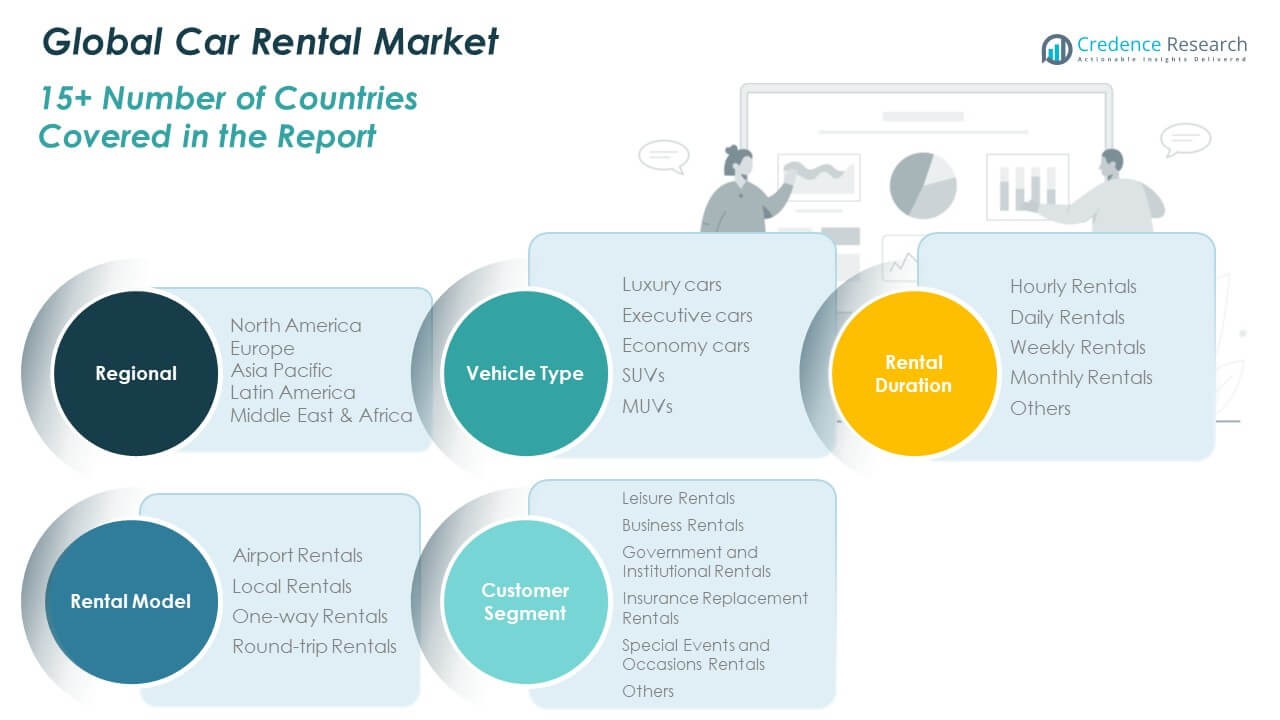
- Segment distribution from the chart shows SUVs holding the largest share (~27%), driven by family travel, long-route comfort, and strong adoption in both mature and emerging markets.
- Economy cars account for roughly (~23%), supported by cost-efficient mobility demand across city travel, business trips, and high-volume rental hubs.
Car Rental Market Drivers:
Rising Demand for Flexible Mobility Solutions Across Global Travel Ecosystems
Strong travel recovery supports rising rental activity across airport and city locations. The Global Car Rental Market benefits from higher business travel and growing leisure trips. Travelers choose rentals to gain schedule control during short and long journeys. Digital reservations increase convenience through quick booking and fast verification. Fleet upgrades raise comfort levels and improve overall user confidence. Hybrid and electric models attract buyers focused on sustainable travel habits. Corporate users select rental contracts to meet daily mobility requirements. Tourist groups adopt rentals for flexible multi-destination movement across regions.
- For instance, Hertz confirmed a purchase of 100,000 Tesla Model 3 units in 2021, marking the largest EV order in rental history.
Growing Adoption of Digital Platforms Enhancing Operational Speed and Customer Experience
Digital tools transform booking habits across major travel channels. Customers rely on apps for real-time fleet visibility and faster pick-up workflows. Automation supports quicker document checks and reduces wait times at service counters. Telematics tools help brands optimize fleet tracking and performance. Online payments raise transaction efficiency and support smooth workflows. Data insights help operators study usage trends for better planning. Digital receipts support transparent billing and improve customer trust. Frequent travelers prefer app-based subscriptions for easy access to diverse vehicle types.
- For instance, Sixt reported that more than 60% of its global bookings were completed through the Sixt app in 2023.
Expansion of Tourism Activities Supporting Higher Rental Utilization Rates Globally
Tourism growth strengthens rental demand in popular destinations worldwide. International visitors select cars to reach remote areas and explore local routes. Road travel preferences increase in regions with strong highway networks. Brands expand rental hubs near major tourist corridors to meet rising movement. Hotel partnerships support seamless booking for travelers across countries. Seasonal peaks push operators to increase fleet availability across cities. Travel agencies promote bundled rental packages for better convenience. Destination-based travel trends raise rental needs during holiday seasons.
Rising Corporate Travel Requirements Driving Short-Term and Long-Term Rental Contracts
Corporate mobility needs support recurring rental activity in global hubs. Companies choose rental fleets to handle employee movement across meetings and events. Long-term leases help reduce ownership costs for frequent business travelers. Operators offer specialized packages to support executive-level travel. Fleet diversity improves access to premium and utility vehicles for corporate tasks. Digital dashboards help firms track usage and plan budgets. Employee relocation programs support rental demand across countries. City-to-city travel routes increase rental bookings during business trips.
 Car Rental Market Trends:
Growing Integration of Connected Vehicle Technologies Transforming Fleet Operations
Telematics tools gain traction for fleet monitoring across diverse regions. The Global Car Rental Market uses connected features to track vehicle health in real time. Predictive maintenance tools help reduce breakdown risks and lower downtime. GPS systems support efficient routing for better customer convenience. Remote engine diagnostics speed up service decisions for operators. Digital alerts notify teams about fuel levels and safety warnings. Fleet managers use dashboards for better allocation planning. High-tech integrations improve transparency and enhance customer trust.
- For instance, Avis Budget Group leverages connected-car data, including real-time mileage and diagnostic information, to implement automated maintenance notifications, which helps the company operate more efficiently and ensures better maintained vehicles.
Rising Demand for Electric and Hybrid Fleets for Cleaner Mobility Across Regions
Sustainability initiatives increase interest in eco-friendly mobility choices. Rental companies invest in hybrid and electric models to meet rising expectations. Travelers choose clean-energy vehicles to lower emissions during city movement. Charging networks expand across airports and urban centers to support EV use. Fleet operators gain regulatory benefits for adopting low-emission cars. Clean fleets strengthen brand positioning in competitive travel markets. EV rental trials gain traction in regions promoting green tourism. Charging analytics help companies understand usage patterns for better planning.
Growing Popularity of Subscription-Based Rental Models Offering Hassle-Free Access
Subscription models attract buyers seeking flexible mobility without ownership. Packages offer monthly access to diverse vehicles for personal and work needs. Travelers prefer subscription plans to avoid long paperwork during bookings. The Global Car Rental Market sees rising interest from users seeking predictable costs. Digital dashboards support quick upgrades and vehicle swaps in real time. Operators design tier-based plans for different usage groups. Subscribers gain maintenance support and insurance coverage through unified plans. Urban customers rely on subscriptions for daily travel needs.
Integration of Contactless Rental Services Strengthening User Convenience
Contactless technology supports smooth pick-up and drop-off procedures. Digital keys help customers unlock cars without staff support. Self-service kiosks speed up check-out steps at airports and city hubs. Mobile identity checks reduce manual verification processes. It improves overall safety and raises user comfort during peak hours. Automated workflows support faster turnarounds for high-demand fleets. Operators upgrade digital platforms to match modern mobility expectations. Contactless services strengthen rental appeal across tech-savvy users.
Car Rental Market Challenges Analysis:
High Fleet Maintenance Costs and Operational Pressures Impacting Long-Term Profitability
Fleet upkeep remains a major operational challenge for global operators. The Global Car Rental Market faces rising repair needs due to high vehicle turnover. Frequent use increases wear across brakes, tires, and engine parts. Maintenance delays reduce fleet availability during peak seasons. Fuel price swings raise travel costs and impact daily bookings. Insurance expenses remain high in regions with strict compliance norms. Old vehicles demand more service hours and lower customer satisfaction. Operators must balance maintenance budgets while expanding fleet capacity.
Growing Competition from Ride-Hailing Platforms Limiting Rental Adoption in Urban Regions
Ride-hailing apps influence user choices across major cities. Travelers choose quick rides for short distances instead of renting cars. It reduces rental preference among younger users seeking low-commitment mobility. High discounts from ride-hailing brands increase pricing pressure on rental firms. Urban congestion lowers driving motivation in traffic-heavy regions. Rental operators need stronger loyalty programs to retain frequent travelers. Digital comparisons make users shift between mobility options faster. Strong promotional strategies are required to maintain user engagement.
Car Rental Market Opportunities:
Expansion of Electric Mobility Infrastructure Creating New Growth Prospects for Rental Operators
Charging networks expand across airports, highways, and city centers. The Global Car Rental Market gains strong opportunities to scale electric fleets. Travelers show rising interest in clean mobility across urban routes. Government incentives support adoption of low-emission vehicles in rental hubs. Operators can diversify offerings by adding compact and premium EV models. Long-term rental contracts encourage firms to adopt sustainable transportation for employees. Tourism-focused regions promote EV rentals for eco-friendly travel experiences. New charging partnerships help brands improve accessibility across destinations.
Rising Demand for Integrated Mobility Platforms Across Global Travel Markets
Unified platforms allow users to book cars, bikes, and shuttles from one app. Seamless access increases customer loyalty in competitive mobility ecosystems. It helps operators expand reach across frequent travelers and daily commuters. Digital bundles encourage buyers to choose long-duration rental services. Real-time fleet insights support faster allocation and improved service reliability. Corporate users adopt integrated tools to track employee travel movement. Multi-modal ecosystems strengthen partnerships between rental firms and travel companies. Urban growth trends create steady demand for flexible mobility planning.
Car Rental Market Segmentation Analysis:
By Vehicle Type
The Global Car Rental Market spans diverse vehicle categories that meet varied mobility needs. Luxury cars serve premium travelers seeking comfort and brand value. Executive cars appeal to business users who require refined travel standards. Economy cars hold wide preference due to cost efficiency and fuel savings. SUVs attract families and long-distance travelers who need space and stability. MUVs support group movement across city and intercity routes. Each category shapes rental demand based on travel purpose, budget, and route conditions. It benefits from fleet diversification that aligns with shifting customer expectations.
By Rental Duration
Rental duration influences user preference across multiple travel segments. Hourly rentals suit short urban trips and quick personal tasks. Daily rentals remain popular for routine business schedules and tourism activities. Weekly rentals support extended family travel and corporate assignments. Monthly rentals capture long-stay customers such as project teams and relocated staff. Other flexible options meet unique requirements linked to seasonal or event-based travel. Operators design varied packages to match user timelines and mobility patterns. It strengthens market penetration across frequent and occasional renters.
- For instance, Enterprise reported rapid growth in long-term rental programs, with subscription-style users staying beyond 30 days, a statement which aligns with public information from industry analysts and the company's own business structure.
By Rental Model
Rental models shape access points across airports and cities. Airport rentals gain strong demand from domestic and international passengers. Local rentals support neighborhood travel and daily commuting needs. One-way rentals allow travelers to drop vehicles at different locations for greater convenience. Round-trip rentals continue to serve traditional travel routes with structured return plans. Operators refine model choices to boost efficiency and customer reach. It ensures better service alignment with leisure and business travel cycles.
By Customer Segment
Customer segments drive rental usage across multiple travel purposes. Leisure rentals support tourism-driven demand during holidays and weekend trips. Business rentals meet executive mobility needs across events and meetings. Government and institutional rentals serve official assignments and administrative travel. Insurance replacement rentals support customers who need temporary vehicles during repairs. Special events and occasions rentals cater to weddings, exhibitions, and group functions. Other segments include customized requirements across personal and corporate travel. It enables operators to design targeted solutions that maximize service adoption.
Segmentation:
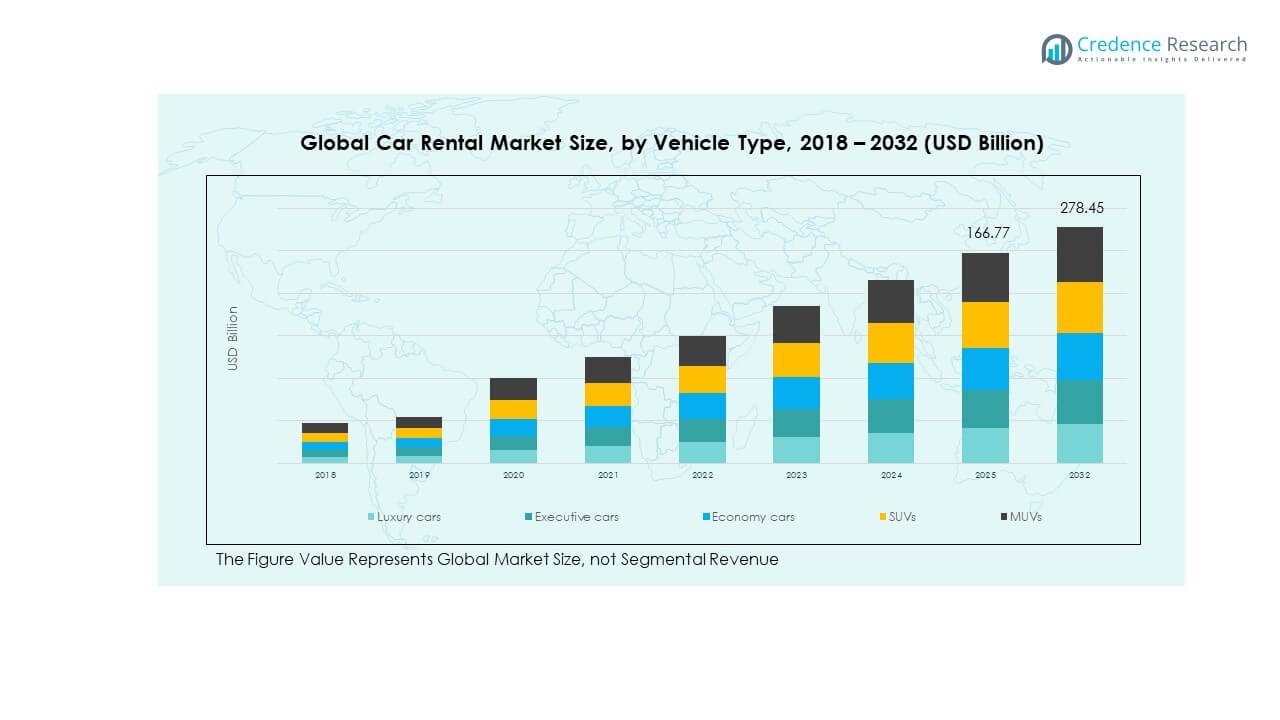
By Vehicle Type
- Luxury Cars
- Executive Cars
- Economy Cars
- SUVs
- MUVs
By Rental Duration
- Hourly Rentals
- Daily Rentals
- Weekly Rentals
- Monthly Rentals
- Others
By Rental Model
- Airport Rentals
- Local Rentals
- One-Way Rentals
- Round-Trip Rentals
By Customer Segment
- Leisure Rentals
- Business Rentals
- Government & Institutional Rentals
- Insurance Replacement Rentals
- Special Events & Occasions Rentals
- Others
By Region
- North America
- U.S.
- Canada
- Mexico
- Europe
- Germany
- France
- U.K.
- Italy
- Spain
- Rest of Europe
- Asia Pacific
- China
- Japan
- India
- South Korea
- South-east Asia
- Rest of Asia Pacific
- Latin America
- Brazil
- Argentina
- Rest of Latin America
- Middle East & Africa
- GCC Countries
- South Africa
- Rest of the Middle East and Africa
Regional Analysis:
North America
The North America Global Car Rental Market size was valued at USD 40.19 million in 2018 to USD 64.20 million in 2024 and is anticipated to reach USD 120.57 million by 2032, at a CAGR of 7.6% during the forecast period. North America holds a 43.17% market share. North America remains a dominant market driven by strong travel demand and extensive mobility infrastructure. The region supports the Global Car Rental Market through large airport networks and high road-travel culture. Business travel creates stable rental volumes across major corporate hubs. Tourism growth in the U.S. and Canada strengthens seasonal bookings. Digital platforms improve rental accessibility across airports and urban centers. Fleet operators expand hybrid and electric vehicle options to meet sustainability requirements. Local rental models gain traction in densely populated metro areas. It maintains leadership through advanced service ecosystems and strong customer loyalty programs.
Europe
The Europe Global Car Rental Market size was valued at USD 17.27 million in 2018 to USD 26.35 million in 2024 and is anticipated to reach USD 44.89 million by 2032, at a CAGR of 6.3% during the forecast period. Europe holds a 17.72% market share. Europe shows stable rental activity supported by mature mobility systems and well-connected transport networks. The Global Car Rental Market benefits from high international tourism across major cities and cultural destinations. Corporate travel contributes steady rental demand in the UK, France, and Germany. Travelers prefer rentals for multi-country road trips made easier by cross-border policies. Urban customers shift toward compact and eco-friendly vehicles for efficient mobility. Airport rentals remain strong due to dense flight networks. Local rental operators expand digital booking tools to meet rising customer expectations. It gains momentum through sustainability programs supporting electric fleet adoption.
Asia Pacific
The Asia Pacific Global Car Rental Market size was valued at USD 26.36 million in 2018 to USD 44.96 million in 2024 and is anticipated to reach USD 91.89 million by 2032, at a CAGR of 8.8% during the forecast period. Asia Pacific holds a 30.22% market share. Asia Pacific experiences rapid expansion driven by rising tourism and strong economic growth. The Global Car Rental Market gains momentum from expanding urbanization across China, India, and Southeast Asia. Domestic travel growth increases rental usage for intercity and leisure routes. Digital payments and app-based platforms support faster adoption of rental services. Modern fleet upgrades help operators meet safety and comfort expectations. Airport hubs in Japan, South Korea, and Australia drive recurring rental demand. Tourism corridors strengthen rental volumes during peak travel seasons. It grows quickly due to expanding middle-income groups and improved transport infrastructure.
Latin America
The Latin America Global Car Rental Market size was valued at USD 4.26 million in 2018 to USD 6.79 million in 2024 and is anticipated to reach USD 11.22 million by 2032, at a CAGR of 5.9% during the forecast period. Latin America holds a 4.56% market share. Latin America shows steady growth supported by rising tourism and improving regional mobility. The Global Car Rental Market benefits from recovery in international travel across Brazil and Mexico. Road travel remains common in tourist locations, raising rental activity during peak seasons. Operators expand localized rental hubs to support city and airport demand. Digital booking tools increase transparency and customer trust. Urban congestion drives interest in efficient vehicle categories. Economic reforms encourage mobility startups to enhance rental accessibility. It continues to strengthen through targeted fleet expansion and improved service quality.
Middle East
The Middle East Global Car Rental Market size was valued at USD 2.52 million in 2018 to USD 3.71 million in 2024 and is anticipated to reach USD 5.83 million by 2032, at a CAGR of 5.2% during the forecast period. The Middle East holds a 2.50% market share. The Middle East maintains consistent rental activity supported by high tourist inflow and strong airport connectivity. The Global Car Rental Market expands with rising business travel across Gulf nations. Large events and exhibitions in the region drive short-term rental demand. Operators introduce luxury and premium vehicles to meet high-end customer preferences. Digital booking adoption increases across UAE and Saudi Arabia. Fleet modernization aligns with tourism development plans. Road-trip culture across desert routes supports seasonal rental demand. It grows steadily due to government initiatives promoting tourism and mobility services.
Africa
The Africa Global Car Rental Market size was valued at USD 1.51 million in 2018 to USD 2.68 million in 2024 and is anticipated to reach USD 4.04 million by 2032, at a CAGR of 4.7% during the forecast period. Africa holds a 1.80% market share. Africa presents emerging opportunities driven by improving transport systems and tourism recovery. The Global Car Rental Market gains momentum in countries with growing business activity and urban expansion. Airport rentals increase due to rising international visitor arrivals. Local operators expand services to meet domestic travel demand. Road infrastructure upgrades support wider adoption of rental services. Travelers prefer SUVs and MUVs for long routes and varied terrain. Digital platforms grow gradually, improving visibility and booking convenience. It holds long-term potential supported by economic development and tourism investments.
Key Player Analysis:
- Hertz Global Holdings
- Enterprise Holdings
- Avis Budget Group
- Sixt SE
- Europcar Mobility Group
- China Auto Rental
- Toyota Rent a Car
- Ola Cabs
- Zoomcar
- Getaround
Competitive Analysis:
The Global Car Rental Market shows strong competition driven by global brands, regional fleets, and digital-first platforms. Leading companies expand service networks across airports and urban hubs to strengthen customer reach. Pricing strategies, loyalty programs, and fleet diversity shape competitive positioning. Operators focus on premium, economy, and electric vehicle categories to meet broad mobility needs. Digital platforms improve booking speed and enhance user experience. Partnerships with airlines, hotels, and travel agencies support repeat demand. Regional firms compete through localized pricing and tailored service models. It evolves through constant fleet upgrades, technology adoption, and expansion into high-growth travel corridors.
Recent Developments:
- In August 2025, Hertz Global Holdings established a strategic partnership with Amazon Autos to sell pre-owned vehicles through Amazon's automotive retail platform. The collaboration initially focused on serving customers within a 75-mile radius of Dallas, Houston, Los Angeles, and Seattle, with plans to expand to all 45 Hertz Car Sales locations nationwide. This partnership marked Amazon Autos' expansion into the used-car market and provided Hertz with a new digital channel for vehicle disposal, allowing shoppers to browse, finance, and purchase from thousands of high-quality pre-owned vehicles through the convenient Amazon shopping experience.
- In July 2025, Avis Budget Group announced a multi-year strategic partnership with Waymo, the leader in self-driving technology, to launch and scale a fully autonomous ride-hailing service in Dallas. Under this agreement announced on July 29, 2025, Avis Budget Group serves as Waymo's fleet operations partner in Dallas, delivering end-to-end services including infrastructure, vehicle readiness, maintenance, and depot operations. Initial testing was already underway in Dallas with the public launch slated for 2026, marking a pivotal milestone in Avis's evolution from a rental car company to a leading provider of fleet management and operations for the broader mobility ecosystem.
- In July 2025, Zoomcar Holdings announced the rollout of ZoomPro on July 10, 2025, a powerful B2B dashboard designed to enable large fleet partners to manage vehicles, pricing, and bookings without relying solely on the Zoomcar mobile app. The platform offered centralized booking views across fleets, multi-user access for streamlined operations, smart car reassignment with real-time availability, vehicle performance tracking and insights, AI-driven pricing recommendations, e-invoicing for B2B partners, and an API integration suite for seamless fleet management. The launch marked a significant step in Zoomcar's strategy to professionalize the self-drive ecosystem with scalable digital infrastructure.
Report Coverage:
The research report offers an in-depth analysis based on By Vehicle Type, By Rental Duration, By Rental Model, and By Customer Segment. It details leading market players, providing an overview of their business, product offerings, investments, revenue streams, and key applications. Additionally, the report includes insights into the competitive environment, SWOT analysis, current market trends, as well as the primary drivers and constraints. Furthermore, it discusses various factors that have driven market expansion in recent years. The report also explores market dynamics, regulatory scenarios, and technological advancements that are shaping the industry. It assesses the impact of external factors and global economic changes on market growth. Lastly, it provides strategic recommendations for new entrants and established companies to navigate the complexities of the market.
Future Outlook:
- Growing demand for flexible mobility will expand short-term and long-term rental usage.
- Electric fleet integration will accelerate as charging networks improve worldwide.
- Digital-first service models will strengthen customer engagement and retention.
- Airport rental activity will remain a key revenue driver across major hubs.
- Subscription-based rentals will gain wide acceptance across urban markets.
- Partnerships with airlines and hotels will enhance multi-channel booking.
- Fleet optimization technologies will reduce downtime and support profitability.
- SUVs and economy cars will maintain strong preference across regions.
- Emerging markets will witness faster adoption due to rising domestic travel.
- Operators will increase focus on sustainability and low-emission vehicle choices.
Request a Free Sample
Fill in your details and we'll send you a free sample report.
- Sample data tables & charts
- Research methodology
Need a Custom Version of This Report?
Tailor the scope, geography, or segments to your exact requirements.
- Custom geography or segment scope
- Direct access to our analyst team
Frequently Asked Questions
What is the current market size for Global Car Rental Market, and what is its projected size in 2032?
At what Compound Annual Growth Rate is the Global Car Rental Market projected to grow between 2025 and 2032?
Which Global Car Rental Market segment held the largest share in 2024?
What are the primary factors fueling the growth of the Global Car Rental Market?
Who are the leading companies in the Global Car Rental Market?
Which region commanded the largest share of the Global Car Rental Market in 2024?
Table of Content
Chapter 1. Report Introduction
- 1.1 Report Description & Purpose
- 1.1.1 Report Title & Market Definition
- 1.1.2 Unique Selling Propositions (USP) & Key Differentiators
- 1.1.3 Value Proposition for Stakeholders
- 1.2 Research Objectives
- 1.2.1 Market Sizing Objectives (Volume & Revenue)
- 1.2.2 Segmentation Objectives
- 1.2.3 Competitive Intelligence Objectives
- 1.2.4 Forecast & Scenario Objectives
- 1.3 Report Scope
- 1.3.1 Car Rental Scope – Types & Subtypes Covered
- 1.3.2 Geographic Scope – Regions & Countries Covered
- 1.3.3 Historical Period, Base Year & Forecast Period (2018; forecast to 2032)
- 1.3.4 Inclusions & Exclusions
- 1.4 HS Code & Classification Framework
- 1.5 Currency, Units & Pricing Basis
- 1.6 Target Stakeholders
- 1.7 Limitations & Assumptions
Chapter 2. Executive Summary
- 2.1 Global Car Rental Market Snapshot
- 2.1.1 Market Size – Historical (2018) & Forecast (2018-2032) (2018: USD 92.11 billion → 2032: USD 278.45 billion)
- 2.1.2 Volume & Revenue – Global Totals
- 2.1.3 Key Market Highlights – Top Five Facts
- 2.2 Car Rental Market Segmentation Snapshot
- 2.2.1 Market Split by Region – 2018 vs. 2032
- 2.3 Competitive Snapshot
- 2.3.1 Top 10 Players by Revenue Share – 2018
- 2.3.2 Top 10 Players by Volume Share – 2018
- 2.3.3 Recent Strategic Developments (18-Month Summary)
- 2.4 Key Investment Highlights & Strategic Conclusions
Chapter 3. Car Rental Market Dynamics & Industry Analysis
- 3.1 Market Overview & Context
- 3.1.1 Car Rental Market Position in the Broader Automotive Value Chain
- 3.1.2 OEM vs. Replacement Market Dynamics
- 3.1.3 Market Maturity & Development Stage by Region
- 3.2 Car Rental Market Drivers
- 3.3 Car Rental Market Restraints & Challenges
- 3.4 Car Rental Market Opportunities
- 3.5 Porter's Five Forces Analysis
- 3.5.1 Threat of New Entrants
- 3.5.2 Bargaining Power of Suppliers
- 3.5.3 Bargaining Power of Buyers
- 3.5.4 Threat of Substitutes
- 3.5.5 Competitive Rivalry – Intensity Assessment
- 3.6 Car Rental Value Chain Analysis
- 3.6.1 Upstream – Raw Material/Input Suppliers
- 3.6.1.1 Raw Material/Input 1
- 3.6.1.2 Raw Material/Input 2
- 3.6.1.3 Raw Material/Input 3
- 3.6.2 Midstream – Production/Manufacturing/Service Delivery
- 3.6.2.1 Production/Process Overview
- 3.6.2.2 Key Facility Locations & Capacity by Manufacturer
- 3.6.3 Downstream – Distribution & End Consumer
- 3.6.3.1 Primary Channel – B2B/OEM
- 3.6.3.2 Secondary Channels – Dealer, Retail, Online, Direct
- 3.6.4 Value Chain Profitability Analysis
- 3.6.1 Upstream – Raw Material/Input Suppliers
- 3.7 PESTEL Analysis
- 3.7.1 Political Factors
- 3.7.2 Economic Factors
- 3.7.3 Social Factors
- 3.7.4 Technological Factors
- 3.7.5 Environmental Factors
- 3.7.6 Legal Factors
- 3.8 Car Rental Supply Chain Analysis
- 3.8.1 Raw Material/Input Supply Risk Assessment
- 3.8.2 Manufacturing Concentration Risk (Geographic Exposure)
- 3.8.3 Trade Disruption Impact Analysis
- 3.9 Regulatory & Policy Landscape
Note: The regulatory and policy landscape section covers regulations based on their applicability to the market, Car Rental category, geography, and scope of the study. Only regulatory frameworks with a material impact on operations, compliance, trade, sustainability, or market access are analyzed in detail.
Chapter 4. Key Investment Pockets & Opportunity Analysis
- 4.1 Car Rental Market Attractiveness Analysis
- 4.1.1 By Region – Investment Attractiveness Matrix (Volume × CAGR)
- 4.2 Absolute Revenue Growth Opportunity
- 4.2.1 By Region – Absolute USD Growth Through 2032
- 4.3 Incremental Volume Opportunity
- 4.3.1 By Region – Incremental Volume Through 2032
- 4.3.2 Segment – Incremental Volume
- 4.4 Emerging Submarket Opportunity Deep Dive (Subject to Applicability)
- 4.5 Emerging Market Opportunity Scorecards
- 4.5.1 United States
- 4.5.2 Europe
- 4.5.3 Asia
- 4.5.4 Middle East & Africa
Note: Emerging Market Opportunity Scorecards will be included based on relevance and strategic importance. Regions listed are indicative and may vary depending on data availability and market dynamics.
Chapter 5. Car Rental Import-Export Analysis & Trade Flows
- 5.1 Global Trade Overview
- 5.1.1 Global Export Value by Country (2018)
- 5.1.2 Global Export Volume by Country (2018)
- 5.1.3 Global Import Value by Country (2018)
- 5.1.4 Global Import Volume by Country (2018)
- 5.1.5 Net Trade Balance by Country (2018)
- 5.2 Export Analysis – Segment
- 5.2.1 Type 1 (HS Code)
- 5.2.2 Type 2 (HS Code)
- 5.2.3 Type 3 (HS Code)
- 5.2.4 Type 4 (HS Code)
- 5.2.5 Type 5 (HS Code)
- 5.3 Import Analysis – Segment
- 5.3.1 Type 1 (HS Code)
- 5.3.2 Type 2 (HS Code)
- 5.3.3 Type 3 (HS Code)
- 5.3.4 Type 4 (HS Code)
- 5.3.5 Type 5 (HS Code)
- 5.4 Average Unit Trade Prices
- 5.4.1 Average Export Price – Segment & Country
- 5.4.2 Average Import Price – Segment & Source Country
- 5.4.3 Price Trends (2018)
- 5.5 Key Trade Route Analysis
- 5.5.1 Trade Route 1
- 5.5.2 Trade Route 2
- 5.5.3 Trade Route 3
- 5.5.4 Trade Route 4
- 5.5.5 Trade Route 5
- 5.6 Trade Policy Impact Assessment
- 5.6.1 US Anti-Dumping & Section 301 Tariffs
- 5.6.2 EU Customs Union Impact
- 5.6.3 Major Free Trade Agreements
- 5.6.4 USMCA Rules of Origin
Note: Trade policy analysis will be included only where relevant to the Car Rental market.
Chapter 6. Competitive Landscape & Company Benchmarking
- 6.1 Car Rental Market Concentration & Structure
- 6.1.1 Herfindahl-Hirschman Index (HHI) – vs. 2018
- 6.1.2 Tier 1, Tier 2 & Tier 3 Market Structure
- 6.1.3 Global, Regional & Local Player Dynamics
- 6.2 Car Rental Market Share Analysis – 2018
- 6.2.1 Global Revenue Share by Company
- 6.2.2 Global Volume Share by Company
- 6.2.3 Regional Revenue Share
- 6.2.4 Market Share Evolution ( vs. 2018)
- 6.2.5 OEM Segment Share by Company
- 6.2.6 Replacement Segment Share by Company
- 6.3 Production/Delivery Capacity & Facility Analysis
- 6.3.1 Global Installed Capacity
- 6.3.2 Capacity Utilization Rates
- 6.3.3 Production/Output Volume
- 6.3.4 Facility Locations & Capacity Map
- 6.3.5 Planned Capacity Additions
- 6.4 Car Rental Competitive Benchmarking Matrix
- 6.4.1 Revenue, Volume, CAGR & Profitability Comparison
- 6.4.2 Channel Revenue Mix
- 6.4.3 Geographic Revenue Exposure
- 6.4.4 R&D Intensity
- 6.4.5 Sustainability Maturity
- 6.5 Strategic Developments in Car Rental (Last 24 Months)
- 6.5.1 Mergers, Acquisitions & Divestments
- 6.5.2 New Car Rental Launches
- 6.5.3 Facility Expansions
- 6.5.4 Strategic Alliances, Joint Ventures & Partnerships
- 6.5.5 Distribution Expansion & Market Entry
- 6.5.6 Sustainability & ESG Initiatives
- 6.6 Competitive Strategy Mapping
- 6.6.1 Leader, Challenger, Follower & Niche Classification
- 6.6.2 Pricing Strategy Comparison
- 6.6.3 Channel Strategy Matrix
Note: Strategic developments are included based on their materiality and the availability of reliable information.
Chapter 7. Global Car Rental Market – By Distribution Channel
- 7.1 Segment Overview
- 7.1.1 Volume & Revenue Split by Channel (2018 & 2032)
- 7.1.2 Channel Mix Evolution (2018-2032)
Chapter 8. Regional Market Analysis – Global Overview
- 8.1 Global Regional Overview
- 8.1.1 Regional Volume Share
- 8.1.2 Regional Revenue Share
- 8.1.3 Regional Volume by Region
- 8.1.4 Regional Revenue by Region
- 8.1.5 Regional Forecast Through 2032
- 8.2 Cross-Regional Segment Analysis
- 8.2.1 By Distribution Channel
- 8.2.2 By Brand/Price Tier
Chapter 9. North America Car Rental Market
- 9.1 United States
- 9.2 Canada
- 9.3 Mexico
Chapter 10. Europe Car Rental Market
- 10.1 Germany
- 10.2 France
- 10.3 Italy
- 10.4 United Kingdom
- 10.5 Spain
- 10.6 Poland
- 10.7 Russia
- 10.8 Netherlands
- 10.9 Belgium
- 10.10 Sweden
- 10.11 Denmark
- 10.12 Norway
- 10.13 Rest of Europe
Chapter 11. Asia Pacific Car Rental Market
- 11.1 China
- 11.2 India
- 11.3 Japan
- 11.4 South Korea
- 11.5 Thailand
- 11.6 Indonesia
- 11.7 Vietnam
- 11.8 Malaysia
- 11.9 Australia
- 11.10 Rest of Asia Pacific
Chapter 12. Latin America Car Rental Market
- 12.1 Brazil
- 12.2 Argentina
- 12.3 Colombia
- 12.4 Chile
- 12.5 Rest of Latin America
Chapter 13. Middle East Car Rental Market
- 13.1 Saudi Arabia
- 13.2 United Arab Emirates
- 13.3 Turkey
- 13.4 Israel
- 13.5 Iran
- 13.6 Rest of the Middle East
Chapter 14. Africa Car Rental Market
- 14.1 South Africa
- 14.2 Egypt
- 14.3 Nigeria
- 14.4 Morocco
- 14.5 Rest of Africa
Chapter 15. Car Rental Company Profiles
- 15.1 [Company 01]
- 15.1.1 Company Overview
- 15.1.2 Key Management Personnel
- 15.1.3 Products & Services Portfolio
- 15.1.4 Financial Performance
- 15.1.5 Key Market Focus & Geographic Presence
- 15.1.6 Recent Developments & Strategic Initiatives
Note: The company profile list is preliminary and may change based on research findings, market developments, data availability, and client requirements.
Chapter 16. Appendices
- Appendix A – List of Abbreviations & Acronyms
- Appendix B – Industry Classification Code Reference – Full Series
- Appendix C – Production & Capacity Data Tables
- Appendix D – End-Use & Demand Base Tables
- Appendix E – Consumption & Replacement Rate Assumptions
- Appendix F – ASP Reference Tables
- Appendix G – Manufacturing & Facility Database
- Appendix H – Import-Export Data Tables
- Appendix I – Regulatory Summary Tables
- Appendix J – Primary Research Participant List (Anonymized)
- Appendix K – Primary Research Questionnaire Framework
- Appendix L – Data Sources & Bibliography
- Appendix M – Market Size Divergence & Source Comparison
Chapter 17. Research Methodology
- 17.1 Research Framework & Philosophy
- 17.2 Secondary Research – Sources, Hierarchy & Data Extraction
- 17.3 Data Modeling – Bottom-Up & Top-Down Market Sizing
- 17.4 Primary Research – Stakeholder Framework, LOI & Sample Sizes
- 17.5 Forecast Methodology – Regression, Scenario & Sensitivity Analysis
- 17.6 Quality Control – Four-Layer Validation Framework
- 17.7 Limitations & Standard Assumptions
- 17.8 Disclaimer
