Market Overview
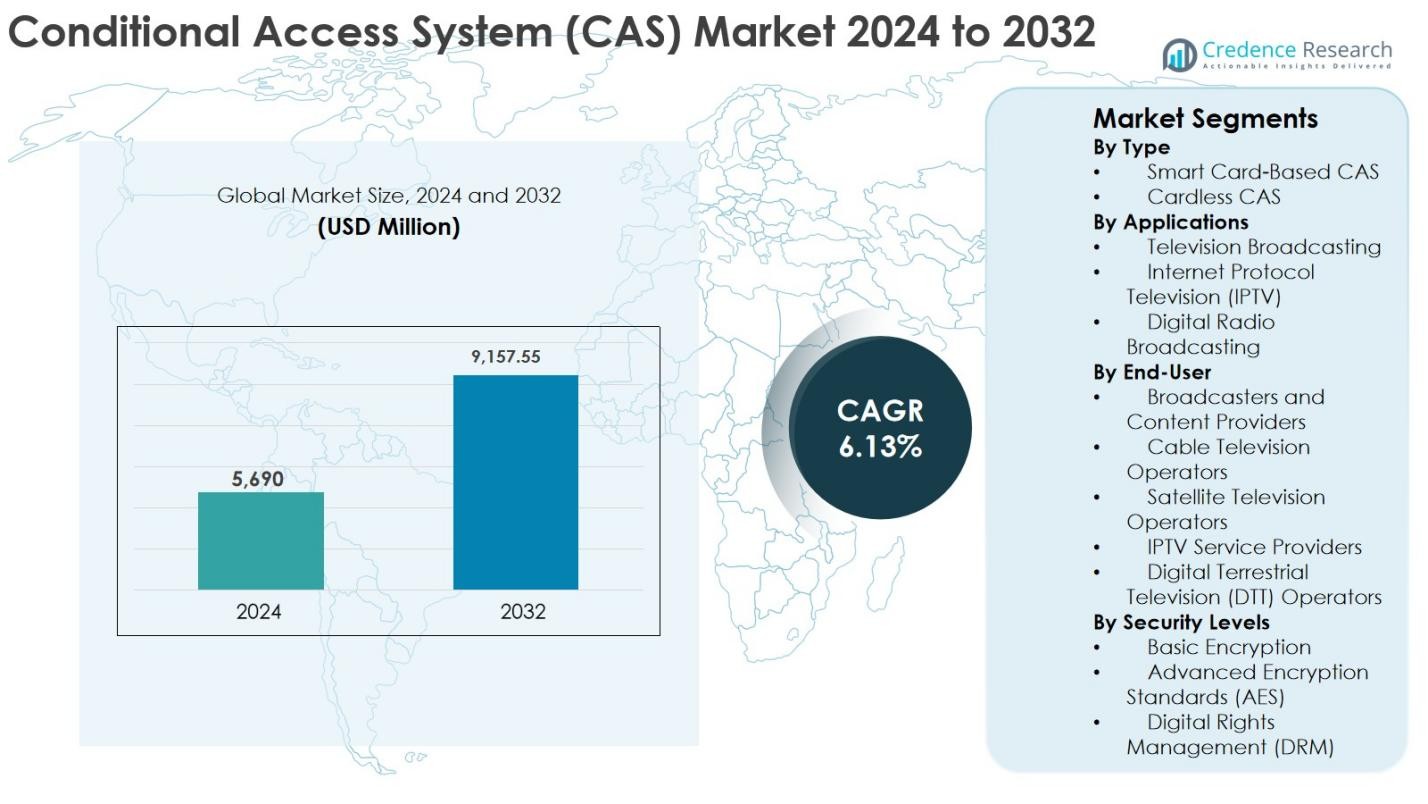
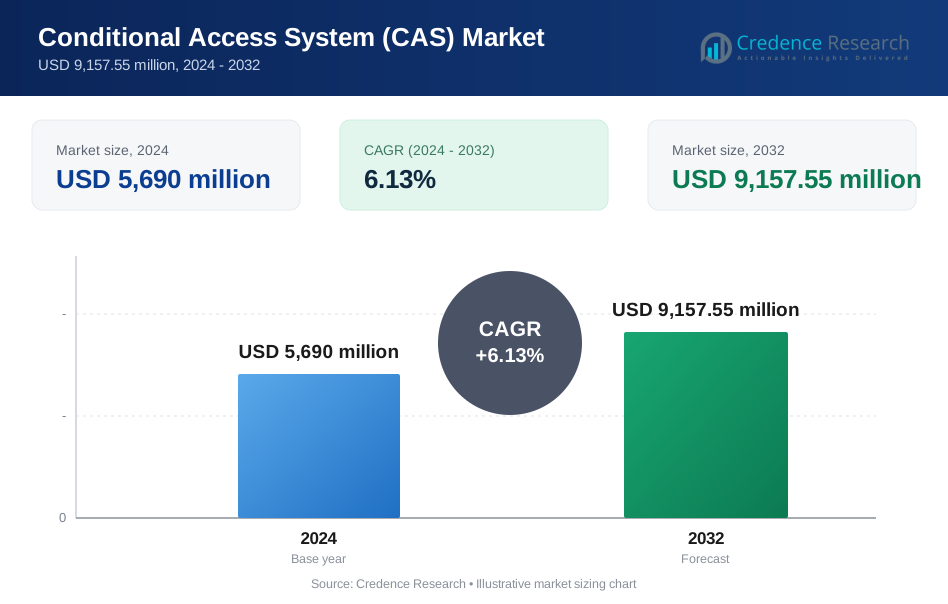
The Conditional Access System (CAS) Market size was valued at USD 5,690 million in 2024 and is anticipated to reach USD 9,157.55 million by 2032, growing at a CAGR of 6.13% during the forecast period.
| REPORT ATTRIBUTE | DETAILS |
|---|---|
| Historical Period | 2020-2023 |
| Base Year | 2024 |
| Forecast Period | 2025-2032 |
| Conditional Access System (CAS) Market Size 2024 | USD 5,690 Million |
| Conditional Access System (CAS) Market, CAGR | 6.13% |
| Conditional Access System (CAS) Market Size 2032 | USD 9,157.55 Million |
The Conditional Access System (CAS) market is supported by established technology providers such as Cisco Systems, Inc., Nagravision SA (Kudelski Group), Irdeto, Inc., Verimatrix, Inc., ARRIS Group, Inc., Alticast Corporation, China Digital TV Holding Co., Ltd., Latens Systems Ltd., Coretrust, Inc., and Austrian Broadcasting Services GmbH & Co. KG (ORS Group), which focus on secure content delivery and advanced access control solutions. North America led the Conditional Access System (CAS) market with an exact market share of 34.6% in 2024, driven by strong pay-TV infrastructure, rapid IPTV adoption, and high investments in anti-piracy technologies. Europe followed with a 27.8% market share, supported by mature digital broadcasting ecosystems and stringent content protection regulations.
Market Insights
- The Conditional Access System (CAS) market was valued at USD 5,690 million in 2024 and is projected to reach USD 9,157.55 million by 2032, growing at a CAGR of 6.13% during the forecast period, driven by rising demand for secure digital content delivery across broadcasting platforms.
- Market growth is primarily supported by increasing pay-TV subscriptions, expansion of IPTV services, and rising investments by broadcasters to prevent content piracy and revenue leakage across satellite, cable, and hybrid networks.
- Cardless CAS dominated the market with a share of 58.4% in 2024 due to lower operational costs, enhanced security, and easier integration with cloud-based and multi-device environments, while television broadcasting led applications with a 46.7% share.
- Key players such as Cisco Systems, Nagravision, Irdeto, Verimatrix, and ARRIS focus on software-based CAS innovation, partnerships with broadcasters, and scalable security solutions to strengthen market presence.
- North America held the largest regional share at 34.6% in 2024, followed by Europe at 27.8% and Asia Pacific at 24.1%, supported by advanced broadcasting infrastructure, regulatory compliance, and rapid digitalization.
 Market Segmentation Analysis:
By Type
The By Type segment of the Conditional Access System (CAS) market is led by Cardless CAS, which accounted for 58.4% of the market share in 2024. Cardless CAS dominates due to its higher security, reduced operational costs, and flexibility compared to traditional smart card-based systems. Broadcasters increasingly prefer cardless solutions as they eliminate risks related to card cloning, theft, and logistics management. The growing adoption of cloud-based CAS, software-defined security architectures, and seamless integration with IPTV and OTT platforms further accelerates demand for cardless CAS across both developed and emerging digital television markets.
- For instance, Nagra’s cardless CAS deployments with major pay‑TV operators have emphasized software-based security updates delivered over the network instead of physical smart card swaps, reducing field service and logistics overheads.
By Applications
By Applications, Television Broadcasting remained the dominant sub-segment, capturing 46.7% of the Conditional Access System (CAS) market share in 2024. This dominance is driven by the continued global reliance on pay-TV services, high penetration of digital cable and satellite TV, and the need to protect premium content from piracy. Broadcasters invest heavily in advanced CAS solutions to secure live sports, movies, and subscription-based channels. Additionally, regulatory mandates for digital broadcasting and upgrades from analog systems continue to sustain strong CAS demand within traditional television broadcasting applications.
- For instance, Dish TV India relies on CAS-integrated set-top boxes across its direct-to-home subscriber base to enforce entitlements on paid channels and regional bouquets, reducing revenue leakage from signal theft.
By End-User
Within the By End-User segment, Broadcasters and Content Providers held the largest share of 41.9% in 2024. Their dominance is supported by rising content monetization strategies, expansion of pay-TV ecosystems, and growing investments in anti-piracy technologies. Broadcasters increasingly deploy advanced CAS platforms to manage subscriber access, support multi-device viewing, and ensure secure content distribution across satellite, cable, IPTV, and hybrid networks. The rapid growth of premium content libraries and exclusive broadcasting rights further drives consistent CAS adoption among broadcasters and content providers globally.
Key Growth Drivers
Rising Demand for Secure Pay-TV and Premium Content Distribution
The Conditional Access System (CAS) market is strongly driven by the growing demand for secure pay-TV services and premium content distribution worldwide. Increasing consumption of high-value content such as live sports, exclusive entertainment, and regional language programming has heightened the need for robust content protection solutions. Broadcasters and operators rely on CAS to prevent unauthorized access, revenue leakage, and signal piracy. The rapid expansion of subscription-based television services across cable, satellite, IPTV, and DTT platforms continues to reinforce CAS adoption. Additionally, the transition from free-to-air to paid digital services in emerging markets significantly boosts demand, as operators prioritize secure subscriber authentication and controlled content access to safeguard long-term revenue streams.
- For instance, Sky protects its premium live sports and cinema offerings across Europe using advanced CAS and encryption to secure high-value rights and subscription packages on its satellite and IPTV platforms.
Expansion of IPTV and Hybrid Broadcasting Platforms
The accelerating growth of IPTV and hybrid broadcasting platforms is another major driver for the Conditional Access System (CAS) market. Telecom operators and service providers increasingly integrate IPTV with traditional broadcasting to deliver bundled digital services, including video-on-demand and multiscreen viewing. CAS solutions enable seamless access management across devices such as smart TVs, smartphones, tablets, and set-top boxes. As internet penetration improves and fiber-to-home deployments expand, IPTV adoption rises, directly increasing the need for scalable and software-driven CAS platforms. Moreover, hybrid broadcast-broadband services demand advanced CAS architectures capable of supporting both linear and non-linear content securely, further accelerating market growth.
- For instance, Telefónica’s Movistar+ service in Spain uses converged content protection for fiber-based IPTV and hybrid broadcast-broadband delivery, enabling secure access to both linear and non-linear content under a single subscription.
Increasing Focus on Anti-Piracy and Regulatory Compliance
Growing concerns over content piracy and stricter regulatory requirements significantly drive the Conditional Access System (CAS) market. Media companies face substantial revenue losses due to illegal streaming, signal theft, and unauthorized redistribution of content. CAS plays a critical role in enforcing digital rights management and ensuring compliance with broadcasting regulations across regions. Governments and industry bodies mandate secure transmission standards for digital television and pay-TV services, compelling operators to upgrade legacy systems. Additionally, the rise of high-definition and ultra-high-definition broadcasting increases the value of protected content, making advanced CAS solutions essential for mitigating piracy risks and maintaining regulatory adherence.
Key Trends & Opportunities
Shift Toward Cardless and Software-Based CAS Solutions
A key trend in the Conditional Access System (CAS) market is the transition from traditional smart card-based systems to cardless and software-centric CAS solutions. Operators increasingly adopt cardless CAS due to lower operational costs, simplified deployment, and enhanced security. Software-based CAS allows remote updates, faster scalability, and seamless integration with cloud infrastructures. This trend creates significant opportunities for vendors offering flexible, interoperable CAS platforms that support multi-network and multi-device environments. As broadcasters modernize their infrastructure, demand for virtualized and cloud-enabled CAS solutions continues to rise, opening new revenue streams for technology providers.
- For instance, Verimatrix’s software-oriented content security solutions support downloadable security clients and cloud-managed entitlements, helping operators secure both set-top boxes and multiscreen apps without relying on separate smart cards.
Growth Opportunities from Emerging Digital Broadcasting Markets
Emerging economies present strong growth opportunities for the Conditional Access System (CAS) market due to ongoing digitalization of broadcasting infrastructure. Governments across Asia-Pacific, Latin America, and Africa actively promote digital television adoption to improve spectrum efficiency and service quality. This transition drives demand for CAS solutions among new pay-TV operators and public broadcasters. Additionally, increasing urbanization, rising disposable incomes, and growing demand for localized content support the expansion of subscription-based services. Vendors that offer cost-effective and scalable CAS platforms tailored to regional requirements are well positioned to capitalize on these expanding digital broadcasting ecosystems.
- For instance, India’s phased digital addressable system (DAS) rollout led cable and DTH operators to deploy CAS-enabled set-top boxes to manage paid channel access in major urban and semi-urban regions.
Key Challenges
High Implementation and Integration Costs
High implementation and integration costs remain a significant challenge for the Conditional Access System (CAS) market, particularly for small and regional broadcasters. Deploying advanced CAS platforms requires substantial investment in hardware, software, encryption technologies, and system integration. Operators often face additional expenses related to infrastructure upgrades, system maintenance, and skilled workforce requirements. These costs can limit CAS adoption in price-sensitive markets and slow modernization efforts. Furthermore, integrating CAS with existing broadcasting, billing, and subscriber management systems adds complexity, posing operational challenges for service providers with legacy infrastructures.
Rapidly Evolving Piracy Techniques and Security Threats
The continuously evolving nature of piracy and cyber threats poses a major challenge to the Conditional Access System (CAS) market. Hackers and illegal streaming platforms constantly develop advanced techniques to bypass encryption and access controls. CAS providers must continuously update security algorithms and monitoring mechanisms to counter these threats, increasing development costs and technical complexity. Failure to address emerging vulnerabilities can lead to revenue losses and reputational damage for broadcasters. Maintaining robust security while ensuring seamless user experience remains a critical balancing challenge for CAS vendors and operators globally.
Regional Analysis
North America
North America dominated the Conditional Access System (CAS) market with a market share of 34.6% in 2024, driven by the strong presence of major broadcasters, advanced pay-TV infrastructure, and high adoption of IPTV and hybrid broadcasting services. The region benefits from early adoption of cardless and software-based CAS solutions to combat content piracy and protect premium sports and entertainment content. Continuous upgrades to UHD and multiscreen services further support CAS demand. Additionally, stringent content protection regulations and high consumer spending on subscription-based services sustain steady CAS adoption across the United States and Canada.
Europe
Europe accounted for 27.8% of the Conditional Access System (CAS) market share in 2024, supported by widespread digital television penetration and strong regulatory frameworks for content security. The region has a mature pay-TV ecosystem, with extensive use of satellite, cable, and IPTV platforms. Increasing investments in anti-piracy technologies and migration toward cardless CAS solutions drive market growth. Public broadcasters and private operators across Western and Eastern Europe continue to upgrade legacy systems to enhance subscriber management and service quality, sustaining consistent demand for advanced CAS platforms.
Asia Pacific
Asia Pacific held 24.1% of the Conditional Access System (CAS) market share in 2024 and represents the fastest-growing regional market. Rapid digitalization, expanding IPTV subscriber bases, and government-led digital TV initiatives significantly drive CAS adoption. Countries such as China, India, Japan, and South Korea witness strong demand due to rising pay-TV subscriptions and increasing consumption of premium regional content. Growing urbanization, improving broadband infrastructure, and cost-effective CAS deployments by regional operators further accelerate market expansion, positioning Asia Pacific as a key growth engine.
Latin America
Latin America captured about 7.6% of the Conditional Access System (CAS) market share in 2024, driven by steady growth in pay-TV and satellite television services. The region continues to transition from analog to digital broadcasting, creating demand for CAS solutions to manage subscriber access and secure content. Brazil, Mexico, and Argentina lead regional adoption due to expanding cable and DTH networks. Although cost sensitivity remains a challenge, increasing focus on piracy prevention and gradual IPTV adoption support sustained CAS market growth across Latin America.
Middle East & Africa
The Middle East & Africa region accounted for 5.9% of the Conditional Access System (CAS) market share in 2024, supported by rising investments in satellite broadcasting and premium content distribution. The Middle East shows strong demand for CAS due to high consumption of sports and entertainment channels, while Africa experiences gradual growth driven by digital TV rollouts. Government initiatives to enhance broadcasting infrastructure and rising penetration of pay-TV services encourage CAS adoption, despite infrastructure and affordability constraints in certain African markets.
Market Segmentations:
By Type
- Smart Card-Based CAS
- Cardless CAS
By Applications
- Television Broadcasting
- Internet Protocol Television (IPTV)
- Digital Radio Broadcasting
By End-User
- Broadcasters and Content Providers
- Cable Television Operators
- Satellite Television Operators
- IPTV Service Providers
- Digital Terrestrial Television (DTT) Operators
By Security Levels
- Basic Encryption
- Advanced Encryption Standards (AES)
- Digital Rights Management (DRM)
By Geography
- North America
- U.S.
- Canada
- Mexico
- Europe
- Germany
- France
- U.K.
- Italy
- Spain
- Rest of Europe
- Asia Pacific
- China
- Japan
- India
- South Korea
- South-east Asia
- Rest of Asia Pacific
- Latin America
- Brazil
- Argentina
- Rest of Latin America
- Middle East & Africa
- GCC Countries
- South Africa
- Rest of the Middle East and Africa
Competitive Landscape
The Conditional Access System (CAS) market features a well-established landscape characterized by the presence of global technology providers and specialized security solution vendors focusing on content protection and access management. Key players such as Cisco Systems, Inc., Nagravision SA (Kudelski Group), Irdeto, Inc., Verimatrix, Inc., ARRIS Group, Inc., Alticast Corporation, China Digital TV Holding Co., Ltd., Latens Systems Ltd., Coretrust, Inc., and Austrian Broadcasting Services GmbH & Co. KG (ORS Group) actively compete through technology innovation and strategic partnerships. Market participants emphasize the development of cardless and software-based CAS platforms to enhance security, scalability, and cost efficiency. Continuous investments in anti-piracy technologies, cloud-enabled architectures, and multi-device compatibility remain central strategies. Additionally, players focus on expanding their regional footprint and strengthening relationships with broadcasters, telecom operators, and IPTV service providers to sustain long-term market growth.
Key Player Analysis
- Verimatrix, Inc.
- Irdeto, Inc.
- China Digital TV Holding Co., Ltd.
- Alticast Corporation
- Austrian Broadcasting Services GmbH & Co. KG (ORS Group)
- Cisco Systems, Inc.
- Latens Systems Ltd.
- Coretrust, Inc.
- Nagravision SA (Kudelski Group)
- ARRIS Group, Inc.
Recent Developments
- In April 2025, Verimatrix partnered with AgileTV to secure its fast-growing TVaaS solution, expanding CAS-related security collaboration in the service provider ecosystem.
- In March 2025, Verimatrix launched the XTD Velocity Partner Alliance to accelerate global channel sales, strengthening its ecosystem support for content security and CAS-related distribution.
- In January 2025, Verimatrix announced the release of its new DVB ReAccess Over-the-Air (OTA) Conditional Access System (CAS) retrofit solution, enabling operators to update CAS on deployed devices without physical swaps
Report Coverage
The research report offers an in-depth analysis based on Type, Application, End-User, Security Levels and Geography. It details leading market players, providing an overview of their business, product offerings, investments, revenue streams, and key applications. Additionally, the report includes insights into the competitive environment, SWOT analysis, current market trends, as well as the primary drivers and constraints. Furthermore, it discusses various factors that have driven market expansion in recent years. The report also explores market dynamics, regulatory scenarios, and technological advancements that are shaping the industry. It assesses the impact of external factors and global economic changes on market growth. Lastly, it provides strategic recommendations for new entrants and established companies to navigate the complexities of the market.
Future Outlook
- The Conditional Access System (CAS) market will continue to benefit from sustained growth in pay-TV, IPTV, and hybrid broadcasting services worldwide.
- Broadcasters will increasingly adopt cardless and software-based CAS solutions to improve security and reduce operational complexity.
- Integration of CAS with cloud platforms will enhance scalability, flexibility, and remote management capabilities.
- Rising demand for multi-screen and multi-device content access will drive advanced subscriber management features within CAS platforms.
- Anti-piracy requirements will push continuous innovation in encryption and access control technologies.
- Expansion of digital television infrastructure in emerging economies will create new growth opportunities for CAS providers.
- Regulatory mandates for secure content distribution will support long-term CAS deployment across regions.
- Partnerships between CAS vendors and telecom operators will strengthen integrated service offerings.
- Increasing adoption of UHD and premium content formats will elevate the need for robust access protection systems.
- Ongoing convergence of broadcasting and broadband networks will position CAS as a critical component of future digital media ecosystems.
Request a Free Sample
Fill in your details and we'll send you a free sample report.
- Sample data tables & charts
- Research methodology
Market Dynamics
Expansion of Pay-TV and IPTV Services
The proliferation of pay-TV subscriptions and the rapid adoption of IPTV platforms are driving demand for advanced CAS solutions to secure content delivery and manage subscriber access across multiple networks.
Transition to Cardless and Software-Based CAS
Broadcasters and operators are increasingly shifting to cardless and software-centric CAS systems due to their lower operational costs, enhanced security, and ease of integration with cloud and multi-device environments.
Rising Investments in Anti-Piracy Technologies
Growing concerns over content piracy and revenue leakage are prompting broadcasters and service providers to invest in robust CAS platforms that enforce digital rights management and comply with stringent regulatory standards.
Digitalization Initiatives in Emerging Markets
Government-led digital TV rollouts and increasing urbanization in regions like Asia Pacific and Latin America are fueling the adoption of CAS solutions as operators upgrade infrastructure to support secure, subscription-based services.
Growth of Premium and UHD Content Distribution
The increasing value and consumption of premium, high-definition, and ultra-high-definition content are elevating the need for sophisticated CAS systems to protect exclusive broadcasting rights and prevent unauthorized access.
Need a Custom Version of This Report?
Tailor the scope, geography, or segments to your exact requirements.
- Custom geography or segment scope
- Direct access to our analyst team
Frequently Asked Questions
What is the current market size for Conditional Access System (CAS) market, and what is its projected size in 2032?
At what Compound Annual Growth Rate is the Conditional Access System (CAS) market projected to grow between 2024 and 2032?
Which Conditional Access System (CAS) market segment held the largest share in 2024?
What are the primary factors fueling the growth of the Conditional Access System (CAS) market?
Who are the leading companies in the Conditional Access System (CAS) market?
Which region commanded the largest share of the Conditional Access System (CAS) market in 2024?
Table of Content
Chapter 1 Market Segmentation
- 1.1 Segmentation Framework
- 1.1.1 Product and Service Classification
- 1.1.2 Application and End-Use Classification
- 1.1.3 Technology and Solution Classification
- 1.1.4 Customer and Distribution Channel Classification
- 1.1.5 Geographic Segmentation
- 1.1.6 Market Segment Definitions and Boundaries
- 1.2 By Type
- 1.2.1 Smart Card-Based CAS
- 1.2.2 Cardless CAS
- 1.3 By End-User
- 1.3.1 Broadcasters and Content Providers
- 1.3.2 Cable Television Operators
- 1.3.3 Satellite Television Operators
- 1.3.4 IPTV Service Providers
- 1.3.5 Digital Terrestrial Television (DTT) Operators
- 1.4 By Application
- 1.4.1 Television Broadcasting
- 1.4.2 Internet Protocol Television (IPTV)
- 1.4.3 Digital Radio Broadcasting
- 1.5 By Security Levels
- 1.5.1 Basic Encryption
- 1.5.2 Advanced Encryption Standards (AES)
- 1.5.3 Digital Rights Management (DRM)
Chapter 2 Introduction
- 2.1 Report Objectives and Scope
- 2.2 Product Definition and Industry Terminology
- 2.3 Market Inclusions and Exclusions
- 2.4 Research Process
- 2.4.1 Primary Research and Expert Interviews
- 2.4.2 Secondary Research and Source Review
- 2.4.3 Top-Down and Bottom-Up Estimation
- 2.4.4 Data Triangulation and Verification
- 2.5 Market Size Measurement Basis
- 2.5.1 2024: USD 5,690 million → 2032: USD 9,157.55 million
- 2.6 Historical and Forecast Reference Periods
- 2.6.1 Base Year: 2024
- 2.6.2 Forecast Period: 2024-2032
- 2.7 Research Assumptions and Limitations
Chapter 3 Executive Summary
- 3.1 Market Snapshot and Key Findings
- 3.2 Base-Year Market Size, 2024
- 3.3 Forecast Market Size, 2032
- 3.4 Revenue and Volume Growth Outlook
- 3.5 Key Demand and Supply Indicators
- 3.6 Leading Market Segments
- 3.7 Fastest-Growing Market Opportunities
- 3.8 Regional Performance Highlights
- 3.9 Technology and Industry Transformation
- 3.10 Competitive Landscape Summary
- 3.11 Analyst View and Strategic Implications
Chapter 4 Global Conditional Access System (CAS) Market Trends and Developments
- 4.1 Historical Industry Development
- 4.2 Recent Market Trends and Developments
- 4.3 Demand and Customer Behavior Trends
- 4.4 Technology and Product Innovation
- 4.5 Artificial Intelligence, Automation and Digitalization
- 4.6 Local Manufacturing and Supply Chain Realignment
- 4.7 Industry Partnerships, Mergers and Acquisitions
- 4.8 Sustainability and Circular Economy Developments
- 4.9 Government and Private Sector Investment Trends
- 4.10 Emerging Business Models and Commercialization
- 4.11 Industry Developments and Announcements
Chapter 5 Global Conditional Access System (CAS) Market Production, Supply and Demand Analysis
- 5.1 Demand Trend and Consumption Analysis
- 5.2 Demand Forecast, 2024-2032
- 5.3 Production and Output Trend
- 5.4 Production and Output Forecast, 2024-2032
- 5.5 Installed Capacity and Capacity Utilization
- 5.6 Company-Wise Production Plants and Statistics
- 5.6.1 Installed Production Capacity
- 5.6.2 Actual Production
- 5.6.3 Planned Capacity and Expansion Targets
- 5.7 Supply Chain Structure and Procurement Trends
- 5.8 Supply-Demand Gap and Bottlenecks
- 5.9 Import Dependence and Sourcing Structure
- 5.10 Contract Manufacturing and Outsourcing
- 5.11 Regional Supply and Demand Concentration
Chapter 6 Global Conditional Access System (CAS) Market Pricing Analysis
- 6.1 Pricing Structure and Measurement
- 6.2 Historical Pricing Trends
- 6.3 Pricing Outlook, 2024-2032
- 6.4 Average Selling Price and Unit Economics
- 6.5 Pricing by Product and Market Segment
- 6.6 Geographic Pricing Differences
- 6.7 Key Input, Energy, Labor and Logistics Costs
- 6.8 Contract Pricing and Purchasing Models
- 6.9 Pricing Sensitivity and Competitive Positioning
- 6.10 Price, Margin and Profitability Implications
Chapter 7 Global Conditional Access System (CAS) Market Dynamics
- 7.1 Market Growth Drivers
- 7.1.1 Demand-Side Drivers
- 7.1.2 Technology and Innovation Drivers
- 7.1.3 Infrastructure and Investment Drivers
- 7.1.4 Regulatory and Policy Drivers
- 7.2 Market Restraints
- 7.2.1 Cost and Affordability Constraints
- 7.2.2 Technology and Adoption Barriers
- 7.2.3 Supply Chain and Operational Constraints
- 7.3 Market Challenges
- 7.3.1 Competitive Pressure and Margin Erosion
- 7.3.2 Skills, Infrastructure and Implementation Gaps
- 7.4 Emerging Market Opportunities
- 7.5 Market Dynamics Impact and Time-Horizon Assessment
Chapter 8 Global Conditional Access System (CAS) Value Chain Analysis
- 8.1 Industry Value Chain Overview
- 8.2 Upstream Suppliers and Critical Inputs
- 8.3 Technology and Component Providers
- 8.4 Manufacturing or Service Delivery
- 8.5 Distribution, Channel Partners and Integrators
- 8.6 Downstream Applications and End Users
- 8.7 Value Addition and Profit Pools
- 8.8 Vertical Integration and Outsourcing
- 8.9 Supplier Concentration and Risk
- 8.10 Supply Chain Localization and Resilience
Chapter 9 Global Conditional Access System (CAS) Market Regulations and Policies
- 9.1 Relevant Laws, Standards and Compliance Frameworks
- 9.2 Product, Service, Safety and Quality Requirements
- 9.3 Government Policies, Incentives and Subsidies
- 9.4 Imports, Exports and Trade Barriers
- 9.5 Public Procurement and Local Content Requirements
- 9.6 Environmental and Sustainability Compliance
- 9.7 Data Protection, AI and Cybersecurity Compliance
- 9.8 Upcoming Policy Changes and Market Implications
Chapter 10 Global Conditional Access System (CAS) Market Hotspots and Opportunities
- 10.1 Market Opportunity Mapping and Growth Hotspots
- 10.2 High-Growth Applications and Customer Groups
- 10.3 Underserved Markets and White-Space Opportunities
- 10.4 Emerging Technology and Product Opportunities
- 10.5 New Capacity and Investment Hotspots
- 10.6 Market Entry and Expansion Opportunities
- 10.7 Distribution and Partnership Opportunities
- 10.8 Near-Term and Long-Term Commercial Potential
- 10.9 Opportunity Attractiveness and Execution Risks
Chapter 11 Global Conditional Access System (CAS) Market Outlook, 2024-2032
- 11.1 Market Size and Analysis
- 11.1.1 Revenue (Market Measurement: 2024: USD 5,690 million → 2032: USD 9,157.55 million)
- 11.1.2 Market Volume and Quantity Sold
- 11.1.3 Historical Market Size
- 11.1.4 Base-Year Market Size, 2024
- 11.2 Market Forecast, 2024-2032
- 11.2.1 Revenue Forecast to 2032
- 11.2.2 Volume Forecast to 2032
- 11.2.3 CAGR and Year-on-Year Growth
- 11.2.4 Incremental Revenue Opportunity
- 11.3 Forecast Assumptions and Scenario Analysis
- 11.3.1 Base-Case Forecast
- 11.3.2 Optimistic and Conservative Scenarios
- 11.3.3 Technology, Pricing and Policy Sensitivities
- 11.4 Market Attractiveness and Growth Outlook
Chapter 12 Global Conditional Access System (CAS) Market Segmentation and Outlook
- 12.1 Segmentation Summary and Market Shares, 2024
- 12.2 Largest and Fastest-Growing Segments
- 12.3 By Type - Market Size and Forecast, 2024-2032
- 12.3.1 Segment Definition and Scope
- 12.3.2 Historical Market Size
- 12.3.3 Revenue Forecast, 2024-2032
- 12.3.4 Volume Forecast, 2024-2032
- 12.3.5 Base-Year Market Share, 2024
- 12.3.6 Segment CAGR and Growth Drivers
- 12.3.7 Subsegment Market Size and Forecast
- 12.3.7.1 Smart Card-Based CAS
- 12.3.7.2 Cardless CAS
- 12.3.8 Subsegment Pricing and Adoption Trends
- 12.3.9 Leading Suppliers and Competition
- 12.3.10 Regional Demand and Opportunities
- 12.4 By End-User - Market Size and Forecast, 2024-2032
- 12.4.1 Segment Definition and Scope
- 12.4.2 Historical Market Size
- 12.4.3 Revenue Forecast, 2024-2032
- 12.4.4 Volume Forecast, 2024-2032
- 12.4.5 Base-Year Market Share, 2024
- 12.4.6 Segment CAGR and Growth Drivers
- 12.4.7 Subsegment Market Size and Forecast
- 12.4.7.1 Broadcasters and Content Providers
- 12.4.7.2 Cable Television Operators
- 12.4.7.3 Satellite Television Operators
- 12.4.7.4 IPTV Service Providers
- 12.4.7.5 Digital Terrestrial Television (DTT) Operators
- 12.4.8 Subsegment Pricing and Adoption Trends
- 12.4.9 Leading Suppliers and Competition
- 12.4.10 Regional Demand and Opportunities
- 12.5 By Application - Market Size and Forecast, 2024-2032
- 12.5.1 Segment Definition and Scope
- 12.5.2 Historical Market Size
- 12.5.3 Revenue Forecast, 2024-2032
- 12.5.4 Volume Forecast, 2024-2032
- 12.5.5 Base-Year Market Share, 2024
- 12.5.6 Segment CAGR and Growth Drivers
- 12.5.7 Subsegment Market Size and Forecast
- 12.5.7.1 Television Broadcasting
- 12.5.7.2 Internet Protocol Television (IPTV)
- 12.5.7.3 Digital Radio Broadcasting
- 12.5.8 Subsegment Pricing and Adoption Trends
- 12.5.9 Leading Suppliers and Competition
- 12.5.10 Regional Demand and Opportunities
- 12.6 By Security Levels - Market Size and Forecast, 2024-2032
- 12.6.1 Segment Definition and Scope
- 12.6.2 Historical Market Size
- 12.6.3 Revenue Forecast, 2024-2032
- 12.6.4 Volume Forecast, 2024-2032
- 12.6.5 Base-Year Market Share, 2024
- 12.6.6 Segment CAGR and Growth Drivers
- 12.6.7 Subsegment Market Size and Forecast
- 12.6.7.1 Basic Encryption
- 12.6.7.2 Advanced Encryption Standards (AES)
- 12.6.7.3 Digital Rights Management (DRM)
- 12.6.8 Subsegment Pricing and Adoption Trends
- 12.6.9 Leading Suppliers and Competition
- 12.6.10 Regional Demand and Opportunities
- 12.7 Segment Growth Comparison
- 12.8 Segment Attractiveness and Priority Matrix
Chapter 13 Global Conditional Access System (CAS) End-Use and Application Market Outlook
- 13.1 End-Use Industry and Customer Demand Structure
- 13.2 Leading Applications and Customer Groups
- 13.3 End-Use Market Size, Share and Forecast
- 13.4 Major End-Use Industry Deep Dives
- 13.4.1 Customer Requirements and Use Cases
- 13.4.2 Demand and Replacement Cycles
- 13.4.3 Technical and Regulatory Considerations
- 13.4.4 Purchasing and Procurement Models
- 13.4.5 Leading Vendors and Distribution Channels
- 13.4.6 Forecast and Commercial Opportunities
- 13.5 Emerging Applications and Cross-Segment Demand
- 13.6 End-Use Industry Investment Priorities
Chapter 14 Global Conditional Access System (CAS) Geographic Market Outlook, 2024-2032
- 14.1 Regional Market Size and Share, 2024
- 14.2 Regional Market Forecast, 2024-2032
- 14.3 Regional Pricing, Production and Demand Differences
- 14.4 North America
- 14.4.1 United States
- 14.4.2 Canada
- 14.4.3 Mexico
- 14.5 Europe
- 14.5.1 Germany
- 14.5.2 France
- 14.5.3 Italy
- 14.5.4 United Kingdom
- 14.5.5 Spain
- 14.5.6 Poland
- 14.5.7 Russia
- 14.5.8 Netherlands
- 14.5.9 Belgium
- 14.5.10 Sweden
- 14.5.11 Denmark
- 14.5.12 Norway
- 14.5.13 Rest of Europe
- 14.6 Asia Pacific
- 14.6.1 China
- 14.6.2 India
- 14.6.3 Japan
- 14.6.4 South Korea
- 14.6.5 Thailand
- 14.6.6 Indonesia
- 14.6.7 Vietnam
- 14.6.8 Malaysia
- 14.6.9 Australia
- 14.6.10 Rest of Asia Pacific
- 14.7 Latin America
- 14.7.1 Brazil
- 14.7.2 Argentina
- 14.7.3 Colombia
- 14.7.4 Chile
- 14.7.5 Rest of Latin America
- 14.8 Middle East
- 14.8.1 Saudi Arabia
- 14.8.2 United Arab Emirates
- 14.8.3 Turkey
- 14.8.4 Israel
- 14.8.5 Iran
- 14.8.6 Rest of the Middle East
- 14.9 Africa
- 14.9.1 South Africa
- 14.9.2 Egypt
- 14.9.3 Nigeria
- 14.9.4 Morocco
- 14.9.5 Rest of Africa
- 14.10 Regional Investment, Policy and Supply Chain Differences
- 14.11 Regional Competitive Landscape
- 14.12 Geographic Growth Hotspots
Chapter 15 Global Conditional Access System (CAS) Technology, Innovation and Sustainability Outlook
- 15.1 Technology Landscape and Maturity
- 15.2 Product, Process and Service Innovation
- 15.3 AI, Automation and Digital Tools in the Industry
- 15.4 Technology Adoption and Performance Benchmarking
- 15.5 Innovation Pipeline and R&D Investment
- 15.6 Patent and Intellectual Property Trends
- 15.7 Energy Efficiency and Resource Management
- 15.8 Sustainability, Recycling and Circularity
- 15.9 Technology Roadmap, 2024-2032
- 15.10 Risks of Obsolescence and Technology Substitution
Chapter 16 Global Conditional Access System (CAS) Market Key Strategic Imperatives
- 16.1 Growth and Market Entry Priorities
- 16.2 High-Return Products and Segments
- 16.3 Pricing, Profitability and Cost Optimization
- 16.4 Technology Investment and Product Differentiation
- 16.5 Supply Chain Localization and Resilience
- 16.6 Distribution and Customer Acquisition
- 16.7 Partnership, Acquisition and Capacity Strategy
- 16.8 Regional Expansion Priorities
- 16.9 Short-, Medium- and Long-Term Actions
Chapter 17 Competition Outlook
- 17.1 Industry Competition Characteristics
- 17.2 Market Structure and Concentration
- 17.3 Market Share and Competitive Positioning, 2024
- 17.4 Company-Wise Revenue and Product Benchmarking
- 17.5 Production and Service Capacity Benchmarking
- 17.6 Technology, Pricing and Differentiation
- 17.7 Regional Footprint and Distribution Strength
- 17.8 Mergers, Acquisitions and Strategic Alliances
- 17.9 New Entrants and Competitive Threats
- 17.10 Porter's Five Forces and Industry Attractiveness
- 17.11 Competitive Outlook, 2024-2032
Chapter 18 Company Profiles
- 18.1 Company Coverage and Selection Criteria
- 18.2 Cisco Systems, Inc.
- 18.2.1 Business Description
- 18.2.2 Company Ownership and Geographic Presence
- 18.2.3 Product and Service Portfolio
- 18.2.4 Manufacturing and Operating Footprint
- 18.2.5 Production Capacity and Expansion Plans
- 18.2.6 Financial Performance and Investment
- 18.2.7 Market Share and Competitive Position
- 18.2.8 Technology and Innovation Capabilities
- 18.2.9 Strategic Alliances or Partnerships
- 18.2.10 Recent Developments
- 18.2.11 Growth Strategy and Outlook
- 18.3 Nagravision SA (Kudelski Group)
- 18.4 Irdeto, Inc.
- 18.5 Verimatrix, Inc.
- 18.6 ARRIS Group, Inc.
- 18.7 Alticast Corporation
- 18.8 China Digital TV Holding Co., Ltd.
- 18.9 Latens Systems Ltd.
- 18.10 Coretrust, Inc.
- 18.11 Austrian Broadcasting Services GmbH & Co. KG (ORS Group)
- 18.12 Other Relevant Market Participants
Note: Every listed company is profiled on the structure shown under the first company. The company list is preliminary and may change based on research findings, market developments, data availability and client requirements.
Chapter 19 Disclaimer
- 19.1 Research and Forecast Disclaimer
- 19.2 Data Source and Estimation Limitations
Note: The depth of individual sections depends on data availability for this market. Volume, capacity, trade and other unit-based metrics are included where applicable.