
| REPORT ATTRIBUTE | DETAILS |
|---|---|
| Historical Period | 2020-2023 |
| Base Year | 2024 |
| Forecast Period | 2025-2032 |
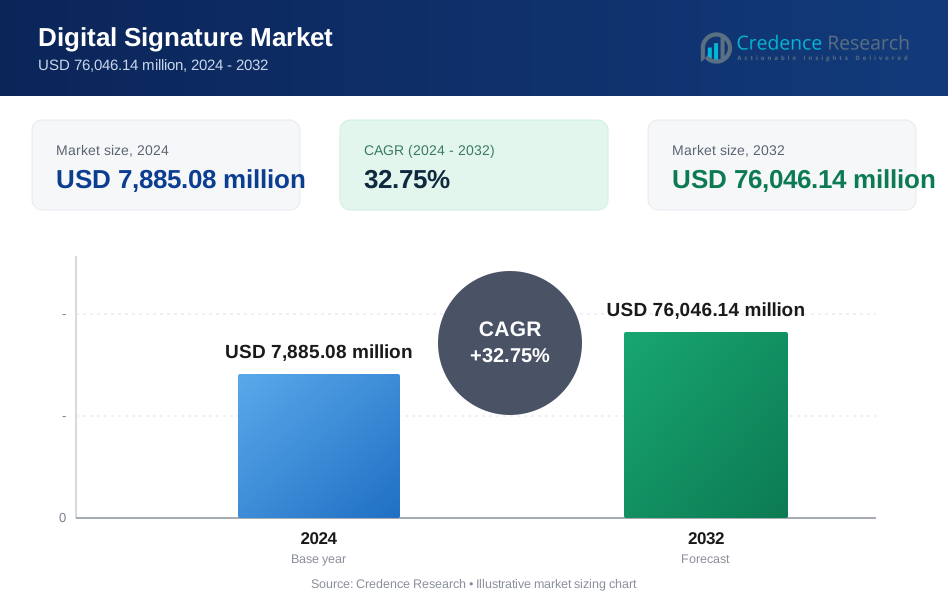
| Digital Signature Market Size 2024 | USD 7,885.08 million |
| Digital Signature Market, CAGR | 32.75% |
| Digital Signature Market Size 2032 | USD 76,046.14 million |
Market Overview:
The Global Digital Signature Market is projected to grow from USD 7,885.08 million in 2024 to an estimated USD 76,046.14 million by 2032, with a compound annual growth rate (CAGR) of 32.75% from 2024 to 2032.
Several key factors are propelling the growth of the digital signature market. The rising incidence of cyber threats and the demand for secure online transactions are compelling organizations to adopt digital signature solutions to ensure the authenticity and integrity of electronic documents. Furthermore, the growing emphasis on digital transformation across industries is accelerating the shift towards paperless workflows, thereby increasing the reliance on digital signatures. Government initiatives and regulatory frameworks, such as the implementation of electronic signature laws and standards, are also fostering market growth by providing a legal foundation for the use of digital signatures in various sectors. The increasing adoption of cloud-based solutions further enhances the scalability and accessibility of digital signature technologies, driving their integration across various business processes.
Regionally, North America holds a significant share of the digital signature market, accounting for a substantial portion of the global revenue in 2024. The United States, in particular, is a major contributor, driven by the presence of key market players and a favorable regulatory environment that supports the adoption of digital signature solutions. Europe follows closely, with countries like Germany, the United Kingdom, and France leading the adoption due to stringent data protection regulations and a strong inclination towards digitalization. The Asia Pacific region is witnessing the fastest growth, attributed to rapid technological advancements, increased internet penetration, and government initiatives promoting electronic transactions. Countries such as India, China, and Japan are at the forefront of this expansion, with India projected to register the highest growth. The widespread shift to digital governance in several countries further strengthens the adoption of digital signatures in this region.
Market Insights:
- The Global Digital Signature Market is projected to grow significantly, from USD 7,885.08 million in 2024 to USD 76,046.14 million by 2032, reflecting a strong CAGR of 32.75% during the forecast period.
- Rising cybersecurity threats are driving the demand for digital signature solutions, as organizations seek secure ways to authenticate electronic documents and protect against fraud and unauthorized changes.
- Government regulations, such as electronic signature laws, are creating a favorable legal framework for digital signature adoption across industries, ensuring their acceptance in business and government transactions.
- The shift toward digital transformation across industries is accelerating the use of digital signatures, as companies increasingly adopt paperless workflows and secure electronic document management systems.
- Cloud technology advancements are enhancing the scalability and accessibility of digital signature solutions, enabling organizations to adopt cloud-based solutions for secure, remote document signing.
- High implementation costs remain a restraint, especially for small and medium-sized enterprises (SMEs) that struggle to justify the initial investment in digital signature solutions.
- Regional analysis indicates that North America leads the market, with Europe and Asia Pacific showing strong growth, particularly driven by stringent regulations and government initiatives promoting digital transformation.
Report scope
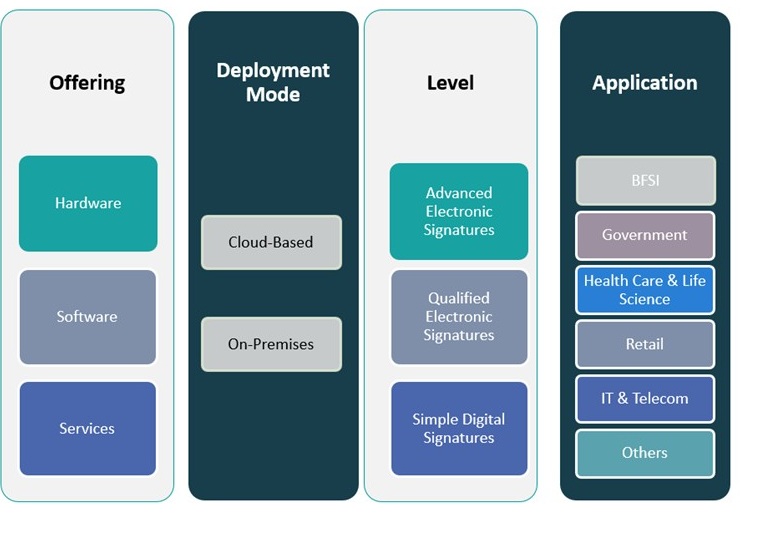
This report segments the Digital Signature Market as follow
Market Drivers:
Rising Cybersecurity Threats
The increasing prevalence of cyber threats is one of the primary drivers for the growth of the global digital signature market. As businesses and governments face growing concerns over the security of online transactions, the need for robust solutions to authenticate electronic documents becomes critical. Digital signatures provide a secure, tamper-evident way of signing documents electronically, ensuring both the integrity and authenticity of data. With cyberattacks becoming more sophisticated, companies are increasingly turning to digital signature solutions as a safeguard against fraud and unauthorized alterations. This need for enhanced cybersecurity is fueling the demand for digital signature technologies across industries.
Government Regulations and Legal Frameworks
Government regulations and legal frameworks also play a pivotal role in driving the adoption of digital signatures. Various countries have implemented electronic signature laws to provide legal validity to digitally signed documents, making them an essential tool for businesses that need to comply with regulatory standards. These regulations ensure that digital signatures are treated with the same legal weight as traditional handwritten signatures, fostering confidence in their use across sectors. For instance, in the U.S., the Electronic Signatures in Global and National Commerce Act (E-SIGN Act) legally equates digital signatures with handwritten ones, supporting widespread governmental and business use. As governments continue to develop and refine electronic transaction laws, the global digital signature market benefits from the legal recognition and acceptance of digital signatures in both business and government applications.
Growing Shift Toward Digital Transformation
The increasing emphasis on digital transformation across industries is another significant factor contributing to the growth of the digital signature market. As organizations continue to modernize their operations and move toward paperless workflows, digital signatures provide a reliable and efficient solution for managing electronic documentation. The shift to remote work, particularly accelerated by the COVID-19 pandemic, has highlighted the need for secure and seamless electronic document management systems. For example, the City of Albany, Georgia, integrated digital signing into its content management system, enabling near-instant document signing and faster project completion. Digital signatures enable businesses to sign contracts, agreements, and other important documents without the need for physical presence, driving greater efficiency and cost savings.
Advancements in Cloud Technology
The rapid growth of cloud-based solutions is also a key driver of the digital signature market. Cloud technology enhances the accessibility and scalability of digital signature solutions, making them more attractive to organizations of all sizes. By integrating digital signature technologies with cloud platforms, companies can offer their employees and clients secure, easy-to-use tools for signing documents remotely, regardless of location. This convenience, coupled with the added security provided by cloud services, is driving widespread adoption. Additionally, cloud-based digital signature solutions can be seamlessly integrated into existing enterprise resource planning (ERP) systems, further streamlining workflows and promoting greater operational efficiency.
Market Trends:
Increased Adoption of Biometric Authentication
A notable trend in the global digital signature market is the integration of biometric authentication technologies. As the demand for secure and user-friendly solutions grows, organizations are increasingly incorporating biometrics, such as facial recognition and fingerprint scanning, into their digital signature processes. For instance, companies like Yousign and DocuSign have implemented biometric authentication-such as facial recognition and fingerprint scanning-in their e-signature platforms to enhance security and user experience, particularly in sectors like banking, healthcare, and legal services. This trend enhances the security of digital signatures by providing a multi-factor authentication method, ensuring that the signatory’s identity is verified through both biometric data and the digital signature itself. Biometric authentication also simplifies the signing process for users, improving overall user experience while bolstering security measures. As consumer and enterprise demand for more advanced security grows, this trend is likely to accelerate, particularly in sectors that require high levels of trust and confidentiality.
Blockchain Technology Integration
Another prominent trend reshaping the digital signature market is the integration of blockchain technology. Blockchain’s decentralized and tamper-proof nature makes it an ideal complement to digital signature solutions, ensuring even greater security and transparency for signed documents. By incorporating blockchain, digital signatures can benefit from an immutable audit trail that records every interaction with a document, making it impossible to alter the signed content without detection. For instance, eMudhra reports that all transactions on blockchain platforms are digitally signed, guaranteeing transaction integrity and non-tampering of data. This integration is especially appealing for industries such as finance, legal, and healthcare, where regulatory compliance and data integrity are paramount. The growing interest in blockchain for digital signature applications highlights the industry's commitment to addressing evolving security concerns while streamlining operations.
Rising Demand for Cloud-Based Digital Signatures
The global shift toward cloud computing continues to influence trends in the digital signature market. As more organizations migrate to cloud-based environments, there is a growing preference for cloud-based digital signature solutions. These platforms offer significant advantages, including cost-effectiveness, scalability, and remote accessibility, making them highly attractive to businesses of all sizes. Cloud-based solutions allow users to sign documents from anywhere, eliminating the need for physical presence and reducing operational bottlenecks associated with traditional paper-based signatures. Additionally, cloud-based digital signatures are easier to integrate into other enterprise software solutions, such as customer relationship management (CRM) systems, further streamlining business workflows.
Government-Driven Digital Transformation Initiatives
Governments around the world are increasingly investing in digital transformation initiatives, which is a key trend driving the growth of the digital signature market. With the aim of improving efficiency, transparency, and security in public sector processes, many governments are adopting digital signatures for various services such as tax filing, permit issuance, and electronic voting. In regions like Europe and Asia Pacific, governments have rolled out national electronic signature systems to promote digital adoption among businesses and citizens alike. These initiatives not only ensure the legality and security of electronically signed documents but also foster greater trust in digital systems, ultimately encouraging widespread use across both private and public sectors.
Market Challenges Analysis:
High Implementation Costs
One of the key restraints in the global digital signature market is the high cost associated with implementing digital signature solutions, especially for small and medium-sized enterprises (SMEs). While large organizations can more easily absorb the costs of software licensing, integration, and ongoing maintenance, SMEs may face challenges in justifying the initial investment. Additionally, some digital signature solutions require significant infrastructure changes or updates to existing systems, which further increases costs. This financial barrier can delay or prevent adoption in sectors where budget constraints are a concern, limiting the market’s overall growth potential.
Regulatory and Legal Concerns
Regulatory complexity remains a major challenge. For example, while the U.S. E-SIGN Act and the EU’s eIDAS regulation provide clear legal frameworks, other countries enforce prescriptive laws that require specific types of digital signatures or additional authentication steps for certain documents. This lack of uniformity means multinational organizations must navigate a patchwork of requirements, increasing compliance costs and legal uncertainty. In some jurisdictions, certain documents-such as those related to birth, adoption, or court matters-cannot be signed digitally, further complicating global adoption.
Security and Privacy Issues
While digital signatures offer enhanced security compared to traditional methods, concerns around data privacy and security remain a significant challenge. Digital signature solutions rely on encryption techniques, but the increasing frequency and sophistication of cyberattacks raise doubts about the vulnerability of electronic systems. If a digital signature solution is compromised, it could lead to unauthorized access to sensitive data and pose significant risks to an organization’s reputation. Ensuring that digital signature systems adhere to the highest security standards and regulatory guidelines is critical, but doing so requires continuous investment in upgrading systems to combat evolving security threats.
Lack of Awareness and Understanding
Another challenge facing the global digital signature market is the lack of awareness and understanding among potential users. Many businesses, particularly in less technologically advanced regions, may not fully grasp the benefits of digital signatures or may be hesitant to adopt new technology. This knowledge gap can delay decision-making processes and result in a slow rate of adoption, especially among smaller organizations that rely heavily on traditional paper-based processes. Increasing education and awareness about the advantages and legal validity of digital signatures is essential to overcoming this challenge.
Market Opportunities:
The global digital signature market presents significant opportunities, primarily driven by the increasing demand for secure, efficient, and paperless business processes. As more organizations undergo digital transformation, the need for reliable and legally accepted electronic documentation solutions is growing. Digital signatures provide a streamlined method of verifying identities, securing transactions, and ensuring document integrity, making them highly valuable across various industries such as banking, healthcare, and legal sectors. Additionally, the rise in remote work, coupled with the increasing reliance on cloud-based services, has created a favorable environment for the adoption of digital signature solutions. This trend is particularly beneficial in regions where businesses are looking to reduce operational costs and enhance security, opening up new opportunities for market growth.
Another promising opportunity lies in the expanding regulatory support for digital signatures. Governments across the globe are increasingly implementing or enhancing electronic signature laws, creating a conducive legal environment for the adoption of digital signature technologies. The European Union’s eIDAS regulation, for example, has set a robust framework for digital signatures, encouraging widespread use in both public and private sectors. Similarly, the growth of blockchain technology as an enabler for digital signatures is opening new avenues for securing transactions, creating transparency, and preventing fraud. These advancements present significant opportunities for both established and emerging players in the digital signature market to expand their offerings and tap into new customer bases, particularly in regions with evolving digital infrastructure.
Market Segmentation Analysis:
The Global Digital Signature Market is segmented across multiple categories, each contributing to its overall growth and development.
By offering segment, the market is divided into hardware, software, and services. Hardware solutions include secure devices like signature pads and smart cards, while software solutions focus on digital signature platforms for document management and verification. The services segment includes integration, training, and support services, playing a vital role in ensuring the smooth deployment and operation of digital signature solutions.
By deployment mode segment is categorized into cloud-based and on-premises solutions. Cloud-based digital signatures are gaining popularity due to their scalability, cost-effectiveness, and accessibility from any location. On-premises solutions, on the other hand, are preferred by organizations that prioritize data control and security.
By level segment, the market is divided into advanced electronic signatures, qualified electronic signatures, and simple digital signatures. Advanced electronic signatures offer enhanced security features, while qualified electronic signatures meet the highest standards for legal compliance. Simple digital signatures are the most basic form and are widely used in less sensitive transactions.
By application segment, digital signatures are widely adopted in BFSI (Banking, Financial Services, and Insurance), government, healthcare & life sciences, retail, IT & telecom, and others. BFSI and government sectors drive significant demand due to regulatory requirements, while healthcare and IT sectors benefit from enhanced security and efficiency in digital transactions.
Segmentation:
By Offering Segment:
- Hardware
- Software
- Services
By Deployment Mode Segment:
- Cloud-Based
- On-Premises
By Level Segment:
- Advanced Electronic Signatures
- Qualified Electronic Signatures
- Simple Digital Signatures
By Application Segment:
- BFSI (Banking, Financial Services, and Insurance)
- Government
- Healthcare & Life Sciences
- Retail
- IT & Telecom
- Others
Regional Analysis:
The global digital signature market is experiencing varied growth across different regions, with North America, Europe, and Asia Pacific leading the charge in terms of adoption and market share. Each region presents unique growth drivers and challenges, influenced by regulatory frameworks, technological advancements, and the increasing demand for secure, efficient document management solutions.
North America
North America holds the largest market share in the global digital signature market, accounting for approximately 32.5% of the total market revenue in 2024. The United States is the primary contributor to this dominance, driven by the presence of major digital signature solution providers and a robust regulatory environment. The U.S. government has set a strong legal foundation for the use of electronic signatures through acts such as the ESIGN Act and UETA, further boosting adoption across various industries, including banking, legal, and healthcare. Additionally, the region’s advanced technological infrastructure and high cybersecurity awareness are significant factors that foster the demand for secure digital transactions. The market in North America is expected to continue expanding, with a strong emphasis on integrating digital signature solutions into cloud-based platforms and mobile applications.
Europe
Europe follows closely, capturing a substantial portion of the market, with a share of around 30%. The adoption of digital signatures in the region is heavily influenced by stringent data protection laws, such as the General Data Protection Regulation (GDPR) and the eIDAS Regulation, which provide legal recognition for digital signatures in member states. Countries like Germany, France, and the UK have been at the forefront of digital signature adoption, primarily driven by the legal, financial, and public sectors. As more businesses in the EU transition towards digitalization, there is an increasing demand for secure, legally compliant solutions, positioning the region for sustained market growth.
Asia Pacific
The Asia Pacific region is witnessing the fastest growth in the global digital signature market, with an anticipated CAGR that surpasses other regions. The market share of Asia Pacific is expected to reach approximately 28% by 2032. The rapid adoption of digital technologies, increasing internet penetration, and strong government initiatives to support digital transformation contribute to this growth. Countries like China, Japan, and India are leading the way in the implementation of digital signature solutions, particularly in sectors like finance, e-commerce, and government services. Government policies that promote digitalization, such as India’s Digital India initiative, are playing a key role in driving the adoption of electronic signatures.
Rest of the World
The Rest of the World (RoW) region, including Latin America, the Middle East, and Africa, accounts for a smaller market share but is expected to witness steady growth. The market share of RoW is projected to be around 9%. In Latin America, countries such as Brazil and Mexico are gradually adopting digital signature technologies, driven by increasing e-commerce activities and government push for digital transactions. Meanwhile, the Middle East and Africa are seeing growth due to increasing government-led initiatives for digital infrastructure and security, which are creating opportunities for digital signature adoption. However, market penetration remains relatively low compared to other regions, presenting opportunities for market expansion as awareness and regulatory frameworks continue to develop.
Key Player Analysis:
- DocuSign
- Adobe Sign
- GlobalSign
- PrimeKey AB
- Topaz Systems, Inc.
Competitive Analysis:
The global digital signature market is highly competitive, with several key players dominating the landscape. Notable companies include DocuSign, Adobe Inc., SignNow, HelloSign, and GlobalSign, among others. These companies offer a range of digital signature solutions tailored to various industries such as finance, healthcare, legal, and government. DocuSign holds a leading position due to its extensive product offerings and strong integration with other enterprise platforms. Adobe, with its trusted brand and vast user base, also maintains a significant market share. Other players, such as SignNow and HelloSign, are differentiating themselves through competitive pricing and ease of use, often targeting small to medium-sized businesses. The market is characterized by innovation, with companies continuously introducing new features such as blockchain integration, biometric authentication, and cloud-based solutions to stay ahead of the competition. Strategic partnerships and acquisitions also play a crucial role in expanding market reach.
Recent Developments:
- In May 2024, DocuSign agreed to acquire Lexion, an AI-powered agreement management software company, for $165 million. This acquisition is set to enhance DocuSign’s Intelligent Agreement Management (IAM) platform with advanced AI capabilities, streamlining contract workflows and centralizing agreement processes for enterprise customers. Lexion’s team will join DocuSign, further strengthening its AI and engineering expertise.
- In March 2025, Adobe launched the Adobe Experience Platform Agent Orchestrator, a tool that enables businesses to build and manage AI agents for customer experiences and marketing workflows. This launch is supported by strategic partnerships with major technology companies, including Microsoft, SAP, and ServiceNow, ensuring seamless integration and execution across various AI-driven use cases.
Market Concentration & Characteristics:
The global digital signature market exhibits moderate to high concentration, with a few dominant players such as DocuSign, Adobe Inc., GlobalSign, Entrust Corporation, and Zoho Corporation Pvt. Ltd. holding substantial market shares. These companies leverage their established brands, extensive product offerings, and strong customer bases to maintain leadership in the market. DocuSign, for example, remains a key player due to its user-friendly platform, strong security features, and widespread integration with enterprise solutions. Adobe, with its trusted brand and integration into its suite of productivity tools, further consolidates its position in the digital signature market. The market is characterized by rapid technological advancements, with a growing emphasis on cloud-based solutions, security, and regulatory compliance. Cloud platforms offer scalability, cost-effectiveness, and enhanced accessibility, driving adoption across various industries. Additionally, regulatory frameworks like the eIDAS Regulation in Europe and the ESIGN Act in the U.S. provide legal recognition for electronic signatures, increasing their use in sectors such as finance, legal, and government. The market is also benefiting from emerging technologies like blockchain and artificial intelligence, which are enhancing security and efficiency, ensuring the continued growth and innovation of digital signature solutions worldwide.
Report Coverage:
The research report offers an in-depth analysis based on Offering, Deployment Mode, Level and Application. It details leading market players, providing an overview of their business, product offerings, investments, revenue streams, and key applications. Additionally, the report includes insights into the competitive environment, SWOT analysis, current market trends, as well as the primary drivers and constraints. Furthermore, it discusses various factors that have driven market expansion in recent years. The report also explores market dynamics, regulatory scenarios, and technological advancements that are shaping the industry. It assesses the impact of external factors and global economic changes on market growth. Lastly, it provides strategic recommendations for new entrants and established companies to navigate the complexities of the market.
Future Outlook:
- The global digital signature market is expected to continue its rapid growth, driven by increased demand for secure, paperless transactions across industries.
- Regulatory support, such as the eIDAS Regulation and ESIGN Act, will continue to provide legal backing for digital signatures, boosting adoption worldwide.
- The integration of blockchain technology will enhance the security and transparency of digital signatures, appealing to high-security sectors like finance and healthcare.
- Cloud-based digital signature solutions will gain popularity due to their cost-effectiveness, scalability, and remote accessibility.
- Biometric authentication will become more prevalent in digital signature systems, offering multi-factor verification for added security.
- Small and medium-sized enterprises (SMEs) will increasingly adopt digital signature solutions as costs decrease and integration becomes more accessible.
- The growing trend of digital transformation across industries will drive widespread adoption of electronic signatures in both public and private sectors.
- Integration with enterprise resource planning (ERP) and customer relationship management (CRM) systems will become a key feature of digital signature solutions.
- Mobile adoption will accelerate the use of digital signatures, with users increasingly relying on mobile platforms for document signing.
- Emerging markets, particularly in Asia Pacific, will see rapid growth in digital signature adoption as governments and businesses invest in digital infrastructure.
Request a Free Sample
Fill in your details and we'll send you a free sample report.
- Sample data tables & charts
- Research methodology
Need a Custom Version of This Report?
Tailor the scope, geography, or segments to your exact requirements.
- Custom geography or segment scope
- Direct access to our analyst team
Frequently Asked Questions
What is the current size of the Global Digital Signature Market?
What factors are driving the growth of the Global Digital Signature Market?
What are the key segments within the Global Digital Signature Market?
Who are the major players in the Global Digital Signature Market?
Table of Content
Chapter 1. Report Introduction
- 1.1 Report Description & Purpose
- 1.1.1 Report Title & Market Definition
- 1.1.2 Unique Selling Propositions (USP) & Key Differentiators
- 1.1.3 Value Proposition for Stakeholders
- 1.2 Research Objectives
- 1.2.1 Market Sizing Objectives (Volume & Revenue)
- 1.2.2 Segmentation Objectives
- 1.2.3 Competitive Intelligence Objectives
- 1.2.4 Forecast & Scenario Objectives
- 1.3 Report Scope
- 1.3.1 Digital Signature Scope – Types & Subtypes Covered
- 1.3.2 Geographic Scope – Regions & Countries Covered
- 1.3.3 Historical Period, Base Year & Forecast Period (2024; forecast to 2032)
- 1.3.4 Inclusions & Exclusions
- 1.4 HS Code & Classification Framework
- 1.5 Currency, Units & Pricing Basis
- 1.6 Target Stakeholders
- 1.7 Limitations & Assumptions
Chapter 2. Executive Summary
- 2.1 Global Digital Signature Market Snapshot
- 2.1.1 Market Size – Historical (2024) & Forecast (2024-2032) (2024: USD 7,885.08 million → 2032: USD 76,046.14 million)
- 2.1.2 Volume & Revenue – Global Totals
- 2.1.3 Key Market Highlights – Top Five Facts
- 2.2 Digital Signature Market Segmentation Snapshot
- 2.2.1 Market Split by Region – 2024 vs. 2032
- 2.3 Competitive Snapshot
- 2.3.1 Top 10 Players by Revenue Share – 2024
- 2.3.2 Top 10 Players by Volume Share – 2024
- 2.3.3 Recent Strategic Developments (18-Month Summary)
- 2.4 Key Investment Highlights & Strategic Conclusions
Chapter 3. Digital Signature Market Dynamics & Industry Analysis
- 3.1 Market Overview & Context
- 3.1.1 Digital Signature Market Position in the Broader Automotive Value Chain
- 3.1.2 OEM vs. Replacement Market Dynamics
- 3.1.3 Market Maturity & Development Stage by Region
- 3.2 Digital Signature Market Drivers
- 3.3 Digital Signature Market Restraints & Challenges
- 3.4 Digital Signature Market Opportunities
- 3.5 Porter's Five Forces Analysis
- 3.5.1 Threat of New Entrants
- 3.5.2 Bargaining Power of Suppliers
- 3.5.3 Bargaining Power of Buyers
- 3.5.4 Threat of Substitutes
- 3.5.5 Competitive Rivalry – Intensity Assessment
- 3.6 Digital Signature Value Chain Analysis
- 3.6.1 Upstream – Raw Material/Input Suppliers
- 3.6.1.1 Raw Material/Input 1
- 3.6.1.2 Raw Material/Input 2
- 3.6.1.3 Raw Material/Input 3
- 3.6.2 Midstream – Production/Manufacturing/Service Delivery
- 3.6.2.1 Production/Process Overview
- 3.6.2.2 Key Facility Locations & Capacity by Manufacturer
- 3.6.3 Downstream – Distribution & End Consumer
- 3.6.3.1 Primary Channel – B2B/OEM
- 3.6.3.2 Secondary Channels – Dealer, Retail, Online, Direct
- 3.6.4 Value Chain Profitability Analysis
- 3.6.1 Upstream – Raw Material/Input Suppliers
- 3.7 PESTEL Analysis
- 3.7.1 Political Factors
- 3.7.2 Economic Factors
- 3.7.3 Social Factors
- 3.7.4 Technological Factors
- 3.7.5 Environmental Factors
- 3.7.6 Legal Factors
- 3.8 Digital Signature Supply Chain Analysis
- 3.8.1 Raw Material/Input Supply Risk Assessment
- 3.8.2 Manufacturing Concentration Risk (Geographic Exposure)
- 3.8.3 Trade Disruption Impact Analysis
- 3.9 Regulatory & Policy Landscape
Note: The regulatory and policy landscape section covers regulations based on their applicability to the market, Digital Signature category, geography, and scope of the study. Only regulatory frameworks with a material impact on operations, compliance, trade, sustainability, or market access are analyzed in detail.
Chapter 4. Key Investment Pockets & Opportunity Analysis
- 4.1 Digital Signature Market Attractiveness Analysis
- 4.1.1 By Region – Investment Attractiveness Matrix (Volume × CAGR)
- 4.2 Absolute Revenue Growth Opportunity
- 4.2.1 By Region – Absolute USD Growth Through 2032
- 4.3 Incremental Volume Opportunity
- 4.3.1 By Region – Incremental Volume Through 2032
- 4.3.2 Segment – Incremental Volume
- 4.4 Emerging Submarket Opportunity Deep Dive (Subject to Applicability)
- 4.5 Emerging Market Opportunity Scorecards
- 4.5.1 United States
- 4.5.2 Europe
- 4.5.3 Asia
- 4.5.4 Middle East & Africa
Note: Emerging Market Opportunity Scorecards will be included based on relevance and strategic importance. Regions listed are indicative and may vary depending on data availability and market dynamics.
Chapter 5. Digital Signature Import-Export Analysis & Trade Flows
- 5.1 Global Trade Overview
- 5.1.1 Global Export Value by Country (2024)
- 5.1.2 Global Export Volume by Country (2024)
- 5.1.3 Global Import Value by Country (2024)
- 5.1.4 Global Import Volume by Country (2024)
- 5.1.5 Net Trade Balance by Country (2024)
- 5.2 Export Analysis – Segment
- 5.2.1 Type 1 (HS Code)
- 5.2.2 Type 2 (HS Code)
- 5.2.3 Type 3 (HS Code)
- 5.2.4 Type 4 (HS Code)
- 5.2.5 Type 5 (HS Code)
- 5.3 Import Analysis – Segment
- 5.3.1 Type 1 (HS Code)
- 5.3.2 Type 2 (HS Code)
- 5.3.3 Type 3 (HS Code)
- 5.3.4 Type 4 (HS Code)
- 5.3.5 Type 5 (HS Code)
- 5.4 Average Unit Trade Prices
- 5.4.1 Average Export Price – Segment & Country
- 5.4.2 Average Import Price – Segment & Source Country
- 5.4.3 Price Trends (2024)
- 5.5 Key Trade Route Analysis
- 5.5.1 Trade Route 1
- 5.5.2 Trade Route 2
- 5.5.3 Trade Route 3
- 5.5.4 Trade Route 4
- 5.5.5 Trade Route 5
- 5.6 Trade Policy Impact Assessment
- 5.6.1 US Anti-Dumping & Section 301 Tariffs
- 5.6.2 EU Customs Union Impact
- 5.6.3 Major Free Trade Agreements
- 5.6.4 USMCA Rules of Origin
Note: Trade policy analysis will be included only where relevant to the Digital Signature market.
Chapter 6. Competitive Landscape & Company Benchmarking
- 6.1 Digital Signature Market Concentration & Structure
- 6.1.1 Herfindahl-Hirschman Index (HHI) – vs. 2024
- 6.1.2 Tier 1, Tier 2 & Tier 3 Market Structure
- 6.1.3 Global, Regional & Local Player Dynamics
- 6.2 Digital Signature Market Share Analysis – 2024
- 6.2.1 Global Revenue Share by Company
- 6.2.2 Global Volume Share by Company
- 6.2.3 Regional Revenue Share
- 6.2.4 Market Share Evolution ( vs. 2024)
- 6.2.5 OEM Segment Share by Company
- 6.2.6 Replacement Segment Share by Company
- 6.3 Production/Delivery Capacity & Facility Analysis
- 6.3.1 Global Installed Capacity
- 6.3.2 Capacity Utilization Rates
- 6.3.3 Production/Output Volume
- 6.3.4 Facility Locations & Capacity Map
- 6.3.5 Planned Capacity Additions
- 6.4 Digital Signature Competitive Benchmarking Matrix
- 6.4.1 Revenue, Volume, CAGR & Profitability Comparison
- 6.4.2 Channel Revenue Mix
- 6.4.3 Geographic Revenue Exposure
- 6.4.4 R&D Intensity
- 6.4.5 Sustainability Maturity
- 6.5 Strategic Developments in Digital Signature (Last 24 Months)
- 6.5.1 Mergers, Acquisitions & Divestments
- 6.5.2 New Digital Signature Launches
- 6.5.3 Facility Expansions
- 6.5.4 Strategic Alliances, Joint Ventures & Partnerships
- 6.5.5 Distribution Expansion & Market Entry
- 6.5.6 Sustainability & ESG Initiatives
- 6.6 Competitive Strategy Mapping
- 6.6.1 Leader, Challenger, Follower & Niche Classification
- 6.6.2 Pricing Strategy Comparison
- 6.6.3 Channel Strategy Matrix
Note: Strategic developments are included based on their materiality and the availability of reliable information.
Chapter 7. Global Digital Signature Market – By Distribution Channel
- 7.1 Segment Overview
- 7.1.1 Volume & Revenue Split by Channel (2024 & 2032)
- 7.1.2 Channel Mix Evolution (2024-2032)
Chapter 8. Regional Market Analysis – Global Overview
- 8.1 Global Regional Overview
- 8.1.1 Regional Volume Share
- 8.1.2 Regional Revenue Share
- 8.1.3 Regional Volume by Region
- 8.1.4 Regional Revenue by Region
- 8.1.5 Regional Forecast Through 2032
- 8.2 Cross-Regional Segment Analysis
- 8.2.1 By Distribution Channel
- 8.2.2 By Brand/Price Tier
Chapter 9. North America Digital Signature Market
- 9.1 United States
- 9.2 Canada
- 9.3 Mexico
Chapter 10. Europe Digital Signature Market
- 10.1 Germany
- 10.2 France
- 10.3 Italy
- 10.4 United Kingdom
- 10.5 Spain
- 10.6 Poland
- 10.7 Russia
- 10.8 Netherlands
- 10.9 Belgium
- 10.10 Sweden
- 10.11 Denmark
- 10.12 Norway
- 10.13 Rest of Europe
Chapter 11. Asia Pacific Digital Signature Market
- 11.1 China
- 11.2 India
- 11.3 Japan
- 11.4 South Korea
- 11.5 Thailand
- 11.6 Indonesia
- 11.7 Vietnam
- 11.8 Malaysia
- 11.9 Australia
- 11.10 Rest of Asia Pacific
Chapter 12. Latin America Digital Signature Market
- 12.1 Brazil
- 12.2 Argentina
- 12.3 Colombia
- 12.4 Chile
- 12.5 Rest of Latin America
Chapter 13. Middle East Digital Signature Market
- 13.1 Saudi Arabia
- 13.2 United Arab Emirates
- 13.3 Turkey
- 13.4 Israel
- 13.5 Iran
- 13.6 Rest of the Middle East
Chapter 14. Africa Digital Signature Market
- 14.1 South Africa
- 14.2 Egypt
- 14.3 Nigeria
- 14.4 Morocco
- 14.5 Rest of Africa
Chapter 15. Digital Signature Company Profiles
- 15.1 [Company 01]
- 15.1.1 Company Overview
- 15.1.2 Key Management Personnel
- 15.1.3 Products & Services Portfolio
- 15.1.4 Financial Performance
- 15.1.5 Key Market Focus & Geographic Presence
- 15.1.6 Recent Developments & Strategic Initiatives
Note: The company profile list is preliminary and may change based on research findings, market developments, data availability, and client requirements.
Chapter 16. Appendices
- Appendix A – List of Abbreviations & Acronyms
- Appendix B – Industry Classification Code Reference – Full Series
- Appendix C – Production & Capacity Data Tables
- Appendix D – End-Use & Demand Base Tables
- Appendix E – Consumption & Replacement Rate Assumptions
- Appendix F – ASP Reference Tables
- Appendix G – Manufacturing & Facility Database
- Appendix H – Import-Export Data Tables
- Appendix I – Regulatory Summary Tables
- Appendix J – Primary Research Participant List (Anonymized)
- Appendix K – Primary Research Questionnaire Framework
- Appendix L – Data Sources & Bibliography
- Appendix M – Market Size Divergence & Source Comparison
Chapter 17. Research Methodology
- 17.1 Research Framework & Philosophy
- 17.2 Secondary Research – Sources, Hierarchy & Data Extraction
- 17.3 Data Modeling – Bottom-Up & Top-Down Market Sizing
- 17.4 Primary Research – Stakeholder Framework, LOI & Sample Sizes
- 17.5 Forecast Methodology – Regression, Scenario & Sensitivity Analysis
- 17.6 Quality Control – Four-Layer Validation Framework
- 17.7 Limitations & Standard Assumptions
- 17.8 Disclaimer
