
| REPORT ATTRIBUTE | DETAILS |
|---|---|
| Historical Period | 2019-2022 |
| Base Year | 2023 |
| Forecast Period | 2024-2032 |
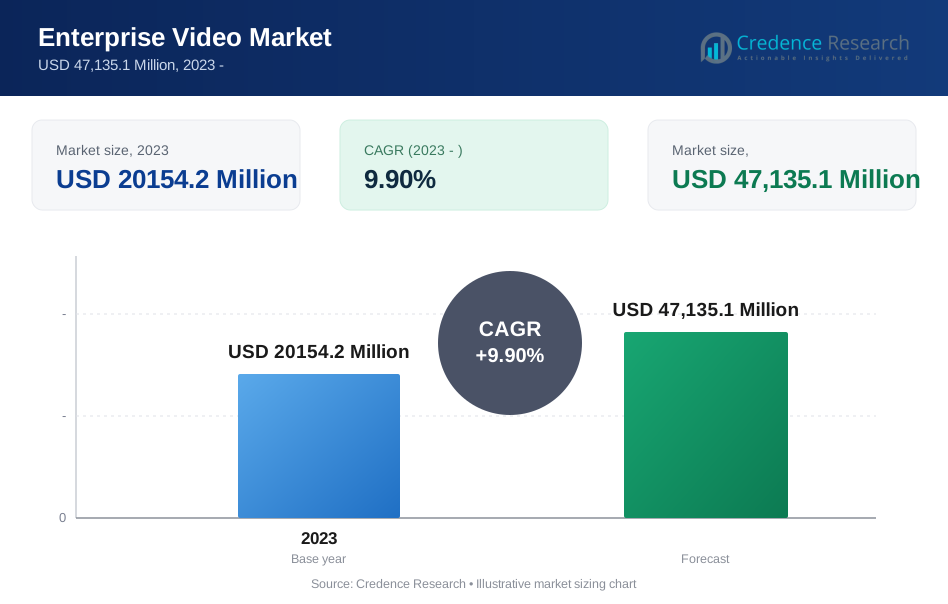
| Enterprise Video Market Size 2023 | USD 20154.2 Million |
| Enterprise Video Market, CAGR | 9.90% |
| Enterprise Video Market Size 2032 | USD 47135.1 Million |
Market Insights
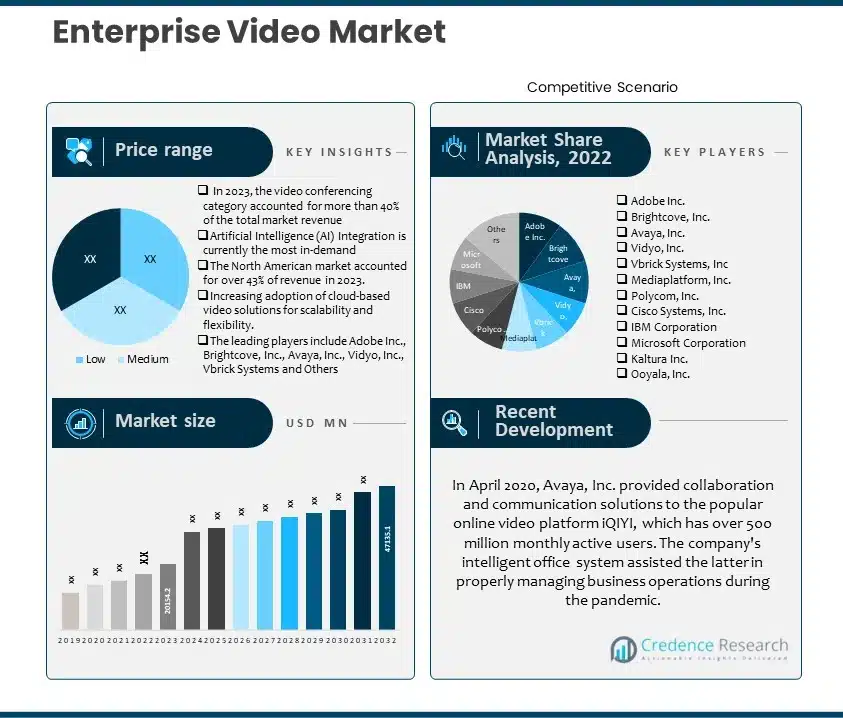
- The global demand for Enterprise Video was valued at USD 20154.2 Million in 2023 and is expected to reach USD 47135.1 Million in 2032, growing at a CAGR of 9.90% between 2024 and 2032.
- The cloud category is predicted to increase at a CAGR of more than 15% over the projection period, and the on-premises business video category had a revenue share of 61.3% in 2023.
- In 2023, the video conferencing category accounted for more than 40% of the total market revenue, while the video content management segment is predicted to rise at a CAGR of 13.6% during the forecast period.
- In 2023, the corporate communications segment held a considerable market share of more than 46%.
- In 2023, the large enterprise category had a revenue share of more than 63%, while the small and medium enterprises sector is expected to increase at a CAGR of 15.4% over the projected period.
- The BFSI segment provided more than 24% of overall revenue in 2023.
- Desktop and mobile video conferencing are prevalent in the workplace video industry.
- The enterprise video market's most popular segment right now is artificial intelligence (AI) integration.
- The Windows platform has a large stakeholder base, while the Android platform is a significant part of the enterprise video market.
- Live video streaming has increased in popularity.
- In 2023, the North American market generated more than 43% of revenue, while the Asia Pacific market is projected to develop at a CAGR of 15.7%.
- An increasing number of internet users worldwide drives the industry.
- Data security issues impede industry expansion.
Executive Summary
Market Definition
The Enterprise Video Market encompasses the industry and market for video-based communication and collaboration solutions for enterprises and organizations. It includes technologies, platforms, and services that let businesses to create, share, and manage video content for a variety of uses, including employee training, corporate communications, virtual meetings, webinars, and more. The industry offers a diverse range of video-related products and services, such as video conferencing systems, streaming platforms, video content management systems, and analytics tools. The Enterprise Video Market is being driven by increased demand for remote collaboration, the requirement for effective communication across geographically dispersed teams, and the growing use of video as a strong medium for engaging and educating employees and consumers. Market Overview The global Enterprise Video market has witnessed steady growth in recent years and is expected to grow at a CAGR of 9.90% between 2024 and 2032. The market was valued at USD 20154.2 million in 2023 and is expected to reach USD 47135.1 million in 2032. The Enterprise Video Market is seeing substantial expansion and transformation. Businesses are increasingly turning to video-based solutions as remote work becomes more prevalent and better communication and collaboration are required. Factors driving the market include the demand for flawless virtual meetings, the requirement for engaging staff training and development programs, and the increasing popularity of video content for marketing and consumer engagement. Businesses are investing in video conferencing systems, video streaming platforms, and video content management solutions to improve collaboration, knowledge sharing, and efficiency. In addition, technological breakthroughs such as cloud-based video solutions and AI-powered video analytics are driving market expansion. Segmentation by Deployment Model- The cloud category is expected to grow at a CAGR of more than 15% throughout the projection period, as this deployment approach provides customers with scalability via pay-as-you-go solutions for video creation, administration, and distribution.
- The on-premises enterprise video category had a revenue share of 61.3% in 2023, adoption in large-scale enterprises like BFSI, healthcare, and pharmaceuticals, where security and compliance are critical.
- In 2023, the video conferencing category accounted for more than 40% of the total market revenue. This can be ascribed to the growing need for video communication caused by geographically dispersed corporate activities and the development of remote working methods.
- The video content management segment is expected to grow at a CAGR of 13.6% over the forecast period.
- In 2023, the corporate communications segment maintained a significant market share of more than 46%. This can be attributed to the increased demand for these solutions during board meetings, CEO briefings, and sales kick-offs.
- In 2023, the large enterprise segment had a revenue share of more than 63%. This might be attributed mostly to increased investment in video conferencing solutions by several large-scale IT and telecom companies.
- The small and medium enterprises sector is estimated to grow at a CAGR of 15.4% over the forecast period as a result of supporting government programs targeted at encouraging the adoption of cloud-based solutions among these businesses.
- The BFSI segment contributed more than 24% of total revenue in 2023, owing to increased demand for video-based marketing and sales to improve branch communications and banking services.
- The healthcare and life sciences segment is expected to have a CAGR of roughly 15.8% between 2023 and 2032.
- Desktop and Mobile Video Conferencing is a popular part of the enterprise video market. This area focuses on video conferencing features for desktop and mobile devices, allowing users to hold virtual meetings and collaborate from anywhere.
- Artificial Intelligence (AI) Integration is currently the most in-demand category in the enterprise video market. AI integration in workplace video solutions enables sophisticated features like automated transcription, real-time language translation, facial recognition, and sentiment analysis. These AI-powered features improve the video experience by making it more interactive, personalized, and efficient. Businesses are rapidly integrating AI into their video solutions to automate processes, improve collaboration, and derive valuable insights from video material.
- The Windows platform has a strong stakeholder base. Windows has a vast user base, and many organizations operate on Windows devices. As a result, there is a strong demand for enterprise video solutions that work with Windows. This guarantees easy integration and accessibility for Windows users.
- The Android platform is an important portion of the enterprise video industry.
- Live video streaming has grown in popularity because it provides an immersive and engaging experience, making it a great marketing, training, and communication tool. With the rise of social media platforms and the growing need for real and interactive content, live video streaming has become a popular option for businesses looking to connect with their audience in a more dynamic and instantaneous manner.
- The North American market accounted for over 43% of revenue in 2023.
- The Asia Pacific market is expected to grow at a CAGR of 15.7% during the forecast period
- The rest of the world, including Latin America, the Middle East, and Africa, supplies the remaining demand for Enterprise Video.
Key Highlights of the Report
Deployment Model, Solution Type, Application, End-User, Industry Vertical, Type, Technology, Device Compatibility, Delivery Mode, and region segment the global Enterprise Video market. In 2023, the large enterprise segment had the largest revenue share, and the Windows platform has a solid stakeholder base. Additionally, desktop and mobile video conferencing are popular, and artificial intelligence (AI) integration is also in high demand. Also, live video streaming has gained in popularity, with North America leading the market growth. The market's primary drivers are rising demand for remote work and virtual collaboration solutions, a growing requirement for effective staff training and development programs, and an increase in the popularity of video content for marketing and consumer engagement. Furthermore, connectivity and bandwidth limits in some locations, security concerns associated to video content and data, and integration challenges with current IT infrastructure and systems are the major market barriers. Nonetheless, North America is expected to have the biggest revenue share in 2023 because to the presence of major market participants such as Adobe, IBM, Cisco Systems, Inc., and Microsoft. Furthermore, the Asia Pacific market is estimated to increase at a CAGR of 15.7% over the forecast period. What Are The Main Drivers Of The Global Enterprise Video Market? Several key factors are driving the Enterprise Video Market. There is an increasing demand for remote work and virtual collaboration solutions. With more companies adopting flexible work arrangements and geographically dispersed teams, video-based communication tools have become essential for seamless collaboration and effective communication. Additionally, there is a growing need for effective employee training and development programs. Videos offer a dynamic and engaging way to deliver training content, enabling companies to enhance employee skills and knowledge. What Are The Major Challenges Faced By The Global Enterprise Video Market? While the Enterprise Video Market is flourishing, it does face certain restraints. One major restraint is the connectivity and bandwidth limitations in some regions. Video content requires a stable and high-speed internet connection, which may not be available in all areas. This can hinder the seamless transmission and viewing of videos. Additionally, there are security concerns related to video content and data. Companies must ensure that their video solutions have robust security measures in place to protect sensitive information. Integration challenges with existing IT infrastructure and systems can also pose a restraint. It may require significant effort and resources to integrate video solutions with legacy systems, which can slow down adoption and implementation. What Are The Growth Opportunities In The Global Enterprise Video Market? The Enterprise Video Market presents several exciting opportunities for businesses. One opportunity lies in the adoption of advanced technologies like AI, VR, and AR. These technologies can enhance video experiences by providing interactive elements, virtual simulations, and augmented reality overlays. Another opportunity is the expansion of video analytics capabilities. By leveraging advanced analytics tools, businesses can gain valuable insights from video content, such as viewer engagement, sentiment analysis, and performance metrics. This data can inform decision-making and help optimize video strategies. Market Drivers The global Enterprise Video Marketis driven by several factors. The following are the key drivers of the global Enterprise Video Market: Increasing Number Of Internet Users Around The World The number of internet users worldwide is quickly increasing due to increased smartphone penetration and improved connectivity. Increased global internet connectivity has opened up new business prospects for telecom service providers. However, in addition to this possibility, telecom players must exceed ever-increasing customer expectations in terms of latency, bandwidth, and reliability to compete. Telecom companies are investing heavily to seize this new potential. The enterprise video industry is likely to develop as telecom players increase their infrastructure investments. As the number of internet users has grown in recent years and is projected to continue to rise in the coming years, so will the demand for enterprise video solutions and services. Market Restraints The global Enterprise Video Market faces some challenges that may hinder its growth. These include the following: Data Security Problems The security and privacy of video footage shared across several channels can be significant concerns for businesses. Furthermore, corporations are concerned about copyright and Digital Rights Management (DRM) due of the potential for misuse, information leakage, and data breaches. In recent years, there have been significant data breaches in the healthcare, Application, retail, and financial sectors. To address such problems, businesses must restructure their strategies for using enterprise video offerings before implementing these solutions. Enterprise video solutions may experience slow adoption if there are no policies and procedures in place to manage video material properly. Opportunities The global Enterprise Video Market offers significant growth opportunities. These include the following: Advancements In Al-powered Video Technologies Will Promote Market Development Al, ML, cloud, 5G, and analytics are examples of technological breakthroughs in enterprise video solutions that improve user video experiences. These technologies enable hardware and software providers in the workplace video industry to collaborate and offer consumers "room" versions of their mobile and desktop video apps, sometimes known as room apps. This allows users to perform video conferences using a room app, eliminating the problems and time required to set up a video meeting room system. Al and ML will play an important part in the future of video conferencing since they enable users to join a meeting session as facilitators.Competitive Landscape
Key Players
The global Enterprise Video Marketis highly competitive, with several key players. Some of the major players in the market and their market share are as follows:- Adobe Inc.
- Brightcove, Inc.
- Avaya, Inc.
- Vidyo, Inc.
- Vbrick Systems, Inc
- Mediaplatform, Inc.
- Polycom, Inc.
- Cisco Systems, Inc.
- IBM Corporation
- Microsoft Corporation
- Kaltura Inc.
- Ooyala, Inc.
Summary of Key Findings
- Advancements in Al-powered video technology will encourage market development.
- Market segmented by Deployment Model, Solution Type, Application, End-User, Industry Vertical, Type, Technology, Device Compatibility, Delivery Mode, and region.
- Artificial Intelligence (AI) Integration is the most in-demand segment in the enterprise video market.
- In 2023, the video conferencing category accounted for more than 40% of total market revenue
- North America is leading market growth; the market is highly competitive with key players including Adobe Inc., Brightcove, Inc., Avaya, Inc., Vidyo, Inc., Vbrick Systems, Inc and Others.
Future Outlook
- Continued growth driven by the demand for remote collaboration and virtual communication.
- Increasing adoption of cloud-based video solutions for scalability and flexibility.
- Integration of artificial intelligence and machine learning for enhanced video analytics and automation.
- Expansion of video content management systems to handle the growing volume of video content.
- Market size and growth forecast: The report provides detailed estimates of the global Enterprise Video Market size, segmented by Deployment Model, Solution Type, Application, End-User, Industry Vertical, Type, Technology, Device Compatibility, Delivery Mode, and region. It also includes forecasts for the market through 2032, based on key trends and drivers.
- Market segmentation: The report segments the Enterprise Video Market by Deployment Model, Solution Type, Application, End-User, Industry Vertical, Type, Technology, Device Compatibility, Delivery Mode, and region. This segmentation provides CXOs with a granular understanding of the market and the opportunities in each segment.
- Competitive landscape: The report profiles the key players in the Enterprise Video Market and provides insights into their strategies, product offerings, and financial performance. This information can help CXOs to identify and assess their competition.
- Key trends and drivers: The report identifies and analyzes the key trends and drivers that are shaping the Enterprise Video Market. This information can help CXOs to make informed decisions about their investments and strategies.
- Identify growth opportunities: The report can help CXOs to identify new growth opportunities in the Enterprise Video Market. For example, it can provide insights into emerging technologies, market trends, and key market players.
- Make informed investment decisions: The report can help CXOs to make informed investment decisions about Enterprise Video. For example, it can provide insights into market trends, growth potential, competitive landscape, and key players in the industry.
- Develop competitive strategies: The report can help CXOs to develop competitive strategies for their Enterprise Video businesses. For example, the report identifies the key strategies that dark fiber providers are using to differentiate themselves from their competitors.
- Track market developments: The report can help CXOs to track market developments and stay ahead of the curve. For example, the report provides insights into the latest trends and innovations in the Enterprise Video Market.
Segmentation
- By Deployment Model:
- On-Premises
- Cloud-Based
- By Solution Type:
- Video Conferencing
- Webcasting
- Video Content Management
- Video on Demand
- Others
- By Application:
- Corporate Communication
- Training and Development
- Webinars and Virtual Events
- Employee Onboarding
- Sales and Marketing
- Others
- By End-User:
- Large Enterprises
- Small and Medium-sized Enterprises (SMEs)
- By Industry Vertical:
- IT and Telecommunications
- Healthcare
- BFSI (Banking, Financial Services, and Insurance)
- Education
- Media and Entertainment
- Manufacturing
- Government and Defense
- Others
- By Type:
- Telepresence Systems
- Desktop and Mobile Video Conferencing
- Integrated Conferencing Solutions
- By Technology:
- Unified Communications (UC) Integration
- Artificial Intelligence (AI) Integration
- Web Real-Time Communication (WebRTC)
- Others
- By Device Compatibility:
- Windows
- iOS
- Android
- Others
- By Delivery Mode:
- Live Video Streaming
- On-Demand Video Streaming
- By Region
- North America
- The U.S.
- Canada
- Mexico
- Europe
- Germany
- France
- The U.K.
- Italy
- Spain
- Rest of Europe
- Asia Pacific
- China
- Japan
- India
- South Korea
- South-east Asia
- Rest of Asia Pacific
- Latin America
- Brazil
- Argentina
- Rest of Latin America
- Middle East & Africa
- GCC Countries
- South Africa
- Rest of Middle East and Africa
- North America
Request a Free Sample
Fill in your details and we'll send you a free sample report.
- Sample data tables & charts
- Research methodology
Need a Custom Version of This Report?
Tailor the scope, geography, or segments to your exact requirements.
- Custom geography or segment scope
- Direct access to our analyst team
Frequently Asked Questions
What is the current size of the global Enterprise Video Market?
What is the expected growth rate of the Enterprise Video Market between 2024 and 2032?
Which segment is leading the market share in terms of Deployment Model?
Which Technology segment governs the demand for Enterprise Video in the world?
Who are the major players in the global Enterprise Video Market?
Table of Content
Chapter 1. Report Introduction
- 1.1 Report Description & Purpose
- 1.1.1 Report Title & Market Definition
- 1.1.2 Unique Selling Propositions (USP) & Key Differentiators
- 1.1.3 Value Proposition for Stakeholders
- 1.2 Research Objectives
- 1.2.1 Market Sizing Objectives (Volume & Revenue)
- 1.2.2 Segmentation Objectives
- 1.2.3 Competitive Intelligence Objectives
- 1.2.4 Forecast & Scenario Objectives
- 1.3 Report Scope
- 1.3.1 Enterprise Video Scope – Types & Subtypes Covered
- 1.3.2 Geographic Scope – Regions & Countries Covered
- 1.3.3 Historical Period, Base Year & Forecast Period (2023; forecast to the forecast period)
- 1.3.4 Inclusions & Exclusions
- 1.4 HS Code & Classification Framework
- 1.5 Currency, Units & Pricing Basis
- 1.6 Target Stakeholders
- 1.7 Limitations & Assumptions
Chapter 2. Executive Summary
- 2.1 Global Enterprise Video Market Snapshot
- 2.1.1 Market Size – Historical (2023) & Forecast (the forecast period) (2023: USD 20154.2 Million → forecast year: USD 47,135.1 Million)
- 2.1.2 Volume & Revenue – Global Totals
- 2.1.3 Key Market Highlights – Top Five Facts
- 2.2 Enterprise Video Market Segmentation Snapshot
- 2.2.1 Market Split by Region – 2023 vs.
- 2.3 Competitive Snapshot
- 2.3.1 Top 10 Players by Revenue Share – 2023
- 2.3.2 Top 10 Players by Volume Share – 2023
- 2.3.3 Recent Strategic Developments (18-Month Summary)
- 2.4 Key Investment Highlights & Strategic Conclusions
Chapter 3. Enterprise Video Market Dynamics & Industry Analysis
- 3.1 Market Overview & Context
- 3.1.1 Enterprise Video Market Position in the Broader Automotive Value Chain
- 3.1.2 OEM vs. Replacement Market Dynamics
- 3.1.3 Market Maturity & Development Stage by Region
- 3.2 Enterprise Video Market Drivers
- 3.3 Enterprise Video Market Restraints & Challenges
- 3.4 Enterprise Video Market Opportunities
- 3.5 Porter's Five Forces Analysis
- 3.5.1 Threat of New Entrants
- 3.5.2 Bargaining Power of Suppliers
- 3.5.3 Bargaining Power of Buyers
- 3.5.4 Threat of Substitutes
- 3.5.5 Competitive Rivalry – Intensity Assessment
- 3.6 Enterprise Video Value Chain Analysis
- 3.6.1 Upstream – Raw Material/Input Suppliers
- 3.6.1.1 Raw Material/Input 1
- 3.6.1.2 Raw Material/Input 2
- 3.6.1.3 Raw Material/Input 3
- 3.6.2 Midstream – Production/Manufacturing/Service Delivery
- 3.6.2.1 Production/Process Overview
- 3.6.2.2 Key Facility Locations & Capacity by Manufacturer
- 3.6.3 Downstream – Distribution & End Consumer
- 3.6.3.1 Primary Channel – B2B/OEM
- 3.6.3.2 Secondary Channels – Dealer, Retail, Online, Direct
- 3.6.4 Value Chain Profitability Analysis
- 3.6.1 Upstream – Raw Material/Input Suppliers
- 3.7 PESTEL Analysis
- 3.7.1 Political Factors
- 3.7.2 Economic Factors
- 3.7.3 Social Factors
- 3.7.4 Technological Factors
- 3.7.5 Environmental Factors
- 3.7.6 Legal Factors
- 3.8 Enterprise Video Supply Chain Analysis
- 3.8.1 Raw Material/Input Supply Risk Assessment
- 3.8.2 Manufacturing Concentration Risk (Geographic Exposure)
- 3.8.3 Trade Disruption Impact Analysis
- 3.9 Regulatory & Policy Landscape
Note: The regulatory and policy landscape section covers regulations based on their applicability to the market, Enterprise Video category, geography, and scope of the study. Only regulatory frameworks with a material impact on operations, compliance, trade, sustainability, or market access are analyzed in detail.
Chapter 4. Key Investment Pockets & Opportunity Analysis
- 4.1 Enterprise Video Market Attractiveness Analysis
- 4.1.1 By Region – Investment Attractiveness Matrix (Volume × CAGR)
- 4.2 Absolute Revenue Growth Opportunity
- 4.2.1 By Region – Absolute USD Growth Through the forecast period
- 4.3 Incremental Volume Opportunity
- 4.3.1 By Region – Incremental Volume Through the forecast period
- 4.3.2 Segment – Incremental Volume
- 4.4 Emerging Submarket Opportunity Deep Dive (Subject to Applicability)
- 4.5 Emerging Market Opportunity Scorecards
- 4.5.1 United States
- 4.5.2 Europe
- 4.5.3 Asia
- 4.5.4 Middle East & Africa
Note: Emerging Market Opportunity Scorecards will be included based on relevance and strategic importance. Regions listed are indicative and may vary depending on data availability and market dynamics.
Chapter 5. Enterprise Video Import-Export Analysis & Trade Flows
- 5.1 Global Trade Overview
- 5.1.1 Global Export Value by Country (2023)
- 5.1.2 Global Export Volume by Country (2023)
- 5.1.3 Global Import Value by Country (2023)
- 5.1.4 Global Import Volume by Country (2023)
- 5.1.5 Net Trade Balance by Country (2023)
- 5.2 Export Analysis – Segment
- 5.2.1 Type 1 (HS Code)
- 5.2.2 Type 2 (HS Code)
- 5.2.3 Type 3 (HS Code)
- 5.2.4 Type 4 (HS Code)
- 5.2.5 Type 5 (HS Code)
- 5.3 Import Analysis – Segment
- 5.3.1 Type 1 (HS Code)
- 5.3.2 Type 2 (HS Code)
- 5.3.3 Type 3 (HS Code)
- 5.3.4 Type 4 (HS Code)
- 5.3.5 Type 5 (HS Code)
- 5.4 Average Unit Trade Prices
- 5.4.1 Average Export Price – Segment & Country
- 5.4.2 Average Import Price – Segment & Source Country
- 5.4.3 Price Trends (2023)
- 5.5 Key Trade Route Analysis
- 5.5.1 Trade Route 1
- 5.5.2 Trade Route 2
- 5.5.3 Trade Route 3
- 5.5.4 Trade Route 4
- 5.5.5 Trade Route 5
- 5.6 Trade Policy Impact Assessment
- 5.6.1 US Anti-Dumping & Section 301 Tariffs
- 5.6.2 EU Customs Union Impact
- 5.6.3 Major Free Trade Agreements
- 5.6.4 USMCA Rules of Origin
Note: Trade policy analysis will be included only where relevant to the Enterprise Video market.
Chapter 6. Competitive Landscape & Company Benchmarking
- 6.1 Enterprise Video Market Concentration & Structure
- 6.1.1 Herfindahl-Hirschman Index (HHI) – vs. 2023
- 6.1.2 Tier 1, Tier 2 & Tier 3 Market Structure
- 6.1.3 Global, Regional & Local Player Dynamics
- 6.2 Enterprise Video Market Share Analysis – 2023
- 6.2.1 Global Revenue Share by Company
- 6.2.2 Global Volume Share by Company
- 6.2.3 Regional Revenue Share
- 6.2.4 Market Share Evolution ( vs. 2023)
- 6.2.5 OEM Segment Share by Company
- 6.2.6 Replacement Segment Share by Company
- 6.3 Production/Delivery Capacity & Facility Analysis
- 6.3.1 Global Installed Capacity
- 6.3.2 Capacity Utilization Rates
- 6.3.3 Production/Output Volume
- 6.3.4 Facility Locations & Capacity Map
- 6.3.5 Planned Capacity Additions
- 6.4 Enterprise Video Competitive Benchmarking Matrix
- 6.4.1 Revenue, Volume, CAGR & Profitability Comparison
- 6.4.2 Channel Revenue Mix
- 6.4.3 Geographic Revenue Exposure
- 6.4.4 R&D Intensity
- 6.4.5 Sustainability Maturity
- 6.5 Strategic Developments in Enterprise Video (Last 24 Months)
- 6.5.1 Mergers, Acquisitions & Divestments
- 6.5.2 New Enterprise Video Launches
- 6.5.3 Facility Expansions
- 6.5.4 Strategic Alliances, Joint Ventures & Partnerships
- 6.5.5 Distribution Expansion & Market Entry
- 6.5.6 Sustainability & ESG Initiatives
- 6.6 Competitive Strategy Mapping
- 6.6.1 Leader, Challenger, Follower & Niche Classification
- 6.6.2 Pricing Strategy Comparison
- 6.6.3 Channel Strategy Matrix
Note: Strategic developments are included based on their materiality and the availability of reliable information.
Chapter 7. Global Enterprise Video Market – By Distribution Channel
- 7.1 Segment Overview
- 7.1.1 Volume & Revenue Split by Channel (2023 & )
- 7.1.2 Channel Mix Evolution (the forecast period)
Chapter 8. Regional Market Analysis – Global Overview
- 8.1 Global Regional Overview
- 8.1.1 Regional Volume Share
- 8.1.2 Regional Revenue Share
- 8.1.3 Regional Volume by Region
- 8.1.4 Regional Revenue by Region
- 8.1.5 Regional Forecast Through the forecast period
- 8.2 Cross-Regional Segment Analysis
- 8.2.1 By Distribution Channel
- 8.2.2 By Brand/Price Tier
Chapter 9. North America Enterprise Video Market
- 9.1 United States
- 9.2 Canada
- 9.3 Mexico
Chapter 10. Europe Enterprise Video Market
- 10.1 Germany
- 10.2 France
- 10.3 Italy
- 10.4 United Kingdom
- 10.5 Spain
- 10.6 Poland
- 10.7 Russia
- 10.8 Netherlands
- 10.9 Belgium
- 10.10 Sweden
- 10.11 Denmark
- 10.12 Norway
- 10.13 Rest of Europe
Chapter 11. Asia Pacific Enterprise Video Market
- 11.1 China
- 11.2 India
- 11.3 Japan
- 11.4 South Korea
- 11.5 Thailand
- 11.6 Indonesia
- 11.7 Vietnam
- 11.8 Malaysia
- 11.9 Australia
- 11.10 Rest of Asia Pacific
Chapter 12. Latin America Enterprise Video Market
- 12.1 Brazil
- 12.2 Argentina
- 12.3 Colombia
- 12.4 Chile
- 12.5 Rest of Latin America
Chapter 13. Middle East Enterprise Video Market
- 13.1 Saudi Arabia
- 13.2 United Arab Emirates
- 13.3 Turkey
- 13.4 Israel
- 13.5 Iran
- 13.6 Rest of the Middle East
Chapter 14. Africa Enterprise Video Market
- 14.1 South Africa
- 14.2 Egypt
- 14.3 Nigeria
- 14.4 Morocco
- 14.5 Rest of Africa
Chapter 15. Enterprise Video Company Profiles
- 15.1 [Company 01]
- 15.1.1 Company Overview
- 15.1.2 Key Management Personnel
- 15.1.3 Products & Services Portfolio
- 15.1.4 Financial Performance
- 15.1.5 Key Market Focus & Geographic Presence
- 15.1.6 Recent Developments & Strategic Initiatives
Note: The company profile list is preliminary and may change based on research findings, market developments, data availability, and client requirements.
Chapter 16. Appendices
- Appendix A – List of Abbreviations & Acronyms
- Appendix B – Industry Classification Code Reference – Full Series
- Appendix C – Production & Capacity Data Tables
- Appendix D – End-Use & Demand Base Tables
- Appendix E – Consumption & Replacement Rate Assumptions
- Appendix F – ASP Reference Tables
- Appendix G – Manufacturing & Facility Database
- Appendix H – Import-Export Data Tables
- Appendix I – Regulatory Summary Tables
- Appendix J – Primary Research Participant List (Anonymized)
- Appendix K – Primary Research Questionnaire Framework
- Appendix L – Data Sources & Bibliography
- Appendix M – Market Size Divergence & Source Comparison
Chapter 17. Research Methodology
- 17.1 Research Framework & Philosophy
- 17.2 Secondary Research – Sources, Hierarchy & Data Extraction
- 17.3 Data Modeling – Bottom-Up & Top-Down Market Sizing
- 17.4 Primary Research – Stakeholder Framework, LOI & Sample Sizes
- 17.5 Forecast Methodology – Regression, Scenario & Sensitivity Analysis
- 17.6 Quality Control – Four-Layer Validation Framework
- 17.7 Limitations & Standard Assumptions
- 17.8 Disclaimer
