
| REPORT ATTRIBUTE | DETAILS |
|---|---|
| Historical Period | 2019-2022 |
| Base Year | 2023 |
| Forecast Period | 2024-2032 |
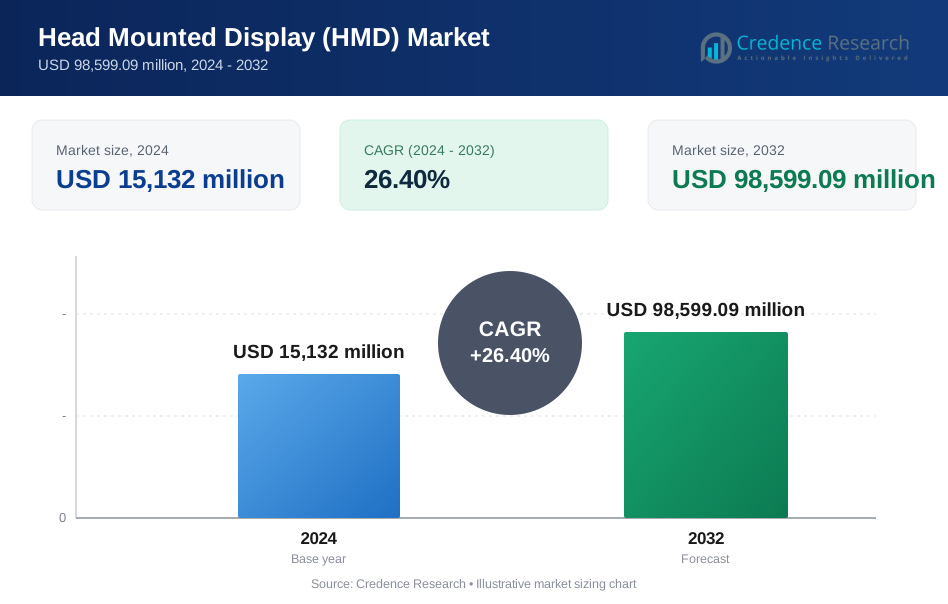
| Head Mounted Display Market Size 2024 | USD 15,132 million |
| Head Mounted Display Market, CAGR | 26.4% |
| Head Mounted Display Market Size 2032 | USD 98,599.09 million |
Market Overview
The Head Mounted Display Market is projected to grow from USD 15,132 million in 2024 to USD 98,599.09 million by 2032, registering an impressive compound annual growth rate (CAGR) of 26.4% during the forecast period.
The Head Mounted Display (HMD) Market is driven by the growing adoption of virtual reality (VR) and augmented reality (AR) technologies across various sectors, including gaming, entertainment, healthcare, and military applications. Increasing demand for immersive experiences in gaming and training simulations is a significant factor fueling market growth. The expansion of the metaverse and advancements in content creation further boost adoption. In healthcare, HMDs are transforming medical training and surgeries by providing real-time, detailed visuals. The military and defense sector utilize HMDs for enhanced situational awareness and training. Technological advancements, such as lightweight designs, improved resolution, and integration with 5G connectivity, are enhancing usability and performance. Additionally, the rise of remote working and virtual collaboration has driven the need for HMDs in professional settings. Government initiatives supporting the development of AR and VR technologies and increasing investments from key players further accelerate market growth, positioning HMDs as a cornerstone of future innovations.
The Head Mounted Display (HMD) market exhibits significant regional variations, with North America leading due to its advanced technological infrastructure, strong presence of key players, and widespread adoption of AR and VR technologies across gaming, defense, and healthcare sectors. Asia-Pacific is the fastest-growing region, driven by the increasing demand for affordable HMDs in countries like China, Japan, and South Korea, supported by a large consumer base and rising investments in digital innovation. Europe also contributes notably, with applications in industrial training and simulation gaining traction. Prominent players in the market include Microsoft, Sony Corporation, Meta, HTC Corporation, and SAMSUNG, whose continuous product innovations and strategic partnerships are fueling growth. These companies are leveraging advancements in display technology and AI integration to maintain competitiveness and expand market reach globally.
Market Drivers:
Growing Adoption of AR and VR Technologies:
The increasing use of augmented reality (AR) and virtual reality (VR) across industries is a significant driver for the Head Mounted Display (HMD) market. Sectors such as gaming, entertainment, and education are embracing immersive technologies to enhance user engagement and learning experiences. For instance, companies like Oculus are developing advanced HMDs to support immersive gaming experiences. The integration of HMDs in AR and VR applications enables realistic simulations, interactive experiences, and a heightened sense of presence, making them indispensable for industries aiming to deliver innovative solutions.
Expanding Use in Healthcare and Military Sectors:
The healthcare and military sectors are emerging as key contributors to the growth of the HMD market. In healthcare, HMDs are revolutionizing medical training, diagnostics, and surgeries by providing real-time visuals and detailed imaging. For instance, Microsoft’s HoloLens is used for medical training and military applications, providing real-time visuals and enhanced situational awareness. Similarly, the military leverages HMDs for tactical training, situational awareness, and combat simulations. These applications underscore the growing reliance on advanced HMD technology for critical, high-precision tasks.
Technological Advancements and Product Innovation:
Rapid advancements in display technologies, such as improved resolution, lightweight designs, and integration of artificial intelligence (AI), are significantly enhancing the functionality and user experience of HMDs. The emergence of 5G connectivity further boosts the performance of these devices by enabling seamless data transmission and low-latency streaming. For instance, Sony's PlayStation VR offers high-resolution displays and 5G connectivity to enhance user experience. Continuous product innovation, including all-in-one devices and compatibility with various platforms, is making HMDs more accessible and versatile, fueling their adoption across diverse applications.
Increasing Demand for Immersive and Collaborative Solutions:
The demand for immersive experiences in gaming, virtual collaboration, and remote work is driving the adoption of HMDs. With the rise of the metaverse and the shift toward virtual spaces, businesses and consumers are investing in advanced HMDs to enable better connectivity and engagement. For instance, Meta is heavily investing in developing advanced HMDs to support the metaverse and virtual collaboration. Additionally, government support and significant investments from leading players are fostering the development of next-generation HMDs, ensuring their integration into future digital ecosystems.
Market Trends:
Integration of AI and Advanced Analytics:
A significant trend in the Head Mounted Display (HMD) market is the integration of artificial intelligence (AI) and advanced analytics. These technologies are enhancing the functionality of HMDs by enabling features such as real-time environment mapping, object recognition, and user behavior analysis. AI-powered HMDs are increasingly used in sectors like healthcare and defense to provide critical insights and support decision-making processes in real-time. For instance, Vuzix uses AI to provide real-time environment mapping and object recognition. This integration is paving the way for smarter, more responsive devices that cater to complex industry requirements.
Expansion of the Metaverse and Virtual Workspaces:
The rise of the metaverse and virtual workspaces is a defining trend in the HMD market. Businesses are leveraging HMDs to facilitate virtual collaboration, creating immersive environments for meetings, training, and events. For instance, Meta is heavily investing in HMDs to facilitate virtual collaboration within the metaverse. This trend is further accelerated by the growing adoption of remote work and hybrid work models. As organizations seek innovative ways to enhance productivity and employee engagement, HMDs are becoming central to creating interconnected digital ecosystems.
Lightweight and User-Centric Designs:
The demand for lightweight and ergonomically designed HMDs is gaining momentum, driven by the need for comfort during extended use. Manufacturers are focusing on reducing device weight and improving wearability without compromising performance. Advances in materials and compact component designs have resulted in sleeker, more user-friendly HMDs, increasing their adoption in both consumer and professional applications. For instance, Sony has developed lightweight HMDs that enhance user comfort during extended gaming sessions. This focus on design is particularly relevant in sectors like gaming, where user comfort is paramount.
Growing Applications in Training and Simulation:
HMDs are increasingly being used in training and simulation programs across industries. In aviation, healthcare, and defense, HMDs enable realistic, high-fidelity simulations that improve learning outcomes and operational readiness. Organizations are recognizing the cost-effectiveness and efficiency of using HMDs for skill development and scenario training, further driving their adoption. For instance, Boeing uses HMDs for pilot training and simulation to improve learning outcomes and operational readiness. This trend underscores the versatility of HMDs as transformative tools across diverse sectors.
Market Challenges Analysis:
High Manufacturing Costs and Affordability Barriers:
One of the primary challenges facing the Head Mounted Display (HMD) market is the high cost associated with manufacturing advanced devices. The integration of cutting-edge technologies such as augmented reality (AR), virtual reality (VR), artificial intelligence (AI), and high-resolution displays necessitates expensive materials and sophisticated production processes. These costs are further amplified by the need for robust hardware components, including sensors, processors, and batteries, to deliver optimal performance. For many potential consumers and organizations, particularly in emerging economies, the high price of HMDs poses a significant barrier to adoption. This affordability issue limits market penetration and restricts the widespread use of HMDs, especially in cost-sensitive sectors like education and small businesses. Additionally, the limited availability of cost-effective solutions hinders small and medium enterprises from leveraging HMDs for operational and training purposes, ultimately affecting their ability to compete with larger, more resourceful organizations.
Technical Limitations and User Experience Concerns:
Technical limitations, such as latency issues, limited field of view, and battery life constraints, present significant challenges for the HMD market. Users often experience discomfort, including motion sickness and eye strain, during prolonged use, especially in devices that lack advanced ergonomics or adaptive technology. These issues detract from the overall user experience and reduce consumer confidence in adopting HMDs for critical applications. Furthermore, the complexity of integrating HMDs into existing workflows and platforms, particularly in professional environments, creates additional hurdles. Compatibility challenges with legacy systems, along with the steep learning curve associated with operating advanced devices, further exacerbate adoption barriers. Many users also highlight concerns related to data privacy and cybersecurity risks, particularly in enterprise settings where sensitive information is processed through connected devices. Resolving these issues is essential for manufacturers to ensure a seamless user experience and broaden the appeal of HMDs in diverse sectors.
Market Segmentation Analysis:
By Type
The Head Mounted Display (HMD) market is segmented into immersive and non-immersive types, each serving distinct applications. Immersive HMDs, such as virtual reality (VR) headsets, provide a fully immersive experience by completely isolating users from their surroundings, making them ideal for gaming, training simulations, and entertainment. These devices dominate the market due to their ability to deliver realistic and engaging environments. Non-immersive HMDs, including augmented reality (AR) glasses, overlay digital information onto the physical world, catering to industries like healthcare, retail, and manufacturing. Their ability to enhance real-world scenarios with interactive digital overlays has fueled adoption in professional and enterprise settings. The increasing demand for AR-based devices for collaborative and on-the-go applications is propelling growth in this segment.
By Technology
The market is further segmented based on technology into augmented reality (AR), virtual reality (VR), and mixed reality (MR). VR technology dominates the segment, driven by its widespread use in gaming and entertainment, as well as training applications in defense and aviation. AR is gaining traction in enterprise settings, with applications in remote assistance, healthcare imaging, and real-time data visualization. Mixed reality, which combines AR and VR capabilities, is an emerging technology gaining attention for its versatility in industrial design, education, and simulation. Advancements in display quality, AI integration, and connectivity are enabling broader adoption across these technologies, ensuring robust growth in the HMD market.
Segments:
Based on Type
- Slide-on HMD
- Integrated HMD
- Discrete HMD
Based on Technology
- AR
- VR
- MR
Based on Component
- Processors and Memory
- Displays
- Lenses
- Sensors
- Controllers
- Cameras
- Cases and Connectors
- Others
Based on Product
- Head-Mounted
- Eyewear
Based on Connectivity
- Wired
- Wireless
Based on End Use
- Consumer
- Commercial
- Enterprise & Industry
- Engineering & Design
- Healthcare
- Aerospace & Defence
- Education
- Others
Based on the Geography:
- North America
- U.S.
- Canada
- Mexico
- Europe
- Germany
- France
- U.K.
- Italy
- Spain
- Rest of Europe
- Asia Pacific
- China
- Japan
- India
- South Korea
- South-east Asia
- Rest of Asia Pacific
- Latin America
- Brazil
- Argentina
- Rest of Latin America
- Middle East & Africa
- GCC Countries
- South Africa
- Rest of the Middle East and Africa
Regional Analysis:
North America
North America maintains its dominance in the Head Mounted Display (HMD) market, holding 38% of the global market share in 2024. This leadership stems from the region’s robust technological infrastructure, presence of key players, and high adoption rates of AR and VR technologies. The United States is a significant contributor, with extensive investments in gaming, healthcare, and defense sectors. The gaming industry in North America thrives on VR integration, supported by advanced HMDs delivering immersive experiences. Government initiatives have further bolstered the use of HMDs in defense, where they are extensively used for training simulations and real-time tactical operations. The healthcare sector, leveraging HMDs for medical training, diagnosis, and telemedicine, has also fueled market growth. Additionally, the rollout of 5G connectivity enhances HMD performance in professional settings, facilitating real-time collaboration and virtual meetings. Companies in North America are also heavily involved in research and development (R&D), fostering innovation in HMDs through partnerships, acquisitions, and new product launches. The region’s emphasis on developing lightweight, ergonomic devices with enhanced features continues to strengthen its market position. Furthermore, the growing popularity of the metaverse and increasing demand for immersive experiences ensure sustained growth and technological advancements in North America’s HMD market.
Asia-Pacific
Asia-Pacific is a rapidly evolving market for HMDs, holding 26% of the global market share in 2024. The region is experiencing significant growth due to rising adoption of AR and VR technologies across gaming, entertainment, and industrial applications. China, Japan, and South Korea are driving this growth with substantial investments in digital innovation and infrastructure. China’s vast consumer base and increasing disposable income, coupled with government support for technological advancements, make it a key player in the market. Affordable locally manufactured HMDs have further expanded accessibility, enabling wider adoption across diverse income groups. In Japan, the gaming industry leads in incorporating VR to create highly immersive experiences, while the entertainment sector explores AR for innovative content delivery. South Korea leverages its strong technological foundation to integrate HMDs in industrial applications, including training and simulation. The region also benefits from the rapid expansion of e-commerce platforms, which has made HMDs readily available to consumers. Additionally, Asia-Pacific’s growing focus on metaverse development and digital content creation positions it as a critical hub for future growth in the global HMD market. These factors collectively enhance the region’s significance as a dynamic and influential player in shaping the future of HMD technology.
Key Player Analysis:
- Siemens
- HTC Corporation
- SAMSUNG
- Brüel & Kjær
- Sony Corporation
- Meta
- Microsoft
- BAE Systems
- HEAD acoustics GmbH
- NATIONAL INSTRUMENTS CORP.
Competitive Analysis:
The Head Mounted Display (HMD) market is characterized by intense competition among leading players, including Microsoft, Sony Corporation, Meta, SAMSUNG, and HTC Corporation. These companies focus on leveraging advanced technologies such as augmented reality (AR), virtual reality (VR), and artificial intelligence (AI) to enhance product performance and user experience. Microsoft and Meta dominate enterprise applications with their AR and VR platforms, catering to professional collaboration and training needs. Meanwhile, Sony Corporation and HTC Corporation maintain strongholds in the gaming sector, offering immersive experiences through cutting-edge VR headsets. For instance, SAMSUNG's Gear VR is known for its ergonomic design and lightweight build, making it popular among consumers. Strategic partnerships, mergers, and continuous investments in research and development are key tactics employed by these players to sustain their competitive edge. The global expansion of these companies ensures their prominent role in shaping the HMD market's growth trajectory.
Recent Developments:
- In May 2024, Siemens and Sony Corporation collaborated to launch a new solution integrating Siemens’ Xcelerator suite of industry software with suite of industry software with Sony's latest XR HMD, the SRH-S1. The SRH-S1 is designed using Siemens’ NX software, a key tool employed by Sony for creating its leading products.
- In January 2024, Sony Corporation launched an immersive content creation system with XR HMD, high-quality video see-through function, 4K OLED Microdisplays, and controllers designed for intuitive interaction with 3D objects and precise pointing.
- In July 2024, Vision Products delivered its advanced Army Aircrew Augmented Reality Optics & Display System HMD to the U.S. Army. Designed for rotorcraft pilots, it features high resolution, a wide field of view, and full-color displays to enhance situational awareness and mission effectiveness. A flight demonstration is planned for late 2024 to further assess its operational capabilities.
- In April 2024, Vuzix Corporation received orders from two aerospace and defense firms to develop advanced waveguide-based display solutions. These include HMD technology for military aircraft and lightweight HUDs to replace previous imports, solidifying Vuzix’s position as a key U.S. supplier in the sector.
- In April 2023, Immersive Display Solutions partnered with Varjo to integrate XR-3 Focal Edition into its training systems. This collaboration enhances mixed reality experiences for military and industrial training, particularly for Joint Fires Training, by combining virtual environments with physical interaction.
Market Concentration & Characteristics:
The Head Mounted Display (HMD) market exhibits moderate to high market concentration, with a few dominant players such as Microsoft, Sony Corporation, Meta, SAMSUNG, and HTC Corporation driving significant innovation and holding substantial market shares. These companies leverage advanced technologies like augmented reality (AR), virtual reality (VR), and artificial intelligence (AI) to maintain their competitive edge. The market is characterized by rapid technological advancements, including high-resolution displays, lightweight designs, and improved connectivity through 5G integration. Despite the dominance of established players, the market also sees contributions from emerging companies specializing in niche applications, particularly in healthcare, industrial training, and education. Additionally, the market benefits from strategic collaborations, mergers, and acquisitions aimed at expanding product portfolios and geographic reach. As consumer demand for immersive experiences grows, the HMD market remains dynamic and competitive, driven by continuous innovation and evolving user requirements across industries.
Report Coverage:
The research report offers an in-depth analysis based on Type, Technology, Component, Product, Connectivity, End use and Geography. It details leading market players, providing an overview of their business, product offerings, investments, revenue streams, and key applications. Additionally, the report includes insights into the competitive environment, SWOT analysis, current market trends, as well as the primary drivers and constraints. Furthermore, it discusses various factors that have driven market expansion in recent years. The report also explores market dynamics, regulatory scenarios, and technological advancements that are shaping the industry. It assesses the impact of external factors and global economic changes on market growth. Lastly, it provides strategic recommendations for new entrants and established companies to navigate the complexities of the market.
Future Outlook:
- The Head Mounted Display market is expected to witness robust growth, driven by increasing adoption across gaming, healthcare, and defense sectors.
- Advances in AR and VR technologies will enhance the immersive experience, expanding their application in diverse industries.
- The rising popularity of the metaverse will create significant demand for HMDs to facilitate virtual interactions and environments.
- Integration of 5G technology will enable seamless connectivity and low-latency performance for HMDs.
- Lightweight and ergonomic designs will improve user comfort, boosting adoption among consumers and professionals.
- Growing use in training and simulation programs across sectors like aviation, defense, and healthcare will drive market expansion.
- Affordable HMD options are expected to penetrate emerging markets, broadening the consumer base.
- Collaboration between hardware manufacturers and content creators will enhance the ecosystem for AR and VR applications.
- Investments in research and development will foster innovation, improving HMD functionality and efficiency.
- Regional growth will be led by Asia-Pacific, driven by increasing digitalization and a large consumer base.
Request a Free Sample
Fill in your details and we'll send you a free sample report.
- Sample data tables & charts
- Research methodology
Need a Custom Version of This Report?
Tailor the scope, geography, or segments to your exact requirements.
- Custom geography or segment scope
- Direct access to our analyst team
Frequently Asked Questions
What is the current size of the Head Mounted Display Market?
Which is the leading region of the market for head-mounted displays?
What are the key drivers for the growth of the head mounted display market?
What are some challenges faced by the Head Mounted Display Market?
Who are the major players in the Head Mounted Display Market?
Table of Content
Chapter 1. Report Introduction
- 1.1 Report Description & Purpose
- 1.1.1 Report Title & Market Definition
- 1.1.2 Unique Selling Propositions (USP) & Key Differentiators
- 1.1.3 Value Proposition for Stakeholders
- 1.2 Research Objectives
- 1.2.1 Market Sizing Objectives (Volume & Revenue)
- 1.2.2 Segmentation Objectives
- 1.2.3 Competitive Intelligence Objectives
- 1.2.4 Forecast & Scenario Objectives
- 1.3 Report Scope
- 1.3.1 Head Mounted Display (HMD) Scope – Types & Subtypes Covered
- 1.3.2 Geographic Scope – Regions & Countries Covered
- 1.3.3 Historical Period, Base Year & Forecast Period (2024; forecast to 2032)
- 1.3.4 Inclusions & Exclusions
- 1.4 HS Code & Classification Framework
- 1.5 Currency, Units & Pricing Basis
- 1.6 Target Stakeholders
- 1.7 Limitations & Assumptions
Chapter 2. Executive Summary
- 2.1 Global Head Mounted Display (HMD) Market Snapshot
- 2.1.1 Market Size – Historical (2024) & Forecast (2024-2032) (2024: USD 15,132 million → 2032: USD 98,599.09 million)
- 2.1.2 Volume & Revenue – Global Totals
- 2.1.3 Key Market Highlights – Top Five Facts
- 2.2 Head Mounted Display (HMD) Market Segmentation Snapshot
- 2.2.1 Market Split by Region – 2024 vs. 2032
- 2.3 Competitive Snapshot
- 2.3.1 Top 10 Players by Revenue Share – 2024
- 2.3.2 Top 10 Players by Volume Share – 2024
- 2.3.3 Recent Strategic Developments (18-Month Summary)
- 2.4 Key Investment Highlights & Strategic Conclusions
Chapter 3. Head Mounted Display (HMD) Market Dynamics & Industry Analysis
- 3.1 Market Overview & Context
- 3.1.1 Head Mounted Display (HMD) Market Position in the Broader Automotive Value Chain
- 3.1.2 OEM vs. Replacement Market Dynamics
- 3.1.3 Market Maturity & Development Stage by Region
- 3.2 Head Mounted Display (HMD) Market Drivers
- 3.3 Head Mounted Display (HMD) Market Restraints & Challenges
- 3.4 Head Mounted Display (HMD) Market Opportunities
- 3.5 Porter's Five Forces Analysis
- 3.5.1 Threat of New Entrants
- 3.5.2 Bargaining Power of Suppliers
- 3.5.3 Bargaining Power of Buyers
- 3.5.4 Threat of Substitutes
- 3.5.5 Competitive Rivalry – Intensity Assessment
- 3.6 Head Mounted Display (HMD) Value Chain Analysis
- 3.6.1 Upstream – Raw Material/Input Suppliers
- 3.6.1.1 Raw Material/Input 1
- 3.6.1.2 Raw Material/Input 2
- 3.6.1.3 Raw Material/Input 3
- 3.6.2 Midstream – Production/Manufacturing/Service Delivery
- 3.6.2.1 Production/Process Overview
- 3.6.2.2 Key Facility Locations & Capacity by Manufacturer
- 3.6.3 Downstream – Distribution & End Consumer
- 3.6.3.1 Primary Channel – B2B/OEM
- 3.6.3.2 Secondary Channels – Dealer, Retail, Online, Direct
- 3.6.4 Value Chain Profitability Analysis
- 3.6.1 Upstream – Raw Material/Input Suppliers
- 3.7 PESTEL Analysis
- 3.7.1 Political Factors
- 3.7.2 Economic Factors
- 3.7.3 Social Factors
- 3.7.4 Technological Factors
- 3.7.5 Environmental Factors
- 3.7.6 Legal Factors
- 3.8 Head Mounted Display (HMD) Supply Chain Analysis
- 3.8.1 Raw Material/Input Supply Risk Assessment
- 3.8.2 Manufacturing Concentration Risk (Geographic Exposure)
- 3.8.3 Trade Disruption Impact Analysis
- 3.9 Regulatory & Policy Landscape
Note: The regulatory and policy landscape section covers regulations based on their applicability to the market, Head Mounted Display (HMD) category, geography, and scope of the study. Only regulatory frameworks with a material impact on operations, compliance, trade, sustainability, or market access are analyzed in detail.
Chapter 4. Key Investment Pockets & Opportunity Analysis
- 4.1 Head Mounted Display (HMD) Market Attractiveness Analysis
- 4.1.1 By Region – Investment Attractiveness Matrix (Volume × CAGR)
- 4.2 Absolute Revenue Growth Opportunity
- 4.2.1 By Region – Absolute USD Growth Through 2032
- 4.3 Incremental Volume Opportunity
- 4.3.1 By Region – Incremental Volume Through 2032
- 4.3.2 Segment – Incremental Volume
- 4.4 Emerging Submarket Opportunity Deep Dive (Subject to Applicability)
- 4.5 Emerging Market Opportunity Scorecards
- 4.5.1 United States
- 4.5.2 Europe
- 4.5.3 Asia
- 4.5.4 Middle East & Africa
Note: Emerging Market Opportunity Scorecards will be included based on relevance and strategic importance. Regions listed are indicative and may vary depending on data availability and market dynamics.
Chapter 5. Head Mounted Display (HMD) Import-Export Analysis & Trade Flows
- 5.1 Global Trade Overview
- 5.1.1 Global Export Value by Country (2024)
- 5.1.2 Global Export Volume by Country (2024)
- 5.1.3 Global Import Value by Country (2024)
- 5.1.4 Global Import Volume by Country (2024)
- 5.1.5 Net Trade Balance by Country (2024)
- 5.2 Export Analysis – Segment
- 5.2.1 Type 1 (HS Code)
- 5.2.2 Type 2 (HS Code)
- 5.2.3 Type 3 (HS Code)
- 5.2.4 Type 4 (HS Code)
- 5.2.5 Type 5 (HS Code)
- 5.3 Import Analysis – Segment
- 5.3.1 Type 1 (HS Code)
- 5.3.2 Type 2 (HS Code)
- 5.3.3 Type 3 (HS Code)
- 5.3.4 Type 4 (HS Code)
- 5.3.5 Type 5 (HS Code)
- 5.4 Average Unit Trade Prices
- 5.4.1 Average Export Price – Segment & Country
- 5.4.2 Average Import Price – Segment & Source Country
- 5.4.3 Price Trends (2024)
- 5.5 Key Trade Route Analysis
- 5.5.1 Trade Route 1
- 5.5.2 Trade Route 2
- 5.5.3 Trade Route 3
- 5.5.4 Trade Route 4
- 5.5.5 Trade Route 5
- 5.6 Trade Policy Impact Assessment
- 5.6.1 US Anti-Dumping & Section 301 Tariffs
- 5.6.2 EU Customs Union Impact
- 5.6.3 Major Free Trade Agreements
- 5.6.4 USMCA Rules of Origin
Note: Trade policy analysis will be included only where relevant to the Head Mounted Display (HMD) market.
Chapter 6. Competitive Landscape & Company Benchmarking
- 6.1 Head Mounted Display (HMD) Market Concentration & Structure
- 6.1.1 Herfindahl-Hirschman Index (HHI) – vs. 2024
- 6.1.2 Tier 1, Tier 2 & Tier 3 Market Structure
- 6.1.3 Global, Regional & Local Player Dynamics
- 6.2 Head Mounted Display (HMD) Market Share Analysis – 2024
- 6.2.1 Global Revenue Share by Company
- 6.2.2 Global Volume Share by Company
- 6.2.3 Regional Revenue Share
- 6.2.4 Market Share Evolution ( vs. 2024)
- 6.2.5 OEM Segment Share by Company
- 6.2.6 Replacement Segment Share by Company
- 6.3 Production/Delivery Capacity & Facility Analysis
- 6.3.1 Global Installed Capacity
- 6.3.2 Capacity Utilization Rates
- 6.3.3 Production/Output Volume
- 6.3.4 Facility Locations & Capacity Map
- 6.3.5 Planned Capacity Additions
- 6.4 Head Mounted Display (HMD) Competitive Benchmarking Matrix
- 6.4.1 Revenue, Volume, CAGR & Profitability Comparison
- 6.4.2 Channel Revenue Mix
- 6.4.3 Geographic Revenue Exposure
- 6.4.4 R&D Intensity
- 6.4.5 Sustainability Maturity
- 6.5 Strategic Developments in Head Mounted Display (HMD) (Last 24 Months)
- 6.5.1 Mergers, Acquisitions & Divestments
- 6.5.2 New Head Mounted Display (HMD) Launches
- 6.5.3 Facility Expansions
- 6.5.4 Strategic Alliances, Joint Ventures & Partnerships
- 6.5.5 Distribution Expansion & Market Entry
- 6.5.6 Sustainability & ESG Initiatives
- 6.6 Competitive Strategy Mapping
- 6.6.1 Leader, Challenger, Follower & Niche Classification
- 6.6.2 Pricing Strategy Comparison
- 6.6.3 Channel Strategy Matrix
Note: Strategic developments are included based on their materiality and the availability of reliable information.
Chapter 7. Global Head Mounted Display (HMD) Market – By Distribution Channel
- 7.1 Segment Overview
- 7.1.1 Volume & Revenue Split by Channel (2024 & 2032)
- 7.1.2 Channel Mix Evolution (2024-2032)
Chapter 8. Regional Market Analysis – Global Overview
- 8.1 Global Regional Overview
- 8.1.1 Regional Volume Share
- 8.1.2 Regional Revenue Share
- 8.1.3 Regional Volume by Region
- 8.1.4 Regional Revenue by Region
- 8.1.5 Regional Forecast Through 2032
- 8.2 Cross-Regional Segment Analysis
- 8.2.1 By Distribution Channel
- 8.2.2 By Brand/Price Tier
Chapter 9. North America Head Mounted Display (HMD) Market
- 9.1 United States
- 9.2 Canada
- 9.3 Mexico
Chapter 10. Europe Head Mounted Display (HMD) Market
- 10.1 Germany
- 10.2 France
- 10.3 Italy
- 10.4 United Kingdom
- 10.5 Spain
- 10.6 Poland
- 10.7 Russia
- 10.8 Netherlands
- 10.9 Belgium
- 10.10 Sweden
- 10.11 Denmark
- 10.12 Norway
- 10.13 Rest of Europe
Chapter 11. Asia Pacific Head Mounted Display (HMD) Market
- 11.1 China
- 11.2 India
- 11.3 Japan
- 11.4 South Korea
- 11.5 Thailand
- 11.6 Indonesia
- 11.7 Vietnam
- 11.8 Malaysia
- 11.9 Australia
- 11.10 Rest of Asia Pacific
Chapter 12. Latin America Head Mounted Display (HMD) Market
- 12.1 Brazil
- 12.2 Argentina
- 12.3 Colombia
- 12.4 Chile
- 12.5 Rest of Latin America
Chapter 13. Middle East Head Mounted Display (HMD) Market
- 13.1 Saudi Arabia
- 13.2 United Arab Emirates
- 13.3 Turkey
- 13.4 Israel
- 13.5 Iran
- 13.6 Rest of the Middle East
Chapter 14. Africa Head Mounted Display (HMD) Market
- 14.1 South Africa
- 14.2 Egypt
- 14.3 Nigeria
- 14.4 Morocco
- 14.5 Rest of Africa
Chapter 15. Head Mounted Display (HMD) Company Profiles
- 15.1 [Company 01]
- 15.1.1 Company Overview
- 15.1.2 Key Management Personnel
- 15.1.3 Products & Services Portfolio
- 15.1.4 Financial Performance
- 15.1.5 Key Market Focus & Geographic Presence
- 15.1.6 Recent Developments & Strategic Initiatives
Note: The company profile list is preliminary and may change based on research findings, market developments, data availability, and client requirements.
Chapter 16. Appendices
- Appendix A – List of Abbreviations & Acronyms
- Appendix B – Industry Classification Code Reference – Full Series
- Appendix C – Production & Capacity Data Tables
- Appendix D – End-Use & Demand Base Tables
- Appendix E – Consumption & Replacement Rate Assumptions
- Appendix F – ASP Reference Tables
- Appendix G – Manufacturing & Facility Database
- Appendix H – Import-Export Data Tables
- Appendix I – Regulatory Summary Tables
- Appendix J – Primary Research Participant List (Anonymized)
- Appendix K – Primary Research Questionnaire Framework
- Appendix L – Data Sources & Bibliography
- Appendix M – Market Size Divergence & Source Comparison
Chapter 17. Research Methodology
- 17.1 Research Framework & Philosophy
- 17.2 Secondary Research – Sources, Hierarchy & Data Extraction
- 17.3 Data Modeling – Bottom-Up & Top-Down Market Sizing
- 17.4 Primary Research – Stakeholder Framework, LOI & Sample Sizes
- 17.5 Forecast Methodology – Regression, Scenario & Sensitivity Analysis
- 17.6 Quality Control – Four-Layer Validation Framework
- 17.7 Limitations & Standard Assumptions
- 17.8 Disclaimer
