
Market Overview
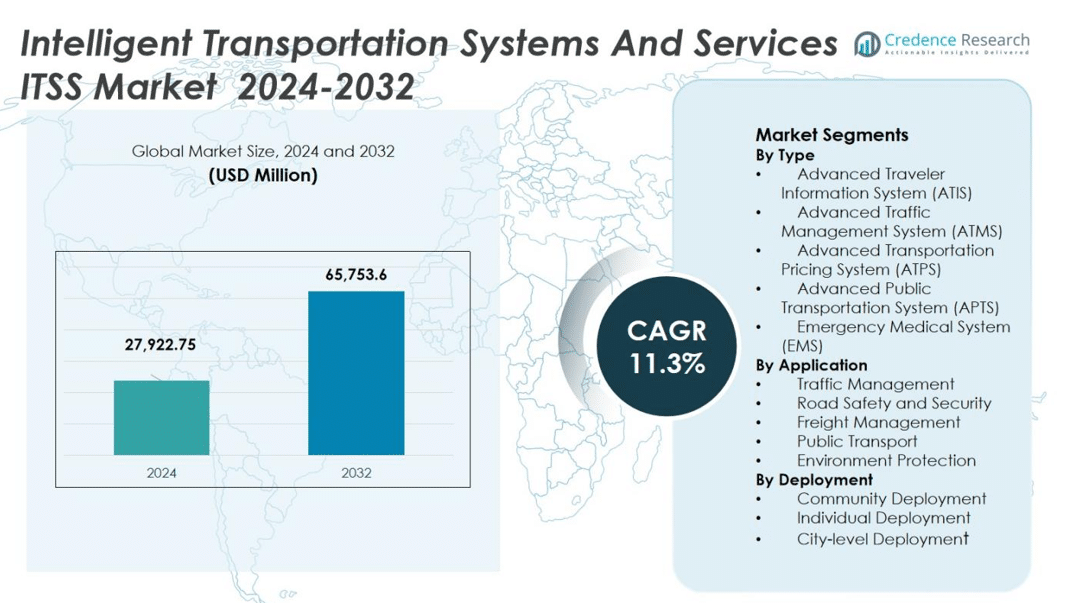
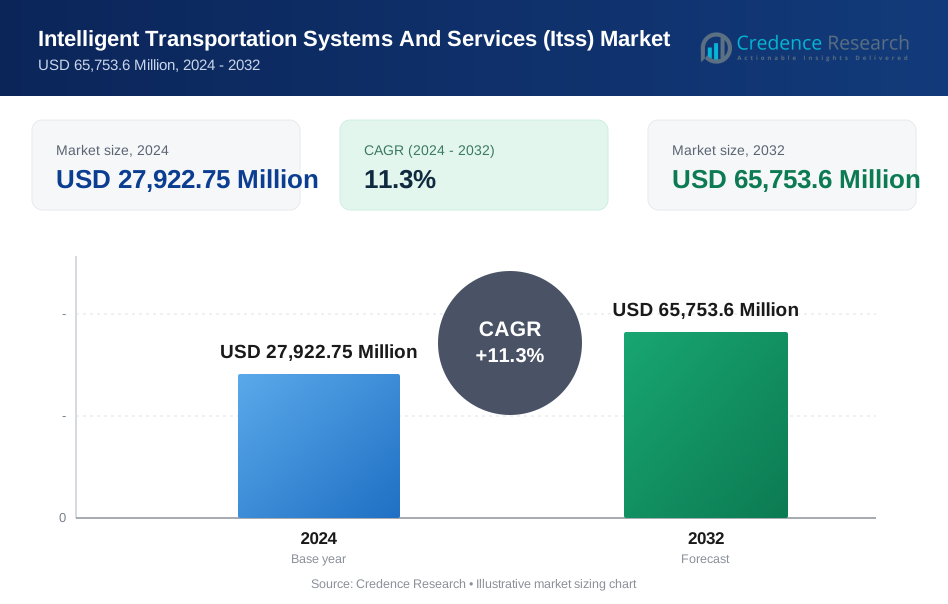
The Intelligent Transportation Systems and Services (ITSS) Market size was valued at USD 27,922.75 Million in 2024 and is anticipated to reach USD 65,753.6 Million by 2032, at a CAGR of 11.3% during the forecast period.
| REPORT ATTRIBUTE | DETAILS |
|---|---|
| Historical Period | 2020-2023 |
| Base Year | 2024 |
| Forecast Period | 2025-2032 |
| Industrial Automation Market Size 2024 | USD 27,922.75 Million |
| Industrial Automation Market, CAGR | 11.3% |
| Industrial Automation Market Size 2032 | USD 65,753.6 Million |
The Intelligent Transportation Systems and Services (ITSS) Market is driven by major players such as Atos SE, Cisco Systems, Inc., Cubic Corporation, Denso Corporation, Fujitsu Limited, Garmin Ltd., HERE Technologies, Hitachi, Ltd., Econolite Group, Inc., and Honeywell International Inc., each contributing advanced mobility technologies, real-time traffic solutions, and integrated transport platforms. These companies focus on enhancing roadway efficiency, connected transport infrastructure, and smart city mobility systems through innovations in AI, IoT, and V2X communication. North America leads the ITSS Market with a 37.2% share in 2024, supported by strong digital infrastructure, smart city investments, and rapid adoption of advanced traffic management systems.
Market Insights
- The Intelligent Transportation Systems and Services ITSS Market reached USD 27,922.75 Million in 2024 and is projected to grow at a CAGR of 11.3% through 2032.
- Strong market drivers include increasing urban congestion, rising demand for real-time mobility data, and expanding smart city programs that accelerate deployment of ATMS, which holds a 34.7% share.
- Key trends highlight rapid integration of AI, cloud platforms, and V2X communication, enabling predictive traffic management, advanced public transport coordination, and safer mobility ecosystems.
- Major players such as Cisco Systems, Atos SE, Cubic Corporation, Denso Corporation, and HERE Technologies focus on advanced traffic platforms, analytics, and connected mobility infrastructure while enhancing system scalability and innovation.
- Regionally, North America leads with a 37.2% share, followed by Europe at 28.5% and Asia-Pacific at 25.1%, supported by robust digital infrastructure, regulatory policies, and increasing investments in city-level ITSS deployment, which dominates with a 41.6% share.
Market Segmentation Analysis:
By Type
The Intelligent Transportation Systems and Services (ITSS) Market by type is dominated by Advanced Traffic Management Systems (ATMS), holding 34.7% market share in 2024. ATMS leads due to its critical role in reducing traffic congestion, optimizing flow, and enabling real-time decision-making through sensors, surveillance systems, and adaptive signal controls. Growing urbanization and rising traffic density are accelerating investments in ATMS infrastructure across major cities. Strong government initiatives targeting reduced travel time, enhanced roadway efficiency, and improved emergency response further strengthen the adoption of ATMS compared to ATIS, ATPS, APTS, and EMS solutions.
- For instance, Miami-Dade County upgraded its ATMS by replacing approximately 3,000 traffic controllers with Advanced Transportation Controllers (ATC), significantly improving detection capabilities for motorists, public transit users, bicyclists, and pedestrians, thereby enhancing overall mobility and safety.
By Application
Within the ITSS Market, Traffic Management is the dominant application segment, accounting for 29.4% market share in 2024. This leadership is driven by increasing congestion levels, the rapid expansion of road networks, and demand for real-time mobility analytics. Cities are deploying advanced traffic monitoring sensors, dynamic message signs, and AI-enabled signal control systems to enhance vehicular movement efficiency. Government programs focused on smart mobility, emissions reduction, and safer transportation infrastructure fuel strong adoption. Traffic Management continues to outpace applications such as Road Safety & Security, Freight Management, Public Transport, and Environment Protection.
- For instance,S. Department of Transportation pilots use machine learning sensors and conflict prediction systems that issue safety warnings for vehicles on potential crash trajectories, enhancing road safety through early alerts.
By Deployment
In the ITSS Market, City-level Deployment holds the largest share at 41.6% in 2024, driven by widespread smart city initiatives integrating traffic monitoring, predictive analytics, and multimodal transport coordination. Municipal authorities are prioritizing large-scale, unified platforms to manage road congestion, enhance public transportation, and streamline emergency response. High investment capacity and growing emphasis on sustainable urban mobility strengthen this segment’s lead over Community Deployment and Individual Deployment. As cities modernize transportation infrastructure through IoT, cloud platforms, and real-time data systems, City-level Deployment continues to expand as the preferred model.
Key Growth Drivers
Expansion of Smart City Programs
Smart city initiatives are driving significant adoption of Intelligent Transportation Systems and Services, as governments invest in digital road infrastructure, adaptive traffic signals, and integrated mobility solutions. The rising need to manage urban congestion and enhance public transportation efficiency is accelerating deployment. Real-time traffic analytics, IoT-based monitoring, and connected roadway technologies enable seamless mobility experiences. Growing funding for urban modernization, combined with increased emphasis on sustainability and reduced emissions, positions ITSS as a core component of next-generation city development strategies.
- For instance, in Dubai, the ITS expansion covers 60% of the main road network and integrates dynamic message signs, real-time traffic monitoring cameras, and fiber-optic communication networks, reducing congestion and enabling faster incident response.
Increasing Demand for Real-Time Mobility Insights
The ITSS market benefits from the growing demand for real-time data across transportation networks. Cities, enterprises, and public agencies rely on intelligent platforms to generate actionable insights for traffic flow optimization, incident detection, and predictive maintenance. The rise of connected vehicles, telematics adoption, and cloud-based data platforms strengthens the requirement for accurate mobility analytics. This driver is further supported by the need for efficient route planning, reduced travel time, and enhanced commuter safety, encouraging broad deployment of advanced information and management systems.
- For instance, connected vehicles generate nearly 25 GB of data per hour from over 100 data points, facilitating advanced telematics applications such as predictive maintenance and safety alerts.
Rising Focus on Road Safety and Accident Reduction
Governments and transportation authorities are prioritizing advanced systems that reduce accidents, enhance emergency response, and improve driver behavior. Technologies such as automated incident detection, emergency medical systems, and vehicle-to-infrastructure communication are being integrated into road networks to minimize risks. With increasing traffic density and rising vehicle ownership, the demand for solutions that improve visibility, monitor high-risk zones, and support quick emergency dispatch is growing rapidly. This strong focus on safety compliance and regulatory advancement fuels ITSS investments across both developed and emerging regions.
Key Trends & Opportunities
Growth of Connected and Autonomous Mobility
The shift toward connected and autonomous mobility is creating transformative opportunities for ITSS providers. Vehicle-to-everything (V2X) communication, advanced driver-assistance systems, and automated traffic control technologies require robust digital infrastructure, strengthening market demand. As automotive OEMs integrate sensors, telematics, and AI-driven systems, transportation networks must support high-speed data transfer and coordinated mobility. This trend enables new opportunities in predictive traffic management, collision avoidance, fleet automation, and integrated public transport platforms.
- For instance, Cohda Wireless, a leader in V2X technologies, partners with automotive OEMs and cities to deploy secure V2X communication modules, enhancing vehicle-to-vehicle and infrastructure communication.
Integration of AI, Big Data, and Cloud Platforms
Artificial intelligence, big data analytics, and cloud architectures are reshaping how transportation systems operate. Intelligent algorithms analyze vast mobility datasets to optimize routes, forecast congestion, and enhance service reliability. Cloud-based ITSS platforms allow scalable deployment, seamless system updates, and integration with multimodal transportation networks. This trend unlocks opportunities for advanced predictive analytics, smart tolling, dynamic traffic control, and automated incident management. As cities aim for data-driven transportation planning, innovation in software-defined mobility continues to accelerate.
- For instance, Econolite offers an AI-powered predictive traffic management system that reduces congestion and improves urban mobility by forecasting traffic patterns to optimize signal timings.
Key Challenges
High Implementation and Maintenance Costs
The deployment of large-scale ITSS infrastructure requires substantial capital investment in sensors, communication networks, control centers, and software integration. Many regions face financial constraints that delay upgrades or limit full-scale adoption. Ongoing maintenance, system calibration, cybersecurity enhancement, and technical workforce training add additional operational burdens. These costs discourage mid-sized municipalities and developing countries from rapid adoption, slowing market expansion despite strong technological availability.
Interoperability and Integration Complexity
The ITSS market faces challenges in integrating diverse systems, legacy infrastructure, and multi-vendor technologies. Differences in communication protocols, hardware specifications, and software platforms create interoperability issues that complicate deployment. Coordinating data exchange among traffic management centers, public transport systems, emergency services, and connected vehicles requires unified standards that are still evolving. This complexity often leads to implementation delays, higher costs, and fragmented system performance, limiting the efficiency of large-scale intelligent transportation networks.
Regional Analysis
North America
North America leads the Intelligent Transportation Systems and Services (ITSS) Market with a 37.2% market share in 2024, driven by strong investments in smart mobility, advanced roadway infrastructure, and connected vehicle technologies. The region benefits from widespread adoption of AI-driven traffic management, autonomous mobility pilots, and large-scale city-level ITS deployments. Government programs supporting real-time traffic monitoring, integrated public transportation, and roadway safety enhancements fuel continued expansion. High penetration of telematics and cloud-based mobility platforms further strengthens adoption across the U.S. and Canada, positioning North America as a global frontrunner in intelligent transportation innovation.
Europe
Europe holds a 28.5% share in the ITSS Market in 2024, supported by strict road safety regulations, sustainability mandates, and strong emphasis on reducing carbon emissions. Countries such as Germany, the U.K., France, and the Netherlands are deploying advanced traffic management systems, digital tolling, and multimodal transport technologies to streamline mobility. The European Union’s Smart Mobility Strategy drives adoption of connected vehicle infrastructure and real-time mobility data platforms. Growing integration of electric vehicle charging networks with traffic systems and expansion of rail-road coordination further accelerate the region’s ITSS development across urban and cross-border corridors.
Asia-Pacific
Asia-Pacific accounts for 25.1% market share in 2024, emerging as the fastest-growing region due to rapid urbanization, high traffic density, and large-scale smart city programs in China, Japan, South Korea, and India. Governments are heavily investing in intelligent traffic control, advanced public transport systems, and automated tolling to reduce congestion and improve mobility efficiency. The region’s growing adoption of connected vehicles, expanding telematics penetration, and surge in digital infrastructure spending support robust ITSS deployment. Strong policy support for sustainable transportation and integration of AI-driven mobility platforms further contributes to Asia-Pacific’s rapid market expansion.
Latin America
Latin America captures a 5.6% market share in 2024, with growth driven by modernization of transport infrastructure, expansion of smart bus systems, and rising urban mobility challenges in Brazil, Mexico, and Chile. Governments are increasingly adopting intelligent traffic monitoring, integrated fare systems, and emergency response platforms to address congestion and safety issues. Public-private partnerships are enabling deployment of digital tolling, real-time travel information systems, and smart crossroads. Although budget constraints remain a challenge, steady investment in digital mobility solutions is improving adoption and strengthening the region’s ITSS ecosystem.
Middle East & Africa
The Middle East & Africa region holds a 3.6% market share in 2024, supported by expanding smart city developments and large-scale infrastructure projects in the UAE, Saudi Arabia, and South Africa. The region is deploying intelligent traffic control systems, integrated public transport platforms, and advanced tolling technologies to support urban transformation. Investments under national vision programs, such as Saudi Vision 2030 and UAE Smart Mobility initiatives, enable integration of IoT-based mobility solutions and automated monitoring systems. Growing focus on safety, sustainability, and digital mobility modernization continues to enhance ITSS adoption across MEA.
Market Segmentations:
By Type
- Advanced Traveler Information System (ATIS)
- Advanced Traffic Management System (ATMS)
- Advanced Transportation Pricing System (ATPS)
- Advanced Public Transportation System (APTS)
- Emergency Medical System (EMS)
By Application
- Traffic Management
- Road Safety and Security
- Freight Management
- Public Transport
- Environment Protection
By Deployment
- Community Deployment
- Individual Deployment
- City-level Deployment
By Region
- North America
- U.S.
- Canada
- Mexico
- Europe
- Germany
- France
- U.K.
- Italy
- Spain
- Rest of Europe
- Asia Pacific
- China
- Japan
- India
- South Korea
- South-east Asia
- Rest of Asia Pacific
- Latin America
- Brazil
- Argentina
- Rest of Latin America
- Middle East & Africa
- GCC Countries
- South Africa
- Rest of the Middle East and Africa
Competitive Landscape
The competitive landscape of the Intelligent Transportation Systems and Services (ITSS) Market features major players such as Atos SE, Cisco Systems, Inc., Cubic Corporation, Denso Corporation, Econolite Group, Inc., Fujitsu Limited, Garmin Ltd., HERE Technologies, Hitachi, Ltd., and Honeywell International Inc. These companies focus on delivering advanced traffic management platforms, connected mobility technologies, and integrated public transport solutions across global markets. Vendors are prioritizing AI-enabled traffic control, cloud-based mobility analytics, and V2X communication to strengthen system performance and scalability. Strategic partnerships with governments, city authorities, and automotive OEMs are expanding their market presence and enabling deployment of large-scale smart mobility networks. Continuous investments in software innovation, telematics development, digital tolling technologies, and autonomous mobility infrastructure enhance product differentiation. As cities accelerate smart transportation initiatives, competition intensifies around real-time data management, cybersecurity capabilities, and end-to-end mobility solutions tailored to national and regional policy priorities.
Key Player Analysis
- Garmin Ltd.
- Fujitsu Limited
- Cubic Corporation
- Honeywell International Inc.
- Denso Corporation
- Cisco Systems, Inc.
- Econolite Group, Inc.
- Atos SE
- Hitachi, Ltd.
- HERE Technologies
Recent Developments
- In August 2024, Equans (US technical services provider) collaborated with Optibus Ltd. (transportation‑management software provider) to launch an intelligent transportation system in the Greater Portland region including CAD/AVL, APC and scheduling modules.
- In September 2025, Via Transportation partnered with Waymo to integrate Waymo’s autonomous robotaxis into public transit networks in Chandler, Arizona.
- In August 2025, TAPCO completed the acquisition of Logix ITS, bringing together TAPCO’s legacy in traffic safety with Logix ITS’s smart‑parking and traffic‑calming solutions to form one of North America’s most comprehensive ITS platforms
Report Coverage
The research report offers an in-depth analysis based on Type, Application, Deployment and Region. It details leading market players, providing an overview of their business, product offerings, investments, revenue streams, and key applications. Additionally, the report includes insights into the competitive environment, SWOT analysis, current market trends, as well as the primary drivers and constraints. Furthermore, it discusses various factors that have driven market expansion in recent years. The report also explores market dynamics, regulatory scenarios, and technological advancements that are shaping the industry. It assesses the impact of external factors and global economic changes on market growth. Lastly, it provides strategic recommendations for new entrants and established companies to navigate the complexities of the market.
Future Outlook
- The market will experience strong growth as cities accelerate adoption of integrated smart mobility platforms.
- Expansion of connected and autonomous vehicle ecosystems will increase demand for advanced ITSS infrastructure.
- AI-driven traffic analytics will become central to congestion management and predictive mobility planning.
- Governments will intensify investments in digital tolling, real-time monitoring, and automated incident response.
- Cloud-based ITSS platforms will gain wider acceptance due to their scalability and lower operational complexity.
- V2X communication technologies will enhance roadway safety and support intelligent urban transport ecosystems.
- Public transportation systems will increasingly integrate digital fare collection and multimodal coordination tools.
- Sustainability goals will drive adoption of eco-friendly traffic solutions and low-emission mobility management systems.
- Private sector participation through PPP models will strengthen infrastructure modernization across regions.
- Cybersecurity advancements will play a critical role in ensuring secure, reliable, and uninterrupted ITSS operations.
Request a Free Sample
Fill in your details and we'll send you a free sample report.
- Sample data tables & charts
- Research methodology
Need a Custom Version of This Report?
Tailor the scope, geography, or segments to your exact requirements.
- Custom geography or segment scope
- Direct access to our analyst team
Frequently Asked Questions
What is the current market size for Intelligent Transportation Systems And Services ITSS Market, and what is its projected size in 2032?
At what Compound Annual Growth Rate is the Intelligent Transportation Systems And Services ITSS Market projected to grow between 2025 and 2032?
Which region is leading for Intelligent Transportation Systems And Services (ITSS)?
What are the key drivers for the growth of the Intelligent Transportation Systems And Services (ITSS) market?
Which is the major segment in the Intelligent Transportation Systems And Services (ITSS) market by application?
Who are the leading companies in the Intelligent Transportation Systems And Services ITSS Market?
Table of Content
Chapter 1. Report Introduction
- 1.1 Report Description & Purpose
- 1.1.1 Report Title & Market Definition
- 1.1.2 Unique Selling Propositions (USP) & Key Differentiators
- 1.1.3 Value Proposition for Stakeholders
- 1.2 Research Objectives
- 1.2.1 Market Sizing Objectives (Volume & Revenue)
- 1.2.2 Segmentation Objectives
- 1.2.3 Competitive Intelligence Objectives
- 1.2.4 Forecast & Scenario Objectives
- 1.3 Report Scope
- 1.3.1 Intelligent Transportation Systems And Services (Itss) Scope – Types & Subtypes Covered
- 1.3.2 Geographic Scope – Regions & Countries Covered
- 1.3.3 Historical Period, Base Year & Forecast Period (2024; forecast to 2032)
- 1.3.4 Inclusions & Exclusions
- 1.4 HS Code & Classification Framework
- 1.5 Currency, Units & Pricing Basis
- 1.6 Target Stakeholders
- 1.7 Limitations & Assumptions
Chapter 2. Executive Summary
- 2.1 Global Intelligent Transportation Systems And Services (Itss) Market Snapshot
- 2.1.1 Market Size – Historical (2024) & Forecast (2024-2032) (2024: USD 27,922.75 Million → 2032: USD 65,753.6 Million)
- 2.1.2 Volume & Revenue – Global Totals
- 2.1.3 Key Market Highlights – Top Five Facts
- 2.2 Intelligent Transportation Systems And Services (Itss) Market Segmentation Snapshot
- 2.2.1 Market Split by Region – 2024 vs. 2032
- 2.3 Competitive Snapshot
- 2.3.1 Top 10 Players by Revenue Share – 2024
- 2.3.2 Top 10 Players by Volume Share – 2024
- 2.3.3 Recent Strategic Developments (18-Month Summary)
- 2.4 Key Investment Highlights & Strategic Conclusions
Chapter 3. Intelligent Transportation Systems And Services (Itss) Market Dynamics & Industry Analysis
- 3.1 Market Overview & Context
- 3.1.1 Intelligent Transportation Systems And Services (Itss) Market Position in the Broader Automotive Value Chain
- 3.1.2 OEM vs. Replacement Market Dynamics
- 3.1.3 Market Maturity & Development Stage by Region
- 3.2 Intelligent Transportation Systems And Services (Itss) Market Drivers
- 3.3 Intelligent Transportation Systems And Services (Itss) Market Restraints & Challenges
- 3.4 Intelligent Transportation Systems And Services (Itss) Market Opportunities
- 3.5 Porter's Five Forces Analysis
- 3.5.1 Threat of New Entrants
- 3.5.2 Bargaining Power of Suppliers
- 3.5.3 Bargaining Power of Buyers
- 3.5.4 Threat of Substitutes
- 3.5.5 Competitive Rivalry – Intensity Assessment
- 3.6 Intelligent Transportation Systems And Services (Itss) Value Chain Analysis
- 3.6.1 Upstream – Raw Material/Input Suppliers
- 3.6.1.1 Raw Material/Input 1
- 3.6.1.2 Raw Material/Input 2
- 3.6.1.3 Raw Material/Input 3
- 3.6.2 Midstream – Production/Manufacturing/Service Delivery
- 3.6.2.1 Production/Process Overview
- 3.6.2.2 Key Facility Locations & Capacity by Manufacturer
- 3.6.3 Downstream – Distribution & End Consumer
- 3.6.3.1 Primary Channel – B2B/OEM
- 3.6.3.2 Secondary Channels – Dealer, Retail, Online, Direct
- 3.6.4 Value Chain Profitability Analysis
- 3.6.1 Upstream – Raw Material/Input Suppliers
- 3.7 PESTEL Analysis
- 3.7.1 Political Factors
- 3.7.2 Economic Factors
- 3.7.3 Social Factors
- 3.7.4 Technological Factors
- 3.7.5 Environmental Factors
- 3.7.6 Legal Factors
- 3.8 Intelligent Transportation Systems And Services (Itss) Supply Chain Analysis
- 3.8.1 Raw Material/Input Supply Risk Assessment
- 3.8.2 Manufacturing Concentration Risk (Geographic Exposure)
- 3.8.3 Trade Disruption Impact Analysis
- 3.9 Regulatory & Policy Landscape
Note: The regulatory and policy landscape section covers regulations based on their applicability to the market, Intelligent Transportation Systems And Services (Itss) category, geography, and scope of the study. Only regulatory frameworks with a material impact on operations, compliance, trade, sustainability, or market access are analyzed in detail.
Chapter 4. Key Investment Pockets & Opportunity Analysis
- 4.1 Intelligent Transportation Systems And Services (Itss) Market Attractiveness Analysis
- 4.1.1 By Region – Investment Attractiveness Matrix (Volume × CAGR)
- 4.2 Absolute Revenue Growth Opportunity
- 4.2.1 By Region – Absolute USD Growth Through 2032
- 4.3 Incremental Volume Opportunity
- 4.3.1 By Region – Incremental Volume Through 2032
- 4.3.2 Segment – Incremental Volume
- 4.4 Emerging Submarket Opportunity Deep Dive (Subject to Applicability)
- 4.5 Emerging Market Opportunity Scorecards
- 4.5.1 United States
- 4.5.2 Europe
- 4.5.3 Asia
- 4.5.4 Middle East & Africa
Note: Emerging Market Opportunity Scorecards will be included based on relevance and strategic importance. Regions listed are indicative and may vary depending on data availability and market dynamics.
Chapter 5. Intelligent Transportation Systems And Services (Itss) Import-Export Analysis & Trade Flows
- 5.1 Global Trade Overview
- 5.1.1 Global Export Value by Country (2024)
- 5.1.2 Global Export Volume by Country (2024)
- 5.1.3 Global Import Value by Country (2024)
- 5.1.4 Global Import Volume by Country (2024)
- 5.1.5 Net Trade Balance by Country (2024)
- 5.2 Export Analysis – Segment
- 5.2.1 Type 1 (HS Code)
- 5.2.2 Type 2 (HS Code)
- 5.2.3 Type 3 (HS Code)
- 5.2.4 Type 4 (HS Code)
- 5.2.5 Type 5 (HS Code)
- 5.3 Import Analysis – Segment
- 5.3.1 Type 1 (HS Code)
- 5.3.2 Type 2 (HS Code)
- 5.3.3 Type 3 (HS Code)
- 5.3.4 Type 4 (HS Code)
- 5.3.5 Type 5 (HS Code)
- 5.4 Average Unit Trade Prices
- 5.4.1 Average Export Price – Segment & Country
- 5.4.2 Average Import Price – Segment & Source Country
- 5.4.3 Price Trends (2024)
- 5.5 Key Trade Route Analysis
- 5.5.1 Trade Route 1
- 5.5.2 Trade Route 2
- 5.5.3 Trade Route 3
- 5.5.4 Trade Route 4
- 5.5.5 Trade Route 5
- 5.6 Trade Policy Impact Assessment
- 5.6.1 US Anti-Dumping & Section 301 Tariffs
- 5.6.2 EU Customs Union Impact
- 5.6.3 Major Free Trade Agreements
- 5.6.4 USMCA Rules of Origin
Note: Trade policy analysis will be included only where relevant to the Intelligent Transportation Systems And Services (Itss) market.
Chapter 6. Competitive Landscape & Company Benchmarking
- 6.1 Intelligent Transportation Systems And Services (Itss) Market Concentration & Structure
- 6.1.1 Herfindahl-Hirschman Index (HHI) – vs. 2024
- 6.1.2 Tier 1, Tier 2 & Tier 3 Market Structure
- 6.1.3 Global, Regional & Local Player Dynamics
- 6.2 Intelligent Transportation Systems And Services (Itss) Market Share Analysis – 2024
- 6.2.1 Global Revenue Share by Company
- 6.2.2 Global Volume Share by Company
- 6.2.3 Regional Revenue Share
- 6.2.4 Market Share Evolution ( vs. 2024)
- 6.2.5 OEM Segment Share by Company
- 6.2.6 Replacement Segment Share by Company
- 6.3 Production/Delivery Capacity & Facility Analysis
- 6.3.1 Global Installed Capacity
- 6.3.2 Capacity Utilization Rates
- 6.3.3 Production/Output Volume
- 6.3.4 Facility Locations & Capacity Map
- 6.3.5 Planned Capacity Additions
- 6.4 Intelligent Transportation Systems And Services (Itss) Competitive Benchmarking Matrix
- 6.4.1 Revenue, Volume, CAGR & Profitability Comparison
- 6.4.2 Channel Revenue Mix
- 6.4.3 Geographic Revenue Exposure
- 6.4.4 R&D Intensity
- 6.4.5 Sustainability Maturity
- 6.5 Strategic Developments in Intelligent Transportation Systems And Services (Itss) (Last 24 Months)
- 6.5.1 Mergers, Acquisitions & Divestments
- 6.5.2 New Intelligent Transportation Systems And Services (Itss) Launches
- 6.5.3 Facility Expansions
- 6.5.4 Strategic Alliances, Joint Ventures & Partnerships
- 6.5.5 Distribution Expansion & Market Entry
- 6.5.6 Sustainability & ESG Initiatives
- 6.6 Competitive Strategy Mapping
- 6.6.1 Leader, Challenger, Follower & Niche Classification
- 6.6.2 Pricing Strategy Comparison
- 6.6.3 Channel Strategy Matrix
Note: Strategic developments are included based on their materiality and the availability of reliable information.
Chapter 7. Global Intelligent Transportation Systems And Services (Itss) Market – By Distribution Channel
- 7.1 Segment Overview
- 7.1.1 Volume & Revenue Split by Channel (2024 & 2032)
- 7.1.2 Channel Mix Evolution (2024-2032)
Chapter 8. Regional Market Analysis – Global Overview
- 8.1 Global Regional Overview
- 8.1.1 Regional Volume Share
- 8.1.2 Regional Revenue Share
- 8.1.3 Regional Volume by Region
- 8.1.4 Regional Revenue by Region
- 8.1.5 Regional Forecast Through 2032
- 8.2 Cross-Regional Segment Analysis
- 8.2.1 By Distribution Channel
- 8.2.2 By Brand/Price Tier
Chapter 9. North America Intelligent Transportation Systems And Services (Itss) Market
- 9.1 United States
- 9.2 Canada
- 9.3 Mexico
Chapter 10. Europe Intelligent Transportation Systems And Services (Itss) Market
- 10.1 Germany
- 10.2 France
- 10.3 Italy
- 10.4 United Kingdom
- 10.5 Spain
- 10.6 Poland
- 10.7 Russia
- 10.8 Netherlands
- 10.9 Belgium
- 10.10 Sweden
- 10.11 Denmark
- 10.12 Norway
- 10.13 Rest of Europe
Chapter 11. Asia Pacific Intelligent Transportation Systems And Services (Itss) Market
- 11.1 China
- 11.2 India
- 11.3 Japan
- 11.4 South Korea
- 11.5 Thailand
- 11.6 Indonesia
- 11.7 Vietnam
- 11.8 Malaysia
- 11.9 Australia
- 11.10 Rest of Asia Pacific
Chapter 12. Latin America Intelligent Transportation Systems And Services (Itss) Market
- 12.1 Brazil
- 12.2 Argentina
- 12.3 Colombia
- 12.4 Chile
- 12.5 Rest of Latin America
Chapter 13. Middle East Intelligent Transportation Systems And Services (Itss) Market
- 13.1 Saudi Arabia
- 13.2 United Arab Emirates
- 13.3 Turkey
- 13.4 Israel
- 13.5 Iran
- 13.6 Rest of the Middle East
Chapter 14. Africa Intelligent Transportation Systems And Services (Itss) Market
- 14.1 South Africa
- 14.2 Egypt
- 14.3 Nigeria
- 14.4 Morocco
- 14.5 Rest of Africa
Chapter 15. Intelligent Transportation Systems And Services (Itss) Company Profiles
- 15.1 [Company 01]
- 15.1.1 Company Overview
- 15.1.2 Key Management Personnel
- 15.1.3 Products & Services Portfolio
- 15.1.4 Financial Performance
- 15.1.5 Key Market Focus & Geographic Presence
- 15.1.6 Recent Developments & Strategic Initiatives
Note: The company profile list is preliminary and may change based on research findings, market developments, data availability, and client requirements.
Chapter 16. Appendices
- Appendix A – List of Abbreviations & Acronyms
- Appendix B – Industry Classification Code Reference – Full Series
- Appendix C – Production & Capacity Data Tables
- Appendix D – End-Use & Demand Base Tables
- Appendix E – Consumption & Replacement Rate Assumptions
- Appendix F – ASP Reference Tables
- Appendix G – Manufacturing & Facility Database
- Appendix H – Import-Export Data Tables
- Appendix I – Regulatory Summary Tables
- Appendix J – Primary Research Participant List (Anonymized)
- Appendix K – Primary Research Questionnaire Framework
- Appendix L – Data Sources & Bibliography
- Appendix M – Market Size Divergence & Source Comparison
Chapter 17. Research Methodology
- 17.1 Research Framework & Philosophy
- 17.2 Secondary Research – Sources, Hierarchy & Data Extraction
- 17.3 Data Modeling – Bottom-Up & Top-Down Market Sizing
- 17.4 Primary Research – Stakeholder Framework, LOI & Sample Sizes
- 17.5 Forecast Methodology – Regression, Scenario & Sensitivity Analysis
- 17.6 Quality Control – Four-Layer Validation Framework
- 17.7 Limitations & Standard Assumptions
- 17.8 Disclaimer
