
| REPORT ATTRIBUTE | DETAILS |
|---|---|
| Historical Period | 2019-2022 |
| Base Year | 2023 |
| Forecast Period | 2024-2032 |
| Meat Packaging Market Size 2023 | USD 7518.2 Million |
| Meat Packaging Market, CAGR | 5.50% |
| Meat Packaging Market Size 2032 | USD 12172.6 Million |
Market Insights
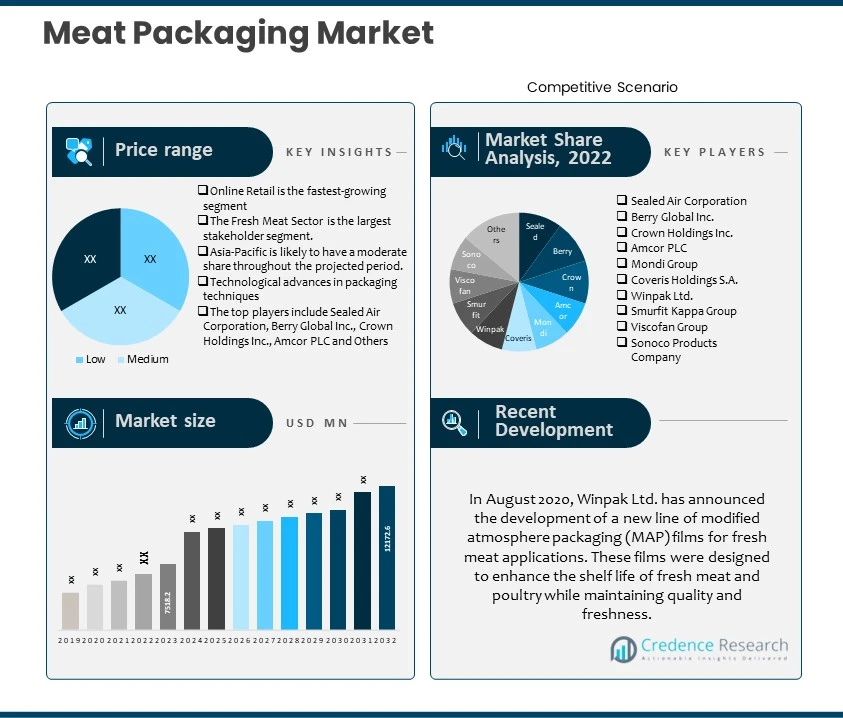
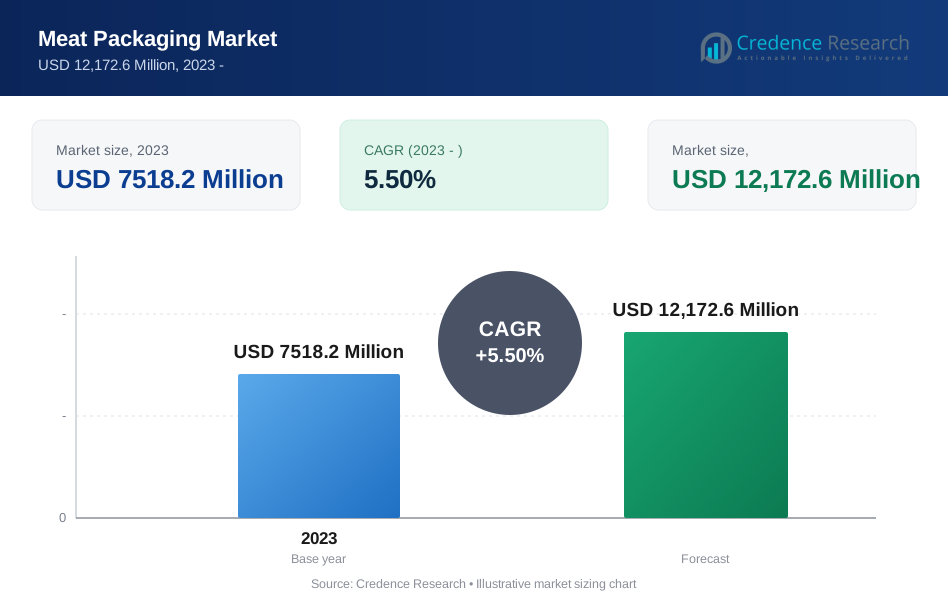
- The global demand for Meat Packaging was valued at USD 7518.2 Million in 2023 and is expected to reach USD 12172.6 Million in 2032, growing at a CAGR of 5.50% between 2024 and 2032.
- The plastic segment of the global processed meat packaging market is predicted to rise at a 5.0% CAGR between 2022 and 2032.
- The Modified Atmosphere Packaging (MAP) technology held the biggest market share in 2023 and is anticipated to increase at the fastest CAGR over the forecast period. The vacuum skin packaging technique is also expected to expand significantly during the forecast period.
- The Fresh Meat Sector is the largest stakeholder segment.
- Online Retail is the fastest-growing segment, while Food Service is predicted to have the fastest CAGR during the forecast period.
- North America accounted for more than 40% of the global market in 2023, with Europe growing at a CAGR of 5.0%. Asia-Pacific is predicted to maintain a moderate share throughout the forecast period. The primary factor driving market expansion is increased access through organized retailing.
- Volatility in raw material pricing is a barrier to market expansion
Executive Summary
Market Definition
Meat packaging is the process of wrapping and sealing meat products to keep them fresh, safe, and presentable. It usually requires the use of specific materials like vacuum-sealed plastic bags, modified atmosphere packaging (MAP), or trays with absorbent pads. The packaging serves several functions, including preserving the meat from contamination, extending its shelf life, preventing rotting, and making handling and storage easier for consumers. Properly packaged meat also enables effective labelling, such as nutritional information, product identity, and handling recommendations.
Market Overview
The global Meat Packaging Market has witnessed steady growth in recent years and is expected to grow at a CAGR of 5.50% between 2024 and 2032. The market was valued at USD 7518.2 million in 2023 and is expected to reach USD 12172.6 million in 2032.
One of the primary factors driving the market's growth is growing global meat production and consumption. For instance, the Food and Agriculture Organization of the United Nations predicts that world beef output will increase by about 44 Mt by 2030, reaching 373 Mt due to increased profitability. The Food and Agriculture Organization of the United Nations also forecasts that worldwide meat consumption per capita will increase by 0.3% per year to 35.4 kg in retail weight equivalent by 2032.
Several elements in the business may impede overall market growth. Price volatility and fluctuations in the availability of raw materials required for Fresh Meat Packaging are important factors that may impede market expansion over the forecast period. Furthermore, the presence of severe government rules for fresh, clean packaging presents significant obstacles to the market's leading competitors. However, the growing emphasis on environmentally friendly food packaging is one of the most promising areas for market vendors. The market's top players are primarily focused on R&D operations aimed at developing novel ecologically friendly and recyclable food packaging for fresh meat.
Segmentation By Material Type
- The plastic segment of the worldwide processed meat packaging market is expected to increase at a 5.0% CAGR between 2022 and 2032. Meat packaging manufacturers commonly use plastic because of its exceptional elasticity and ability to improve product visibility.
Segmentation By Packaging Type
- The Modified Atmosphere Packaging (MAP) technology held the greatest market share in 2023 and is predicted to grow at the quickest CAGR during the forecast period. MAP technology extends the shelf life of beef from three to twenty-one days. As a result, this method is perfect for long-distance meat export.
- The vacuum skin packaging technique is predicted to expand significantly over the projection period. This technology is gaining popularity among customers due to its capacity to present products effectively. It improves product visibility, making various sizes and styles of meat packing more enticing.
- The flexible packaging segment's market share will increase significantly during the projection period.
Segmentation by Product Type
- The Fresh Meat sector is the largest shareholder segment. Fresh meat necessitates specific packaging to retain its quality and freshness, making it an essential component of the market.
- Another popular market sector is Processed Meat. Processed meat is frequently treated and packaged in various ways to extend its shelf life and appeal to consumers.
Segmentation By Distribution Channel
- Online Retail is the fastest-expanding segment. The rise of online shopping and e-commerce platforms has resulted in increased demand for packaged beef products via online channels. This market is expanding rapidly because of the ease and accessibility it provides to consumers who want to buy meat products online.
- The Food Service segment is expected to have the fastest CAGR over the projection period.
Segmentation by Region
- In 2023, North America accounted for over 40% of the worldwide market.
- Europe is forecast to grow at a CAGR of 5.0%, while Asia-Pacific is expected to have a moderate share throughout the projected period.
- The rest of the world, including Latin America, the Middle East, and Africa, supplies the remaining demand for Meat Packaging.
North America is predicted to dominate the worldwide fresh meat packaging market due to rising demand for meat products and the implementation of sustainable packaging solutions. Factors such as rising meat consumption, increased desire for convenient foods, and the growing popularity of sustainable and eco-friendly packaging solutions all help to drive the meat packaging industry forward. The United States is expected to dominate the fresh meat packaging market, thanks to the presence of large meat producers such as Tyson Foods, JBS USA Holdings, Inc., and Cargill, Incorporated, among others.
Europe is expected to have a CAGR of 5.0% over the predicted period. Europe is expected to expand during the projection period. The meat packaging industry in the United Kingdom is being driven by increased production and export of meat products such as beef and pork, as well as a growing emphasis on using sustainable packaging choices. According to the Agriculture and Horticulture Development Board (AHDB), the United Kingdom produces roughly 900,000 tonnes of beef each year, with 148,000 tonnes exported to other countries across the world.
Moreover, Asia-Pacific is expected to have a moderate share over the projection period. Rapid industrialization has increased the purchasing power of consumers in this region. According to the International Monetary Fund (IMF), Asia-Pacific is expected to grow by 4.6% in 2023, up from 3.9% in 2022. The World Bank anticipates 5% growth in developing East Asia and the Pacific in 2023, with a decrease to 4.5% in 2024. This has increased demand for meat and meat products, resulting in regional market growth during the forecast period.
Key Highlights of the Report
Material Type, Packaging Type, Product Type, Distribution Channel, and region segment of the global Meat Packaging Market. The Modified Atmosphere Packaging (MAP) technology had the largest market share in 2023, with Fresh Meat being the largest shareholder segment. Moreover, online retail is the fastest growing segment. The Food Service segment is predicted to have the quickest CAGR throughout the projection period, with North America dominating the market expansion.
Growing consumption of protein-rich products, rising demand for packaged food items, and a higher emphasis on meat product shelf life extension are just a few of the primary drivers of global meat packaging market growth. However, some aspects of the business may hamper overall market growth. Price volatility and fluctuations in the availability of raw materials required for Fresh Meat Packaging are significant factors that could hinder market growth throughout the projection period. Furthermore, the presence of stringent government regulations for fresh, clean packaging provides substantial challenges for the market's top rivals.
In 2023, North America is expected to dominate the global fresh meat packaging market due to rising demand for meat products and the adoption of sustainable packaging methods. Furthermore, Europe is estimated to have a 5.0% CAGR throughout the forecast period. Europe is predicted to grow during the projection period. Moroeover, Asia-Pacific is likely to maintain a moderate proportion during the projection period.
What Are The Main Drivers Of The Global Meat Packaging Market?
Growing consumption of protein-rich products, rising demand for packaged food items, and a greater emphasis on extending the shelf life of meat products are just a few of the key factors driving global meat packaging market growth.
What Are The Major Challenges Faced By The Global Meat Packaging Market?
Several elements in the business may impede overall market growth. Price volatility and fluctuations in the availability of raw materials required for Fresh Meat Packaging are important factors that may impede market expansion over the forecast period. Furthermore, the presence of severe government rules for fresh, clean packaging presents significant obstacles to the market's leading competitors.
What Are The Growth Opportunities In The Global Meat Packaging Market?
Despite these constraints, there are substantial prospects for the market. The growing emphasis on environmentally friendly food packaging is a crucial area of opportunity for market vendors. The market's top players are primarily focused on research and development operations aimed at creating novel ecologically friendly and recyclable food packaging for fresh meat.
Market Drivers
Several factors drive the global Meat Packaging Market. The following are the key drivers of the global Meat Packaging Market:
Wider Reach Through Organized Retailing
The emergence of organized merchants such as supermarkets, hypermarkets, and specialty stores provides a vast product and brand assortment, allowing consumers to save time by having many options for food products in one location. Large, organized merchants sell the majority of ready-to-eat meals, indicating consumers' reliance on large, organized retailers. As a result, the number of organized shops is expanding, leading to an increase in sales of prepared goods such as meat and poultry. This will increase demand for meat packing and propel the market forward during the forecast period.
Market Restraints
The global Meat Packaging Market faces some challenges that may hinder its growth. These include the following:
Volatility In Raw Material Pricing
The prices of raw materials used to create meat packing are quite volatile. This is primarily due to the heavy reliance on crude oil prices. Meat packaging is typically made from a variety of substrates, including polymers, resins, and additives. Prices of raw materials such as polyethylene and additives fluctuate frequently because they are petroleum derivatives and are influenced by crude oil prices.
In addition, changes in raw material prices can cause market volatility, increase production costs, and diminish vendor profit margins. Market actors in meat packing can only shift a portion of the cost burden to end users since they must retain their customer base. Thus, fluctuation in crude oil prices is expected to stymie the expansion of the worldwide meat packaging market throughout the forecast period.
Opportunities
The global Meat Packaging Market offers significant growth opportunities. These include the following:
Adoption Of Sustainable Meat Packaging
Pollution caused by the inability to control packaging trash is increasing environmental and health risks around the world. Plastic, a vital packaging material, has made a considerable contribution to the problem.
In addition, to address these issues, market participants are implementing sustainable packaging choices that lessen the negative environmental impact of disposal. Various players have made ongoing attempts to develop such sustainable packaging choices. As a result, the increasing emphasis on sustainable packaging will drive the market throughout the projection period.
Competitive Landscape
Key Players
The global Meat Packaging Marketis highly competitive, with several key players. Some of the major players in the market and their market share are as follows:
- Sealed Air Corporation
- Berry Global Inc.
- Crown Holdings Inc.
- Amcor PLC
- Mondi Group
- Coveris Holdings S.A.
- Winpak Ltd.
- Smurfit Kappa Group
- Viscofan Group
- Sonoco Products Company
These organizations prioritize product innovation, Product Type expansion, and mergers and acquisitions to stay competitive.
The global Meat Packaging Market's key players continually seek to stay ahead by offering new products and developments.
In January 2023, Amcor introduced DairySeal and PrimeSeal Recyclable Thermoforming Films for dairy and meat packing in Europe. According to the business, these recycle-ready thermoforming films can reduce carbon footprints by up to 80% when compared to identical packaging.
In July 2019, Faerch created MAPET® II packaging goods for the protein market, which is constructed of 100% recycled material.
In March 2019, Amerplast created AmerSafe® Bags Go Green, which are convenient, sustainable, of outstanding quality, and have high-security features.
In September 2020, ULMA Packaging, S.Coop introduced the ARTIC family of thermoforming packaging machines. These machines are specifically intended for the packaging of fresh meat and other food goods, and they use innovative technology to assure high-quality packaging while also increasing efficiency.
Summary of Key Findings
- The use of sustainable meat packing is the main trend driving market growth.
- The market is segmented by Material Type, Packaging Type, Product Type, Distribution Channel, and region.
- The fresh meat sector is the largest stakeholder section.
- Online Retail is the fastest growing segment
- North America is leading in market growth; the market is highly competitive, with key players including Sealed Air Corporation, Berry Global Inc., Crown Holdings Inc., Amcor PLC and Others.
Future Outlook
- Increasing demand for ecological packaging solutions.
- Technological advances in packaging techniques
- Increased emphasis on food safety and hygiene.
- Increased need for convenient packing options.
How CXOs Can Benefit from the Credence Research Meat Packaging Market Report
The Credence Research Meat Packaging Market Report provides CXOs with a comprehensive overview of the market, including:
- Market size and growth forecast: The report provides detailed estimates of the global Meat Packaging Market size, segmented By Material Type, Packaging Type, Product Type, Distribution Channel and region. It also includes forecasts for the market through 2032 based on key trends and drivers.
- Market segmentation: The report segments the Meat Packaging Market By by Material Type, Packaging Type, Product Type, Distribution Channel, and region. This segmentation provides CXOs with a granular understanding of the market and the opportunities in each segment.
- Competitive Landscape: The report profiles the key players in the Meat Packaging Market and provides insights into their strategies, product offerings, and financial performance. This information can help CXOs identify and assess their competition.
- Key trends and drivers: The report identifies and analyzes the key trends and drivers that are shaping the Meat Packaging Market. This information can help CXOs to make informed decisions about their investments and strategies.
CXOs can use the insights from the Credence Research Meat Packaging Market Report to:
- Identify growth opportunities: The report can help CXOs identify new growth opportunities in the Meat Packaging Market. By analyzing the data and trends in the report, they can make informed decisions about where to invest and expand their business.
- Make informed investment decisions: The report can help CXOs make informed investment decisions about Meat Packaging. For example, it may provide useful insights into market trends, customer preferences, the competitive landscape, and growth prospects in the Meat Packaging Market.
- Develop competitive strategies: The report can help CXOs develop competitive strategies for their Meat Packaging businesses. For example, by analyzing market trends, client preferences, and the competitive environment mentioned in the report, CXOs can fine-tune their strategies, differentiate their offers, and effectively position their firms in the marketplace.
- Track market developments: The report can help CXOs monitor market developments and stay ahead of the curve. For example, it provides insights into the latest trends and innovations in the Meat Packaging Market.
Overall, the Credence Research Meat Packaging Market Report is a valuable resource for CXOs who want to gain a deeper understanding of the market and identify opportunities for growth.
Segmentation
- By Material Type:
- Plastic
- Paper & Paperboard
- Metal
- Others
- By Packaging Type:
- Flexible Packaging
- Rigid Packaging
- Modified Atmosphere Packaging (MAP)
- Vacuum Packaging
- Others
- By Product Type:
- Fresh Meat
- Processed Meat
- Frozen Meat
- Others
- By Distribution Channel:
- Retail
- Food Service
- Online Retail
- By Region
- North America
- The U.S.
- Canada
- Mexico
- Europe
- Germany
- France
- The U.K.
- Italy
- Spain
- Rest of Europe
- Asia Pacific
- China
- Japan
- India
- South Korea
- South-east Asia
- Rest of Asia Pacific
- Latin America
- Brazil
- Argentina
- Rest of Latin America
- Middle East & Africa
- GCC Countries
- South Africa
- Rest of the Middle East and Africa
- North America
Request a Free Sample
Fill in your details and we'll send you a free sample report.
- Sample data tables & charts
- Research methodology
Need a Custom Version of This Report?
Tailor the scope, geography, or segments to your exact requirements.
- Custom geography or segment scope
- Direct access to our analyst team
Frequently Asked Questions
What is the current size of the global Meat Packaging Market?
What is the expected growth rate of the Meat Packaging Market between 2024 and 2032?
Which segment is leading the market share in terms of Packaging Type?
Which Product Type segment governs the demand for Meat Packaging in the world?
Who are the major players in the global Meat Packaging Market?
Table of Content
Chapter 1. Report Introduction
- 1.1 Report Description & Purpose
- 1.1.1 Report Title & Market Definition
- 1.1.2 Unique Selling Propositions (USP) & Key Differentiators
- 1.1.3 Value Proposition for Stakeholders
- 1.2 Research Objectives
- 1.2.1 Market Sizing Objectives (Volume & Revenue)
- 1.2.2 Segmentation Objectives
- 1.2.3 Competitive Intelligence Objectives
- 1.2.4 Forecast & Scenario Objectives
- 1.3 Report Scope
- 1.3.1 Meat Packaging Scope – Types & Subtypes Covered
- 1.3.2 Geographic Scope – Regions & Countries Covered
- 1.3.3 Historical Period, Base Year & Forecast Period (2023; forecast to the forecast period)
- 1.3.4 Inclusions & Exclusions
- 1.4 HS Code & Classification Framework
- 1.5 Currency, Units & Pricing Basis
- 1.6 Target Stakeholders
- 1.7 Limitations & Assumptions
Chapter 2. Executive Summary
- 2.1 Global Meat Packaging Market Snapshot
- 2.1.1 Market Size – Historical (2023) & Forecast (the forecast period) (2023: USD 7518.2 Million → forecast year: USD 12,172.6 Million)
- 2.1.2 Volume & Revenue – Global Totals
- 2.1.3 Key Market Highlights – Top Five Facts
- 2.2 Meat Packaging Market Segmentation Snapshot
- 2.2.1 Market Split by Region – 2023 vs.
- 2.3 Competitive Snapshot
- 2.3.1 Top 10 Players by Revenue Share – 2023
- 2.3.2 Top 10 Players by Volume Share – 2023
- 2.3.3 Recent Strategic Developments (18-Month Summary)
- 2.4 Key Investment Highlights & Strategic Conclusions
Chapter 3. Meat Packaging Market Dynamics & Industry Analysis
- 3.1 Market Overview & Context
- 3.1.1 Meat Packaging Market Position in the Broader Automotive Value Chain
- 3.1.2 OEM vs. Replacement Market Dynamics
- 3.1.3 Market Maturity & Development Stage by Region
- 3.2 Meat Packaging Market Drivers
- 3.3 Meat Packaging Market Restraints & Challenges
- 3.4 Meat Packaging Market Opportunities
- 3.5 Porter's Five Forces Analysis
- 3.5.1 Threat of New Entrants
- 3.5.2 Bargaining Power of Suppliers
- 3.5.3 Bargaining Power of Buyers
- 3.5.4 Threat of Substitutes
- 3.5.5 Competitive Rivalry – Intensity Assessment
- 3.6 Meat Packaging Value Chain Analysis
- 3.6.1 Upstream – Raw Material/Input Suppliers
- 3.6.1.1 Raw Material/Input 1
- 3.6.1.2 Raw Material/Input 2
- 3.6.1.3 Raw Material/Input 3
- 3.6.2 Midstream – Production/Manufacturing/Service Delivery
- 3.6.2.1 Production/Process Overview
- 3.6.2.2 Key Facility Locations & Capacity by Manufacturer
- 3.6.3 Downstream – Distribution & End Consumer
- 3.6.3.1 Primary Channel – B2B/OEM
- 3.6.3.2 Secondary Channels – Dealer, Retail, Online, Direct
- 3.6.4 Value Chain Profitability Analysis
- 3.6.1 Upstream – Raw Material/Input Suppliers
- 3.7 PESTEL Analysis
- 3.7.1 Political Factors
- 3.7.2 Economic Factors
- 3.7.3 Social Factors
- 3.7.4 Technological Factors
- 3.7.5 Environmental Factors
- 3.7.6 Legal Factors
- 3.8 Meat Packaging Supply Chain Analysis
- 3.8.1 Raw Material/Input Supply Risk Assessment
- 3.8.2 Manufacturing Concentration Risk (Geographic Exposure)
- 3.8.3 Trade Disruption Impact Analysis
- 3.9 Regulatory & Policy Landscape
Note: The regulatory and policy landscape section covers regulations based on their applicability to the market, Meat Packaging category, geography, and scope of the study. Only regulatory frameworks with a material impact on operations, compliance, trade, sustainability, or market access are analyzed in detail.
Chapter 4. Key Investment Pockets & Opportunity Analysis
- 4.1 Meat Packaging Market Attractiveness Analysis
- 4.1.1 By Region – Investment Attractiveness Matrix (Volume × CAGR)
- 4.2 Absolute Revenue Growth Opportunity
- 4.2.1 By Region – Absolute USD Growth Through the forecast period
- 4.3 Incremental Volume Opportunity
- 4.3.1 By Region – Incremental Volume Through the forecast period
- 4.3.2 Segment – Incremental Volume
- 4.4 Emerging Submarket Opportunity Deep Dive (Subject to Applicability)
- 4.5 Emerging Market Opportunity Scorecards
- 4.5.1 United States
- 4.5.2 Europe
- 4.5.3 Asia
- 4.5.4 Middle East & Africa
Note: Emerging Market Opportunity Scorecards will be included based on relevance and strategic importance. Regions listed are indicative and may vary depending on data availability and market dynamics.
Chapter 5. Meat Packaging Import-Export Analysis & Trade Flows
- 5.1 Global Trade Overview
- 5.1.1 Global Export Value by Country (2023)
- 5.1.2 Global Export Volume by Country (2023)
- 5.1.3 Global Import Value by Country (2023)
- 5.1.4 Global Import Volume by Country (2023)
- 5.1.5 Net Trade Balance by Country (2023)
- 5.2 Export Analysis – Segment
- 5.2.1 Type 1 (HS Code)
- 5.2.2 Type 2 (HS Code)
- 5.2.3 Type 3 (HS Code)
- 5.2.4 Type 4 (HS Code)
- 5.2.5 Type 5 (HS Code)
- 5.3 Import Analysis – Segment
- 5.3.1 Type 1 (HS Code)
- 5.3.2 Type 2 (HS Code)
- 5.3.3 Type 3 (HS Code)
- 5.3.4 Type 4 (HS Code)
- 5.3.5 Type 5 (HS Code)
- 5.4 Average Unit Trade Prices
- 5.4.1 Average Export Price – Segment & Country
- 5.4.2 Average Import Price – Segment & Source Country
- 5.4.3 Price Trends (2023)
- 5.5 Key Trade Route Analysis
- 5.5.1 Trade Route 1
- 5.5.2 Trade Route 2
- 5.5.3 Trade Route 3
- 5.5.4 Trade Route 4
- 5.5.5 Trade Route 5
- 5.6 Trade Policy Impact Assessment
- 5.6.1 US Anti-Dumping & Section 301 Tariffs
- 5.6.2 EU Customs Union Impact
- 5.6.3 Major Free Trade Agreements
- 5.6.4 USMCA Rules of Origin
Note: Trade policy analysis will be included only where relevant to the Meat Packaging market.
Chapter 6. Competitive Landscape & Company Benchmarking
- 6.1 Meat Packaging Market Concentration & Structure
- 6.1.1 Herfindahl-Hirschman Index (HHI) – vs. 2023
- 6.1.2 Tier 1, Tier 2 & Tier 3 Market Structure
- 6.1.3 Global, Regional & Local Player Dynamics
- 6.2 Meat Packaging Market Share Analysis – 2023
- 6.2.1 Global Revenue Share by Company
- 6.2.2 Global Volume Share by Company
- 6.2.3 Regional Revenue Share
- 6.2.4 Market Share Evolution ( vs. 2023)
- 6.2.5 OEM Segment Share by Company
- 6.2.6 Replacement Segment Share by Company
- 6.3 Production/Delivery Capacity & Facility Analysis
- 6.3.1 Global Installed Capacity
- 6.3.2 Capacity Utilization Rates
- 6.3.3 Production/Output Volume
- 6.3.4 Facility Locations & Capacity Map
- 6.3.5 Planned Capacity Additions
- 6.4 Meat Packaging Competitive Benchmarking Matrix
- 6.4.1 Revenue, Volume, CAGR & Profitability Comparison
- 6.4.2 Channel Revenue Mix
- 6.4.3 Geographic Revenue Exposure
- 6.4.4 R&D Intensity
- 6.4.5 Sustainability Maturity
- 6.5 Strategic Developments in Meat Packaging (Last 24 Months)
- 6.5.1 Mergers, Acquisitions & Divestments
- 6.5.2 New Meat Packaging Launches
- 6.5.3 Facility Expansions
- 6.5.4 Strategic Alliances, Joint Ventures & Partnerships
- 6.5.5 Distribution Expansion & Market Entry
- 6.5.6 Sustainability & ESG Initiatives
- 6.6 Competitive Strategy Mapping
- 6.6.1 Leader, Challenger, Follower & Niche Classification
- 6.6.2 Pricing Strategy Comparison
- 6.6.3 Channel Strategy Matrix
Note: Strategic developments are included based on their materiality and the availability of reliable information.
Chapter 7. Global Meat Packaging Market – By Distribution Channel
- 7.1 Segment Overview
- 7.1.1 Volume & Revenue Split by Channel (2023 & )
- 7.1.2 Channel Mix Evolution (the forecast period)
Chapter 8. Regional Market Analysis – Global Overview
- 8.1 Global Regional Overview
- 8.1.1 Regional Volume Share
- 8.1.2 Regional Revenue Share
- 8.1.3 Regional Volume by Region
- 8.1.4 Regional Revenue by Region
- 8.1.5 Regional Forecast Through the forecast period
- 8.2 Cross-Regional Segment Analysis
- 8.2.1 By Distribution Channel
- 8.2.2 By Brand/Price Tier
Chapter 9. North America Meat Packaging Market
- 9.1 United States
- 9.2 Canada
- 9.3 Mexico
Chapter 10. Europe Meat Packaging Market
- 10.1 Germany
- 10.2 France
- 10.3 Italy
- 10.4 United Kingdom
- 10.5 Spain
- 10.6 Poland
- 10.7 Russia
- 10.8 Netherlands
- 10.9 Belgium
- 10.10 Sweden
- 10.11 Denmark
- 10.12 Norway
- 10.13 Rest of Europe
Chapter 11. Asia Pacific Meat Packaging Market
- 11.1 China
- 11.2 India
- 11.3 Japan
- 11.4 South Korea
- 11.5 Thailand
- 11.6 Indonesia
- 11.7 Vietnam
- 11.8 Malaysia
- 11.9 Australia
- 11.10 Rest of Asia Pacific
Chapter 12. Latin America Meat Packaging Market
- 12.1 Brazil
- 12.2 Argentina
- 12.3 Colombia
- 12.4 Chile
- 12.5 Rest of Latin America
Chapter 13. Middle East Meat Packaging Market
- 13.1 Saudi Arabia
- 13.2 United Arab Emirates
- 13.3 Turkey
- 13.4 Israel
- 13.5 Iran
- 13.6 Rest of the Middle East
Chapter 14. Africa Meat Packaging Market
- 14.1 South Africa
- 14.2 Egypt
- 14.3 Nigeria
- 14.4 Morocco
- 14.5 Rest of Africa
Chapter 15. Meat Packaging Company Profiles
- 15.1 [Company 01]
- 15.1.1 Company Overview
- 15.1.2 Key Management Personnel
- 15.1.3 Products & Services Portfolio
- 15.1.4 Financial Performance
- 15.1.5 Key Market Focus & Geographic Presence
- 15.1.6 Recent Developments & Strategic Initiatives
Note: The company profile list is preliminary and may change based on research findings, market developments, data availability, and client requirements.
Chapter 16. Appendices
- Appendix A – List of Abbreviations & Acronyms
- Appendix B – Industry Classification Code Reference – Full Series
- Appendix C – Production & Capacity Data Tables
- Appendix D – End-Use & Demand Base Tables
- Appendix E – Consumption & Replacement Rate Assumptions
- Appendix F – ASP Reference Tables
- Appendix G – Manufacturing & Facility Database
- Appendix H – Import-Export Data Tables
- Appendix I – Regulatory Summary Tables
- Appendix J – Primary Research Participant List (Anonymized)
- Appendix K – Primary Research Questionnaire Framework
- Appendix L – Data Sources & Bibliography
- Appendix M – Market Size Divergence & Source Comparison
Chapter 17. Research Methodology
- 17.1 Research Framework & Philosophy
- 17.2 Secondary Research – Sources, Hierarchy & Data Extraction
- 17.3 Data Modeling – Bottom-Up & Top-Down Market Sizing
- 17.4 Primary Research – Stakeholder Framework, LOI & Sample Sizes
- 17.5 Forecast Methodology – Regression, Scenario & Sensitivity Analysis
- 17.6 Quality Control – Four-Layer Validation Framework
- 17.7 Limitations & Standard Assumptions
- 17.8 Disclaimer
