
| REPORT ATTRIBUTE | DETAILS |
|---|---|
| Historical Period | 2019-2022 |
| Base Year | 2023 |
| Forecast Period | 2024-2032 |
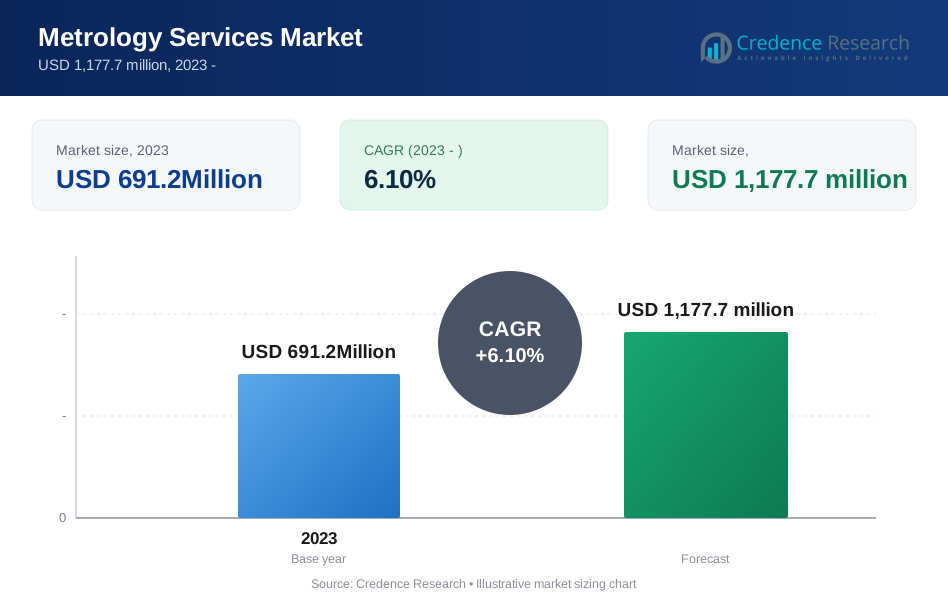
| Metrology Services Market Size 2023 | USD 691.2 Million |
| Metrology Services Market, CAGR | 6.10% |
| Metrology Services Market Size 2032 | USD 1177.7 Million |
Market Insights
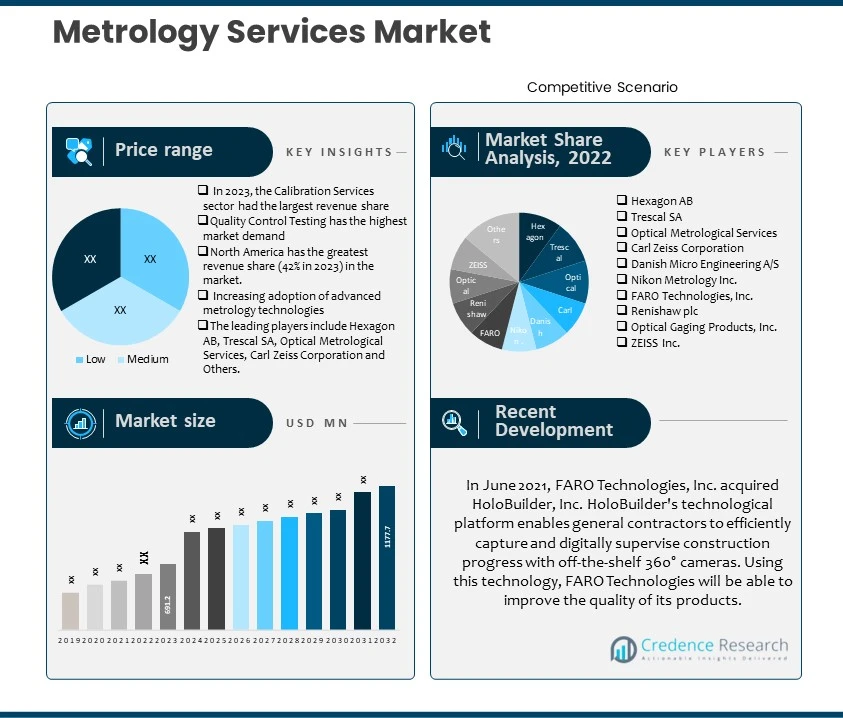
- The global demand for Metrology Services was valued at USD 691.2 million in 2023 and is expected to reach USD 1177.7 million in 2032, growing at a CAGR of 6.10% between 2024 and 2032.
- In 2023, the Calibration Services sector had the biggest revenue share, while the Dimensional Inspection Services segment is predicted to increase at a robust CAGR of 11.7% over the forecast period.
- In 2023, hardware accounted for around 38% of metrology market revenue.
- Automotive is a popular area, and another major stakeholder segment is aerospace.
- Quality Control Testing has the highest market demand.
- The Coordinate Measuring Machine (CMM) segment dominated the market in 2023 and is predicted to be the fastest-growing sector throughout the forecast period (2023-2032). Laser Tracker was another prominent stakeholder category in 2023.
- Third-party metrology Service Providers are typically the most demanding segment.
- ISO 9001 is a key section of the Metrology Services Market, as is ISO/IEC 17025.
- The Metrology Services Market's most popular segment is 3D measuring.
- North America has the largest revenue share (42% in 2023), and Asia-Pacific is predicted to see the quickest growth in the Metrology Services Market.
- Rising demand on global infrastructure is projected to fuel the global metrology services market growth during the forecast period.
- A lack of service providers delivering full metrology services is a barrier to industry expansion.
Executive Summary
Market Definition
The Metrology Services Market refers to the industry that offers measuring and calibration services to a variety of industries, including manufacturing, aerospace, and automotive. Metrology services entail the accurate measuring of physical quantities to ensure accuracy, dependability, and compliance with standards. These services include dimensional measurement, instrument and equipment calibration, inspection, and quality assurance. The demand for accurate measurements and quality control in a variety of industries drives the metrology services industry.
Market Overview
The global Metrology Services Market has witnessed steady growth in recent years and is expected to grow at a CAGR of 6.10% between 2024 and 2032. The market was valued at USD 691.2 million in 2023 and is expected to reach USD 1177.7 million in 2032.
The Metrology Services Market is expanding rapidly across the globe. The market is being pushed by factors such as the rising need for precision and accuracy in manufacturing processes, the need for quality control and assurance, and the growing use of advanced metrology technologies. The market provides a diverse range of services, including dimensional measurement, calibration, inspection, and alignment. Metrology services are used extensively in industries such as automotive, aerospace, electronics, and medical devices to ensure product quality and conformity with industry standards. The market is distinguished by the presence of both global and regional service providers, who supply a wide range of solutions adapted to specific industry needs.
Segmentation by Type of Service
- In 2023, the Calibration Services sector had the largest revenue share. Calibration services involve measuring and adjusting devices, equipment, or systems to meet predefined criteria. This procedure can be used to maintain accuracy and guarantee that equipment works properly.
- The Dimensional Inspection Services segment is expected to grow at a strong CAGR of 11.7% over the forecast period. Dimensional Inspection Services are the process of determining the condition of components, materials, products, or systems. This process often employs visual and electronic inspection techniques to identify defects, deficiencies, or infractions. It also guarantees that the items comply with established national, international, and/or industry-specific standards.
Segmentation by Product Type
- In 2023, hardware accounted for around 38% of the metrology market revenue. This is because it improves precision and accuracy when measuring surface separations and distances ranging from millimeters to kilometers.
Segmentation by End-User
- Automotive is a popular section. Metrology services are used in the automotive sector to determine component size, shape, and alignment during the manufacturing process. These services are critical for maintaining product quality throughout the manufacturing process. Metrology services assist the automotive sector in ensuring process control, traceability, and measurement accuracy for components used in automobile production.
- Another large stakeholder segment is Aerospace. Metrology services are used to measure precise aircraft and spacecraft components. Metrology services play a vital role in the development of innovative aerospace products by optimizing component performance, lowering costs, and enabling the fabrication of extremely precise aerospace products.
Segmentation by Application
- Quality Control Testing has the highest market demand. Metrology service providers offer quality control, which businesses use to define and encourage a high level of accuracy and repeatability while also reducing expenses through cost-effective ways. Measurement and inspection operations are carried out in accordance with certified standards and specifications using precise instruments and specialist software. This entire procedure strengthens the company's ability to provide a dependable product to customers.
Segmentation by Technology
- The Coordinate Measuring Machine (CMM) segment dominated the market in 2023 and is expected to be the fastest-growing sector during the forecast period (2023-2032). Because of the increasing use of complex quality control procedures in the manufacturing and automotive industries, the trend of growing adoption of advanced measurement technology will continue during the forecast period.
- Laser Tracker is another significant shareholder segment in 2023. Laser Tracker Metrology Services provides precise three-dimensional measurements of items. This approach uses laser light and a tracking device to give precise and portable measurements. These services are commonly employed in aerospace and industrial manufacturing, where dimensional accuracy is critical.
Segmentation by Service Provider
- The most demanding segment is frequently the Third-Party Metrology Service Providers. These companies provide specialist metrology services to a variety of industries, including automotive, aerospace, manufacturing, and more. As third-party providers, they meet the needs of a variety of businesses that require exact measures for their products and processes.
Segmentation by Industry Standards
- ISO 9001 is a popular segment of the Metrology Services Market. It is a widely accepted international standard for quality management systems. Many businesses across industries aspire to ISO 9001 accreditation to demonstrate their dedication to quality and client satisfaction.
- ISO/IEC 17025 is another prominent area in the Metrology Services Market. This international standard outlines the general qualifications for testing and calibration laboratories. Many laboratories and testing facilities seek ISO/IEC 17025 certification to demonstrate their technical expertise and capacity to generate accurate and dependable results.
Segmentation by Measurement Type
- The most popular segment in the Metrology Services Market is 3D measurement. With technological breakthroughs and the rising complexity of products and components, the demand for precise and accurate three-dimensional measurements has increased dramatically. 3D measurement provides for a thorough investigation of things, including their shape, size, and surface characteristics.
Segmentation by Region
- North America has the greatest revenue share (42% in 2023) in the market.
- Asia-Pacific is expected to experience the fastest growth in the Metrology Services Market
- The rest of the world, including Latin America, the Middle East, and Africa, supplies the remaining demand for Metrology Services.
North America has the greatest revenue share in 2023. The Metrology Services Market in North America is expanding rapidly due to increased demand for precision measurement and calibration services. This is motivated by the need for precise measurements in the industrial and engineering industries, as well as quality assurance in the medical and pharmaceutical industries. In addition, the number of metrology service providers in the region is increasing, as is the development of new technologies and services. This allows for more accurate and efficient measurements, as well as the capacity to serve a larger number of consumers.
On the other hand, The Metrology Services Market in the Asia Pacific area is rapidly expanding. This is due to the growing need for precision measurement and calibration services in the region. The demand is driven by the requirement for precise measurements in manufacturing and engineering, as well as quality assurance in the medical and pharmaceutical industries. The Asian metrology services market is also expanding due to increased adoption of modern technologies such as 3D printing, robots, and automation.
Key Highlights of the Report
Type of Service, Product Type, Test Type, Application, Method, Service Provider, Industry Standards, Measurement Type, and Region segment of the global Metrology Services Market. In 2023, the Calibration Services sector had the largest revenue share, while Quality Control Testing had the highest market demand. In addition, ISO 9001 is a prominent area, with 3D measurement being the most popular in the Metrology Services Market. Laser Tracker is another important stakeholder segment in 2023, with North America leading the market growth.
The market is being driven by an increasing need for precision and accuracy in manufacturing processes, a growing emphasis on quality control and compliance with industry standards, advances in metrology technology, and the adoption of Industry 4.0 solutions. Furthermore, high initial investment and maintenance costs of metrology equipment, lack of qualified individuals in the field of metrology, and challenges connected with the integration of metrology services into current production processes are the main limitations of the market.
North America will have the highest revenue share in 2023. North America's metrology services market is quickly developing as demand for precise measurement and calibration services rises. On the other hand, the metrology services market in the Asia Pacific region is quickly developing.
What Are The Main Drivers Of The Global Metrology Services Market?
Several major reasons are propelling the metrology services market. There is an increasing requirement for precision and accuracy in manufacturing operations. As companies strive for higher quality and tighter tolerances, the demand for dependable and accurate measurements grows. Additionally, there is an increasing emphasis on quality control and adherence to industry standards. Metrology services are essential for ensuring that items fulfill standards and regulatory requirements.
What Are The Major Challenges Faced By The Global Metrology Services Market?
While the Metrology Services Market offers promise, some limitations must be noted. The high initial and ongoing expenditures of metrology equipment can be prohibitively expensive for some businesses. Acquiring precise instruments, as well as frequent calibration and maintenance, can be costly, particularly for small and medium-sized organizations. Additionally, there is a shortage of skilled metrologists. Operating and interpreting metrology equipment requires specific expertise, making it difficult to recruit skilled workers.
What Are The Growth Opportunities In The Global Metrology Services Market?
The Metrology Services Market also offers various attractive opportunities. Emerging markets with expanding manufacturing sectors provide tremendous growth opportunities. As these markets grow and demand higher-quality products, the demand for metrology services will rise. Furthermore, the introduction of portable and handheld metrology gear opens up new possibilities for on-site measurements. These devices provide flexibility and simplicity by allowing measurements to be obtained directly in the field or at the point of production.
Market Drivers
Several factors drive the global Metrology Services Market. The following are the key drivers of the global Metrology Services Market:
Rising Demand for Worldwide Infrastructure and Resources
According to the United Nations (UN), the global population is predicted to reach 9 billion by 2050, with around 180,000 people added to the urban population each day. According to the same source, more than two billion people will be above the age of sixty. All of this is projected to have a significant impact on food, energy, and other basic requirements. As a result, producers are constantly under pressure to meet increasing demand while maintaining production capacity. Thus, trends such as a rapidly growing and aging population, as well as increased consumerism, are putting a strain on global infrastructure and resources. These challenges must be skillfully managed in order to achieve long-term growth. As a result, these factors are projected to drive the worldwide metrology services market growth over the forecast period.
Market Restraints
The global Metrology Services Market faces some challenges that may hinder its growth. These include the following:
Insufficient Number of Service Providers Offering Comprehensive Metrology Services
The worldwide metrology services market is relatively fragmented due to the huge number of industry competitors. However, only a few metrology service providers offer comprehensive services such as comparing a manufactured part or tool to its CAD model, reverse engineering, 3D modeling, industrial robot calibration, and the integration of metrology systems with manufacturing processes or metrology automation.
Furthermore, a lack of service providers forces buyers of these services to rely on several market actors for a single production process. To address this issue, some market players, particularly in the aerospace and defense industries, prefer to build in-house metrology knowledge, as these industries have little or no tolerance for dimensional error. This reduces market growth during the projection period.
Opportunities
The global Metrology Services Market offers significant growth opportunities. These include the following:
Increasing Adherence to Global Quality Standards
The increasing adherence to global quality standards is the primary factor driving market expansion. To remain competitive and increase profitability, the global manufacturing sector is focusing on reducing the amount of defects. This is feasible by adhering to worldwide quality standards, which aim to measure various metrological characteristics of products after each value-added activity. Quality standards specify the requirements and processes for a measuring system, resulting in fewer defects.
Furthermore, as global quality standards become more widely adopted, manufacturers are measuring every stage of their operations, including those that were previously deemed unnecessary. This is boosting the demand for metrology services. As a result, the worldwide metrology services market is expected to increase significantly throughout the forecast period.
Competitive Landscape
Key Players
The global Metrology Services Market is highly competitive, with several key players. Some of the major players in the market and their market share are as follows:
- Hexagon AB
- Trescal SA
- Optical Metrological Services
- Carl Zeiss Corporation
- Danish Micro Engineering A/S
- Nikon Metrology Inc.
- FARO Technologies, Inc.
- Renishaw plc
- Optical Gaging Products, Inc.
- ZEISS Inc.
These organizations prioritize product innovation, Service Provider expansion, and mergers and acquisitions to stay competitive.
The global Metrology Services Market's key players continually seek to stay ahead by offering new products and developments.
In April 2022, FARO Technologies, Inc., a provider of 4D digital reality solutions, launched a new end-to-end 3D digital reality capture and collaboration platform. This platform analyzes and stores measurement data using cutting-edge technologies such as artificial intelligence and cloud computing.
In May 2021, Nikon Corporation collaborated with their MENA3D. This strategic step will strengthen their sales collaboration and cooperative approach to providing cutting-edge metrology and optical inspection solutions throughout the Middle East and North Africa.
Summary of Key Findings
- The rising adherence to global quality standards is a key driver of market expansion.
- Type of Service, Product Type, End-User, Application, Technology, Service Provider, Industry Standards, Measurement Type, and Region segment of the market.
- The largest market demand is for quality control testing.
- In 2023, hardware was responsible for around 38% of the metrology market revenue.
- North America is leading market growth. The market is highly competitive, with key players including Hexagon AB, Trescal SA, Optical Metrological Services, Carl Zeiss Corporation, Danish Micro Engineering A/S, and Others.
Future Outlook
- Continued growth is driven by demand for precision and accuracy
- Increasing adoption of advanced metrology technologies
- Expansion of the market in various industries
- Emphasis on quality control and compliance
- Rising investment in research and development
How CXOs Can Benefit from the Credence Research Metrology Services Market Report
The Credence Research Metrology Services Market Report provides CXOs with a comprehensive overview of the market, including:
- Market Product Type and growth forecast: The report provides detailed estimates of the global Metrology Services Market Product Type, segmented by Type of Service, Product Type, End-User, Application, Technology, Service Provider, Industry Standards, Measurement Type, and Region. It also includes forecasts for the market through 2032 based on key trends and drivers.
- Market segmentation: The report segments the Metrology Services Market by Type of Service, Type of Service, Product Type, End-User, Application, Technology, Service Provider, Industry Standards, Measurement Type, and Region. This segmentation provides CXOs with a granular understanding of the market and the opportunities in each segment.
- Competitive Landscape: The report profiles the key players in the Metrology Services Market and provides insights into their strategies, product offerings, and financial performance. This information can help CXOs to identify and assess their competition.
- Key trends and drivers: The report identifies and analyzes the key trends and drivers shaping the Metrology Services Market. This information can help CXOs make informed decisions about their investments and strategies.
CXOs can use the insights from the Credence Research Metrology Services Market Report to:
- Identify growth opportunities: The report can help CXOs identify new growth opportunities in the Metrology Services Market. For example, it provides valuable insights and analysis that can assist them in making informed decisions and strategic plans for their businesses.
- Make informed investment decisions: The report can help CXOs to make informed investment decisions about Metrology Services. For example, it analyzes market trends, growth potential, and competitive landscape, allowing CXOs to assess the market's attractiveness and identify investment opportunities.
- Develop competitive strategies: The report can help CXOs develop competitive strategies for their Metrology Services businesses. For example, the report identifies the key strategies that dark fiber providers are using to differentiate themselves from their competitors.
- Track market developments: The report can help CXOs track market developments and stay ahead of the curve. For example, it provides insights into the latest trends and innovations in the Metrology Services Market.
Overall, the Credence Research Metrology Services Market Report is a valuable resource for CXOs who are looking to gain a deeper understanding of the market and identify opportunities for growth.
Segmentation
By Type of Service:- Coordinate Measuring Services (CMM)
- 3D Scanning Services
- Reverse Engineering Services
- Calibration Services
- Dimensional Inspection Services
- Form Measurement Services
- Alignment Services
- Others
- Hardware (Coordinate Measuring Machines, Optical Digitizers and Scanners)
- Software
- Services
- Automotive
- Aerospace
- Manufacturing
- Electronics
- Medical
- Energy and Power
- Construction
- Others
- Quality Control and Inspection
- Reverse Engineering
- Dimensional Analysis
- Alignment
- Material and Component Testing
- Others
- Coordinate Measuring Machines (CMM)
- 3D Scanners
- Laser Trackers
- Optical Digitizers
- Portable Measuring Arms
- X-ray and CT Scanning
- Others
- OEM (Original Equipment Manufacturer) Metrology Service Providers
- Third-Party Metrology Service Providers
- ISO 9001
- ISO/IEC 17025
- ISO 13485
- AS9100
- Others
- 3D Measurement
- 2D Measurement
- 4D Measurement
- North America
- The U.S.
- Canada
- Mexico
- Europe
- Germany
- France
- The U.K.
- Italy
- Spain
- Rest of Europe
- Asia Pacific
- China
- Japan
- India
- South Korea
- South-east Asia
- Rest of Asia Pacific
- Latin America
- Brazil
- Argentina
- Rest of Latin America
- Middle East & Africa
- GCC Countries
- South Africa
- Rest of the Middle East and Africa
Request a Free Sample
Fill in your details and we'll send you a free sample report.
- Sample data tables & charts
- Research methodology
Market Dynamics
Increasing Need for Precision and Accuracy in Manufacturing
As industries such as automotive, aerospace, and electronics demand tighter tolerances and higher product quality, the need for precise and accurate measurement services is driving the adoption of advanced metrology solutions.
Growing Emphasis on Quality Control and Compliance
Stricter regulatory requirements and the widespread adoption of international standards like ISO 9001 and ISO/IEC 17025 are compelling manufacturers to utilize metrology services to ensure compliance and reduce defects.
Advancements in Metrology Technology
The integration of technologies such as 3D measurement, laser tracking, and automated CMMs is enabling faster, more accurate, and more flexible measurement solutions, expanding the scope and efficiency of metrology services.
Expansion of Manufacturing in Emerging Markets
Rapid industrialization and the growth of manufacturing sectors in Asia Pacific and other emerging regions are increasing the demand for metrology services to support quality assurance and process optimization.
Need a Custom Version of This Report?
Tailor the scope, geography, or segments to your exact requirements.
- Custom geography or segment scope
- Direct access to our analyst team
Frequently Asked Questions
What is the current Product Type of the global Metrology Services Market?
What is the expected growth rate of the Metrology Services Market between 2024 and 2032?
Which segment is leading the market share in terms of Technology?
Which Type of Service segment is expected to post the highest CAGR during the forecast period?
Who are the major players in the global Metrology Services Market?
Table of Content
Chapter 1 Market Segmentation
- 1.1 Segmentation Framework
- 1.1.1 Product and Service Classification
- 1.1.2 Application and End-Use Classification
- 1.1.3 Technology and Solution Classification
- 1.1.4 Customer and Distribution Channel Classification
- 1.1.5 Geographic Segmentation
- 1.1.6 Market Segment Definitions and Boundaries
- 1.2 By End-User
- 1.2.1 Automotive
- 1.2.2 Aerospace
- 1.2.3 Manufacturing
- 1.2.4 Electronics
- 1.2.5 Medical
- 1.3 By Technology
- 1.3.1 Coordinate Measuring Machines (CMM)
- 1.3.2 Laser Trackers
- 1.3.3 3D Scanners
- 1.3.4 Optical Digitizers
- 1.4 By Type of Service
- 1.4.1 Calibration Services
- 1.4.2 Dimensional Inspection Services
- 1.4.3 Coordinate Measuring Services (CMM)
- 1.4.4 3D Scanning Services
- 1.4.5 Reverse Engineering Services
Chapter 2 Introduction
- 2.1 Report Objectives and Scope
- 2.2 Product Definition and Industry Terminology
- 2.3 Market Inclusions and Exclusions
- 2.4 Research Process
- 2.4.1 Primary Research and Expert Interviews
- 2.4.2 Secondary Research and Source Review
- 2.4.3 Top-Down and Bottom-Up Estimation
- 2.4.4 Data Triangulation and Verification
- 2.5 Market Size Measurement Basis
- 2.5.1 2023: USD 691.2Million → 2032: USD 1,177.7 million
- 2.6 Historical and Forecast Reference Periods
- 2.6.1 Base Year: 2023
- 2.6.2 Forecast Period: 2023-2032
- 2.7 Research Assumptions and Limitations
Chapter 3 Executive Summary
- 3.1 Market Snapshot and Key Findings
- 3.2 Base-Year Market Size, 2023
- 3.3 Forecast Market Size, 2032
- 3.4 Revenue and Volume Growth Outlook
- 3.5 Key Demand and Supply Indicators
- 3.6 Leading Market Segments
- 3.7 Fastest-Growing Market Opportunities
- 3.8 Regional Performance Highlights
- 3.9 Technology and Industry Transformation
- 3.10 Competitive Landscape Summary
- 3.11 Analyst View and Strategic Implications
Chapter 4 Global Metrology Services Market Trends and Developments
- 4.1 Historical Industry Development
- 4.2 Recent Market Trends and Developments
- 4.3 Demand and Customer Behavior Trends
- 4.4 Technology and Product Innovation
- 4.5 Artificial Intelligence, Automation and Digitalization
- 4.6 Local Manufacturing and Supply Chain Realignment
- 4.7 Industry Partnerships, Mergers and Acquisitions
- 4.8 Sustainability and Circular Economy Developments
- 4.9 Government and Private Sector Investment Trends
- 4.10 Emerging Business Models and Commercialization
- 4.11 Industry Developments and Announcements
Chapter 5 Global Metrology Services Market Supply and Demand Analysis
- 5.1 Demand Trend and Consumption Analysis
- 5.2 Demand Forecast, 2023-2032
- 5.3 Supply Chain Structure and Procurement Trends
- 5.4 Supply-Demand Gap and Bottlenecks
- 5.5 Import Dependence and Sourcing Structure
- 5.6 Regional Supply and Demand Concentration
Chapter 6 Global Metrology Services Market Pricing Analysis
- 6.1 Pricing Structure and Measurement
- 6.2 Historical Pricing Trends
- 6.3 Pricing Outlook, 2023-2032
- 6.4 Pricing by Product and Market Segment
- 6.5 Geographic Pricing Differences
- 6.6 Key Input, Energy, Labor and Logistics Costs
- 6.7 Contract Pricing and Purchasing Models
- 6.8 Pricing Sensitivity and Competitive Positioning
- 6.9 Price, Margin and Profitability Implications
Chapter 7 Global Metrology Services Market Dynamics
- 7.1 Market Growth Drivers
- 7.1.1 Demand-Side Drivers
- 7.1.2 Technology and Innovation Drivers
- 7.1.3 Infrastructure and Investment Drivers
- 7.1.4 Regulatory and Policy Drivers
- 7.2 Market Restraints
- 7.2.1 Cost and Affordability Constraints
- 7.2.2 Technology and Adoption Barriers
- 7.2.3 Supply Chain and Operational Constraints
- 7.3 Market Challenges
- 7.3.1 Competitive Pressure and Margin Erosion
- 7.3.2 Skills, Infrastructure and Implementation Gaps
- 7.4 Emerging Market Opportunities
- 7.5 Market Dynamics Impact and Time-Horizon Assessment
Chapter 8 Global Metrology Services Value Chain Analysis
- 8.1 Industry Value Chain Overview
- 8.2 Upstream Suppliers and Critical Inputs
- 8.3 Technology and Component Providers
- 8.4 Manufacturing or Service Delivery
- 8.5 Distribution, Channel Partners and Integrators
- 8.6 Downstream Applications and End Users
- 8.7 Value Addition and Profit Pools
- 8.8 Vertical Integration and Outsourcing
- 8.9 Supplier Concentration and Risk
- 8.10 Supply Chain Localization and Resilience
Chapter 9 Global Metrology Services Market Regulations and Policies
- 9.1 Relevant Laws, Standards and Compliance Frameworks
- 9.2 Product, Service, Safety and Quality Requirements
- 9.3 Government Policies, Incentives and Subsidies
- 9.4 Imports, Exports and Trade Barriers
- 9.5 Public Procurement and Local Content Requirements
- 9.6 Data Protection, AI and Cybersecurity Compliance
- 9.7 Upcoming Policy Changes and Market Implications
Chapter 10 Global Metrology Services Market Hotspots and Opportunities
- 10.1 Market Opportunity Mapping and Growth Hotspots
- 10.2 High-Growth Applications and Customer Groups
- 10.3 Underserved Markets and White-Space Opportunities
- 10.4 Emerging Technology and Product Opportunities
- 10.5 New Capacity and Investment Hotspots
- 10.6 Market Entry and Expansion Opportunities
- 10.7 Distribution and Partnership Opportunities
- 10.8 Near-Term and Long-Term Commercial Potential
- 10.9 Opportunity Attractiveness and Execution Risks
Chapter 11 Global Metrology Services Market Outlook, 2023-2032
- 11.1 Market Size and Analysis
- 11.1.1 Revenue (Market Measurement: 2023: USD 691.2Million → 2032: USD 1,177.7 million)
- 11.1.2 Historical Market Size
- 11.1.3 Base-Year Market Size, 2023
- 11.2 Market Forecast, 2023-2032
- 11.2.1 Revenue Forecast to 2032
- 11.2.2 CAGR and Year-on-Year Growth
- 11.2.3 Incremental Revenue Opportunity
- 11.3 Forecast Assumptions and Scenario Analysis
- 11.3.1 Base-Case Forecast
- 11.3.2 Optimistic and Conservative Scenarios
- 11.3.3 Technology, Pricing and Policy Sensitivities
- 11.4 Market Attractiveness and Growth Outlook
Chapter 12 Global Metrology Services Market Segmentation and Outlook
- 12.1 Segmentation Summary and Market Shares, 2023
- 12.2 Largest and Fastest-Growing Segments
- 12.3 By End-User - Market Size and Forecast, 2023-2032
- 12.3.1 Segment Definition and Scope
- 12.3.2 Historical Market Size
- 12.3.3 Revenue Forecast, 2023-2032
- 12.3.4 Base-Year Market Share, 2023
- 12.3.5 Segment CAGR and Growth Drivers
- 12.3.6 Subsegment Market Size and Forecast
- 12.3.6.1 Automotive
- 12.3.6.2 Aerospace
- 12.3.6.3 Manufacturing
- 12.3.6.4 Electronics
- 12.3.6.5 Medical
- 12.3.7 Subsegment Pricing and Adoption Trends
- 12.3.8 Leading Suppliers and Competition
- 12.3.9 Regional Demand and Opportunities
- 12.4 By Technology - Market Size and Forecast, 2023-2032
- 12.4.1 Segment Definition and Scope
- 12.4.2 Historical Market Size
- 12.4.3 Revenue Forecast, 2023-2032
- 12.4.4 Base-Year Market Share, 2023
- 12.4.5 Segment CAGR and Growth Drivers
- 12.4.6 Subsegment Market Size and Forecast
- 12.4.6.1 Coordinate Measuring Machines (CMM)
- 12.4.6.2 Laser Trackers
- 12.4.6.3 3D Scanners
- 12.4.6.4 Optical Digitizers
- 12.4.7 Subsegment Pricing and Adoption Trends
- 12.4.8 Leading Suppliers and Competition
- 12.4.9 Regional Demand and Opportunities
- 12.5 By Type of Service - Market Size and Forecast, 2023-2032
- 12.5.1 Segment Definition and Scope
- 12.5.2 Historical Market Size
- 12.5.3 Revenue Forecast, 2023-2032
- 12.5.4 Base-Year Market Share, 2023
- 12.5.5 Segment CAGR and Growth Drivers
- 12.5.6 Subsegment Market Size and Forecast
- 12.5.6.1 Calibration Services
- 12.5.6.2 Dimensional Inspection Services
- 12.5.6.3 Coordinate Measuring Services (CMM)
- 12.5.6.4 3D Scanning Services
- 12.5.6.5 Reverse Engineering Services
- 12.5.7 Subsegment Pricing and Adoption Trends
- 12.5.8 Leading Suppliers and Competition
- 12.5.9 Regional Demand and Opportunities
- 12.6 Segment Growth Comparison
- 12.7 Segment Attractiveness and Priority Matrix
Chapter 13 Global Metrology Services End-Use and Application Market Outlook
- 13.1 End-Use Industry and Customer Demand Structure
- 13.2 Leading Applications and Customer Groups
- 13.3 End-Use Market Size, Share and Forecast
- 13.4 Major End-Use Industry Deep Dives
- 13.4.1 Customer Requirements and Use Cases
- 13.4.2 Demand and Replacement Cycles
- 13.4.3 Technical and Regulatory Considerations
- 13.4.4 Purchasing and Procurement Models
- 13.4.5 Leading Vendors and Distribution Channels
- 13.4.6 Forecast and Commercial Opportunities
- 13.5 Emerging Applications and Cross-Segment Demand
- 13.6 End-Use Industry Investment Priorities
Chapter 14 Global Metrology Services Geographic Market Outlook, 2023-2032
- 14.1 Regional Market Size and Share, 2023
- 14.2 Regional Market Forecast, 2023-2032
- 14.3 Regional Pricing, Production and Demand Differences
- 14.4 North America
- 14.4.1 United States
- 14.4.2 Canada
- 14.4.3 Mexico
- 14.5 Europe
- 14.5.1 Germany
- 14.5.2 France
- 14.5.3 Italy
- 14.5.4 United Kingdom
- 14.5.5 Spain
- 14.5.6 Poland
- 14.5.7 Russia
- 14.5.8 Netherlands
- 14.5.9 Belgium
- 14.5.10 Sweden
- 14.5.11 Denmark
- 14.5.12 Norway
- 14.5.13 Rest of Europe
- 14.6 Asia Pacific
- 14.6.1 China
- 14.6.2 India
- 14.6.3 Japan
- 14.6.4 South Korea
- 14.6.5 Thailand
- 14.6.6 Indonesia
- 14.6.7 Vietnam
- 14.6.8 Malaysia
- 14.6.9 Australia
- 14.6.10 Rest of Asia Pacific
- 14.7 Latin America
- 14.7.1 Brazil
- 14.7.2 Argentina
- 14.7.3 Colombia
- 14.7.4 Chile
- 14.7.5 Rest of Latin America
- 14.8 Middle East
- 14.8.1 Saudi Arabia
- 14.8.2 United Arab Emirates
- 14.8.3 Turkey
- 14.8.4 Israel
- 14.8.5 Iran
- 14.8.6 Rest of the Middle East
- 14.9 Africa
- 14.9.1 South Africa
- 14.9.2 Egypt
- 14.9.3 Nigeria
- 14.9.4 Morocco
- 14.9.5 Rest of Africa
- 14.10 Regional Investment, Policy and Supply Chain Differences
- 14.11 Regional Competitive Landscape
- 14.12 Geographic Growth Hotspots
Chapter 15 Global Metrology Services Technology, Innovation and Sustainability Outlook
- 15.1 Technology Landscape and Maturity
- 15.2 Product, Process and Service Innovation
- 15.3 AI, Automation and Digital Tools in the Industry
- 15.4 Technology Adoption and Performance Benchmarking
- 15.5 Innovation Pipeline and R&D Investment
- 15.6 Energy Efficiency and Resource Management
- 15.7 Sustainability, Recycling and Circularity
- 15.8 Technology Roadmap, 2023-2032
- 15.9 Risks of Obsolescence and Technology Substitution
Chapter 16 Global Metrology Services Market Key Strategic Imperatives
- 16.1 Growth and Market Entry Priorities
- 16.2 High-Return Products and Segments
- 16.3 Pricing, Profitability and Cost Optimization
- 16.4 Technology Investment and Product Differentiation
- 16.5 Supply Chain Localization and Resilience
- 16.6 Distribution and Customer Acquisition
- 16.7 Partnership, Acquisition and Capacity Strategy
- 16.8 Regional Expansion Priorities
- 16.9 Short-, Medium- and Long-Term Actions
Chapter 17 Competition Outlook
- 17.1 Industry Competition Characteristics
- 17.2 Market Structure and Concentration
- 17.3 Market Share and Competitive Positioning, 2023
- 17.4 Company-Wise Revenue and Product Benchmarking
- 17.5 Production and Service Capacity Benchmarking
- 17.6 Technology, Pricing and Differentiation
- 17.7 Regional Footprint and Distribution Strength
- 17.8 Mergers, Acquisitions and Strategic Alliances
- 17.9 New Entrants and Competitive Threats
- 17.10 Porter's Five Forces and Industry Attractiveness
- 17.11 Competitive Outlook, 2023-2032
Chapter 18 Company Profiles
- 18.1 Company Coverage and Selection Criteria
- 18.2 Hexagon AB
- 18.2.1 Business Description
- 18.2.2 Company Ownership and Geographic Presence
- 18.2.3 Product and Service Portfolio
- 18.2.4 Manufacturing and Operating Footprint
- 18.2.5 Financial Performance and Investment
- 18.2.6 Market Share and Competitive Position
- 18.2.7 Technology and Innovation Capabilities
- 18.2.8 Strategic Alliances or Partnerships
- 18.2.9 Recent Developments
- 18.2.10 Growth Strategy and Outlook
- 18.3 Trescal SA
- 18.4 Carl Zeiss Corporation
- 18.5 Nikon Metrology Inc.
- 18.6 FARO Technologies, Inc.
- 18.7 Renishaw plc
- 18.8 Optical Gaging Products, Inc.
- 18.9 ZEISS Inc.
- 18.10 Danish Micro Engineering A/S
- 18.11 Optical Metrological Services
- 18.12 Other Relevant Market Participants
Note: Every listed company is profiled on the structure shown under the first company. The company list is preliminary and may change based on research findings, market developments, data availability and client requirements.
Chapter 19 Disclaimer
- 19.1 Research and Forecast Disclaimer
- 19.2 Data Source and Estimation Limitations
Note: The depth of individual sections depends on data availability for this market. Volume, capacity, trade and other unit-based metrics are included where applicable.

