
| REPORT ATTRIBUTE | DETAILS |
|---|---|
| Historical Period | 2019-2022 |
| Base Year | 2023 |
| Forecast Period | 2024-2032 |
| Rapid Microbiology Tests in Food and Beverages Market Size 2023 | USD 700.8 Million |
| Rapid Microbiology Tests in Food and Beverages Market, CAGR | 9.60% |
| Rapid Microbiology Tests in Food and Beverages Market Size 2032 | USD 1599.1 Million |
Market Insights
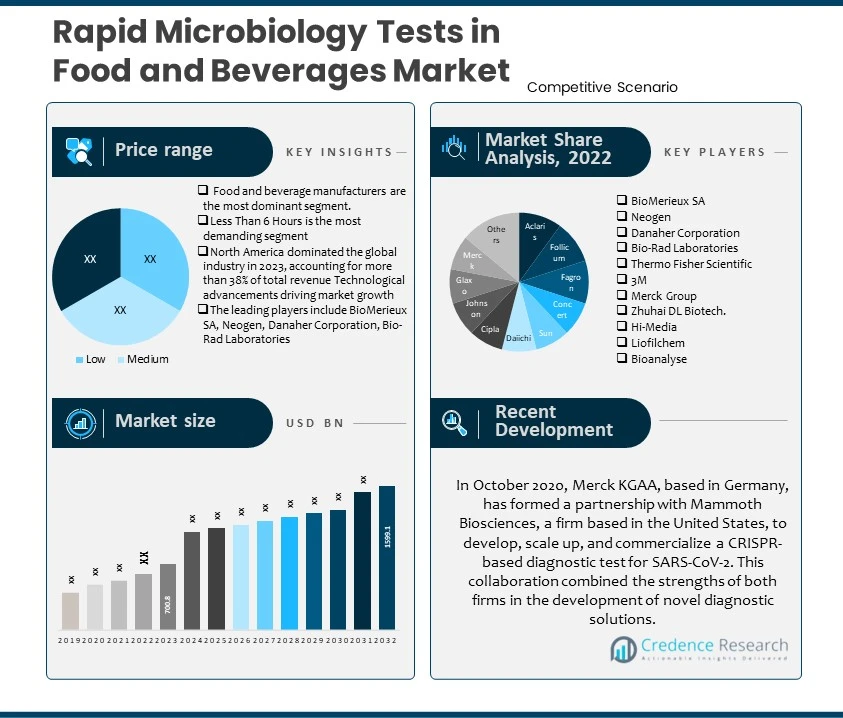
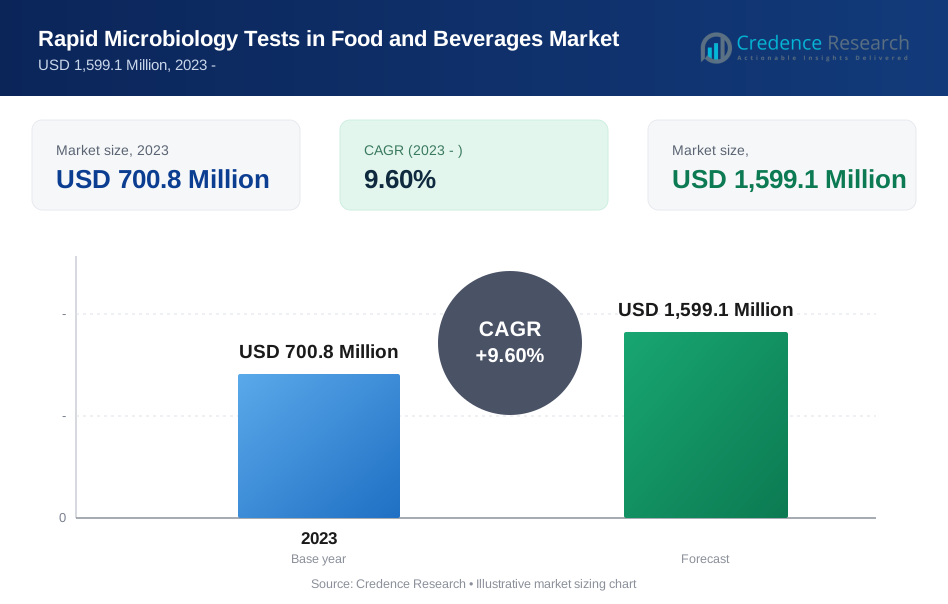
- The global demand for Rapid Microbiology Tests in Food and Beverages was valued at USD 700.8 Million in 2023 and is expected to reach USD 1599.1 Million in 2032, growing at a CAGR of 9.60% between 2024 and 2032.
- Pathogen detection is the fastest-growing segment of the Rapid Microbiology Tests for the Food and Beverage Market.
- PCR-Based Methods is the most hard section, and Immunological Methods is another important business sector.
- In 2023, the Instruments sector had a revenue share of 43%, and the consumables segment is predicted to increase at a robust CAGR of 11.7% throughout the projection period.
- Dairy products are the most prominent market category, while meat and poultry are another important shareholder group in the industry.
- Food and beverage manufacturers are the most dominating category and Contract testing laboratories are the market's second-largest segment
- Molecular-based Methods is the most popular component of the Rapid Microbiology Tests in Food and Beverages Market.
- Less than 6 hours is the most demanding segment, with 6-10 hours accounting for a sizable market share.
- North America dominated the global industry in 2023, accounting for more than 38% of total revenue, while Asia Pacific is projected to have the fastest CAGR throughout the forecast period.
- Consumers need safety, which promotes market growth.
- Validation and standardization impede market growth.
Executive Summary
Market Definition
Rapid microbiology tests in the food and beverage industry are quick and effective procedures for detecting hazardous microbes in food and drinks. These tests are essential for assuring food safety and product quality. These tests identify potential contamination issues quickly, enabling for timely intervention and prevention of foodborne infections. They are intended to be fast, accurate, and dependable, allowing food manufacturers and regulatory authorities to maintain high hygiene requirements while delivering safe products to consumers.
Market Overview
The global Rapid Microbiology Tests in Food and Beverages Market has witnessed steady growth in recent years and is expected to grow at a CAGR of 9.60% between 2024 and 2032. The market was valued at USD 700.8 million in 2023 and is expected to reach USD 1599.1 million in 2032.
The market for rapid microbiological tests in the food and beverage industry is rapidly expanding. These tests are becoming more crucial in maintaining food safety and quality. With growing worries about foodborne illnesses and the necessity for prompt and precise detection of hazardous microbes, the demand for rapid microbiology tests is increasing. Key market competitors are always innovating to produce better testing methods that deliver faster results while maintaining accuracy. This industry is likely to grow further as food manufacturers and regulatory authorities prioritize the installation of effective microbiological testing techniques.
Segmentation by Test Type
- Pathogen Detection is the fastest growing segment in the Rapid Microbiology Tests for Food and Beverage Market. Pathogens are hazardous bacteria that can cause foodborne illnesses, thus their detection is critical for guaranteeing food safety. With rising consumer awareness and severe regulations, there is a growing demand for fast and accurate pathogen detection technologies in the food and beverage business.
Segmentation by Technology
- PCR-Based Methods is the most challenging section. Polymerase Chain Reaction (PCR) is a commonly used technique for amplification and detection of specific DNA or RNA sequences, including those from infections and spoilage organisms. PCR-based technologies are highly valued in the industry due to their excellent sensitivity, specificity, and speed of results.
- Immunological Methods is another key market sector that comprises techniques such as Enzyme-Linked Immunosorbent Assay (ELISA) and Lateral Flow Immunoassay.
Segmentation by Product Type
- In 2023, the Instruments sector had a revenue share of 43%. The Instruments segment dominates the quick microbiological testing market because of its critical role in supporting accurate and efficient testing operations.
- The consumables segment is expected to grow at a strong CAGR of 11.7% over the forecast period. Owing to its frequent use and requirement in testing procedures, the consumables sector has a considerable proportion of the quick microbiological testing market.
Segmentation by Food Type
- Dairy Products is the most prominent market category for Rapid Microbiology Tests in Food and Beverages. Dairy products go through several processing phases and have strict microbiological criteria to assure their safety and quality. As a result, fast microbiology tests are commonly utilized in this segment to identify pathogens, spoilage organisms, and indicator microbes.
- Meat and poultry are another key shareholder segment in the market.
Segmentation by End-User
- Food and beverage manufacturers are the most dominant segment. These manufacturers produce a wide range of food and beverage goods, and they have a high demand for quick microbiological tests to verify product safety and quality. These tests allow them to detect and monitor infections, spoilage organisms, and other microbiological markers.
- Contract testing laboratories are the market's second largest segment. These laboratories specialize in offering testing services to food and beverage industries, assisting them in meeting regulatory standards and ensuring product safety. Contract testing laboratories play an important role in the industry, providing knowledge and resources for quick microbial testing.
Segmentation by Method
- The most popular section in the Rapid Microbiology Tests in Food and Beverages Market is Molecular-based Methods. Polymerase Chain Reaction (PCR) and Next-Generation Sequencing (NGS) are two modern molecular techniques used to detect and identify specific DNA or RNA sequences from diseases or indicator species.
- On the other hand, Conventional Methods refer to standard microbiological procedures like culture, biochemical testing, and microscopy.
Segmentation by Detection Time
- Less Than 6 Hours is the most demanding segment. This part relates to quick microbiological tests that produce findings in less than 6 hours. Food and beverage makers highly seek these tests because they enable the rapid identification of infections and other microbiological indications, allowing for speedier decision-making and ensuring product safety.
- The 6-10 Hours sector also accounts for a large market share.
Segmentation by Region
- North America dominated the global industry in 2023, accounting for more than 38% of total revenue
- Asia Pacific is predicted to have the quickest CAGR throughout the forecast period.
- The rest of the world, including Latin America, the Middle East, and Africa, supplies the remaining demand for Rapid Microbiology Tests in Food and Beverages.
North America has the greatest revenue share. North America dominates the quick microbiological testing market due to a variety of factors. The region's excellent healthcare infrastructure, tight regulatory environment, and strong emphasis on food safety all contribute to increased need for quick microbiology testing. Furthermore, the presence of major pharmaceutical and biotechnology businesses, together with significant R&D activity, encourages innovation in testing technologies.
Furthermore, the region's response to new healthcare concerns, like as the COVID-19 pandemic, has sped up the adoption of quick testing technologies. These features, together with a well-established market ecology, establish North America as a prominent participant in the quick microbiological testing industry.
Asia-Pacific is expected to experience the fastest growth. The Asia-Pacific region is experiencing considerable expansion in the quick microbiological testing market due to a variety of factors. First, the region's large population and increasing urbanization have boosted demand for food safety and healthcare, prompting the use of rapid microbial testing procedures in these industries. Second, the growing pharmaceutical and biotechnology sectors in China and India necessitate strong microbiological quality control, which drives the market even higher. Finally, government actions that promote technology developments and healthcare infrastructure development help the region maintain its market supremacy. These factors combine to position Asia-Pacific as a significant growth leader in the quick microbiological testing market.
Key Highlights of the Report
Test Type, Technology, Product Type, Food Type, Type, Method, and region segment of the global Rapid Microbiology Tests in Food and Beverages Market. In 2023, the Instruments sector had a revenue share of 43%, with PCR-Based Methods being the most difficult segment. Also, food and beverage makers are the most dominating segment, while Less Than 6 Hours is the most demanding segment. In addition, pathogen detection is the fastest expanding area, with North America leading the market growth.
The market's primary drivers include rising consumer demand for safe and high-quality food items, strict government regulations and food safety standards, and technological improvements. Furthermore, high initial investment and operating expenses associated with quick microbiological testing, limited availability of experienced staff, and challenges in harmonizing testing methodologies across diverse food and beverage items are the main limitations of the market.
Nonetheless, North America has the highest revenue share. North America dominates the fast microbiological testing industry for a variety of reasons. Furthermore, Asia-Pacific is likely to see the most rapid increase. The Asia-Pacific region is experiencing significant increase in the rapid microbiological testing market due to a multitude of factors.
What Are The Main Drivers Of The Global Rapid Microbiology Tests in Food and Beverages Market?
Several factors fuel the demand for quick microbiology tests in the food and beverage industry. Consumers are increasingly demanding safe, high-quality food products. With increased knowledge of foodborne illnesses, consumers are becoming more aware of the importance of rigorous testing to assure the safety of the food they consume. Furthermore, severe government laws and food safety requirements contribute significantly to the use of fast microbiological tests. These regulations compel food makers to employ stringent testing processes in order to maintain compliance and preserve consumer safety.
What Are The Major Challenges Faced By The Global Rapid Microbiology Tests in the Food and Beverages Market?
While numerous drivers are fueling the growth of rapid microbiology tests, there are also some restraints to consider. One major restraint is the high initial investment and operating costs associated with implementing rapid microbiology testing. The equipment, reagents, and skilled personnel required for these tests can be costly, especially for smaller food and beverage companies. Additionally, there is a limited availability of skilled personnel who can perform and interpret test results accurately. This shortage of qualified professionals can pose challenges in implementing and maintaining effective testing procedures.
What Are The Growth Opportunities In The Global Rapid Microbiology Tests in the Food and Beverages Market?
Despite the challenges, there are significant opportunities for rapid microbiology tests in the food and beverage industry. One possibility is the increasing market potential in emerging markets. These regions are placing a greater emphasis on food safety and are required to implement swift testing methods to assure the quality and safety of their food supply. Another opportunity is the creation of portable and user-friendly testing instruments for on-site use. These devices would allow for quick and convenient testing in a variety of locations, including farms, food processing facilities, and restaurants.
Market Drivers
Several factors drive the global Rapid Microbiology Tests in Food and Beverages Market. The following are the key drivers of the global Rapid Microbiology Tests in Food and Beverages Market:
Consumers Demand Safety
The growing customer concern about safety is a driving force behind the growth of the quick microbiological testing market. Modern customers are acutely aware of the safety and quality of the things they eat, which include pharmaceuticals, meals, beverages, and healthcare services. This increased consciousness leads to a greater demand for uncompromising safety standards.
The importance of quick microbiological testing in achieving customer expectations cannot be emphasized. Consumers increasingly expect the things they use to be free of harmful bacteria and diseases, and they choose goods that have undergone extensive testing to ensure their safety. As a result, industries such as food and beverage and pharmaceuticals are increasingly adopting rapid microbiology testing methods to meet these stringent demands.
Furthermore, in today's age of immediate communication and social media, knowledge of safety violations or contamination can spread quickly, inflicting significant damage to company reputation and financial losses. Rapid microbiological testing enables businesses to proactively monitor and ensure product safety, increasing consumer confidence and loyalty. As a result, the market for rapid microbiology testing is thriving as businesses recognize the importance of complying with consumer safety preferences and regulatory requirements.
Market Restraints
The global Rapid Microbiology Tests in Food and Beverages Market faces some challenges that may hinder its growth. These include the following:
Validation and Standardization
Validation and standardization are important impediments to the growth of the quick microbiological testing industry. Validation is a vital step in demonstrating that a testing procedure consistently generates trustworthy and accurate outcomes. Validation of rapid microbiology testing methods can be time-consuming, resource-intensive, and complex. This barrier frequently discourages companies from implementing these novel ideas, particularly in highly regulated industries such as pharmaceuticals and healthcare. Standardization presents an equal challenge. Establishing generally accepted techniques and standards for quick microbiological testing is a continuous process that requires collaboration between industry players and regulatory organizations.
The lack of established methodologies can lead to confusion and variability in outcomes, limiting widespread adoption. Furthermore, regulatory compliance relies on validation and standardization. Companies must adapt their testing techniques to changing regulatory requirements, which adds another degree of complexity and uncertainty. In conclusion, a lack of efficient validation and standardization processes can discourage firms from using quick microbiological testing, restricting its growth potential and impeding its widespread adoption in important areas where safety and quality are paramount.
Opportunities
The global Rapid Microbiology Tests in Food and Beverages Market offers significant growth opportunities. These include the following:
Pharmaceutical Manufacturing
Pharmaceutical manufacturing creates enormous prospects in the quick microbiological testing sector. Rapid microbiological testing is an essential component of pharmaceutical manufacture due to severe regulatory regulations and the critical necessity for consistent product quality. Opportunities abound in the development of advanced and customized quick testing solutions adapted to the pharmaceutical industry's specific requirements, such as real-time monitoring of aseptic operations, microbiological contamination management, and sterility testing.
Furthermore, as pharmaceutical businesses work to speed up product development and time-to-market, quick microbiology testing procedures help improve quality assurance operations, lowering production delays and costs. Collaborations between technology providers and pharmaceutical producers are driving innovation in this field, resulting in the development of increasingly complex and automated testing platforms. As the pharmaceutical sector grows internationally, the demand for robust and effective quick microbiological testing solutions is expected to rise, providing numerous opportunity for market players to fulfill these changing requirements.
Competitive Landscape
Key Players
The global Rapid Microbiology Tests in Food and Beverages Market is highly competitive, with several key players. Some of the major players in the market and their market share are as follows:
- BioMerieux SA
- Neogen
- Danaher Corporation
- Bio-Rad Laboratories
- Thermo Fisher Scientific
- 3M
- Merck Group
- Zhuhai DL Biotech.
- Hi-Media
- Liofilchem
- Bioanalyse
These organizations prioritize product innovation, Product Type expansion, and mergers and acquisitions to stay competitive.
The global Rapid Microbiology Tests in Food and Beverages Market's key players continually seek to stay ahead by offering new products and developments.
In November 2022, IDEXX made a strategic move by acquiring Tecta-PDS, a cutting-edge Canadian business known for automating water microbiology testing processes, notably for evaluating factors such as E. coli and total coliforms. This acquisition greatly expanded IDEXX's line of water microbiological testing solutions, which cater to both laboratory and in-field applications.
In November 2022, Archer Daniels Midland (ADM) enhanced its microbiological capabilities by establishing a new laboratory at its ADM Specialty Manufacturing site in Decatur, Illinois. This extension project increased the size of the microbiology laboratory while also improving its testing capabilities, demonstrating ADM's commitment to sophisticated microbiological analysis.
Summary of Key Findings
- Pharmaceutical manufacturing represents a commercial opportunity.
- Market segmented by Test Type, Technology, Product Type, Food Type, Type, Method, Detection Time and region.
- Food and beverage makers are the most dominating segment, with contract testing laboratories coming in second.
- Dairy Products is the most important market category
- North America is leading market growth; the market is highly competitive with key players including BioMerieux SA, Neogen, Danaher Corporation, Bio-Rad Laboratories and Others.
Future Outlook
- Increasing adoption of rapid microbiology tests
- Technological advancements driving market growth
- Growing awareness about food safety
- Stringent regulations promoting the use of rapid tests
- Expansion of the food and beverages industry
- Rising demand for convenient and fast testing methods
- Emergence of innovative testing solutions
How CXOs Can Benefit from the Credence Research Rapid Microbiology Tests in Food and Beverages Market Report
The Credence Research Rapid Microbiology Tests in Food and Beverages Market Report provides CXOs with a comprehensive overview of the market, including:
- Market size and growth forecast: The report provides detailed estimates of the global Rapid Microbiology Tests in Food and Beverages Market size, segmented by Test Type, Technology, Product Type, Food Type, Type, Method, Detection Time and region. It also includes forecasts for the market through 2032 based on key trends and drivers.
- Market segmentation: The report segments the Rapid Microbiology Tests in the Food and Beverages Market by Test Type, Technology, Product Type, Food Type, Type, Method, Detection Time, and Region. This segmentation provides CXOs with a granular understanding of the market and the opportunities in each segment.
- Competitive Landscape: The report profiles the key players in the Rapid Microbiology Tests in Food and Beverages Market and provides insights into their strategies, product offerings, and financial performance. This information can help CXOs to identify and assess their competition.
- Key trends and drivers: The report identifies and analyzes the key trends and drivers that are shaping the Rapid Microbiology Tests in Food and Beverages Market. This information can help CXOs to make informed decisions about their investments and strategies.
CXOs can use the insights from the Credence Research Rapid Microbiology Tests in Food and Beverages Market Report to:
- Identify growth opportunities: The report can help CXOs identify new growth opportunities in the Rapid Microbiology Tests in the Food and beverage market. For example, it can provide insights into emerging trends and technologies. It may highlight the increasing demand for rapid testing solutions driven by stricter regulations and consumer demand for safe and high-quality food and beverages.
- Make informed investment decisions: The report can help CXOs to make informed investment decisions about Rapid Microbiology Tests in Food and Beverages. For example, the report can provide CXOs with valuable insights and market analysis to make informed investment decisions in the Rapid Microbiology Tests in Food and Beverages sector. It may highlight the market potential, growth projections, and key players in the industry.
- Develop competitive strategies: The report can help CXOs to develop competitive strategies for their Rapid Microbiology Tests in Food and Beverages businesses. For example, the report identifies the key strategies that dark fiber providers are using to differentiate themselves from their competitors.
- Track market developments: The report can help CXOs to track market developments and stay ahead of the curve. For example, the report provides insights into the latest trends and innovations in the Rapid Microbiology Tests in Food and Beverages Market.
Overall, the Credence Research Breast Cancer .Treatment Market Report is a valuable resource for CXOs who are looking to gain a deeper understanding of the market and identify opportunities for growth.
Segmentation
By Test Type:- Pathogen Detection
- Spoilage Organism Detection
- Indicator Microorganisms Detection
- PCR-Based Methods
- Immunological Methods (Enzyme-Linked Immunosorbent Assay - ELISA, Lateral Flow Immunoassay)
- Genetic Methods
- Biosensors
- Others
- Kits and Reagents
- Instruments
- Consumables
- Dairy Products
- Meat and Poultry
- Beverages
- Processed Foods
- Fruits and Vegetables
- Seafood
- Others
- Food and Beverage Manufacturers
- Contract Testing Laboratories
- Research Institutes
- Others
- Molecular-based Methods
- Conventional Methods
- Others
- Less Than 6 Hours
- 6–10 Hours
- More Than 10 Hours
-
- North America
- The U.S.
- Canada
- Mexico
- Europe
- Germany
- France
- The UK.
- Italy
- Spain
- Rest of Europe
- Asia Pacific
- China
- Japan
- India
- South Korea
- South-east Asia
- Rest of Asia Pacific
- Latin America
- Brazil
- Argentina
- Rest of Latin America
- Middle East & Africa
- GCC Countries
- South Africa
- Rest of Middle East and Africa
- North America
Request a Free Sample
Fill in your details and we'll send you a free sample report.
- Sample data tables & charts
- Research methodology
Need a Custom Version of This Report?
Tailor the scope, geography, or segments to your exact requirements.
- Custom geography or segment scope
- Direct access to our analyst team
Frequently Asked Questions
What is the current size of the global Rapid Microbiology Tests in Food and Beverages Market?
What is the expected growth rate of the Rapid Microbiology Tests in Food and Beverages Market between 2024 and 2032?
Which segment is leading the market share in terms of End-User?
Which Method segment governs the global demand for Rapid Microbiology Tests in Food and Beverages?
Who are the major players in the global Rapid Microbiology Tests in Food and Beverages Market?
Table of Content
Chapter 1. Report Introduction
- 1.1 Report Description & Purpose
- 1.1.1 Report Title & Market Definition
- 1.1.2 Unique Selling Propositions (USP) & Key Differentiators
- 1.1.3 Value Proposition for Stakeholders
- 1.2 Research Objectives
- 1.2.1 Market Sizing Objectives (Volume & Revenue)
- 1.2.2 Segmentation Objectives
- 1.2.3 Competitive Intelligence Objectives
- 1.2.4 Forecast & Scenario Objectives
- 1.3 Report Scope
- 1.3.1 Rapid Microbiology Tests in Food and Beverages Scope – Types & Subtypes Covered
- 1.3.2 Geographic Scope – Regions & Countries Covered
- 1.3.3 Historical Period, Base Year & Forecast Period (2023; forecast to the forecast period)
- 1.3.4 Inclusions & Exclusions
- 1.4 HS Code & Classification Framework
- 1.5 Currency, Units & Pricing Basis
- 1.6 Target Stakeholders
- 1.7 Limitations & Assumptions
Chapter 2. Executive Summary
- 2.1 Global Rapid Microbiology Tests in Food and Beverages Market Snapshot
- 2.1.1 Market Size – Historical (2023) & Forecast (the forecast period) (2023: USD 700.8 Million → forecast year: USD 1,599.1 Million)
- 2.1.2 Volume & Revenue – Global Totals
- 2.1.3 Key Market Highlights – Top Five Facts
- 2.2 Rapid Microbiology Tests in Food and Beverages Market Segmentation Snapshot
- 2.2.1 Market Split by Region – 2023 vs.
- 2.3 Competitive Snapshot
- 2.3.1 Top 10 Players by Revenue Share – 2023
- 2.3.2 Top 10 Players by Volume Share – 2023
- 2.3.3 Recent Strategic Developments (18-Month Summary)
- 2.4 Key Investment Highlights & Strategic Conclusions
Chapter 3. Rapid Microbiology Tests in Food and Beverages Market Dynamics & Industry Analysis
- 3.1 Market Overview & Context
- 3.1.1 Rapid Microbiology Tests in Food and Beverages Market Position in the Broader Automotive Value Chain
- 3.1.2 OEM vs. Replacement Market Dynamics
- 3.1.3 Market Maturity & Development Stage by Region
- 3.2 Rapid Microbiology Tests in Food and Beverages Market Drivers
- 3.3 Rapid Microbiology Tests in Food and Beverages Market Restraints & Challenges
- 3.4 Rapid Microbiology Tests in Food and Beverages Market Opportunities
- 3.5 Porter's Five Forces Analysis
- 3.5.1 Threat of New Entrants
- 3.5.2 Bargaining Power of Suppliers
- 3.5.3 Bargaining Power of Buyers
- 3.5.4 Threat of Substitutes
- 3.5.5 Competitive Rivalry – Intensity Assessment
- 3.6 Rapid Microbiology Tests in Food and Beverages Value Chain Analysis
- 3.6.1 Upstream – Raw Material/Input Suppliers
- 3.6.1.1 Raw Material/Input 1
- 3.6.1.2 Raw Material/Input 2
- 3.6.1.3 Raw Material/Input 3
- 3.6.2 Midstream – Production/Manufacturing/Service Delivery
- 3.6.2.1 Production/Process Overview
- 3.6.2.2 Key Facility Locations & Capacity by Manufacturer
- 3.6.3 Downstream – Distribution & End Consumer
- 3.6.3.1 Primary Channel – B2B/OEM
- 3.6.3.2 Secondary Channels – Dealer, Retail, Online, Direct
- 3.6.4 Value Chain Profitability Analysis
- 3.6.1 Upstream – Raw Material/Input Suppliers
- 3.7 PESTEL Analysis
- 3.7.1 Political Factors
- 3.7.2 Economic Factors
- 3.7.3 Social Factors
- 3.7.4 Technological Factors
- 3.7.5 Environmental Factors
- 3.7.6 Legal Factors
- 3.8 Rapid Microbiology Tests in Food and Beverages Supply Chain Analysis
- 3.8.1 Raw Material/Input Supply Risk Assessment
- 3.8.2 Manufacturing Concentration Risk (Geographic Exposure)
- 3.8.3 Trade Disruption Impact Analysis
- 3.9 Regulatory & Policy Landscape
Note: The regulatory and policy landscape section covers regulations based on their applicability to the market, Rapid Microbiology Tests in Food and Beverages category, geography, and scope of the study. Only regulatory frameworks with a material impact on operations, compliance, trade, sustainability, or market access are analyzed in detail.
Chapter 4. Key Investment Pockets & Opportunity Analysis
- 4.1 Rapid Microbiology Tests in Food and Beverages Market Attractiveness Analysis
- 4.1.1 By Region – Investment Attractiveness Matrix (Volume × CAGR)
- 4.2 Absolute Revenue Growth Opportunity
- 4.2.1 By Region – Absolute USD Growth Through the forecast period
- 4.3 Incremental Volume Opportunity
- 4.3.1 By Region – Incremental Volume Through the forecast period
- 4.3.2 Segment – Incremental Volume
- 4.4 Emerging Submarket Opportunity Deep Dive (Subject to Applicability)
- 4.5 Emerging Market Opportunity Scorecards
- 4.5.1 United States
- 4.5.2 Europe
- 4.5.3 Asia
- 4.5.4 Middle East & Africa
Note: Emerging Market Opportunity Scorecards will be included based on relevance and strategic importance. Regions listed are indicative and may vary depending on data availability and market dynamics.
Chapter 5. Rapid Microbiology Tests in Food and Beverages Import-Export Analysis & Trade Flows
- 5.1 Global Trade Overview
- 5.1.1 Global Export Value by Country (2023)
- 5.1.2 Global Export Volume by Country (2023)
- 5.1.3 Global Import Value by Country (2023)
- 5.1.4 Global Import Volume by Country (2023)
- 5.1.5 Net Trade Balance by Country (2023)
- 5.2 Export Analysis – Segment
- 5.2.1 Type 1 (HS Code)
- 5.2.2 Type 2 (HS Code)
- 5.2.3 Type 3 (HS Code)
- 5.2.4 Type 4 (HS Code)
- 5.2.5 Type 5 (HS Code)
- 5.3 Import Analysis – Segment
- 5.3.1 Type 1 (HS Code)
- 5.3.2 Type 2 (HS Code)
- 5.3.3 Type 3 (HS Code)
- 5.3.4 Type 4 (HS Code)
- 5.3.5 Type 5 (HS Code)
- 5.4 Average Unit Trade Prices
- 5.4.1 Average Export Price – Segment & Country
- 5.4.2 Average Import Price – Segment & Source Country
- 5.4.3 Price Trends (2023)
- 5.5 Key Trade Route Analysis
- 5.5.1 Trade Route 1
- 5.5.2 Trade Route 2
- 5.5.3 Trade Route 3
- 5.5.4 Trade Route 4
- 5.5.5 Trade Route 5
- 5.6 Trade Policy Impact Assessment
- 5.6.1 US Anti-Dumping & Section 301 Tariffs
- 5.6.2 EU Customs Union Impact
- 5.6.3 Major Free Trade Agreements
- 5.6.4 USMCA Rules of Origin
Note: Trade policy analysis will be included only where relevant to the Rapid Microbiology Tests in Food and Beverages market.
Chapter 6. Competitive Landscape & Company Benchmarking
- 6.1 Rapid Microbiology Tests in Food and Beverages Market Concentration & Structure
- 6.1.1 Herfindahl-Hirschman Index (HHI) – vs. 2023
- 6.1.2 Tier 1, Tier 2 & Tier 3 Market Structure
- 6.1.3 Global, Regional & Local Player Dynamics
- 6.2 Rapid Microbiology Tests in Food and Beverages Market Share Analysis – 2023
- 6.2.1 Global Revenue Share by Company
- 6.2.2 Global Volume Share by Company
- 6.2.3 Regional Revenue Share
- 6.2.4 Market Share Evolution ( vs. 2023)
- 6.2.5 OEM Segment Share by Company
- 6.2.6 Replacement Segment Share by Company
- 6.3 Production/Delivery Capacity & Facility Analysis
- 6.3.1 Global Installed Capacity
- 6.3.2 Capacity Utilization Rates
- 6.3.3 Production/Output Volume
- 6.3.4 Facility Locations & Capacity Map
- 6.3.5 Planned Capacity Additions
- 6.4 Rapid Microbiology Tests in Food and Beverages Competitive Benchmarking Matrix
- 6.4.1 Revenue, Volume, CAGR & Profitability Comparison
- 6.4.2 Channel Revenue Mix
- 6.4.3 Geographic Revenue Exposure
- 6.4.4 R&D Intensity
- 6.4.5 Sustainability Maturity
- 6.5 Strategic Developments in Rapid Microbiology Tests in Food and Beverages (Last 24 Months)
- 6.5.1 Mergers, Acquisitions & Divestments
- 6.5.2 New Rapid Microbiology Tests in Food and Beverages Launches
- 6.5.3 Facility Expansions
- 6.5.4 Strategic Alliances, Joint Ventures & Partnerships
- 6.5.5 Distribution Expansion & Market Entry
- 6.5.6 Sustainability & ESG Initiatives
- 6.6 Competitive Strategy Mapping
- 6.6.1 Leader, Challenger, Follower & Niche Classification
- 6.6.2 Pricing Strategy Comparison
- 6.6.3 Channel Strategy Matrix
Note: Strategic developments are included based on their materiality and the availability of reliable information.
Chapter 7. Global Rapid Microbiology Tests in Food and Beverages Market – By Distribution Channel
- 7.1 Segment Overview
- 7.1.1 Volume & Revenue Split by Channel (2023 & )
- 7.1.2 Channel Mix Evolution (the forecast period)
Chapter 8. Regional Market Analysis – Global Overview
- 8.1 Global Regional Overview
- 8.1.1 Regional Volume Share
- 8.1.2 Regional Revenue Share
- 8.1.3 Regional Volume by Region
- 8.1.4 Regional Revenue by Region
- 8.1.5 Regional Forecast Through the forecast period
- 8.2 Cross-Regional Segment Analysis
- 8.2.1 By Distribution Channel
- 8.2.2 By Brand/Price Tier
Chapter 9. North America Rapid Microbiology Tests in Food and Beverages Market
- 9.1 United States
- 9.2 Canada
- 9.3 Mexico
Chapter 10. Europe Rapid Microbiology Tests in Food and Beverages Market
- 10.1 Germany
- 10.2 France
- 10.3 Italy
- 10.4 United Kingdom
- 10.5 Spain
- 10.6 Poland
- 10.7 Russia
- 10.8 Netherlands
- 10.9 Belgium
- 10.10 Sweden
- 10.11 Denmark
- 10.12 Norway
- 10.13 Rest of Europe
Chapter 11. Asia Pacific Rapid Microbiology Tests in Food and Beverages Market
- 11.1 China
- 11.2 India
- 11.3 Japan
- 11.4 South Korea
- 11.5 Thailand
- 11.6 Indonesia
- 11.7 Vietnam
- 11.8 Malaysia
- 11.9 Australia
- 11.10 Rest of Asia Pacific
Chapter 12. Latin America Rapid Microbiology Tests in Food and Beverages Market
- 12.1 Brazil
- 12.2 Argentina
- 12.3 Colombia
- 12.4 Chile
- 12.5 Rest of Latin America
Chapter 13. Middle East Rapid Microbiology Tests in Food and Beverages Market
- 13.1 Saudi Arabia
- 13.2 United Arab Emirates
- 13.3 Turkey
- 13.4 Israel
- 13.5 Iran
- 13.6 Rest of the Middle East
Chapter 14. Africa Rapid Microbiology Tests in Food and Beverages Market
- 14.1 South Africa
- 14.2 Egypt
- 14.3 Nigeria
- 14.4 Morocco
- 14.5 Rest of Africa
Chapter 15. Rapid Microbiology Tests in Food and Beverages Company Profiles
- 15.1 [Company 01]
- 15.1.1 Company Overview
- 15.1.2 Key Management Personnel
- 15.1.3 Products & Services Portfolio
- 15.1.4 Financial Performance
- 15.1.5 Key Market Focus & Geographic Presence
- 15.1.6 Recent Developments & Strategic Initiatives
Note: The company profile list is preliminary and may change based on research findings, market developments, data availability, and client requirements.
Chapter 16. Appendices
- Appendix A – List of Abbreviations & Acronyms
- Appendix B – Industry Classification Code Reference – Full Series
- Appendix C – Production & Capacity Data Tables
- Appendix D – End-Use & Demand Base Tables
- Appendix E – Consumption & Replacement Rate Assumptions
- Appendix F – ASP Reference Tables
- Appendix G – Manufacturing & Facility Database
- Appendix H – Import-Export Data Tables
- Appendix I – Regulatory Summary Tables
- Appendix J – Primary Research Participant List (Anonymized)
- Appendix K – Primary Research Questionnaire Framework
- Appendix L – Data Sources & Bibliography
- Appendix M – Market Size Divergence & Source Comparison
Chapter 17. Research Methodology
- 17.1 Research Framework & Philosophy
- 17.2 Secondary Research – Sources, Hierarchy & Data Extraction
- 17.3 Data Modeling – Bottom-Up & Top-Down Market Sizing
- 17.4 Primary Research – Stakeholder Framework, LOI & Sample Sizes
- 17.5 Forecast Methodology – Regression, Scenario & Sensitivity Analysis
- 17.6 Quality Control – Four-Layer Validation Framework
- 17.7 Limitations & Standard Assumptions
- 17.8 Disclaimer
